
Introduction
AI Assortment Planning Analytics refers to software platforms that leverage machine learning and predictive analytics to guide retailers and brands in selecting the right set of products to offer across stores, channels, and regions. These tools analyze historical sales, demand signals, inventory levels, customer behavior, and external factors (e.g., seasonality, trends) to recommend assortments that maximize revenue, minimize stockouts, and reduce overstock risk.
In 2026+, assortment planning is far more complex than static catalogue lists: retailers operate across omnichannel environments, consumer preferences shift rapidly, and data sources multiply (POS, ecommerce, mobile, loyalty). AI amplifies human planning by forecasting demand, simulating scenarios, modeling substitution effects, and optimizing SKU mix under real‑world constraints.
Real‑world use cases:
- Recommending store‑specific assortments based on local demand signals.
- Forecasting demand for new product launches to reduce risk of markdowns.
- Aligning seasonal assortments across regions and channels.
- Predicting product substitution and cannibalization effects.
- Optimizing SKU mix for profit, shelf space, and inventory efficiency.
- Integrating assortment recommendations with replenishment and pricing for coordinated execution.
What to evaluate (8–12 criteria):
Accuracy and reliability of demand forecasting, integration with ERP/WMS/CRM systems, support for multichannel operations, real‑time analytics, scalability, guardrails and constraint handling (e.g., shelf space), observability and reporting, ease of use, total cost of ownership, security and data privacy, admin and governance controls, vendor support and ecosystem.
Best for: Retail category managers, merchandising teams, supply chain planners, and decision makers at mid‑market to enterprise retailers that operate across multiple locations or channels.
Not ideal for: Small businesses with few SKUs and limited inventory complexity, organizations lacking structured sales data, or teams focused narrowly on pricing without inventory or assortment strategy needs.
What’s Changed in AI Assortment Planning Analytics in 2026+
- Agentic workflows now automate scenario simulation, SKU recommendations, and integration with replenishment rules.
- Multimodal inputs combine sales, inventory, customer signals, external market trends, and competitive data for richer insights.
- Real‑time evaluation and adaptive recommendations allow plans to adjust dynamically as data updates.
- Guardrails and constraint enforcement protect against SKU overload, shelf space violations, and profit erosion.
- Privacy‑first architectures embed consent management, retention policies, and data governance controls.
- BYO (Bring Your Own) model support and hybrid inference optimize latency and cost while using proprietary data models.
- Observability dashboards show prediction accuracy, forecast vs actual, latency, and operational metrics by store and channel.
- Scenario simulation enables “what‑if” analysis for promotions, seasonal shifts, and external shocks.
- AI risk testing for drift, bias, and inconsistency ensures reliable outputs.
- Integration with replenishment and supply chain systems makes assortment recommendations actionable.
Quick Buyer Checklist (Scan‑Friendly)
- Real‑time predictive modeling
- Integration with ERP/WMS/CRM systems
- Support for multichannel (store + ecommerce)
- Guardrails for constraints (shelf space, inventory limits)
- Scenario simulation and “what‑if” analysis
- Observability and performance metrics
- BYO models and hybrid inference support
- Security: encryption, roles, audit logs
- AI evaluation and bias testing
- Dashboard reporting and KPI tracking
- SKU‑level granular recommendations
- Constraint optimization (profit, margin, space)
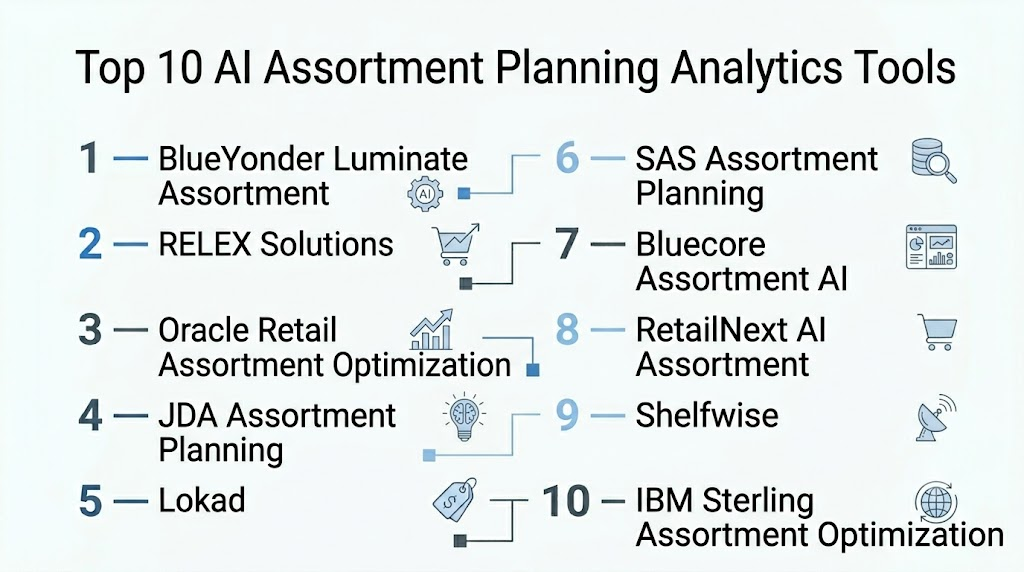
Top 10 AI Assortment Planning Analytics Tools
1 — BlueYonder Luminate Assortment
One‑line verdict: Best for enterprise retailers seeking comprehensive forecasting, simulation, and automated assortment recommendations.
Short description: BlueYonder’s Luminate Assortment blends advanced AI forecasting with inventory and merchandising constraints to deliver optimized SKU mixes across stores, regions, and channels.
Standout Capabilities
- SKU‑level assortment recommendations with demand forecasts.
- Scenario simulation for seasonal and promotional changes.
- Cannibalization and substitution modeling.
- Constraint management (shelf space, inventory limits).
- Integration with replenishment and supply chain platforms.
AI‑Specific Depth
- Model support: Proprietary + optional BYO model capabilities.
- RAG / knowledge integration: ERP/WMS connectors available.
- Evaluation: Continuous validation with back‑testing.
- Guardrails: Inventory and constraint rule enforcement.
- Observability: Dashboards for forecast accuracy and KPI metrics.
Pros
- Enterprise‑grade scalability.
- Deep scenario modeling capabilities.
- Tight integration with other supply chain modules.
Cons
- Premium pricing tier.
- Setup and configuration complexity.
- Steep learning curve for smaller teams.
Security & Compliance
SSO/SAML, RBAC, encryption at rest and in transit, audit logs; Certifications: Not publicly stated.
Deployment & Platforms
Cloud, Web.
Integrations & Ecosystem
ERP systems, WMS platforms, POS data, analytics tools, APIs for custom connections.
Pricing Model
Enterprise subscription with tiered modules; Not publicly stated.
Best‑Fit Scenarios
- Large multichannel retailers.
- SKU‑rich assortments by region.
- Complex seasonal planning.
2 — RELEX Solutions
One‑line verdict: Ideal mid‑market tool combining reliable demand forecasts with automated assortment actions.
Short description: RELEX provides AI‑driven demand forecasts and data‑informed assortment recommendations, helping planners balance stock levels, profit, and space constraints.
Standout Capabilities
- Predictive SKU demand modeling.
- Automated, prioritized assortment recommendations.
- Store and channel allocation optimization.
- Visual dashboards for trend analysis.
- Scenario planning for promotions and seasonality.
AI‑Specific Depth
- Model support: Proprietary hosted models.
- RAG / knowledge integration: ERP/WMS connectivity.
- Evaluation: Forecast validation and test analytics.
- Guardrails: Inventory thresholds and policies.
- Observability: KPI dashboards with forecast vs actual.
Pros
- Easier mid‑market adoption.
- Intuitive visual insights for planners.
- Balanced forecasting and assortment guidance.
Cons
- Less customizable than enterprise platforms.
- Limited BYO model support.
- Some integration effort required.
Security & Compliance
Standard encryption; Not publicly stated.
Deployment & Platforms
Cloud, Web.
Integrations & Ecosystem
ERP/WMS, analytics dashboards, API access.
Pricing Model
Subscription based on usage and scale; Not publicly stated.
Best‑Fit Scenarios
- Regional retail chains.
- Seasonal product planning cycles.
- Mid‑market inventory optimization.
3 — Oracle Retail Assortment Optimization
One‑line verdict: Excellent for global retailers requiring tightly integrated forecasting and assortment planning.
Short description: Oracle’s solution blends predictive analytics with global allocation and constraint management, supporting omnichannel operations and complex assortments.
Standout Capabilities
- Store and channel‑specific optimization.
- Multicountry category and SKU planning.
- Forecast‑driven assortment and allocation.
- Scenario simulation and constraint modeling.
- Cannibalization and substitution insights.
AI‑Specific Depth
- Model support: Proprietary models with optional custom extensions.
- RAG / knowledge integration: ERP and supply chain modules.
- Evaluation: Continuous model evaluation and tuning.
- Guardrails: Constraint enforcement and policy checks.
- Observability: Detailed analytics and outcome tracking.
Pros
- Highly integrated within enterprise stack.
- Supports global assortment strategies.
- Mature forecasting capabilities.
Cons
- Complex to implement.
- Requires trained practitioners.
- Licensing and total cost can be high.
Security & Compliance
SSO, RBAC, encryption, audit logs; Not publicly stated.
Deployment & Platforms
Cloud, Web, Hybrid.
Integrations & Ecosystem
ERP, supply chain, POS, analytics.
Pricing Model
Tiered enterprise licensing; Not publicly stated.
Best‑Fit Scenarios
- Global omnichannel retailers.
- SKU‑intensive assortments.
- Coordinated promotional planning.
4 — JDA Assortment Planning
One‑line verdict: Strong option for retailers needing SKU optimization with margin and substitution insights.
Short description: JDA uses AI to recommend assortments by assessing demand, margin potential, and substitution dynamics at store level.
Standout Capabilities
- SKU‑level assortment guidance.
- Margin and profitability evaluation.
- Cannibalization analysis.
- Store‑specific plans.
- Demand forecasting layers.
AI‑Specific Depth
- Model support: Proprietary forecasting models.
- RAG / knowledge integration: ERP/WMS integration.
- Evaluation: Historical accuracy analysis.
- Guardrails: Stock and margin policies.
- Observability: Forecast vs actual dashboards.
Pros
- Focused SKU‑to‑store match.
- Combines margin with demand insights.
- Store‑specific tailoring.
Cons
- Less flexible for BYO models.
- Setup and integration complexity.
- Minimal real‑time dynamic updates.
Security & Compliance
Encryption, audit trails; Not publicly stated.
Deployment & Platforms
Cloud, Web.
Integrations & Ecosystem
ERP, WMS, POS data feeds.
Pricing Model
Subscription; Not publicly stated.
Best‑Fit Scenarios
- SKU‑rich stores.
- Margin‑sensitive assortments.
- Targeted optimization by location.
5 — Lokad
One‑line verdict: Well‑suited for mid‑market and SMB retailers seeking predictive demand‑driven assortment analytics.
Short description: Lokad uses probabilistic forecasting and demand analytics to inform assortment decisions with confidence intervals and inventory risk scoring.
Standout Capabilities
- Probabilistic demand forecasts.
- Inventory risk assessment.
- SKU recommendations by channel.
- Scenario simulation for demand shock.
- Multichannel demand insights.
AI‑Specific Depth
- Model support: Proprietary with optional custom extensions.
- RAG / knowledge integration: ERP/WMS connectors.
- Evaluation: Forecast reliability testing.
- Guardrails: Thresholds for inventory risk.
- Observability: Prediction vs actual reports.
Pros
- Flexible for mid‑market.
- Helpful risk scoring.
- Support for channel diversity.
Cons
- Less enterprise scale.
- Requires clean data.
- Some configuration effort.
Security & Compliance
Encryption; Not publicly stated.
Deployment & Platforms
Cloud, Web.
Integrations & Ecosystem
API, ERP/WMS, dashboards.
Pricing Model
Volume‑based subscription; Not publicly stated.
Best‑Fit Scenarios
- SMB retail chains.
- Demand‑sensitive assortments.
- Inventory risk management.
6 — SAS Assortment Planning
One‑line verdict: Great for advanced analytics and statistical rigor in demand and assortment forecasting.
Short description: SAS combines advanced analytics, optimization engines, and forecasting models to recommend assortments that align with demand and profit goals.
Standout Capabilities
- Deep statistical forecasting.
- Optimization under constraints.
- Robust scenario simulations.
- Margin and risk tradeoff analysis.
- Store‑specific and channel situational planning.
AI‑Specific Depth
- Model support: Proprietary advanced models.
- RAG / knowledge integration: ERP/WMS connectors.
- Evaluation: Statistical back‑testing tools.
- Guardrails: Constraint modeling enforcement.
- Observability: Advanced analytics dashboards.
Pros
- Strong analytical foundation.
- Flexible scenario modeling.
- Good for high‑complexity environments.
Cons
- Requires analytics expertise.
- Higher entry complexity.
- Cost can be high.
Security & Compliance
Encryption, audit logs; Not publicly stated.
Deployment & Platforms
Cloud, Web, On‑premise options.
Integrations & Ecosystem
ERP, WMS, analytics platforms via connectors.
Pricing Model
Subscription / enterprise license; Not publicly stated.
Best‑Fit Scenarios
- Data science heavy retailers.
- Complex seasonal and promotional planning.
- Constraint‑intensive assortments.
7 — Bluecore Assortment AI
One‑line verdict: Best for ecommerce‑focused assortments and personalization‑enabled product mix.
Short description: Bluecore blends customer behavior analytics with assortment optimization to tailor product mix for online channel segments.
Standout Capabilities
- Customer segment‑driven recommendations.
- Behavioral demand signals.
- Personalized SKU prioritization.
- Integration with ecommerce platforms.
- A/B testing support.
AI‑Specific Depth
- Model support: Proprietary hosted models.
- RAG / knowledge integration: Ecommerce and CRM connectors.
- Evaluation: Variant performance analytics.
- Guardrails: Category standards enforcement.
- Observability: Segment‑level dashboards.
Pros
- Personalized assortment insights.
- Ecommerce integration.
- A/B testing support.
Cons
- Less suited for physical stores.
- Focused more on online behavior.
- Limited constraint modeling.
Security & Compliance
Encryption; Not publicly stated.
Deployment & Platforms
Cloud, Web.
Integrations & Ecosystem
Ecommerce platforms, CRM, analytics.
Pricing Model
Subscription; Not publicly stated.
Best‑Fit Scenarios
- Ecommerce retailers.
- Personalized assortment strategies.
- Customer behavior‑driven optimization.
8 — RetailNext AI Assortment
One‑line verdict: Designed for omnichannel retailers needing data‑rich insights from physical and digital channels.
Short description: RetailNext uses AI analytics across POS, mobile, and online data to recommend assortments that align with real shopper behavior.
Standout Capabilities
- Omnichannel data ingestion.
- Real shopper behavior analytics.
- SKU prioritization by channel.
- Inventory and sales trend forecasting.
- Visual analytics dashboards.
AI‑Specific Depth
- Model support: Proprietary models.
- RAG / knowledge integration: POS, online, mobile, CRM.
- Evaluation: Shopper behavior validation.
- Guardrails: Inventory and sales policies.
- Observability: Omnichannel KPI views.
Pros
- Unified physical + digital insights.
- Shopper behavior focus.
- Visual analytics strength.
Cons
- Data integration prerequisites.
- Not as deep in scenario simulation.
- May require custom connectors.
Security & Compliance
Encryption and controls; Not publicly stated.
Deployment & Platforms
Cloud, Web.
Integrations & Ecosystem
POS systems, ecommerce platforms, CRM.
Pricing Model
Subscription; Not publicly stated.
Best‑Fit Scenarios
- Brick + click retailers.
- Behavior‑driven assortment optimization.
- Omnichannel analytics.
9 — Shelfwise
One‑line verdict: Solid choice for retailers emphasizing shelf space optimization and physical placement decisions.
Short description: Shelfwise combines space analytics and demand data to recommend assortment adjustments that maximize floor productivity and reduce stockouts.
Standout Capabilities
- Shelf space allocation recommendations.
- SKU placement modeling.
- Foot traffic and demand correlation.
- Visual planogram insights.
- Inventory constraint enforcement.
AI‑Specific Depth
- Model support: Proprietary space‑aware models.
- RAG / knowledge integration: Planogram and POS systems.
- Evaluation: Placement performance metrics.
- Guardrails: Space and SKU limits.
- Observability: Foot traffic vs demand dashboards.
Pros
- Strong shelf space focus.
- Visual planogram analytics.
- Foot‑traffic correlation.
Cons
- More niche than full assortment tools.
- Less predictive forecasting depth.
- Best when paired with broader analytics.
Security & Compliance
Standard encryption; Not publicly stated.
Deployment & Platforms
Cloud, Web.
Integrations & Ecosystem
Planogram systems, POS, analytics.
Pricing Model
Subscription; Not publicly stated.
Best‑Fit Scenarios
- Physical retailers with space constraints.
- Planogram‑led assortment decisions.
- Foot traffic‑informed insights.
10 — IBM Sterling Assortment Optimization
One‑line verdict: Best for enterprises needing highly customizable AI models and integration into wider supply chain and planning ecosystems.
Short description: IBM Sterling enables deep analytic modeling for SKU assortments with constraint handling, scenario simulation, and extensible AI plug‑ins.
Standout Capabilities
- Extensible AI model support.
- SKU and channel prioritization.
- Scenario optimization under constraints.
- Integration with broader supply chain modules.
- Dashboard and analytics insights.
AI‑Specific Depth
- Model support: Proprietary + BYO models.
- RAG / knowledge integration: ERP, SCM, analytics.
- Evaluation: Regression and model‑drift testing.
- Guardrails: Constraint and compliance checks.
- Observability: Dashboard metrics and outcome tracking.
Pros
- Highly customizable.
- Strong integration potential.
- Good for complex supply chains.
Cons
- Complexity requires expertise.
- Higher cost.
- Implementation cycle can be long.
Security & Compliance
SSO, encryption, audits; Not publicly stated.
Deployment & Platforms
Cloud, Hybrid, Web.
Integrations & Ecosystem
ERP/SCM, analytics, planning modules, APIs.
Pricing Model
Enterprise subscription; Not publicly stated.
Best‑Fit Scenarios
- Enterprise multichannel retailers.
- Complex constraint environments.
- Deep customization needs.
Comparison Table
| Tool Name | Best For | Deployment | Model Flexibility | Strength | Watch‑Out | Public Rating |
|---|---|---|---|---|---|---|
| BlueYonder Luminate | Enterprise retailers | Cloud | Proprietary + BYO | Scenario simulation | Premium cost | N/A |
| RELEX Solutions | Mid‑market | Cloud | Proprietary | Automated workflow | Limited BYO | N/A |
| Oracle Retail | Global omnichannel | Cloud/Hybrid | Proprietary + BYO | Integrated forecasting | Complex | N/A |
| JDA Assortment | SKU/margin focus | Cloud | Proprietary | Store‑specific recommendations | Setup effort | N/A |
| Lokad | SMB/mid‑market | Cloud | Proprietary + custom | Probabilistic forecasting | Data readiness | N/A |
| SAS Assortment | High‑complexity analytics | Cloud/Web | Proprietary | Deep analytics | Complexity | N/A |
| Bluecore AI | Ecommerce retailers | Cloud | Proprietary | Personalized insights | Narrower scope | N/A |
| RetailNext AI | Omnichannel analytics | Cloud | Proprietary | Shopper data focus | Integration needed | N/A |
| Shelfwise | Shelf space emphasis | Cloud | Proprietary | Planogram analytics | Less breadth | N/A |
| IBM Sterling | Enterprise customization | Cloud/Hybrid | Proprietary + BYO | Extensible models | Implementation time | N/A |
Scoring & Evaluation (Transparent Rubric)
Scoring explains relative strength across key dimensions:
Weighted Framework:
- Core features – 20%
- AI reliability & evaluation – 15%
- Guardrails & safety – 10%
- Integrations & ecosystem – 15%
- Ease of use – 10%
- Performance & cost controls – 15%
- Security & admin – 10%
- Support & community – 5%
| Tool | Core | Reliability | Guardrails | Integrations | Ease | Perf/Cost | Security | Support | Weighted Total |
|---|---|---|---|---|---|---|---|---|---|
| BlueYonder Luminate | 9 | 9 | 9 | 9 | 7 | 8 | 8 | 7 | 8.6 |
| RELEX Solutions | 8 | 8 | 8 | 8 | 8 | 8 | 7 | 7 | 7.9 |
| Oracle Retail | 9 | 9 | 9 | 9 | 6 | 8 | 8 | 7 | 8.4 |
| JDA Assortment | 8 | 8 | 8 | 8 | 7 | 8 | 7 | 7 | 8.0 |
| Lokad | 8 | 8 | 7 | 7 | 8 | 7 | 7 | 7 | 7.7 |
| SAS Assortment | 9 | 9 | 8 | 8 | 6 | 8 | 8 | 7 | 8.2 |
| Bluecore AI | 7 | 7 | 7 | 7 | 8 | 7 | 7 | 7 | 7.3 |
| RetailNext AI | 8 | 8 | 8 | 8 | 7 | 8 | 7 | 7 | 7.9 |
| Shelfwise | 7 | 7 | 7 | 7 | 8 | 7 | 7 | 7 | 7.3 |
| IBM Sterling | 9 | 9 | 9 | 9 | 6 | 8 | 8 | 7 | 8.3 |
Top 3 for Enterprise: BlueYonder Luminate, Oracle Retail, IBM Sterling
Top 3 for SMB/Mid‑Market: RELEX Solutions, Lokad, RetailNext AI
Top 3 for Ecommerce/Behavior‑Driven: Bluecore AI, RetailNext AI, JDA Assortment
Which AI Assortment Planning Tool Is Right for You?
Solo / Freelancer
- Lokad — accessible probabilistic recommendations.
- Shelfwise — simple shelf space insights for physical stores.
SMB
- RELEX Solutions — balanced automation and ease.
- Bluecore AI — ecommerce‑centric personalization.
Mid‑Market
- JDA Assortment — SKU and margin focus.
- RetailNext AI — omnichannel shopper analytics.
Enterprise
- BlueYonder Luminate — full forecasting + simulation.
- Oracle Retail — integrated enterprise stack.
- IBM Sterling — highly customizable models.
Regulated Industries (Finance / Healthcare / Food Safety)
Enterprise players with guardrails and audit logs (BlueYonder, Oracle, IBM) ensure compliance with pricing and recall policies.
Budget vs Premium
- Budget: Lokad, Shelfwise, Bluecore AI
- Premium: BlueYonder Luminate, Oracle Retail, IBM Sterling
Build vs Buy (When to DIY)
DIY makes sense if you have strong internal analytics teams and clean data pipelines. Buy when you need faster time to value, packaged scenario models, and integrated workflow automation.
Implementation Playbook (30 / 60 / 90 Days)
30 Days – Pilot
- Select 2 tools from shortlist.
- Integrate 6–12 months of historical sales and inventory data.
- Establish KPIs: forecast accuracy, stockouts, turnover metric.
- Train models and assess initial recommendations.
- Define guardrails and policies (e.g., min inventory, shelf limits).
60 Days – Harden & Expand
- Validate forecast vs actual performance.
- Integrate replenishment and allocation workflows.
- Extend pilot across more stores/channels.
- Add scenario simulation for seasonal events.
- Implement security and admin controls.
90 Days – Optimize & Scale
- Automate data flows and real‑time updates.
- Fine‑tune AI models and feedback loops.
- Expand across all locations and product categories.
- Establish reporting cadences and dashboards.
- Embed governance with audit logs and evaluation metrics.
Common Mistakes & How to Avoid Them
- Relying on incomplete or noisy historical data — ensure clean inputs.
- Skipping scenario simulation — always test “what‑if” conditions.
- Ignoring guardrails — enforce constraints like shelf‑space and margins.
- Overlooking real‑time data — leverage updates for dynamic adjustments.
- Treating AI as black box — require visibility and explainability.
- Failing to integrate with replenishment — plans must be actionable.
- Not evaluating forecast accuracy — build systematic validation.
- Over‑automation without oversight — include human checkpoints.
- Not managing data privacy — implement governance and consent.
- Ignoring cost and latency — optimize model routing and hybrid inference.
FAQs
What is AI Assortment Planning Analytics?
It’s the use of machine learning and predictive analytics to recommend the best product mix and SKU allocation across channels and locations.
Do these tools replace merchandisers?
No — they augment planners with data‑driven insights; humans still set strategy and guardrails.
How accurate are forecasts?
Accuracy depends on data quality, model tuning, and ongoing validation; modern tools provide continuous evaluation.
Are real‑time adjustments supported?
Many platforms support near real‑time recommendations as data flows update.
Is integration with ERP required?
Yes, dependable ERP/WMS/CRM integration enables accurate analytics and execution.
Can these tools handle omnichannel?
Yes — most support both physical and digital channels with channel‑specific insights.
Do tools support BYO models?
Several enterprise platforms allow custom model integration for proprietary use cases.
Are there privacy concerns?
Yes — choose vendors with strong data governance, consent controls, and retention policies.
What data do these tools need?
POS, inventory, sales history, product attributes, channel performance, and optionally external trend data.
How do guardrails work?
Guardrails enforce thresholds for inventory limits, shelf space, profit, and compliance policies.
Can AI recommend new products?
Some tools incorporate external trends and substitution modeling to suggest potential new SKUs.
What’s a realistic ROI timeframe?
ROI can appear as early as 60–90 days with pilots, improving over time with expanded use.
Conclusion
AI Assortment Planning Analytics tools are reshaping how retailers make product mix and allocation decisions. The right choice depends on your scale, channel complexity, and data maturity — whether it’s deep enterprise forecasting, mid‑market automation, or ecommerce personalization. Start by shortlisting tools aligned with your business goals, pilot with key data feeds, ensure robust security and guardrails, and iterate with continuous evaluation for measurable impact.

Find Trusted Cardiac Hospitals
Compare heart hospitals by city and services — all in one place.
Explore Hospitals
The article mentions “real-time recommendations” but not the engineering cost behind it.
Missing:
In reality:
Most “real-time assortment AI” systems degrade into near-real-time batch systems due to cost.