
Introduction
AI Auto-Remediation Platforms combine artificial intelligence, machine learning, and automation to detect IT incidents and automatically execute corrective actions. They enable IT operations, DevOps, SRE, cloud, and infrastructure teams to reduce downtime, improve system reliability, and maintain service performance across complex hybrid and cloud-native environments. These platforms analyze logs, metrics, traces, alerts, configuration changes, and service dependencies to identify root causes and apply automated remediation actions in real time.
Why It Matters
Modern IT systems are dynamic, distributed, and multi-cloud. Incidents can originate from applications, infrastructure, microservices, Kubernetes clusters, or third-party APIs. Manual remediation is slow, error-prone, and reactive, resulting in increased downtime, operational costs, and SLA breaches. AI Auto-Remediation Platforms allow teams to proactively detect issues, execute fixes automatically, optimize resource usage, and enforce governance while reducing human intervention.
Real World Use Cases
- Cloud infrastructure failures: Detect and remediate cloud resource bottlenecks, misconfigurations, or outages automatically.
- Kubernetes and container scaling: Auto-scale pods, restart failed containers, and adjust resource limits.
- Application performance degradation: Trigger service restarts or rollbacks when latency thresholds are breached.
- Configuration drift remediation: Detect and restore misconfigured or non-compliant settings.
- Security incident response: Automatically isolate affected endpoints or revoke access.
- Network or service disruption: Re-route traffic or restart network services to maintain availability.
- Database and storage issues: Optimize queries, clear caches, or allocate storage when thresholds are exceeded.
- Incident workflow automation: Automatically create tickets, notify teams, and apply remediation playbooks.
Evaluation Criteria for Buyers
- Automation coverage across cloud, Kubernetes, containers, infrastructure, and applications
- AI accuracy in anomaly detection and root cause analysis
- Integration with observability, monitoring, CI/CD, ITSM, and cloud platforms
- Policy governance with approval workflows and role-based access
- Scalability for large and distributed environments
- Observability correlation with logs, metrics, traces, and service dependencies
- Alert and event correlation to reduce false positives
- Scenario modeling for safe automated actions
- Compliance and auditability including RBAC, SSO, retention, and encryption
- Human-in-the-loop support to review or override automated actions
- Cost optimization by reducing manual intervention and preventing over-provisioning
- Post-incident reporting with root cause explanations and timelines
Best for: Enterprise IT, cloud operations, SRE, DevOps, platform engineering teams, and hybrid infrastructure organizations that require proactive incident resolution.
Not ideal for: Small IT teams with simple infrastructure, organizations without centralized telemetry, or teams not ready to implement automation and governance.
What’s Changed in AI Auto-Remediation Platforms
- Automation now covers full-stack cloud-native environments
- AI-driven root cause detection triggers corrective actions
- Kubernetes, serverless, and container support is essential
- Multi-cloud and hybrid environments require unified automation
- Intelligent event correlation reduces false remediation
- Automation policies include approval workflows and human-in-the-loop triggers
- AI models now predict incidents before thresholds are breached
- Customizable remediation playbooks are standard
- Cost optimization integrated to prevent over-provisioning
- Compliance features ensure safe automation for sensitive workloads
- Integration with ITSM and ticketing platforms is mandatory
- Observability data drives automated remediation decisions
Quick Buyer Checklist
- Automated remediation across cloud, Kubernetes, virtualized, and hybrid infrastructure
- AI accuracy and root cause detection validation
- Integration with monitoring, observability, ITSM, CI/CD, and cloud platforms
- Governance, approval workflows, and role-based controls
- Scalability for multi-service, high-event environments
- Post-incident reporting and audit logs
- Cost and resource optimization
- Scenario modeling for safe automated changes
- Kubernetes and container support
- Alert correlation to avoid unnecessary remediation
- Visibility dashboards for engineers, FinOps, and managers
- Human-in-the-loop and override capabilities
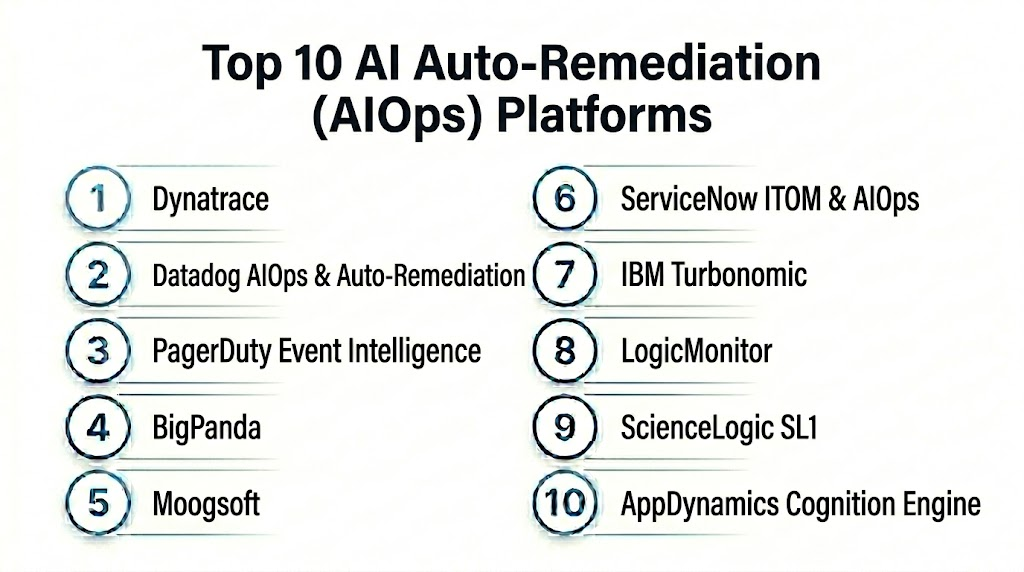
Top 10 AI Auto-Remediation (AIOps) Platforms
1- Dynatrace
2- Datadog AIOps & Auto-Remediation
3- PagerDuty Event Intelligence
4- BigPanda
5- Moogsoft
6- ServiceNow ITOM & AIOps
7- IBM Turbonomic
8- LogicMonitor
9- ScienceLogic SL1
10- AppDynamics Cognition Engine
1- Dynatrace
One-line verdict: Enterprise-grade AI platform for automated remediation across applications, cloud, and hybrid environments.
Short description: Dynatrace delivers AI-assisted root cause detection and automatic remediation for cloud-native and hybrid IT stacks, including Kubernetes and containerized workloads.
Standout Capabilities
- Full-stack monitoring and automated remediation
- Kubernetes and container support
- Root cause-driven remediation actions
- Cloud scaling and load balancing adjustments
- Code rollbacks and configuration fixes
- Customizable automation playbooks
- CI/CD and ITSM integrations
- Real-time anomaly detection
AI-Specific Depth
- Model support: Proprietary AI for root cause and remediation
- RAG / knowledge integration: Varies / N/A
- Evaluation: Regression testing and anomaly validation
- Guardrails: Approval workflows, rollback policies
- Observability: Service topology, metrics, traces, logs feed remediation decisions
Pros
- Enterprise-grade full-stack automation
- Real-time root cause remediation
- Strong integration with cloud and observability platforms
Cons
- Requires onboarding and configuration
- Cost may scale with environment size
- Custom playbooks required for complex systems
Security & Compliance
SSO, RBAC, audit logs, encryption, and retention controls; certifications Not publicly stated
Deployment & Platforms
Cloud, hybrid, Windows/Linux/macOS agents, Kubernetes, cloud workloads
Integrations & Ecosystem
CI/CD, ITSM, cloud providers, Kubernetes, observability tools, APIs
Pricing Model
Subscription-based, usage-influenced, Not publicly stated
Best-Fit Scenarios
- Enterprise microservices environments
- Cloud-native teams implementing auto-remediation
- SRE teams aiming to reduce MTTR
2- Datadog AIOps & Auto-Remediation
One-line verdict: Cloud-native platform integrating monitoring, anomaly detection, and automated corrective actions.
Short description: Datadog provides predictive alerts, anomaly detection, and automatic remediation workflows for cloud infrastructure, applications, and Kubernetes clusters.
Standout Capabilities
- Infrastructure and application monitoring
- Cloud-native auto-remediation workflows
- Anomaly detection with root cause insights
- Service dependency mapping
- Alert grouping and noise reduction
- CI/CD and ITSM integration
- Auto-scaling and container remediation
- Custom automation triggers
AI-Specific Depth
- Model support: Proprietary anomaly detection AI
- RAG / knowledge integration: Varies / N/A
- Evaluation: Not publicly stated
- Guardrails: Automation policies and access controls
- Observability: Metrics, logs, traces, dashboards drive remediation
Pros
- Cloud-native automation
- Integrated with Datadog observability
- Reduces incident noise and manual intervention
Cons
- Cost scales with telemetry volume
- Depends on tagging discipline
- Complex workflows may need tuning
Security & Compliance
Enterprise controls; SSO, RBAC, encryption, retention Not publicly stated
Deployment & Platforms
Cloud, agents for Windows/Linux/macOS, Kubernetes
Integrations & Ecosystem
Cloud providers, Kubernetes, CI/CD, ITSM, APIs
Pricing Model
Usage-based subscription; Not publicly stated
Best-Fit Scenarios
- Cloud-native teams
- DevOps teams needing automated remediation
- SRE teams reducing manual incident response
3- PagerDuty Event Intelligence
One-line verdict: Incident-centric automation platform for alert correlation and automatic remediation.
Short description: PagerDuty Event Intelligence reduces alert noise, correlates events, and triggers automated remediation actions while routing incidents to the correct responders.
Standout Capabilities
- Event correlation and noise reduction
- Automated incident remediation
- Service ownership mapping
- Escalation workflows and approvals
- Integration with observability and ITSM
- Alert prioritization and deduplication
- Playbook-driven remediation
- Post-incident reporting
AI-Specific Depth
- Model support: Proprietary event intelligence AI
- RAG / knowledge integration: Varies / N/A
- Evaluation: Not publicly stated
- Guardrails: Escalation and approval policies
- Observability: Event clusters, service context, alerts drive actions
Pros
- Strong alert correlation
- Integrates with ITSM and monitoring tools
- Reduces false positives and manual intervention
Cons
- RCA depth limited by observability integrations
- Not full-stack remediation
- Pricing depends on event volume
Security & Compliance
SSO, RBAC, audit logs, encryption, retention Not publicly stated
Deployment & Platforms
Cloud-based, web and mobile interfaces
Integrations & Ecosystem
Observability, ITSM, cloud providers, collaboration tools, APIs
Pricing Model
Subscription-based; Not publicly stated
Best-Fit Scenarios
- Teams needing automated incident routing
- Organizations reducing alert noise
- SMBs with cloud-native monitoring
4- BigPanda
One-line verdict: Enterprise platform for event correlation, automated remediation, and IT operations orchestration.
Short description: BigPanda correlates alerts from multiple monitoring tools and triggers automated remediation for hybrid IT environments.
Standout Capabilities
- Event correlation across monitoring tools
- Noise reduction and alert grouping
- Probable cause identification
- Auto-remediation triggers
- Integration with ITSM and incident management
- Custom automation playbooks
- Service dependency context
- Dashboards for operations teams
AI-Specific Depth
- Model support: Proprietary AIOps and event correlation
- RAG / knowledge integration: Varies / N/A
- Evaluation: Not publicly stated
- Guardrails: Policy rules and approval workflows
- Observability: Alert clusters, incident dashboards drive actions
Pros
- Reduces alert noise significantly
- Supports hybrid IT environments
- Easy integration with multiple monitoring tools
Cons
- Requires good integration hygiene
- RCA depends on service maps
- Advanced automation setup required
Security & Compliance
Enterprise-grade controls; Not publicly stated
Deployment & Platforms
Cloud-based, web console
Integrations & Ecosystem
Monitoring tools, ITSM, cloud providers, APIs, dashboards
Pricing Model
Subscription; Not publicly stated
Best-Fit Scenarios
- Enterprises with multiple monitoring tools
- NOC and IT operations teams
- Hybrid cloud IT environments
5- Moogsoft
One-line verdict: Focused AIOps platform for event correlation and automated remediation across IT operations.
Short description: Moogsoft reduces incident noise, correlates events, and triggers automated actions using AI-driven workflows for hybrid IT.
Standout Capabilities
- Event correlation and clustering
- Automated remediation triggers
- Anomaly detection
- Integration with monitoring and ITSM
- Service context awareness
- Incident dashboards and notifications
- Customizable automation playbooks
- Post-incident analysis
AI-Specific Depth
- Model support: Proprietary AI for anomaly detection
- RAG / knowledge integration: Varies / N/A
- Evaluation: Not publicly stated
- Guardrails: Policy-based automation rules
- Observability: Alerts, events, and service context feed remediation
Pros
- Reduces alert overload
- Supports hybrid IT environments
- Good fit for IT operations and DevOps teams
Cons
- Automation depends on integration quality
- Setup can be complex
- RCA depth is limited
Security & Compliance
SSO, RBAC, audit logs, encryption, retention Not publicly stated
Deployment & Platforms
Cloud-based, web interface
Integrations & Ecosystem
Monitoring tools, ITSM, cloud platforms, APIs
Pricing Model
Subscription; Not publicly stated
Best-Fit Scenarios
- IT operations teams managing alerts
- DevOps teams with hybrid environments
- Incident response teams
6- ServiceNow ITOM & AIOps
One-line verdict: Enterprise ITSM-integrated platform for automated remediation and workflow orchestration.
Short description: ServiceNow ITOM & AIOps integrates auto-remediation with ITSM, CMDB, and change management workflows for complex enterprise environments.
Standout Capabilities
- CMDB-aware automated remediation
- Event correlation and alert deduplication
- Service impact analysis
- Integration with ITSM and incident workflows
- Workflow automation for tickets and approvals
- AI-driven root cause analysis
- Scenario simulation before remediation
- Post-incident reporting
AI-Specific Depth
- Model support: Proprietary predictive AI
- RAG / knowledge integration: Varies / N/A
- Evaluation: Not publicly stated
- Guardrails: Policy-based approvals and human-in-the-loop triggers
- Observability: Event clusters, service maps, and incidents drive automation
Pros
- Strong integration with ITSM
- Enterprise-scale auto-remediation
- CMDB-driven service context
Cons
- Requires mature CMDB
- Complex setup
- Implementation can be lengthy
Security & Compliance
SSO, RBAC, audit logs, encryption, retention Not publicly stated
Deployment & Platforms
Cloud-based ServiceNow platform
Integrations & Ecosystem
ServiceNow ITSM, CMDB, monitoring tools, cloud platforms, automation workflows
Pricing Model
Subscription-based; Not publicly stated
Best-Fit Scenarios
- Enterprise IT operations
- CMDB-aware automation workflows
- Organizations requiring governance and auditability
7- IBM Turbonomic
One-line verdict: AI-driven optimization platform with automated resource remediation across hybrid infrastructure.
Short description: Turbonomic monitors application demand and supply, then executes automated actions to optimize resources, scale workloads, and maintain performance.
Standout Capabilities
- Application-aware resource optimization
- Automated scaling and placement
- Hybrid infrastructure support
- Kubernetes and cloud resource optimization
- Rightsizing recommendations
- Automation policy governance
- Forecasting resource utilization
- Cost-aware remediation actions
AI-Specific Depth
- Model support: Proprietary AI-driven optimization
- RAG / knowledge integration: Varies / N/A
- Evaluation: Not publicly stated
- Guardrails: Automation policies, approvals
- Observability: Utilization, demand, supply, and workload trends drive actions
Pros
- Hybrid infrastructure optimization
- Automated rightsizing and remediation
- Application demand-aware decisions
Cons
- Governance and policies required
- VMware/cloud environment integration needed
- Implementation complexity
Security & Compliance
SSO, RBAC, audit logs, encryption, retention Not publicly stated
Deployment & Platforms
Cloud and hybrid; web interface; agent-based integration
Integrations & Ecosystem
Cloud providers, Kubernetes, VMware, CI/CD, ITSM, observability APIs
Pricing Model
Subscription; Not publicly stated
Best-Fit Scenarios
- Hybrid IT optimization
- Resource-heavy enterprise workloads
- Automated scaling and performance management
8- LogicMonitor
One-line verdict: Hybrid IT platform providing predictive monitoring with automated remediation capabilities.
Short description: LogicMonitor combines hybrid infrastructure monitoring with predictive insights and automated remediation for servers, storage, networks, and cloud services.
Standout Capabilities
- Infrastructure and network monitoring
- Predictive capacity insights
- Alert correlation and auto-remediation
- Cloud and hybrid monitoring
- Dashboards and reporting
- AIOps-driven anomaly detection
- Automation workflows
- Integration with ITSM
AI-Specific Depth
- Model support: Proprietary AIOps predictive models
- RAG / knowledge integration: Varies / N/A
- Evaluation: Not publicly stated
- Guardrails: Policy-based automation
- Observability: Metrics, logs, alerts, dashboards drive remediation
Pros
- Hybrid IT support
- Predictive remediation
- Easy dashboards for operations
Cons
- Application-level depth limited
- Forecasting depends on monitoring coverage
- Pricing and packaging vary
Security & Compliance
SSO, RBAC, audit logs, encryption, retention Not publicly stated
Deployment & Platforms
Cloud; collectors for infrastructure; web interface
Integrations & Ecosystem
Cloud providers, ITSM, monitoring tools, APIs, dashboards
Pricing Model
Subscription-based; Not publicly stated
Best-Fit Scenarios
- Hybrid IT operations
- Predictive incident remediation
- Infrastructure and network monitoring teams
9- ScienceLogic SL1
One-line verdict: Hybrid IT and MSP AIOps platform for predictive remediation and operational intelligence.
Short description: ScienceLogic SL1 monitors hybrid infrastructure, correlates events, and triggers automated remediation with service dependency context.
Standout Capabilities
- Hybrid IT monitoring
- AIOps-driven event correlation
- Automated remediation workflows
- Predictive capacity analysis
- Service dependency awareness
- Dashboards and reporting
- MSP-focused operations
- Integration with cloud and on-prem services
AI-Specific Depth
- Model support: Proprietary AI for incident prediction
- RAG / knowledge integration: Varies / N/A
- Evaluation: Not publicly stated
- Guardrails: Policy-based automation rules
- Observability: Monitoring dashboards, event correlation, and alerts drive remediation
Pros
- Supports complex hybrid environments
- Predictive remediation
- Good for service provider operations
Cons
- Implementation planning required
- Application-level remediation limited
- Pricing varies by environment
Security & Compliance
SSO, RBAC, audit logs, encryption, retention Not publicly stated
Deployment & Platforms
Cloud and enterprise; web interface; collectors for hybrid infrastructure
Integrations & Ecosystem
Cloud providers, monitoring tools, IT
ITSM systems, MSP workflows, APIs
Pricing Model
Subscription-based; Not publicly stated
Best-Fit Scenarios
- Hybrid IT monitoring
- Managed service providers
- Enterprise operations teams
10- AppDynamics Cognition Engine
One-line verdict: Application performance-focused AIOps engine for automated remediation and root cause detection.
Short description: AppDynamics Cognition Engine detects performance anomalies, identifies root causes, and can trigger automated remediation workflows for applications and services.
Standout Capabilities
- Application performance monitoring
- Root cause detection
- Automated remediation triggers
- Code-level visibility
- Business transaction monitoring
- Service dependency mapping
- Alert correlation
- Integration with CI/CD and ITSM
AI-Specific Depth
- Model support: Proprietary AI and ML models
- RAG / knowledge integration: Varies / N/A
- Evaluation: Not publicly stated
- Guardrails: Policy-based actions and approval workflows
- Observability: Metrics, traces, logs, and topology drive remediation
Pros
- Strong application performance focus
- Business transaction context
- Supports remediation workflows
Cons
- Best for application-centric environments
- Limited infrastructure automation compared with AIOps suites
- Setup and instrumentation required
Security & Compliance
SSO, RBAC, audit logs, encryption, retention Not publicly stated
Deployment & Platforms
Cloud and on-prem options; agents for applications; web interface
Integrations & Ecosystem
CI/CD, ITSM, cloud providers, observability tools, APIs
Pricing Model
Subscription-based; Not publicly stated
Best-Fit Scenarios
- Application performance teams
- DevOps teams handling microservices
- Teams automating app-level fixes
Comparison Table
| Tool | Best For | Deployment | Model Flexibility | Strength | Watch Out | Public Rating |
|---|---|---|---|---|---|---|
| Dynatrace | Full-stack automation | Cloud/Hybrid | Proprietary | AI-driven root cause & remediation | Onboarding complexity | N/A |
| Datadog | Cloud-native auto-remediation | Cloud | Proprietary | Monitoring + automation | Telemetry cost | N/A |
| PagerDuty | Incident automation | Cloud | Proprietary | Event routing & correlation | Limited RCA depth | N/A |
| BigPanda | Event correlation | Cloud | Proprietary | Noise reduction | Integration quality | N/A |
| Moogsoft | Alert correlation & remediation | Cloud | Proprietary | AIOps event clustering | Setup complexity | N/A |
| ServiceNow | ITSM-integrated remediation | Cloud | Proprietary | CMDB & workflow automation | CMDB maturity needed | N/A |
| IBM Turbonomic | Hybrid resource optimization | Cloud/Hybrid | Proprietary | AI rightsizing & scaling | Governance required | N/A |
| LogicMonitor | Hybrid IT remediation | Cloud | Proprietary | Predictive infrastructure monitoring | Limited app depth | N/A |
| ScienceLogic | MSP & hybrid operations | Cloud/Hybrid | Proprietary | AIOps + MSP workflows | Implementation effort | N/A |
| AppDynamics | Application-level remediation | Cloud/On-prem | Proprietary | Business transaction insight | App-focused | N/A |
Scoring & Evaluation
| Tool | Core | Reliability/Eval | Guardrails | Integrations | Ease | Perf/Cost | Security/Admin | Support | Weighted Total |
|---|---|---|---|---|---|---|---|---|---|
| Dynatrace | 9.4 | 8.9 | 8.7 | 9.0 | 8.3 | 8.1 | 8.8 | 8.8 | 8.8 |
| Datadog | 9.0 | 8.6 | 8.6 | 9.2 | 8.5 | 8.2 | 8.7 | 8.7 | 8.7 |
| PagerDuty | 8.9 | 8.5 | 8.7 | 9.0 | 8.3 | 8.2 | 8.7 | 8.6 | 8.6 |
| BigPanda | 8.7 | 8.5 | 8.5 | 8.8 | 8.1 | 8.2 | 8.5 | 8.4 | 8.5 |
| Moogsoft | 8.5 | 8.4 | 8.4 | 8.7 | 8.1 | 8.3 | 8.4 | 8.3 | 8.3 |
| ServiceNow | 8.6 | 8.4 | 8.8 | 8.8 | 8.0 | 8.0 | 8.9 | 8.7 | 8.5 |
| IBM Turbonomic | 8.8 | 8.5 | 8.4 | 8.6 | 8.3 | 8.3 | 8.6 | 8.5 | 8.5 |
| LogicMonitor | 8.4 | 8.2 | 8.4 | 8.6 | 8.4 | 8.4 | 8.5 | 8.5 | 8.4 |
| ScienceLogic | 8.4 | 8.2 | 8.4 | 8.6 | 8.0 | 8.3 | 8.5 | 8.5 | 8.3 |
| AppDynamics | 8.3 | 8.1 | 8.3 | 8.5 | 8.1 | 8.2 | 8.4 | 8.3 | 8.3 |
Top 3 for Enterprise
1- Dynatrace
2- ServiceNow ITOM & AIOps
3- IBM Turbonomic
Top 3 for SMB
1- Datadog
2- BigPanda
3- AppDynamics
Top 3 for Developers
1- Dynatrace
2- AppDynamics
3- LogicMonitor
Which AI Auto-Remediation Platform Is Right for You
Solo / Freelancer
Lightweight platforms like Datadog and AppDynamics provide useful automation without full enterprise complexity.
SMB
BigPanda, Datadog, and Moogsoft help growing teams reduce noise and automate repetitive remediation workflows.
Mid-Market
LogicMonitor, IBM Turbonomic, and Dynatrace provide predictive remediation and hybrid infrastructure support.
Enterprise
Dynatrace, ServiceNow ITOM & AIOps, and IBM Turbonomic provide governance, scale, and full-stack automation.
Regulated Industries
ServiceNow, Dynatrace, and IBM Turbonomic provide strong governance, RBAC, audit trails, and approval workflows.
Budget vs Premium
Budget teams can start with Datadog or BigPanda. Premium teams should evaluate Dynatrace, ServiceNow, or IBM Turbonomic.
Build vs Buy
Building internal remediation may work for mature DevOps teams, but buying provides tested, scalable automation with governance and enterprise support.
Implementation Playbook
First 30 Days
- Identify repetitive incident types
- Connect monitoring and observability tools
- Define automation guardrails
- Pilot low-risk remediation actions
- Validate AI accuracy
- Track MTTR baseline
- Train teams on manual approval workflows
First 60 Days
- Expand playbooks across services
- Add ITSM and CI/CD integrations
- Implement human-in-the-loop approvals
- Run simulation tests
- Add post-incident reporting
- Review false remediation risks
- Create rollback procedures
First 90 Days
- Scale automation to production-critical services
- Track MTTR and incident reduction
- Optimize remediation workflows
- Add cost-aware actions
- Refine governance policies
- Review audit logs and compliance
- Continue model and workflow tuning
Common Mistakes & How to Avoid Them
- Automating without human approval
- Using incomplete telemetry
- Skipping rollback planning
- Ignoring service dependencies
- Poor governance controls
- Running playbooks without testing
- Ignoring security and compliance requirements
- Over-scaling cloud resources
- Not measuring MTTR improvements
- Ignoring false-positive remediation
- Poor integration with ITSM
- Not training teams
- Treating auto-remediation as one-time setup
- Missing post-incident reviews
FAQs
1- What is AI Auto-Remediation?
It is the use of AI and automation to detect incidents and automatically trigger corrective actions.
2- How does it differ from monitoring?
Monitoring alerts teams. Auto-remediation applies fixes automatically or semi-automatically.
3- Is it safe for production?
Yes, if guardrails, approval workflows, rollback policies, and testing are properly implemented.
4- Can it work with Kubernetes?
Yes, many platforms support pod restarts, resource adjustments, and cluster-level automation.
5- Can it reduce MTTR?
Yes, it can reduce MTTR by executing repetitive fixes faster than manual intervention.
6- Which tool is best for enterprise?
Dynatrace, ServiceNow, and IBM Turbonomic are strong enterprise options.
7- Which tool is best for SMB?
Datadog, BigPanda, and AppDynamics are practical for smaller teams.
8- Does it support ITSM?
Yes, most tools integrate with ServiceNow, Jira, PagerDuty, and similar platforms.
9- Can it prevent incidents?
Predictive AIOps can prevent certain incidents by acting before thresholds are breached.
10- What should buyers test first?
Test low-risk playbooks such as service restarts, ticket creation, cache clearing, and scaling recommendations.
11- Does it reduce cost?
Yes, by reducing manual workload, downtime, and over-provisioning.
12- What is the biggest risk?
The biggest risk is automated action without proper validation, governance, and rollback planning.
Conclusion
AI Auto-Remediation (AIOps) Platforms help IT teams move from reactive incident response to proactive, automated operations. Dynatrace is ideal for full-stack enterprise automation, Datadog supports cloud-native teams, PagerDuty improves incident routing, BigPanda and Moogsoft reduce alert noise, ServiceNow connects remediation with ITSM governance, IBM Turbonomic optimizes hybrid infrastructure, LogicMonitor supports predictive remediation, ScienceLogic serves hybrid and MSP environments, and AppDynamics strengthens application-level remediation. The right choice depends on your telemetry stack, automation maturity, governance requirements, and operational goals. Start with low-risk playbooks, validate AI accuracy, add human approval, and scale automation gradually for safer and more reliable IT operations.

Find Trusted Cardiac Hospitals
Compare heart hospitals by city and services — all in one place.
Explore Hospitals
A key consideration is how safely these AIOps platforms execute auto-remediation at scale without causing cascading failures or violating change-control policies.