
Introduction
AI Automated Root Cause Analysis for manufacturing helps teams identify the true reason behind production issues, quality defects, downtime, process instability, equipment failures, and performance losses. Instead of relying only on manual investigation, spreadsheets, operator memory, or delayed reports, these tools use artificial intelligence, machine learning, time-series analytics, process data, quality data, maintenance records, and production context to detect patterns and suggest likely root causes.
Manufacturing problems often appear as symptoms. A line may slow down, defects may increase, a machine may stop, scrap may rise, or output may fall. The real cause may be hidden in process settings, material quality, operator actions, machine behavior, environmental conditions, upstream operations, maintenance history, or supplier variation. AI Automated Root Cause Analysis tools help connect these signals so engineers and plant teams can investigate faster and act with more confidence.
These platforms are especially useful in factories where production data is complex, issues repeat across shifts, and manual troubleshooting takes too long. They help quality teams, process engineers, maintenance teams, production supervisors, and operations leaders reduce investigation time and prevent repeated failures.
Why It Matters
Root cause analysis is one of the most important problem-solving practices in manufacturing. When teams only treat symptoms, the same issue keeps returning. Repeated downtime, recurring defects, missed production targets, and unresolved equipment problems can increase cost, reduce customer trust, and weaken operational performance.
Traditional root cause analysis methods such as manual observation, five why analysis, fishbone diagrams, and team workshops remain useful. However, modern factories produce large volumes of machine data, sensor data, quality records, maintenance history, production events, and process variables. Human teams cannot always analyze every relationship quickly, especially when problems involve many variables across machines, shifts, materials, and production steps.
AI Automated Root Cause Analysis matters because it helps teams move faster from problem detection to problem explanation. It can highlight likely causes, correlate events, detect hidden patterns, compare normal and abnormal behavior, and recommend investigation paths. This improves downtime recovery, quality control, continuous improvement, and operational learning.
Real World Use Cases
- Identifying root causes of recurring machine downtime
- Investigating quality defects and scrap increases
- Explaining sudden drops in line throughput
- Detecting causes of process instability
- Finding reasons behind OEE losses
- Connecting maintenance history with production failures
- Investigating supplier or material-related defects
- Analyzing abnormal sensor and PLC behavior
- Detecting bottlenecks across production stages
- Supporting corrective and preventive action workflows
- Reducing time spent in manual investigations
- Improving defect containment and quality response
- Supporting continuous improvement and lean programs
- Identifying patterns across shifts, lines, and plants
- Preventing repeated production incidents
Evaluation Criteria for Buyers
When evaluating AI Automated Root Cause Analysis tools for manufacturing, buyers should consider:
- Ability to analyze machine, process, quality, and maintenance data
- Support for time-series data from sensors and industrial systems
- Root cause ranking and explanation quality
- Integration with ERP, MES, SCADA, historian, CMMS, and quality systems
- Support for causal analysis, correlation, and pattern discovery
- Ability to compare normal and abnormal production behavior
- Alerting and investigation workflow support
- Human review and engineer feedback loops
- Support for quality, maintenance, OEE, and production use cases
- Ease of use for engineers and supervisors
- Visualization of cause-and-effect relationships
- Model monitoring and continuous learning
- Security, access control, and audit features
- Deployment flexibility across cloud, hybrid, edge, and on-premises environments
- Scalability across lines, assets, and plants
Best For
AI Automated Root Cause Analysis tools are best for manufacturers, quality teams, process engineers, maintenance leaders, reliability engineers, production supervisors, industrial engineers, operations managers, plant leaders, and continuous improvement teams that need faster investigation, fewer repeated issues, and better understanding of production losses.
Not Ideal For
These tools may not be ideal for very small operations with simple processes, limited production data, or low defect and downtime impact. If a factory does not collect reliable machine, quality, process, or maintenance data, AI root cause analysis may not produce strong results until the data foundation improves. In simple environments, standard manual RCA methods may be enough.
What’s Changing in AI Automated Root Cause Analysis for Manufacturing
- Root cause analysis is moving from manual workshops to data-driven investigation workflows.
- AI is helping teams identify likely causes across large volumes of production and sensor data.
- Causal AI and knowledge graphs are becoming more useful for explaining cause-and-effect relationships.
- Time-series analytics is helping manufacturers compare normal and abnormal process behavior.
- Automated RCA is being connected with OEE, quality, maintenance, and production scheduling systems.
- AI copilots are starting to help engineers ask natural language questions about production issues.
- Edge and real-time analytics are reducing delays in issue detection and investigation.
- Human feedback loops are becoming important because process experts need to validate AI findings.
- Explainability is becoming essential because teams need to trust recommended root causes.
- Multi-site manufacturers are using RCA analytics to compare recurring issues across facilities.
- Computer vision and sensor data are being combined to investigate quality defects.
- Automated RCA is increasingly linked with corrective and preventive action workflows.
- Manufacturers are using RCA insights for continuous improvement, training, and standard work updates.
- Data quality and contextualization are becoming major success factors for automated RCA.
- AI root cause analysis is shifting from reactive troubleshooting toward prevention and early warning.
Quick Buyer Checklist
Before selecting an AI Automated Root Cause Analysis platform, verify:
- It can connect to your main production and quality data sources
- It supports time-series machine and process data
- It can analyze maintenance history and downtime events
- It provides ranked likely causes, not only dashboards
- It explains why a cause is suggested
- It supports human validation and feedback
- It integrates with MES, ERP, CMMS, SCADA, historian, and quality systems
- It can compare normal and abnormal production patterns
- It supports real-time or near-real-time investigation where needed
- It includes visualization for cause relationships
- It can handle multiple lines, products, and plants
- It includes role-based access and audit controls
- It supports corrective action workflows
- It can reduce manual investigation time
- It is usable by engineers and supervisors without heavy data science work
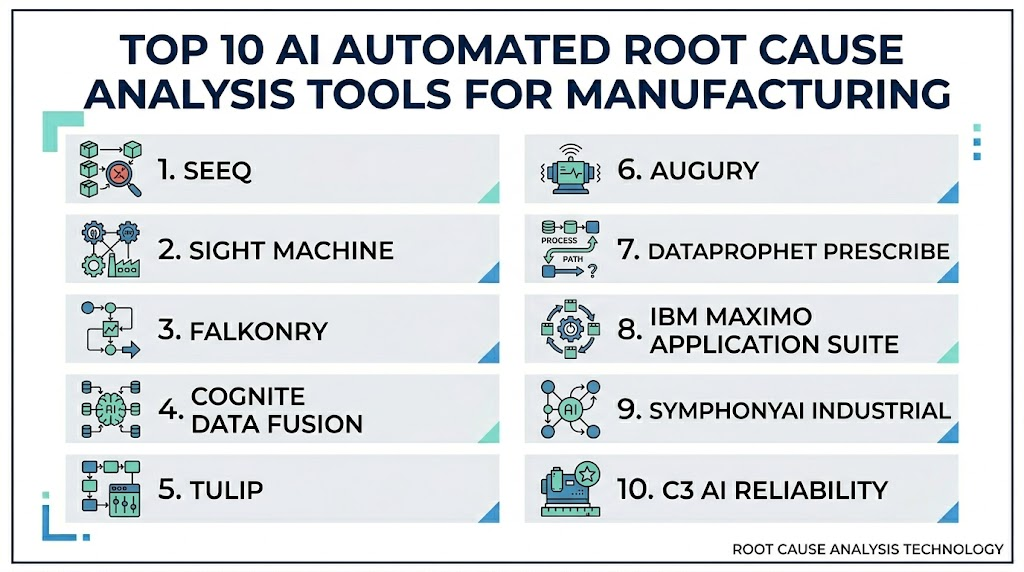
Top 10 AI Automated Root Cause Analysis Tools for Manufacturing
1- Seeq
One-Line Verdict: Best for process engineers needing advanced time-series analytics and root cause investigation.
Short Description
Seeq helps manufacturing and industrial teams analyze process data, detect abnormal behavior, investigate production losses, and identify likely root causes. It is widely used by engineers working with time-series data from industrial historians, sensors, and production systems.For automated root cause analysis, Seeq is valuable because it helps users compare process conditions, isolate abnormal periods, identify contributing variables, and collaborate on investigation workflows. It is especially useful in process manufacturing, chemicals, energy, pharmaceuticals, and other data-rich industrial environments.
Standout Capabilities
- Advanced time-series analytics
- Process condition comparison
- Root cause investigation workflows
- Abnormal behavior detection
- Collaboration for engineering teams
- Visualization of process relationships
- Industrial historian connectivity
- Support for continuous improvement analysis
AI-Specific Depth
- Model support: Machine learning and statistical analytics
- Knowledge integration: Industrial process data and engineering context
- Evaluation: Engineer validation and investigation review
- Guardrails: Human review, workbook controls, and user permissions
- Observability: Dashboards, trends, event views, and process analytics
Pros
- Strong fit for process engineers
- Excellent for time-series root cause investigation
- Helps reduce manual analysis effort
Cons
- Requires quality process data
- Advanced analysis may need engineering skill
- Not a fully automatic corrective action system by itself
Security and Compliance
Enterprise security features are available. Buyers should verify role-based access, audit logging, encryption, identity management, data retention, and deployment-specific governance needs.
Deployment and Platforms
- Cloud
- Hybrid
- Enterprise industrial environments
Integrations and Ecosystem
Seeq works well with industrial process and operational data environments.
- Industrial historians
- Time-series databases
- Manufacturing systems
- Cloud data platforms
- Process analytics workflows
- Engineering collaboration tools
Pricing Model
Enterprise subscription pricing. Exact pricing is not publicly stated.
Best-Fit Scenarios
- Process anomaly investigation
- Quality and yield issue analysis
- Root cause analysis for time-series process data
2- Sight Machine
One-Line Verdict: Best for manufacturers connecting production, quality, and machine data for RCA insights.
Short Description
Sight Machine provides a manufacturing data platform that connects production data, machine data, quality data, and operational context. It helps teams analyze performance losses, quality problems, and process inefficiencies across factories.For AI Automated Root Cause Analysis, Sight Machine is useful when manufacturers need a structured data foundation to compare lines, shifts, machines, products, materials, and quality outcomes. It supports root cause investigation by contextualizing factory data and making patterns easier to detect.
Standout Capabilities
- Manufacturing data contextualization
- Production performance analytics
- Quality and process correlation
- Machine and line-level visibility
- Multi-site manufacturing analytics
- Root cause investigation support
- Operational dashboards
- Factory data model support
AI-Specific Depth
- Model support: Predictive and analytical models vary by implementation
- Knowledge integration: Production, quality, machine, and process data context
- Evaluation: Performance review and outcome validation workflows
- Guardrails: Role-based workflows and data governance controls
- Observability: Dashboards, production metrics, and factory analytics
Pros
- Strong manufacturing data foundation
- Useful for multi-line and multi-site analysis
- Connects quality, production, and machine data
Cons
- Requires data integration effort
- Best value depends on data maturity
- Advanced RCA workflows may need configuration
Security and Compliance
Enterprise security capabilities are available. Buyers should verify user permissions, audit logs, encryption, data governance, and data retention policies before deployment.
Deployment and Platforms
- Cloud
- Hybrid manufacturing environments
Integrations and Ecosystem
Sight Machine connects manufacturing data across factory systems.
- MES systems
- ERP systems
- Machine data sources
- Quality systems
- Industrial IoT platforms
- Analytics and reporting workflows
Pricing Model
Enterprise subscription pricing. Exact pricing is not publicly stated.
Best-Fit Scenarios
- Production loss root cause analysis
- Multi-site manufacturing analytics
- Quality and machine data correlation
3- Falkonry
One-Line Verdict: Best for industrial teams needing AI-driven anomaly detection and root cause investigation from sensor data.
Short Description
Falkonry focuses on AI-driven operational intelligence for industrial environments. It helps teams monitor machine and process data, detect abnormal conditions, and identify patterns that may explain production issues.For automated root cause analysis, Falkonry is useful when factories need early warnings and investigation support from time-series sensor data. It can help reliability, maintenance, and process teams understand abnormal operating behavior and prioritize follow-up actions.
Standout Capabilities
- Time-series anomaly detection
- Industrial process monitoring
- Machine behavior analysis
- Early warning alerts
- Operational pattern recognition
- Sensor data analytics
- Root cause investigation support
- Scalable monitoring across assets
AI-Specific Depth
- Model support: Proprietary industrial AI models
- Knowledge integration: Sensor and operational data context
- Evaluation: Alert review and anomaly validation
- Guardrails: Human review and operational thresholds
- Observability: Anomaly dashboards and time-series monitoring
Pros
- Strong fit for industrial sensor data
- Helps detect abnormal patterns early
- Useful for maintenance and operations teams
Cons
- Requires reliable sensor data
- May need integration with existing systems
- Best suited for data-rich industrial environments
Security and Compliance
Enterprise security features vary by deployment. Buyers should verify role-based access, audit logging, encryption, data retention, and governance requirements.
Deployment and Platforms
- Cloud
- Hybrid
- Industrial environments
Integrations and Ecosystem
Falkonry fits into industrial monitoring and investigation workflows.
- Sensor data streams
- Industrial historians
- Manufacturing systems
- Process data platforms
- Maintenance workflows
- Operational dashboards
Pricing Model
Enterprise subscription pricing. Exact pricing is not publicly stated.
Best-Fit Scenarios
- Sensor-driven RCA
- Abnormal process behavior investigation
- Early warning for production issues
4- Cognite Data Fusion
One-Line Verdict: Best for manufacturers building RCA workflows on contextualized industrial data.
Short Description
Cognite Data Fusion is an industrial data platform that helps organizations collect, contextualize, and use operational data for analytics, AI, and digital operations. It connects asset data, time-series data, documents, engineering information, and process context into a usable data foundation.For AI Automated Root Cause Analysis, Cognite Data Fusion is valuable when the biggest challenge is fragmented industrial data. It helps teams build RCA workflows by making equipment relationships, process signals, documents, and operational events easier to understand together.
Standout Capabilities
- Industrial data contextualization
- Asset hierarchy mapping
- Time-series data management
- AI-ready industrial data foundation
- Document and engineering data connection
- Operational analytics enablement
- Root cause workflow support
- Scalable industrial data integration
AI-Specific Depth
- Model support: Bring-your-own models and ecosystem-based AI workflows
- Knowledge integration: Strong industrial data contextualization
- Evaluation: Depends on connected analytics workflows
- Guardrails: Data governance and access controls
- Observability: Operational dashboards and data visibility
Pros
- Strong industrial data foundation
- Useful for complex asset relationships
- Supports custom RCA analytics
Cons
- Not a standalone RCA tool for every use case
- Requires data and workflow design
- Best value depends on data maturity
Security and Compliance
Enterprise security and governance capabilities are available. Buyers should verify identity controls, audit logs, encryption, data retention, and data residency requirements.
Deployment and Platforms
- Cloud
- Hybrid industrial environments
Integrations and Ecosystem
Cognite Data Fusion connects industrial data sources for analytics and AI workflows.
- Industrial historians
- Asset management systems
- Sensor platforms
- Engineering documents
- Maintenance systems
- Analytics and AI tools
Pricing Model
Enterprise subscription pricing. Exact pricing is not publicly stated.
Best-Fit Scenarios
- Contextualized RCA data foundation
- Complex asset and process investigations
- Custom AI root cause analytics
5- Tulip
One-Line Verdict: Best for frontline manufacturing teams building RCA workflows around operator and process data.
Short Description
Tulip is a frontline operations platform that allows manufacturers to build custom applications for production tracking, quality checks, work instructions, issue reporting, and process improvement. It helps teams capture human and machine context directly from the shop floor.For AI Automated Root Cause Analysis, Tulip is valuable when RCA depends on operator input, quality checks, production steps, and workflow data. It can support structured problem-solving by helping teams capture issues consistently and connect them with process conditions.
Standout Capabilities
- Custom frontline apps
- Issue and defect tracking workflows
- Operator data capture
- Quality check applications
- Production process visibility
- No-code and low-code app building
- Shop floor dashboards
- Workflow-driven RCA support
AI-Specific Depth
- Model support: Varies through connected analytics and AI workflows
- Knowledge integration: Operator input, machine data, and process workflow context
- Evaluation: Workflow review and production outcome validation
- Guardrails: App governance, user permissions, and approval workflows
- Observability: App analytics, dashboards, and production workflow metrics
Pros
- Highly flexible for shop floor workflows
- Strong operator data capture
- Useful for quality and process issue tracking
Cons
- RCA quality depends on app design
- Advanced AI requires configuration or integration
- Governance becomes important as apps scale
Security and Compliance
Enterprise security features are available. Buyers should verify role-based access, identity management, audit logging, app governance, encryption, and data management controls.
Deployment and Platforms
- Cloud
- Edge-supported shop floor environments
- Web-based and tablet-friendly workflows
Integrations and Ecosystem
Tulip connects people, machines, and manufacturing workflows.
- Machine connectivity tools
- ERP systems
- Quality systems
- Sensors and devices
- APIs
- Operator workstations and tablets
Pricing Model
Subscription-based pricing. Exact pricing varies by deployment and usage.
Best-Fit Scenarios
- Frontline RCA workflows
- Defect and issue capture
- Operator-driven continuous improvement
6- Augury
One-Line Verdict: Best for manufacturers linking machine health insights with root cause investigation and maintenance actions.
Short Description
Augury monitors machine health, detects abnormal equipment behavior, and highlights early warning signs of mechanical problems. It uses AI-driven diagnostics to help maintenance and reliability teams investigate issues quickly and prioritize corrective actions.
Standout Capabilities
- Machine health monitoring
- Equipment anomaly detection
- Predictive maintenance insights
- Failure pattern recognition
- Asset-level diagnostics
- Maintenance prioritization
- Reliability trend analysis
- Root cause support for equipment-related issues
AI-Specific Depth
- Model support: Proprietary machine health AI models
- Knowledge integration: Machine condition and maintenance data
- Evaluation: Alert review and outcome validation
- Guardrails: Human review and workflow approvals
- Observability: Dashboards, alerts, and asset trends
Pros
- Strong equipment reliability focus
- Helps reduce unplanned downtime
- Supports proactive maintenance
Cons
- Focused mainly on machine-related issues
- Requires sensor coverage and quality data
- Limited coverage for process or quality root causes
Security and Compliance
Enterprise security features including role-based access, audit logging, and encryption.
Deployment and Platforms
- Cloud
- Edge-supported industrial environments
- Web dashboards
Integrations and Ecosystem
- Machine sensors
- Maintenance management systems
- Asset management platforms
- Reliability dashboards
- Industrial operations systems
- Alerting workflows
Pricing Model
Enterprise subscription. Exact pricing not publicly stated.
Best-Fit Scenarios
- Equipment-related root cause analysis
- Predictive maintenance investigations
- Reliability improvement programs
7- DataProphet PRESCRIBE
One-Line Verdict: Best for process engineers needing AI recommendations to reduce process-driven quality losses.
Short Description
DataProphet PRESCRIBE applies AI to process data to identify causes of quality defects, process instability, and performance issues. It provides prescriptive recommendations to adjust process parameters and reduce defects.
Standout Capabilities
- Process optimization AI
- Root cause support for quality issues
- Prescriptive recommendations
- Process parameter analysis
- Defect reduction insights
- Production performance improvement
- Multi-variable pattern detection
- Quality improvement analytics
AI-Specific Depth
- Model support: Proprietary prescriptive AI
- Knowledge integration: Process, quality, and production data
- Evaluation: Outcome validation and improvement tracking
- Guardrails: Human review and approval workflows
- Observability: Dashboards, trends, and recommendation tracking
Pros
- Strong fit for quality-driven RCA
- Connects process variables to outcomes
- Useful for complex manufacturing processes
Cons
- Requires strong process and quality data
- Domain expertise needed for setup
- Advanced analytics may require configuration
Security and Compliance
Enterprise-grade security features with access control, encryption, and governance.
Deployment and Platforms
- Cloud
- Hybrid industrial environments
Integrations and Ecosystem
- Manufacturing execution systems
- Quality systems
- Machine data sources
- Industrial analytics platforms
- Production reporting systems
Pricing Model
Enterprise subscription. Exact pricing not publicly stated.
Best-Fit Scenarios
- Defect root cause analysis
- Process parameter investigations
- Prescriptive quality improvement
8- IBM Maximo Application Suite
One-Line Verdict: Best for large enterprises connecting asset failures, maintenance data, and RCA workflows.
Short Description
IBM Maximo supports enterprise asset management, maintenance planning, and reliability improvement. It connects equipment history, work orders, inspections, and asset health data for deeper root cause investigation.
Standout Capabilities
- Enterprise asset management
- Maintenance history analysis
- Asset performance monitoring
- Reliability workflow support
- Work order connection
- Failure pattern visibility
- Inspection and maintenance context
- Root cause support for asset failures
AI-Specific Depth
- Model support: Configurable AI capabilities
- Knowledge integration: Asset data, inspections, maintenance records
- Evaluation: Performance review and maintenance outcome tracking
- Guardrails: Approval workflows and permissions
- Observability: Asset dashboards and reliability reports
Pros
- Strong asset management foundation
- Connects RCA with maintenance workflows
- Suitable for large enterprise environments
Cons
- Broad platform beyond RCA
- Implementation complexity
- Best value depends on data quality
Security and Compliance
Enterprise-grade access control, audit logging, encryption, and governance.
Deployment and Platforms
- Cloud
- Hybrid enterprise environments
Integrations and Ecosystem
- Enterprise asset management workflows
- Maintenance systems
- Work order systems
- Industrial IoT platforms
- ERP systems
- Reliability analytics workflows
Pricing Model
Enterprise subscription. Exact pricing not publicly stated.
Best-Fit Scenarios
- Asset failure investigation
- Maintenance-driven RCA
- Enterprise reliability programs
9- SymphonyAI Industrial
One-Line Verdict: Best for enterprises needing AI analytics across operations, quality, and asset performance.
Short Description
SymphonyAI Industrial provides AI-powered industrial analytics for manufacturing performance, quality improvement, and operational intelligence. It analyzes production and operational data to detect issues, investigate causes, and improve plant performance.
Standout Capabilities
- Industrial AI analytics
- Production performance analysis
- Quality issue investigation
- Asset reliability insights
- Operational intelligence dashboards
- Pattern recognition across manufacturing data
- Root cause investigation support
- Multi-site analytics support
AI-Specific Depth
- Model support: Proprietary industrial AI models
- Knowledge integration: Production, asset, quality, and operational data
- Evaluation: Outcome tracking and model performance review
- Guardrails: Role-based workflows and governance controls
- Observability: Dashboards, alerts, and analytics reports
Pros
- Broad industrial AI capabilities
- Useful for enterprise manufacturing analytics
- Supports operations and quality improvement
Cons
- Requires significant data integration
- Best for mature industrial environments
- RCA workflows may need configuration
Security and Compliance
Enterprise-grade features for access, audit, and data security.
Deployment and Platforms
- Cloud
- Hybrid industrial environments
Integrations and Ecosystem
- Manufacturing execution systems
- Industrial IoT systems
- Quality systems
- Asset systems
- Production databases
- Enterprise analytics tools
Pricing Model
Enterprise subscription. Exact pricing not publicly stated.
Best-Fit Scenarios
- Manufacturing performance RCA
- Quality and production issue investigation
- Multi-site operational analytics
10- C3 AI Reliability
One-Line Verdict: Best for large enterprises using AI to investigate asset failures and operational risk.
Short Description
C3 AI Reliability detects asset risks, predicts failures, and improves reliability through enterprise AI. It connects asset data, operational history, sensor signals, and maintenance workflows for multi-site industrial environments.
Standout Capabilities
- Enterprise AI reliability analytics
- Asset failure prediction
- Operational risk visibility
- Multi-site asset monitoring
- Sensor and maintenance data analysis
- Root cause investigation support
- Predictive maintenance workflows
- Scalable AI application architecture
AI-Specific Depth
- Model support: Multi-model enterprise AI
- Knowledge integration: Asset, sensor, operational, and maintenance data
- Evaluation: Model performance tracking and failure validation
- Guardrails: Policy-based governance and workflow controls
- Observability: Dashboards, alerts, and operational analytics
Pros
- Strong enterprise scalability
- Useful for complex asset-heavy environments
- Supports reliability and risk analytics
Cons
- Resource-intensive rollout
- Better for large enterprises
- Requires mature data and IT infrastructure
Security and Compliance
Enterprise-grade identity, audit, access, and governance controls.
Deployment and Platforms
- Cloud
- Hybrid industrial environments
Integrations and Ecosystem
- ERP systems
- Industrial systems
- Data lakes
- Asset management systems
- Maintenance platforms
- Enterprise analytics tools
Pricing Model
Enterprise subscription. Exact pricing not publicly stated.
Best-Fit Scenarios
Multi-site predictive maintenance programs
Enterprise reliability RCA
Asset failure investigation
Comparison Table
| Tool Name | Best For | Deployment | Model Flexibility | Strength | Watch-Out | Public Rating |
|---|---|---|---|---|---|---|
| Seeq | Time-series process RCA | Cloud and hybrid | Machine learning and statistical analytics | Deep process investigation | Requires engineering skill | N/A |
| Sight Machine | Manufacturing data RCA | Cloud and hybrid | Predictive analytics varies | Factory data contextualization | Data integration effort | N/A |
| Falkonry | Sensor-driven RCA | Cloud and hybrid | Proprietary industrial AI | Time-series anomaly detection | Needs reliable sensor data | N/A |
| Cognite Data Fusion | Contextualized industrial RCA | Cloud and hybrid | Bring-your-own model | Industrial data foundation | Needs workflow design | N/A |
| Tulip | Frontline RCA workflows | Cloud and edge | Varies by workflow | Operator and process data capture | App governance needed | N/A |
| Augury | Machine health RCA | Cloud and edge | Proprietary diagnostic AI | Equipment reliability insights | Asset-focused scope | N/A |
| DataProphet PRESCRIBE | Quality and process RCA | Cloud and hybrid | Proprietary prescriptive AI | Process parameter recommendations | Needs strong process data | N/A |
| IBM Maximo Application Suite | Maintenance-driven RCA | Cloud and hybrid | Configurable AI capabilities | Asset and work order context | Broad platform complexity | N/A |
| SymphonyAI Industrial | Enterprise industrial analytics | Cloud and hybrid | Proprietary industrial AI | Operations and quality analytics | Configuration may be needed | N/A |
| C3 AI Reliability | Enterprise asset RCA | Cloud and hybrid | Multi-model AI | Enterprise reliability scale | Resource-intensive rollout | N/A |
Scoring and Evaluation
The scoring below is a practical comparative guide, not an absolute ranking. Each tool is evaluated based on RCA depth, AI readiness, manufacturing relevance, data integration strength, usability, governance, security, and enterprise scalability. Buyers should validate these scores through a pilot using their own production data, machine signals, quality records, maintenance history, downtime events, and investigation workflows.
| Tool | Core Features | Reliability and Evaluation | Guardrails | Integrations | Ease of Use | Performance and Cost | Security and Admin | Support | Weighted Total |
| Seeq | 9 | 9 | 8 | 9 | 8 | 8 | 8 | 8 | 8.5 |
| Sight Machine | 9 | 8 | 8 | 9 | 8 | 8 | 8 | 8 | 8.4 |
| Falkonry | 8 | 8 | 7 | 8 | 8 | 8 | 7 | 7 | 7.8 |
| Cognite Data Fusion | 8 | 8 | 8 | 9 | 7 | 8 | 8 | 8 | 8.0 |
| Tulip | 8 | 8 | 8 | 9 | 9 | 8 | 8 | 8 | 8.4 |
| Augury | 8 | 9 | 8 | 8 | 8 | 8 | 8 | 8 | 8.2 |
| DataProphet PRESCRIBE | 9 | 8 | 8 | 8 | 7 | 8 | 8 | 7 | 8.0 |
| IBM Maximo Application Suite | 8 | 8 | 9 | 9 | 7 | 8 | 9 | 9 | 8.4 |
| SymphonyAI Industrial | 8 | 8 | 8 | 8 | 7 | 8 | 8 | 8 | 8.0 |
| C3 AI Reliability | 9 | 8 | 9 | 9 | 7 | 8 | 9 | 8 | 8.5 |
Top 3 for Enterprise
- C3 AI Reliability
- Seeq
- IBM Maximo Application Suite
Top 3 for SMB
- Tulip
- Falkonry
- Augury
Top 3 for Developers
- Cognite Data Fusion
- Tulip
- Seeq
Which AI Automated Root Cause Analysis Tool for Manufacturing Is Right for You
Solo and Freelancer
Solo consultants and independent manufacturing improvement specialists usually need tools that help them analyze production problems quickly and communicate findings clearly. Seeq is strong for time-series process investigation, while Tulip can support structured operator-driven RCA workflows. Cognite Data Fusion may be useful for consultants working with clients that need industrial data contextualization before building deeper RCA analytics.
SMB
Small and medium manufacturers should prioritize ease of adoption, clear workflows, and practical investigation support. Tulip, Falkonry, and Augury are strong candidates depending on whether the main challenge is operator issue capture, sensor-based anomaly investigation, or machine health. SMBs should start with one repeated problem, validate data quality, and avoid overbuilding a complex analytics environment too early.
Mid-Market
Mid-market manufacturers often need stronger integration across production, quality, maintenance, and machine data. Sight Machine, Seeq, DataProphet PRESCRIBE, and IBM Maximo can support more structured RCA programs. These organizations should focus on tools that connect root cause insights with corrective actions, maintenance workflows, and quality improvement programs.
Enterprise
Large manufacturers need RCA tools that scale across lines, plants, products, and business units. C3 AI Reliability, IBM Maximo Application Suite, Seeq, SymphonyAI Industrial, and Sight Machine are strong options for enterprise environments. Enterprises should prioritize governance, access control, standardized investigation workflows, multi-site analytics, and integration with existing industrial systems.
Regulated Industries
Regulated industries such as pharmaceuticals, medical devices, aerospace, food production, chemicals, and automotive should prioritize audit trails, traceability, approval workflows, and data integrity. RCA findings should connect with quality management, corrective and preventive actions, maintenance records, and compliance documentation. Buyers should verify that the tool supports controlled review and documented investigation history.
Budget vs Premium
Budget-conscious manufacturers should begin with a focused RCA use case such as recurring downtime, repeated defects, or one high-cost quality issue. Tools with flexible workflows or focused anomaly detection can show value quickly. Premium platforms are better when the organization needs enterprise-scale RCA, deep integration, multi-site benchmarking, advanced AI, and governance across many teams.
Build vs Buy
Building custom RCA analytics can work for organizations with strong data engineering, manufacturing analytics, and process engineering teams. However, automated RCA requires clean data, event context, causal reasoning, visualization, user feedback, governance, and integration with action workflows. Buying a proven platform is usually better when the company needs faster deployment, vendor support, and tested industrial workflows. A hybrid model can work by using a commercial platform while building custom RCA models around it.
Implementation Playbook
Implementing AI Automated Root Cause Analysis for Manufacturing should be treated as an operational improvement program, not just an analytics deployment. The goal is to reduce repeated problems, shorten investigation time, improve quality, reduce downtime, and help teams understand why production issues happen. A successful rollout connects machine data, process data, quality records, maintenance history, operator input, and production context into one practical investigation workflow.
First Phase
The first phase should focus on one high-value manufacturing problem. This could be recurring machine downtime, repeated quality defects, abnormal process variation, scrap increase, speed loss, or a persistent bottleneck. Starting with one clear problem helps teams validate data, build trust, and prove business value before expanding.
Key activities include:
- Select one repeated production or quality problem
- Define the current investigation baseline
- Identify machines, lines, products, shifts, and materials involved
- Collect relevant production, process, quality, and maintenance data
- Review sensor quality and missing data
- Standardize downtime and defect reason codes
- Align production, quality, maintenance, engineering, and IT teams
- Define what successful root cause identification means
- Create basic investigation dashboards
- Train users on RCA workflow expectations
AI-specific tasks include:
- Identify normal and abnormal process patterns
- Train models using historical production and quality data
- Detect correlations between process variables and outcomes
- Create ranked likely cause suggestions
- Define human review workflows for AI findings
- Document model assumptions and limitations
- Track accepted and rejected AI suggestions
- Set up alert thresholds for recurring issues
Success metrics should include:
- Faster investigation time
- Fewer repeated defects
- Reduced downtime recurrence
- Better quality issue containment
- Improved root cause confidence
- More consistent investigation documentation
- Higher engineer and supervisor adoption
- Better visibility into process variation
Second Phase
The second phase should focus on validation, workflow integration, and broader adoption. At this stage, AI-generated insights should be compared with engineering judgment, quality findings, maintenance records, and actual production outcomes. The goal is to confirm that suggested causes are practical, explainable, and useful.
Key activities include:
- Validate AI-suggested root causes with engineers
- Compare findings with manual RCA outcomes
- Connect RCA workflows with corrective actions
- Integrate with quality and maintenance systems
- Improve dashboards for supervisors and managers
- Train teams on interpreting AI insights
- Add structured feedback from operators
- Review false cause suggestions and missed causes
- Expand to similar machines or product families
- Create review routines for repeated issues
AI-specific tasks include:
- Monitor model performance and investigation accuracy
- Review false positives and false negatives
- Add more context from maintenance and quality records
- Improve explanation quality for suggested causes
- Compare model findings across shifts and lines
- Detect model drift when processes change
- Add version control for models and rules
- Create audit trails for RCA findings
- Track corrective action outcomes
- Refine cause ranking based on user feedback
Success metrics should include:
- Reduced time to identify likely cause
- Fewer recurring production issues
- Better corrective action effectiveness
- Higher quality yield
- Improved maintenance planning
- Reduced manual analysis workload
- Better collaboration between teams
- Higher trust in RCA insights
Third Phase
The third phase should focus on scaling automated RCA across more lines, sites, processes, and business units. Once the first RCA workflows are trusted, organizations can standardize investigation methods, connect more data sources, and use insights for prevention rather than only troubleshooting.
Key activities include:
- Expand RCA workflows across more assets and lines
- Standardize root cause categories
- Connect RCA insights with continuous improvement programs
- Create enterprise dashboards for recurring issues
- Benchmark root causes across plants
- Integrate with corrective action workflows
- Train additional production and quality teams
- Create governance for investigation data
- Review vendor support and model performance
- Build a repeatable RCA center of excellence
AI-specific tasks include:
- Scale models across product families and equipment types
- Add new data sources such as vision, supplier, or environmental data
- Monitor model drift across plants
- Automate recurring issue detection
- Improve root cause ranking accuracy
- Connect RCA insights with predictive alerts
- Add natural language search where useful
- Maintain model documentation and change logs
- Review access controls and audit logs
- Improve recommendations through feedback loops
Long-term success metrics should include:
- Lower repeated downtime
- Reduced scrap and rework
- Faster corrective action closure
- Higher first-pass yield
- Improved OEE
- Lower maintenance firefighting
- Better standard work updates
- Stronger continuous improvement maturity
- Better cross-site learning
- More proactive issue prevention
Common Mistakes and How to Avoid Them
1. Starting Without a Clear Problem
AI RCA works best when the business problem is specific. Starting with a vague goal like improving the factory makes it difficult to collect the right data and measure success. Begin with one recurring issue such as defects, downtime, or process instability.
2. Ignoring Data Quality
Poor data quality leads to weak root cause suggestions. Missing sensor values, inconsistent reason codes, incorrect timestamps, and incomplete maintenance records can reduce accuracy. Clean and validate the most important data before scaling.
3. Treating Correlation as Proof
AI may identify strong relationships between variables, but correlation does not always prove causation. Engineers should review AI findings with process knowledge. Human validation remains important for reliable root cause decisions.
4. Not Capturing Operator Context
Operators often know important details that are not visible in machine data. Shift notes, manual observations, material changes, cleaning activities, and setup differences can be critical. Include frontline input in RCA workflows.
5. Using Too Many Root Cause Categories
If categories are too broad or too many, analysis becomes confusing. Standardize root cause categories and keep them practical. Review categories regularly to improve consistency across teams.
6. Ignoring Maintenance History
Many production problems are connected to asset condition, repairs, inspections, or delayed maintenance. RCA should include maintenance records and work order history where relevant. This helps teams distinguish process problems from equipment problems.
7. Weak Integration With Corrective Actions
Root cause insights are only valuable if they lead to action. Connect RCA findings with corrective actions, maintenance tasks, quality workflows, and process updates. This ensures the same issue does not return.
8. Over-Automating RCA Decisions
AI should support investigation, not replace accountability. High-impact decisions should include human review, especially in regulated, safety-critical, or customer-facing quality situations. Keep engineers and quality leaders involved.
9. Not Explaining AI Findings
If users do not understand why a cause is suggested, they may not trust the system. RCA tools should show contributing variables, time windows, event relationships, and confidence indicators where possible.
10. Skipping Model Monitoring
Manufacturing processes change over time due to new materials, tooling changes, equipment aging, process updates, and operator behavior. Models should be monitored and updated to remain useful.
11. Measuring Only Investigation Speed
Faster RCA is valuable, but it is not enough. Teams should also measure whether corrective actions prevent recurrence. The real goal is not just faster investigation but better problem resolution.
12. Failing to Standardize Across Sites
Multi-site manufacturers need consistent definitions for downtime, defects, root causes, and corrective actions. Without standardization, cross-site comparison becomes unreliable. Standard rules improve benchmarking and shared learning.
13. Ignoring Change Management
RCA tools change how engineers, quality teams, maintenance teams, and operators work together. Training and communication are essential. Users need to understand how AI supports their expertise rather than replaces it.
14. Expecting AI to Fix Weak Processes Alone
AI can identify patterns and suggest likely causes, but it cannot fix poor maintenance discipline, weak quality systems, bad process control, or unclear ownership by itself. RCA improvement must be part of a broader operational excellence program.
FAQs
1. What is AI Automated Root Cause Analysis for Manufacturing?
AI Automated Root Cause Analysis for Manufacturing uses artificial intelligence, machine learning, and operational data to identify likely causes of production problems. It analyzes machine signals, quality records, maintenance history, process variables, and operator inputs. The goal is to help teams investigate issues faster and more accurately. It supports better corrective actions, fewer repeated problems, and stronger continuous improvement.
2. Why is automated RCA important in manufacturing?
Automated RCA is important because manufacturing problems often involve many connected variables. A defect or downtime event may be caused by machine condition, process settings, material variation, maintenance history, or operator workflow. AI helps analyze these relationships faster than manual investigation alone. This reduces troubleshooting time and helps teams prevent the same issue from returning.
3. How does AI identify root causes?
AI identifies root causes by comparing normal and abnormal production behavior, detecting correlations, ranking contributing variables, and analyzing historical patterns. It can review sensor data, downtime events, defect records, maintenance logs, and process conditions. The system suggests likely causes, but engineers should validate findings. Human review helps confirm whether the suggested cause is practical and accurate.
4. Can AI RCA replace manual methods like five why analysis?
No, AI RCA should not fully replace structured human problem-solving methods. Five why analysis, fishbone diagrams, and team reviews are still useful for understanding context and validating findings. AI improves these methods by providing data-driven evidence and faster pattern discovery. The strongest approach combines AI insights with engineering expertise and structured problem-solving.
5. What data is needed for AI root cause analysis?
Common data includes machine states, sensor values, process parameters, production counts, defect records, downtime reasons, maintenance history, work orders, material lots, operator notes, and quality inspection results. The exact data depends on the issue being investigated. Clean, consistent, and contextualized data improves RCA quality. Missing or inaccurate data can weaken recommendations.
6. Can AI RCA reduce downtime?
Yes, AI RCA can reduce downtime by helping teams identify why failures or stoppages occur. It can reveal patterns such as recurring machine conditions, maintenance gaps, process instability, or operational sequences that lead to downtime. When teams act on these insights, they can prevent repeated failures. The impact depends on data quality and corrective action discipline.
7. Can AI RCA improve product quality?
Yes, AI RCA can improve quality by connecting defects with process variables, machine behavior, material conditions, or production events. It helps quality teams identify where problems begin and what conditions increase defect risk. This supports faster containment and better corrective actions. Over time, it can reduce scrap, rework, and customer complaints.
8. Is AI RCA useful for small manufacturers?
AI RCA can be useful for small manufacturers if recurring downtime, defects, or process issues create significant cost. However, small teams should start with one focused use case and simple data sources. If production data is limited or mostly manual, they may need to improve data collection first. Basic RCA methods may be enough for very simple operations.
9. How important is explainability in AI RCA?
Explainability is very important because teams need to understand why a tool suggests a root cause. Engineers and quality managers are unlikely to trust a black-box answer without supporting evidence. Good tools show contributing variables, event timing, trends, and relationships. Explainability helps users validate findings and take confident corrective action.
10. Can AI RCA integrate with MES and CMMS systems?
Yes, many RCA platforms can integrate with manufacturing execution systems, maintenance systems, quality systems, historians, ERP systems, and industrial data platforms. Integration is important because root causes often span production, maintenance, quality, and process data. Buyers should verify integration depth before selecting a tool. Strong integration reduces manual data collection and improves investigation speed.
11. What is the role of time-series data in RCA?
Time-series data is critical because many production problems develop over time. Temperature, pressure, vibration, speed, cycle time, flow, and other signals can show abnormal patterns before a failure or defect occurs. AI tools can compare time windows and detect changes that humans may miss. This is especially useful for process and equipment-related investigations.
12. How should manufacturers measure RCA success?
Manufacturers should measure investigation time, recurrence rate, downtime reduction, defect reduction, corrective action effectiveness, first-pass yield, scrap reduction, and user adoption. It is not enough to measure how many insights the tool generates. The goal is to reduce repeated issues and improve operational outcomes. A baseline should be defined before implementation.
13. What are the biggest implementation challenges?
Common challenges include poor data quality, weak integration, inconsistent reason codes, lack of operator context, and low trust in AI recommendations. Some teams also struggle because RCA responsibilities are split across production, quality, maintenance, and engineering. A successful rollout needs cross-functional ownership and clear workflows. Training and governance are essential.
14. Can AI RCA support corrective and preventive actions?
Yes, AI RCA can support corrective and preventive actions by identifying likely causes and linking them to recommended follow-up actions. Some platforms can connect findings with quality workflows, maintenance tasks, or improvement projects. This helps ensure that insights lead to real changes. The integration depth varies by tool and implementation.
15. What is the future of AI Automated Root Cause Analysis?
The future of AI RCA will include stronger causal analysis, better explainability, natural language investigation copilots, more real-time insights, and deeper integration with production, quality, and maintenance systems. AI will help teams move from reactive troubleshooting to proactive prevention. The best results will come from combining AI recommendations with human expertise, clean data, and disciplined corrective action workflows.
Conclusion
AI Automated Root Cause Analysis for Manufacturing helps teams investigate production issues faster, understand why problems happen, and prevent recurring failures. The right platform depends on the type of problems being solved, the available data, integration requirements, manufacturing complexity, and internal expertise. Seeq, Sight Machine, Falkonry, Cognite Data Fusion, Tulip, Augury, DataProphet PRESCRIBE, IBM Maximo Application Suite, SymphonyAI Industrial, and C3 AI Reliability each serve different needs across process analytics, manufacturing data contextualization, sensor-driven anomaly detection, maintenance-driven RCA, quality improvement, and enterprise reliability.The best approach is to start with one high-impact recurring issue, validate data quality, run a focused pilot, and compare AI findings with expert investigation. Shortlist tools based on your production environment, data maturity, RCA workflow needs, and integration requirements. Verify security, explainability, human review controls, and corrective action workflows before scaling. Once the pilot proves value, expand gradually across more lines, machines, product families, and plants with standardized root cause categories, strong governance, and continuous improvement routines.

Find Trusted Cardiac Hospitals
Compare heart hospitals by city and services — all in one place.
Explore Hospitals
AI RCA tools help surface patterns, but real root cause accuracy still depends on high-quality telemetry, proper event correlation, and well-instrumented production systems.