
Introduction
AI Compliance Management tools for the EU AI Act help organizations manage regulatory obligations, governance workflows, risk assessments, technical documentation, transparency requirements, monitoring, and audit readiness for artificial intelligence systems operating within the European Union. These platforms are becoming essential for enterprises deploying machine learning models, generative AI systems, AI agents, foundation models, and high-risk AI applications subject to EU regulatory oversight.
The EU AI Act introduces one of the world’s most comprehensive regulatory frameworks for artificial intelligence, applying risk-based obligations across providers, deployers, importers, and distributors of AI systems. Organizations must now maintain AI inventories, classify risk levels, document model behavior, monitor operational performance, maintain human oversight, manage transparency requirements, and demonstrate continuous compliance readiness.
Modern AI compliance platforms automate these governance activities by combining policy management, AI inventory discovery, risk scoring, lifecycle documentation, operational monitoring, explainability reporting, conformity assessments, and audit evidence collection into centralized governance environments. Many tools now integrate directly with MLOps and LLMOps pipelines to provide continuous governance visibility rather than periodic manual reviews.
Why It Matters
- Helps organizations comply with EU AI Act obligations
- Reduces regulatory and operational AI risk
- Simplifies audit and conformity assessment workflows
- Improves AI transparency and accountability
- Automates governance evidence collection
- Supports responsible AI initiatives
- Centralizes AI inventory and lifecycle visibility
- Enables continuous compliance monitoring
Real-World Use Cases
- Managing high-risk AI system compliance
- Automating Annex IV technical documentation
- Tracking prompts, datasets, and model lineage
- Conducting AI risk classification workflows
- Supporting conformity assessments
- Monitoring operational AI behavior
- Managing foundation model governance
- Building enterprise-wide AI governance programs
Evaluation Criteria for Buyers
When evaluating EU AI Act compliance management tools, buyers should focus on:
- AI inventory and discovery automation
- Risk classification capabilities
- Annex IV documentation support
- Governance workflow automation
- Integration with MLOps and cloud environments
- Explainability and fairness reporting
- Operational monitoring and telemetry
- Audit and evidence management
- Policy management and enforcement
- Scalability for enterprise AI operations
Best for: Enterprises, regulated industries, AI governance teams, legal and compliance departments, organizations deploying generative AI systems, and businesses operating AI services within the European Union.
Not ideal for: Small research projects, lightweight experimentation environments, or organizations without formal AI governance requirements.
What’s Changing in EU AI Act Compliance
- EU AI Act obligations are driving rapid adoption of AI governance platforms
- Organizations are shifting from spreadsheet-based governance to automated compliance systems
- Continuous AI monitoring is replacing periodic audit preparation
- Foundation model governance is becoming a major compliance focus
- AI inventory discovery is now a critical operational requirement
- Runtime AI governance layers are emerging alongside policy governance systems
- Explainability reporting is increasingly integrated into compliance workflows
- Enterprises are automating technical documentation generation
- AI observability and compliance monitoring are converging
- ISO 42001 alignment is becoming important for enterprise governance maturity
Quick Buyer Checklist
Before selecting a platform, verify:
- Does the platform support EU AI Act risk classification?
- Can it generate Annex IV documentation?
- Does it provide AI inventory discovery?
- Are governance workflows configurable?
- Can it monitor generative AI systems?
- Does it integrate with your MLOps stack?
- Are audit and evidence workflows automated?
- Can it support high-risk AI systems?
- Does it provide explainability reporting?
- Is operational monitoring included?
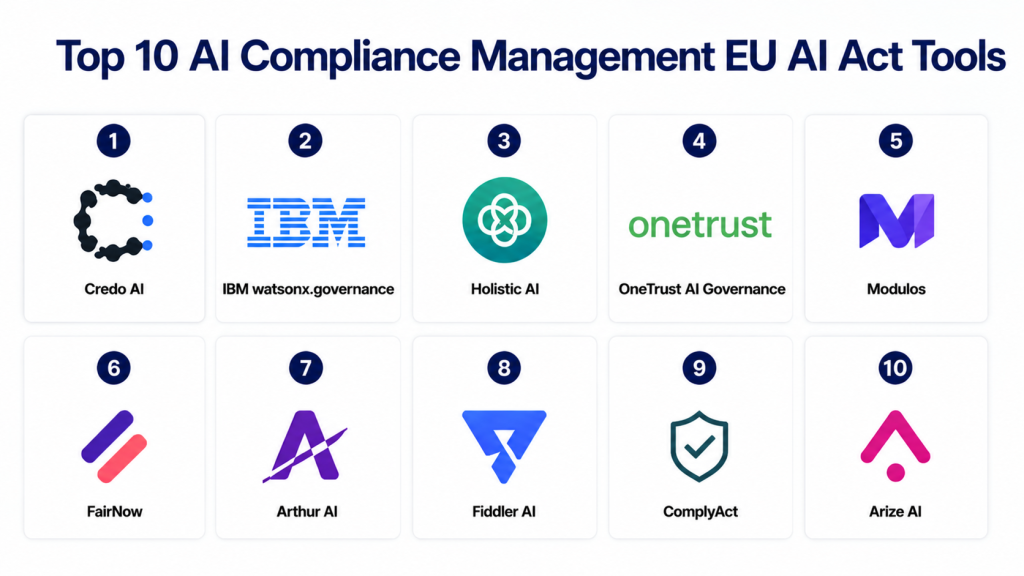
Top 10 AI Compliance Management EU AI Act Tools
1- Credo AI
2- IBM watsonx.governance
3- Holistic AI
4- OneTrust AI Governance
5- Modulos
6- FairNow
7- Arthur AI
8- Fiddler AI
9- ComplyAct
10- Arize AI
1- Credo AI
One-line Verdict
One of the strongest enterprise AI governance and EU AI Act compliance platforms for policy management and operational oversight.
Short Description
Credo AI helps enterprises operationalize AI governance through centralized policy management, AI inventory tracking, compliance automation, risk assessments, and audit workflows. The platform is widely recognized for supporting global AI governance frameworks including the EU AI Act, NIST AI RMF, and ISO 42001.
The platform enables organizations to manage AI systems throughout their lifecycle while maintaining continuous compliance readiness and governance visibility.
Standout Capabilities
- AI inventory management
- EU AI Act compliance workflows
- Risk classification automation
- Governance dashboards
- Audit evidence collection
- Policy enforcement
- Compliance reporting
- AI lifecycle visibility
AI-Specific Depth
Credo AI supports governance for foundation models, generative AI applications, prompts, AI agents, and high-risk AI systems.
Pros
- Excellent governance depth
- Strong EU AI Act alignment
- Mature enterprise workflows
Cons
- Enterprise-focused pricing
- Advanced governance setup required
- Complex onboarding for smaller teams
Security & Compliance
Supports enterprise governance and regulatory frameworks including EU AI Act and ISO 42001 alignment.
Deployment & Platforms
- SaaS
- Enterprise cloud
Integrations & Ecosystem
- Cloud providers
- Enterprise governance stacks
- AI lifecycle systems
- Risk management platforms
Pricing Model
Custom enterprise pricing.
Best-Fit Scenarios
- Enterprise AI governance
- EU AI Act compliance programs
- Responsible AI operations
2- IBM watsonx.governance
One-line Verdict
Enterprise-grade governance platform with strong AI audit readiness and regulatory compliance automation.
Short Description
IBM watsonx.governance provides centralized governance, AI lifecycle management, operational monitoring, risk management, and audit-ready documentation for enterprise AI systems. The platform supports compliance workflows for both traditional machine learning and generative AI systems.
Its enterprise governance depth makes it highly suitable for organizations preparing for EU AI Act obligations.
Standout Capabilities
- AI governance automation
- AI inventory tracking
- Audit management
- Risk scoring
- Policy enforcement
- Explainability reporting
- Compliance documentation
- Lifecycle monitoring
AI-Specific Depth
Supports governance workflows for LLMs, prompts, foundation models, and high-risk AI applications.
Pros
- Strong compliance tooling
- Excellent enterprise scalability
- Mature governance architecture
Cons
- Complex implementation
- Premium pricing
- Enterprise-oriented deployments
Security & Compliance
Enterprise-grade compliance and governance controls.
Deployment & Platforms
- Hybrid
- Cloud
- Enterprise infrastructure
Integrations & Ecosystem
- IBM AI ecosystem
- Red Hat OpenShift
- AWS
- Azure
- Enterprise governance systems
Pricing Model
Enterprise pricing.
Best-Fit Scenarios
- Regulated enterprises
- High-risk AI systems
- Enterprise compliance operations
3- Holistic AI
One-line Verdict
Comprehensive AI governance and risk management platform focused on responsible AI compliance.
Short Description
Holistic AI provides AI governance, operational risk management, compliance automation, and continuous monitoring for enterprise AI systems. The platform supports organizations implementing EU AI Act governance frameworks and responsible AI operations.
It combines risk assessments, monitoring, inventory management, and governance reporting into centralized operational workflows.
Standout Capabilities
- AI risk assessments
- Governance workflows
- Compliance automation
- Monitoring dashboards
- AI inventory discovery
- Responsible AI reporting
- Audit management
AI-Specific Depth
Supports governance workflows for generative AI systems, AI agents, and enterprise foundation model deployments.
Pros
- Strong compliance capabilities
- Good governance automation
- Mature enterprise reporting
Cons
- Enterprise-focused setup
- Advanced governance maturity required
- Less developer-oriented flexibility
Security & Compliance
Supports EU AI Act and enterprise governance frameworks.
Deployment & Platforms
- SaaS
- Enterprise cloud
Integrations & Ecosystem
- AWS
- Azure
- Databricks
- GitHub
- Enterprise governance stacks
Pricing Model
Custom enterprise pricing.
Best-Fit Scenarios
- Responsible AI initiatives
- Enterprise governance
- Compliance-heavy organizations
4- OneTrust AI Governance
One-line Verdict
Compliance-focused AI governance platform extending enterprise privacy and risk workflows into AI operations.
Short Description
OneTrust AI Governance helps enterprises manage AI compliance, risk assessments, governance workflows, policy enforcement, and accountability tracking across AI systems.
Organizations already using OneTrust for privacy and compliance management often extend the platform into AI governance operations.
Standout Capabilities
- AI compliance workflows
- Policy management
- Governance automation
- Risk assessments
- Audit reporting
- Accountability tracking
- Approval management
AI-Specific Depth
Supports governance and operational accountability for generative AI and machine learning systems.
Pros
- Strong compliance heritage
- Mature governance workflows
- Good enterprise reporting
Cons
- Ecosystem dependency may increase
- Limited technical observability depth
- Enterprise-oriented implementation
Security & Compliance
Enterprise-grade compliance capabilities.
Deployment & Platforms
- SaaS
- Enterprise cloud
Integrations & Ecosystem
- OneTrust ecosystem
- Enterprise compliance platforms
- Cloud providers
Pricing Model
Enterprise pricing.
Best-Fit Scenarios
- Compliance-focused enterprises
- Governance operations
- AI policy management
5- Modulos
One-line Verdict
AI governance platform focused on operational risk quantification and EU AI Act compliance workflows.
Short Description
Modulos provides AI governance, operational risk assessment, compliance automation, and financial risk quantification for enterprise AI systems. The platform focuses heavily on measurable AI governance rather than static documentation workflows.
It helps organizations operationalize governance across AI deployments while maintaining regulatory readiness.
Standout Capabilities
- Risk quantification
- Governance workflows
- Compliance automation
- AI inventory tracking
- Audit evidence collection
- Operational analytics
- Lifecycle visibility
AI-Specific Depth
Supports operational governance for generative AI systems, model evaluations, and AI risk monitoring.
Pros
- Strong operational governance focus
- Good AI risk quantification
- Modern governance approach
Cons
- Enterprise-oriented deployments
- Smaller ecosystem than larger vendors
- Advanced onboarding complexity
Security & Compliance
Supports enterprise governance operations.
Deployment & Platforms
- SaaS
- Enterprise cloud
Integrations & Ecosystem
- Enterprise governance systems
- Cloud environments
- AI operations stacks
Pricing Model
Custom pricing.
Best-Fit Scenarios
- Operational AI governance
- EU AI Act compliance
- AI risk management
6- FairNow
One-line Verdict
Responsible AI governance platform with strong EU AI Act workflow automation and bias management.
Short Description
FairNow helps organizations automate compliance across multiple AI governance frameworks including the EU AI Act. The platform focuses heavily on fairness analysis, governance workflows, risk assessments, and operational accountability.
It is particularly strong for organizations managing HR technology and sensitive decision-making systems.
Standout Capabilities
- Bias detection
- Governance workflows
- Risk scoring
- Compliance automation
- Fairness reporting
- AI accountability
- Audit documentation
AI-Specific Depth
Supports governance workflows for high-risk AI systems and generative AI deployments.
Pros
- Strong fairness tooling
- Good compliance automation
- Responsible AI specialization
Cons
- Enterprise-focused pricing
- Technical monitoring less extensive
- Smaller ecosystem
Security & Compliance
Supports EU AI Act governance and fairness reporting workflows.
Deployment & Platforms
- SaaS
- Enterprise cloud
Integrations & Ecosystem
- Enterprise governance systems
- HR technology stacks
- Cloud environments
Pricing Model
Subscription-based enterprise pricing.
Best-Fit Scenarios
- HR AI governance
- Responsible AI programs
- Bias-sensitive AI operations
7- Arthur AI
One-line Verdict
AI observability and governance platform with strong operational audit and compliance visibility.
Short Description
Arthur AI combines AI observability, operational monitoring, governance workflows, and explainability reporting into a centralized enterprise platform.
The solution helps organizations maintain continuous operational visibility and audit readiness across production AI systems.
Standout Capabilities
- AI observability
- Governance dashboards
- Drift monitoring
- Explainability analytics
- AI inventory tracking
- Operational telemetry
- Compliance visibility
AI-Specific Depth
Supports LLM observability, prompt analytics, hallucination monitoring, and operational governance workflows.
Pros
- Excellent operational visibility
- Strong enterprise scalability
- Good generative AI monitoring
Cons
- Enterprise pricing
- Complex onboarding
- Advanced deployment requirements
Security & Compliance
Enterprise governance architecture.
Deployment & Platforms
- Cloud
- Hybrid
- Enterprise infrastructure
Integrations & Ecosystem
- Databricks
- Kubernetes
- MLflow
- AWS
- Azure
Pricing Model
Custom enterprise pricing.
Best-Fit Scenarios
- AI observability
- Compliance monitoring
- Enterprise AI governance
8- Fiddler AI
One-line Verdict
Responsible AI and explainability platform with mature governance and transparency reporting capabilities.
Short Description
Fiddler AI enables enterprises to operationalize explainability, fairness analysis, governance workflows, and AI monitoring for production systems.
Its explainability-focused architecture makes it valuable for regulated industries and transparency-heavy compliance environments.
Standout Capabilities
- Explainability dashboards
- Bias analysis
- Governance reporting
- Drift monitoring
- Audit evidence collection
- AI transparency workflows
- Operational analytics
AI-Specific Depth
Supports LLM explainability, fairness reporting, and prompt-level governance analysis.
Pros
- Excellent explainability tooling
- Strong responsible AI focus
- Mature enterprise governance
Cons
- Enterprise-oriented pricing
- Advanced governance setup needed
- Smaller teams may underutilize capabilities
Security & Compliance
Enterprise-grade governance controls.
Deployment & Platforms
- Cloud
- Enterprise SaaS
Integrations & Ecosystem
- Snowflake
- Databricks
- SageMaker
- AWS
- Azure
Pricing Model
Custom pricing.
Best-Fit Scenarios
- Explainable AI initiatives
- Transparency reporting
- Responsible AI governance
9- ComplyAct
One-line Verdict
Purpose-built EU AI Act compliance platform with automated documentation and conformity workflows.
Short Description
ComplyAct focuses specifically on EU AI Act compliance management through automated risk classification, Annex IV documentation generation, conformity assessment workflows, and governance automation.
The platform is designed for organizations needing faster operational readiness for EU AI Act obligations.
Standout Capabilities
- Annex IV documentation generation
- Risk classification automation
- Compliance assessments
- Governance workflows
- AI inventory tracking
- Conformity assessment support
- Audit reporting
AI-Specific Depth
Supports governance workflows for high-risk AI systems and operational compliance management.
Pros
- Strong EU AI Act specialization
- Fast compliance onboarding
- Purpose-built governance workflows
Cons
- Narrower ecosystem
- Less operational telemetry depth
- Enterprise governance maturity still evolving
Security & Compliance
Built specifically for EU AI Act compliance workflows.
Deployment & Platforms
- SaaS
- Enterprise cloud
Integrations & Ecosystem
- Enterprise governance environments
- AI lifecycle systems
- Cloud platforms
Pricing Model
Subscription-based pricing.
Best-Fit Scenarios
- EU AI Act readiness
- Annex IV documentation
- Compliance-focused enterprises
10- Arize AI
One-line Verdict
Modern AI observability platform with strong telemetry and operational compliance visibility.
Short Description
Arize AI focuses on AI observability, telemetry, tracing, evaluation, and monitoring for production AI systems. The platform provides operational visibility that supports governance and compliance readiness workflows.
It is particularly effective for generative AI systems and retrieval-augmented generation applications.
Standout Capabilities
- AI observability
- LLM tracing
- Retrieval evaluation
- Prompt analytics
- Telemetry reporting
- Operational monitoring
- Drift analysis
AI-Specific Depth
Supports monitoring and tracing for prompts, embeddings, AI agents, and generative AI systems.
Pros
- Excellent LLM telemetry
- Strong observability tooling
- Modern interface
Cons
- Governance depth still evolving
- Enterprise-oriented feature set
- Advanced workflows require customization
Security & Compliance
Varies by deployment environment.
Deployment & Platforms
- Cloud-native SaaS
- Enterprise deployments
Integrations & Ecosystem
- OpenAI
- LangChain
- Databricks
- Kubernetes
- Snowflake
Pricing Model
Custom enterprise pricing.
Best-Fit Scenarios
- LLM monitoring
- AI telemetry
- Operational compliance visibility
Comparison Table
| Tool | Best For | Deployment | Core Strength | EU AI Act Support | Governance Depth | Public Rating |
|---|---|---|---|---|---|---|
| Credo AI | Enterprise governance | SaaS | Policy automation | Strong | Very High | Varies / N/A |
| IBM watsonx.governance | Regulated enterprises | Hybrid | Governance workflows | Strong | Very High | Varies / N/A |
| Holistic AI | Responsible AI | Cloud | Risk management | Strong | High | Varies / N/A |
| OneTrust AI Governance | Compliance operations | SaaS | Compliance workflows | Strong | High | Varies / N/A |
| Modulos | AI risk management | Cloud | Risk quantification | Strong | High | Varies / N/A |
| FairNow | Fairness governance | SaaS | Bias analysis | Strong | Medium | Varies / N/A |
| Arthur AI | AI observability | Cloud | Monitoring | Medium | High | Varies / N/A |
| Fiddler AI | Explainability | SaaS | Transparency reporting | Medium | High | Varies / N/A |
| ComplyAct | EU AI Act readiness | SaaS | Annex IV workflows | Very Strong | Medium | Varies / N/A |
| Arize AI | LLM telemetry | Cloud | Operational visibility | Medium | Medium | Varies / N/A |
Scoring & Evaluation Table
| Tool | Core | Ease | Integrations | Security | Performance | Support | Value | Weighted Total |
|---|---|---|---|---|---|---|---|---|
| Credo AI | 9.5 | 8.2 | 8.8 | 9.4 | 8.9 | 8.8 | 8.3 | 8.93 |
| IBM watsonx.governance | 9.7 | 7.6 | 9.0 | 9.8 | 9.2 | 9.1 | 7.8 | 9.00 |
| Holistic AI | 9.1 | 8.0 | 8.5 | 9.2 | 8.8 | 8.5 | 8.2 | 8.63 |
| OneTrust AI Governance | 8.9 | 8.1 | 8.7 | 9.1 | 8.5 | 8.6 | 8.0 | 8.55 |
| Modulos | 9.0 | 8.0 | 8.4 | 8.9 | 8.7 | 8.4 | 8.3 | 8.54 |
| FairNow | 8.8 | 8.3 | 8.2 | 8.8 | 8.5 | 8.3 | 8.4 | 8.43 |
| Arthur AI | 9.4 | 8.2 | 9.1 | 9.3 | 9.2 | 8.9 | 8.4 | 8.98 |
| Fiddler AI | 9.2 | 8.5 | 8.9 | 9.1 | 9.0 | 8.8 | 8.3 | 8.84 |
| ComplyAct | 8.7 | 8.6 | 7.9 | 8.8 | 8.3 | 8.2 | 8.8 | 8.43 |
| Arize AI | 9.1 | 8.8 | 9.0 | 8.8 | 9.3 | 8.6 | 8.6 | 8.87 |
Top 3 Recommendations
Best for Enterprise Governance
- IBM watsonx.governance
- Credo AI
- Holistic AI
Best for Operational Monitoring
- Arthur AI
- Arize AI
- Fiddler AI
Best for EU AI Act Readiness
- ComplyAct
- Credo AI
- IBM watsonx.governance
Which Tool Is Right for You
Solo Developers
Lightweight governance and monitoring tools such as Arize AI may be sufficient for small AI experimentation environments.
SMB Organizations
FairNow and ComplyAct provide focused compliance workflows without the complexity of massive enterprise governance suites.
Mid-Market Enterprises
Fiddler AI and Holistic AI balance explainability, governance automation, and operational visibility for scaling AI operations.
Large Enterprises
IBM watsonx.governance, Credo AI, and OneTrust AI Governance provide enterprise-scale governance, policy enforcement, and audit automation.
Budget vs Premium
Purpose-built compliance platforms reduce manual governance work but typically require enterprise budgets and operational maturity.
Governance vs Observability
Governance-focused tools emphasize policy and compliance workflows, while observability platforms focus more heavily on operational monitoring and telemetry.
Implementation Playbook
First 30 Days
- Inventory all enterprise AI systems
- Identify EU AI Act exposure areas
- Define governance ownership
- Select pilot compliance workflows
Days 30–60
- Configure AI risk classification workflows
- Integrate governance with MLOps pipelines
- Automate audit evidence collection
- Build technical documentation templates
Days 60–90
- Expand governance coverage
- Enable continuous compliance monitoring
- Improve explainability reporting
- Scale governance processes organization-wide
Common Mistakes to Avoid
- Treating EU AI Act compliance as a one-time project
- Ignoring AI inventory discovery
- Failing to automate governance evidence collection
- Missing prompt governance for LLMs
- Delaying operational monitoring
- Neglecting explainability reporting
- Using inconsistent governance standards
- Overlooking human oversight requirements
- Ignoring runtime AI telemetry
- Underestimating conformity assessment complexity
Frequently Asked Questions
1. What are EU AI Act compliance management tools?
These platforms help organizations manage governance, documentation, risk assessments, monitoring, and audit workflows required under the EU AI Act.
2. Why are AI governance platforms important for the EU AI Act?
The EU AI Act introduces extensive obligations around transparency, risk management, technical documentation, and operational oversight for AI systems.
3. What is Annex IV documentation?
Annex IV defines technical documentation requirements for high-risk AI systems under the EU AI Act, including system descriptions, evaluations, risks, and monitoring information.
4. Do these platforms support generative AI systems?
Yes. Many modern governance tools now support LLM governance, prompt tracking, AI agents, and foundation model compliance workflows.
5. Which industries benefit most from these tools?
Healthcare, finance, insurance, manufacturing, HR technology, government, and enterprise SaaS organizations commonly require AI governance tooling.
6. Are AI compliance platforms difficult to implement?
Implementation complexity depends on governance maturity, infrastructure complexity, and the scale of AI operations across the organization.
7. What is AI inventory discovery?
AI inventory discovery identifies AI systems, models, datasets, prompts, and AI services operating across enterprise environments.
8. Can these platforms automate compliance workflows?
Yes. Most enterprise platforms automate risk assessments, documentation generation, audit evidence collection, and governance approvals.
9. What is continuous compliance monitoring?
Continuous compliance monitoring tracks operational AI behavior and governance status in real time instead of relying on periodic audits.
10. What should buyers prioritize first?
Organizations should prioritize AI inventory visibility, risk classification, governance automation, operational monitoring, and audit readiness capabilities.
Conclusion
AI Compliance Management platforms for the EU AI Act are quickly becoming foundational components of enterprise AI governance and operational risk management strategies. As organizations scale machine learning, generative AI, and AI agent deployments across business operations, maintaining continuous compliance readiness, governance visibility, explainability reporting, and operational accountability becomes increasingly important. Platforms such as Credo AI, IBM watsonx.governance, and Holistic AI provide strong enterprise governance capabilities for regulated environments, while observability-focused tools like Arthur AI and Arize AI strengthen operational monitoring and runtime compliance visibility. The right platform depends on governance maturity, operational complexity, regulatory exposure, and AI deployment scale. Organizations should begin by building centralized AI inventories, piloting governance workflows across critical systems, and gradually scaling automated compliance processes across their broader AI ecosystem to improve transparency, trust, accountability, and long-term regulatory resilience

Find Trusted Cardiac Hospitals
Compare heart hospitals by city and services — all in one place.
Explore Hospitals
This article provides a clear and practical overview of AI compliance management tools designed for the EU AI Act. I liked how the comparisons highlighted both the strengths and challenges of each platform in an easy-to-understand format.