
Introduction
AI Control Tower Copilots are advanced artificial intelligence systems that provide real‑time visibility, predictive insights, and actionable guidance across complex operations. They act as centralized decision assistants, integrating data from multiple enterprise systems — such as ERP, supply chain execution, transportation management, IoT, CRM, and more — and then highlighting risks, opportunities, exceptions, and recommended actions for operations teams.
In 2026, these tools matter more than ever as organizations face distributed supply chains, global logistics constraints, real‑time customer expectations, and a need to automate complex decisions. They help teams shift from reactive firefighting to proactive orchestration.
Real‑world use cases include:
- Predicting supply chain disruptions and recommending mitigation actions
- Providing real‑time logistics and shipment visibility across carriers
- Automating exception handling in order execution and inventory operations
- Synchronizing cross‑functional operations (finance, sales, logistics)
- Forecasting demand with AI and simulating operational scenarios
- Generating executive dashboards and prioritized recommendations
Evaluation criteria buyers should use:
- Data integration and system compatibility
- Real‑time analytics accuracy
- AI reliability and evaluation frameworks
- Guardrails and safety controls
- Observability and traceability
- Alerting and notification quality
- Scenario simulation and what‑if analysis
- Security, compliance, and auditability
- Cost and latency controls
- Deployment flexibility (cloud/self‑hosted/hybrid)
- User experience for technical and non‑technical users
- Extensibility via APIs and connectors
Best for: supply chain managers, logistics teams, operations leaders, enterprise decision makers, and medium‑to‑large organizations with complex operations.
Not ideal for: very small businesses with simple workflows, teams without data infrastructure, or environments where manual processes suffice.
What’s Changed in AI Control Tower Copilots in 2026+
- Agentic workflows that autonomously trigger corrective actions.
- Multimodal inputs combining textual logs, numeric metrics, and IoT sensor feeds.
- Model evaluation frameworks to assess reliability and reduce inaccurate predictions.
- Guardrails and policy enforcement to prevent unsafe or costly AI recommendations.
- Enterprise privacy controls including data residency, retention policies, and encryption.
- Model routing and BYO (Bring Your Own) models for specialized optimization.
- Observability dashboards showing decision trace, token usage, latency, and cost.
- Real‑time simulation and what‑if analysis to test outcome scenarios.
- RAG and knowledge integration to pull decision context from documentation or BI systems.
- Hybrid deployment options for secure access in regulated industries.
- Governance controls for role‑based access, audit trails, and compliance reporting.
- Predictive alerts with confidence scores to prioritize actions.
Quick Buyer Checklist (Scan‑Friendly)
- Evaluate data privacy & retention controls.
- Check model choice: hosted, BYO, or open‑source support.
- Confirm RAG/knowledge integration for external context.
- Assess evaluation frameworks for reliability and drift detection.
- Validate guardrails and policy enforcement to prevent unsafe suggestions.
- Review latency & cost controls across global operations.
- Ensure auditability & admin controls (RBAC, logs).
- Minimize vendor lock‑in risk with extensible APIs and standards compliance.
- Confirm real‑time dashboards & alerts for operations teams.
- Check scenario planning and simulation support.
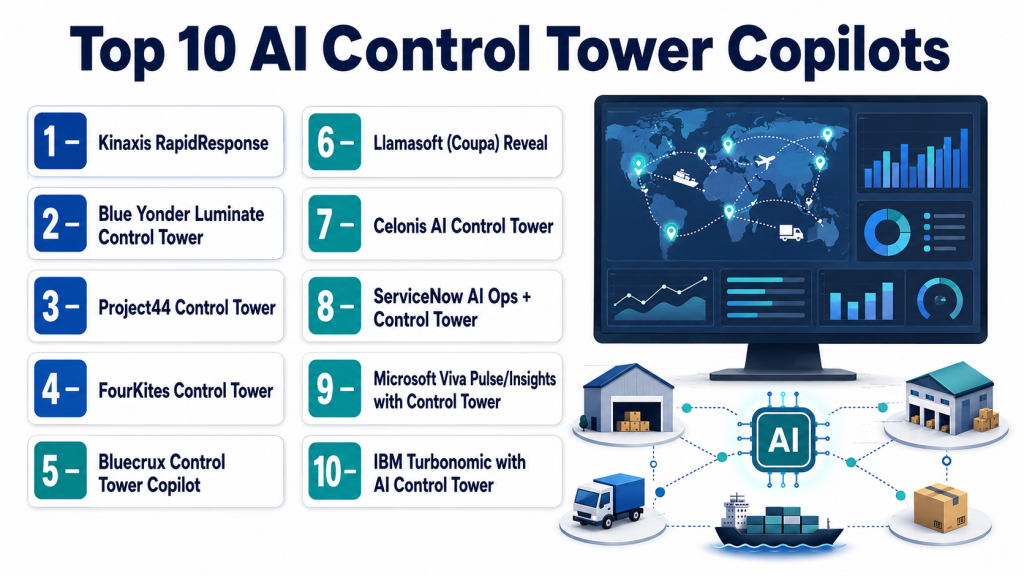
Top 10 AI Control Tower Copilots
#1 — Kinaxis RapidResponse
One‑line verdict: Best for enterprise supply chain teams needing predictive insights and automated exception handling.
Short description: Kinaxis RapidResponse offers AI‑driven control tower capabilities that provide real‑time visibility, risk prediction, and scenario‑based recommendations across global supply chains.
Standout Capabilities
- Real‑time supply chain monitoring
- Predictive demand forecasting
- Automated exception alerts
- Scenario simulation for operational decisions
- Collaboration capabilities across teams
- Integrated KPI dashboards
- AI‑assisted risk mitigation planning
AI‑Specific Depth
- Model support: Proprietary AI + BYO
- RAG / knowledge integration: ERP, WMS, vector DB support
- Evaluation: Regression testing, scenario validation
- Guardrails: Policy enforcement, anomaly alerts
- Observability: Latency, token/cost metrics
Pros
- Comprehensive supply chain visibility
- Strong exception management
- Enterprise scalability
Cons
- Implementation complexity
- High cost for smaller organizations
- Data quality dependent
Security & Compliance
SSO/SAML, RBAC, encryption, audit logs; Certifications: Not publicly stated
Deployment & Platforms
Web; Cloud/Hybrid
Integrations & Ecosystem
ERP connectors, WMS, IoT sensors, BI dashboards, APIs
Pricing Model
Tiered enterprise subscription
Best‑Fit Scenarios
- Global supply chain orchestration
- Exception management
- Risk and resilience planning
#2 — Blue Yonder Luminate Control Tower
One‑line verdict: Ideal for enterprises requiring AI‑driven end‑to‑end supply chain visibility and insights.
Short description: Blue Yonder Luminate uses AI to optimize inventory, predict disruptions, and coordinate global supply chain operations across functions.
Standout Capabilities
- AI‑powered demand sensing
- Predictive anomaly detection
- Automated exception workflows
- Real‑time KPI dashboards
- Multi‑enterprise collaboration tools
- Integration with IoT and ERP
- Supply chain simulation features
AI‑Specific Depth
- Model support: Proprietary
- RAG / knowledge integration: ERP, IoT systems
- Evaluation: Historical performance validation
- Guardrails: Policy alerts for thresholds
- Observability: Token usage, latency dashboards
Pros
- End‑to‑end visibility
- Strong predictive analytics
- Multi‑enterprise scale
Cons
- High complexity for small teams
- Requires analyst training
- Proprietary integration ecosystem
Security & Compliance
SSO, encryption, audit logs; Certifications: Not publicly stated
Deployment & Platforms
Cloud
Integrations & Ecosystem
ERP connectors, IoT, BI systems, API access
Pricing Model
Enterprise SaaS
Best‑Fit Scenarios
- Large‑scale supply chain operations
- Cross‑enterprise collaboration
- Predictive disruption alerts
#3 — Project44 Control Tower
One‑line verdict: Suited for logistics teams needing real‑time shipment visibility and predictive alerts.
Short description: Project44 Control Tower gives logistics operations teams real‑time movement visibility, predictive ETAs, and automated exception workflows across carriers.
Standout Capabilities
- Real‑time shipment tracking
- Predictive ETAs
- Automated exception handling
- KPI dashboards
- Carrier integrations
- Historical trend analytics
- Contextual alerts
AI‑Specific Depth
- Model support: Proprietary + BYO
- RAG / knowledge integration: Carrier APIs, ERP
- Evaluation: ETA accuracy testing
- Guardrails: Alerts with policy controls
- Observability: Latency and token metrics
Pros
- Excellent carrier visibility
- Real‑time predictive alerts
- Automated workflows
Cons
- Limited multi‑tier supply chain view
- Learning curve for new users
- Some proprietary connectors
Security & Compliance
Encryption, RBAC; Certifications: Not publicly stated
Deployment & Platforms
Web; Cloud
Integrations & Ecosystem
Carrier APIs, ERP/WMS, BI dashboards
Pricing Model
Tiered SaaS
Best‑Fit Scenarios
- Shipment visibility
- Logistics exception alerts
- Carrier performance metrics
#4 — FourKites Control Tower
One‑line verdict: Best for enterprises managing multimodal transportation with predictive analytics.
Short description: FourKites Control Tower offers AI‑powered visibility across truck, rail, air, and ocean freight, with predictions and insights for every leg of transit.
Standout Capabilities
- Multimodal transport visibility
- Predictive delay alerts
- Automated exception workflows
- KPI dashboards
- Collaboration across carriers
- Historical analytics
- Custom alert thresholds
AI‑Specific Depth
- Model support: Proprietary
- RAG / knowledge integration: Carrier APIs, ERP
- Evaluation: Historical trend validation
- Guardrails: Delay threshold alerts
- Observability: Token, cost, latency metrics
Pros
- Strong multimodal support
- Predictive alerting
- Good analytics tools
Cons
- Higher subscription cost
- Integration complexity
- Learning curve
Security & Compliance
SSO, RBAC, encryption; Certifications: Not publicly stated
Deployment & Platforms
Web; Cloud
Integrations & Ecosystem
ERP, carrier APIs, BI dashboards
Pricing Model
SaaS
Best‑Fit Scenarios
- Multimodal transport operations
- Carrier collaboration
- End‑to‑end freight visibility
#5 — Bluecrux Control Tower Copilot
One‑line verdict: Excellent for multi‑enterprise orchestration with human‑centered AI recommendations.
Short description: Bluecrux combines AI insights, scenario modeling, and human copilot guidance to optimize complex operations across supply chain tiers.
Standout Capabilities
- Collaborative decision workflows
- Simulation and what‑if analysis
- Predictive risk scoring
- Human‑centric AI recommendations
- Executive dashboards
- Event correlation and alerts
- Cross‑system visibility
AI‑Specific Depth
- Model support: Proprietary + BYO
- RAG / knowledge integration: ERP, WMS, vector DB
- Evaluation: Regression and scenario tests
- Guardrails: Policy enforcement, anomaly thresholds
- Observability: Token/latency dashboards
Pros
- Strong human‑AI mix
- Excellent what‑if tools
- Predictive risk scoring
Cons
- Implementation time
- Requires structured data inputs
- Higher enterprise price
Security & Compliance
SSO/SAML, RBAC, encryption; Certifications: Not publicly stated
Deployment & Platforms
Web; Cloud/Hybrid
Integrations & Ecosystem
ERP, WMS, BI systems, APIs
Pricing Model
Enterprise subscription
Best‑Fit Scenarios
- Multi‑enterprise orchestration
- Scenario planning
- Risk‑aware operations
#6 — Llamasoft (Coupa) Reveal
One‑line verdict: Best for demand‑to‑delivery optimization with AI simulation and planning.
Short description: Coupa Reveal (formerly Llamasoft) offers AI modeling for supply chain planning, control‑tower insights, and optimization of operations flows.
Standout Capabilities
- End‑to‑end planning visibility
- AI‑powered optimization
- Scenario modeling
- Predictive risk alerts
- Workflow automation
- KPI dashboards
- Cross‑system integration
AI‑Specific Depth
- Model support: Proprietary + BYO
- RAG / knowledge integration: ERP, BI systems
- Evaluation: Multi‑scenario validation
- Guardrails: Policy‑based thresholds
- Observability: Token metric dashboards
Pros
- Robust planning features
- Cross‑enterprise integration
- What‑if simulations
Cons
- Complex setup
- Requires analyst training
- Higher entry cost
Security & Compliance
SSO, RBAC, encryption; Certifications: Not publicly stated
Deployment & Platforms
Web; Cloud
Integrations & Ecosystem
ERP, BI dashboards, APIs
Pricing Model
Enterprise SaaS
Best‑Fit Scenarios
- Demand‑to‑delivery planning
- Risk and optimization modeling
- Large‑scale supply chain operations
#7 — Celonis AI Control Tower
One‑line verdict: Strong for process mining and operational efficiency insights with AI copilots.
Short description: Celonis combines process mining with AI copilots to surface bottlenecks, run simulations, and recommend optimized execution actions.
Standout Capabilities
- Process mining for visibility
- Root‑cause analysis
- AI-driven recommendations
- Simulation of alternate flows
- KPI dashboards
- Cross‑system data unification
- Automated alerts
AI‑Specific Depth
- Model support: Proprietary
- RAG / knowledge integration: ERP, BI systems
- Evaluation: KPI validation
- Guardrails: Policy‑based alerts
- Observability: Token, latency dashboards
Pros
- Excellent at process bottleneck detection
- Strong AI‑driven recommendations
- Good integration connectors
Cons
- Learning curve for non‑technical users
- Limited carrier‑level visibility
- Higher price tier
Security & Compliance
SSO, RBAC, encryption; Certifications: Not publicly stated
Deployment & Platforms
Web; Cloud
Integrations & Ecosystem
ERP, CRM, BI dashboards, APIs
Pricing Model
Subscription
Best‑Fit Scenarios
- Process optimization
- Operational bottleneck discovery
- Cross‑enterprise workflow insights
#8 — ServiceNow AI Ops + Control Tower
One‑line verdict: Best for IT and service operations control with predictive AI guidance.
Short description: ServiceNow combines AI Ops with control tower visibility to monitor and optimize enterprise IT and service operations with recommended actions.
Standout Capabilities
- Event correlation and prioritization
- Automated incident predictions
- Real‑time dashboards
- Recommended resolution actions
- Alerting and escalation workflows
- Service performance insights
- Integration with enterprise systems
AI‑Specific Depth
- Model support: Proprietary + BYO
- RAG / knowledge integration: ITSM systems, knowledge bases
- Evaluation: Incident prediction validation
- Guardrails: Policy‑based safeguards
- Observability: Token, latency dashboards
Pros
- Integration with IT operations
- Automated incident guidance
- Strong alerting tools
Cons
- Less supply chain focus
- Complex deployment
- Requires ITSM maturity
Security & Compliance
SSO/SAML, RBAC, encryption; Certifications: Not publicly stated
Deployment & Platforms
Web; Cloud/Hybrid
Integrations & Ecosystem
ITSM, monitoring systems, APIs
Pricing Model
Enterprise subscription
Best‑Fit Scenarios
- IT operations and service control
- Predictive incident response
- Enterprise workflow automation
#9 — Microsoft Viva Pulse/Insights with Control Tower
One‑line verdict: Best for organizational performance visibility and employee‑centric operational insights.
Short description: Microsoft’s AI‑powered Viva modules provide operational and employee performance insights with prioritized recommendations across teams.
Standout Capabilities
- Organizational health insights
- Productivity patterns and alerts
- Predictive risk indicators
- Executive dashboards
- Collaboration insights
- AI‑driven recommendations
- Integration with Microsoft 365
AI‑Specific Depth
- Model support: Microsoft AI models
- RAG / knowledge integration: M365, Teams, SharePoint
- Evaluation: Behavior pattern validation
- Guardrails: Policy alerts
- Observability: Token/latency dashboards
Pros
- Strong employee/organization insights
- Integrated with Microsoft stack
- Easy adoption
Cons
- Less supply chain focus
- Not specialized for logistics
- Dependent on Microsoft ecosystem
Security & Compliance
Enterprise security stack; Certifications: Not publicly stated
Deployment & Platforms
Web; Cloud
Integrations & Ecosystem
Microsoft 365, Teams, Power BI, APIs
Pricing Model
Subscription
Best‑Fit Scenarios
- Organizational performance insights
- Cross‑team operational insights
- Collaboration command centers
#10 — IBM Turbonomic with AI Control Tower
One‑line verdict: Ideal for hybrid cloud resource optimization and automated operational insights.
Short description: IBM Turbonomic uses AI to optimize cloud infrastructure, application performance, and operational costs, augmented with control tower visibility.
Standout Capabilities
- Automated resource optimization
- AI‑driven recommendations
- Real‑time performance insights
- Cost optimization dashboards
- Scenario planning for capacity
- Hybrid cloud support
- Alerts and operational insights
AI‑Specific Depth
- Model support: Proprietary + BYO
- RAG / knowledge integration: Cloud usage data, IT logs
- Evaluation: Performance and cost metrics
- Guardrails: Resource policy alerts
- Observability: Latency, token/cost dashboards
Pros
- Strong hybrid cloud focus
- Cost vs performance optimization
- Automated recommended actions
Cons
- Less supply chain centric
- Requires cloud ops expertise
- Higher enterprise pricing
Security & Compliance
SSO/SAML, encryption, RBAC; Certifications: Not publicly stated
Deployment & Platforms
Web; Cloud/Hybrid
Integrations & Ecosystem
Cloud providers, IT logs, monitoring systems, APIs
Pricing Model
Enterprise subscription
Best‑Fit Scenarios
- Hybrid cloud operations
- Performance vs cost optimization
- Infrastructure automation
Comparison Table
| Tool Name | Best For | Deployment | Model Flexibility | Strength | Watch‑Out | Public Rating |
|---|---|---|---|---|---|---|
| Kinaxis RapidResponse | Supply chain orchestration | Cloud/Hybrid | Proprietary + BYO | Exception handling | Complexity | N/A |
| Blue Yonder Luminate | End‑to‑end supply chain | Cloud | Proprietary | Predictive insights | High complexity | N/A |
| Project44 Control Tower | Logistics visibility | Cloud | Proprietary + BYO | Shipment predictions | Limited multi‑tier | N/A |
| FourKites Control Tower | Multimodal transport | Cloud | Proprietary | Freight analytics | Cost | N/A |
| Bluecrux Control Tower Copilot | Multi‑enterprise orchestration | Cloud/Hybrid | Proprietary + BYO | Human‑AI mix | Data prep required | N/A |
| Coupa Reveal | Demand‑to‑delivery planning | Cloud | Proprietary + BYO | Optimization + simulation | Complexity | N/A |
| Celonis AI Control Tower | Process mining insights | Cloud | Proprietary | Process optimization | Price | N/A |
| ServiceNow AI Ops + Control Tower | IT operations control | Cloud/Hybrid | Proprietary + BYO | IT Ops insights | Not SCM focus | N/A |
| Microsoft Viva Insights | Organizational visibility | Cloud | Proprietary | Org performance | Not SCM focus | N/A |
| IBM Turbonomic | Cloud resource ops | Cloud/Hybrid | Proprietary + BYO | Resource optimization | Enterprise‑centric | N/A |
Scoring & Evaluation
Scoring is comparative. Each criterion receives a 1–10 rating, weighted by business importance:
| Tool | Core | Reliability/Eval | Guardrails | Integrations | Ease | Perf/Cost | Security/Admin | Support | Weighted Total |
|---|---|---|---|---|---|---|---|---|---|
| Kinaxis RapidResponse | 9 | 8 | 8 | 8 | 7 | 7 | 8 | 7 | 8.0 |
| Blue Yonder Luminate | 8 | 8 | 8 | 8 | 6 | 7 | 8 | 7 | 7.8 |
| Project44 | 8 | 7 | 7 | 7 | 8 | 8 | 7 | 7 | 7.6 |
| FourKites | 8 | 8 | 7 | 7 | 7 | 7 | 7 | 7 | 7.6 |
| Bluecrux | 8 | 8 | 8 | 7 | 6 | 7 | 8 | 7 | 7.6 |
| Coupa Reveal | 8 | 8 | 7 | 8 | 6 | 7 | 8 | 7 | 7.6 |
| Celonis | 7 | 7 | 7 | 7 | 7 | 7 | 8 | 7 | 7.2 |
| ServiceNow | 8 | 8 | 8 | 8 | 6 | 7 | 8 | 7 | 7.7 |
| Viva Insights | 7 | 7 | 7 | 7 | 8 | 7 | 8 | 7 | 7.3 |
| IBM Turbonomic | 8 | 8 | 8 | 8 | 6 | 8 | 8 | 7 | 7.8 |
Top 3 for Enterprise: Kinaxis RapidResponse, Blue Yonder Luminate, IBM Turbonomic
Top 3 for SMB: Project44 Control Tower, Celonis AI Control Tower, Microsoft Viva Insights
Top 3 for Developers: Coupa Reveal, Bluecrux, ServiceNow AI Ops + Control Tower
Which AI Control Tower Copilot Is Right for You?
Solo / Freelancer
- Project44 Control Tower: Easy logistics visibility
- Celonis AI Control Tower: Bottleneck discovery and insights
SMB
- Project44 Control Tower: Fast time to value
- Microsoft Viva Insights: Organizational operations visibility
Mid‑Market
- Bluecrux Control Tower Copilot: Balanced orchestration + AI recommendations
- Celonis AI Control Tower: Process optimization
Enterprise
- Kinaxis RapidResponse: Supply chain orchestration
- Blue Yonder Luminate: End‑to‑end visibility
- IBM Turbonomic: Hybrid cloud performance ops
Regulated industries
- ServiceNow AI Ops + Control Tower: IT compliance and predictive ops
- Bluecrux: Multi‑enterprise simulation and governance
Budget vs premium
- Budget: Project44, Microsoft Viva Insights
- Premium: Kinaxis RapidResponse, Blue Yonder Luminate, IBM Turbonomic
Build vs buy
- Build: Only if you have strong internal data science + integration teams
- Buy: Recommended for most organizations for speed, governance, and scalability
Implementation Playbook (30 / 60 / 90 Days)
30 days:
- Set up core data integrations (ERP, IoT, WMS)
- Validate real‑time dashboards
- Configure alerting and policy thresholds
60 days:
- Run scenario simulations with key stakeholders
- Establish guardrails and evaluation metrics
- Train teams on AI assistant workflows
90 days:
- Optimize latency and cost controls
- Scale pilots to full operational scope
- Implement governance reviews and audit reporting
AI‑specific tasks: evaluation harness deployment, red‑teaming for safety, prompt/version control, anomaly incident response playbooks.
Common Mistakes & How to Avoid Them
- Ignoring input data quality and validation
- Over‑automation without human review
- Lack of guardrails leading to unsafe recommendations
- Absence of a structured evaluation framework
- Blindly trusting AI predictions
- Poor integration leading to data silos
- No cost/latency visibility
- No audit trails for compliance
- Failing to align with business KPIs
- Relying on single data sources
- Inadequate role‑based access controls
- Not planning for model drift
- Missing cross‑team change management
- Underestimating training needs
FAQs
1‑ What is an AI Control Tower Copilot?
An AI Control Tower Copilot centralizes visibility over operations and uses AI to forecast issues, provide alerts, and recommend actions.
2‑ How do these tools integrate with existing systems?
They typically connect via APIs to ERP, WMS, TMS, CRM, IoT, and BI systems.
3‑ Can I use my own models?
Many tools support BYO models, though implementation varies.
4‑ Is on‑premise deployment possible?
Some platforms offer hybrid or self‑hosted options for regulated environments.
5‑ How do guardrails work?
Guardrails enforce policy limits, prevent unsafe actions, and flag anomalies before decisions are executed.
6‑ What data privacy features should I look for?
Data residency controls, encryption at rest/in transit, retention policies, and audit logs.
7‑ How do I evaluate model reliability?
Use regression testing, scenario validations, and human review processes.
8‑ Can control tower copilots automate actions?
Yes — many allow automated workflows, exceptions, and recommended action triggers.
9‑ What’s the difference between control towers and traditional dashboards?
Control towers use AI to predict, recommend, and prescribe actions, beyond static KPIs.
10‑ How do these tools help cross‑functional teams?
They centralize insights, share alerts, and provide prioritized recommendations tailored to roles.
11‑ Are these suitable outside supply chain?
Yes — tools like ServiceNow and Viva extend to IT and organizational operations.
12‑ Do copilots replace human operators?
No — they assist by providing insights and recommended actions; human oversight remains crucial.
Conclusion
AI Control Tower Copilots in 2026 go beyond traditional dashboards to provide predictive insights, automated alerts, and prioritized recommendations across complex operations. The best solution depends on organization size, industry focus, data maturity, and integration needs. Start by shortlisting tools using the checklist, run pilots to validate real‑time and predictive accuracy, and ensure strong guardrails and observability before scaling.

Find Trusted Cardiac Hospitals
Compare heart hospitals by city and services — all in one place.
Explore Hospitals