
Introduction
AI Customer Support for Banking Agentic tools are advanced AI platforms that help banks, fintech companies, credit unions, and financial service providers automate customer conversations, support workflows, and service operations. Unlike traditional chatbots, these tools can understand intent, retrieve approved knowledge, trigger workflows, escalate sensitive cases, and support customers across chat, voice, email, mobile apps, and internal service channels.
These platforms are especially useful in banking because customer queries are often sensitive, urgent, and highly regulated. A customer may need help with card blocking, transaction disputes, loan status, KYC updates, account onboarding, fraud alerts, payment issues, or branch appointment scheduling. Agentic AI helps banking teams handle these requests faster while keeping human agents involved where judgment, compliance, or empathy is required.
Why It Matters
Banking customers expect fast, secure, and accurate service at all times. Long wait times, repeated verification steps, and inconsistent answers can damage trust. AI customer support platforms help banks reduce service load, improve response speed, and deliver more consistent customer experiences.
For banking leaders, these tools also matter because they support operational efficiency. They can reduce repetitive tickets, assist agents with knowledge retrieval, automate routine workflows, and improve visibility into support performance. When implemented properly, they help banks balance automation, compliance, customer trust, and cost control.
Real World Use Cases
- Account balance and transaction support
- Card blocking and fraud reporting assistance
- Loan and mortgage application support
- KYC and onboarding workflow guidance
- Payment failure and dispute handling
- Branch appointment scheduling
- Internal employee support desk automation
- Multilingual customer service
- Call center automation and agent assist
- Customer identity verification workflow support
Evaluation Criteria for Buyers
Before choosing an AI customer support platform for banking, buyers should evaluate:
- Data privacy and retention controls
- Security architecture and encryption
- Role-based access control
- Audit logs and governance controls
- Human escalation workflows
- AI evaluation and hallucination testing
- Prompt injection and jailbreak protection
- Banking system integration support
- CRM and contact center integrations
- RAG and knowledge base connectivity
- Voice and chat support
- Omnichannel deployment options
- Cost and latency monitoring
- Model flexibility and vendor lock-in risk
- Admin controls and compliance readiness
Best for: banks, fintech companies, credit unions, digital banking platforms, customer experience teams, IT leaders, AI transformation teams, and regulated financial institutions that need secure customer support automation.
Not ideal for: very small teams with low customer support volume, organizations needing only a simple FAQ chatbot, or companies without clear knowledge documentation and escalation processes.
What’s Changed in AI Customer Support for Banking Agentic
- AI agents now support multi-step banking workflows instead of only answering basic questions.
- Human approval and escalation are becoming essential for sensitive banking actions.
- AI systems are increasingly connected to knowledge bases, CRM systems, and workflow platforms.
- Voice AI is becoming more important for banking call centers.
- Multimodal support is expanding across chat, voice, documents, screenshots, and forms.
- Prompt injection protection is now a major security requirement.
- AI observability helps teams track latency, hallucinations, cost, and failed workflows.
- Banks are demanding stronger data retention and privacy controls.
- Multi-model routing is helping organizations balance cost, speed, and reliability.
- AI evaluation is becoming a standard part of support operations.
- Governance dashboards are becoming important for audit and compliance teams.
- Banks are reducing vendor lock-in by looking for flexible APIs and model options.
Quick Buyer Checklist
Use this checklist before shortlisting any AI banking support platform:
- Does it support secure customer data handling?
- Does it offer RBAC, SSO, audit logs, and encryption?
- Can it connect with banking knowledge systems?
- Does it support human handoff for sensitive cases?
- Can it handle chat, voice, and omnichannel workflows?
- Does it provide AI evaluation and testing tools?
- Does it include guardrails against unsafe responses?
- Can it monitor cost, latency, and model performance?
- Does it support APIs and enterprise integrations?
- Can it integrate with CRM and contact center platforms?
- Does it offer flexible deployment options?
- Does it reduce vendor lock-in risk?
- Can admins control data retention and access?
- Does it support multilingual banking customers?
- Can it scale for enterprise support volume?
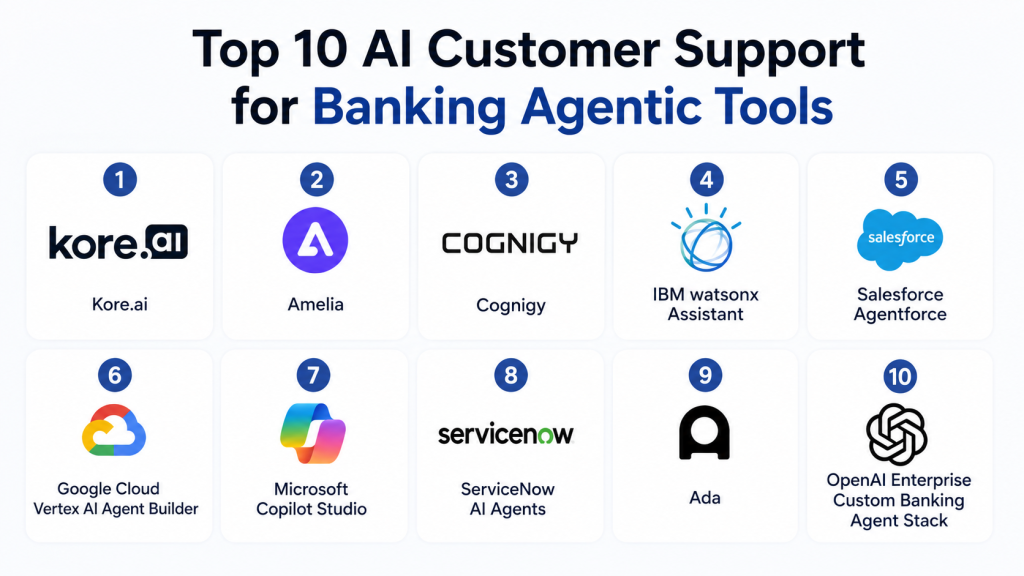
Top 10 AI Customer Support for Banking Agentic Tools
1- Kore.ai
One-line verdict: Best for large banks needing enterprise-grade conversational AI, workflow automation, and governance.
Short description:
Kore.ai is an enterprise conversational AI and automation platform used for customer service, employee support, and complex workflow orchestration. For banking teams, it can support digital assistants, contact center automation, self-service workflows, and internal support automation.
Standout Capabilities
- Enterprise conversational AI for chat and voice
- Banking-focused automation workflows
- Omnichannel customer engagement
- Human agent escalation
- Workflow orchestration for support processes
- Knowledge integration for accurate responses
- Analytics for customer interactions
- Enterprise governance and admin controls
AI-Specific Depth
- Model support: Multi-model and enterprise AI integrations
- RAG / knowledge integration: Enterprise knowledge connectors available
- Evaluation: Testing and monitoring capabilities available
- Guardrails: Policy controls and response governance available
- Observability: Conversation analytics and operational dashboards
Pros
- Strong fit for enterprise banking environments
- Good workflow automation depth
- Supports large-scale contact center use cases
Cons
- Implementation can be complex
- May require expert configuration
- Smaller teams may find it too enterprise-heavy
Security & Compliance
Supports enterprise security controls such as RBAC, SSO, audit logs, encryption, and admin governance. Certifications and residency details vary by deployment and contract.
Deployment & Platforms
- Web platform
- Cloud deployment
- Hybrid deployment support
- Voice and chat channels
- Mobile-compatible customer experiences
Integrations & Ecosystem
Kore.ai integrates with enterprise systems, customer support platforms, CRM tools, contact centers, and internal workflow systems.
- APIs
- CRM integrations
- Contact center integrations
- Enterprise knowledge bases
- Voice systems
- Cloud platforms
- Workflow tools
Pricing Model
Enterprise subscription and usage-based pricing. Exact pricing varies.
Best-Fit Scenarios
- Large retail banking customer support
- AI-powered contact center automation
- Regulated enterprise service workflows
2- Amelia
One-line verdict: Strong for banks that want natural conversational AI with enterprise service automation.
Short description:
Amelia is an enterprise AI platform focused on conversational support, digital assistants, and service automation. It is useful for banks that want AI-powered customer engagement with natural language understanding and workflow support.
Standout Capabilities
- Human-like conversational AI
- Voice and chat automation
- Customer service workflow support
- Context-aware banking interactions
- Employee support automation
- Omnichannel engagement
- Enterprise analytics
- Human handoff support
AI-Specific Depth
- Model support: Proprietary AI platform with enterprise integrations
- RAG / knowledge integration: Enterprise knowledge connectivity available
- Evaluation: Varies / N/A
- Guardrails: Enterprise governance controls available
- Observability: Operational analytics available
Pros
- Strong conversational experience
- Useful for banking customer engagement
- Supports internal and external service use cases
Cons
- Pricing transparency is limited
- Advanced customization may need vendor support
- Developer flexibility may be less than API-first platforms
Security & Compliance
Supports enterprise authentication, encryption, RBAC, and governance controls. Specific certifications are not publicly stated for every deployment.
Deployment & Platforms
- Cloud deployment
- Enterprise web platform
- Hybrid support may be available
- Voice and chat channels
Integrations & Ecosystem
Amelia connects with enterprise service systems, customer engagement platforms, and operational tools used by banking teams.
- APIs
- CRM systems
- Contact center software
- Voice systems
- IT service tools
- Workflow platforms
Pricing Model
Enterprise licensing model. Exact pricing is not publicly stated.
Best-Fit Scenarios
- Banking virtual assistants
- AI customer engagement programs
- Internal employee support automation
3- Cognigy
One-line verdict: Excellent for banks prioritizing AI voice agents and omnichannel contact center automation.
Short description:
Cognigy is an enterprise conversational AI platform with strong voice automation, contact center integration, and workflow orchestration capabilities. It is a strong option for banks modernizing high-volume call centers and digital support channels.
Standout Capabilities
- AI voice automation
- Omnichannel support workflows
- Contact center integrations
- Low-code conversation design
- Real-time agent assist
- Customer self-service automation
- Multilingual support
- Analytics and monitoring
AI-Specific Depth
- Model support: Multi-model support available
- RAG / knowledge integration: Knowledge base integrations available
- Evaluation: Conversation analytics and testing support available
- Guardrails: Enterprise governance controls available
- Observability: Conversation monitoring and performance dashboards
Pros
- Strong voice AI capabilities
- Good contact center ecosystem
- Flexible workflow design
Cons
- Enterprise setup can require expertise
- Advanced use cases may need technical teams
- Best value appears in larger support operations
Security & Compliance
Supports enterprise controls such as SSO, RBAC, encryption, and audit-related administration. Certification details vary by deployment.
Deployment & Platforms
- Cloud deployment
- Hybrid deployment support
- Web platform
- Voice and chat channels
Integrations & Ecosystem
Cognigy is designed for enterprise service environments and integrates with major contact center and customer support systems.
- APIs
- Contact center platforms
- CRM platforms
- Telephony systems
- Enterprise knowledge systems
- Analytics tools
- Workflow automation platforms
Pricing Model
Enterprise subscription pricing. Exact pricing varies.
Best-Fit Scenarios
- Banking call center automation
- Voice-first customer support
- Omnichannel financial service workflows
4- IBM watsonx Assistant
One-line verdict: Best for regulated financial institutions that prioritize governance, hybrid deployment, and enterprise control.
Short description:
IBM watsonx Assistant is an enterprise AI assistant platform designed for conversational automation, customer support, and workflow integration. It is well-suited for regulated organizations that need governance, security controls, and deployment flexibility.
Standout Capabilities
- Enterprise conversational AI
- Hybrid deployment flexibility
- AI governance features
- Customer self-service automation
- Human escalation support
- Knowledge integration
- Analytics and monitoring
- Enterprise workflow connectivity
AI-Specific Depth
- Model support: IBM and third-party model support
- RAG / knowledge integration: Enterprise document and knowledge retrieval available
- Evaluation: AI testing and monitoring capabilities available
- Guardrails: Enterprise safety and governance controls available
- Observability: Monitoring and analytics dashboards available
Pros
- Strong enterprise governance
- Suitable for regulated industries
- Flexible deployment architecture
Cons
- Implementation may require skilled teams
- Advanced configuration can be complex
- May feel heavy for smaller organizations
Security & Compliance
Supports enterprise security features including RBAC, encryption, audit logging, identity controls, and governance tooling. Certifications and residency options vary by deployment.
Deployment & Platforms
- Cloud deployment
- Hybrid deployment
- Enterprise-managed environments
- Web and API-based access
Integrations & Ecosystem
IBM watsonx Assistant integrates with enterprise systems, cloud environments, customer service platforms, and knowledge sources.
- APIs
- IBM ecosystem tools
- CRM systems
- Enterprise databases
- Workflow automation
- Cloud services
- Contact center platforms
Pricing Model
Tiered enterprise pricing. Exact pricing varies.
Best-Fit Scenarios
- Regulated banking support
- Hybrid AI deployment
- Governance-first AI customer service
5- Salesforce Agentforce
One-line verdict: Best for banks already using Salesforce for CRM, service, and customer data workflows.
Short description:
Salesforce Agentforce extends the Salesforce ecosystem with AI agents that can support customer service, workflow automation, and CRM-based interactions. For banks using Salesforce, it can help automate service journeys with customer context.
Standout Capabilities
- CRM-native AI agents
- Customer service workflow automation
- Integrated customer context
- Omnichannel service support
- Low-code configuration
- Service analytics
- Case management automation
- Enterprise admin controls
AI-Specific Depth
- Model support: Salesforce AI ecosystem
- RAG / knowledge integration: Salesforce knowledge and data integrations
- Evaluation: AI monitoring and service analytics available
- Guardrails: Enterprise governance tooling available
- Observability: Service and AI performance dashboards available
Pros
- Deep CRM integration
- Strong fit for Salesforce-based banks
- Good customer service workflow alignment
Cons
- Best value depends on Salesforce ecosystem adoption
- Licensing can be complex
- Less attractive for non-Salesforce environments
Security & Compliance
Supports enterprise security controls such as RBAC, encryption, admin permissions, auditability, and identity integrations. Certification details vary by product and deployment.
Deployment & Platforms
- Cloud deployment
- Web platform
- Mobile support
- Salesforce ecosystem access
Integrations & Ecosystem
Salesforce Agentforce works best inside Salesforce-driven service and customer data environments.
- Salesforce CRM
- Service Cloud
- Data Cloud
- APIs
- Workflow automation
- Contact center integrations
- Analytics tools
Pricing Model
Subscription and enterprise pricing. Exact pricing varies.
Best-Fit Scenarios
- Salesforce-based banking support
- CRM-driven service automation
- Customer journey automation
6- Google Cloud Vertex AI Agent Builder
One-line verdict: Best for banks building custom AI support agents on a cloud-native architecture.
Short description:
Google Cloud Vertex AI Agent Builder helps teams create AI agents and conversational experiences using cloud AI infrastructure. It is a strong option for banks with technical teams that want custom AI workflows, retrieval systems, and scalable integrations.
Standout Capabilities
- Custom AI agent development
- Cloud-native AI orchestration
- RAG and enterprise search support
- Multimodal AI capabilities
- API-first architecture
- Model and data integration options
- Scalable infrastructure
- Monitoring through cloud tooling
AI-Specific Depth
- Model support: Google models and third-party model options
- RAG / knowledge integration: Strong retrieval and enterprise search support
- Evaluation: AI evaluation tooling available
- Guardrails: Safety filters and policy controls available
- Observability: Cloud monitoring and logging integrations available
Pros
- Highly flexible for custom banking workflows
- Strong developer and cloud ecosystem
- Good option for advanced AI teams
Cons
- Requires cloud and AI engineering expertise
- Not a plug-and-play banking support tool
- Governance must be designed carefully
Security & Compliance
Supports cloud security controls such as IAM, encryption, logging, access control, and governance tooling. Compliance details vary by service configuration and region.
Deployment & Platforms
- Cloud-native deployment
- Web console
- API-based development
- Integration with cloud infrastructure
Integrations & Ecosystem
Vertex AI Agent Builder connects with Google Cloud services, enterprise data systems, APIs, and AI development workflows.
- Cloud APIs
- Enterprise search
- Data platforms
- Analytics tools
- Workflow systems
- Model development tools
- Monitoring services
Pricing Model
Usage-based cloud pricing. Total cost depends on model usage, infrastructure, storage, and integrations.
Best-Fit Scenarios
- Custom banking AI agents
- Developer-led AI support platforms
- Cloud-native financial service automation
7- Microsoft Copilot Studio
One-line verdict: Best for Microsoft-centric banks building low-code AI agents and internal support automation.
Short description:
Microsoft Copilot Studio allows organizations to build AI agents and conversational workflows connected to Microsoft tools and business systems. It is useful for banking teams already using Microsoft cloud, productivity, data, and workflow platforms.
Standout Capabilities
- Low-code AI agent creation
- Microsoft ecosystem integration
- Workflow automation
- Enterprise copilots
- Knowledge source connectivity
- Admin and governance controls
- Internal employee support automation
- Service process automation
AI-Specific Depth
- Model support: Microsoft AI ecosystem
- RAG / knowledge integration: Microsoft knowledge and data connectors
- Evaluation: Analytics and testing support available
- Guardrails: Governance and admin controls available
- Observability: Monitoring and usage dashboards available
Pros
- Strong fit for Microsoft-based enterprises
- Low-code experience for business teams
- Good internal workflow automation
Cons
- Best value depends on Microsoft ecosystem
- Advanced customization can still require technical skills
- Licensing can be complex
Security & Compliance
Supports enterprise identity, RBAC, admin policies, encryption, and audit capabilities through Microsoft enterprise environments. Compliance details vary by configuration.
Deployment & Platforms
- Cloud deployment
- Web platform
- Microsoft ecosystem access
- Integrated business application support
Integrations & Ecosystem
Copilot Studio integrates strongly with Microsoft business applications and enterprise workflows.
- Microsoft 365
- Dynamics
- Power Platform
- Azure services
- Enterprise APIs
- Data connectors
- Workflow automation
Pricing Model
Subscription and usage-based pricing. Exact pricing varies.
Best-Fit Scenarios
- Microsoft-based banking teams
- Internal banking employee assistants
- Low-code AI workflow automation
8- ServiceNow AI Agents
One-line verdict: Best for banks automating internal service operations, IT workflows, and enterprise support processes.
Short description:
ServiceNow AI Agents extend ServiceNow workflows with AI-powered automation for service management, operations, and customer support. For banking organizations, it is especially useful where support workflows depend on structured processes, approvals, and internal teams.
Standout Capabilities
- Enterprise workflow automation
- IT and service operations support
- AI-powered case routing
- Knowledge retrieval for agents
- Incident and request automation
- Governance and admin controls
- Operational analytics
- Human approval workflows
AI-Specific Depth
- Model support: Multi-model integrations available
- RAG / knowledge integration: ServiceNow knowledge systems and enterprise data integrations
- Evaluation: Workflow analytics and monitoring available
- Guardrails: Governance and workflow controls available
- Observability: Operational dashboards and reporting available
Pros
- Strong enterprise workflow foundation
- Good fit for internal banking operations
- Mature service management ecosystem
Cons
- Best suited for larger enterprises
- Implementation can be complex
- Less focused on lightweight customer chatbot use cases
Security & Compliance
Supports enterprise-grade access controls, RBAC, encryption, audit trails, workflow governance, and admin controls. Certification details vary by deployment and product scope.
Deployment & Platforms
- Cloud platform
- Enterprise web applications
- Workflow-based service environment
Integrations & Ecosystem
ServiceNow integrates with enterprise service systems, IT platforms, CRM tools, and operational workflows.
- APIs
- ITSM tools
- CRM integrations
- Enterprise databases
- Workflow engines
- Monitoring platforms
- Knowledge systems
Pricing Model
Enterprise licensing. Exact pricing varies.
Best-Fit Scenarios
- Banking service operations automation
- Internal support desk automation
- IT and customer workflow orchestration
9- Ada
One-line verdict: Best for fast AI customer support deployment across digital banking channels.
Short description:
Ada is an AI customer service automation platform designed to help teams launch digital support experiences quickly. It is useful for banks and fintech companies that want customer-facing automation without building everything from scratch.
Standout Capabilities
- AI customer service automation
- Fast chatbot deployment
- Omnichannel support
- Knowledge-based responses
- Human handoff workflows
- Multilingual support
- Customer experience analytics
- No-code and low-code configuration
AI-Specific Depth
- Model support: Hosted AI infrastructure
- RAG / knowledge integration: Knowledge integrations available
- Evaluation: Varies / N/A
- Guardrails: Enterprise controls available
- Observability: Reporting and analytics available
Pros
- Faster implementation than many enterprise platforms
- Strong customer support focus
- Easier for non-technical teams
Cons
- May offer less deep customization
- Advanced banking workflows may require integrations
- Enterprise governance depth varies by plan and setup
Security & Compliance
Supports enterprise security and admin controls. Specific certifications and data residency details should be validated during procurement.
Deployment & Platforms
- Cloud deployment
- Web platform
- Digital support channels
- Chat-based experiences
Integrations & Ecosystem
Ada integrates with customer support platforms, CRM tools, knowledge systems, and customer engagement channels.
- APIs
- CRM tools
- Helpdesk systems
- Contact center platforms
- Knowledge bases
- Messaging channels
- Analytics platforms
Pricing Model
Subscription and usage-based pricing. Exact pricing varies.
Best-Fit Scenarios
- Fast digital banking support rollout
- Fintech customer service automation
- Self-service support for common issues
10- OpenAI Enterprise Custom Banking Agent Stack
One-line verdict: Best for banks with strong engineering teams building highly customized AI support systems.
Short description:
OpenAI Enterprise combined with custom orchestration, RAG, guardrails, observability, and workflow systems can power advanced banking support agents. This approach is best for organizations that want maximum flexibility and have the engineering maturity to build and govern their own AI support stack.
Standout Capabilities
- Custom AI agent architecture
- Advanced reasoning capabilities
- Multimodal support
- Flexible RAG architecture
- Integration with internal banking systems
- Custom workflow orchestration
- Developer-first API ecosystem
- Strong ability to build differentiated experiences
AI-Specific Depth
- Model support: Proprietary models with multi-model architecture possible
- RAG / knowledge integration: Compatible with custom RAG and vector database systems
- Evaluation: Requires external or custom evaluation tooling
- Guardrails: Requires custom guardrail implementation
- Observability: Requires external monitoring and logging systems
Pros
- Maximum customization flexibility
- Strong developer ecosystem
- Suitable for advanced AI innovation
Cons
- Requires strong AI engineering maturity
- Governance must be carefully designed
- Higher operational responsibility
Security & Compliance
Enterprise controls depend on the selected architecture, cloud environment, integrations, and governance layer. Banks must validate data handling, retention, auditability, and access control carefully.
Deployment & Platforms
- API-based deployment
- Cloud architecture
- Hybrid architecture possible
- Custom web, mobile, and internal applications
Integrations & Ecosystem
A custom OpenAI-based banking agent stack can connect with enterprise systems through APIs, orchestration frameworks, retrieval layers, and monitoring tools.
- APIs
- Vector databases
- RAG frameworks
- Workflow orchestration tools
- Evaluation systems
- Cloud platforms
- Observability platforms
Pricing Model
Usage-based API pricing plus infrastructure, engineering, and operations costs.
Best-Fit Scenarios
- Custom banking AI platforms
- Advanced AI engineering teams
- Differentiated customer support experiences
Comparison Table
| Tool Name | Best For | Deployment | Model Flexibility | Strength | Watch-Out | Public Rating |
|---|---|---|---|---|---|---|
| Kore.ai | Enterprise banking AI | Cloud and hybrid | Multi-model | Workflow orchestration | Complex implementation | N/A |
| Amelia | Conversational banking AI | Cloud and hybrid | Proprietary | Human-like conversations | Limited pricing transparency | N/A |
| Cognigy | Voice banking automation | Cloud and hybrid | Multi-model | Contact center voice AI | Enterprise learning curve | N/A |
| IBM watsonx Assistant | Regulated enterprises | Cloud and hybrid | Hosted and BYO options | Governance controls | Requires skilled setup | N/A |
| Salesforce Agentforce | CRM-centric banks | Cloud | Hosted | CRM integration | Ecosystem dependency | N/A |
| Vertex AI Agent Builder | Custom AI agents | Cloud | Multi-model | Developer flexibility | Requires engineering | N/A |
| Microsoft Copilot Studio | Microsoft-based banks | Cloud | Hosted | Low-code Microsoft integration | Licensing complexity | N/A |
| ServiceNow AI Agents | Internal service workflows | Cloud | Multi-model | Workflow automation | Enterprise-heavy | N/A |
| Ada | Fast support automation | Cloud | Hosted | Quick deployment | Less deep customization | N/A |
| OpenAI Enterprise Stack | Custom banking AI | Cloud and hybrid | Multi-model possible | Maximum flexibility | Requires governance design | N/A |
Scoring & Evaluation
The scoring below is comparative, not absolute. It reflects how each platform may fit banking support environments based on core features, AI reliability, guardrails, integrations, ease of use, performance, security, and support ecosystem. Actual results depend on configuration, data quality, integration depth, governance maturity, and internal team capability. Buyers should use this table as a starting point, then validate each tool through a pilot.
| Tool | Core | Reliability | Guardrails | Integrations | Ease | Performance | Security | Support | Weighted Total |
| Kore.ai | 9 | 8 | 9 | 9 | 7 | 7 | 9 | 8 | 8.3 |
| Amelia | 8 | 7 | 8 | 7 | 8 | 7 | 8 | 7 | 7.6 |
| Cognigy | 9 | 8 | 8 | 9 | 7 | 8 | 8 | 8 | 8.2 |
| IBM watsonx Assistant | 9 | 8 | 9 | 8 | 6 | 7 | 10 | 8 | 8.3 |
| Salesforce Agentforce | 8 | 7 | 8 | 10 | 8 | 7 | 8 | 8 | 8.0 |
| Vertex AI Agent Builder | 9 | 9 | 8 | 9 | 6 | 8 | 8 | 7 | 8.2 |
| Microsoft Copilot Studio | 8 | 7 | 8 | 9 | 8 | 7 | 8 | 8 | 7.9 |
| ServiceNow AI Agents | 8 | 7 | 8 | 9 | 6 | 7 | 9 | 8 | 7.9 |
| Ada | 7 | 6 | 7 | 7 | 9 | 8 | 7 | 7 | 7.3 |
| OpenAI Enterprise Stack | 10 | 9 | 6 | 10 | 5 | 8 | 7 | 7 | 8.1 |
Top 3 for Enterprise
- Kore.ai
- IBM watsonx Assistant
- Cognigy
Top 3 for SMB
- Ada
- Microsoft Copilot Studio
- Salesforce Agentforce
Top 3 for Developers
- Vertex AI Agent Builder
- OpenAI Enterprise Stack
- Cognigy
Which AI Customer Support for Banking Agentic Tool Is Right for You
Solo / Freelancer
Solo professionals generally do not need enterprise banking AI platforms. A lightweight chatbot, helpdesk automation tool, or simple AI assistant is usually enough unless they are building a fintech product or consulting for financial institutions.
SMB
Small and mid-sized financial service providers should prioritize ease of deployment, lower operational overhead, strong customer self-service, and simple integrations. Ada, Microsoft Copilot Studio, and Salesforce Agentforce can be practical options depending on the existing software stack.
Mid-Market
Mid-market banks and fintech companies need a balance of automation, governance, and scalability. Cognigy, Kore.ai, Salesforce Agentforce, and Microsoft Copilot Studio can work well when the organization needs better workflow automation without building everything internally.
Enterprise
Large banks need advanced governance, observability, security controls, deployment flexibility, AI evaluation, and deep integrations. Kore.ai, IBM watsonx Assistant, Cognigy, ServiceNow AI Agents, and custom OpenAI-based stacks are stronger fits for enterprise environments.
Regulated Industries
Banks, insurance providers, healthcare organizations, and public sector institutions should prioritize auditability, role-based access, data retention policies, human approval, incident handling, and security-by-design. IBM watsonx Assistant, Kore.ai, ServiceNow AI Agents, and well-governed custom stacks are often better aligned for regulated use cases.
Budget vs Premium
Budget-conscious teams should focus on faster deployment, simple workflows, and lower customization requirements. Premium buyers should invest in governance, workflow orchestration, AI evaluation, security controls, and long-term scalability.
Build vs Buy
Buying is better when teams need faster deployment, proven workflows, vendor support, and lower engineering overhead. Building is better when a bank has mature AI engineering teams, strict architecture requirements, proprietary workflows, and strong internal governance capacity.
Implementation Playbook
First 30 Days
- Choose two or three high-volume banking support use cases
- Define success metrics such as resolution rate, escalation rate, latency, and customer satisfaction
- Prepare approved knowledge base content
- Build a small evaluation dataset
- Configure human escalation workflows
- Define prompt and response review processes
- Set access controls and admin permissions
- Run an internal pilot before customer rollout
Days 31 to 60
- Expand testing across more customer intents
- Add adversarial testing for prompt injection risks
- Configure observability dashboards
- Review data retention and privacy settings
- Connect CRM, helpdesk, and contact center systems
- Add regression testing for prompt and workflow updates
- Train support agents on AI-assisted workflows
- Create exception handling and incident response processes
Days 61 to 90
- Expand automation to more banking journeys
- Optimize model routing for cost and latency
- Review unresolved and escalated conversations
- Improve knowledge retrieval accuracy
- Create governance review cycles
- Add performance reporting for leadership
- Validate compliance and audit readiness
- Scale to more channels such as voice, mobile, and web chat
Common Mistakes & How to Avoid Them
- Deploying AI without human escalation for sensitive banking cases
- Allowing AI to answer from unapproved or outdated knowledge
- Ignoring prompt injection and jailbreak risks
- Not testing hallucination behavior before rollout
- Failing to monitor token costs and latency
- Over-automating fraud, dispute, or compliance workflows
- Not involving legal, risk, and compliance teams early
- Using weak access control for support data
- Skipping audit log configuration
- Not creating a clear incident response plan
- Treating AI as a one-time deployment instead of an ongoing program
- Ignoring multilingual customer support requirements
- Choosing a tool only by brand name instead of fit
- Not planning for vendor lock-in and migration risk
FAQs
1- What is AI Customer Support for Banking Agentic
AI Customer Support for Banking Agentic refers to AI systems that can understand customer intent, retrieve approved banking knowledge, automate workflows, and escalate complex cases. These tools go beyond basic chatbots by supporting multi-step service journeys.
2- How is agentic AI different from a normal banking chatbot
A normal chatbot usually answers predefined questions. Agentic AI can perform actions, call systems, retrieve knowledge, follow workflows, and coordinate tasks across different tools while still allowing human review.
3- Can AI customer support tools handle sensitive banking data
Enterprise tools can support security controls such as encryption, RBAC, audit logs, and retention settings. However, each bank must validate the deployment model, data flow, access controls, and compliance requirements before rollout.
4- Do banks still need human agents
Yes. Human agents remain essential for fraud cases, disputes, complaints, compliance reviews, emotional conversations, and high-risk financial decisions. AI should support agents, not remove judgment from sensitive banking operations.
5- What is RAG in banking customer support
RAG means retrieval augmented generation. It allows AI to retrieve approved information from internal knowledge bases, policy documents, FAQs, and service systems before generating a customer response.
6- What are guardrails in AI banking support
Guardrails are controls that prevent unsafe, inaccurate, or non-compliant AI behavior. They can include policy checks, restricted actions, escalation rules, prompt injection defense, and response validation.
7- Why is AI evaluation important
AI evaluation helps teams test whether responses are accurate, safe, compliant, and consistent. Without evaluation, banks risk hallucinations, poor customer experience, and compliance failures.
8- Can these tools support voice banking
Yes. Several enterprise platforms support voice AI, call center automation, and agent assist for banking support teams. Voice use cases require extra testing for latency, accuracy, escalation, and customer verification.
9- What deployment model is best for banks
The best model depends on risk tolerance, compliance needs, data architecture, and internal IT maturity. Many banks prefer cloud or hybrid models with strong governance, auditability, encryption, and access controls.
10- Are open-source models useful for banking support
Open-source models can be useful in private or controlled environments, especially for organizations wanting more control. However, banks must manage hosting, security, evaluation, monitoring, and governance themselves.
11- How should banks control AI support costs
Banks should monitor token usage, latency, escalation rates, model routing, and automation success rates. Cost controls should be part of the platform design from the beginning, not added after deployment.
12- Is vendor lock-in a concern
Yes. Banks should evaluate API openness, data export options, model flexibility, integration portability, and contract terms. A good architecture should allow future changes without rebuilding the entire support system.
Conclusion
AI Customer Support for Banking Agentic tools are becoming a core part of modern financial service operations. They help banks improve customer response times, reduce repetitive support work, support multilingual service, automate common workflows, and strengthen internal support efficiency. However, these tools must be implemented carefully because banking support involves sensitive data, regulatory expectations, fraud risks, and customer trust.There is no single best platform for every organization. Kore.ai, IBM watsonx Assistant, Cognigy, Salesforce Agentforce, Vertex AI Agent Builder, Microsoft Copilot Studio, ServiceNow AI Agents, Ada, Amelia, and custom OpenAI-based stacks all serve different needs. The right choice depends on your banking workflows, compliance requirements, existing software ecosystem, internal AI skills, deployment preference, and budget.The best next step is to shortlist tools based on real use cases, run a controlled pilot, test security and reliability, validate human escalation, and then scale gradually. Banks that combine AI automation with strong governance, observability, and responsible human oversight will be better positioned to deliver faster, safer, and more trusted customer support.

Find Trusted Cardiac Hospitals
Compare heart hospitals by city and services — all in one place.
Explore Hospitals
A key gap in most MTBF discussions (including this guide) is how MTBF becomes less meaningful in modern cloud-native systems where failures are often partial, distributed, and auto-healed before being fully observed as “incidents.” In real SRE practice, autoscaling, redundancy, and rollout strategies like canary deployments can hide or fragment failure signals, which makes MTBF dependent more on observability maturity than actual system reliability. Another overlooked aspect is that MTBF alone can be misleading without being tied tightly to MTTD and MTTR, because a system with high MTBF but slow detection or recovery can still deliver poor user experience. It would also be useful to extend the discussion toward SLO-based reliability engineering, where MTBF is treated as a diagnostic signal rather than a primary KPI, especially in environments where deployment frequency and system changes continuously shift the baseline.