
Introduction
AI Demand Sensing for Retail refers to systems that leverage artificial intelligence to predict near‑term retail demand with high accuracy. These tools analyze point‑of‑sale (POS) data, inventory levels, promotions, market trends, weather, and external signals in real time to help retailers optimize inventory, prevent stockouts, and improve operational performance.
In 2026, demand sensing has become mission‑critical as retail environments become more dynamic, consumer behavior shifts rapidly, and omni‑channel fulfillment grows more complex. AI demand sensing provides the speed, precision, and context awareness required for effective planning and execution.
Real‑world use cases include:
- Predicting SKU‑level demand across stores and channels
- Optimizing inventory replenishment for e‑commerce and brick‑and‑mortar
- Reducing overstocks and markdowns
- Anticipating demand spikes due to promotions or seasonality
- Aligning supply chain planning with actual demand signals
- Synchronizing omni‑channel fulfillment
Evaluation criteria buyers should use:
- Forecast accuracy and responsiveness
- Real‑time data ingestion and processing
- Integration with POS, ERP, WMS, and ecommerce systems
- Scenario simulation and what‑if analysis
- AI model explainability and evaluation framework
- Scalability for multi‑store retail networks
- Guardrails and exception handling
- Analytics and observability dashboards
- Security and compliance for retail data
- Ease of implementation and adoption
- Support for multi‑channel demand forecasting
Best for: Retail supply chain planners, inventory managers, demand managers, and enterprises with large SKU portfolios and omni‑channel operations.
Not ideal for: Very small retailers, static demand patterns, or businesses without sufficient historical data.
What’s Changed in AI Demand Sensing for Retail in 2026+
- Real‑time demand sensing with continuous POS and inventory updates
- Multimodal data inputs: sales, inventory, promotions, weather, competitor pricing
- Hybrid AI models that combine proprietary and open‑source forecasting
- Automated scenario simulation and what‑if testing
- Enhanced guardrails to prevent stockouts and overstock
- Predictive alerts for inventory risks
- Observability dashboards for forecast accuracy and operational KPIs
- Seamless integration with ERP, WMS, ecommerce, and BI systems
- Privacy‑first AI design compliant with GDPR/CCPA
- Advanced evaluation frameworks to reduce forecast drift
- AI‑powered exception handling
- Scalability for global, multi‑store deployments
Quick Buyer Checklist (Scan‑Friendly)
- Evaluate forecast accuracy & responsiveness
- Confirm real‑time data ingestion from POS/ERP/WMS
- Check scenario simulation and what‑if planning features
- Assess guardrails and alerting mechanisms
- Review analytics, dashboards, and KPI visibility
- Ensure security & privacy compliance
- Verify scalable deployment for multi‑store retail
- Evaluate multi‑channel (in‑store + ecommerce) forecasting
- Confirm API & integration support
- Review AI evaluation and monitoring tools
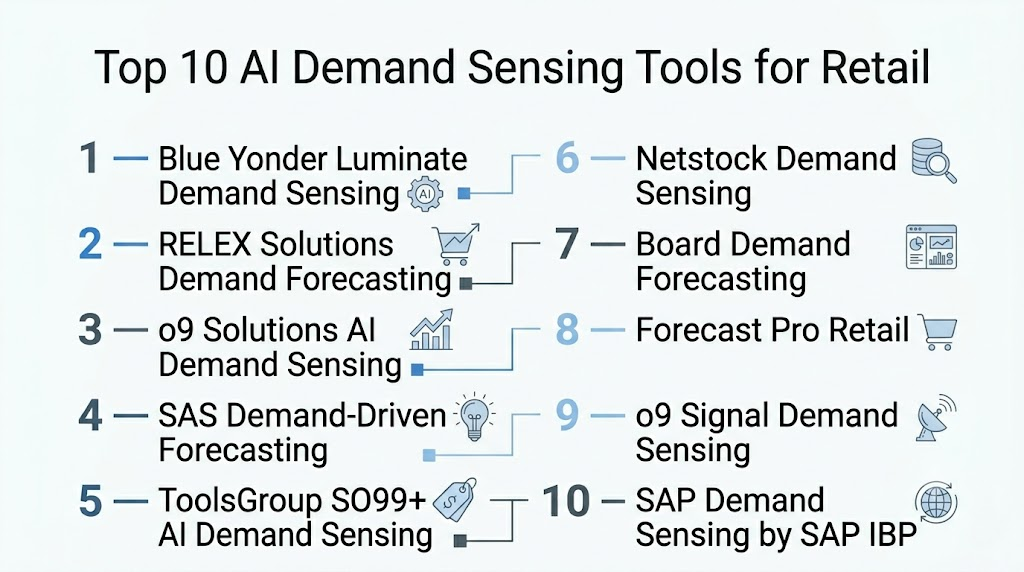
Top 10 AI Demand Sensing Tools for Retail
#1 — Blue Yonder Luminate Demand Sensing
One‑line verdict: Enterprise‑grade real‑time demand sensing with strong integration across retail channels.
Short description: Blue Yonder Luminate uses AI to deliver continuous demand forecasts based on POS, inventory, promotions, and external signals.
Standout Capabilities
- Real‑time SKU‑level forecasts
- Promotion and seasonal demand detection
- Multi‑channel demand optimization
- Scenario simulation and exception handling
- Alerts for stockouts & overstocks
- Integration with ERP/WMS
- Analytics dashboards for planners
AI‑Specific Depth
- Model support: Proprietary + BYO options
- RAG / knowledge integration: POS, ERP, WMS
- Evaluation: Forecast accuracy metrics, regression testing
- Guardrails: Threshold alerts for inventory misalignment
- Observability: Forecast error dashboards, latency metrics
Pros
- High SKU‑level accuracy
- Real‑time data updates
- Strong enterprise integration
Cons
- Implementation complexity
- Higher enterprise pricing
- Requires skilled planners
Security & Compliance
SSO, RBAC, encryption; Certifications: Not publicly stated
Deployment & Platforms
Web, Cloud
Integrations & Ecosystem
ERP, WMS, POS, ecommerce systems, BI dashboards
Pricing Model
Enterprise SaaS subscription
Best‑Fit Scenarios
- Omni‑channel retail
- Promotional demand spikes
- Large multi‑store forecasting
#2 — RELEX Solutions Demand Forecasting
One‑line verdict: Best for retailers who want automated demand forecasts tied to replenishment planning.
Short description: RELEX uses AI to generate granular demand forecasts and integrates directly with inventory and replenishment workflows.
Standout Capabilities
- SKU & store‑level forecasting
- Automated replenishment recommendations
- Promotion and seasonal demand insights
- Alerts for stock imbalances
- Scenario simulation
- Analytics dashboards
AI‑Specific Depth
- Model support: Proprietary AI
- RAG / knowledge integration: POS, ERP, inventory systems
- Evaluation: Forecast accuracy validation
- Guardrails: Over/under stock thresholds
- Observability: Forecast performance dashboards
Pros
- Automated replenishment advice
- Granular forecasting
- Strong analytics
Cons
- Enterprise pricing
- Implementation complexity
- Best for larger catalogs
Security & Compliance
SSO, encryption; Certifications: Not publicly stated
Deployment & Platforms
Cloud, Web
Integrations & Ecosystem
ERP, WMS, POS, ecommerce, APIs
Pricing Model
Enterprise SaaS
Best‑Fit Scenarios
- Retail chains
- Inventory & replenishment planning
- Promotion forecasting
#3 — o9 Solutions AI Demand Sensing
One‑line verdict: Versatile solution combining demand sensing with supply chain integration and scenario analytics.
Short description: o9 Sense predicts demand patterns and integrates with supply chain planning to sync forecasts with operational decisions.
Standout Capabilities
- Real‑time demand sensing
- Multi‑channel forecasting
- Scenario simulations
- Inventory optimization insights
- Promotion and seasonality modelling
- Alerting and exception workflows
AI‑Specific Depth
- Model support: Proprietary + open‑source libraries
- RAG / knowledge integration: POS, ERP, supply chain data
- Evaluation: Backtesting, regression evaluation
- Guardrails: Stockout and overstock mitigation
- Observability: Latency and forecast accuracy dashboards
Pros
- Strong integration with planning systems
- Sophisticated scenario analysis
- Omni‑channel support
Cons
- Setup complexity
- Enterprise pricing
- Requires trained analysts
Security & Compliance
SSO, RBAC, encryption; Certifications: Not publicly stated
Deployment & Platforms
Cloud, Web
Integrations & Ecosystem
ERP, POS, WMS, ecommerce, BI
Pricing Model
Enterprise subscription
Best‑Fit Scenarios
- Integrated supply & demand planning
- Multi‑SKU forecasting
- Promotion planning
#4 — SAS Demand‑Driven Forecasting
One‑line verdict: Best for large retailers needing advanced statistical AI forecasting.
Short description: SAS combines statistical and AI models to generate demand forecasts that help optimize inventory and reduce error variance.
Standout Capabilities
- Machine learning demand forecasts
- SKU/store forecasts
- Promotion and seasonality modelling
- Exception alerts
- Inventory optimization
- Scenario testing
AI‑Specific Depth
- Model support: Proprietary ML/AI models
- RAG / knowledge integration: ERP, POS
- Evaluation: Accuracy metrics, backtesting
- Guardrails: Overstock/stockout thresholds
- Observability: Forecast error dashboards
Pros
- Advanced analytics depth
- Statistical precision
- Detailed scenario capabilities
Cons
- Technical expertise required
- Enterprise pricing
- Integration complexity
Security & Compliance
SSO, encryption, audit logs; Certifications: Not publicly stated
Deployment & Platforms
Cloud, Web
Integrations & Ecosystem
ERP, POS, WMS, BI systems
Pricing Model
Enterprise SaaS
Best‑Fit Scenarios
- Large retail forecasting
- Inventory efficiency programs
- Seasonal demand trends
#5 — ToolsGroup SO99+ AI Demand Sensing
One‑line verdict: Well suited for retailers seeking integrated demand forecasts with inventory optimization.
Short description: ToolsGroup SO99+ uses AI demand signals to predict real‑time demand and drive inventory decisions across channels.
Standout Capabilities
- SKU & store forecasts
- Inventory optimization
- Scenario simulation
- Alerts for demand anomalies
- Promotion & seasonality modelling
- Multi‑channel analytics
AI‑Specific Depth
- Model support: Proprietary AI
- RAG / knowledge integration: ERP, POS, WMS
- Evaluation: Forecast validation
- Guardrails: Threshold settings for high risk SKUs
- Observability: Performance dashboards
Pros
- Integrated inventory recommendations
- Multi‑channel scope
- Promotion detection
Cons
- Setup complexity
- Enterprise pricing
- Requires structured data
Security & Compliance
Encryption, RBAC; Certifications: Not publicly stated
Deployment & Platforms
Cloud, Web
Integrations & Ecosystem
ERP, POS, WMS, ecommerce, APIs
Pricing Model
SaaS subscription
Best‑Fit Scenarios
- Inventory & demand alignment
- Omni‑channel forecasting
- Promotion demand sensing
#6 — Netstock Demand Sensing
One‑line verdict: Great for SMB to mid‑market retailers needing demand forecasting with inventory integration.
Short description: Netstock combines AI demand sensing with inventory planning to help retailers maintain optimal stock levels.
Standout Capabilities
- AI demand forecasting
- Replenishment suggestions
- Safety stock recommendations
- Promotion uplift analytics
- Inventory alerts
- Simple analytics dashboards
AI‑Specific Depth
- Model support: Proprietary AI
- RAG / knowledge integration: POS, ERP
- Evaluation: Forecast accuracy tracking
- Guardrails: Min/max inventory enforcement
- Observability: Basic performance metrics
Pros
- SMB to mid‑market focus
- Easy adoption
- Inventory planning tie‑in
Cons
- Less advanced analytics
- Not ideal for extremely large catalogs
- Limited scenario simulations
Security & Compliance
Encryption; Certifications: Not publicly stated
Deployment & Platforms
Web, Cloud
Integrations & Ecosystem
ERP, POS, ecommerce platforms
Pricing Model
SaaS subscription
Best‑Fit Scenarios
- Mid‑market retailers
- Inventory optimization
- SMB forecasting
#7 — Board Demand Forecasting
One‑line verdict: Best for retailers seeking demand forecasts embedded with financial and operational planning.
Short description: Board allows retailers to integrate demand sensing with financial planning and operational analytics for cross‑functional alignment.
Standout Capabilities
- AI demand forecasts
- Scenario analysis
- Financial & operational modeling
- Promotion impact simulations
- Multi‑channel data integration
- Analytics dashboards
AI‑Specific Depth
- Model support: Proprietary AI
- RAG / knowledge integration: ERP, POS, finance data
- Evaluation: Cross‑scenario validation
- Guardrails: Risk thresholds for inventory
- Observability: Forecast and planning metrics
Pros
- Cross‑functional planning linkage
- Strong scenario capabilities
- Integrated financial context
Cons
- Complexity for retail‑only teams
- Enterprise pricing
- Setup overhead
Security & Compliance
SSO, encryption; Certifications: Not publicly stated
Deployment & Platforms
Web, Cloud
Integrations & Ecosystem
ERP, POS, financial systems, APIs
Pricing Model
Enterprise subscription
Best‑Fit Scenarios
- Retail + finance planning
- Forecast alignment with financial KPIs
- Multi‑department analytics
#8 — Forecast Pro Retail
One‑line verdict: Excellent for retailers needing intuitive AI demand forecasting with strong statistical foundations.
Short description: Forecast Pro Retail provides machine learning‑assisted demand forecasts with easy‑to‑use interfaces and visual analytics.
Standout Capabilities
- AI and statistical hybrid forecasts
- SKU/store forecasting
- Promotion impact analysis
- Inventory level advisories
- Scenario simulations
- Ease‑of‑use dashboards
AI‑Specific Depth
- Model support: Proprietary + statistical models
- RAG / knowledge integration: POS, ERP
- Evaluation: Forecast accuracy reports
- Guardrails: Threshold settings
- Observability: Forecast vs actual analytics
Pros
- Strong statistical basis
- Intuitive UI
- Forecast accuracy reports
Cons
- Not as scalable for large enterprises
- Limited omni‑channel support
- Basic integration
Security & Compliance
Encryption; Certifications: Not publicly stated
Deployment & Platforms
Web, Cloud
Integrations & Ecosystem
ERP, POS, ecommerce platforms
Pricing Model
Subscription
Best‑Fit Scenarios
- Small to mid‑size retailers
- Forecast accuracy insights
- Simple scenario planning
#9 — o9 Signal Demand Sensing
One‑line verdict: Best for retailers needing advanced streaming AI forecasting with integrated signals.
Short description: o9 Signal uses real‑time data signals and AI to detect demand changes and adjust forecasts rapidly.
Standout Capabilities
- Real‑time demand signal processing
- Streaming forecasting updates
- Promotion and price elasticity modelling
- Alerts and anomaly detection
- Scenario testing
- Integration with ERP/WMS/POS
AI‑Specific Depth
- Model support: Proprietary + open‑source
- RAG / knowledge integration: POS, ERP, supply chain data
- Evaluation: Real‑time validation
- Guardrails: Thresholds for actionable alerts
- Observability: Latency and performance dashboards
Pros
- Real‑time signal forecasting
- Rapid responsiveness
- Advanced anomaly detection
Cons
- Enterprise setup complexity
- Higher pricing
- Requires structured data flows
Security & Compliance
SSO, encryption; Certifications: Not publicly stated
Deployment & Platforms
Cloud, Web
Integrations & Ecosystem
ERP, POS, WMS, BI systems
Pricing Model
Enterprise subscription
Best‑Fit Scenarios
- Real‑time demand responsiveness
- Multi‑channel forecasting
- Promotion & event forecasting
#10 — SAP Demand Sensing by SAP IBP
One‑line verdict: Excellent for large enterprises using SAP for integrated demand and supply planning.
Short description: SAP Demand Sensing, part of SAP Integrated Business Planning (IBP), uses AI to refine short‑term demand forecasts within the SAP ecosystem.
Standout Capabilities
- AI‑augmented demand sensing
- Integration with SAP ERP & IBP
- Inventory and supply alignment
- Promotion & seasonal forecasting
- Scenario simulations
- Alerts and exception handling
- Analytics dashboards
AI‑Specific Depth
- Model support: Proprietary ML/AI in SAP IBP
- RAG / knowledge integration: SAP ERP, POS, WMS
- Evaluation: Forecast accuracy tracking
- Guardrails: Integrated inventory rules
- Observability: KPIs & forecast reports
Pros
- Seamless SAP ecosystem integration
- Strong enterprise planning tools
- Unified analytics
Cons
- SAP dependency limits flexibility
- Enterprise pricing
- Requires SAP expertise
Security & Compliance
SSO/SAML, encryption, RBAC; Certifications: Not publicly stated
Deployment & Platforms
Cloud, SAP HANA environments
Integrations & Ecosystem
SAP ERP, WMS, POS, BI
Pricing Model
Enterprise subscription
Best‑Fit Scenarios
- SAP‑centric enterprises
- Supply & demand integrated planning
- Global retail operations
Comparison Table
| Tool Name | Best For | Deployment | Model Flexibility | Strength | Watch‑Out | Public Rating |
|---|---|---|---|---|---|---|
| Blue Yonder Luminate | Large omni‑channel | Cloud | Proprietary + BYO | Real‑time SKU forecasts | Complexity | N/A |
| RELEX | Retail chains | Cloud | Proprietary | Automated replenishment | Enterprise price | N/A |
| o9 Demand Sensing | Integrated planning | Cloud | Proprietary + open‑source | Supply chain sync | Requires expertise | N/A |
| SAS Forecasting | Large retailers | Cloud | Proprietary ML | Advanced analytics | Setup complexity | N/A |
| ToolsGroup SO99+ | Inventory optimization | Cloud | Proprietary AI | Promotion detection | Enterprise focus | N/A |
| Netstock | SMB / mid‑market | Cloud | Proprietary AI | Easy adoption | Less advanced analytics | N/A |
| Board Demand Forecasting | Cross‑functional planning | Cloud | Proprietary AI | Financial linkage | Overhead | N/A |
| Forecast Pro Retail | Simple retail forecasting | Cloud | Hybrid models | Intuitive UI | Limited scale | N/A |
| o9 Signal | Real‑time signal forecasting | Cloud | Hybrid AI | Streaming responsiveness | High complexity | N/A |
| SAP Demand Sensing | SAP enterprises | Cloud/SAP | Proprietary ML | SAP ecosystem | SAP dependency | N/A |
Scoring & Evaluation
| Tool | Core | Reliability/Eval | Guardrails | Integrations | Ease | Perf/Cost | Security/Admin | Support | Weighted Total |
|---|---|---|---|---|---|---|---|---|---|
| Blue Yonder | 9 | 9 | 8 | 9 | 6 | 7 | 8 | 7 | 8.1 |
| RELEX | 9 | 8 | 8 | 8 | 7 | 7 | 8 | 7 | 7.8 |
| o9 Demand Sensing | 8 | 9 | 8 | 9 | 6 | 7 | 8 | 7 | 7.9 |
| SAS Forecasting | 9 | 9 | 8 | 8 | 6 | 7 | 8 | 7 | 8.0 |
| ToolsGroup | 8 | 8 | 8 | 8 | 7 | 7 | 8 | 7 | 7.8 |
| Netstock | 7 | 7 | 7 | 7 | 8 | 7 | 7 | 7 | 7.3 |
| Board | 8 | 8 | 8 | 8 | 7 | 7 | 8 | 7 | 7.7 |
| Forecast Pro | 7 | 7 | 7 | 7 | 8 | 7 | 7 | 7 | 7.3 |
| o9 Signal | 8 | 9 | 8 | 9 | 6 | 7 | 8 | 7 | 7.9 |
| SAP Demand | 9 | 8 | 8 | 9 | 6 | 7 | 8 | 7 | 8.0 |
Top 3 for Enterprise: Blue Yonder Luminate, SAS Demand Forecasting, SAP Demand Sensing
Top 3 for SMB: Netstock, Forecast Pro Retail, Board Demand Forecasting
Top 3 for Developers: o9 Demand Sensing, o9 Signal, ToolsGroup SO99+
Which AI Demand Sensing Tool Is Right for You?
Solo / Freelancer
- Netstock: Easy setup and inventory planning
- Forecast Pro Retail: Intuitive forecasting
SMB
- Netstock: Best for mid‑market inventory tie‑ins
- Forecast Pro Retail: Simple demand insights
Mid‑Market
- Board Demand Forecasting: Link forecasts with finance
- ToolsGroup SO99+: Integrated inventory and demand
Enterprise
- Blue Yonder Luminate: Real‑time omni‑channel
- SAS Demand Forecasting: Advanced analytics
- SAP Demand Sensing: SAP ecosystem leverage
Regulated Industries
- SAP Demand Sensing: Compliance and unified planning
- SAS: Strong analytics governance
Budget vs Premium
- Budget: Netstock, Forecast Pro Retail
- Premium: Blue Yonder, SAS, SAP Demand Sensing
Build vs Buy
- Build: Only if internal data teams exist
- Buy: Recommended for speed and accuracy
Implementation Playbook (30 / 60 / 90 Days)
30 Days: Connect POS/ERP/WMS data, configure forecasts, and monitor initial accuracy.
60 Days: Set up scenario simulations, alerts, and supply chain integrations.
90 Days: Optimize AI models, implement guardrails, scale across SKUs and channels, and monitor KPIs continuously.
Common Mistakes & How to Avoid Them
- Ignoring data quality and completeness
- Failing to monitor forecast accuracy over time
- Not using scenario simulations
- Over‑automation without human review
- Neglecting guardrails for high‑risk SKUs
- Poor integration with ERP/WMS
- Overlooked analytics dashboards
- Insufficient retraining of models
- Ignoring omni‑channel signals
- Misaligned KPIs
- Inadequate privacy and security settings
- Underestimating training and adoption
FAQs
1‑ What is demand sensing?
AI‑powered demand sensing predicts short‑term demand using real‑time data signals to improve planning and inventory decisions.
2‑ What data sources are needed?
POS, ERP, inventory, promotions, weather, and external trend indicators.
3‑ Can demand sensing handle promotions?
Yes, most tools model promotional lift and seasonal effects.
4‑ Are these tools real‑time?
Leading solutions update forecasts in real time or near real time.
5‑ Do these tools work for omnichannel retail?
Yes — enterprise tools support in‑store and online channels.
6‑ How are forecasts evaluated?
Using accuracy metrics, backtesting, and deviation tracking.
7‑ Can these tools integrate with ERP/WMS?
Yes — integrations are standard via APIs or connectors.
8‑ Do these tools support scenario planning?
Most provide what‑if simulations and scenario comparisons.
9‑ Are SMBs supported?
Yes — tools like Netstock and Forecast Pro Retail are SMB‑friendly.
10‑ How does AI improve demand sensing?
By learning patterns, responding to real‑time signals, and reducing forecasting errors.
11‑ Is manual intervention needed?
Yes — planners review AI suggestions and apply business context.
12‑ Are these tools compliant?
Enterprise tools include privacy and security controls; compliance varies by vendor.
Conclusion
AI Demand Sensing for Retail in 2026 provides high‑precision, real‑time demand forecasts essential for inventory planning, omni‑channel fulfillment, and revenue optimization. The best choice depends on your catalog size, data infrastructure, integration needs, and budget. Start by shortlisting tools using evaluation criteria, run pilot demand forecasts, and validate accuracy before scaling. Continuously monitor guardrails, model drift, and business KPIs to maintain forecast effectivenes

Find Trusted Cardiac Hospitals
Compare heart hospitals by city and services — all in one place.
Explore Hospitals
The article mentions “forecast accuracy dashboards” and “observability” at a feature level, but it doesn’t go into how teams actually operationalize this in production. In real deployments, the harder problem isn’t visibility—it’s defining actionable drift thresholds per SKU cluster and per channel. A 2% MAPE drift on high-volume SKUs is very different from the same drift on long-tail inventory, yet most tools treat this uniformly.
In practice, you need a tiered observability model (A/B/C SKU classification) and automated actions tied to drift severity—e.g., triggering reorder policy changes or safety stock recalibration. Without this, “observability dashboards” become passive reporting layers rather than operational control systems.