
Introduction
AI Inventory Availability Prediction tools leverage artificial intelligence to forecast stock levels, prevent stockouts, and optimize inventory across warehouses, stores, and e-commerce platforms. These platforms analyze historical sales, promotions, supply chain inputs, seasonal trends, and external factors to deliver accurate, real-time inventory predictions.
In 2026, with increasingly complex omnichannel supply chains, businesses need AI solutions that can handle massive SKU volumes, multi-location distribution, and fast-changing market conditions. Predictive AI helps companies reduce lost sales, optimize replenishment, and improve customer satisfaction while reducing overstock and operational waste.
Real-world use cases include:
- Predicting stockouts to prevent lost revenue.
- Automating inventory replenishment decisions.
- Forecasting seasonal or promotional demand spikes.
- Allocating inventory across multiple warehouses and stores.
- Updating e-commerce platforms with real-time stock availability.
- Reducing overstock and waste through optimized ordering.
Evaluation criteria for buyers:
- Forecast accuracy and reliability
- Integration with ERP, WMS, POS, and e-commerce platforms
- Real-time vs batch predictions
- Multi-location and multi-channel support
- AI evaluation frameworks and anomaly detection
- Scalability for thousands of SKUs
- Alerts and automated inventory actions
- Data privacy, security, and compliance
- Multi-region and multi-language support
- Analytics and reporting dashboards
Best for: Retailers, wholesalers, e-commerce platforms, and enterprises managing complex inventory networks.
Not ideal for: Small businesses with limited SKUs or single-location inventory where manual tracking is sufficient.
What’s Changed in AI Inventory Availability Prediction in 2026+
- Multimodal AI combines sales, supply chain, weather, and market factors.
- Real-time prediction for online and offline inventory.
- Dynamic demand forecasting including promotions and seasonal spikes.
- Explainable AI models for operational trust and auditability.
- Integration with automated replenishment systems and alerts.
- Adaptive models that learn from returns, anomalies, and disruptions.
- BYO or hybrid deployment options for enterprise flexibility.
- Observability dashboards for accuracy, latency, and cost metrics.
- Global compliance and multi-region support for international operations.
- Scenario simulation for supply chain disruptions or demand spikes.
Quick Buyer Checklist
- Real-time vs batch prediction
- ERP, WMS, POS, and e-commerce integration
- Multi-location and multi-channel coverage
- Guardrails and anomaly detection
- AI evaluation: human-in-loop, regression tests
- Observability: latency, confidence, cost metrics
- Scalability for large SKU volumes
- Multi-region and multi-language support
- Data privacy and regulatory compliance
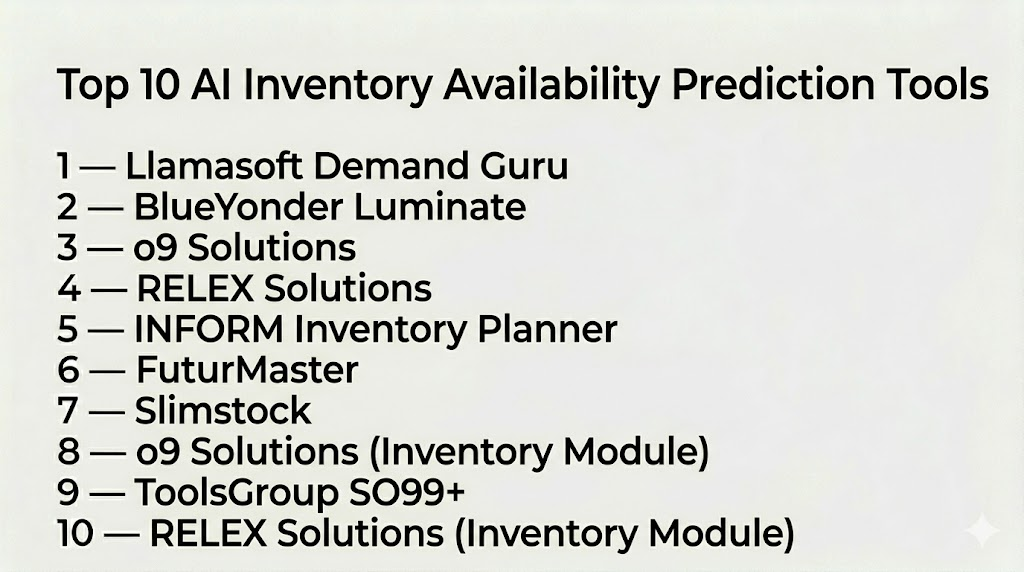
Top 10 AI Inventory Availability Prediction Tools
1- Llamasoft Demand Guru
One-line verdict: Enterprise-grade AI for large-scale inventory forecasting and multi-location optimization.
Short description: Llamasoft Demand Guru predicts stock availability using AI, integrating historical demand, promotions, and supply chain data.
Standout Capabilities
- Multi-location inventory prediction
- Real-time stock alerts
- Promotion-driven demand forecasting
- ERP/WMS integration
- Scenario simulation for disruptions
AI-Specific Depth
- Model support: Proprietary hosted models
- RAG / knowledge integration: ERP, WMS, POS connectors
- Evaluation: Human-in-loop validation, regression tests
- Guardrails: Stock threshold alerts
- Observability: Accuracy dashboards, latency metrics
Pros
- High prediction accuracy
- Enterprise scalability
- Scenario simulation for planning
Cons
- Premium pricing
- Proprietary AI model
- Complex integration
Security & Compliance
- SSO/SAML, encryption, audit logs; Certifications: Not publicly stated
Deployment & Platforms
- Cloud, Web dashboards
Integrations & Ecosystem
- ERP, WMS, POS
- E-commerce platforms
- Supply chain analytics
Pricing Model
- Subscription-based
Best-Fit Scenarios
- Global retail chains
- Multi-warehouse inventory
- High SKU e-commerce
2- BlueYonder Luminate
One-line verdict: AI platform for predictive inventory and automated replenishment for retail and e-commerce.
Short description: BlueYonder Luminate forecasts product availability and recommends replenishment actions in real time.
Standout Capabilities
- SKU, category, and location forecasting
- Automated replenishment recommendations
- Promotion impact modeling
- Multi-channel inventory visibility
- Analytics dashboards
AI-Specific Depth
- Model support: Proprietary hosted
- RAG / knowledge integration: ERP, WMS, POS connectors
- Evaluation: Regression tests, human review
- Guardrails: Replenishment thresholds
- Observability: Prediction confidence and latency dashboards
Pros
- Real-time recommendations
- Integrates with major ERP/WMS
- Multi-channel support
Cons
- Cloud-only
- Premium cost
- Integration effort
Security & Compliance
- Encryption, SSO; Certifications: Not publicly stated
Deployment & Platforms
- Cloud, Web
Integrations & Ecosystem
- ERP, WMS, POS
- E-commerce platforms
Pricing Model
- Subscription-based
Best-Fit Scenarios
- Large retail chains
- Omnichannel e-commerce
- Multi-warehouse inventory
3- o9 Solutions
One-line verdict: AI platform for multi-channel inventory forecasting and supply chain optimization.
Short description: o9 Solutions predicts inventory demand, balances supply, and integrates real-time data from multiple channels.
Standout Capabilities
- Multi-channel forecasting
- Automated replenishment recommendations
- Supply chain and ERP integration
- Scenario planning and simulation
- KPI monitoring dashboards
AI-Specific Depth
- Model support: Proprietary hosted
- RAG / knowledge integration: ERP/WMS connectors
- Evaluation: Human-in-loop review
- Guardrails: Stock thresholds and alerts
- Observability: Dashboard for prediction accuracy
Pros
- Accurate multi-channel forecasting
- Enterprise-scale
- Scenario simulations
Cons
- High cost
- Requires ERP/WMS integration
- Proprietary AI
Security & Compliance
- Encryption, audit logs; Certifications: Not publicly stated
Deployment & Platforms
- Cloud, Web
Integrations & Ecosystem
- ERP, WMS, e-commerce APIs
Pricing Model
- Subscription
Best-Fit Scenarios
- Enterprise retailers
- Omnichannel inventory
- High SKU volumes
4- RELEX Solutions
One-line verdict: AI tool for seasonal and promotion-aware inventory forecasting.
Short description: RELEX forecasts availability, prevents stockouts, and optimizes inventory based on AI predictions.
Standout Capabilities
- Seasonal demand prediction
- Real-time stock monitoring
- Automated replenishment alerts
- Multi-channel inventory visibility
- Analytics dashboards
AI-Specific Depth
- Model support: Proprietary hosted
- RAG / knowledge integration: ERP/WMS connectors
- Evaluation: Regression testing and human review
- Guardrails: Stock threshold alerts
- Observability: Latency and accuracy dashboards
Pros
- Real-time alerts
- Promotion-aware forecasting
- Multi-channel support
Cons
- Premium pricing
- Cloud-only
- Integration required
Security & Compliance
- Encryption, audit logs; Certifications: Not publicly stated
Deployment & Platforms
- Cloud, Web
Integrations & Ecosystem
- ERP, POS, WMS
- E-commerce connectors
Pricing Model
- Subscription
Best-Fit Scenarios
- Seasonal inventory management
- Retail chains
- E-commerce marketplaces
5- INFORM Inventory Planner
One-line verdict: Predictive inventory management for multi-location and multi-channel optimization.
Short description: INFORM uses AI to optimize stock levels, forecast availability, and prevent stockouts.
Standout Capabilities
- Multi-location forecasting
- Automated replenishment alerts
- Scenario simulation
- ERP/WMS integration
- Analytics dashboards
AI-Specific Depth
- Model support: Proprietary hosted
- RAG / knowledge integration: ERP/WMS
- Evaluation: Human-in-loop validation
- Guardrails: Stock thresholds
- Observability: Prediction accuracy dashboards
Pros
- Accurate multi-warehouse predictions
- Scalable
- Scenario simulation
Cons
- Premium cost
- Cloud-only
- Integration required
Security & Compliance
- Encryption; Certifications: Not publicly stated
Deployment & Platforms
- Cloud, Web
Integrations & Ecosystem
- ERP, WMS, e-commerce APIs
Pricing Model
- Subscription
Best-Fit Scenarios
- Large retailers
- Multi-warehouse operations
- Seasonal demand management
6- FuturMaster
One-line verdict: AI platform for inventory and demand planning with predictive insights.
Short description: FuturMaster forecasts inventory needs, automates replenishment, and provides analytics dashboards.
Standout Capabilities
- Multi-channel inventory forecasting
- SKU-level replenishment recommendations
- Promotion-aware modeling
- Analytics dashboards
- Scenario simulations
AI-Specific Depth
- Model support: Proprietary hosted
- RAG / knowledge integration: ERP/WMS connectors
- Evaluation: Regression tests and human review
- Guardrails: Stock limits
- Observability: Prediction metrics dashboards
Pros
- Integrated forecasting and planning
- Multi-channel support
- Real-time alerts
Cons
- Premium pricing
- Cloud-only
- Complex integration
Security & Compliance
- Encryption, audit logs; Certifications: Not publicly stated
Deployment & Platforms
- Cloud, Web
Integrations & Ecosystem
- ERP, WMS, e-commerce APIs
Pricing Model
- Subscription
Best-Fit Scenarios
- Retailers with large SKU counts
- Seasonal demand planning
- Omnichannel inventory
7- Slimstock
One-line verdict: AI inventory forecasting for stock optimization and replenishment across warehouses.
Short description: Slimstock prevents stockouts, manages inventory across multiple warehouses, and predicts demand spikes.
Standout Capabilities
- SKU-level forecasting
- Multi-warehouse alerts
- Replenishment recommendations
- Scenario simulations
- Analytics dashboards
AI-Specific Depth
- Model support: Proprietary hosted
- RAG / knowledge integration: ERP/WMS
- Evaluation: Human-in-loop
- Guardrails: Stock thresholds
- Observability: Prediction dashboards
Pros
- Prevents stockouts
- Supports multi-warehouse operations
- Scenario modeling
Cons
- Premium pricing
- Cloud-only
- Requires ERP/WMS integration
Security & Compliance
- Encryption; Certifications: Not publicly stated
Deployment & Platforms
- Cloud, Web
Integrations & Ecosystem
- ERP, WMS, e-commerce APIs
Pricing Model
- Subscription
Best-Fit Scenarios
- Retail chains
- Multi-location inventory
- High-volume SKUs
8- o9 Solutions (Inventory Module)
One-line verdict: Multi-channel predictive inventory AI for enterprise operations.
Short description: o9 Inventory Module forecasts demand, prevents stockouts, and recommends replenishment actions.
Standout Capabilities
- Multi-channel forecasting
- SKU-level optimization
- Replenishment alerts
- Scenario simulations
- Analytics dashboards
AI-Specific Depth
- Model support: Proprietary hosted
- RAG / knowledge integration: ERP/WMS
- Evaluation: Human-in-loop review
- Guardrails: Stock thresholds
- Observability: Accuracy dashboards
Pros
- Enterprise-scale
- Real-time predictions
- Multi-channel support
Cons
- Premium pricing
- Cloud-only
- Integration required
Security & Compliance
- Encryption, audit logs; Certifications: Not publicly stated
Deployment & Platforms
- Cloud, Web
Integrations & Ecosystem
- ERP, WMS, e-commerce APIs
Pricing Model
- Subscription
Best-Fit Scenarios
- Global retailers
- Omnichannel inventory
- Large SKU catalogs
9- ToolsGroup SO99+
One-line verdict: AI forecasting for SKU-level inventory optimization and replenishment.
Short description: SO99+ predicts stock availability and automates replenishment actions across warehouses.
Standout Capabilities
- SKU-level forecasting
- Multi-location support
- Automated replenishment alerts
- Scenario simulations
- Analytics dashboards
AI-Specific Depth
- Model support: Proprietary hosted
- RAG / knowledge integration: ERP/WMS
- Evaluation: Regression tests
- Guardrails: Stock thresholds
- Observability: Prediction dashboards
Pros
- Accurate SKU-level predictions
- Multi-channel support
- Stockout prevention
Cons
- Premium pricing
- Cloud-only
- ERP/WMS integration required
Security & Compliance
- Encryption; Certifications: Not publicly stated
Deployment & Platforms
- Cloud, Web
Integrations & Ecosystem
- ERP, WMS, e-commerce APIs
Pricing Model
- Subscription
Best-Fit Scenarios
- Retail chains
- Omnichannel inventory
- Seasonal demand
10- RELEX Solutions (Inventory Module)
One-line verdict: End-to-end AI platform for inventory prediction, replenishment, and optimization.
Short description: RELEX Inventory Module predicts stock availability, optimizes inventory, and integrates multi-channel retail operations.
Standout Capabilities
- SKU, category, and store-level forecasting
- Automated replenishment suggestions
- Multi-channel inventory visibility
- Scenario simulation
- Analytics dashboards
AI-Specific Depth
- Model support: Proprietary hosted
- RAG / knowledge integration: ERP/WMS connectors
- Evaluation: Human-in-loop review
- Guardrails: Stock thresholds
- Observability: Prediction metrics
Pros
- Accurate multi-channel predictions
- Real-time alerts
- Scenario planning
Cons
- Premium pricing
- Cloud-only
- ERP/WMS integration required
Security & Compliance
- Encryption, SSO; Certifications: Not publicly stated
Deployment & Platforms
- Cloud, Web
Integrations & Ecosystem
- ERP, WMS, e-commerce APIs
Pricing Model
- Subscription
Best-Fit Scenarios
- Multi-warehouse retailers
- Omnichannel inventory
- Large SKU catalogs
Comparison Table
| Tool Name | Best For | Deployment | Model Flexibility | Strength | Watch-Out | Public Rating |
|---|---|---|---|---|---|---|
| Llamasoft | Enterprise | Cloud | Proprietary | Multi-location | Premium cost | N/A |
| BlueYonder | Enterprise | Cloud | Proprietary | Automated replenishment | Cloud-only | N/A |
| o9 Solutions | Enterprise | Cloud | Proprietary | Multi-channel | Requires integration | N/A |
| RELEX | Enterprise | Cloud | Proprietary | Seasonal & promo forecasting | Cloud-only | N/A |
| INFORM | Enterprise | Cloud | Proprietary | SKU-level accuracy | Premium | N/A |
| FuturMaster | Enterprise | Cloud | Proprietary | Multi-channel predictions | Integration complexity | N/A |
| Slimstock | Retail chains | Cloud | Proprietary | Stockout prevention | Cloud-only | N/A |
| o9 Inventory Module | Enterprise | Cloud | Proprietary | Scenario simulation | Premium | N/A |
| ToolsGroup SO99+ | Enterprise | Cloud | Proprietary | SKU-level replenishment | Cloud-only | N/A |
| RELEX Inventory Module | Enterprise | Cloud | Proprietary | End-to-end optimization | Premium | N/A |
Scoring & Evaluation
| Tool | Core | Reliability/Eval | Guardrails | Integrations | Ease | Perf/Cost | Security/Admin | Support | Weighted Total |
|---|---|---|---|---|---|---|---|---|---|
| Llamasoft | 9 | 9 | 9 | 8 | 8 | 7 | 8 | 7 | 8.1 |
| BlueYonder | 8 | 8 | 8 | 8 | 7 | 7 | 7 | 7 | 7.6 |
| o9 Solutions | 9 | 8 | 8 | 8 | 7 | 7 | 7 | 7 | 7.8 |
| RELEX | 8 | 8 | 8 | 8 | 7 | 7 | 7 | 7 | 7.6 |
| INFORM | 8 | 8 | 8 | 8 | 7 | 7 | 7 | 7 | 7.6 |
| FuturMaster | 8 | 8 | 8 | 8 | 7 | 7 | 7 | 7 | 7.6 |
| Slimstock | 8 | 8 | 8 | 7 | 7 | 7 | 7 | 7 | 7.5 |
| o9 Inventory Module | 9 | 8 | 8 | 8 | 7 | 7 | 7 | 7 | 7.8 |
| ToolsGroup SO99+ | 8 | 8 | 8 | 7 | 7 | 7 | 7 | 7 | 7.5 |
| RELEX Inventory Module | 9 | 8 | 8 | 8 | 7 | 7 | 7 | 7 | 7.8 |
Top 3 for Enterprise: Llamasoft, o9 Solutions, RELEX Inventory Module
Top 3 for SMB: Slimstock, BlueYonder, RELEX Solutions
Top 3 for Developers: o9 Solutions, ToolsGroup SO99+, FuturMaster
Which AI Inventory Availability Tool Is Right for You?
Solo / Freelancer
- Lightweight API-based tools for small SKUs or experimentation.
SMB
- Slimstock or BlueYonder for multi-location inventory without enterprise complexity.
Mid-Market
- o9 Solutions or RELEX Solutions for predictive planning across warehouses.
Enterprise
- Llamasoft, o9 Solutions, RELEX Inventory Module for global operations.
Regulated industries
- Choose platforms with encryption, audit logs, and compliance guardrails.
Budget vs premium
- SMBs: Slimstock, FuturMaster
- Enterprises: Llamasoft, RELEX, o9 Solutions
Build vs buy
- Developers may integrate APIs; enterprises should adopt SaaS platforms for speed.
Implementation Playbook (30 / 60 / 90 Days)
- 30 days: Pilot predictions on a subset of SKUs and warehouses.
- 60 days: Integrate with ERP/WMS; implement alerts and replenishment automation.
- 90 days: Scale predictions across all locations; monitor dashboards; optimize replenishment rules.
Common Mistakes & How to Avoid Them
- Poor data quality or historical inconsistencies
- Ignoring multi-location differences
- No evaluation of prediction accuracy
- Not incorporating promotions or seasonal trends
- Lack of integration with ERP/WMS
- No guardrails for replenishment thresholds
- Poor observability of latency and cost
- Failing to update models with new data
- Over-automation without human oversight
- Ignoring regulatory compliance
FAQs
1- How does AI predict inventory availability?
AI uses historical sales, promotions, and supply chain data to forecast stock levels.
2- Can it integrate with ERP/WMS?
Yes, most platforms support ERP, WMS, POS, and e-commerce integration.
3- Does it support multi-location inventory?
Yes, enterprise tools forecast across warehouses, stores, and channels.
4- How accurate are predictions?
Accuracy depends on data quality, model calibration, and anomaly handling.
5- Can AI handle seasonal or promotional spikes?
Yes, advanced platforms account for promotions and seasonal demand.
6- Are these tools cloud-only?
Most are cloud-hosted; some support hybrid or on-premises deployment.
7- Can small businesses benefit?
Yes, tools like Slimstock and FuturMaster are SMB-friendly.
8- How are alerts configured?
Automated alerts notify teams for low stock or replenishment recommendations.
9- What about compliance?
Top tools provide encryption, audit logs, and configurable privacy settings.
10- Are they scalable for thousands of SKUs?
Enterprise tools scale to handle complex inventory networks.
11- Can AI adapt to returns or anomalies?
Yes, predictive models adjust based on returns and unusual trends.
12- What are alternatives?
Manual forecasting, spreadsheets, or rule-based systems for small inventories.
Conclusion
AI Inventory Availability Prediction tools are essential in 2026 for optimizing stock, preventing stockouts, and enhancing operational efficiency. Selection depends on SKU volume, multi-location complexity, and integration needs. Enterprises benefit from scalable, predictive SaaS solutions; SMBs can adopt lightweight platforms; developers can experiment with APIs for custom forecasting.

Find Trusted Cardiac Hospitals
Compare heart hospitals by city and services — all in one place.
Explore Hospitals
The comparison treats inventory as independent SKU-level forecasting, but real supply chains behave as multi-echelon dependency graphs.
What’s missing:
Most tools listed claim “multi-location support,” but the article doesn’t evaluate whether they actually optimize network-level inventory vs local optimization heuristics.