
Introduction
AI Lab Automation Orchestration Tools are platforms that use artificial intelligence and workflow automation to manage, schedule, and optimize laboratory processes. They enable research teams to coordinate robotic equipment, automate repetitive experiments, and integrate data pipelines across multiple instruments. By connecting lab hardware, software, and AI models, these tools reduce human error, accelerate discovery, and increase reproducibility.
Why it matters: With increasing experiment complexity and high-throughput lab operations, AI orchestration ensures efficient resource use, real-time monitoring, and faster research outcomes. These tools help labs scale operations, improve data quality, and maintain compliance in regulated environments.
Real-world use cases:
- Automating robotic pipetting, liquid handling, and sample preparation
- Scheduling experiments across multiple instruments
- Monitoring experimental progress and detecting anomalies in real time
- Integrating AI models for predictive assay optimization
- Centralizing data collection and enabling reproducible workflows
- Coordinating multi-step synthetic chemistry or biology workflows
Evaluation criteria for buyers: Platform scalability, integration with lab hardware and software, workflow flexibility, AI-assisted decision-making, error detection, cloud or on-premise deployment, security and compliance, ease of use, analytics and reporting, guardrails for experimental safety, cost efficiency, and vendor support.
Best for: Life sciences research teams, biotech startups, pharmaceutical R&D, high-throughput screening facilities.
Not ideal for: Small academic labs with minimal automation needs or low-complexity experiments.
What’s Changed in AI Lab Automation Orchestration
- Agentic workflows for autonomous scheduling and experiment optimization
- Real-time AI monitoring of lab equipment and experimental outcomes
- Predictive maintenance alerts for lab instruments
- Integration with cloud-based data pipelines and LIMS
- Enhanced guardrails to prevent unsafe experimental conditions
- Support for multimodal inputs, including assay data, sensor readings, and instrument logs
- Cost and latency optimization via workflow prioritization and resource allocation
- Model explainability for AI-driven workflow decisions
- Observability dashboards tracking experiment status, throughput, and costs
- Support for BYO AI models alongside proprietary orchestration engines
- Regulatory and compliance features for GLP/GMP labs
- Workflow versioning and experiment reproducibility tracking
Quick Buyer Checklist
- Verify integration with existing lab instruments and software
- Check platform scalability and ability to manage high-throughput experiments
- Evaluate AI-assisted workflow optimization features
- Confirm workflow error detection and guardrails for safety
- Assess cloud, on-premise, or hybrid deployment options
- Review observability and analytics dashboards
- Evaluate cost controls and resource allocation features
- Examine workflow versioning and reproducibility tools
- Consider security, compliance, and audit capabilities
- Assess vendor support, training, and documentation
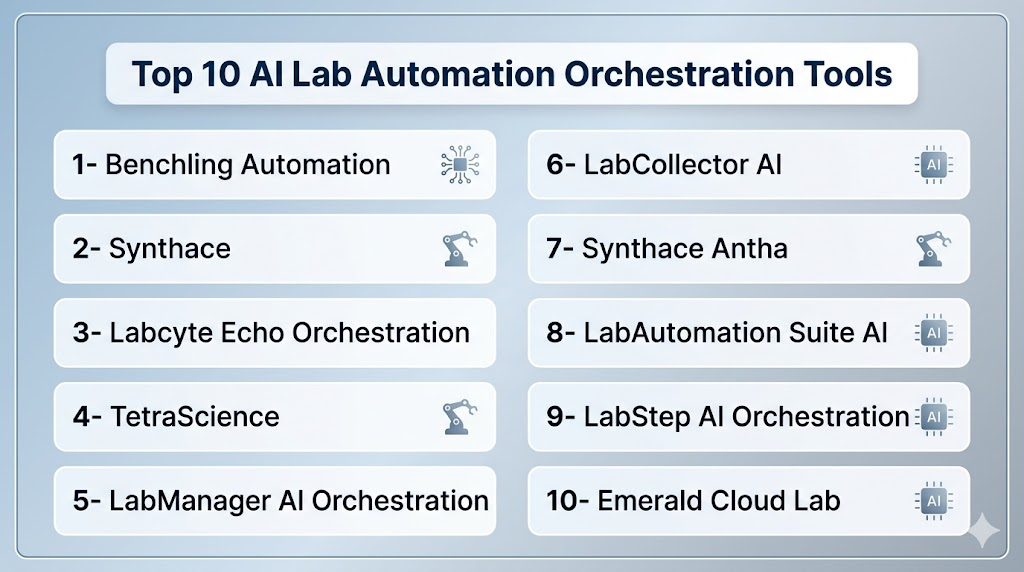
Top 10 AI Lab Automation Orchestration Tools
1- Benchling Automation
One-line verdict: Ideal for life sciences teams needing integrated lab automation and AI workflow orchestration.
Short description: Benchling Automation coordinates experiments, robotic instruments, and data pipelines while providing AI-assisted workflow optimization. Suitable for biotech and pharmaceutical R&D teams.
Standout Capabilities
- Centralized experiment scheduling
- Robotic instrument integration
- AI-assisted workflow optimization
- Real-time monitoring and alerts
- Data centralization and analytics
- Experiment reproducibility tracking
- Cloud-based collaboration
- API access for custom workflows
AI-Specific Depth
- Model support: Proprietary + BYO N/A
- RAG / knowledge integration: LIMS connectors
- Evaluation: Predictive model testing and validation
- Guardrails: Safety thresholds for automated experiments
- Observability: Dashboards with workflow metrics
Pros
- Unified platform for lab and AI workflows
- Real-time monitoring reduces errors
- Supports collaborative research teams
Cons
- Proprietary platform may limit flexibility
- Requires onboarding for complex workflows
- Cloud dependency for some features
Security & Compliance
- Role-based access controls
- Audit logs
- Data encryption
Deployment & Platforms
- Web-based, cloud
- Windows, macOS, Linux
Integrations & Ecosystem
- LIMS and ELN connectors
- Python API, REST API
- Workflow automation SDK
- Instrument control integrations
Pricing Model
Subscription-based, tiered by lab size
Best-Fit Scenarios
- Biotech R&D with multi-instrument labs
- High-throughput assay facilities
- Collaborative pharma research teams
2- Synthace
One-line verdict: Suited for labs requiring flexible AI-driven workflow orchestration across robotic and assay systems.
Short description: Synthace automates experimental protocols and coordinates instruments, while providing AI optimization and reproducible digital workflows for complex lab processes.
Standout Capabilities
- Graphical workflow builder
- Robotic instrument orchestration
- AI predictive scheduling
- Experiment versioning
- Error detection and automatic adjustments
- Cloud-based collaboration
- Data centralization
- API and SDK access
AI-Specific Depth
- Model support: Proprietary + BYO N/A
- RAG / knowledge integration: Instrument logs and LIMS
- Evaluation: Simulation-based validation
- Guardrails: Safety thresholds on automated protocols
- Observability: Real-time monitoring dashboards
Pros
- Flexible workflow design
- Supports complex protocols
- Cloud-native collaboration
Cons
- Requires setup for custom instruments
- Learning curve for new users
- Proprietary pricing
Security & Compliance
- Audit logs
- Role-based access
- Data encryption
Deployment & Platforms
- Web-based, cloud
- Cross-platform support
Integrations & Ecosystem
- ELN/LIMS connectors
- Python SDK
- REST API
- Robotic control
Pricing Model
Tiered subscription
Best-Fit Scenarios
- Automated synthetic biology labs
- Pharmaceutical R&D teams
- Multi-instrument labs
3- Labcyte Echo Orchestration
One-line verdict: Best for labs focused on acoustic liquid handling and AI-driven scheduling.
Short description: Labcyte Echo Orchestration integrates robotic acoustic dispensers with AI scheduling, ensuring efficient and reproducible liquid handling workflows for high-throughput screening.
Standout Capabilities
- Acoustic liquid handling automation
- AI workflow optimization
- Batch experiment scheduling
- Data integration with LIMS
- Error detection and alerts
- Cloud dashboards
- Reproducibility tracking
AI-Specific Depth
- Model support: Proprietary
- RAG / knowledge integration: LIMS
- Evaluation: Experiment reproducibility metrics
- Guardrails: Safety checks for liquid handling
- Observability: Workflow monitoring and logs
Pros
- High precision liquid handling
- Real-time AI scheduling
- Reduces human error
Cons
- Hardware dependency
- Proprietary platform
- Limited integration with non-Echo instruments
Security & Compliance
- Audit logs
- User role management
- Data encryption
Deployment & Platforms
- Cloud-based
- Web interface
Integrations & Ecosystem
- LIMS connectors
- API access for automation
- Batch processing tools
Pricing Model
Enterprise subscription
Best-Fit Scenarios
- High-throughput screening labs
- Drug discovery pipelines
- Synthetic biology labs
4- TetraScience
One-line verdict: Ideal for labs needing cloud orchestration and AI integration across multiple instruments.
Short description: TetraScience centralizes lab instrument data and coordinates experiments with AI-driven workflow orchestration. Supports multi-lab collaboration and analytics.
Standout Capabilities
- Centralized instrument data
- AI-driven workflow scheduling
- Multi-lab collaboration dashboards
- Error detection
- Cloud-native orchestration
- Integration with ELN/LIMS
- Data analytics and reporting
AI-Specific Depth
- Model support: Proprietary + BYO N/A
- RAG / knowledge integration: ELN and instrument logs
- Evaluation: Predictive workflow validation
- Guardrails: Safety and error detection thresholds
- Observability: Real-time monitoring dashboards
Pros
- Centralized orchestration
- Scalable across labs
- Integrated AI monitoring
Cons
- Proprietary
- Cloud-dependent
- Integration complexity with legacy systems
Security & Compliance
- Role-based access
- Audit logs
- Data encryption
Deployment & Platforms
- Cloud-based, web interface
Integrations & Ecosystem
- ELN/LIMS connectors
- Python SDK, REST API
- Workflow automation
Pricing Model
Subscription-based
Best-Fit Scenarios
- Multi-site labs
- Automated R&D workflows
- Pharmaceutical instrument coordination
5- LabManager AI Orchestration
One-line verdict: Recommended for academic and industrial labs requiring integrated workflow automation.
Short description: LabManager AI Orchestration manages instruments, schedules protocols, and uses AI to optimize lab operations for efficiency and reproducibility.
Standout Capabilities
- Protocol scheduling
- Instrument management
- AI workflow optimization
- Data centralization
- Error alerts and recovery
- Reproducibility tracking
- Cloud dashboards
AI-Specific Depth
- Model support: Proprietary
- RAG / knowledge integration: N/A
- Evaluation: AI-driven experiment validation
- Guardrails: Safety thresholds on automated protocols
- Observability: Metrics dashboards
Pros
- Supports multi-instrument labs
- Reduces manual errors
- Cloud-enabled reporting
Cons
- Proprietary licensing
- Learning curve
- Integration with legacy systems may require effort
Security & Compliance
- Audit logs
- Role-based access
- Data encryption
Deployment & Platforms
- Web-based, cloud
Integrations & Ecosystem
- LIMS/ELN connectors
- API and SDK
- Robotic control
Pricing Model
Subscription-based
Best-Fit Scenarios
- Academic automation labs
- Biotech R&D teams
- Multi-instrument coordination
6- LabCollector AI
One-line verdict: Best for medium-scale labs needing experiment orchestration and instrument integration.
Short description: LabCollector AI orchestrates lab workflows, instruments, and data pipelines with AI-driven optimization, improving throughput and reproducibility.
Standout Capabilities
- Experiment orchestration
- Instrument integration
- AI optimization
- Data logging and dashboards
- Protocol scheduling
- Error detection
- Cloud-enabled access
AI-Specific Depth
- Model support: Proprietary
- RAG / knowledge integration: ELN connectors
- Evaluation: Predictive experiment validation
- Guardrails: Safety thresholds
- Observability: Workflow dashboards
Pros
- Multi-instrument orchestration
- Data centralization
- AI-assisted scheduling
Cons
- Proprietary software
- Cloud dependency
- Integration setup required
Security & Compliance
- Audit logs
- User roles
- Encryption
Deployment & Platforms
- Cloud-based, web interface
Integrations & Ecosystem
- ELN connectors
- REST API
- Workflow automation
Pricing Model
Subscription-based
Best-Fit Scenarios
- Mid-scale biotech labs
- Automated R&D workflows
- Multi-protocol management
7- Synthace Antha
One-line verdict: Recommended for synthetic biology labs needing advanced workflow orchestration.
Short description: Synthace Antha provides AI-driven orchestration for synthetic biology workflows, connecting robotics, assays, and predictive models for automated experimentation.
Standout Capabilities
- Synthetic biology workflow automation
- Robotic instrument integration
- AI predictive optimization
- Experiment versioning
- Error detection and recovery
- Cloud collaboration
- Data centralization
AI-Specific Depth
- Model support: Proprietary
- RAG / knowledge integration: Instrument logs, LIMS
- Evaluation: Predictive workflow validation
- Guardrails: Safety checks
- Observability: Real-time dashboards
Pros
- Flexible workflow design
- Supports complex protocols
- Cloud-native collaboration
Cons
- Proprietary
- Hardware setup may be needed
- Learning curve
Security & Compliance
- Audit logs
- Role-based access
- Encryption
Deployment & Platforms
- Cloud-based, web interface
Integrations & Ecosystem
- ELN/LIMS connectors
- Python SDK, API
- Robotic control
Pricing Model
Enterprise subscription
Best-Fit Scenarios
- Synthetic biology labs
- High-throughput automation
- Research teams needing predictive orchestration
8- LabAutomation Suite AI
One-line verdict: Best for large labs coordinating multiple instruments and experiments with AI scheduling.
Short description: LabAutomation Suite AI manages multiple robotic instruments, schedules experiments, and uses AI to optimize resource usage and experiment throughput.
Standout Capabilities
- Instrument orchestration
- AI-driven scheduling
- Multi-experiment management
- Error detection
- Reproducibility tracking
- Cloud and on-premise deployment
- Data analytics dashboards
AI-Specific Depth
- Model support: Proprietary
- RAG / knowledge integration: LIMS
- Evaluation: Workflow simulation
- Guardrails: Safety thresholds
- Observability: Monitoring dashboards
Pros
- Multi-instrument coordination
- AI optimization
- Scalable for large labs
Cons
- Proprietary
- Cloud dependency
- Integration setup required
Security & Compliance
- Audit logs
- Role-based access
- Encryption
Deployment & Platforms
- Cloud and on-premise
- Web interface
Integrations & Ecosystem
- ELN/LIMS connectors
- REST API, Python SDK
- Instrument control
Pricing Model
Subscription-based
Best-Fit Scenarios
- Large pharma labs
- High-throughput R&D
- Multi-protocol coordination
9- LabStep AI Orchestration
One-line verdict: Suited for academic and industry labs needing workflow automation and AI scheduling.
Short description: LabStep AI orchestrates instruments, schedules protocols, and tracks data. AI assists with workflow optimization and error detection for reproducibility and efficiency.
Standout Capabilities
- Protocol scheduling
- Instrument management
- AI-assisted workflow optimization
- Data logging and visualization
- Error alerts
- Cloud dashboards
AI-Specific Depth
- Model support: Proprietary
- RAG / knowledge integration: ELN and instrument connectors
- Evaluation: Predictive workflow testing
- Guardrails: Safety thresholds
- Observability: Real-time monitoring
Pros
- Efficient workflow management
- Reduces manual errors
- Cloud-based collaboration
Cons
- Proprietary platform
- Learning curve
- Integration with legacy instruments
Security & Compliance
- Audit logs
- Role-based access
- Data encryption
Deployment & Platforms
- Cloud-based, web interface
Integrations & Ecosystem
- ELN/LIMS connectors
- API, Python SDK
- Instrument automation
Pricing Model
Subscription-based
Best-Fit Scenarios
- Academic labs
- Biotech startups
- Multi-instrument research teams
10- Emerald Cloud Lab
One-line verdict: Recommended for labs needing fully cloud-based remote AI orchestration.
Short description: Emerald Cloud Lab offers fully remote AI-driven orchestration, scheduling robotic experiments, collecting data, and providing reproducible digital workflows for R&D teams.
Standout Capabilities
- Remote cloud-based automation
- AI scheduling and resource optimization
- Multi-step experiment orchestration
- Real-time monitoring and alerts
- Data centralization and reporting
- Reproducibility tracking
AI-Specific Depth
- Model support: Proprietary
- RAG / knowledge integration: ELN and instrument logs
- Evaluation: Predictive workflow testing
- Guardrails: Safety checks
- Observability: Dashboards and alerts
Pros
- Fully remote orchestration
- Reduces human error
- AI optimization of lab resources
Cons
- Proprietary
- Cloud-only
- Requires reliable internet
Security & Compliance
- Audit logs
- Role-based access
- Data encryption
Deployment & Platforms
- Cloud-based, web interface
Integrations & Ecosystem
- ELN/LIMS connectors
- REST API, Python SDK
- Robotic control
Pricing Model
Subscription-based
Best-Fit Scenarios
- Remote labs
- Cloud-first R&D
- Multi-site research teams
Comparison Table
| Tool Name | Best For | Deployment | Model Flexibility | Strength | Watch-Out | Public Rating |
|---|---|---|---|---|---|---|
| Benchling Automation | Biotech / Pharma | Cloud | Proprietary | Integrated AI lab orchestration | Cloud-dependent | N/A |
| Synthace | Biotech / Synthetic biology | Cloud | Proprietary | Flexible workflow design | Learning curve | N/A |
| Labcyte Echo Orchestration | High-throughput screening | Cloud | Proprietary | Acoustic liquid handling | Hardware dependency | N/A |
| TetraScience | Multi-site labs | Cloud | Proprietary | Centralized orchestration | Integration complexity | N/A |
| LabManager AI | Academic / Industrial labs | Cloud | Proprietary | Protocol scheduling | Proprietary | N/A |
| LabCollector AI | Mid-scale labs | Cloud | Proprietary | Experiment orchestration | Proprietary | N/A |
| Synthace Antha | Synthetic biology | Cloud | Proprietary | Complex protocol automation | Hardware setup | N/A |
| LabAutomation Suite AI | Large labs | Cloud / On-prem | Proprietary | Multi-instrument orchestration | Cloud-dependent | N/A |
| LabStep AI | Academic / Industry labs | Cloud | Proprietary | Workflow optimization | Proprietary | N/A |
| Emerald Cloud Lab | Remote labs | Cloud | Proprietary | Fully remote AI orchestration | Cloud-only | N/A |
Scoring Table
| Tool | Core Features | AI Optimization | Guardrails | Integrations | Ease of Use | Performance/Cost | Security/Admin | Support | Weighted Total |
|---|---|---|---|---|---|---|---|---|---|
| Benchling Automation | 10 | 9 | 8 | 9 | 8 | 8 | 8 | 7 | 8.9 |
| Synthace | 9 | 8 | 8 | 8 | 7 | 8 | 7 | 6 | 8.0 |
| Labcyte Echo | 8 | 8 | 7 | 7 | 8 | 7 | 6 | 6 | 7.4 |
| TetraScience | 8 | 7 | 8 | 8 | 7 | 7 | 7 | 6 | 7.5 |
| LabManager AI | 8 | 7 | 7 | 7 | 7 | 7 | 6 | 6 | 7.1 |
| LabCollector AI | 7 | 7 | 7 | 7 | 7 | 7 | 6 | 6 | 6.9 |
| Synthace Antha | 9 | 8 | 8 | 8 | 7 | 8 | 7 | 6 | 8.0 |
| LabAutomation Suite AI | 8 | 8 | 8 | 8 | 7 | 8 | 7 | 6 | 7.8 |
| LabStep AI | 7 | 7 | 7 | 7 | 8 | 7 | 6 | 6 | 7.0 |
| Emerald Cloud Lab | 9 | 8 | 8 | 8 | 7 | 8 | 7 | 6 | 8.0 |
Top 3 Enterprise: Benchling Automation, Synthace, Synthace Antha
Top 3 SMB: LabManager AI, LabCollector AI, LabStep AI
Top 3 Developers: Labcyte Echo, TetraScience, Emerald Cloud Lab
Which Tool Is Right for You
- Solo / Freelancer: LabStep AI or LabCollector AI for lightweight orchestration and cloud collaboration
- SMB: LabManager AI, LabCollector AI for scalable AI-assisted workflows
- Mid-Market: Synthace, Synthace Antha for flexible protocol automation and predictive scheduling
- Enterprise: Benchling Automation, Emerald Cloud Lab, LabAutomation Suite AI for high-throughput and multi-instrument orchestration
- Regulated industries: Tools with guardrails, audit logs, and compliance dashboards like Benchling and Synthace
- Budget vs Premium: Free or lightweight tools for small labs; enterprise subscriptions for fully integrated orchestration
- Build vs Buy: Open-source or BYO frameworks for AI-savvy labs; commercial suites for rapid deployment
Implementation Playbook (30 / 60 / 90 Days)
- 30 days: Pilot selected tools, define success metrics, integrate critical instruments, enable monitoring dashboards
- 60 days: Harden security, validate AI guardrails, train teams, connect LIMS/ELN systems
- 90 days: Optimize workflow throughput and cost, implement governance policies, scale orchestration across multi-site operations
Common Mistakes & How to Avoid Them
- Ignoring automated guardrails and safety checks
- No evaluation or testing of AI workflows
- Unmanaged instrument data retention
- Limited observability of experiment progress
- Unexpected compute or subscription costs
- Over-automation without human review
- Vendor lock-in without abstraction
- Skipping integration with LIMS/ELN
- Misinterpreting AI predictions
- Insufficient staff training
- Skipping versioning and reproducibility tracking
- Ignoring regulatory requirements
- Overlooking multi-instrument scheduling conflicts
- Selecting tools without scalability evaluation
FAQs
- Can AI lab orchestration replace lab personnel?
No, it enhances efficiency and reduces errors but human oversight is still required. - Are these tools suitable for high-throughput screening?
Yes, platforms like Benchling and Synthace support multi-instrument automation. - Do I need cloud access?
Most tools are cloud-based, though some offer hybrid deployment. - Can I integrate my existing instruments?
Yes, most tools provide API and LIMS/ELN connectors. - How secure is my lab data?
Enterprise tools include encryption, role-based access, and audit logs. - Are these tools compatible with robotics?
Yes, most orchestrate pipetting, liquid handling, and other lab robots. - Can I customize AI workflows?
Tools like Synthace and DeepChem support BYO models and custom AI workflows. - Do these platforms support error detection?
Yes, guardrails monitor workflow safety and instrument errors. - What is the pricing model?
Typically subscription-based, tiered for lab size and automation complexity. - Can I track experiment reproducibility?
Yes, most platforms include workflow versioning and data logging. - Are there educational or academic options?
Some tools offer free tiers or academic subscriptions. - How do I select the right tool?
Consider lab size, instrument type, AI features, compliance requirements, and scalability.
Conclusion
AI Lab Automation Orchestration Tools are transforming laboratory workflows by integrating AI with instrument scheduling, protocol automation, and data centralization, enabling faster, safer, and more reproducible experiments. Choosing the right platform depends on lab size, complexity, and regulatory needs, with solo users benefiting from lightweight orchestration, SMBs using AI-assisted multi-instrument coordination, and enterprise labs requiring full-scale, high-throughput orchestration with guardrails and monitoring. Strategic adoption through pilots, evaluation, secure workflows, and scalable orchestration ensures efficient resource utilization, reproducibility, and improved research outcomes while supporting compliance and long-term lab productivity.

Find Trusted Cardiac Hospitals
Compare heart hospitals by city and services — all in one place.
Explore Hospitals
One thing worth adding is how important system compatibility is—lab automation works best when tools integrate smoothly with existing instruments and workflows instead of creating extra complexity.