
Introduction
AI Log Parsing and Normalization Tools help security, DevOps, IT, and observability teams convert messy raw logs into structured, searchable, and analysis-ready data. These tools parse logs from firewalls, endpoints, cloud platforms, applications, APIs, identity systems, databases, containers, Kubernetes, SaaS platforms, and custom systems. They extract fields such as timestamp, user, source IP, destination IP, hostname, event type, action, severity, process, request path, status code, and error message, then normalize them into consistent schemas for SIEM, SOAR, observability, threat detection, compliance, and troubleshooting workflows.
Why It Matters
Security and operations teams often collect logs from hundreds of tools, but each source uses different formats, field names, timestamps, encodings, and event structures. Without clean parsing and normalization, alerts become unreliable, dashboards break, detections miss important context, and analysts waste time translating raw events manually. AI log parsing and normalization matters because it improves detection accuracy, reduces SIEM noise, standardizes telemetry, controls data volume, and makes investigations faster. It also helps teams prepare logs for AI copilots, analytics engines, anomaly detection, compliance reporting, and long-term search.
Real World Use Cases
- SIEM data normalization: Convert logs from multiple vendors into common fields for better detection and correlation.
- Security alert enrichment: Add user, asset, geo, threat intelligence, severity, and event-category context.
- Cloud log standardization: Normalize AWS, Microsoft Azure, Google Cloud, Kubernetes, and SaaS audit logs.
- Application troubleshooting: Parse custom application logs into structured fields for faster debugging.
- Observability pipelines: Route, filter, enrich, and transform logs before sending them to analytics platforms.
- Cost control: Drop duplicates, reduce noisy fields, sample low-value logs, and route only useful data.
- Compliance reporting: Standardize audit logs for retention, reporting, and evidence review.
- AI-ready telemetry: Prepare normalized logs for AI assistants, anomaly detection, incident summarization, and automated investigation.
Evaluation Criteria for Buyers
- Parsing accuracy: The platform should reliably extract fields from structured, semi-structured, and unstructured logs.
- Normalization schema support: Buyers should check support for ECS, OCSF, OpenTelemetry, vendor schemas, and custom schemas.
- AI-assisted parsing: The tool should help create parsers, detect patterns, suggest fields, and reduce manual regex work.
- Data routing: Strong tools should send normalized logs to SIEM, data lakes, observability platforms, and security tools.
- Enrichment capabilities: Look for asset context, identity context, geo data, threat intelligence, severity mapping, and event categorization.
- Pipeline performance: The platform should support high-volume log throughput without major latency.
- Cost controls: Buyers should evaluate filtering, sampling, deduplication, suppression, and tiered routing.
- Deployment flexibility: Cloud, self-hosted, agent-based, agentless, edge, hybrid, and Kubernetes options matter.
- Security governance: SSO, RBAC, audit logs, encryption, retention controls, and masking are important.
- Developer experience: Teams should be able to build, test, version, and monitor parsers easily.
- Observability: Pipelines should show dropped events, parse failures, routing issues, latency, and volume trends.
- Integration depth: The tool should connect with SIEM, SOAR, EDR, cloud platforms, observability tools, message queues, and storage.
Best for: SOC teams, SIEM engineers, detection engineers, DevOps teams, SREs, platform engineers, cloud security teams, observability teams, compliance teams, and organizations handling large volumes of logs across many vendors and environments.
Not ideal for: Very small teams with only one or two simple log sources, organizations that do not need centralized logging, or teams that cannot maintain basic data pipelines and schema governance.
What Changed in AI Log Parsing and Normalization
- AI-assisted parser creation is becoming more useful: Teams can reduce manual regex work by using AI to identify patterns and suggest fields.
- Schema standardization is more important: Detection, analytics, and AI workflows need consistent event categories and field names.
- Telemetry pipelines are replacing direct-to-SIEM ingestion: Many teams now transform, filter, enrich, and route logs before storage.
- Cost control is a major buying driver: Log volume continues to grow, so teams need filtering, deduplication, and smart routing.
- Cloud-native logs are harder to normalize: Cloud, Kubernetes, containers, and serverless services create high-volume, varied event formats.
- Security and observability data are converging: Logs now support both threat detection and reliability engineering workflows.
- OpenTelemetry adoption is growing: Teams want vendor-neutral telemetry formats and easier pipeline portability.
- OCSF and ECS-style schemas are becoming more common: Security teams want normalized data that supports correlation across tools.
- Data masking and privacy controls matter more: Logs may contain user data, secrets, tokens, session IDs, and business-sensitive values.
- Real-time enrichment is expected: Identity, asset, cloud, and threat context should be added before analytics.
- Pipeline observability is now required: Teams need to know when parsing fails, fields are missing, or routes are overloaded.
- AI security copilots need better normalized logs: AI assistants perform better when telemetry is clean, structured, and consistently labeled.
Quick Buyer Checklist
- Confirm support for structured, semi-structured, and unstructured logs.
- Check support for schema mapping such as ECS, OCSF, OpenTelemetry, vendor schemas, and custom schemas.
- Test parser accuracy with real logs from your environment.
- Review AI-assisted parser creation and field extraction capabilities.
- Confirm routing support for SIEM, SOAR, data lake, observability, storage, and streaming systems.
- Check filtering, sampling, deduplication, and cost-control features.
- Validate enrichment for asset, user, cloud, geo, threat intelligence, and severity context.
- Review sensitive data masking, token redaction, and privacy controls.
- Confirm deployment options such as cloud, self-hosted, agent, edge, Kubernetes, and hybrid.
- Check pipeline observability for parse failures, dropped events, throughput, latency, and routing errors.
- Review SSO, RBAC, audit logs, encryption, and retention controls.
- Test parser versioning, rollback, and change management.
- Confirm scalability for peak log volume.
- Run a pilot with real security and application logs before rollout.
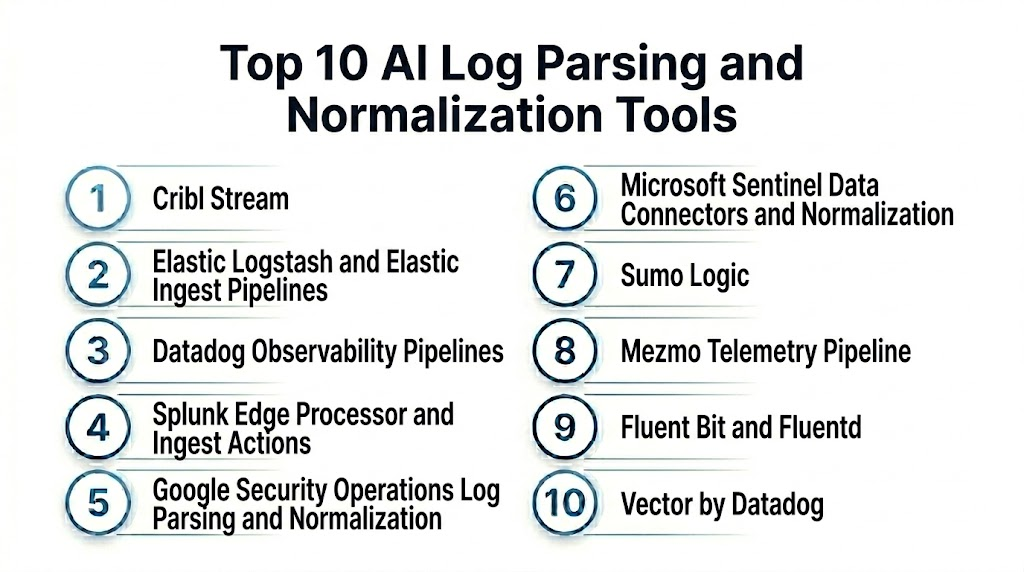
Top 10 AI Log Parsing and Normalization Tools
1- Cribl Stream
2- Elastic Logstash and Elastic Ingest Pipelines
3- Datadog Observability Pipelines
4- Splunk Edge Processor and Ingest Actions
5- Google Security Operations Log Parsing and Normalization
6- Microsoft Sentinel Data Connectors and Normalization
7- Sumo Logic
8- Mezmo Telemetry Pipeline
9- Fluent Bit and Fluentd
10- Vector by Datadog
1- Cribl Stream
One-line verdict: Best for enterprises needing flexible telemetry pipelines, log routing, enrichment, and cost control.
Short description:
Cribl Stream helps teams collect, parse, transform, enrich, filter, route, and replay telemetry before it reaches SIEM, observability, storage, or analytics platforms. It is useful for organizations that need control over high-volume logs and want to normalize security and operational data without locking everything into one destination.
Standout Capabilities
- Telemetry pipeline for logs, metrics, events, and traces
- Parsing, filtering, routing, and enrichment workflows
- Data reduction and cost-control features
- Multi-destination routing to SIEM, data lake, and observability tools
- Replay support for testing and reprocessing
- Edge and cloud deployment options
- Pipeline observability and data flow monitoring
- Strong fit for vendor-neutral telemetry strategies
AI-Specific Depth
- Model support: Varies / N/A
- RAG and knowledge integration: N/A
- Evaluation: Pipeline testing and validation features vary by configuration
- Guardrails: Routing policies, masking, access controls, and pipeline rules vary by deployment
- Observability: Pipeline metrics, route health, event flow, parse outcomes, throughput, and volume trends
Pros
- Strong telemetry routing and cost control
- Useful for multi-tool SIEM and observability environments
- Flexible pipeline design for complex enterprises
Cons
- Requires pipeline design and governance
- AI-native parser generation may vary by product capability
- Teams need skills to manage transformations safely
Security and Compliance
Cribl provides enterprise telemetry pipeline capabilities with security controls such as access management and administrative governance. Exact SSO, RBAC, audit logs, encryption, retention, residency, and certifications should be verified during procurement. If not confirmed, write Not publicly stated.
Deployment and Platforms
- Cloud and self-managed options may vary
- Edge and distributed worker deployment options
- Linux and containerized environments supported depending on setup
- Kubernetes and hybrid deployment options vary
- Web management interface
Integrations and Ecosystem
Cribl Stream is designed to sit between data sources and data destinations, making it useful for security and observability data movement.
- SIEM platforms
- Observability platforms
- Data lakes and object storage
- Kafka and streaming systems
- Syslog and HTTP sources
- Cloud provider logs
- APIs and custom destinations
Pricing Model
Typically subscription-based and often influenced by data volume, deployment model, or enterprise contract. Exact pricing is Not publicly stated.
Best-Fit Scenarios
- Enterprises reducing SIEM ingestion cost
- Teams routing normalized logs to multiple tools
- Security and observability teams building vendor-neutral telemetry pipelines
2- Elastic Logstash and Elastic Ingest Pipelines
One-line verdict: Best for teams needing flexible parsing, enrichment, and normalization inside Elastic workflows.
Short description:
Elastic Logstash and Elastic Ingest Pipelines help teams parse, transform, enrich, and index logs for search, analytics, SIEM, and observability workflows. They are useful for organizations using Elastic Security, Elastic Observability, or Elastic Stack for centralized log analysis and detection engineering.
Standout Capabilities
- Flexible parsing through filters and processors
- Support for structured and semi-structured logs
- Enrichment through lookups and pipelines
- Schema mapping support with Elastic Common Schema
- Integration with Beats, Elastic Agent, and Elastic Security
- Strong search and analytics support
- Pipeline testing and transformation workflows
- Broad community and ecosystem adoption
AI-Specific Depth
- Model support: Varies by Elastic deployment and AI features configured
- RAG and knowledge integration: Varies / N/A
- Evaluation: Pipeline testing and index validation vary by implementation
- Guardrails: Role controls, data masking, index permissions, and ingest rules vary by deployment
- Observability: Pipeline metrics, ingest errors, index health, parsing failures, and search analytics
Pros
- Highly flexible parsing and normalization
- Strong fit for Elastic Security and observability teams
- Good schema support through Elastic Common Schema
Cons
- Requires engineering skill for complex pipelines
- Self-managed deployments need operational planning
- Complex parsing rules can become difficult to maintain
Security and Compliance
Elastic provides enterprise security features such as access control, audit logging, encryption, and index-level governance depending on subscription and deployment. Exact certifications, retention, residency, and security controls should be verified during procurement. If not confirmed, use Not publicly stated.
Deployment and Platforms
- Cloud and self-managed options may vary
- Logstash runs on supported server environments
- Elastic Ingest Pipelines run inside Elasticsearch
- Works with Elastic Agent and Beats
- Kubernetes deployment possible depending on architecture
Integrations and Ecosystem
Elastic works across security, observability, search, and analytics workflows.
- Elastic Security
- Elastic Observability
- Beats and Elastic Agent
- Syslog and application logs
- Cloud logs
- Kafka and message queues
- Data enrichment processors
Pricing Model
Elastic has subscription and usage options depending on cloud or self-managed deployment. Exact pricing depends on usage, subscription tier, infrastructure, and selected capabilities. Exact pricing is Not publicly stated in a universal format.
Best-Fit Scenarios
- Teams using Elastic as SIEM or observability platform
- Detection engineers building normalized log schemas
- Organizations needing flexible parsing and search analytics
3- Datadog Observability Pipelines
One-line verdict: Best for teams needing log transformation, routing, and cost control across observability data flows.
Short description:
Datadog Observability Pipelines helps teams process, transform, filter, enrich, and route logs before they reach Datadog or other destinations. It is useful for DevOps, SRE, and security teams that need better control over log volume, sensitive data, and pipeline routing.
Standout Capabilities
- Log processing and transformation
- Routing to Datadog and external destinations
- Filtering, sampling, and data reduction
- Sensitive data redaction and masking support
- Pipeline monitoring and reliability controls
- Support for high-volume telemetry
- Integration with observability workflows
- Useful for cost and compliance control
AI-Specific Depth
- Model support: Varies / N/A
- RAG and knowledge integration: N/A
- Evaluation: Pipeline testing and validation vary by configuration
- Guardrails: Data redaction, routing policies, and access controls vary by deployment
- Observability: Pipeline health, throughput, dropped data, processing errors, and routing metrics
Pros
- Strong fit for Datadog observability environments
- Useful cost control through filtering and routing
- Good for sensitive data management in log streams
Cons
- Best value depends on Datadog adoption
- Advanced normalization may require pipeline engineering
- Pricing should be reviewed carefully for high-volume logs
Security and Compliance
Datadog provides enterprise platform security features such as access controls, audit capabilities, and data governance options. Exact SSO, RBAC, encryption, retention, residency, and certifications should be verified directly. If details are not confirmed, write Not publicly stated.
Deployment and Platforms
- Cloud-managed and worker-based deployment options may vary
- Supports telemetry pipeline workflows
- Works with Datadog and external destinations
- Containerized and infrastructure deployment details vary
- Web-based configuration interface
Integrations and Ecosystem
Datadog Observability Pipelines fits into cloud, DevOps, and security monitoring workflows.
- Datadog Logs
- Datadog Security Monitoring
- Cloud log sources
- Syslog sources
- Object storage
- SIEM and analytics destinations
- Streaming and HTTP destinations
Pricing Model
Typically subscription-based or usage-based depending on data processing and platform usage. Exact pricing is Not publicly stated in a universal format.
Best-Fit Scenarios
- Datadog-centered observability teams
- Teams needing log cost control and redaction
- Organizations routing logs to multiple analytics destinations
4- Splunk Edge Processor and Ingest Actions
One-line verdict: Best for Splunk customers needing parsing, filtering, masking, and routing before indexing.
Short description:
Splunk Edge Processor and Ingest Actions help teams process data before or during ingestion into Splunk environments. They are useful for security and observability teams that need to filter, transform, mask, route, and standardize log data before it becomes expensive or difficult to manage at index time.
Standout Capabilities
- Pre-ingest filtering and transformation
- Sensitive data masking and redaction
- Routing to Splunk and supported destinations
- Data reduction before indexing
- Support for Splunk search and analytics workflows
- Integration with Splunk Cloud and Enterprise use cases
- Pipeline control for log onboarding
- Useful for SIEM cost and data quality management
AI-Specific Depth
- Model support: Varies by Splunk AI capabilities and deployment
- RAG and knowledge integration: N/A
- Evaluation: Pipeline validation and ingestion monitoring vary by configuration
- Guardrails: Role controls, masking policies, routing rules, and data access controls vary by setup
- Observability: Ingestion metrics, parsing outcomes, routing events, indexing health, and processing status
Pros
- Strong fit for Splunk-based SOC teams
- Helps reduce indexing noise and cost
- Useful for improving data quality before SIEM analysis
Cons
- Best value depends on Splunk ecosystem adoption
- Complex transformations require Splunk expertise
- Feature availability may vary by deployment and license
Security and Compliance
Splunk provides enterprise security and data management capabilities. Exact SSO, RBAC, audit logs, encryption, data retention, residency, and certifications depend on deployment and subscription. If not verified, use Not publicly stated.
Deployment and Platforms
- Splunk Cloud and Splunk Enterprise options may vary
- Edge processing and ingest workflow options
- Web-based management experience varies by product
- Works with Splunk data pipelines and indexing workflows
Integrations and Ecosystem
Splunk processing tools support security, observability, and operational analytics pipelines.
- Splunk Enterprise Security
- Splunk Observability
- Splunk SOAR
- Universal Forwarder and HTTP Event Collector
- Cloud and application logs
- Syslog sources
- Security and IT data sources
Pricing Model
Typically tied to Splunk platform licensing, data volume, or subscription model. Exact pricing is Not publicly stated.
Best-Fit Scenarios
- Splunk SIEM teams controlling ingestion cost
- Organizations needing masking before indexing
- Security teams improving log quality for detection engineering
5- Google Security Operations Log Parsing and Normalization
One-line verdict: Best for security teams needing normalized log ingestion into Google-scale threat detection workflows.
Short description:
Google Security Operations supports log ingestion, parsing, normalization, and security analytics for large-scale threat detection and investigation workflows. It is useful for SOC teams that need structured security telemetry, normalized fields, and fast investigation across many data sources.
Standout Capabilities
- Security-focused log ingestion and normalization
- Parser support for many security data sources
- Normalized event model for investigation and detection
- Large-scale security data search
- Threat intelligence and context support
- Cloud-scale retention and analytics capabilities
- Integration with detection and response workflows
- Useful for high-volume SOC environments
AI-Specific Depth
- Model support: Proprietary Google security AI capabilities vary by configuration
- RAG and knowledge integration: Security data retrieval from normalized datasets where configured
- Evaluation: Parser and detection validation vary by implementation
- Guardrails: Role-based access, data controls, and security policies vary by deployment
- Observability: Ingestion status, parser output, normalized fields, search results, and detection context
Pros
- Strong fit for large-scale security data environments
- Security-focused normalization for SOC workflows
- Useful for fast investigation and detection correlation
Cons
- Best value depends on Google Security Operations adoption
- Custom log sources may require parser work
- Pricing and data ingestion model should be reviewed carefully
Security and Compliance
Google Cloud and Google Security Operations provide enterprise security and governance capabilities. Exact SSO, RBAC, audit logs, encryption, retention, residency, and certifications should be verified during procurement. If not confirmed, write Not publicly stated.
Deployment and Platforms
- Cloud-based security operations platform
- Web-based analyst interface
- Supports security log ingestion and normalization
- Integration scope depends on supported parsers and connectors
Integrations and Ecosystem
Google Security Operations connects normalized logs with detection, investigation, and threat intelligence workflows.
- Cloud logs
- Endpoint and network telemetry
- Identity and SaaS logs
- Threat intelligence sources
- SIEM workflows
- SOAR workflows
- Security analytics and case workflows
Pricing Model
Typically subscription-based or usage-based depending on data ingestion, retention, and platform agreement. Exact pricing is Not publicly stated.
Best-Fit Scenarios
- Large SOC teams needing normalized security telemetry
- Enterprises with high-volume log investigation requirements
- Google security and cloud-centered environments
6- Microsoft Sentinel Data Connectors and Normalization
One-line verdict: Best for Microsoft-centered SOCs needing normalized security logs in cloud SIEM workflows.
Short description:
Microsoft Sentinel provides data connectors, parsers, analytics rules, and normalization approaches that help teams ingest and standardize security logs across Microsoft and third-party environments. It is useful for SOC teams that want normalized data for detection, hunting, workbooks, and incident response inside Microsoft cloud SIEM workflows.
Standout Capabilities
- Data connectors for Microsoft and third-party sources
- Log parsing and transformation through supported methods
- Normalized schemas for detection and hunting content
- Integration with Microsoft Defender and Entra signals
- KQL-based search and analytics
- Workbooks and dashboards
- Automation through playbooks
- Cloud SIEM and SOAR alignment
AI-Specific Depth
- Model support: Microsoft AI capabilities vary by Sentinel and Security Copilot configuration
- RAG and knowledge integration: Retrieval from connected Sentinel data where configured
- Evaluation: Detection and parser validation depend on customer implementation
- Guardrails: Workspace permissions, role controls, automation approvals, and data access policies vary by setup
- Observability: Data connector health, ingestion metrics, query results, alert outputs, and workbook views
Pros
- Strong fit for Microsoft security environments
- Flexible normalization using KQL and schema mapping
- Good integration with cloud SIEM and automation workflows
Cons
- Requires KQL and Sentinel expertise for advanced normalization
- Data ingestion costs require planning
- Third-party logs may need custom parsing
Security and Compliance
Microsoft provides enterprise cloud security controls such as identity integration, encryption, access management, audit capabilities, and governance features. Exact certifications, retention, residency, and feature availability depend on plan, region, and configuration. If not verified, use Not publicly stated.
Deployment and Platforms
- Cloud-based Microsoft Sentinel workspace
- Azure-native security operations experience
- Web console and query interface
- Connectors for Microsoft and third-party log sources
- Integration with automation playbooks
Integrations and Ecosystem
Microsoft Sentinel connects normalized logs with cloud SIEM, SOAR, and XDR workflows.
- Microsoft Defender XDR
- Microsoft Entra
- Microsoft Defender for Cloud
- Azure Monitor
- Third-party security connectors
- SOAR playbooks
- ITSM and ticketing workflows
Pricing Model
Typically usage-based and influenced by data ingestion, retention, and Microsoft licensing. Exact pricing varies by usage and region. Exact pricing is Not publicly stated in a universal format.
Best-Fit Scenarios
- Microsoft-centered SOC teams
- Cloud SIEM teams using KQL-based analytics
- Organizations normalizing Microsoft and third-party security logs
7- Sumo Logic
One-line verdict: Best for cloud-native teams needing log management, parsing, analytics, and security insights.
Short description:
Sumo Logic provides cloud-native log management and security analytics capabilities that help teams collect, parse, normalize, search, and analyze logs from applications, infrastructure, cloud platforms, and security tools. It is useful for organizations that need centralized log analytics and operational security visibility.
Standout Capabilities
- Cloud-native log management
- Log parsing and field extraction
- Search and analytics workflows
- Security analytics and alerting
- Dashboards and reporting
- Cloud and application integrations
- Support for compliance and audit log use cases
- Useful for DevOps and security collaboration
AI-Specific Depth
- Model support: Proprietary analytics and AI-assisted capabilities vary by package
- RAG and knowledge integration: Varies / N/A
- Evaluation: Query validation and analytics testing depend on implementation
- Guardrails: Access controls, retention settings, and data governance vary by configuration
- Observability: Log ingestion status, dashboards, queries, alerts, data volume, and parsing outputs
Pros
- Strong cloud-native log analytics platform
- Useful for security and operational observability
- Good dashboard and search experience
Cons
- Advanced normalization may require query and parser design
- Pricing should be reviewed for high data volume
- Security workflow depth depends on selected modules
Security and Compliance
Sumo Logic provides enterprise platform controls such as access management and data governance capabilities. Exact SSO, RBAC, audit logs, encryption, retention, residency, and certifications should be verified directly. If not confirmed, use Not publicly stated.
Deployment and Platforms
- Cloud-based platform
- Web console
- Collectors and agents depending on source
- Cloud, application, infrastructure, and security log support
- API and integration options
Integrations and Ecosystem
Sumo Logic supports security, DevOps, and observability data workflows.
- Cloud providers
- Application logs
- Infrastructure logs
- Security tools
- Kubernetes and container logs
- SIEM and alerting workflows
- APIs and custom integrations
Pricing Model
Typically subscription-based or usage-based depending on data volume, retention, and selected features. Exact pricing is Not publicly stated in a universal format.
Best-Fit Scenarios
- Cloud-native log analytics teams
- DevOps and security teams sharing log data
- Organizations needing search, parsing, dashboards, and alerting in one platform
8- Mezmo Telemetry Pipeline
One-line verdict: Best for teams needing telemetry pipeline control, log reduction, and routing across observability destinations.
Short description:
Mezmo Telemetry Pipeline helps teams collect, transform, enrich, route, and reduce telemetry before sending it to observability or security platforms. It is useful for organizations that need to control log volume, improve data quality, mask sensitive fields, and route normalized data to multiple tools.
Standout Capabilities
- Telemetry pipeline for logs and events
- Parsing, transformation, and enrichment
- Data reduction and filtering
- Routing to multiple destinations
- Sensitive data masking support
- Pipeline monitoring
- Support for observability workflows
- Useful for cost and data governance control
AI-Specific Depth
- Model support: Varies / N/A
- RAG and knowledge integration: N/A
- Evaluation: Pipeline validation and testing vary by deployment
- Guardrails: Masking rules, routing controls, and access permissions vary by configuration
- Observability: Pipeline health, throughput, processed volume, dropped events, and route status
Pros
- Useful for controlling telemetry volume
- Helps improve log quality before downstream analysis
- Good for multi-destination routing
Cons
- Advanced parsing requires pipeline design
- Best value depends on existing observability strategy
- AI-native parsing depth may vary by feature set
Security and Compliance
Mezmo provides telemetry pipeline and log management capabilities. Exact SSO, RBAC, audit logs, encryption, retention, residency, and certifications should be verified during procurement. If not confirmed, write Not publicly stated.
Deployment and Platforms
- Cloud-based and pipeline deployment options may vary
- Supports telemetry routing workflows
- Web-based management interface
- Works with cloud, application, infrastructure, and observability data sources
Integrations and Ecosystem
Mezmo Telemetry Pipeline supports log processing and routing into multiple downstream platforms.
- Observability platforms
- SIEM tools
- Cloud log sources
- Application logs
- Kubernetes logs
- Object storage
- Streaming destinations
Pricing Model
Typically subscription-based and influenced by telemetry volume, features, and enterprise agreement. Exact pricing is Not publicly stated.
Best-Fit Scenarios
- Teams reducing log volume before ingestion
- Organizations routing telemetry to multiple destinations
- DevOps and security teams improving pipeline governance
9- Fluent Bit and Fluentd
One-line verdict: Best for open-source log collection, parsing, routing, and lightweight normalization.
Short description:
Fluent Bit and Fluentd are widely used open-source log collectors and processors that help teams collect, parse, filter, transform, and route logs across infrastructure, cloud, containers, and Kubernetes environments. They are useful for teams that want flexible, vendor-neutral log pipeline components.
Standout Capabilities
- Open-source log collection and routing
- Lightweight edge collection with Fluent Bit
- Flexible processing and plugin ecosystem with Fluentd
- Support for Kubernetes and container logs
- Parsing and filtering workflows
- Multi-destination routing
- Large ecosystem of inputs and outputs
- Strong fit for cloud-native logging architectures
AI-Specific Depth
- Model support: N/A
- RAG and knowledge integration: N/A
- Evaluation: Parser testing depends on implementation and tooling
- Guardrails: Access controls, masking, and routing safeguards depend on deployment design
- Observability: Pipeline metrics, plugin status, output errors, and routing health depend on configuration
Pros
- Vendor-neutral and open-source
- Strong for Kubernetes and cloud-native logging
- Large plugin ecosystem and broad adoption
Cons
- Requires engineering skill to operate well
- No native enterprise AI parser assistant by default
- Governance and security controls depend on deployment design
Security and Compliance
As open-source components, security and compliance controls depend heavily on how Fluent Bit and Fluentd are deployed, configured, and monitored. SSO, RBAC, audit logs, encryption, and retention are usually handled by surrounding infrastructure and destinations. Exact certifications are Not publicly stated.
Deployment and Platforms
- Linux and containerized environments
- Kubernetes DaemonSet deployments
- Edge and infrastructure logging
- Cloud and on-premises support through deployment design
- Works with many destinations through plugins
Integrations and Ecosystem
Fluent Bit and Fluentd integrate with many logging, storage, and analytics systems.
- Elasticsearch and OpenSearch
- Kafka
- Cloud provider logging services
- SIEM destinations
- Object storage
- Kubernetes
- Observability platforms
Pricing Model
Open-source software with no license cost for the core projects. Enterprise support, managed services, infrastructure, and operations costs vary. Exact enterprise pricing is Varies / N/A.
Best-Fit Scenarios
- Kubernetes and container log collection
- Teams building vendor-neutral logging pipelines
- Organizations with engineering resources to manage open-source telemetry components
10- Vector by Datadog
One-line verdict: Best for high-performance open-source telemetry collection, transformation, and routing.
Short description:
Vector is an open-source telemetry pipeline tool that collects, transforms, and routes logs and metrics across infrastructure and cloud environments. It is useful for teams that want high-performance data movement, flexible transformations, and vendor-neutral telemetry routing.
Standout Capabilities
- High-performance telemetry collection and routing
- Log transformation and parsing
- Support for logs and metrics
- Flexible configuration and routing
- Open-source core
- Works with many sources and destinations
- Useful for observability and security pipelines
- Strong fit for infrastructure and cloud-native teams
AI-Specific Depth
- Model support: N/A
- RAG and knowledge integration: N/A
- Evaluation: Pipeline validation depends on configuration and testing process
- Guardrails: Masking, filtering, and routing safeguards depend on deployment design
- Observability: Component metrics, pipeline health, errors, throughput, and event routing status depend on setup
Pros
- Fast and efficient telemetry pipeline
- Vendor-neutral and flexible
- Strong for teams wanting infrastructure-level control
Cons
- Requires configuration and engineering ownership
- No native AI parser assistant by default
- Enterprise governance depends on surrounding platform and deployment
Security and Compliance
Vector’s security controls depend on how it is deployed, configured, and connected to downstream systems. Enterprise controls such as SSO, RBAC, audit logs, retention, and certifications are generally handled outside the open-source component. Exact certifications are Not publicly stated.
Deployment and Platforms
- Linux and containerized environments
- Cloud and on-premises infrastructure
- Kubernetes deployment supported by architecture
- Agent and aggregator patterns possible
- Works with many telemetry destinations
Integrations and Ecosystem
Vector supports broad telemetry source and destination workflows.
- Datadog
- Elasticsearch and OpenSearch
- Kafka
- Cloud logging services
- Object storage
- Syslog sources
- Observability and analytics destinations
Pricing Model
Open-source core with infrastructure and operational costs. Enterprise or managed support may vary depending on vendor and deployment. Exact pricing is Varies / N/A.
Best-Fit Scenarios
- Engineering teams building high-performance telemetry pipelines
- Organizations wanting vendor-neutral log routing
- Cloud-native teams needing flexible parsing and transformation
Comparison Table
| Tool Name | Best For | Deployment | Model Flexibility | Strength | Watch Out | Public Rating |
|---|---|---|---|---|---|---|
| Cribl Stream | Enterprise telemetry pipelines | Cloud and self-managed options vary | Varies / N/A | Routing, enrichment, cost control | Requires pipeline governance | N/A |
| Elastic Logstash and Ingest Pipelines | Elastic-centered parsing and normalization | Cloud and self-managed options vary | Varies by Elastic setup | Flexible parsing and ECS mapping | Needs engineering skill | N/A |
| Datadog Observability Pipelines | Datadog-centered telemetry control | Cloud and worker options vary | Varies / N/A | Redaction and routing | Datadog fit matters | N/A |
| Splunk Edge Processor and Ingest Actions | Splunk pre-ingest processing | Cloud and enterprise options vary | Varies by Splunk setup | Ingest control and masking | Splunk expertise needed | N/A |
| Google Security Operations Log Parsing and Normalization | Security-scale normalized logs | Cloud | Hosted proprietary | Security-focused normalization | Custom parsers may be needed | N/A |
| Microsoft Sentinel Data Connectors and Normalization | Microsoft cloud SIEM normalization | Cloud | Hosted proprietary | KQL and Microsoft ecosystem fit | Ingestion cost planning needed | N/A |
| Sumo Logic | Cloud-native log analytics | Cloud | Hosted proprietary | Search, dashboards, parsing | Volume pricing needs review | N/A |
| Mezmo Telemetry Pipeline | Log reduction and routing | Cloud and pipeline options vary | Varies / N/A | Telemetry pipeline governance | Advanced parsing needs design | N/A |
| Fluent Bit and Fluentd | Open-source log routing | Self-hosted and cloud-native | Open-source | Lightweight collection and plugins | Governance is DIY | N/A |
| Vector by Datadog | High-performance telemetry routing | Self-hosted and cloud-native | Open-source | Fast transformations | Requires engineering ownership | N/A |
Scoring and Evaluation
This scoring is comparative, not absolute. It helps buyers compare AI log parsing and normalization tools based on parsing depth, reliability, guardrails, integrations, usability, performance, security controls, and support. Scores may vary based on log volume, deployment model, schema needs, engineering maturity, SIEM strategy, and cloud architecture. Public ratings are not guessed. Buyers should validate shortlisted tools with real logs, custom formats, peak event volume, and target SIEM or observability destinations.
| Tool | Core | Reliability and Eval | Guardrails | Integrations | Ease | Performance and Cost | Security and Admin | Support | Weighted Total |
| Cribl Stream | 9.2 | 8.6 | 8.8 | 9.2 | 8.3 | 9.0 | 8.7 | 8.7 | 8.8 |
| Elastic Logstash and Ingest Pipelines | 8.8 | 8.4 | 8.2 | 9.0 | 7.8 | 8.5 | 8.4 | 8.5 | 8.5 |
| Datadog Observability Pipelines | 8.7 | 8.4 | 8.6 | 8.8 | 8.4 | 8.6 | 8.6 | 8.5 | 8.6 |
| Splunk Edge Processor and Ingest Actions | 8.8 | 8.4 | 8.7 | 9.0 | 8.0 | 8.5 | 8.7 | 8.6 | 8.6 |
| Google Security Operations Log Parsing and Normalization | 8.9 | 8.5 | 8.5 | 8.8 | 8.1 | 8.4 | 8.8 | 8.6 | 8.6 |
| Microsoft Sentinel Data Connectors and Normalization | 8.7 | 8.3 | 8.6 | 9.0 | 8.2 | 8.3 | 8.8 | 8.7 | 8.6 |
| Sumo Logic | 8.5 | 8.2 | 8.4 | 8.6 | 8.3 | 8.3 | 8.5 | 8.4 | 8.4 |
| Mezmo Telemetry Pipeline | 8.4 | 8.2 | 8.5 | 8.5 | 8.2 | 8.6 | 8.4 | 8.2 | 8.4 |
| Fluent Bit and Fluentd | 8.3 | 8.0 | 7.8 | 9.0 | 7.4 | 9.0 | 7.5 | 8.0 | 8.2 |
| Vector by Datadog | 8.4 | 8.1 | 7.9 | 8.8 | 7.8 | 9.0 | 7.6 | 8.0 | 8.3 |
Top 3 for Enterprise
1- Cribl Stream
2- Splunk Edge Processor and Ingest Actions
3- Google Security Operations Log Parsing and Normalization
Top 3 for SMB
1- Sumo Logic
2- Elastic Logstash and Elastic Ingest Pipelines
3- Datadog Observability Pipelines
Top 3 for Developers
1- Fluent Bit and Fluentd
2- Vector by Datadog
3- Elastic Logstash and Elastic Ingest Pipelines
Which AI Log Parsing and Normalization Tool Is Right for You
Solo / Freelancer
Solo consultants and independent engineers usually need flexible, low-cost, and portable tools. Fluent Bit and Fluentd are good for open-source log collection and routing, while Vector by Datadog is useful for high-performance transformations. Elastic Logstash and Ingest Pipelines can work well when the project requires searchable normalized data in Elastic.
SMB
SMBs should choose tools that are easy to operate and do not require heavy pipeline engineering. Sumo Logic can be useful for cloud-native log management and dashboards. Datadog Observability Pipelines works well when the team already uses Datadog. Elastic Logstash and Ingest Pipelines can fit teams with technical ownership and Elastic adoption.
Mid-Market
Mid-market teams usually need better routing, schema control, cost management, and multi-destination support. Cribl Stream, Datadog Observability Pipelines, Splunk Edge Processor and Ingest Actions, and Mezmo Telemetry Pipeline can help reduce noise, transform logs, and route data to the right tools. The best choice depends on whether the organization is Splunk-centered, Datadog-centered, or vendor-neutral.
Enterprise
Large enterprises should prioritize scale, governance, pipeline observability, role-based controls, masking, multi-destination routing, and schema consistency. Cribl Stream is strong for vendor-neutral telemetry routing. Splunk Edge Processor and Ingest Actions is strong for Splunk-centered SOCs. Google Security Operations Log Parsing and Normalization and Microsoft Sentinel Data Connectors and Normalization fit security operations built around those cloud SIEM environments.
Regulated Industries
Finance, healthcare, government, and critical infrastructure teams should prioritize audit logs, retention controls, encryption, role-based access, data masking, schema consistency, and evidence integrity. Cribl Stream, Splunk Edge Processor and Ingest Actions, Microsoft Sentinel, Google Security Operations, and Elastic may be strong options depending on the existing SIEM and compliance workflow. Buyers should verify all compliance claims directly.
Budget vs Premium
Budget-conscious teams can start with Fluent Bit, Fluentd, Vector, or Elastic depending on skill level and infrastructure. Premium enterprise teams may benefit from Cribl Stream, Splunk Edge Processor, Datadog Observability Pipelines, or Google Security Operations when they need stronger governance, support, and high-volume pipeline control.
Build vs Buy
Building log parsing and normalization internally can work for teams with strong data engineering, DevOps, and SIEM engineering skills. However, most organizations should buy or combine managed tools because production-grade log pipelines require parser testing, monitoring, schema governance, masking, routing, retries, scalability, and support. A hybrid model can work where open-source collectors feed into commercial telemetry pipelines or SIEM-native normalization layers.
Implementation Playbook
First 30 Days
- Identify the most important log sources such as firewalls, endpoints, cloud logs, identity logs, SaaS audit logs, application logs, and Kubernetes logs.
- Define the target schema such as ECS, OCSF, OpenTelemetry, vendor schema, or custom field standard.
- Select two or three tools for pilot testing.
- Collect real sample logs from high-value sources.
- Test parsing accuracy, timestamp handling, field extraction, severity mapping, and event categorization.
- Validate sensitive data masking for tokens, secrets, email addresses, IPs, and user identifiers where required.
- Measure pipeline throughput and latency.
- Compare normalized output across target destinations.
- Define success metrics such as parse success rate, detection quality, storage reduction, and onboarding time.
- Create a pilot team with SIEM engineers, SOC analysts, DevOps, SREs, and compliance stakeholders.
First 60 Days
- Expand coverage to more log sources and environments.
- Create parser versioning and testing workflows.
- Add enrichment such as asset inventory, user context, cloud account, geo data, and threat intelligence.
- Configure routing rules for SIEM, data lake, observability tools, and archive storage.
- Build dashboards for parse failures, data volume, field completeness, and destination health.
- Tune filtering and sampling rules to reduce low-value noise.
- Create governance rules for masking and retention.
- Train analysts and engineers on normalized fields and schema usage.
- Document parser ownership and change approval processes.
- Validate that detections and dashboards work correctly with normalized fields.
First 90 Days
- Scale parsing and normalization across production log sources.
- Automate parser testing in deployment workflows.
- Review data reduction outcomes and SIEM cost impact.
- Add alerts for pipeline failures, missing fields, sudden volume spikes, and parse error increases.
- Review schema drift and field naming consistency.
- Build executive reporting around telemetry quality, cost reduction, and detection readiness.
- Create exception processes for custom applications and unusual log formats.
- Integrate normalized logs with AI incident summarization and threat hunting workflows.
- Review security and privacy controls with compliance teams.
- Establish continuous improvement for parsers, schemas, enrichment, and routing policies.
Common Mistakes and How to Avoid Them
- Parsing without normalization: Extracting fields is useful, but inconsistent field names still break correlation.
- No schema strategy: Choose a target schema early so teams do not create conflicting field names.
- Ignoring timestamp problems: Time zone, format, and clock drift issues can break timelines and investigations.
- Overusing regex: Regex is powerful, but complex parsers can become fragile and hard to maintain.
- Skipping parser testing: Always test parsers against real logs and edge cases.
- Not monitoring parse failures: Silent parsing failures can damage detection quality.
- Sending everything to SIEM: Route low-value logs to cheaper storage and keep high-value events for detection.
- Ignoring sensitive data: Logs may contain secrets, tokens, personal data, and credentials that should be masked.
- No parser ownership: Every major log source should have an owner for updates and troubleshooting.
- Not enriching logs: Asset, identity, cloud, and threat context make normalized logs more useful.
- Poor documentation: Analysts need clear field definitions and event category guidance.
- No rollback plan: Broken parser updates can disrupt detections and dashboards.
- Ignoring pipeline latency: Real-time detection needs timely processing.
- Buying before piloting: Test tools with real logs, high volume, and target destinations before committing.
FAQs
1- What are AI Log Parsing and Normalization Tools?
AI Log Parsing and Normalization Tools help convert raw logs into structured, consistent, and searchable data. They extract fields, map them to standard schemas, enrich events, and route them to SIEM, observability, storage, or analytics platforms.
2- What is the difference between parsing and normalization?
Parsing extracts fields from raw logs, such as user, IP address, timestamp, action, and event type. Normalization maps those fields into consistent names, categories, and formats so different log sources can be searched and correlated together.
3- Why is log normalization important for security?
Security detections rely on consistent fields. If one source uses source_ip, another uses src, and another uses clientAddress, correlation becomes difficult. Normalization helps SIEM rules, dashboards, and AI tools work more reliably.
4- Can AI create log parsers automatically?
Some tools can assist with parser creation by detecting patterns, suggesting fields, or reducing manual work. However, teams should still test parser accuracy and validate output before using it for production detections.
5- What schemas should buyers consider?
Common options include Elastic Common Schema, Open Cybersecurity Schema Framework, OpenTelemetry conventions, vendor-specific schemas, and custom internal schemas. The best choice depends on SIEM, observability, and security analytics strategy.
6- Which tool is best for vendor-neutral telemetry pipelines?
Cribl Stream is a strong option for vendor-neutral telemetry routing and pipeline control. Fluent Bit, Fluentd, and Vector are also useful for open-source, portable log collection and routing.
7- Which tool is best for Elastic environments?
Elastic Logstash and Elastic Ingest Pipelines are strong choices for Elastic-centered environments. They support flexible parsing, enrichment, and mapping into Elastic workflows such as Elastic Security and Elastic Observability.
8- Which tool is best for Microsoft Sentinel environments?
Microsoft Sentinel Data Connectors and Normalization are strong fits for Microsoft-centered SOCs. They work well with KQL-based analytics, Microsoft Defender signals, automation playbooks, and cloud SIEM workflows.
9- Which tool is best for Splunk environments?
Splunk Edge Processor and Ingest Actions are strong options for Splunk-based teams that need to filter, mask, route, and transform data before indexing. They help improve data quality and manage ingestion costs.
10- Do log parsing tools reduce SIEM costs?
Yes, they can reduce SIEM costs by filtering duplicate or low-value logs, dropping unnecessary fields, routing data to cheaper storage, and sending only high-value events to expensive analytics platforms.
11- What should teams test during a pilot?
Teams should test parsing accuracy, schema mapping, timestamp handling, sensitive data masking, throughput, destination routing, pipeline failure handling, enrichment quality, and compatibility with SIEM detections.
12- What is the biggest risk in log normalization?
The biggest risk is creating inconsistent or incorrect mappings that break detections, dashboards, and investigations. Teams should use parser testing, schema governance, documentation, and change control to avoid this problem.
Conclusion
AI Log Parsing and Normalization Tools help organizations turn messy raw logs into structured, consistent, enriched, and analysis-ready telemetry for security, observability, compliance, and AI-assisted investigation. Cribl Stream is strong for enterprise telemetry pipelines and vendor-neutral routing, Elastic Logstash and Ingest Pipelines fit Elastic-based analytics, Datadog Observability Pipelines helps Datadog teams control log flow and redaction, Splunk Edge Processor and Ingest Actions support Splunk ingestion governance, Google Security Operations provides security-focused normalized telemetry, Microsoft Sentinel supports cloud SIEM normalization, Sumo Logic works well for cloud-native log analytics, Mezmo helps with telemetry pipeline control, Fluent Bit and Fluentd are strong open-source collection options, and Vector is useful for high-performance telemetry routing. To choose the right tool, shortlist based on your SIEM and observability strategy, pilot with real logs, validate parser accuracy and schema quality, then scale with governance, masking, monitoring, and continuous pipeline improvement.

Find Trusted Cardiac Hospitals
Compare heart hospitals by city and services — all in one place.
Explore Hospitals
A key gap is how well these tools maintain schema consistency and parsing accuracy at scale when log formats evolve across distributed microservices.