
Introduction
AI Medical Imaging Diagnosis Support Tools help radiologists, clinicians, imaging departments, hospitals, and care teams review medical images faster and more consistently. These tools use artificial intelligence, deep learning, computer vision, pattern recognition, workflow automation, and clinical decision-support models to assist with detecting, flagging, prioritizing, measuring, and monitoring findings across imaging modalities such as X-ray, CT, MRI, ultrasound, mammography, and retinal imaging. They do not replace qualified clinicians; instead, they support image review, worklist prioritization, follow-up coordination, and diagnostic confidence.
Why It Matters
Medical imaging volume continues to grow, while radiology teams face pressure from staffing shortages, high reporting workloads, emergency triage demands, and the need for faster diagnosis. Missed findings, delayed reads, inconsistent reporting, and slow follow-up can affect patient outcomes and hospital efficiency. AI medical imaging diagnosis support matters because it can help prioritize urgent cases, flag suspicious findings, support second-read workflows, reduce repetitive review burden, and improve care coordination. In areas such as stroke, pulmonary embolism, chest X-ray findings, lung nodules, fractures, mammography, and emergency imaging, timely detection and escalation can directly support faster clinical decisions.
Real World Use Cases
- Emergency radiology triage: Flag time-sensitive findings such as stroke indicators, pulmonary embolism, intracranial hemorrhage, or critical chest findings.
- Chest X-ray support: Detect and prioritize suspected findings such as lung nodules, pneumothorax, consolidation, pleural effusion, or tuberculosis-related abnormalities.
- CT imaging decision support: Assist with detection, quantification, prioritization, and monitoring of findings across trauma, neuro, vascular, lung, and abdominal workflows.
- Mammography support: Help breast imaging teams detect suspicious lesions and prioritize follow-up review.
- Lung nodule management: Identify, measure, track, and follow up lung nodules across X-ray and CT workflows.
- Stroke workflow coordination: Notify care teams quickly and coordinate time-sensitive interventions.
- Radiology worklist prioritization: Move urgent cases higher in the reading queue based on AI-detected findings.
- Clinical reporting support: Provide measurements, annotations, triage signals, and structured findings to assist radiologist review.
Evaluation Criteria for Buyers
- Regulatory status: Buyers must verify whether the product is cleared, approved, or authorized for the intended clinical use in their region.
- Clinical validation: The tool should have evidence for performance, safety, workflow impact, and intended-use fit.
- Modality coverage: Check whether it supports X-ray, CT, MRI, mammography, ultrasound, or other required modalities.
- Condition coverage: Match tools to specific clinical needs such as stroke, chest X-ray, pulmonary embolism, fractures, mammography, or lung nodules.
- Workflow integration: Strong tools integrate with PACS, RIS, VNA, EHR, reporting systems, and communication workflows.
- Triage and prioritization: The platform should help prioritize urgent cases without disrupting radiologist workflows.
- Explainability: Outputs should include clear overlays, measurements, confidence indicators, or finding-level context where appropriate.
- False positive management: Teams should evaluate how the tool handles alert noise and uncertain cases.
- Security and privacy: SSO, RBAC, audit logs, encryption, retention, and data handling controls are important.
- Clinical governance: Hospitals should define who reviews AI outputs, how disagreements are handled, and how model performance is monitored.
- Deployment model: Cloud, on-premises, hybrid, edge, and regional data requirements should be reviewed carefully.
- Support and training: Clinical adoption depends on onboarding, radiologist training, workflow design, and vendor support.
Best for: Hospitals, radiology groups, imaging centers, emergency departments, stroke centers, lung cancer screening programs, public health programs, teleradiology providers, and health systems with high imaging volume or time-sensitive diagnostic workflows.
Not ideal for: Organizations expecting AI to replace clinician diagnosis, very small imaging sites without integration resources, teams without clinical governance, or providers that cannot verify regulatory clearance and intended-use fit for their region.
What Changed in AI Medical Imaging Diagnosis Support Tools
- Clinical AI is moving from single-point algorithms to platform workflows: Hospitals increasingly want unified platforms that connect multiple imaging AI tools with PACS, RIS, EHR, and care teams.
- Triage is a major driver: AI is often used to prioritize urgent findings, reduce time-to-review, and improve escalation pathways.
- Regulatory scrutiny is stronger: Buyers must verify intended use, clearance status, region-specific approvals, and ongoing performance monitoring.
- Care coordination is becoming part of imaging AI: Some tools do not only detect findings; they also notify teams and help move patients through care pathways.
- Multimodal imaging support is expanding: Vendors are covering more modalities and body areas, including CT, X-ray, MRI, mammography, ultrasound, and retinal imaging.
- AI is supporting follow-up management: Lung nodules, incidental findings, and screening workflows increasingly require longitudinal tracking.
- Radiologist-in-the-loop workflows are expected: AI output should support clinical review, not bypass professional judgment.
- Hospital buyers want measurable workflow impact: Turnaround time, prioritization accuracy, follow-up completion, and radiologist productivity matter.
- Model monitoring is becoming important: Teams need to track drift, false positives, false negatives, and site-specific performance.
- Interoperability is a key buying factor: PACS, RIS, VNA, EHR, and reporting integration can determine whether adoption succeeds.
- Data privacy and residency requirements are increasing: Imaging data is sensitive and may require regional processing or strong controls.
- AI adoption now requires change management: Clinical trust, training, governance, and workflow fit matter as much as model performance.
Quick Buyer Checklist
- Confirm the tool’s regulatory status for your region and intended clinical use.
- Verify whether the tool is for triage, detection, measurement, follow-up, reporting support, or care coordination.
- Test the tool with real local imaging data and workflow scenarios.
- Review clinical validation, safety evidence, and intended-use documentation.
- Confirm integration with PACS, RIS, VNA, EHR, reporting, and notification workflows.
- Check modality and condition coverage against your clinical priorities.
- Review explainability, overlays, measurements, and confidence outputs.
- Validate false positive and false negative handling.
- Confirm SSO, RBAC, audit logs, encryption, retention, and data handling policies.
- Check deployment options such as cloud, on-premises, hybrid, or edge.
- Define clinician review workflows and escalation rules.
- Review vendor support, onboarding, training, and clinical governance assistance.
- Evaluate total cost, including integration, implementation, maintenance, and workflow change.
- Run a pilot with radiologists, technologists, clinicians, IT, compliance, and operations stakeholders.
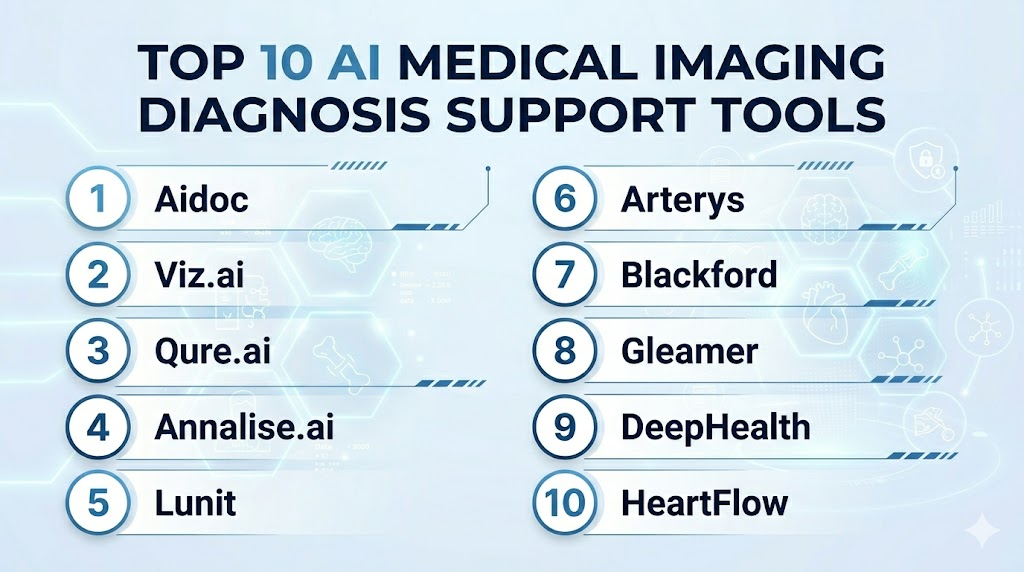
Top 10 AI Medical Imaging Diagnosis Support Tools
1- Aidoc
2- Viz.ai
3- Qure.ai
4- Annalise.ai
5- Lunit
6- Arterys
7- Blackford
8- Gleamer
9- DeepHealth
10- HeartFlow
1- Aidoc
One-line verdict: Best for health systems needing a broad clinical AI platform for radiology triage and care coordination.
Short description:
Aidoc provides clinical AI solutions that support radiology workflows, case prioritization, care coordination, and decision support across multiple imaging use cases. It is useful for hospitals and health systems that need enterprise-scale imaging AI across emergency, inpatient, and specialty workflows.
Standout Capabilities
- AI-powered radiology workflow support
- Case prioritization for suspected critical findings
- Clinical AI platform approach for multiple use cases
- Support for care team activation and coordination
- Integration with radiology and hospital workflows
- Imaging AI across CT and X-ray use cases depending on product scope
- Dashboard and operational visibility for health systems
- Enterprise deployment support for large imaging programs
AI-Specific Depth
- Model support: Proprietary clinical AI and computer vision models
- RAG and knowledge integration: Varies / N/A
- Evaluation: Clinical validation and regulatory status vary by algorithm and region
- Guardrails: Intended-use limits, clinician review, workflow permissions, and escalation controls vary by deployment
- Observability: Worklist prioritization, AI notifications, case status, workflow analytics, and operational dashboards vary by configuration
Pros
- Strong enterprise clinical AI platform positioning
- Useful for urgent radiology triage workflows
- Good fit for health systems needing multi-algorithm deployment
Cons
- Individual clinical capabilities vary by region and clearance
- Implementation requires PACS, RIS, and workflow planning
- Buyers must validate performance on local data and use cases
Security and Compliance
Aidoc provides healthcare-focused clinical AI capabilities. Exact SSO, RBAC, audit logs, encryption, retention, residency, and certifications should be verified directly during procurement. If not confirmed, write Not publicly stated.
Deployment and Platforms
- Cloud, on-premises, or hybrid options may vary by region and customer environment
- Integrates with radiology workflows
- Supports hospital and health system deployments
- PACS, RIS, and EHR integration should be verified for each site
Integrations and Ecosystem
Aidoc is designed to fit into radiology and clinical operations workflows.
- PACS integration
- RIS workflow integration
- EHR and care coordination workflows
- Notification and team communication systems
- Radiology worklists
- Clinical dashboards
- Hospital IT integration workflows
Pricing Model
Typically enterprise subscription or contract-based. Exact pricing depends on modules, algorithms, sites, imaging volume, deployment model, and agreement. Exact pricing is Not publicly stated.
Best-Fit Scenarios
- Health systems deploying multiple imaging AI workflows
- Emergency radiology triage and care coordination
- Hospitals needing enterprise clinical AI governance and integration
2- Viz.ai
One-line verdict: Best for AI-powered care coordination and time-sensitive disease detection workflows.
Short description:
Viz.ai provides an AI-powered care coordination platform focused on disease detection, clinical workflow optimization, and rapid team notification. It is especially relevant for time-sensitive conditions where imaging findings need fast escalation to specialist care teams.
Standout Capabilities
- AI-powered disease detection workflows
- Care coordination and clinical team notification
- Stroke and vascular workflow support depending on product scope
- Imaging-based triage and prioritization
- Specialist activation workflows
- Mobile and web-based care coordination experience
- Integration with hospital imaging and clinical systems
- Workflow optimization for urgent care pathways
AI-Specific Depth
- Model support: Proprietary imaging AI and clinical workflow intelligence
- RAG and knowledge integration: Varies / N/A
- Evaluation: Clinical validation and regulatory status vary by algorithm, region, and indication
- Guardrails: Clinician review, intended-use controls, notification policies, and workflow rules vary by deployment
- Observability: Case notifications, workflow status, team response, imaging alerts, and operational metrics vary by configuration
Pros
- Strong care coordination focus
- Useful for time-sensitive clinical pathways
- Supports rapid communication between care teams
Cons
- Best fit depends on specific disease workflow needs
- Requires careful clinical protocol alignment
- Buyers must verify clearance and intended use by module and region
Security and Compliance
Viz.ai provides healthcare-focused AI and care coordination capabilities. Exact SSO, RBAC, audit logs, encryption, retention, data residency, and certifications should be verified directly. If not confirmed, use Not publicly stated.
Deployment and Platforms
- Cloud-based and workflow deployment options may vary
- Web and mobile workflow experiences may be available depending on configuration
- Integrates with imaging and clinical systems
- Deployment depends on hospital IT and clinical workflow design
Integrations and Ecosystem
Viz.ai connects imaging AI findings with clinical coordination workflows.
- PACS and imaging workflows
- EHR integration
- Stroke and specialty care pathways
- Care team notification systems
- Mobile clinical communication
- Hospital workflow systems
- Analytics and reporting workflows
Pricing Model
Typically enterprise contract-based. Exact pricing depends on modules, sites, clinical workflows, imaging volume, and contract. Exact pricing is Not publicly stated.
Best-Fit Scenarios
- Stroke centers and time-sensitive care pathways
- Hospitals needing rapid imaging-based team activation
- Health systems focused on AI-enabled care coordination
3- Qure.ai
One-line verdict: Best for chest X-ray, head CT, lung health, and public health imaging AI workflows.
Short description:
Qure.ai provides AI solutions for medical imaging decision support, with strong visibility in chest X-ray and CT-based workflows. It is useful for hospitals, radiology programs, screening initiatives, emergency settings, and public health deployments that need scalable imaging support.
Standout Capabilities
- Chest X-ray AI support
- CT head and emergency imaging support depending on product
- Lung nodule and lung health workflow support
- Public health and screening use cases
- Triage and prioritization for suspected findings
- Care coordination and reporting support depending on solution
- Multi-region deployment experience
- Scalable imaging AI for high-volume environments
AI-Specific Depth
- Model support: Proprietary clinical AI and computer vision models
- RAG and knowledge integration: Varies / N/A
- Evaluation: Regulatory status and validation vary by product, region, and indication
- Guardrails: Intended-use controls, clinician review, workflow rules, and escalation settings vary by deployment
- Observability: AI findings, case prioritization, workflow metrics, reporting outputs, and follow-up views vary by product
Pros
- Strong chest imaging and lung health focus
- Useful for high-volume and public health workflows
- Broad clinical AI portfolio across X-ray and CT use cases
Cons
- Clearance and intended use vary by country and product
- Integration planning is needed for clinical workflow fit
- Local validation is important before production use
Security and Compliance
Qure.ai provides healthcare AI capabilities. Exact SSO, RBAC, audit logs, encryption, retention, residency, and certifications should be verified during procurement. If not confirmed, write Not publicly stated.
Deployment and Platforms
- Cloud, on-premises, or hybrid deployment options may vary
- Supports radiology and clinical workflows
- Integration with PACS, RIS, and reporting should be verified
- Deployment depends on product and regional requirements
Integrations and Ecosystem
Qure.ai connects imaging AI output with radiology, screening, and care workflows.
- PACS integration
- RIS and reporting workflows
- EHR and care coordination systems
- Public health screening workflows
- Clinical dashboards
- Notification systems
- Data and operational reporting
Pricing Model
Typically enterprise or program-based pricing. Exact pricing depends on product, sites, volume, deployment, and contract. Exact pricing is Not publicly stated.
Best-Fit Scenarios
- Chest X-ray AI support programs
- Lung nodule and lung health workflows
- Public health screening and emergency imaging programs
4- Annalise.ai
One-line verdict: Best for radiology teams needing broad chest X-ray and CT decision-support coverage.
Short description:
Annalise.ai develops AI tools that support radiologists and clinicians with medical image interpretation assistance. It is especially known for broad finding coverage in chest X-ray and CT workflows, helping clinicians detect, prioritize, and review imaging findings.
Standout Capabilities
- Broad radiology AI decision-support workflows
- Chest X-ray AI support
- CT AI support depending on product and region
- Detection and prioritization of suspected findings
- Worklist and reporting workflow support
- Second-reader style clinical assistance
- Hospital and public imaging deployment support
- Clinician-in-the-loop review design
AI-Specific Depth
- Model support: Proprietary deep learning and computer vision models
- RAG and knowledge integration: Varies / N/A
- Evaluation: Clinical validation and regulatory status vary by product, finding, and region
- Guardrails: Intended-use limitations, clinician review, reporting controls, and workflow rules vary by deployment
- Observability: Finding outputs, prioritization data, workflow analytics, case status, and reporting support vary by setup
Pros
- Broad imaging finding coverage in supported workflows
- Useful as a radiology decision-support layer
- Strong fit for chest imaging and CT support where available
Cons
- Product availability and clearance vary by country
- Broad finding coverage needs careful workflow governance
- Buyers must validate local clinical performance
Security and Compliance
Annalise.ai provides healthcare AI capabilities. Exact SSO, RBAC, audit logs, encryption, retention, residency, and certifications should be verified directly. If not confirmed, use Not publicly stated.
Deployment and Platforms
- Cloud, on-premises, or hybrid options may vary by region
- Integrates with radiology workflows
- PACS and reporting integration should be verified
- Deployment depends on clinical and IT requirements
Integrations and Ecosystem
Annalise.ai supports radiology and hospital imaging workflows.
- PACS integration
- RIS workflows
- Reporting systems
- Hospital imaging operations
- Clinical review workflows
- Worklist prioritization
- Analytics and governance reporting
Pricing Model
Typically enterprise contract-based. Exact pricing depends on product, sites, imaging volume, deployment, and contract. Exact pricing is Not publicly stated.
Best-Fit Scenarios
- Radiology departments needing chest X-ray decision support
- Hospitals evaluating broad imaging AI coverage
- Health systems wanting clinician-reviewed AI support workflows
5- Lunit
One-line verdict: Best for oncology-focused imaging AI, chest X-ray support, and mammography decision support.
Short description:
Lunit develops AI solutions for medical imaging and oncology workflows, including tools for chest imaging and breast imaging support. It is useful for hospitals, radiology groups, screening programs, and oncology-focused imaging teams that need AI-assisted detection and workflow support.
Standout Capabilities
- Chest X-ray AI support
- Mammography AI support
- Oncology-oriented imaging workflows
- Detection and prioritization support
- Screening workflow assistance
- Radiologist decision-support design
- Analytics and image review assistance
- Enterprise imaging deployment support
AI-Specific Depth
- Model support: Proprietary deep learning and computer vision models
- RAG and knowledge integration: Varies / N/A
- Evaluation: Clinical validation and regulatory status vary by product, region, and indication
- Guardrails: Intended-use limits, clinician review, reporting policies, and deployment controls vary by configuration
- Observability: AI finding outputs, case prioritization, reporting support, and workflow analytics vary by product
Pros
- Strong focus on imaging AI for cancer-related workflows
- Useful for breast imaging and chest imaging programs
- Supports radiologist decision-making rather than replacement
Cons
- Product availability varies by region and indication
- Needs careful integration with screening and reporting workflows
- Buyers must verify regulatory status for local use
Security and Compliance
Lunit provides healthcare AI solutions. Exact SSO, RBAC, audit logs, encryption, retention, residency, and certifications should be verified directly. If not confirmed, write Not publicly stated.
Deployment and Platforms
- Cloud, on-premises, or hybrid options may vary
- Supports imaging workflow integration
- PACS and reporting integration should be verified
- Deployment depends on product and region
Integrations and Ecosystem
Lunit supports radiology, screening, and oncology imaging workflows.
- PACS integration
- Mammography workflow systems
- Radiology reporting systems
- Screening program workflows
- Hospital imaging operations
- Clinical analytics
- Enterprise imaging workflows
Pricing Model
Typically enterprise contract-based. Exact pricing depends on product, sites, imaging volume, deployment, and agreement. Exact pricing is Not publicly stated.
Best-Fit Scenarios
- Breast imaging and mammography support
- Chest X-ray decision-support programs
- Oncology-focused imaging workflows
6- Arterys
One-line verdict: Best for cloud-based medical imaging analytics, especially advanced imaging quantification workflows.
Short description:
Arterys provides cloud-based medical imaging AI and analytics solutions used in advanced imaging workflows such as cardiac, oncology, and quantitative imaging support. It is useful for imaging teams that need AI-assisted measurements, visualization, workflow efficiency, and analysis tools for complex imaging studies.
Standout Capabilities
- Cloud-based imaging analytics
- Quantitative imaging support
- Cardiac imaging workflow support depending on product scope
- Oncology imaging analysis support depending on configuration
- AI-assisted measurements and visualization
- Collaboration-friendly imaging workflows
- Support for advanced imaging review
- Integration with clinical imaging systems
AI-Specific Depth
- Model support: Proprietary medical imaging AI and analytics models
- RAG and knowledge integration: Varies / N/A
- Evaluation: Regulatory status and validation vary by module, indication, and region
- Guardrails: Clinician review, intended-use boundaries, workflow controls, and data permissions vary by setup
- Observability: Case analytics, measurements, imaging outputs, workflow status, and user activity vary by configuration
Pros
- Strong advanced imaging analytics focus
- Useful for quantitative imaging workflows
- Cloud-based approach can support collaboration and scalability
Cons
- Product scope varies by clinical area
- Cloud deployment requires data governance review
- Buyers must verify local regulatory status and integration needs
Security and Compliance
Arterys provides medical imaging analytics capabilities. Exact SSO, RBAC, audit logs, encryption, retention, residency, and certifications should be verified during procurement. If not confirmed, use Not publicly stated.
Deployment and Platforms
- Cloud-based imaging analytics platform
- Web-based imaging workflows
- PACS integration should be verified
- Deployment depends on site requirements and product configuration
Integrations and Ecosystem
Arterys supports medical imaging analytics and clinical review workflows.
- PACS and imaging systems
- Advanced visualization workflows
- Radiology and cardiology workflows
- DICOM image handling
- Clinical reporting workflows
- Collaboration workflows
- Enterprise imaging integrations
Pricing Model
Typically enterprise contract-based or module-based. Exact pricing depends on product, imaging volume, deployment, and agreement. Exact pricing is Not publicly stated.
Best-Fit Scenarios
- Advanced imaging quantification workflows
- Cardiac and oncology imaging analysis where supported
- Cloud-based imaging analytics programs
7- Blackford
One-line verdict: Best for imaging organizations needing a platform approach to manage multiple AI applications.
Short description:
Blackford provides an imaging AI platform and marketplace-style ecosystem that helps radiology organizations deploy, manage, and integrate multiple medical imaging AI applications. It is useful for hospitals and imaging groups that want flexible access to different AI algorithms through a unified platform layer.
Standout Capabilities
- Imaging AI platform approach
- Support for multiple third-party AI applications
- Workflow integration for radiology departments
- AI orchestration and deployment management
- PACS and imaging workflow connectivity
- Vendor-neutral AI ecosystem
- Centralized management of imaging AI tools
- Support for multi-algorithm adoption strategies
AI-Specific Depth
- Model support: Varies by third-party AI application and selected algorithm
- RAG and knowledge integration: Varies / N/A
- Evaluation: Regulatory status and validation vary by integrated AI application
- Guardrails: Workflow controls, access controls, intended-use governance, and deployment policies vary by configuration
- Observability: Algorithm status, workflow outputs, integration health, case routing, and platform analytics vary by setup
Pros
- Useful for managing multiple imaging AI vendors
- Vendor-neutral platform approach
- Helps simplify AI deployment and orchestration
Cons
- Clinical capability depends on selected partner applications
- Regulatory and validation review must be done per algorithm
- Platform value depends on integration strategy
Security and Compliance
Blackford provides an imaging AI platform capability. Exact SSO, RBAC, audit logs, encryption, retention, residency, and certifications should be verified directly. Third-party AI applications may have separate requirements. If not confirmed, use Not publicly stated.
Deployment and Platforms
- Deployment options may vary by customer and partner applications
- Supports radiology workflow integration
- PACS and enterprise imaging connectivity should be verified
- Platform configuration depends on selected AI tools
Integrations and Ecosystem
Blackford supports imaging AI orchestration across radiology environments.
- PACS integration
- Imaging AI partner applications
- Radiology workflow tools
- DICOM routing
- Reporting workflows
- Enterprise imaging systems
- Operational analytics
Pricing Model
Typically enterprise contract-based and dependent on platform scope, sites, algorithms, integrations, and partner applications. Exact pricing is Not publicly stated.
Best-Fit Scenarios
- Hospitals deploying multiple imaging AI tools
- Radiology groups needing vendor-neutral AI orchestration
- Health systems building an enterprise imaging AI strategy
8- Gleamer
One-line verdict: Best for musculoskeletal imaging support, fracture detection, and X-ray workflow assistance.
Short description:
Gleamer develops AI tools for radiology image interpretation support, with visibility in musculoskeletal imaging and fracture detection workflows. It is useful for emergency departments, radiology groups, and imaging centers that need assistance identifying suspected fractures and prioritizing X-ray review.
Standout Capabilities
- AI support for musculoskeletal imaging workflows
- Fracture detection assistance depending on product and clearance
- X-ray workflow support
- Worklist prioritization for suspected findings
- Radiologist decision-support design
- Emergency imaging workflow support
- Visual outputs and case-level assistance
- Integration with radiology systems
AI-Specific Depth
- Model support: Proprietary computer vision and medical imaging AI models
- RAG and knowledge integration: Varies / N/A
- Evaluation: Clinical validation and regulatory status vary by product, region, and indication
- Guardrails: Clinician review, intended-use controls, workflow rules, and reporting boundaries vary by deployment
- Observability: AI findings, case status, workflow prioritization, and reporting support vary by configuration
Pros
- Strong focus on fracture and musculoskeletal imaging support
- Useful for emergency and high-volume X-ray settings
- Can help prioritize suspected positive cases
Cons
- Clinical scope is narrower than broad radiology platforms
- Clearance and availability vary by region
- Integration and local validation remain necessary
Security and Compliance
Gleamer provides healthcare imaging AI capabilities. Exact SSO, RBAC, audit logs, encryption, retention, residency, and certifications should be verified during procurement. If not confirmed, write Not publicly stated.
Deployment and Platforms
- Cloud, on-premises, or hybrid options may vary
- Supports radiology workflow integration
- PACS and reporting integration should be verified
- Deployment depends on product and regional requirements
Integrations and Ecosystem
Gleamer supports radiology and emergency imaging workflows.
- PACS integration
- X-ray workflow systems
- Radiology reporting workflows
- Emergency department workflows
- DICOM routing
- Clinical review workflows
- Operational analytics
Pricing Model
Typically enterprise or site-based contract pricing. Exact pricing depends on modules, imaging volume, deployment, and contract. Exact pricing is Not publicly stated.
Best-Fit Scenarios
- Emergency departments reviewing fracture X-rays
- Radiology groups needing musculoskeletal AI support
- Imaging centers wanting X-ray prioritization assistance
9- DeepHealth
One-line verdict: Best for breast imaging, screening support, and AI-enabled radiology workflow solutions.
Short description:
DeepHealth focuses on AI-enabled medical imaging and radiology workflows, with strong relevance in breast imaging and screening support. It is useful for radiology organizations, breast screening programs, and imaging networks that need AI assistance for detection, workflow efficiency, and screening operations.
Standout Capabilities
- Breast imaging AI support
- Screening workflow assistance
- Radiology workflow optimization
- Detection support depending on product and clearance
- Enterprise imaging and reporting alignment
- Support for high-volume screening programs
- Clinical decision-support design
- Workflow analytics and operational reporting
AI-Specific Depth
- Model support: Proprietary medical imaging AI and computer vision models
- RAG and knowledge integration: Varies / N/A
- Evaluation: Clinical validation and regulatory status vary by product, indication, and region
- Guardrails: Clinician review, intended-use controls, access policies, and reporting rules vary by configuration
- Observability: Screening workflow metrics, AI outputs, reporting support, case status, and operational dashboards vary by product
Pros
- Strong fit for breast imaging and screening workflows
- Useful for high-volume radiology operations
- Supports imaging workflow efficiency and decision support
Cons
- Product scope varies by region and clinical use
- Requires integration with screening and reporting systems
- Buyers must verify clearance and intended use locally
Security and Compliance
DeepHealth provides healthcare imaging capabilities. Exact SSO, RBAC, audit logs, encryption, retention, residency, and certifications should be verified during procurement. If not confirmed, use Not publicly stated.
Deployment and Platforms
- Cloud, on-premises, or hybrid deployment options may vary
- Supports radiology and breast imaging workflows
- PACS, mammography, and reporting integration should be verified
- Deployment depends on clinical environment and region
Integrations and Ecosystem
DeepHealth connects imaging AI with radiology and screening workflows.
- PACS and mammography systems
- Radiology reporting tools
- Screening program workflows
- Enterprise imaging systems
- Case management workflows
- Clinical analytics
- Operational reporting
Pricing Model
Typically enterprise contract-based. Exact pricing depends on modules, sites, image volume, deployment, and agreement. Exact pricing is Not publicly stated.
Best-Fit Scenarios
- Breast screening programs
- Radiology groups focused on mammography workflow
- Health systems improving imaging workflow efficiency
10- HeartFlow
One-line verdict: Best for non-invasive coronary artery disease assessment using AI-enabled cardiac CT analysis.
Short description:
HeartFlow provides AI-enabled coronary CT analysis to support clinicians in evaluating coronary artery disease and patient-specific cardiac anatomy. It is useful for cardiology and radiology teams that need advanced cardiac imaging analysis and non-invasive decision support for suspected coronary disease.
Standout Capabilities
- AI-enabled cardiac CT analysis
- Coronary artery disease assessment support
- Patient-specific anatomical modeling
- Non-invasive clinical decision support
- Cardiology and radiology workflow alignment
- Advanced visualization and analysis
- Support for care pathway decision-making
- Specialist-focused imaging workflow
AI-Specific Depth
- Model support: Proprietary AI and advanced cardiac image analysis models
- RAG and knowledge integration: Varies / N/A
- Evaluation: Regulatory status and clinical validation vary by product, indication, and region
- Guardrails: Intended-use controls, clinician interpretation, workflow policies, and access permissions vary by deployment
- Observability: Case analysis outputs, cardiac models, workflow status, reporting support, and operational metrics vary by configuration
Pros
- Strong focus on cardiac CT and coronary disease assessment
- Useful for specialized cardiology decision support
- Supports non-invasive evaluation workflows
Cons
- Narrower clinical scope than broad radiology AI platforms
- Requires appropriate cardiac CT workflow and specialist use
- Buyers must verify local regulatory status and clinical pathway fit
Security and Compliance
HeartFlow provides medical imaging and cardiac analysis capabilities. Exact SSO, RBAC, audit logs, encryption, retention, residency, and certifications should be verified directly. If not confirmed, write Not publicly stated.
Deployment and Platforms
- Cloud-enabled or service-based workflow options may vary
- Supports cardiac CT analysis workflows
- Integration with imaging and reporting workflows should be verified
- Deployment depends on hospital cardiology and radiology operations
Integrations and Ecosystem
HeartFlow connects advanced cardiac imaging analysis with clinical decision workflows.
- Cardiac CT workflows
- Radiology and cardiology reporting
- PACS and imaging systems
- Clinical care pathways
- Specialist review workflows
- EHR integration where configured
- Operational reporting
Pricing Model
Typically enterprise, case-based, or contract-based depending on region and deployment. Exact pricing is Not publicly stated.
Best-Fit Scenarios
- Cardiology teams evaluating suspected coronary artery disease
- Hospitals using coronary CT workflows
- Specialist programs needing AI-enabled cardiac imaging analysis
Comparison Table
| Tool Name | Best For | Deployment | Model Flexibility | Strength | Watch Out | Public Rating |
|---|---|---|---|---|---|---|
| Aidoc | Enterprise radiology AI platform | Cloud, on-premises, or hybrid options vary | Hosted proprietary | Broad clinical AI platform | Verify clearance by module | N/A |
| Viz.ai | Care coordination and urgent triage | Cloud and workflow options vary | Hosted proprietary | Fast care team activation | Best for selected pathways | N/A |
| Qure.ai | Chest X-ray, CT, and public health imaging | Cloud, on-premises, or hybrid options vary | Hosted proprietary | Scalable chest imaging AI | Clearance varies by region | N/A |
| Annalise.ai | Broad chest X-ray and CT support | Cloud, on-premises, or hybrid options vary | Hosted proprietary | Broad finding coverage | Needs strong workflow governance | N/A |
| Lunit | Oncology, chest, and breast imaging | Cloud, on-premises, or hybrid options vary | Hosted proprietary | Cancer-focused imaging support | Product scope varies | N/A |
| Arterys | Advanced imaging quantification | Cloud | Hosted proprietary | Cloud imaging analytics | Specialty workflow fit needed | N/A |
| Blackford | Multi-vendor imaging AI platform | Deployment varies | Multi-algorithm ecosystem | AI orchestration and marketplace approach | Validate each algorithm separately | N/A |
| Gleamer | Musculoskeletal X-ray support | Cloud, on-premises, or hybrid options vary | Hosted proprietary | Fracture detection workflows | Narrower clinical scope | N/A |
| DeepHealth | Breast imaging and screening workflows | Cloud, on-premises, or hybrid options vary | Hosted proprietary | Screening workflow support | Verify local intended use | N/A |
| HeartFlow | Cardiac CT analysis | Cloud or service-based options vary | Hosted proprietary | Coronary disease decision support | Specialized cardiac scope | N/A |
Scoring and Evaluation
This scoring is comparative, not absolute. It helps buyers compare AI medical imaging diagnosis support tools based on clinical coverage, AI reliability, guardrails, integrations, usability, performance, security controls, and support. Scores may vary based on regulatory region, modality, clinical use case, PACS integration, imaging volume, radiologist workflow, and local validation results. Public ratings are not guessed. Buyers should validate shortlisted tools with real local imaging data, clinician review, IT workflow testing, compliance review, and patient safety governance before procurement.
| Tool | Core | Reliability and Eval | Guardrails | Integrations | Ease | Performance and Cost | Security and Admin | Support | Weighted Total |
| Aidoc | 9.2 | 8.8 | 8.7 | 8.8 | 8.3 | 8.1 | 8.7 | 8.7 | 8.7 |
| Viz.ai | 9.0 | 8.7 | 8.7 | 8.6 | 8.5 | 8.2 | 8.7 | 8.7 | 8.6 |
| Qure.ai | 8.9 | 8.6 | 8.5 | 8.5 | 8.4 | 8.4 | 8.5 | 8.5 | 8.5 |
| Annalise.ai | 8.8 | 8.6 | 8.5 | 8.4 | 8.4 | 8.3 | 8.5 | 8.5 | 8.5 |
| Lunit | 8.7 | 8.5 | 8.5 | 8.4 | 8.3 | 8.3 | 8.5 | 8.5 | 8.4 |
| Arterys | 8.3 | 8.2 | 8.3 | 8.2 | 8.2 | 8.2 | 8.4 | 8.3 | 8.3 |
| Blackford | 8.4 | 8.1 | 8.5 | 8.8 | 8.3 | 8.2 | 8.5 | 8.4 | 8.4 |
| Gleamer | 8.2 | 8.3 | 8.4 | 8.2 | 8.5 | 8.3 | 8.4 | 8.4 | 8.3 |
| DeepHealth | 8.4 | 8.4 | 8.4 | 8.3 | 8.3 | 8.2 | 8.4 | 8.4 | 8.4 |
| HeartFlow | 8.5 | 8.6 | 8.5 | 8.2 | 8.2 | 8.0 | 8.5 | 8.5 | 8.4 |
Top 3 for Enterprise
1- Aidoc
2- Viz.ai
3- Blackford
Top 3 for SMB
1- Qure.ai
2- Gleamer
3- Lunit
Top 3 for Developers
1- Blackford
2- Arterys
3- Aidoc
Which AI Medical Imaging Diagnosis Support Tool Is Right for You
Solo / Freelancer
Solo radiologists and independent consultants usually do not buy enterprise imaging AI directly unless they advise imaging centers or teleradiology groups. For advisory work, the best approach is to evaluate tools by modality, regulatory status, workflow integration, clinical validation, and cost of deployment. Gleamer, Qure.ai, or Lunit may be easier to evaluate for focused use cases, while Blackford may be useful when advising on multi-algorithm strategy.
SMB
Small and mid-sized imaging centers should start with one high-value clinical workflow rather than deploying many algorithms at once. Qure.ai can be practical for chest imaging programs, Gleamer can fit musculoskeletal X-ray support, and Lunit can support chest or mammography workflows depending on product availability and clearance. Buyers should prioritize PACS integration, workflow simplicity, and clinical validation.
Mid-Market
Mid-market hospitals and radiology groups usually need broader workflow integration and clinical governance. Aidoc, Viz.ai, Annalise.ai, and Lunit can be strong candidates depending on whether the focus is emergency triage, care coordination, broad chest imaging support, or oncology-related imaging. Mid-market teams should involve radiologists, IT, compliance, and clinical operations early.
Enterprise
Large health systems should prioritize scalability, multi-site deployment, governance, auditability, integration, support, and platform management. Aidoc is strong for enterprise clinical AI platform needs, Viz.ai is strong for care coordination pathways, and Blackford is strong for managing multiple AI applications through a platform layer. Enterprises should also evaluate Qure.ai, Annalise.ai, Lunit, and DeepHealth by department-level needs.
Regulated Industries
Healthcare is highly regulated, so every buyer should treat medical imaging AI as a clinical governance decision, not just a software purchase. Hospitals must verify clearance, approval, intended use, clinical validation, privacy controls, audit logs, data handling, and post-deployment monitoring. Aidoc, Viz.ai, Qure.ai, Lunit, HeartFlow, and others may have region-specific clearances, but each use case must be verified directly.
Budget vs Premium
Budget-conscious buyers should begin with high-volume, high-impact workflows such as chest X-ray triage, fracture detection, or follow-up management. Premium buyers may deploy enterprise platforms like Aidoc, Viz.ai, or Blackford to manage multiple algorithms and clinical workflows. Total cost should include licensing, integration, radiologist training, IT maintenance, governance, and clinical validation.
Build vs Buy
Building medical imaging AI internally is generally difficult because it requires curated datasets, annotation, clinical validation, regulatory strategy, cybersecurity, integration, model monitoring, and clinical governance. Most hospitals should buy regulated tools from established vendors and validate them locally. A hybrid approach may work for research institutions that build models internally but deploy commercial tools for clinical use.
Implementation Playbook
First 30 Days
- Define the clinical use case clearly, such as stroke triage, chest X-ray support, mammography support, fracture detection, or lung nodule follow-up.
- Verify regulatory status, intended use, and regional availability.
- Identify required modalities, imaging volume, workflow pain points, and target clinical outcomes.
- Select two or three tools for pilot evaluation.
- Review clinical validation, safety evidence, and performance claims.
- Assess PACS, RIS, VNA, EHR, reporting, and notification integration needs.
- Define clinician review responsibilities and escalation rules.
- Validate privacy, security, data retention, and audit requirements.
- Create a pilot team with radiologists, clinicians, imaging operations, IT, compliance, and procurement.
- Define success metrics such as turnaround time, prioritization accuracy, follow-up completion, workflow adoption, and clinician satisfaction.
First 60 Days
- Run a controlled pilot using local imaging data and real workflow scenarios.
- Compare AI outputs with radiologist review and historical case outcomes.
- Measure false positives, false negatives, alert noise, and prioritization impact.
- Test integration with PACS, RIS, reporting, and communication tools.
- Train radiologists, technologists, and clinicians on intended use and limitations.
- Build workflow protocols for AI findings, disagreements, escalation, and documentation.
- Review cybersecurity, access controls, audit logs, and data transfer controls.
- Create dashboards for adoption, volume, findings, turnaround time, and operational impact.
- Review legal, clinical governance, and compliance requirements.
- Decide whether to expand, refine, or stop the pilot based on evidence.
First 90 Days
- Scale deployment to more sites, modalities, or clinical pathways if pilot results are strong.
- Establish ongoing model monitoring for performance drift, workflow issues, and alert quality.
- Create recurring clinical review meetings with radiology leadership and governance teams.
- Document AI-assisted workflow policies and escalation paths.
- Review cost impact, reporting efficiency, patient throughput, and clinician workload.
- Integrate AI outputs into follow-up workflows where appropriate.
- Train new users and update protocols based on feedback.
- Monitor vendor support responsiveness and system uptime.
- Build executive reporting for clinical, operational, and financial outcomes.
- Continue local validation whenever workflows, devices, populations, or algorithms change.
Common Mistakes and How to Avoid Them
- Assuming AI replaces radiologists: These tools support clinical decision-making but do not replace qualified clinician review.
- Ignoring intended use: A cleared tool should only be used for the clinical purpose and region it is authorized for.
- Skipping local validation: Performance may vary by scanner, population, workflow, and imaging protocol.
- Buying without radiologist involvement: Clinical adoption depends on trust and workflow fit.
- Underestimating integration work: PACS, RIS, EHR, VNA, and reporting integration can determine success.
- Ignoring false positives: Too many alerts can slow radiologists and reduce trust.
- Ignoring false negatives: Clinical governance must define how missed findings are reviewed.
- No model monitoring: AI performance should be monitored after deployment.
- Poor training: Radiologists and clinicians need to understand outputs, limitations, and escalation rules.
- No data privacy review: Imaging data is sensitive and requires strong governance.
- Over-deploying too many algorithms at once: Start with one or two high-value workflows.
- No follow-up process: Detection without care coordination may not improve patient outcomes.
- Not measuring outcomes: Track clinical, workflow, and operational impact.
- Ignoring change management: Adoption requires leadership, communication, and feedback loops.
FAQs
1- What are AI Medical Imaging Diagnosis Support Tools?
AI Medical Imaging Diagnosis Support Tools use deep learning and computer vision to assist clinicians in reviewing medical images. They may help detect, prioritize, measure, track, or summarize findings, but final clinical interpretation remains with qualified healthcare professionals.
2- Do these tools replace radiologists?
No. They are designed to support radiologists and clinicians, not replace them. AI can help prioritize cases or flag suspicious findings, but clinical judgment, patient history, and professional interpretation remain essential.
3- What imaging modalities do these tools support?
Common modalities include X-ray, CT, MRI, mammography, ultrasound, retinal imaging, and cardiac CT. Coverage varies by vendor, product, region, and regulatory clearance.
4- Are AI medical imaging tools regulated?
Many tools require regulatory clearance, approval, or authorization depending on region and intended use. Buyers should verify regulatory status directly for each product, algorithm, indication, and deployment location.
5- Which tool is best for radiology triage?
Aidoc and Viz.ai are strong options for radiology triage and urgent care workflows. The best choice depends on the clinical pathway, modality, integration needs, and regional clearance.
6- Which tool is best for chest X-ray support?
Qure.ai, Annalise.ai, and Lunit are strong candidates for chest X-ray decision-support workflows. Buyers should verify the specific findings supported and regulatory status in their region.
7- Which tool is best for mammography support?
Lunit and DeepHealth are strong options for breast imaging and screening workflows. Buyers should evaluate clinical validation, local clearance, integration, and radiologist workflow fit.
8- Which tool is best for cardiac CT analysis?
HeartFlow is a strong option for AI-enabled coronary CT analysis and non-invasive coronary artery disease decision support. It is more specialized than broad radiology AI platforms.
9- What should hospitals test during a pilot?
Hospitals should test local imaging data, false positive rates, false negative rates, workflow impact, turnaround time, integration quality, radiologist usability, notification speed, and governance requirements.
10- Can AI improve radiology turnaround time?
AI can help improve turnaround time when used for worklist prioritization, urgent finding alerts, and workflow routing. Results depend on integration quality, clinical workflow design, and user adoption.
11- What security controls should buyers verify?
Buyers should verify SSO, RBAC, audit logs, encryption, data retention, data residency, access controls, incident response processes, and privacy policies. Healthcare data handling should be reviewed carefully.
12- What is the biggest risk with medical imaging AI?
The biggest risk is using AI outside its intended use or trusting outputs without clinical review. Hospitals should implement governance, local validation, monitoring, training, and clear clinician-in-the-loop workflows.
Conclusion
AI Medical Imaging Diagnosis Support Tools can help radiology and clinical teams improve triage, prioritization, detection support, workflow efficiency, and care coordination when implemented responsibly. Aidoc is strong for enterprise clinical AI platform deployment, Viz.ai is valuable for time-sensitive care coordination, Qure.ai supports chest imaging and public health workflows, Annalise.ai offers broad radiology decision support, Lunit fits oncology, chest, and breast imaging use cases, Arterys supports advanced imaging analytics, Blackford helps manage multiple imaging AI applications, Gleamer is useful for musculoskeletal and fracture workflows, DeepHealth supports breast imaging and screening operations, and HeartFlow is specialized for cardiac CT decision support. To choose the right tool, shortlist by clinical use case and modality, verify regulatory status and intended use, pilot with local imaging data, validate workflow impact and safety, then scale with clinical governance, monitoring, training, and continuous performance review.

Find Trusted Cardiac Hospitals
Compare heart hospitals by city and services — all in one place.
Explore Hospitals
A key perspective is how these tools balance diagnostic accuracy with clinical accountability, ensuring outputs remain explainable and support—not replace—physician decision-making.
A key challenge is ensuring these systems stay robust across rare or atypical cases while still providing transparent, clinically interpretable reasoning that doctors can trust.