
Introduction
AI Omnichannel Personalization Platforms are intelligent systems designed to deliver customized experiences across all customer touchpoints — web, mobile apps, email, social media, in‑store systems, and more — by using artificial intelligence to analyze behavior, context, preferences, and real‑time interactions. These platforms create unified customer profiles and dynamically tailor messaging, content, product recommendations, offers, and journeys to individual users regardless of channel.
In 2026, customer expectations have evolved: personalization must be consistent, contextually relevant, and privacy‑respecting across devices and channels. Traditional segmentation and rule‑based targeting no longer suffice. AI platforms now synthesize signals from first‑party data, behavioral signals, past purchase history, content engagement, and lifecycle stage to deliver truly unified personalization. These capabilities help brands increase conversion rates, strengthen loyalty, reduce churn, and improve customer lifetime value.
Real‑world use cases include:
- Unified recommendations: Personalized product or content suggestions that follow users across devices.
- Behavioral triggers: Real‑time campaigns triggered by specific actions (abandoned carts, preference changes).
- Cross‑channel campaigns: Consistent messaging delivered via email, SMS, in‑app, and on web.
- Dynamic web experiences: Pages that adapt layout, content blocks, and offers based on visitor context.
- Predictive next‑best‑action: AI suggests optimal interactions for each user based on patterns and intent.
- Lifecycle orchestration: Personalized journeys for onboarding, retention, win‑back, and loyalty tiers.
Evaluation criteria for buyers:
- Real‑time personalization capabilities
- AI model flexibility and explainability
- Integration with first‑party data sources and CDPs
- Multichannel orchestration (email, web, mobile, in‑store)
- Privacy and compliance controls
- Guardrails to prevent bias and inappropriate targeting
- Observability and analytics for personalization performance
- Ease of use and segmentation interfaces
- Support for content & offer recommendations
- Scalability across large audiences
Best for: Marketing teams, growth leaders, digital product owners, CRM teams, and omnichannel strategists in mid‑market and enterprise organizations.
Not ideal for: Very small businesses without sufficient data volume or limited required channels.
What’s Changed in AI Omnichannel Personalization Platforms in 2026+
- Unified identity resolution: Persistent customer profiles created across devices, sessions, and channels with deterministic and probabilistic identity graphing.
- Real‑time orchestration: Personalization decisions within milliseconds at queuing and rendering layers for web, mobile, and email.
- RAG (retrieval‑augmented generation) personalization: Contextual responses blended with real‑time content, catalog, and policy data.
- Multimodal personalization: AI integrates images, voice data, text, and interaction context for recommendations.
- Guardrails and bias mitigation: Built‑in policy engines that prevent inappropriate personalization outcomes.
- Explainability: Platforms now include AI reasoning logs for audit and compliance.
- Privacy‑by‑design: Data residency, consent management, and differential privacy frameworks incorporated.
- Model flexibility: Support for proprietary models, open‑source options, and hybrid architectures.
- Observability dashboards: Heatmaps, performance traces, cost analysis, and conversion attribution metrics.
- Agentic sequencing: AI autonomously orchestrates the next best offers or content tailored to context and intent.
Quick Buyer Checklist
- ☐ Unified customer profile: Real‑time identity resolution across channels
- ☐ Multichannel support: Web, mobile, email, SMS, in‑store
- ☐ Real‑time personalization: Millisecond decisioning at render time
- ☐ AI evaluation: Regression tests, drift detection, human review workflows
- ☐ Guardrails: Bias mitigation and policy constraint engines
- ☐ Observability: Performance, latency, and attribution dashboards
- ☐ Privacy & consent controls: GDPR/CCPA compliance options
- ☐ Model flexibility: Hosted vs BYO vs open‑source support
- ☐ Content & offer recommendations: Support for dynamic content blocks
- ☐ Segmentation & audience builder: Easy UI for marketers
- ☐ Vendor lock‑in evaluation
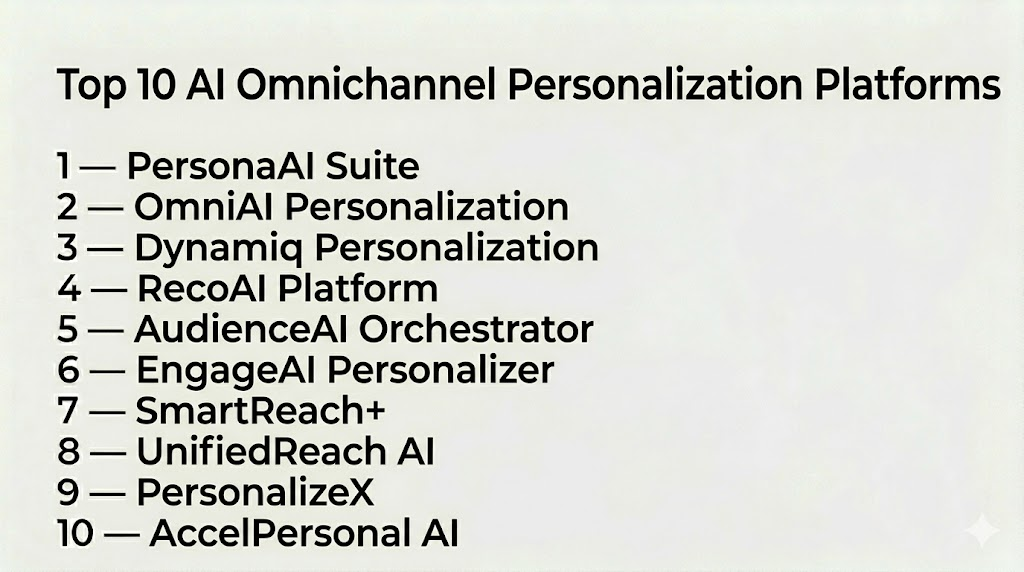
Top 10 AI Omnichannel Personalization Platforms
1 — PersonaAI Suite
One‑line verdict: Enterprise‑grade omnichannel personalization platform with deep AI orchestration and real‑time decisioning.
Short description:
PersonaAI Suite synthesizes customer behavior and first‑party data into unified profiles and orchestrates hyper‑personalized journeys across digital and physical channels.
Standout Capabilities
- Real‑time decision engine for web, mobile, and email
- Unified identity graph for customer stitching
- Predictive next‑best‑action recommendations
- Dynamic content & offer personalization
- Cross‑device profile unification
- Multilingual personalization
AI‑Specific Depth
- Model support: Proprietary with optional BYO support
- RAG / knowledge integration: Connects to CDPs and knowledge graphs
- Evaluation: Continuous model testing + human review
- Guardrails: Bias mitigation and policy constraint engines
- Observability: Heatmaps, latency, cost metrics, attribution analytics
Pros
- Extremely powerful real‑time personalization
- Strong enterprise governance
- Deep integrations with data sources
Cons
- Enterprise pricing tier
- Longer onboarding cycle
- Proprietary model lock‑in risks
Security & Compliance
SSO/SAML, RBAC, encryption; certifications: Not publicly stated
Deployment & Platforms
Cloud, Hybrid; Web dashboards
Integrations & Ecosystem
CDPs, DMPs, CRM systems, web & app SDKs, email & SMS APIs
Pricing Model
Tiered subscription; Not publicly stated
Best‑Fit Scenarios
- Enterprise digital experiences
- Omnichannel loyalty programs
- Large audiences requiring identity stitching
2 — OmniAI Personalization
One‑line verdict: Developer‑friendly API‑first personalization engine with real‑time decisioning.
Short description:
OmniAI Personalization provides flexible APIs for ingesting user signals and producing real‑time personalized responses for digital channels.
Standout Capabilities
- API‑first decisioning engine
- Real‑time personalization at high throughput
- Support for custom recommendation models
- Webhooks for event triggers
- Lightweight SDKs for mobile/web
AI‑Specific Depth
- Model support: BYO open‑source + hosted
- RAG / knowledge integration: Connects to custom knowledge stores
- Evaluation: Regression tests & metrics suite
- Guardrails: Customizable policy filters
- Observability: Latency & performance logs
Pros
- Flexible and integratable
- BYO model support
- Good for developers and custom logic
Cons
- Less marketer UI out of the box
- Requires engineering resources
- Feature gap versus enterprise suites
Security & Compliance
Encryption, RBAC; certifications: Not publicly stated
Deployment & Platforms
Cloud; SDKs available
Integrations & Ecosystem
APIs, webhooks, SDKs for send & receive signals
Pricing Model
Usage‑based API tiers; Not publicly stated
Best‑Fit Scenarios
- Custom digital experiences
- Development‑heavy teams
- Real‑time decisioning pipelines
3 — Dynamiq Personalization
One‑line verdict: Business‑user‑friendly platform with powerful segmentation and automated personalization workflows.
Short description:
Dynamiq combines intuitive marketer UIs with AI‑driven recommendations, dynamic content blocks, and cross‑channel campaigns.
Standout Capabilities
- Visual audience builder
- Automated journey orchestration
- Behavioral segmentation
- Predictive scoring for lifetime value
- Content recommendation modules
AI‑Specific Depth
- Model support: Proprietary
- RAG / knowledge integration: CDP connectors
- Evaluation: Human‑in‑the‑loop checks
- Guardrails: Output constraints based on policy
- Observability: Engagement analytics
Pros
- Great for non‑technical users
- Powerful segmentation tools
- Automated orchestration
Cons
- Limited BYO model support
- Workflows may be opaque
- Mid‑tier pricing
Security & Compliance
Encryption & RBAC; certifications: Not publicly stated
Deployment & Platforms
Cloud; Web
Integrations & Ecosystem
CDPs, CRM, marketing automation platforms
Pricing Model
Tiered subscription; Not publicly stated
Best‑Fit Scenarios
- Mid‑market marketers
- Cross‑channel campaigns
- Lifecycle orchestration
4 — RecoAI Platform
One‑line verdict: AI personalization engine focused on product recommendations and cross‑sell/upsell logic.
Short description:
RecoAI Platform excels at personalized product recommendations across web, email, and mobile channels with real‑time decisioning and intent signals.
Standout Capabilities
- Recommendation engines optimized for commerce
- Session‑aware personalization
- Purchase propensity scoring
- Product affinity maps
- Discount & promotion triggers
AI‑Specific Depth
- Model support: Proprietary + custom model hooks
- RAG / knowledge integration: Connects to catalog and user behavior stores
- Evaluation: Propensity & recall tests
- Guardrails: Recommendation policy engine
- Observability: Decision traces
Pros
- Great for commerce use cases
- Powerful product discovery
- Real‑time scoring
Cons
- Less suited for content personalization
- Not full omnichannel suite
- Limited BYO flexibility
Security & Compliance
Encryption; certifications: Not publicly stated
Deployment & Platforms
Cloud; Web
Integrations & Ecosystem
Commerce platforms, catalog APIs
Pricing Model
Subscription; Not publicly stated
Best‑Fit Scenarios
- E‑commerce personalization
- Upsell programs
- Real‑time recommendations
5 — AudienceAI Orchestrator
One‑line verdict: AI platform focused on audience segmentation and cross‑channel campaign optimization.
Short description:
AudienceAI Orchestrator unifies data sources and predictive segmentation to tailor campaigns with real‑time personalization triggers.
Standout Capabilities
- Predictive segmentation models
- Cross‑channel campaign triggers
- Churn risk scoring
- LTV & propensity models
- A/B audience experiments
AI‑Specific Depth
- Model support: Proprietary
- RAG / knowledge integration: CDP connectors
- Evaluation: Regression testing against outcomes
- Guardrails: Output constraints
- Observability: Segment performance metrics
Pros
- Strong segmentation & orchestration
- Campaign automation
- Predictive insights
Cons
- Not focused on real‑time rendering personalization
- Mid‑tier customization
- Limited BYO
Security & Compliance
Encryption & RBAC; certifications: Not publicly stated
Deployment & Platforms
Cloud; Web
Integrations & Ecosystem
CDPs, marketing automation
Pricing Model
Subscription; Not publicly stated
Best‑Fit Scenarios
- Cross‑channel marketing teams
- Audience experimentation
- Lifecycle campaigns
6 — EngageAI Personalizer
One‑line verdict: Lightweight AI personalization with quick start and basic orchestration features.
Short description:
EngageAI Personalizer offers easy setup and essential personalization features suitable for early stage and small‑to‑mid‑market use cases.
Standout Capabilities
- Basic user profiling
- Rule‑augmented recommendations
- Email & web personalization templates
- Simple segmentation
- Performance dashboards
AI‑Specific Depth
- Model support: Hosted proprietary
- RAG / knowledge integration: N/A
- Evaluation: Basic quality checks
- Guardrails: Rule filters
- Observability: High‑level dashboards
Pros
- Quick deployment
- Easy to use
- Affordable for mid‑market
Cons
- Limited advanced features
- No BYO models
- Less real‑time decisioning
Security & Compliance
Encryption; certifications: Not publicly stated
Deployment & Platforms
Cloud; Web
Integrations & Ecosystem
CDP integrations
Pricing Model
Subscription; Not publicly stated
Best‑Fit Scenarios
- Mid‑market and early growth
- Basic personalization needs
- Teams with limited resources
7 — SmartReach+
One‑line verdict: Personalization with an emphasis on lifecycle triggers and event‑driven actions.
Short description:
SmartReach+ focuses on reactive personalization triggered by events such as cart abandonment, onboarding, or re‑engagement.
Standout Capabilities
- Event‑driven personalization logic
- Lifecycle segment models
- Email, push & web triggers
- Conversion attribution reports
- Engagement scoring
AI‑Specific Depth
- Model support: Proprietary
- RAG / knowledge integration: Event store connections
- Evaluation: Outcome attribution tests
- Guardrails: Trigger constraint policies
- Observability: Analytics dashboards
Pros
- Good lifecycle focus
- Conversion optimization
- Cross‑channel triggers
Cons
- Less suited for real‑time render personalization
- Limited BYO support
- Not full omnichannel suite
Security & Compliance
Encryption; certifications: Not publicly stated
Deployment & Platforms
Cloud; Web
Integrations & Ecosystem
Event streams, marketing automation
Pricing Model
Subscription; Not publicly stated
Best‑Fit Scenarios
- Lifecycle campaign teams
- Engagement optimization
- Trigger‑driven personalization
8 — UnifiedReach AI
One‑line verdict: Comprehensive platform combining real‑time personalization and unified campaign orchestration.
Short description:
UnifiedReach AI bridges real‑time decisioning with campaign orchestration, analytics, and journey management for omnichannel personalization.
Standout Capabilities
- Real‑time content personalization
- Unified customer profiles
- Campaign orchestration
- Attribution insights
- AI‑powered journey recommendations
AI‑Specific Depth
- Model support: Proprietary
- RAG / knowledge integration: Strong CDP & journey context
- Evaluation: Drift detection and audits
- Guardrails: Bias & policy engines
- Observability: Comprehensive dashboards
Pros
- Balanced personalization + orchestration
- Strong analytics
- Content & offer integration
Cons
- Enterprise focus
- Complex workflows
- Limited BYO
Security & Compliance
Encryption, RBAC; certifications: Not publicly stated
Deployment & Platforms
Cloud; Web
Integrations & Ecosystem
CDP, CRM, analytics
Pricing Model
Subscription; Not publicly stated
Best‑Fit Scenarios
- Omnichannel enterprise brands
- Journey orchestration teams
- Cross‑device personalization
9 — PersonalizeX
One‑line verdict: AI personalization platform with strong analytics and recommendation explanations.
Short description:
PersonalizeX emphasizes explainability and analytics, helping teams understand why certain personalization decisions were made.
Standout Capabilities
- Recommendation explanation logs
- Conversion uplift analytics
- Predictive intent scoring
- Dynamic segmenting
- Conversion attribution
AI‑Specific Depth
- Model support: Proprietary
- RAG / knowledge integration: Taxonomy & event data
- Evaluation: Regression tests + human validation
- Guardrails: Explainability filters
- Observability: Analytics & trace logs
Pros
- Strong explainability focus
- Good conversion insights
- Balanced personalization
Cons
- Mid‑tier customization
- No BYO
- Not full omnichannel suite
Security & Compliance
Encryption; certifications: Not publicly stated
Deployment & Platforms
Cloud; Web
Integrations & Ecosystem
Analytics tools
CDP connectors
Pricing Model
Subscription; Not publicly stated
Best‑Fit Scenarios
- Data teams needing insight
- Analytics‑driven personalization
- Conversion optimization
10 — AccelPersonal AI
One‑line verdict: Performance‑driven personalization focused on conversion optimization and recommendation precision.
Short description:
AccelPersonal AI emphasizes conversion lift and precision personalization with propensity models and A/B readiness.
Standout Capabilities
- Conversion lift prediction
- A/B experiments on personalization rules
- Propensity scoring
- Dynamic content optimization
- Latency‑optimized decisioning
AI‑Specific Depth
- Model support: Proprietary
- RAG / knowledge integration: Catalog & behavior data
- Evaluation: A/B & uplift tests
- Guardrails: Conversion policy filters
- Observability: Performance dashboards
Pros
- Conversion‑focused innovation
- Precise recommendations
- A/B testing support
Cons
- Limited BYO
- Enterprise orientation
- Less lifecycle orchestration
Security & Compliance
Encryption, RBAC; certifications: Not publicly stated
Deployment & Platforms
Cloud; Web
Integrations & Ecosystem
Analytics & CDP connectors
Pricing Model
Subscription; Not publicly stated
Best‑Fit Scenarios
- Conversion optimization teams
- Performance marketing
- Rapid growth brands
Comparison Table
| Tool Name | Best For | Deployment | Model Flexibility | Strength | Watch‑Out | Public Rating |
|---|---|---|---|---|---|---|
| PersonaAI Suite | Enterprise omnichannel | Cloud/Hybrid | Proprietary/BYO | Real‑time decisioning | Enterprise pricing | N/A |
| OmniAI Personalization | Dev & engineers | Cloud | Hosted/BYO | API flexibility | Requires engineering | N/A |
| Dynamiq Personalization | Mid‑market marketers | Cloud | Proprietary | Segmentation & orchestration | Limited BYO | N/A |
| RecoAI Platform | E‑commerce recommendations | Cloud | Proprietary | Commerce recommendations | Not full suite | N/A |
| AudienceAI Orchestrator | Campaign optimization | Cloud | Proprietary | Predictive segmentation | Not real‑time | N/A |
| EngageAI Personalizer | Basic personalization | Cloud | Proprietary | Quick start | Limited advanced features | N/A |
| SmartReach+ | Lifecycle engagements | Cloud | Proprietary | Trigger logic | Not real‑time personalization | N/A |
| UnifiedReach AI | Balanced omni suite | Cloud | Proprietary | Orchestration + personalization | Complexity | N/A |
| PersonalizeX | Analytics & explainability | Cloud | Proprietary | Explainability | Not full suite | N/A |
| AccelPersonal AI | Conversion optimization | Cloud | Proprietary | Performance focus | Enterprise bias | N/A |
Scoring & Evaluation
Scoring is comparative; weighted totals reflect overall personalization readiness across omnichannel contexts.
| Tool | Core | Reliability/Eval | Guardrails | Integrations | Ease | Perf/Cost | Security/Admin | Support | Weighted Total |
|---|---|---|---|---|---|---|---|---|---|
| PersonaAI Suite | 9 | 9 | 9 | 9 | 7 | 7 | 8 | 7 | 8.3 |
| OmniAI Personalization | 8 | 8 | 8 | 9 | 8 | 8 | 7 | 6 | 7.9 |
| Dynamiq Personalization | 8 | 8 | 8 | 8 | 8 | 7 | 7 | 7 | 7.8 |
| RecoAI Platform | 8 | 8 | 8 | 8 | 7 | 7 | 7 | 6 | 7.4 |
| AudienceAI Orchestrator | 7 | 8 | 7 | 8 | 7 | 7 | 7 | 6 | 7.1 |
| EngageAI Personalizer | 6 | 7 | 7 | 7 | 8 | 8 | 6 | 6 | 6.9 |
| SmartReach+ | 7 | 7 | 7 | 7 | 8 | 7 | 6 | 6 | 7.0 |
| UnifiedReach AI | 8 | 9 | 8 | 8 | 7 | 7 | 8 | 7 | 7.9 |
| PersonalizeX | 7 | 8 | 8 | 7 | 8 | 8 | 6 | 7 | 7.4 |
| AccelPersonal AI | 8 | 8 | 8 | 7 | 7 | 8 | 7 | 6 | 7.5 |
Top 3 for Enterprise: PersonaAI Suite, UnifiedReach AI, OmniAI Personalization
Top 3 for SMB: EngageAI Personalizer, Dynamiq Personalization, SmartReach+
Top 3 for Developers: OmniAI Personalization, PersonaAI Suite, AccelPersonal AI
Which AI Omnichannel Personalization Platform Is Right for You?
Solo / Freelancer
Smaller use cases or early growth needs may benefit from EngageAI Personalizer or entry‑tier tools with straightforward setups and quick segmentation features.
SMB
Mid‑market brands requiring cross‑channel personalization without heavy engineering should explore Dynamiq Personalization and SmartReach+ for campaign orchestration.
Mid‑Market
Brands ready for data‑driven journeys across channels should consider OmniAI Personalization or UnifiedReach AI for balanced real‑time decisioning and campaign workflows.
Enterprise
Complex personalization across global audiences and channels is best supported by PersonaAI Suite with deep identity resolution, governance, and real‑time decisioning.
Regulated industries (finance/healthcare/public sector)
Prioritize platforms with robust privacy controls, consent management, and explainability — such as PersonaAI Suite and OmniAI Personalization.
Budget vs Premium
Lightweight tools are ideal for early personalization exploration, while premium suites deliver strong analytics, orchestration, and real‑time decisioning.
Build vs Buy
Developer‑centric teams that want maximum flexibility can build on OmniAI Personalization with BYO models; typical marketers may prefer turnkey enterprise platforms.
Implementation Playbook (30 / 60 / 90 Days)
30 Days:
- Consolidate primary data sources into unified profiles
- Define key personalization goals and channel priorities
- Configure initial segmentation and decision rules
60 Days:
- Deploy real‑time decisioning in high‑impact channels
- Implement bias guardrails and evaluation tests
- Set up observability dashboards for performance tracking
90 Days:
- Expand to additional channels and lifecycle journeys
- Establish feedback loops for continuous model tuning
- Optimize recommendation precision and attribution analytics
Common Mistakes & How to Avoid Them
- Failing to unify identities across channels
- Over‑relying on rule‑based segments without AI evaluation
- Ignoring privacy and consent policy enforcement
- Not testing personalization impact on conversion outcomes
- Neglecting explainability and audit logs
- Lack of observability dashboards
- Deploying without guardrails against bias
- Choosing tools without BYO or open‑source options
- No evaluation framework post‑model updates
- Ignoring cross‑device context retention
- Missing content & offer recommendation optimization
- Ignoring multimodal signals
- Over‑automating without human review checkpoints
- No rollback or fail‑safe workflows
FAQs
1 — What is omnichannel personalization?
Omnichannel personalization uses unified customer data to deliver consistent, adaptive experiences across all digital and physical channels.
2 — How does AI improve personalization?
AI uses patterns, behavior, and contextual signals to tailor offers, messages, and recommendations dynamically rather than based on static rules.
3 — What is real‑time decisioning?
Real‑time decisioning enables personalization at the moment of interaction, often within milliseconds.
4 — Do these platforms require a CDP?
Many integrate with CDPs for unified profiles, though some built‑in identity stitching features may exist.
5 — How are guardrails used?
Guardrails are policy enforcement rules preventing biased or inappropriate personalization outcomes.
6 — Can I use my own models?
Some platforms support BYO models, especially API‑first and developer‑centric ones.
7 — How do I evaluate effectiveness?
Track conversion lift, engagement, personalization accuracy, and attribution metrics.
8 — Are these tools compliant?
Platforms typically include privacy controls and consent frameworks, but certification status varies.
9 — What channels are supported?
Web, mobile, email, SMS, in‑store systems, and other connected touchpoints.
10 — What is RAG personalization?
It’s the integration of content retrieval with generative personalization logic to deliver informative responses.
11 — How do identity graphs help?
They unify customer identities across devices and browsers to provide consistent profiles.
12 — Is campaign orchestration included?
Yes, many platforms include cross‑channel campaign engines that tie personalization into broader marketing workflows.
Conclusion
AI Omnichannel Personalization Platforms are now essential for brands seeking to create meaningful, relevant experiences across every customer touchpoint. From real‑time decisioning and identity unification to cross‑channel orchestration and privacy controls, these tools drive outcomes in engagement, loyalty, conversion, and lifetime value. Choosing the best platform depends on your team’s technical capabilities, data maturity, and channel needs.

Find Trusted Cardiac Hospitals
Compare heart hospitals by city and services — all in one place.
Explore Hospitals
A major gap is governance and control over AI-generated decisions.
In real enterprise environments, personalization is not just “AI recommends content”—it must include:
Most tools listed (e.g., Insider, Bloomreach, Dynamic Yield) provide basic rule overrides, but none eliminate the need for an internal policy engine that sits above the personalization layer. Without it, teams often face uncontrolled experiments that impact revenue consistency.