
Introduction
AI Personalized Search for E-commerce enables online retailers to deliver highly relevant and tailored product search experiences to shoppers. These tools leverage AI and machine learning to analyze user behavior, historical interactions, and contextual signals to dynamically rank search results and recommend products. In 2026, such AI-powered search is critical for improving conversion rates, user engagement, and revenue optimization.
Real-world use cases include:
- Personalized product recommendations during site search
- Predicting shopper intent for better ranking
- Dynamic prioritization of products by relevance, popularity, or likelihood to convert
- Search-based merchandising and promotions
- Multimodal search (images, voice, text) for richer customer experiences
- AI-driven cross-sell and upsell suggestions
Evaluation criteria buyers should use:
- Search relevance and personalization accuracy
- Real-time indexing speed and scalability
- Integration with e-commerce platforms (Shopify, Magento, Salesforce, etc.)
- Support for natural language and voice search
- Advanced analytics and performance dashboards
- AI evaluation and testing framework
- Guardrails to prevent bias or irrelevant results
- Security, compliance, and data privacy
- Multimodal search capability
- Ease of integration and deployment
- Extensibility through APIs and SDKs
- Observability and monitoring of AI performance
Best for: e-commerce teams, product managers, digital marketers, and medium-to-large online retailers seeking to optimize search-driven conversions.
Not ideal for: very small sites with limited product catalogs, businesses relying solely on simple keyword searches, or organizations without sufficient traffic/data to leverage AI effectively.
What’s Changed in AI Personalized Search for E-commerce in 2026+
- Multimodal search: combining text, images, and voice for richer experiences
- Context-aware personalization: AI predicts user intent in real-time
- Real-time catalog indexing: instant ranking updates as products change
- Hybrid AI models: combining proprietary, BYO, and open-source models
- Advanced evaluation frameworks: A/B testing and conversion metrics
- Guardrails for fairness: mitigating bias and irrelevant results
- Scalability: optimized for high traffic and large catalogs
- Integration with recommendation engines and marketing automation
- Privacy-first design: GDPR and CCPA compliant personalization
- Observability dashboards: monitor query performance, latency, and metrics
- Predictive analytics: anticipating trends and seasonal behaviors
Quick Buyer Checklist (Scan-Friendly)
- Confirm data privacy & retention compliance
- Evaluate AI model options: proprietary, BYO, or open-source
- Ensure multimodal support: text, image, voice
- Validate search relevance & personalization performance
- Check guardrails for bias mitigation
- Assess latency & real-time indexing capabilities
- Review analytics and observability dashboards
- Verify integration with e-commerce platforms
- Consider API and SDK extensibility
- Ensure scalability for peak traffic
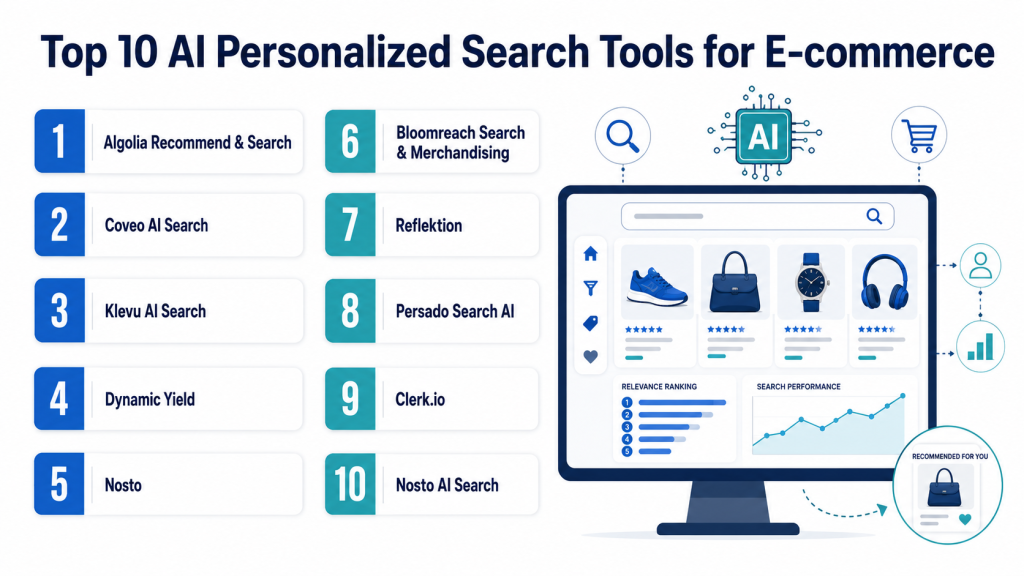
Top 10 AI Personalized Search Tools for E-commerce
#1 — Algolia Recommend & Search
One-line verdict: Ideal for e-commerce teams needing AI-driven personalized search with merchandising controls.
Short description: Algolia provides AI-powered search and recommendation services that dynamically rank products based on relevance and shopper behavior.
Standout Capabilities
- Instant search indexing
- AI-driven personalization
- Merchandising controls for promotions
- Synonym and typo tolerance
- Analytics dashboards
- A/B testing for ranking rules
- Recommendations engine
AI-Specific Depth
- Model support: Proprietary
- RAG / knowledge integration: API connections to catalogs and CRM
- Evaluation: A/B testing, conversion tracking
- Guardrails: Business rules for ranking
- Observability: Query latency, token usage
Pros
- Fast indexing and results
- Flexible personalization rules
- Strong developer ecosystem
Cons
- Enterprise pricing for large catalogs
- Limited multimodal AI
- Advanced customization requires technical expertise
Security & Compliance
SSO, RBAC, encryption; Certifications: Not publicly stated
Deployment & Platforms
Web, Cloud
Integrations & Ecosystem
Shopify, Magento, Salesforce Commerce Cloud, APIs, SDKs
Pricing Model
Tiered SaaS subscription
Best-Fit Scenarios
- Large e-commerce catalogs
- Personalized product discovery
- Merchandising promotions
#2 — Coveo AI Search
One-line verdict: Suited for enterprises needing contextual AI search across web, mobile, and commerce channels.
Short description: Coveo delivers AI-powered search and personalization that integrates across multiple channels to optimize relevance and conversion.
Standout Capabilities
- Contextual AI ranking
- Cross-channel personalization
- Predictive search suggestions
- Analytics dashboards
- A/B testing
- Recommendation engine integration
- Voice search support
AI-Specific Depth
- Model support: Proprietary + open-source components
- RAG / knowledge integration: Catalog, CRM, knowledge bases
- Evaluation: Conversion tracking, regression testing
- Guardrails: Bias mitigation, ranking policies
- Observability: Latency, query monitoring
Pros
- Multichannel personalization
- Strong AI ranking accuracy
- Deep analytics
Cons
- Implementation complexity
- Higher cost for SMBs
- Advanced features require developers
Security & Compliance
SSO, encryption; Certifications: Not publicly stated
Deployment & Platforms
Cloud
Integrations & Ecosystem
E-commerce platforms, CRM, BI tools, APIs
Pricing Model
Enterprise SaaS
Best-Fit Scenarios
- Multi-channel e-commerce
- Predictive search and recommendations
- Enterprise personalization
#3 — Klevu AI Search
One-line verdict: Best for self-learning AI search with easy integration for mid-size e-commerce stores.
Short description: Klevu provides AI-driven search that learns from shopper behavior to improve relevance over time.
Standout Capabilities
- Self-learning AI search
- Personalization based on behavior
- Natural language query support
- Merchandising rules integration
- Search analytics dashboards
- Recommendations engine
- Spellcheck and synonyms
AI-Specific Depth
- Model support: Proprietary
- RAG / knowledge integration: Catalogs, CRM
- Evaluation: Behavioral learning, conversion tracking
- Guardrails: Ranking business rules
- Observability: Query performance metrics
Pros
- Easy integration
- Self-learning AI
- Strong natural language processing
Cons
- Limited multimodal support
- Mid-sized catalogs only
- Advanced analytics require enterprise plan
Security & Compliance
SSO, encryption; Certifications: Not publicly stated
Deployment & Platforms
Web, Cloud
Integrations & Ecosystem
Magento, Shopify, Salesforce, APIs
Pricing Model
Tiered SaaS
Best-Fit Scenarios
- Mid-sized e-commerce websites
- Self-learning search
- Personalization campaigns
#4 — Dynamic Yield
One-line verdict: Ideal for retailers needing AI-driven personalized search with integrated recommendation capabilities.
Short description: Dynamic Yield combines AI search and recommendation to deliver personalized experiences across web and mobile.
Standout Capabilities
- Contextual personalization
- AI-powered recommendations
- Multichannel experience delivery
- Real-time search analytics
- Scenario-based A/B testing
- Merchandising control
- Conversion tracking
AI-Specific Depth
- Model support: Proprietary AI
- RAG / knowledge integration: Product catalogs, CRM
- Evaluation: Conversion analysis, behavioral testing
- Guardrails: Business rules for relevance
- Observability: Latency, query performance
Pros
- Strong AI recommendations
- Multichannel personalization
- Real-time analytics
Cons
- High cost for SMBs
- Complex setup
- Requires ongoing tuning
Security & Compliance
Encryption, RBAC; Certifications: Not publicly stated
Deployment & Platforms
Web, Cloud
Integrations & Ecosystem
E-commerce platforms, APIs, SDKs
Pricing Model
SaaS subscription
Best-Fit Scenarios
- Large online retailers
- Conversion optimization
- Multichannel personalization
#5 — Nosto
One-line verdict: Best for e-commerce SMBs seeking easy-to-use AI personalization and search.
Short description: Nosto provides AI-powered product search and recommendations for online retailers to enhance shopper experience and conversion.
Standout Capabilities
- AI-powered search and product recommendations
- Customer segmentation
- Automated personalization rules
- Analytics dashboards
- Merchandising integration
- Recommendations A/B testing
- Conversion tracking
AI-Specific Depth
- Model support: Proprietary AI
- RAG / knowledge integration: Catalogs, e-commerce data
- Evaluation: Behavioral learning, conversion tracking
- Guardrails: Ranking policies
- Observability: Search performance metrics
Pros
- Easy to deploy
- SMB-friendly
- Built-in analytics
Cons
- Limited enterprise features
- Less advanced AI modeling
- Catalog size constraints
Security & Compliance
SSO, encryption; Certifications: Not publicly stated
Deployment & Platforms
Web, Cloud
Integrations & Ecosystem
Shopify, Magento, WooCommerce, APIs
Pricing Model
Tiered SaaS
Best-Fit Scenarios
- SMB e-commerce
- Personalized product discovery
- Small catalog merchandising
#6 — Bloomreach Search & Merchandising
One-line verdict: Ideal for large retailers needing AI search with deep merchandising and analytics.
Short description: Bloomreach uses AI to deliver personalized search, product recommendations, and advanced merchandising for e-commerce platforms.
Standout Capabilities
- Contextual AI search
- Dynamic merchandising
- Natural language processing
- Recommendations engine
- Analytics dashboards
- AI-powered synonyms and query expansion
- Scenario testing
AI-Specific Depth
- Model support: Proprietary AI
- RAG / knowledge integration: Catalogs, ERP
- Evaluation: Conversion and ranking testing
- Guardrails: Business rule enforcement
- Observability: Query latency, analytics
Pros
- Strong merchandising controls
- AI personalization
- Enterprise-grade analytics
Cons
- Complex setup
- High enterprise pricing
- Developer support needed
Security & Compliance
SSO, RBAC; Certifications: Not publicly stated
Deployment & Platforms
Web, Cloud
Integrations & Ecosystem
Magento, Shopify, Salesforce, APIs
Pricing Model
Enterprise SaaS
Best-Fit Scenarios
- Enterprise retailers
- High-volume catalog personalization
- Advanced merchandising
#7 — Reflektion
One-line verdict: Best for mid-size e-commerce sites needing AI-driven search and personalization.
Short description: Reflektion leverages AI to dynamically personalize search results and recommendations in real time.
Standout Capabilities
- Real-time AI personalization
- Recommendations engine
- Search analytics dashboards
- Behavioral tracking
- Merchandising control
- Conversion optimization
- Scenario A/B testing
AI-Specific Depth
- Model support: Proprietary AI
- RAG / knowledge integration: Catalog, CRM
- Evaluation: Conversion analysis
- Guardrails: Ranking and merchandising rules
- Observability: Query metrics
Pros
- Real-time personalization
- Easy integration
- SMB-friendly
Cons
- Limited enterprise scalability
- Less multimodal support
- Manual tuning required
Security & Compliance
Encryption, RBAC; Certifications: Not publicly stated
Deployment & Platforms
Web, Cloud
Integrations & Ecosystem
Shopify, Magento, APIs
Pricing Model
SaaS subscription
Best-Fit Scenarios
- Mid-size e-commerce
- Real-time search personalization
- Behavioral recommendations
#8 — Persado Search AI
One-line verdict: Suited for e-commerce teams focusing on AI-powered semantic search and messaging.
Short description: Persado combines AI search with NLP to understand intent and optimize search and product discovery messaging.
Standout Capabilities
- NLP-powered query understanding
- Personalized search ranking
- Recommendations engine
- Semantic search
- Analytics and insights
- Integration with merchandising
- Multichannel search support
AI-Specific Depth
- Model support: Proprietary AI
- RAG / knowledge integration: Catalogs, CRM
- Evaluation: Intent and relevance testing
- Guardrails: Semantic relevance rules
- Observability: Search performance dashboards
Pros
- AI semantic search
- Intent-driven personalization
- Analytics insights
Cons
- Limited SMB features
- Requires NLP expertise
- Higher cost
Security & Compliance
SSO, encryption; Certifications: Not publicly stated
Deployment & Platforms
Web, Cloud
Integrations & Ecosystem
Shopify, Magento, APIs
Pricing Model
Enterprise SaaS
Best-Fit Scenarios
- Semantic search
- AI messaging optimization
- High-traffic enterprise e-commerce
#9 — Clerk.io
One-line verdict: Best for smaller retailers needing plug-and-play AI search with recommendations.
Short description: Clerk.io provides AI search, product recommendations, and email personalization with easy setup.
Standout Capabilities
- Plug-and-play AI search
- Product recommendations
- Email personalization
- Analytics dashboards
- Behavioral insights
- Merchandising integration
- Conversion tracking
AI-Specific Depth
- Model support: Proprietary AI
- RAG / knowledge integration: Catalogs
- Evaluation: Conversion testing
- Guardrails: Ranking rules
- Observability: Query performance metrics
Pros
- Easy setup
- SMB-friendly
- Conversion-focused
Cons
- Limited enterprise features
- Catalog size limitations
- Less customization
Security & Compliance
Encryption; Certifications: Not publicly stated
Deployment & Platforms
Web, Cloud
Integrations & Ecosystem
Shopify, Magento, WooCommerce, APIs
Pricing Model
SaaS subscription
Best-Fit Scenarios
- Small e-commerce sites
- Basic personalization
- Quick setup search solution
#10 — Nosto AI Search
One-line verdict: Excellent for SMB and mid-market retailers needing AI-driven search and recommendation automation.
Short description: Nosto provides AI search and recommendations to enhance product discovery and increase conversion rates.
Standout Capabilities
- Personalized AI search
- Recommendations engine
- Behavioral insights
- Merchandising rules
- Analytics dashboards
- Scenario testing
- Conversion optimization
AI-Specific Depth
- Model support: Proprietary AI
- RAG / knowledge integration: Catalogs
- Evaluation: Behavioral conversion tracking
- Guardrails: Ranking and merchandising rules
- Observability: Query latency, token metrics
Pros
- Easy integration
- Behavioral learning
- Conversion-focused insights
Cons
- Limited enterprise capabilities
- Small catalog focus
- Manual optimization may be required
Security & Compliance
SSO, encryption; Certifications: Not publicly stated
Deployment & Platforms
Web, Cloud
Integrations & Ecosystem
Shopify, Magento, WooCommerce, APIs
Pricing Model
Tiered SaaS
Best-Fit Scenarios
- SMB e-commerce
- Personalized search
- Recommendation automation
Comparison Table
| Tool Name | Best For | Deployment | Model Flexibility | Strength | Watch-Out | Public Rating |
|---|---|---|---|---|---|---|
| Algolia | Enterprise e-commerce | Cloud | Proprietary | Fast, flexible personalization | Enterprise cost | N/A |
| Coveo | Enterprise multichannel | Cloud | Proprietary + open-source | Contextual AI search | Complex setup | N/A |
| Klevu | Mid-sized e-commerce | Cloud | Proprietary | Self-learning AI | Limited multimodal | N/A |
| Dynamic Yield | Enterprise | Cloud | Proprietary | Personalized recommendations | Complex tuning | N/A |
| Nosto | SMB | Cloud | Proprietary | Easy-to-use personalization | Limited enterprise | N/A |
| Bloomreach | Large retailers | Cloud | Proprietary | Merchandising + AI | Complex integration | N/A |
| Reflektion | Mid-size e-commerce | Cloud | Proprietary | Real-time personalization | Limited enterprise | N/A |
| Persado | Enterprise | Cloud | Proprietary | Semantic search | NLP expertise required | N/A |
| Clerk.io | SMB | Cloud | Proprietary | Plug-and-play search | Limited customization | N/A |
| Nosto AI Search | SMB / Mid-market | Cloud | Proprietary | Behavioral recommendations | Small catalog | N/A |
Scoring & Evaluation
| Tool | Core | Reliability/Eval | Guardrails | Integrations | Ease | Perf/Cost | Security/Admin | Support | Weighted Total |
|---|---|---|---|---|---|---|---|---|---|
| Algolia | 9 | 9 | 8 | 8 | 8 | 7 | 8 | 7 | 8.1 |
| Coveo | 8 | 9 | 8 | 8 | 7 | 7 | 8 | 7 | 7.8 |
| Klevu | 8 | 8 | 7 | 7 | 8 | 8 | 7 | 7 | 7.6 |
| Dynamic Yield | 8 | 8 | 8 | 8 | 7 | 7 | 8 | 7 | 7.7 |
| Nosto | 7 | 7 | 7 | 7 | 8 | 7 | 7 | 7 | 7.1 |
| Bloomreach | 9 | 9 | 8 | 8 | 7 | 7 | 8 | 7 | 7.9 |
| Reflektion | 8 | 8 | 7 | 7 | 8 | 7 | 7 | 7 | 7.3 |
| Persado | 8 | 8 | 8 | 7 | 7 | 7 | 8 | 7 | 7.5 |
| Clerk.io | 7 | 7 | 7 | 7 | 8 | 7 | 7 | 7 | 7.0 |
| Nosto AI | 7 | 7 | 7 | 7 | 8 | 7 | 7 | 7 | 7.0 |
Top 3 for Enterprise: Algolia, Coveo, Bloomreach
Top 3 for SMB: Klevu, Nosto, Clerk.io
Top 3 for Developers: Dynamic Yield, Persado, Reflektion
Which AI Personalized Search Tool Is Right for You?
Solo / Freelancer
- Klevu: Easy integration, self-learning AI
- Clerk.io: Plug-and-play, low overhead
SMB
- Nosto: Behavioral recommendations, easy-to-use
- Klevu: Mid-sized catalogs, personalization
Mid-Market
- Reflektion: Real-time AI personalization for mid-sized catalogs
- Dynamic Yield: AI-driven recommendations and merchandising
Enterprise
- Algolia: Fast, flexible AI-powered search with advanced personalization
- Coveo: Multichannel contextual AI search for large catalogs
- Bloomreach: Enterprise-grade personalized search with merchandising insights
Regulated Industries
- Persado: Semantic AI search with bias mitigation for sensitive sectors
- Algolia / Coveo: GDPR-compliant personalization and privacy-first design
Budget vs Premium
- Budget / SMB: Clerk.io, Klevu, Nosto – easy-to-deploy, smaller catalogs
- Premium / Enterprise: Algolia, Coveo, Bloomreach – full-scale, multichannel AI search
Build vs Buy
- Build: Only recommended if internal data scientists can manage search models, ranking, and analytics
- Buy: Recommended for most retailers for speed, reliability, and AI-driven personalization
Implementation Playbook (30 / 60 / 90 Days)
30 Days:
- Connect e-commerce catalog and user behavior data
- Configure AI search engine and default ranking rules
- Validate search relevance using historical queries
60 Days:
- Implement personalization models and A/B testing
- Integrate recommendation engine for upsell/cross-sell
- Train marketing and product teams on dashboard insights
90 Days:
- Optimize AI models based on user engagement and conversion metrics
- Scale indexing for peak traffic periods
- Monitor guardrails and implement regular evaluation/retraining
AI-specific tasks: monitor personalization accuracy, red-team query tests, track bias, observe token/latency metrics, and ensure privacy compliance.
Common Mistakes & How to Avoid Them
- Ignoring input data quality and behavior signals
- Over-reliance on AI without human review
- Lack of A/B testing or evaluation framework
- Not monitoring search performance metrics or analytics
- Bias in AI recommendations or ranking
- Neglecting catalog updates for indexing
- Poor integration with merchandising and recommendation tools
- Overcomplicated implementation for small catalogs
- Ignoring multimodal search opportunities
- Failing to track conversion impact
- Insufficient privacy and compliance monitoring
- Underestimating training requirements for teams
- Ignoring seasonal or trending behavior
FAQs
1- What is AI Personalized Search for E-commerce?
It is an AI system that tailors search results to users based on behavior, context, and product attributes to improve conversions.
2- Can AI handle product synonyms and typos?
Yes, most AI search platforms automatically handle synonyms, typos, and query expansion to improve relevance.
3- Do these tools support voice and image search?
Many support multimodal search including text, voice, and images, enhancing discoverability for customers.
4- Can I use my own AI models?
Some tools support BYO models; others rely on proprietary AI engines.
5- How are AI models evaluated?
Evaluation is done using A/B testing, conversion tracking, regression testing, and real-time behavioral monitoring.
6- How are guardrails implemented?
Ranking rules, bias detection, and business policy constraints ensure relevant and safe search results.
7- Are these tools suitable for small catalogs?
Yes, tools like Clerk.io, Klevu, and Nosto are optimized for small to mid-size catalogs.
8- Can these tools integrate with Shopify or Magento?
Yes, all major platforms support API integration with top AI search providers.
9- How does personalization improve revenue?
By delivering relevant products, increasing add-to-cart rates, and reducing bounce rates.
10- What analytics do these tools provide?
They offer query analytics, click-through tracking, conversion insights, and relevance metrics.
11- Can AI search help with merchandising?
Yes, tools like Algolia, Dynamic Yield, and Bloomreach allow dynamic product ranking for campaigns.
12- Do these tools comply with GDPR/CCPA?
Most enterprise-grade platforms implement privacy-first AI and compliance mechanisms.
Conclusion
AI Personalized Search for E-commerce in 2026 provides critical conversion and engagement advantages by leveraging user behavior, AI ranking, and real-time personalization. Selecting the right tool depends on catalog size, traffic, budget, and AI maturity. Start by shortlisting tools that meet your integration, AI depth, and personalization needs. Pilot search experiences, validate relevance and conversion impact, then scale across the full e-commerce site. Monitor continuously for performance, guardrails, and privacy compliance.

Find Trusted Cardiac Hospitals
Compare heart hospitals by city and services — all in one place.
Explore Hospitals