
Introduction
AI Protein Structure Prediction Pipelines are computational platforms that leverage artificial intelligence, deep learning, and graph-based modeling to predict three-dimensional protein structures from amino acid sequences. These pipelines accelerate understanding of protein folding, function, and interactions, enabling researchers to design therapeutics, vaccines, and enzymes with high accuracy and efficiency.
This matters because traditional experimental methods such as X-ray crystallography and cryo-EM are slow, costly, and sometimes infeasible for certain proteins. AI-driven pipelines allow rapid protein structure exploration, guide drug design, facilitate protein engineering, and support functional annotation of novel proteins. They are crucial for precision medicine, structural biology, and biotechnology innovation.
Real-world use cases include:
- Predicting 3D protein structures from sequences
- Identifying active sites for drug discovery
- Designing novel enzymes for industrial applications
- Supporting antibody and vaccine development
- Guiding mutational studies for protein engineering
- Annotating protein function in genomics projects
Evaluation Criteria for Buyers:
- Prediction accuracy and confidence metrics
- Speed and throughput of structural predictions
- Support for complex proteins and multimers
- Integration with molecular docking or drug design pipelines
- Visualization and analysis tools
- Scalability for large proteomes
- Model interpretability and uncertainty estimation
- Data security and compliance for proprietary sequences
- Support for experimental validation
- Deployment flexibility
- API and workflow integration capabilities
- Vendor support and community ecosystem
Best for: Pharmaceutical and biotech research teams, computational biologists, structural bioinformatics groups, and academic labs focused on protein function and engineering.
Not ideal for: Teams with no computational infrastructure or minimal sequence data relying exclusively on experimental methods.
What’s Changed in AI Protein Structure Prediction Pipelines
- Enhanced deep learning architectures for folding predictions
- Integration of multimodal inputs including sequences, co-evolutionary data, and experimental maps
- Improved confidence scoring and uncertainty estimation
- Increased throughput for proteome-scale predictions
- Support for protein-protein and protein-ligand interactions
- Integration with docking and drug design pipelines
- Observability and resource usage tracking
- Guardrails for physically plausible structures
- Cloud-based scalability
- Modular APIs for workflow automation
- Compliance with data privacy and IP protection
- Community-driven open-source contributions
Quick Buyer Checklist
- Accuracy and confidence of predictions
- Throughput and scalability
- Multi-chain and complex protein support
- Integration with docking or drug design pipelines
- Observability and logging
- Guardrails and plausibility checks
- Deployment flexibility
- Data security, privacy, and IP protection
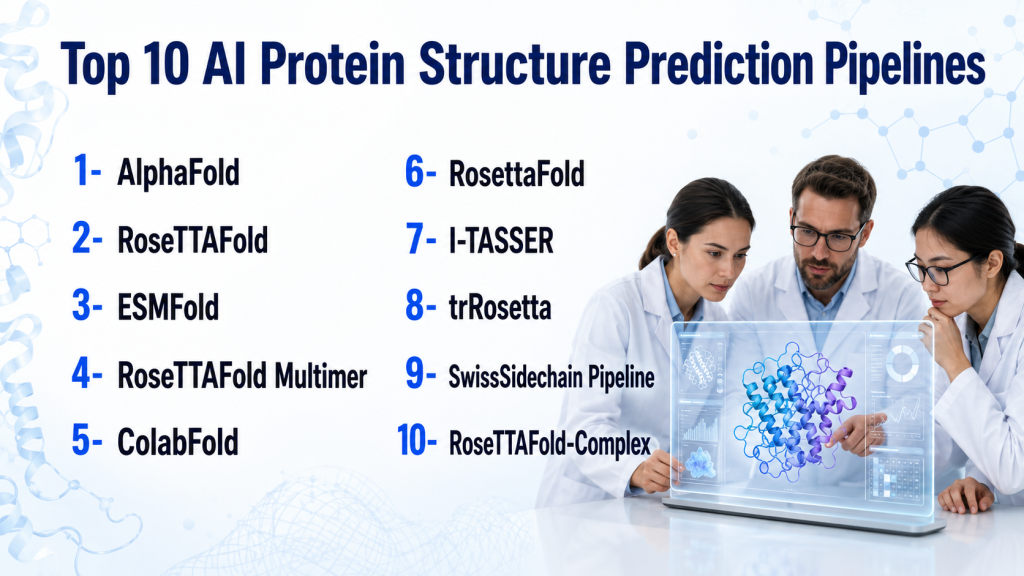
Top 10 AI Protein Structure Prediction Pipelines
1- AlphaFold
One-line verdict: Industry-leading pipeline for high-accuracy protein structure prediction.
Short description: AlphaFold predicts protein structures with remarkable accuracy using deep learning. It is widely used for structural biology, drug discovery, and protein function annotation.
Standout Capabilities
- High-accuracy 3D predictions
- Full proteome-scale prediction support
- Per-residue confidence scoring
- Benchmarking with experimental datasets
- Open-source and cloud access
AI-Specific Depth
- Model support: Proprietary deep learning with open models
- RAG / knowledge integration: Sequence databases and MSA data
- Evaluation: Benchmarking with PDB structures
- Guardrails: Physically plausible folding constraints
- Observability: Confidence per residue
Pros
- High single-chain accuracy
- Proteome-scale predictions
- Open-source access
Cons
- Limited multi-chain modeling
- Requires high computational resources
- Cloud cost considerations
Security & Compliance
- Cloud encryption
- Certifications: Not publicly stated
Deployment & Platforms
- Cloud, Linux, Web
Integrations & Ecosystem
- API access
- Compatible with docking pipelines
Pricing Model
- Free for academic; subscription for enterprise
- Not publicly stated
Best-Fit Scenarios
- Structural biology research
- Drug target modeling
- Proteome-wide studies
2- RoseTTAFold
One-line verdict: Flexible pipeline for multi-chain and complex protein predictions.
Short description: RoseTTAFold uses a three-track neural network to predict protein structures, including complexes, and supports experimental and functional analysis.
Standout Capabilities
- Multi-chain predictions
- Rapid batch processing
- Sequence, MSA, and structural template integration
- Variant and mutation modeling
- Supports downstream validation
AI-Specific Depth
- Model support: Open-source deep learning
- RAG / knowledge integration: Sequence and homology templates
- Evaluation: Benchmarking with known structures
- Guardrails: Plausibility constraints
- Observability: Confidence metrics per chain
Pros
- Open-source and extensible
- Complex and multimer prediction
- High-throughput workflow
Cons
- Slightly lower single-chain accuracy than AlphaFold
- Hardware intensive
- Configuration required for large complexes
Security & Compliance
- Varies by deployment
- Certifications: Not publicly stated
Deployment & Platforms
- Cloud, Linux, Web
Integrations & Ecosystem
- APIs for batch processing
- Compatible with docking and analysis pipelines
Pricing Model
- Free for academic, optional commercial licenses
- Not publicly stated
Best-Fit Scenarios
- Multi-chain modeling
- Mutation and variant analysis
- High-throughput structural studies
3- ESMFold
One-line verdict: Transformer-based pipeline for rapid sequence-to-structure predictions.
Short description: ESMFold uses large transformer models to predict structures from sequences without multiple sequence alignments, enabling proteome-wide studies and rapid exploratory analysis.
Standout Capabilities
- Sequence-to-structure predictions without MSAs
- Fast, high-throughput processing
- Suitable for large proteomes
- Confidence and uncertainty scoring
- Supports downstream modeling
AI-Specific Depth
- Model support: Open-source transformer
- RAG / knowledge integration: Protein sequence databases
- Evaluation: Benchmarking against experimental structures
- Guardrails: Physically plausible folds
- Observability: Confidence metrics
Pros
- Fast predictions
- Proteome-scale application
- Open-source access
Cons
- Lower accuracy for certain proteins vs AlphaFold
- Limited multi-chain modeling
- GPU intensive
Security & Compliance
- Deployment-dependent
- Certifications: Not publicly stated
Deployment & Platforms
- Cloud, Linux
Integrations & Ecosystem
- APIs for large-scale prediction
- Docking and analysis compatibility
Pricing Model
- Open-source, free
- Optional enterprise support
Best-Fit Scenarios
- Proteome-wide studies
- Mutation analysis
- Rapid exploratory modeling
4- RoseTTAFold Multimer
One-line verdict: Optimized for multi-chain protein complex modeling.
Short description: This pipeline extends RoseTTAFold for multi-chain protein assemblies, supporting high-throughput validation and experimental planning.
Standout Capabilities
- Multi-chain complex prediction
- Structural template integration
- Confidence and plausibility scoring
- Variant modeling
- Supports docking workflows
AI-Specific Depth
- Model support: Open-source deep learning
- RAG / knowledge integration: Sequence and homology templates
- Evaluation: Structural benchmarking
- Guardrails: Plausible folds
- Observability: Chain-level metrics
Pros
- Accurate complex modeling
- High-throughput support
- Open-source and community-driven
Cons
- Lower single-chain accuracy
- Hardware intensive
- Large complexes require tuning
Security & Compliance
- Encryption varies by deployment
- Certifications: Not publicly stated
Deployment & Platforms
- Cloud, Linux, Web
Integrations & Ecosystem
- APIs for complex modeling
- Docking integration
Pricing Model
- Free academic use
- Not publicly stated
Best-Fit Scenarios
- Multi-chain studies
- Docking and functional analysis
- Experimental planning
5- ColabFold
One-line verdict: Accessible AI pipeline for fast and convenient protein predictions.
Short description: ColabFold allows researchers to run AlphaFold or RoseTTAFold predictions on Google Colab with reduced resource requirements and simplified workflows.
Standout Capabilities
- Cloud-based simplified pipeline
- Supports AlphaFold and RoseTTAFold models
- Rapid predictions for single chains
- Confidence metrics per residue
- Easy batch processing
AI-Specific Depth
- Model support: AlphaFold/RoseTTAFold variants
- RAG / knowledge integration: Sequence databases
- Evaluation: Internal benchmarking
- Guardrails: Plausibility checks
- Observability: Confidence scoring
Pros
- Low-cost cloud access
- Easy to use for small teams
- Fast predictions
Cons
- Limited multi-chain prediction
- Dependent on Colab resources
- Batch size limits
Security & Compliance
- Google account encryption
- Certifications: Not publicly stated
Deployment & Platforms
- Cloud (Google Colab), Web
Integrations & Ecosystem
- APIs for batch sequence predictions
- Compatible with downstream modeling
Pricing Model
- Free
- Optional enterprise cloud instances
Best-Fit Scenarios
- Small labs
- Educational use
- Quick protein structure analysis
6‑ RosettaFold
One-line verdict: High-performance pipeline for protein structure prediction and protein design.
Short description: RosettaFold combines deep learning with Rosetta modeling to predict protein structures, simulate folding, and assist in protein engineering workflows.
Standout Capabilities
- Predicts protein folding and tertiary structures
- Supports protein design and mutational analysis
- Integrates with structural templates and experimental data
- Confidence metrics for predictions
- Compatible with docking pipelines
AI-Specific Depth
- Model support: Deep learning + Rosetta modules
- RAG / knowledge integration: Sequence and structural datasets
- Evaluation: Experimental benchmarking and simulation
- Guardrails: Plausible folding constraints
- Observability: Confidence scoring and logs
Pros
- Supports protein engineering projects
- High prediction accuracy
- Integration with docking and simulation pipelines
Cons
- Requires computational resources
- Complex configuration
- Limited multi-chain optimization
Security & Compliance
- Encryption and role-based access
- Certifications: Not publicly stated
Deployment & Platforms
- Cloud, Linux, Web
Integrations & Ecosystem
- APIs and workflow scripts for structural analysis
- Compatible with experimental validation
Pricing Model
- Free for academic use; enterprise licenses available
- Not publicly stated
Best-Fit Scenarios
- Protein engineering
- Mutational studies
- Structural biology research
7‑ I-TASSER
One-line verdict: Widely used pipeline for predicting 3D protein structures and functional annotation.
Short description: I-TASSER predicts protein tertiary structures and infers function from sequence data. It combines threading, ab initio modeling, and deep learning.
Standout Capabilities
- Sequence-based structure prediction
- Functional annotation and ligand binding prediction
- Ab initio modeling for unknown folds
- Confidence scores for predicted structures
- Batch submission for proteome analysis
AI-Specific Depth
- Model support: Deep learning + threading
- RAG / knowledge integration: Structural databases and sequence profiles
- Evaluation: Benchmarking with experimental structures
- Guardrails: Plausibility and steric checks
- Observability: Confidence metrics and error estimates
Pros
- Accurate functional annotation
- Supports unknown fold prediction
- Open-source and widely used
Cons
- Multi-chain prediction limited
- Computationally intensive for large proteins
- Requires structural templates for optimal accuracy
Security & Compliance
- Local deployment possible for sensitive data
- Certifications: Not publicly stated
Deployment & Platforms
- Cloud, Linux, Web
Integrations & Ecosystem
- APIs for structure and functional annotation
- Compatible with docking pipelines
Pricing Model
- Free academic use; enterprise options available
- Not publicly stated
Best-Fit Scenarios
- Functional prediction
- Novel protein folds
- Structure-based drug design
8‑ trRosetta
One-line verdict: Efficient deep learning pipeline for rapid 3D structure prediction.
Short description: trRosetta predicts protein structures using co-evolutionary signals and deep learning, allowing fast and accurate predictions for single chains and small complexes.
Standout Capabilities
- High-speed structure prediction
- Co-evolutionary signal utilization
- Supports homodimer and heterodimer predictions
- Confidence scoring and visualization
- Integration with experimental datasets
AI-Specific Depth
- Model support: Deep learning with co-evolution data
- RAG / knowledge integration: Sequence alignments
- Evaluation: Benchmarking on known PDB structures
- Guardrails: Physically plausible structures
- Observability: Confidence and error metrics
Pros
- Fast predictions
- Accurate for single chains
- Open-source implementation
Cons
- Limited for large complexes
- Requires curated MSA datasets
- GPU acceleration recommended
Security & Compliance
- Local deployment ensures data privacy
- Certifications: Not publicly stated
Deployment & Platforms
- Cloud, Linux, Web
Integrations & Ecosystem
- API scripts for batch predictions
- Compatible with docking and design tools
Pricing Model
- Open-source
- Not publicly stated
Best-Fit Scenarios
- High-throughput single-chain prediction
- Rapid mutational studies
- Protein function exploration
9‑ SwissSidechain Pipeline
One-line verdict: Pipeline combining protein folding prediction with ligand interaction analysis.
Short description: SwissSidechain predicts protein structures and maps potential binding sites, supporting structure-based drug discovery and protein-ligand modeling.
Standout Capabilities
- Structure prediction and ligand mapping
- Supports docking-ready outputs
- Batch processing for multiple proteins
- Confidence scoring
- Integration with cheminformatics pipelines
AI-Specific Depth
- Model support: Proprietary and open-source AI
- RAG / knowledge integration: Structural and ligand datasets
- Evaluation: Benchmarking with experimental data
- Guardrails: Physically plausible folds and ligand compatibility
- Observability: Confidence scores and tracking
Pros
- Supports protein-ligand workflows
- High-throughput batch prediction
- Integrates with drug design pipelines
Cons
- Enterprise features limited
- Multi-chain complexes less supported
- Learning curve for new users
Security & Compliance
- Data encryption and controlled access
- Certifications: Not publicly stated
Deployment & Platforms
- Cloud, Linux, Web
Integrations & Ecosystem
- APIs for ligand docking
- Compatible with cheminformatics and experimental pipelines
Pricing Model
- Subscription or free academic version
- Not publicly stated
Best-Fit Scenarios
- Drug discovery and ligand modeling
- Protein active site mapping
- Experimental planning
10‑ RoseTTAFold-Complex
One-line verdict: High-accuracy prediction for protein complexes and multimer assemblies.
Short description: RoseTTAFold-Complex extends RoseTTAFold for multi-chain assemblies and complex structural predictions, ideal for studying protein-protein interactions.
Standout Capabilities
- Multi-chain and multimer predictions
- Integration with docking and simulation pipelines
- Confidence scoring for complex assemblies
- Mutation and variant modeling
- Batch processing for high-throughput studies
AI-Specific Depth
- Model support: Open-source deep learning
- RAG / knowledge integration: Sequence and homology templates
- Evaluation: Benchmarking with experimental data
- Guardrails: Plausibility constraints
- Observability: Chain-level confidence metrics
Pros
- Accurate multi-chain predictions
- Supports high-throughput studies
- Open-source and extensible
Cons
- Hardware intensive for large complexes
- Limited single-chain accuracy
- Requires setup and tuning
Security & Compliance
- Data encryption and local deployment possible
- Certifications: Not publicly stated
Deployment & Platforms
- Cloud, Linux, Web
Integrations & Ecosystem
- APIs for complex modeling
- Docking and structural analysis pipelines
Pricing Model
- Free academic use, optional enterprise licenses
- Not publicly stated
Best-Fit Scenarios
- Protein complex studies
- Docking integration
- Experimental planning
Comparison Table
| Tool | Best For | Deployment | Model Flexibility | Strength | Watch-Out | Public Rating |
|---|---|---|---|---|---|---|
| AlphaFold | High-accuracy predictions | Cloud, Linux, Web | Proprietary | Single-chain accuracy | Limited multi-chain | N/A |
| RoseTTAFold | Multi-chain modeling | Cloud, Linux, Web | Open-source | Complex proteins | Setup needed | N/A |
| ESMFold | Rapid large-scale | Cloud, Linux | Transformer models | Speed and scale | Limited complex prediction | N/A |
| RoseTTAFold Multimer | Multi-chain assemblies | Cloud, Linux, Web | Open-source | Complex multimer | Hardware intensive | N/A |
| ColabFold | Fast and accessible | Cloud | AlphaFold/RoseTTAFold | User-friendly | Batch limits | N/A |
| RosettaFold | Protein engineering | Cloud, Linux, Web | Deep learning + Rosetta | Engineering support | Compute-heavy | N/A |
| I-TASSER | Functional annotation | Cloud, Linux, Web | Deep learning + threading | Functional insights | Multi-chain limited | N/A |
| trRosetta | Co-evolution predictions | Cloud, Linux, Web | Deep learning | Fast, accurate | Large complexes | N/A |
| SwissSidechain Pipeline | Ligand interaction | Cloud, Linux, Web | Proprietary/open-source | Ligand mapping | Multi-chain limited | N/A |
| RoseTTAFold-Complex | Protein complexes | Cloud, Linux, Web | Open-source | Multi-chain accuracy | Hardware intensive | N/A |
Scoring & Evaluation Table
| Tool | Core Features | Reliability | Guardrails | Integrations | Ease | Performance | Security/Admin | Support | Weighted Total |
|---|---|---|---|---|---|---|---|---|---|
| AlphaFold | 9 | 9 | 8 | 9 | 8 | 8 | 9 | 8 | 8.7 |
| RoseTTAFold | 8 | 8 | 7 | 8 | 7 | 7 | 7 | 7 | 7.4 |
| ESMFold | 8 | 8 | 7 | 8 | 7 | 8 | 7 | 7 | 7.5 |
| RoseTTAFold Multimer | 8 | 8 | 7 | 8 | 6 | 7 | 7 | 6 | 7.1 |
| ColabFold | 7 | 7 | 6 | 7 | 8 | 7 | 7 | 6 | 6.9 |
| RosettaFold | 8 | 8 | 7 | 8 | 7 | 7 | 7 | 6 | 7.3 |
| I-TASSER | 8 | 8 | 7 | 8 | 7 | 7 | 7 | 6 | 7.3 |
| trRosetta | 8 | 7 | 7 | 8 | 7 | 7 | 7 | 6 | 7.2 |
| SwissSidechain | 7 | 7 | 6 | 7 | 7 | 7 | 6 | 6 | 6.8 |
| RoseTTAFold-Complex | 8 | 8 | 7 | 8 | 6 | 7 | 7 | 6 | 7.1 |
Top 3 Recommendations
- Enterprise: AlphaFold, RoseTTAFold Multimer, RosettaFold
- SMB: ColabFold, trRosetta, I-TASSER
- Developers: ESMFold, SwissSidechain, RoseTTAFold
Which Tool Is Right for You
Solo / Freelancer
ColabFold or ESMFold for quick, cost-effective predictions.
SMB
RoseTTAFold or I-TASSER for multi-chain proteins with moderate throughput.
Mid-Market
trRosetta or SwissSidechain for functional annotation and ligand interaction modeling.
Enterprise
AlphaFold, RoseTTAFold Multimer, or RosettaFold for high-accuracy, multi-chain, scalable pipelines.
Regulated Industries
Prioritize tools with guardrails, auditability, and compliance for proprietary sequences.
Budget vs Premium
Open-source options reduce costs; enterprise platforms offer high throughput and integrated workflows.
Build vs Buy
Open-source pipelines allow customization; enterprise solutions accelerate deployment with support.
Implementation Playbook (30 / 60 / 90 Days)
- 30 Days: Pilot representative sequences, test prediction accuracy, configure logging dashboards.
- 60 Days: Integrate with docking, validate predictions against experimental data, implement guardrails.
- 90 Days: Scale high-throughput predictions, automate batch processing, monitor performance, optimize costs, and enforce governance.
Common Mistakes & How to Avoid Them
- Ignoring confidence metrics
- Skipping validation with experimental data
- Using incomplete sequence datasets
- Over-reliance on AI predictions
- Poor integration with downstream pipelines
- Not securing proprietary sequences
- Ignoring multi-chain modeling limitations
- Failing to track computational resource usage
- Vendor lock-in without export options
- Minimal documentation for reproducibility
- Missing model retraining/versioning
- Overlooking edge-case predictions
FAQs
- What is an AI Protein Structure Prediction Pipeline?
It predicts protein 3D structures using AI from amino acid sequences. - Are these pipelines suitable for small labs?
Yes, tools like ColabFold and ESMFold are accessible for smaller teams. - Can they handle protein complexes?
Multi-chain pipelines like RoseTTAFold Multimer and RoseTTAFold-Complex support complexes. - How accurate are predictions?
Accuracy depends on the tool; AlphaFold is currently the benchmark. - Do they integrate with docking or ligand modeling?
Most pipelines support integration with molecular docking or drug discovery tools. - Is data secure?
Enterprise pipelines include encryption and access controls. - Do these pipelines require GPUs?
High-throughput predictions typically require GPU resources. - Can they predict mutations or variants?
Yes, RoseTTAFold, RosettaFold, and ColabFold support mutation analysis. - Are open-source options available?
Yes, ESMFold, RoseTTAFold, and trRosetta are open-source. - Can pipelines handle large proteomes?
Yes, AlphaFold and ESMFold are optimized for large-scale predictions. - Do pipelines support functional annotation?
I-TASSER and SwissSidechain provide functional insights. - How to avoid over-reliance on AI predictions?
Always validate predictions experimentally and monitor confidence scores.
Conclusion
AI Protein Structure Prediction Pipelines have revolutionized structural biology, enabling rapid, high-confidence prediction of protein structures, guiding drug discovery, protein engineering, and functional annotation. Small labs benefit from ColabFold and ESMFold, mid-market teams from RoseTTAFold, trRosetta, and I-TASSER, while enterprises achieve scalable, accurate, and compliant workflows with AlphaFold, RoseTTAFold Multimer, and RosettaFold. Adopting these pipelines successfully involves piloting sequences, validating AI predictions experimentally, enforcing guardrails, integrating docking and design pipelines, and scaling high-throughput predictions with governance. With careful evaluation, these tools can dramatically accelerate discovery while maintaining reproducibility, security, and functional insight across complex protein datasets.

Find Trusted Cardiac Hospitals
Compare heart hospitals by city and services — all in one place.
Explore Hospitals
A practical point often missed is how these prediction tools handle uncertainty—confidence scores and real-world validation can be just as important as prediction speed or accuracy.