
Introduction
AI Runtime Platforms for WASM/WASI provide lightweight, secure, and portable environments for running artificial intelligence workloads using WebAssembly (WASM) and WebAssembly System Interface (WASI). These platforms allow developers to execute AI models and intelligent applications across cloud, edge, browser, server, and embedded environments without depending on traditional operating systems or hardware-specific runtimes.
WebAssembly has evolved from a browser-focused technology into a broader application runtime model that supports cloud-native services, edge computing, serverless workloads, and portable AI execution. WASI extends WebAssembly capabilities by providing standardized system-level access, enabling applications to interact with files, networking, devices, and operating system resources in controlled environments.
AI Runtime Platforms based on WASM/WASI are becoming important because organizations need faster, safer, and more portable ways to deploy AI models. They help reduce deployment complexity by allowing AI workloads to run consistently across different environments while maintaining strong isolation and resource control.
Common use cases include:
- Edge AI inference workloads
- Serverless AI applications
- Secure AI plugins and extensions
- Portable machine learning inference
- AI-powered microservices
- Embedded and IoT intelligence
When evaluating AI Runtime Platforms for WASM/WASI, organizations should consider runtime performance, model compatibility, hardware acceleration support, security isolation, deployment flexibility, developer experience, observability, AI lifecycle integration, scalability, and ecosystem maturity.
Best for: Developers, AI engineers, cloud-native teams, edge computing organizations, SaaS companies, enterprises building portable AI applications, and teams requiring secure lightweight execution environments.
Not ideal for: Organizations running only traditional cloud AI workloads, teams requiring maximum GPU training performance, or projects where standard container-based deployment already meets requirements.
What’s Changed in AI Runtime Platforms for WASM/WASI in 2026+
AI runtime environments based on WebAssembly and WASI are evolving as organizations look for more portable and secure ways to deploy intelligent applications.
Key trends include:
- Portable AI inference: Organizations are exploring WASM-based runtimes to deploy AI inference workloads consistently across cloud, edge, and embedded environments.
- AI at the edge: Lightweight WASM runtimes are becoming useful for running AI workloads closer to users and devices where latency and privacy matter.
- Secure sandbox execution: WASM isolation is gaining attention for running untrusted or third-party AI components safely.
- Serverless AI workloads: Developers are exploring WASM runtimes for fast startup AI services without traditional infrastructure overhead.
- Smaller AI models for lightweight execution: Compact models optimized for edge and portable environments are becoming increasingly important.
- Hardware acceleration integration: AI runtime platforms are improving support for specialized hardware acceleration approaches.
- AI plugin architectures: WASM components are being explored as secure extensions for AI applications and enterprise platforms.
- Cloud-native AI development: Teams are combining WASM runtimes with modern application architectures, APIs, and distributed systems.
- Improved observability: Organizations need better visibility into AI execution time, memory usage, latency, and runtime behavior.
- Security-first AI deployment: Enterprises are focusing on isolation, permissions, controlled execution, and governance for AI workloads.
Quick Buyer Checklist (Scan-Friendly)
Before selecting an AI Runtime Platform for WASM/WASI, evaluate:
- Support for WASM and WASI standards
- AI model execution capabilities
- Machine learning framework compatibility
- Model format support
- CPU and hardware acceleration options
- Runtime performance
- Memory efficiency
- Startup latency
- Security isolation features
- Permission management
- Sandboxing capabilities
- Cloud deployment support
- Edge deployment support
- Browser execution support
- Embedded system compatibility
- API and SDK availability
- Developer tooling quality
- Observability and monitoring
- AI evaluation workflows
- Integration with MLOps pipelines
- Vendor ecosystem maturity
- Open-source availability
- Long-term portability
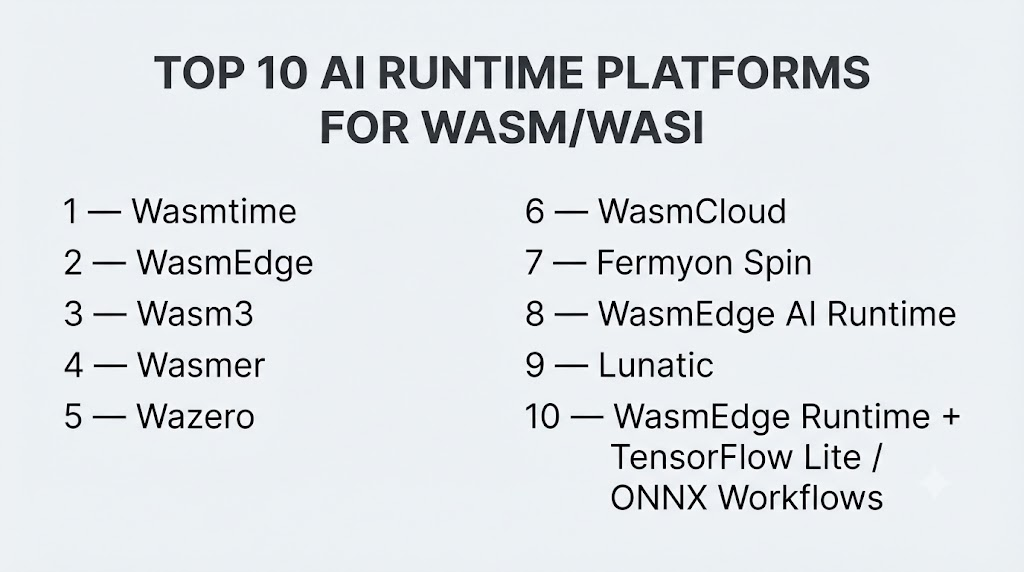
Top 10 AI Runtime Platforms for WASM/WASI
#1 — Wasmtime
One-line verdict: Best for developers building secure and high-performance WASM/WASI AI execution environments.
Short description (2–3 lines):
Wasmtime is a WebAssembly runtime designed for secure and efficient execution of WASM applications. It supports WASI-based workloads and is widely used for building portable application runtimes.
It is suitable for developers creating lightweight AI execution environments where security and portability are important.
Standout Capabilities
- High-performance WebAssembly execution
- WASI support
- Secure sandboxing
- Cross-platform runtime support
- Developer-focused architecture
- Embedding capabilities
- Lightweight execution model
- Runtime customization
AI-Specific Depth (Must Include)
- Model support: AI model support depends on integration with compatible frameworks and runtime components.
- RAG / knowledge integration: N/A
- Evaluation: Requires application-specific AI evaluation workflows.
- Guardrails: Provides runtime isolation; AI-specific safety controls depend on implementation.
- Observability: Runtime metrics depend on connected monitoring systems.
Pros
- Strong WASM/WASI ecosystem support.
- Good security isolation model.
- Flexible for custom AI runtime development.
Cons
- Requires developer expertise.
- AI features depend on additional integrations.
- Not a complete AI lifecycle platform.
Security & Compliance
Security capabilities are based on runtime isolation and configuration. Specific certifications are not publicly stated.
Deployment & Platforms
- Platforms: Linux, Windows, macOS, and cloud environments.
- Deployment: Self-hosted and embedded runtime scenarios.
Integrations & Ecosystem
Supports integration with:
- WASM applications
- WASI components
- Cloud-native systems
- Developer tooling
- Custom AI runtimes
Pricing Model
Open-source.
Best-Fit Scenarios
- Secure AI execution environments
- Custom WASM AI runtimes
- Cloud-native development
#2 — WasmEdge
One-line verdict: Best for edge AI and cloud-native teams running AI workloads through WebAssembly.
Short description (2–3 lines):
WasmEdge is a WebAssembly runtime designed for cloud-native, edge computing, and AI application workloads.
It focuses on high-performance execution and supports use cases involving AI inference, serverless applications, and decentralized computing environments.
Standout Capabilities
- High-performance WASM runtime
- AI inference support
- Edge computing support
- Cloud-native integration
- Secure execution environment
- Lightweight deployment
- Plugin-based architecture
- Developer tooling
AI-Specific Depth (Must Include)
- Model support: Supports AI workloads through compatible integrations. Specific model compatibility varies.
- RAG / knowledge integration: N/A
- Evaluation: Requires connected testing workflows.
- Guardrails: Runtime isolation available; AI safety depends on implementation.
- Observability: Runtime monitoring depends on deployment tools.
Pros
- Designed for AI and edge workloads.
- Lightweight compared with traditional virtualization.
- Strong cloud-native positioning.
Cons
- Requires WASM expertise.
- AI workflows may require additional configuration.
- Enterprise features vary.
Security & Compliance
Security depends on deployment configuration. Specific certifications are not publicly stated.
Deployment & Platforms
- Platforms: Cloud, edge, Linux, embedded environments.
- Deployment: Self-hosted and hybrid.
Integrations & Ecosystem
Supports:
- AI inference workflows
- Cloud platforms
- Edge applications
- WASM components
- Developer tools
Pricing Model
Open-source with enterprise options varying.
Best-Fit Scenarios
- Edge AI applications
- Secure AI plugins
- Cloud-native AI services
#3 — Wasm3
One-line verdict: Best for lightweight embedded environments requiring minimal WebAssembly execution overhead.
Short description (2–3 lines):
Wasm3 is a lightweight WebAssembly interpreter designed for constrained environments where memory efficiency and portability are important.
It is commonly considered for embedded and IoT scenarios requiring compact runtime capabilities.
Standout Capabilities
- Extremely lightweight runtime
- Embedded execution
- Portable architecture
- Low resource usage
- Fast integration
- Simple deployment model
- IoT suitability
AI-Specific Depth (Must Include)
- Model support: AI model support depends on custom integration.
- RAG / knowledge integration: N/A
- Evaluation: Requires external testing workflows.
- Guardrails: Runtime isolation depends on implementation.
- Observability: Requires additional monitoring tools.
Pros
- Very small runtime footprint.
- Suitable for constrained devices.
- Easy embedding.
Cons
- Limited enterprise features.
- Requires technical customization.
- Not designed as a full AI platform.
Security & Compliance
Not publicly stated.
Deployment & Platforms
- Platforms: Embedded systems and lightweight environments.
- Deployment: Self-managed.
Integrations & Ecosystem
Supports:
- Embedded applications
- IoT devices
- WASM workloads
- Custom runtimes
Pricing Model
Open-source.
Best-Fit Scenarios
- Embedded AI experiments
- IoT intelligence
- Resource-constrained devices
#4 — Wasmer
One-line verdict: Best for developers building portable WebAssembly applications across multiple execution environments.
Short description (2–3 lines):
Wasmer is a WebAssembly runtime designed to execute WASM applications across different platforms and environments.
It focuses on portability, developer flexibility, and embedding WebAssembly execution into applications.
Standout Capabilities
- Cross-platform WASM execution
- Embeddable runtime architecture
- Multiple language support
- Portable application execution
- Runtime customization
- Developer-focused tooling
- Cloud and edge flexibility
AI-Specific Depth (Must Include)
- Model support: AI model execution depends on connected frameworks and application design.
- RAG / knowledge integration: N/A
- Evaluation: Requires external AI testing systems.
- Guardrails: Runtime sandboxing available; AI-specific controls depend on implementation.
- Observability: Depends on integrated monitoring solutions.
Pros
- Strong portability across environments.
- Flexible runtime integration.
- Useful for custom AI execution layers.
Cons
- Requires WASM development expertise.
- AI capabilities depend on external components.
- Not a complete AI management platform.
Security & Compliance
Security depends on runtime configuration. Specific certifications are not publicly stated.
Deployment & Platforms
- Platforms: Linux, Windows, macOS, cloud, and embedded environments.
- Deployment: Self-hosted and application-embedded.
Integrations & Ecosystem
Supports integration with:
- WebAssembly applications
- Programming languages
- Cloud services
- Developer tools
- Custom AI runtimes
Pricing Model
Open-source options available. Enterprise pricing varies.
Best-Fit Scenarios
- Portable AI applications
- Embedded runtimes
- Custom WASM platforms
#5 — Wazero
One-line verdict: Best for Go developers embedding lightweight WASM execution into AI applications.
Short description (2–3 lines):
Wazero is a WebAssembly runtime implemented in Go that allows developers to execute WASM applications directly inside Go-based systems.
It is useful for building portable application components and secure execution environments.
Standout Capabilities
- Pure Go WebAssembly runtime
- No external dependencies
- Embeddable architecture
- Lightweight execution
- Developer-friendly integration
- Cross-platform support
- Secure component execution
AI-Specific Depth (Must Include)
- Model support: AI model support depends on custom integrations.
- RAG / knowledge integration: N/A
- Evaluation: Requires custom AI evaluation workflows.
- Guardrails: Runtime isolation available; AI safety depends on implementation.
- Observability: Requires application-level monitoring.
Pros
- Easy integration with Go applications.
- Lightweight runtime design.
- Good for custom systems.
Cons
- Limited built-in AI capabilities.
- Requires development expertise.
- Smaller ecosystem compared with larger runtimes.
Security & Compliance
Not publicly stated.
Deployment & Platforms
- Platforms: Go-supported environments.
- Deployment: Cloud, edge, and embedded scenarios.
Integrations & Ecosystem
Supports:
- Go applications
- WASM modules
- Cloud services
- Custom AI workflows
- Developer platforms
Pricing Model
Open-source.
Best-Fit Scenarios
- Go-based AI systems
- Secure plugins
- Custom WASM applications
#6 — WasmCloud
One-line verdict: Best for distributed cloud-native applications using WebAssembly components.
Short description (2–3 lines):
WasmCloud is a WebAssembly-based application platform designed for distributed cloud, edge, and serverless workloads.
It focuses on portable components, secure execution, and decentralized application architectures.
Standout Capabilities
- Component-based architecture
- Cloud-native deployment
- Edge application support
- Secure execution
- Distributed application development
- Service connectivity
- Portable workloads
AI-Specific Depth (Must Include)
- Model support: AI workload support depends on connected components and integrations.
- RAG / knowledge integration: N/A
- Evaluation: Requires external AI testing workflows.
- Guardrails: Provides secure component execution; AI guardrails depend on implementation.
- Observability: Depends on connected monitoring systems.
Pros
- Strong cloud-native architecture.
- Supports portable application design.
- Useful for distributed workloads.
Cons
- Requires understanding of WASM component architecture.
- AI features require customization.
- Adoption requires technical expertise.
Security & Compliance
Security depends on deployment configuration. Specific certifications are not publicly stated.
Deployment & Platforms
- Platforms: Cloud, edge, distributed environments.
- Deployment: Hybrid.
Integrations & Ecosystem
Supports:
- Cloud-native systems
- WASM components
- APIs
- Distributed applications
- Edge workloads
Pricing Model
Open-source with enterprise options varying.
Best-Fit Scenarios
- Distributed AI applications
- Edge-cloud architectures
- Secure plugin systems
#7 — Fermyon Spin
One-line verdict: Best for developers building serverless AI applications using WebAssembly.
Short description (2–3 lines):
Fermyon Spin is a WebAssembly-based application platform focused on building and running lightweight serverless applications.
It enables fast-starting services suitable for cloud-native and edge workloads.
Standout Capabilities
- Serverless WASM applications
- Fast startup times
- Lightweight execution
- Developer workflows
- Cloud deployment support
- Edge-friendly architecture
- Application portability
AI-Specific Depth (Must Include)
- Model support: Depends on integrated AI frameworks and APIs.
- RAG / knowledge integration: Depends on connected services.
- Evaluation: Requires application-specific testing.
- Guardrails: Depends on AI implementation.
- Observability: Application monitoring depends on deployment environment.
Pros
- Very lightweight execution model.
- Suitable for fast AI microservices.
- Developer-friendly approach.
Cons
- Not designed for large AI model training.
- Requires WASM knowledge.
- AI capabilities depend on integrations.
Security & Compliance
Not publicly stated.
Deployment & Platforms
- Platforms: Cloud and edge environments.
- Deployment: Managed and self-hosted options vary.
Integrations & Ecosystem
Supports:
- Serverless applications
- WASM components
- APIs
- Cloud services
- Developer tools
Pricing Model
Not publicly stated.
Best-Fit Scenarios
- AI microservices
- Serverless AI applications
- Edge APIs
#8 — WasmEdge AI Runtime
One-line verdict: Best for AI inference workloads requiring optimized WebAssembly execution.
Short description (2–3 lines):
WasmEdge AI Runtime focuses on executing AI workloads efficiently using WebAssembly-based environments.
It is designed for scenarios where portability, lightweight execution, and edge deployment are important.
Standout Capabilities
- AI inference execution
- WASM runtime optimization
- Edge deployment support
- Cloud-native integration
- Lightweight AI services
- Hardware acceleration support
- Secure execution
AI-Specific Depth (Must Include)
- Model support: Supports AI workloads through compatible model integrations.
- RAG / knowledge integration: N/A
- Evaluation: Requires connected AI evaluation workflows.
- Guardrails: Runtime security depends on implementation.
- Observability: Depends on monitoring integrations.
Pros
- Designed around AI runtime scenarios.
- Suitable for edge AI workloads.
- Supports portable execution.
Cons
- Requires technical expertise.
- Model compatibility varies.
- Enterprise governance requires additional tooling.
Security & Compliance
Not publicly stated.
Deployment & Platforms
- Platforms: Cloud, edge, Linux environments.
- Deployment: Hybrid.
Integrations & Ecosystem
Supports:
- AI inference workloads
- WASM applications
- Edge platforms
- Cloud systems
- Developer tools
Pricing Model
Open-source options available.
Best-Fit Scenarios
- Edge AI inference
- Portable AI services
- WASM-based AI applications
#9 — Lunatic
One-line verdict: Best for developers exploring secure WebAssembly-based backend services.
Short description (2–3 lines):
Lunatic is a WebAssembly-based runtime environment designed for building secure and scalable backend applications.
It focuses on lightweight execution and isolated workloads.
Standout Capabilities
- WASM backend execution
- Secure isolation
- Lightweight services
- Scalable workloads
- Component-based design
- Developer flexibility
AI-Specific Depth (Must Include)
- Model support: Depends on external AI integrations.
- RAG / knowledge integration: N/A
- Evaluation: Requires custom workflows.
- Guardrails: Runtime isolation available.
- Observability: Requires additional tooling.
Pros
- Strong isolation model.
- Lightweight architecture.
- Flexible backend execution.
Cons
- Smaller ecosystem.
- Requires WASM expertise.
- Limited AI-specific tooling.
Security & Compliance
Not publicly stated.
Deployment & Platforms
- Platforms: Cloud and server environments.
- Deployment: Self-managed.
Integrations & Ecosystem
Supports:
- WASM applications
- Backend services
- APIs
- Cloud environments
- Developer workflows
Pricing Model
Open-source.
Best-Fit Scenarios
- Secure AI services
- Experimental runtimes
- Backend automation
#10 — WasmEdge Runtime + TensorFlow Lite / ONNX Workflows
One-line verdict: Best for teams combining WASM portability with lightweight AI inference models.
Short description (2–3 lines):
WasmEdge combined with lightweight AI model formats enables developers to build portable inference workflows for edge and cloud environments.
It supports scenarios where AI execution needs flexibility across different platforms.
Standout Capabilities
- Portable inference workflows
- Lightweight model execution
- Edge deployment support
- WASM-based application design
- AI runtime customization
- Cross-platform execution
AI-Specific Depth (Must Include)
- Model support: Depends on supported AI frameworks and model formats.
- RAG / knowledge integration: N/A
- Evaluation: Requires external evaluation pipelines.
- Guardrails: Depends on application design.
- Observability: Requires additional monitoring solutions.
Pros
- Flexible architecture.
- Supports portable AI deployment.
- Useful for edge inference scenarios.
Cons
- Requires technical implementation.
- Not a complete AI lifecycle platform.
- Monitoring requires additional tooling.
Security & Compliance
Not publicly stated.
Deployment & Platforms
- Platforms: Cloud, edge, embedded environments.
- Deployment: Hybrid.
Integrations & Ecosystem
Supports:
- AI model formats
- WASM runtimes
- Edge systems
- ML workflows
- Custom applications
Pricing Model
Varies depending on selected components.
Best-Fit Scenarios
- Edge AI inference
- Portable ML applications
- Custom AI runtimes
Comparison Table
| Tool Name | Best For | Deployment (Cloud/Self-hosted/Hybrid) | Model Flexibility (Hosted / BYO / Multi-model / Open-source) | Strength | Watch-Out | Public Rating |
|---|---|---|---|---|---|---|
| Wasmtime | Secure WASM/WASI execution | Self-hosted/Embedded | Open-source/BYO models | High-performance runtime | Requires development expertise | N/A |
| WasmEdge | Edge AI and cloud-native workloads | Hybrid | Open-source/BYO models | AI-focused WASM runtime | Technical complexity | N/A |
| Wasm3 | Lightweight embedded execution | Self-hosted | Open-source/BYO models | Small runtime footprint | Limited enterprise features | N/A |
| Wasmer | Portable WASM applications | Cloud/Self-hosted | Open-source/BYO models | Cross-platform execution | AI requires customization | N/A |
| Wazero | Go-based WASM applications | Self-hosted | Open-source/BYO models | Easy Go integration | Smaller ecosystem | N/A |
| WasmCloud | Distributed WASM applications | Hybrid | Open-source/component-based | Cloud-native architecture | Learning curve | N/A |
| Fermyon Spin | Serverless AI services | Cloud/Edge | WASM-based applications | Fast startup workloads | Not for large AI models | N/A |
| WasmEdge AI Runtime | Portable AI inference | Hybrid | Open-source/BYO models | AI inference optimization | Requires technical setup | N/A |
| Lunatic | Secure backend execution | Self-hosted | Open-source | Runtime isolation | Limited AI tooling | N/A |
| WasmEdge + TensorFlow Lite/ONNX Workflows | Lightweight AI inference | Hybrid | BYO models | Flexible AI deployment | Requires integration work | N/A |
Scoring & Evaluation (Transparent Rubric)
The following evaluation compares AI Runtime Platforms for WASM/WASI based on their ability to support portable AI execution, security, developer experience, integration flexibility, performance, and operational readiness.
The scoring is comparative rather than absolute. Different organizations may prioritize different factors depending on whether they are building edge AI systems, cloud-native applications, embedded solutions, or enterprise platforms.
| Tool | Core | Reliability/Eval | Guardrails | Integrations | Ease | Perf/Cost | Security/Admin | Support | Weighted Total |
|---|---|---|---|---|---|---|---|---|---|
| Wasmtime | 9 | 8 | 9 | 8 | 7 | 9 | 9 | 8 | 8.5 |
| WasmEdge | 9 | 8 | 8 | 9 | 8 | 9 | 8 | 8 | 8.5 |
| Wasm3 | 7 | 7 | 8 | 7 | 8 | 10 | 7 | 7 | 7.7 |
| Wasmer | 8 | 8 | 8 | 8 | 8 | 8 | 8 | 8 | 8.0 |
| Wazero | 8 | 8 | 8 | 8 | 9 | 8 | 8 | 7 | 8.0 |
| WasmCloud | 8 | 8 | 8 | 9 | 7 | 8 | 8 | 8 | 8.0 |
| Fermyon Spin | 8 | 7 | 8 | 8 | 9 | 8 | 8 | 8 | 8.0 |
| WasmEdge AI Runtime | 9 | 8 | 8 | 9 | 7 | 9 | 8 | 8 | 8.4 |
| Lunatic | 7 | 7 | 8 | 7 | 7 | 8 | 8 | 7 | 7.4 |
| WasmEdge + TensorFlow Lite/ONNX Workflows | 8 | 8 | 7 | 9 | 7 | 9 | 8 | 8 | 8.1 |
Top 3 for Enterprise
1. WasmEdge
Best suited for enterprises exploring AI inference, edge computing, and cloud-native WebAssembly workloads.
2. Wasmtime
A strong choice for organizations requiring secure, flexible, and high-performance WASM/WASI execution environments.
3. WasmCloud
Useful for enterprises building distributed applications with portable WebAssembly components.
Top 3 for SMB
1. Fermyon Spin
A practical option for smaller teams building lightweight AI-powered serverless applications.
2. Wazero
Suitable for development teams that need simple WASM integration within Go applications.
3. Wasmer
Useful for organizations requiring portable application execution across different environments.
Top 3 for Developers
1. Wasmtime
Provides a flexible foundation for building custom WASM/WASI applications.
2. WasmEdge
A strong option for developers experimenting with AI inference and edge execution.
3. Wazero
Excellent for developers building embedded WASM functionality inside Go applications.
Which AI Runtime Platform for WASM/WASI Is Right for You?
Solo / Freelancer
Individual developers should prioritize:
- Simple development experience
- Good documentation
- Low operational complexity
- Easy experimentation
Recommended options:
- Wasmtime
- Wazero
- Fermyon Spin
These platforms allow developers to experiment with portable AI workloads without managing large infrastructure.
Important considerations:
- Learning curve
- Runtime flexibility
- Available community support
- Integration requirements
Solo developers should avoid complex distributed architectures unless they are building production-scale applications.
SMB
Small and medium businesses should focus on balancing flexibility, cost, and operational simplicity.
Recommended options:
- WasmEdge
- Fermyon Spin
- Wasmer
SMBs should evaluate:
- Deployment requirements
- Cloud versus edge needs
- Developer productivity
- Long-term maintenance
- Security requirements
For growing companies, choosing a runtime with strong ecosystem support can reduce future migration challenges.
Mid-Market
Mid-market organizations usually require better governance, scalability, and integration capabilities.
Recommended options:
- WasmEdge
- Wasmtime
- WasmCloud
Key requirements:
- Portable deployment
- Security isolation
- Monitoring capabilities
- Integration with existing platforms
- AI workflow compatibility
Mid-market teams should consider how WASM runtimes fit into their broader application architecture.
Enterprise
Large organizations require secure, scalable, and manageable AI execution environments.
Recommended options:
- Wasmtime
- WasmEdge
- WasmCloud
Enterprise buyers should prioritize:
- Security isolation
- Runtime governance
- Deployment consistency
- Observability
- Integration with cloud platforms
- Long-term ecosystem support
For enterprise AI systems, WASM/WASI runtimes can provide a lightweight alternative to traditional application deployment models.
Regulated Industries (Finance / Healthcare / Public Sector)
Organizations operating in regulated environments should focus on:
- Secure execution environments
- Access control
- Data privacy
- Auditability
- Controlled AI deployment
WASM isolation can help organizations run components in restricted environments, but governance depends on implementation.
Recommended approach:
- Validate AI workloads before deployment.
- Control runtime permissions.
- Monitor application behavior.
- Maintain deployment history.
Budget vs Premium
Budget Approach
Suitable for:
- Developers
- Startups
- Research teams
Consider:
- Open-source WASM runtimes
- Lightweight deployment models
- Custom integrations
Advantages:
- Lower infrastructure costs
- More flexibility
- Greater control
Challenges:
- More engineering responsibility
- Limited enterprise support
- More internal maintenance
Premium Enterprise Approach
Suitable for:
- Large organizations
- Production AI systems
- Mission-critical applications
Advantages:
- Better governance
- Enterprise support options
- Easier operational management
- Stronger integration capabilities
Challenges:
- Higher implementation complexity
- Additional platform management requirements
Build vs Buy (When to DIY)
Build a custom AI runtime solution when:
- The application requires specialized execution behavior.
- Internal engineering expertise is available.
- Full control over runtime architecture is required.
Choose an established platform when:
- Faster development is important.
- Security requirements are high.
- The organization needs ecosystem compatibility.
- Long-term maintenance resources are limited.
A hybrid approach is often effective, combining WASM runtimes with existing AI infrastructure and MLOps workflows.
Implementation Playbook (30 / 60 / 90 Days)
First 30 Days: Pilot + Success Metrics
The first phase should focus on testing the runtime architecture and understanding workload requirements.
Key activities:
- Identify AI workloads suitable for WASM/WASI.
- Select initial runtime candidates.
- Test model execution performance.
- Validate deployment environments.
- Define success metrics.
AI-specific tasks:
- Test supported model formats.
- Measure inference latency.
- Compare memory usage.
- Evaluate accuracy consistency.
Success metrics:
- Runtime performance
- Startup latency
- Memory consumption
- Deployment reliability
- Model execution accuracy
First 60 Days: Security + Evaluation
The second phase focuses on improving reliability and operational readiness.
Key activities:
- Implement security controls.
- Establish testing workflows.
- Monitor runtime behavior.
- Validate AI workloads.
- Create deployment standards.
AI-specific tasks:
- Build evaluation pipelines.
- Test model behavior.
- Validate edge scenarios.
- Track runtime performance.
- Document AI deployment processes.
Security improvements:
- Permission management
- Runtime isolation
- Secure communication
- Access controls
- Deployment validation
First 90 Days: Optimization + Governance
The final phase focuses on scaling and operational maturity.
Key activities:
- Expand workload deployment.
- Improve runtime performance.
- Automate deployment workflows.
- Establish governance processes.
- Optimize infrastructure usage.
AI-specific improvements:
- Continuous model evaluation
- Runtime monitoring
- Performance optimization
- AI workload management
- Version tracking
Organizations should establish a repeatable process connecting AI development, runtime execution, monitoring, and improvement.
Common Mistakes & How to Avoid Them
Deploying AI workloads through WASM/WASI runtimes provides strong portability and security benefits, but organizations can face challenges if they underestimate architecture, performance, and operational requirements.
Below are common mistakes to avoid when implementing AI Runtime Platforms for WASM/WASI.
- Choosing WASM without evaluating workload requirements Not every AI workload is suitable for WebAssembly environments. Large model training, intensive GPU workloads, and highly specialized processing may require different architectures.
- Ignoring model optimization requirements AI models designed for traditional cloud environments may not perform efficiently in lightweight WASM runtimes. Organizations should optimize models for size, memory usage, and inference speed.
- Treating WASM as a complete AI platform WASM runtimes provide execution environments, not complete AI lifecycle management. Teams may still need tools for training, evaluation, monitoring, and governance.
- Skipping performance benchmarking Developers should measure startup time, memory consumption, inference latency, and runtime efficiency before production deployment.
- Ignoring security configuration WASM provides isolation capabilities, but secure deployment still requires proper permissions, access controls, and application-level security practices.
- No AI evaluation process Deploying AI models without testing can lead to unreliable results. Organizations should establish evaluation workflows before releasing models.
- Overlooking observability requirements Runtime performance alone is not enough. Teams need visibility into AI behavior, failures, resource usage, and application performance.
- Using incompatible AI model formats AI models may require conversion or optimization before running efficiently inside WASM environments.
- Ignoring hardware limitations Edge environments may have limited CPU, memory, and storage. AI workloads should be designed according to available resources.
- Creating unnecessary runtime complexity Adding WASM layers without clear benefits can increase operational complexity. Organizations should ensure the architecture solves a real deployment challenge.
- Lack of version management AI models and runtime components should have clear version tracking to support debugging and reliable updates.
- Ignoring portability goals One major advantage of WASM is portability. Teams should avoid creating unnecessary dependencies that reduce runtime flexibility.
- No failure recovery strategy Production AI systems need recovery mechanisms when applications fail or models behave unexpectedly.
- Ignoring ecosystem maturity Organizations should evaluate community support, tooling availability, and long-term sustainability before adopting a runtime.
FAQs
What is an AI Runtime Platform for WASM/WASI?
An AI Runtime Platform for WASM/WASI provides an environment for executing AI workloads using WebAssembly and WebAssembly System Interface technologies.
These platforms focus on portability, lightweight execution, and secure deployment across different environments.
Why use WASM/WASI for AI applications?
WASM/WASI can help developers create portable applications that run consistently across cloud, edge, browser, and embedded environments.
It provides lightweight execution and strong isolation compared with traditional deployment approaches.
Can AI models run directly inside WebAssembly runtimes?
Some AI models can run through WASM-compatible frameworks or converted formats, but compatibility depends on model size, framework support, and runtime capabilities.
Are WASM AI runtimes suitable for large language models?
WASM runtimes are generally better suited for lightweight inference workloads, edge applications, and specialized AI tasks.
Large-scale model execution may require additional infrastructure depending on requirements.
Can WASM runtimes support edge AI applications?
Yes. Lightweight WASM runtimes are increasingly explored for edge AI scenarios where portability, low resource usage, and secure execution are important.
Do WASM/WASI platforms replace traditional containers?
Not completely. WASM and containers solve different problems.
Containers are commonly used for full application environments, while WASM focuses on lightweight portable execution.
Are WASM AI runtimes secure?
WASM provides sandboxing and isolation capabilities, but overall security depends on application design, permissions, deployment practices, and monitoring.
Can organizations use custom AI models with WASM runtimes?
Yes, organizations can integrate custom AI models, but model compatibility depends on runtime support and optimization requirements.
Do WASM AI platforms support RAG applications?
Support depends on the architecture. WASM runtimes can execute components of AI applications, while knowledge retrieval systems usually require additional services.
How do companies evaluate WASM AI performance?
Organizations typically measure:
- Inference latency
- Memory usage
- Startup time
- Accuracy
- Resource efficiency
- Runtime stability
Can WASM AI runtimes work in cloud environments?
Yes. Many WASM runtimes are designed for cloud-native applications, serverless workloads, and distributed systems.
Are WASM AI runtimes suitable for IoT devices?
Yes. Lightweight runtimes can be useful for IoT devices with limited computing resources.
How do organizations monitor WASM AI applications?
Monitoring usually involves runtime metrics, application logs, resource usage tracking, and AI performance monitoring systems.
Should companies build their own WASM AI runtime?
Building a custom runtime may make sense for specialized requirements, but many organizations benefit from adopting established runtimes and extending them.
What industries can benefit from AI Runtime Platforms for WASM/WASI?
Industries that may benefit include:
- Edge computing
- IoT
- Healthcare technology
- Manufacturing
- SaaS platforms
- Cloud-native applications
- Developer platforms
Conclusion
AI Runtime Platforms for WASM/WASI are becoming an important option for organizations looking to build lightweight, portable, and secure AI applications. As AI moves beyond traditional cloud environments into edge devices, browsers, embedded systems, and distributed applications, efficient runtime architectures become increasingly valuable.The right WASM/WASI AI runtime depends on the organization’s goals, workload requirements, deployment environment, and technical expertise. Developers may prefer flexible open-source runtimes, while enterprises may prioritize governance, security, and operational scalability.WASM-based AI execution is especially valuable for scenarios requiring portability, fast startup times, resource efficiency, and secure component execution. However, organizations should evaluate workload suitability carefully and combine runtimes with appropriate AI lifecycle tools

Find Trusted Cardiac Hospitals
Compare heart hospitals by city and services — all in one place.
Explore Hospitals
A practical area that could be discussed further is the operational management of WebAssembly runtimes in production environments. Beyond runtime performance, organizations should consider observability, secure sandbox configuration, resource isolation, and runtime policy enforcement across distributed deployments. Integrating centralized logging, performance monitoring, and automated security updates helps maintain reliability while ensuring WASM workloads remain scalable, secure, and easier to manage as application ecosystems continue to grow.