
Introduction
AI Script Writing Assistants are intelligent software platforms designed to help writers, content creators, and production teams generate, refine, and structure scripts for films, TV, video games, marketing, and other media projects. By leveraging natural language processing and generative AI models, these tools accelerate idea generation, dialogue writing, scene planning, and storyboarding, reducing manual effort while enhancing creativity.
In 2026, content production cycles have become faster, and demand for high-quality scripts in multiple genres, formats, and languages has surged. AI assistants provide writers with real-time suggestions, automated formatting, consistency checks, and style adaptation, making them essential for individual creators, studios, and agencies.
Real-world use cases include:
- Film and TV scriptwriting: Accelerating dialogue creation and scene generation.
- Marketing campaigns: Generating copy and narrative scripts for ads and social media.
- Video game storylines: Assisting in branching narrative generation and character dialogue.
- Corporate videos: Producing training scripts, presentations, and explainer videos.
- Educational content: Automating lesson script creation with structured formats.
- Podcast scripting: Assisting hosts with dialogue, segments, and storytelling.
Evaluation criteria buyers should consider:
- Script generation quality and coherence
- Dialogue naturalness and character consistency
- Genre and tone adaptation
- Formatting and export options (screenplay, storyboard)
- Collaboration and co-writing capabilities
- Multilingual support for localization
- AI evaluation and style checks
- Guardrails to avoid plagiarism or offensive content
- Integration with production pipelines or content management systems
- Real-time vs batch generation options
- Licensing and intellectual property clarity
Best for: Screenwriters, content creators, media studios, agencies, and developers integrating AI into script workflows.
Not ideal for: Teams requiring fully human-authored scripts for legal, artistic, or high-end cinematic projects where AI suggestions may be limiting.
What’s Changed in AI Script Writing Assistants in 2026+
- Context-aware dialogue generation ensures continuity across scenes and characters.
- Adaptive tone and genre selection allows switching between comedy, drama, sci-fi, or educational formats.
- Collaboration features support multiple users editing and reviewing in real-time.
- Automated formatting and export for standard screenplay, teleplay, and storyboarding formats.
- Evaluation metrics for plot coherence, pacing, and dialogue realism.
- Guardrails and plagiarism checks prevent AI from producing offensive or copied content.
- Enterprise privacy and security ensure script drafts remain confidential.
- Integration with creative pipelines like project management and media production software.
- Multilingual capabilities enable localization of scripts for global audiences.
- Template-based workflows streamline common script structures for commercials, podcasts, or short films.
- Observability dashboards track usage, token cost, and AI suggestion quality.
- BYO or open-source model options allow studios to run custom language models.
Quick Buyer Checklist (Scan-Friendly)
- Script generation quality and coherence
- Dialogue realism and character consistency
- Genre, tone, and style adaptability
- Formatting and export compatibility
- Collaboration and multi-user support
- Plagiarism checks and guardrails
- Multilingual capabilities
- API/SDK integration for production pipelines
- Observability dashboards for usage and cost
- Real-time vs batch generation
- Licensing clarity for commercial use
- Model flexibility (hosted vs BYO vs open-source)
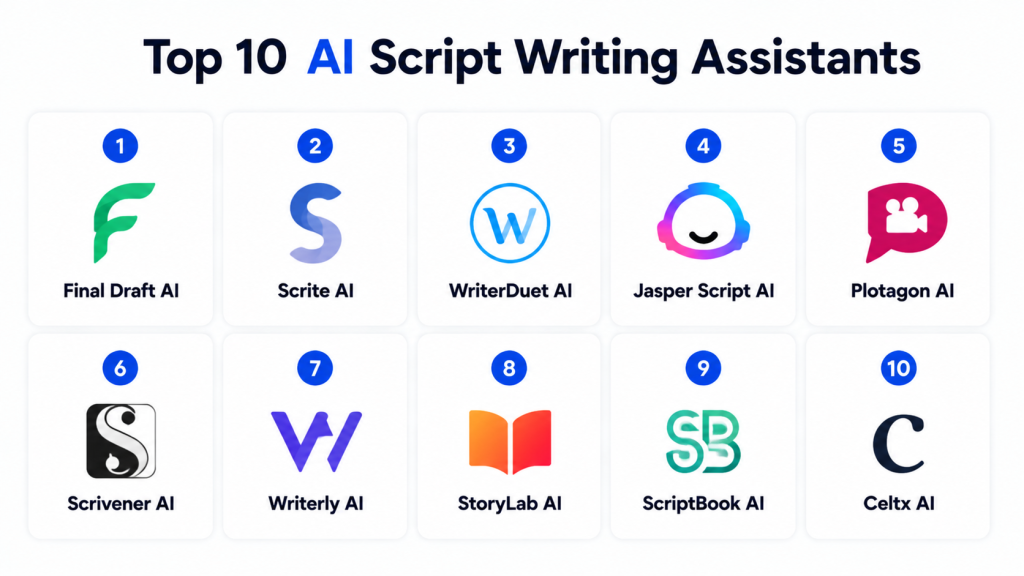
Top 10 AI Script Writing Assistants
1- Final Draft AI
One-line verdict: Industry-standard screenplay tool enhanced with AI for professional writers and studios.
Short description:
Final Draft AI integrates AI-powered dialogue generation and formatting within the classic Final Draft environment, allowing screenwriters and production teams to streamline scriptwriting without compromising standard industry formatting.
Standout Capabilities
- AI-assisted dialogue and scene suggestions
- Automatic screenplay formatting
- Collaboration tools for teams
- Multi-genre and tone adaptation
- Version control and history tracking
AI-Specific Depth
- Model support: Proprietary
- RAG / knowledge integration: N/A
- Evaluation: Coherence and structure checks
- Guardrails: Plagiarism detection
- Observability: Usage dashboards
Pros
- Industry-standard formatting
- Supports professional teams
- AI suggestions improve efficiency
Cons
- Requires Final Draft license
- Limited free access
- AI suggestions may need heavy editing
Security & Compliance
Not publicly stated
Deployment & Platforms
- Windows, macOS, Cloud
Integrations & Ecosystem
- Studio collaboration tools
- Export to PDF, Celtx, Storyboard software
- API access for team automation
Pricing Model
Subscription-based with enterprise tier
Best-Fit Scenarios
- Professional screenplay development
- TV/film script teams
- Multi-user production projects
2- Scrite AI
One-line verdict: Scriptwriting platform with AI tools for indie writers and collaborative teams.
Short description:
Scrite AI allows writers to structure scenes, generate dialogue, and outline stories with AI assistance while maintaining creative control. Suitable for indie writers and collaborative media teams.
Standout Capabilities
- Scene and dialogue generation
- Script outline recommendations
- Character consistency tracking
- Multi-user collaboration
- Formatting export options
AI-Specific Depth
- Model support: Proprietary
- RAG / knowledge integration: N/A
- Evaluation: Story coherence analysis
- Guardrails: Offensive content filter
- Observability: Metrics for usage and edits
Pros
- Free-tier accessibility
- Collaboration-friendly
- AI-driven story suggestions
Cons
- Less suitable for Hollywood-level scripts
- Limited customization of AI voice/style
- Export options may need manual adjustment
Security & Compliance
Not publicly stated
Deployment & Platforms
- Windows, macOS, Linux
Integrations & Ecosystem
- Storyboard software
- Export to standard script formats
- API integration for collaborative editing
Pricing Model
Freemium + premium tier
Best-Fit Scenarios
- Indie film scripts
- Short film writing
- Collaborative writing projects
3- WriterDuet AI
One-line verdict: Real-time collaborative scriptwriting with AI dialogue and scene suggestions.
Short description:
WriterDuet AI integrates AI dialogue suggestions into real-time collaborative writing, enabling writers to work synchronously while improving dialogue flow, pacing, and character consistency.
Standout Capabilities
- AI dialogue suggestions
- Real-time multi-user collaboration
- Scene pacing analysis
- Automated formatting
- Multi-genre support
AI-Specific Depth
- Model support: Proprietary
- RAG / knowledge integration: N/A
- Evaluation: Coherence and character analysis
- Guardrails: Content safety filters
- Observability: Usage and suggestion metrics
Pros
- Collaborative editing in real-time
- Supports remote writing teams
- AI enhances dialogue quality
Cons
- Requires stable internet
- Advanced AI may produce generic suggestions
- Subscription needed for full features
Security & Compliance
Not publicly stated
Deployment & Platforms
- Windows, macOS, Web
Integrations & Ecosystem
- Video and storyboard integration
- Export to industry formats
- Team workflow API
Pricing Model
Subscription
Best-Fit Scenarios
- TV show writers
- Remote collaborative teams
- Dialogue-focused projects
4- Jasper Script AI
One-line verdict: AI-powered writing assistant for fast script and marketing copy generation.
Short description:
Jasper Script AI leverages generative AI to create dialogue, story outlines, and promotional scripts quickly, supporting content creators and marketing agencies in efficient script production.
Standout Capabilities
- Genre-specific script generation
- Multi-language support
- Automated story structure suggestions
- Collaborative editing tools
- Export to screenplay and document formats
AI-Specific Depth
- Model support: Proprietary GPT-style
- RAG / knowledge integration: N/A
- Evaluation: Coherence and tone assessment
- Guardrails: Offensive content filter
- Observability: Usage and token metrics
Pros
- Fast script prototyping
- Supports multiple genres
- Collaboration-friendly
Cons
- May require editing for polish
- Not fully Hollywood-standard
- Cloud-only
Security & Compliance
Not publicly stated
Deployment & Platforms
- Web, Cloud
Integrations & Ecosystem
- CMS and content platforms
- Export to screenplay formats
- API for automation
Pricing Model
Subscription
Best-Fit Scenarios
- Marketing scripts
- Short film prototypes
- YouTube or social media scripts
5- Plotagon AI
One-line verdict: AI scriptwriting and animation tool for storytelling with lip-sync integration.
Short description:
Plotagon AI assists writers in generating scripts and directly converting them into animated videos with AI-powered lip-sync for characters.
Standout Capabilities
- Script-to-animation conversion
- Automated lip-sync for dialogue
- Multi-character interaction suggestions
- Scene outline templates
- Multi-language support
AI-Specific Depth
- Model support: Proprietary
- RAG / knowledge integration: N/A
- Evaluation: Story consistency and lip-sync check
- Guardrails: Offensive content filters
- Observability: Token usage and processing time
Pros
- Direct animation output
- Multi-character lip-sync
- Fast prototyping for storytellers
Cons
- Limited cinematic realism
- Subscription required
- Advanced customization limited
Security & Compliance
Not publicly stated
Deployment & Platforms
- Web, Windows, macOS
Integrations & Ecosystem
- Animation software
- Export to video formats
- Storyboard integration
Pricing Model
Subscription
Best-Fit Scenarios
- Short animated films
- Educational videos
- Story prototyping
6- Scrivener AI
One-line verdict: AI-enhanced script formatting and scene drafting for writers and teams.
Short description:
Scrivener AI adds AI-powered drafting, scene suggestions, and dialogue improvements to the Scrivener writing platform, suitable for writers and indie production teams.
Standout Capabilities
- AI scene and dialogue suggestions
- Automated script formatting
- Story outline tools
- Multi-user collaboration
- Character consistency tracking
AI-Specific Depth
- Model support: Proprietary
- RAG / knowledge integration: N/A
- Evaluation: Coherence checks
- Guardrails: Content filter
- Observability: Usage dashboards
Pros
- Enhances story flow
- Supports multiple writers
- Maintains script structure
Cons
- Not specialized for Hollywood scripts
- Learning curve for beginners
- Cloud features limited
Security & Compliance
Not publicly stated
Deployment & Platforms
- Windows, macOS, Cloud
Integrations & Ecosystem
- Export to industry formats
- Integration with storyboarding
- Collaboration tools
Pricing Model
Subscription
Best-Fit Scenarios
- Indie film scripts
- Writing workshops
- Collaborative projects
7- Writerly AI
One-line verdict: AI assistant for drafting and refining scripts across video, games, and marketing.
Short description:
Writerly AI generates structured scripts, dialogue, and story outlines with AI suggestions, targeting creators, studios, and marketing teams needing fast content drafting.
Standout Capabilities
- Script and dialogue generation
- Multi-format export
- Character and plot consistency
- Collaboration tools
- Genre and tone adaptation
AI-Specific Depth
- Model support: Proprietary
- RAG / knowledge integration: N/A
- Evaluation: Automated plot analysis
- Guardrails: Style and content filter
- Observability: Usage tracking
Pros
- Fast drafting
- Multi-genre support
- Collaborative editing
Cons
- AI suggestions may need refinement
- Cloud-only
- Limited formatting for TV/film
Security & Compliance
Not publicly stated
Deployment & Platforms
- Web, Cloud
Integrations & Ecosystem
- CMS export
- Storyboarding tools
- API access
Pricing Model
Subscription
Best-Fit Scenarios
- Game storylines
- Marketing scripts
- YouTube content
8- StoryLab AI
One-line verdict: AI storytelling platform with script writing and dialogue generation.
Short description:
StoryLab AI assists writers in drafting stories, creating dialogue, and structuring scripts for video, games, and animation using AI-assisted suggestions.
Standout Capabilities
- Automated story outlines
- Dialogue generation
- Multi-character interaction
- Scene flow analysis
- Export in standard formats
AI-Specific Depth
- Model support: Proprietary
- RAG / knowledge integration: N/A
- Evaluation: Plot and dialogue consistency
- Guardrails: Offensive content filters
- Observability: Usage analytics
Pros
- Supports creative brainstorming
- Multi-character management
- Fast output generation
Cons
- Cloud-only
- Limited cinematic formatting
- AI suggestions require editing
Security & Compliance
Not publicly stated
Deployment & Platforms
- Web, Cloud
Integrations & Ecosystem
- Storyboarding software
- Video production export
- API endpoints
Pricing Model
Subscription
Best-Fit Scenarios
- Short film scripts
- Game dialogue writing
- Animated content
9- ScriptBook AI
One-line verdict: AI-assisted script analysis and suggestion tool for studios and content agencies.
Short description:
ScriptBook AI focuses on analyzing scripts for narrative quality, pacing, and dialogue flow, while suggesting improvements using AI models.
Standout Capabilities
- Plot analysis and suggestions
- Character and dialogue evaluation
- Scene pacing and structure
- Multi-language support
- AI-based improvements
AI-Specific Depth
- Model support: Proprietary
- RAG / knowledge integration: N/A
- Evaluation: Automated narrative scoring
- Guardrails: Content filters
- Observability: Analytics dashboards
Pros
- Insightful analysis
- Multi-format support
- Enhances narrative coherence
Cons
- Limited creative generation
- Cloud-based only
- Requires manual integration for export
Security & Compliance
Not publicly stated
Deployment & Platforms
- Web, Cloud
Integrations & Ecosystem
- Screenplay software
- Storyboarding tools
- API endpoints
Pricing Model
Subscription
Best-Fit Scenarios
- Studio script review
- Marketing copy analysis
- Game storyboarding
10- Celtx AI
One-line verdict: Cloud-based AI scriptwriting assistant for pre-production, collaborative writing, and storyboarding.
Short description:
Celtx AI integrates AI-assisted script generation into the Celtx pre-production platform, supporting writers, media teams, and collaborative content development.
Standout Capabilities
- AI-assisted dialogue and scene suggestions
- Script formatting and exporting
- Collaboration and version control
- Multi-genre support
- Integration with storyboarding
AI-Specific Depth
- Model support: Proprietary
- RAG / knowledge integration: N/A
- Evaluation: Coherence scoring and style checks
- Guardrails: Content and plagiarism filters
- Observability: Usage dashboards
Pros
- Collaborative workflow
- Pre-production integration
- AI suggestions streamline writing
Cons
- Cloud-based
- Limited offline use
- AI outputs may require editing
Security & Compliance
Not publicly stated
Deployment & Platforms
- Web, Cloud
Integrations & Ecosystem
- Storyboarding software
- Project management tools
- API for automation
Pricing Model
Subscription
Best-Fit Scenarios
- TV/film pre-production
- Marketing scripts
- Game narrative writing
Comparison Table
| Tool Name | Best For | Deployment | Model Flexibility | Strength | Watch-Out | Public Rating |
|---|---|---|---|---|---|---|
| Final Draft AI | Professional screenwriters | Windows/Mac | Proprietary | Industry-standard formatting | Requires Final Draft license | N/A |
| Scrite AI | Indie writers, teams | Windows/Mac/Linux | Proprietary | Collaborative scripting | Less Hollywood-ready | N/A |
| WriterDuet AI | Remote collaborative teams | Web | Proprietary | Real-time collaboration | Needs internet | N/A |
| Jasper Script AI | Marketing & fast content | Web/Cloud | Proprietary | Quick drafting | Cloud-only | N/A |
| Plotagon AI | Animation & storytelling | Web/Windows/Mac | Proprietary | Direct animation export | Limited cinematic realism | N/A |
| Scrivener AI | Writers & indie teams | Windows/Mac/Cloud | Proprietary | Scene and dialogue suggestions | Limited advanced features | N/A |
| Writerly AI | Game & marketing scripts | Web/Cloud | Proprietary | Multi-genre script drafting | Cloud-only | N/A |
| StoryLab AI | Short films & animation | Web/Cloud | Proprietary | Fast creative output | Needs editing for polish | N/A |
| ScriptBook AI | Script review & analysis | Web/Cloud | Proprietary | Narrative insights | Limited creative generation | N/A |
| Celtx AI | Pre-production & collaboration | Web/Cloud | Proprietary | Workflow & formatting support | Cloud-based | N/A |
Scoring & Evaluation
Scoring is comparative, reflecting the relative strengths of each tool. Scores range 1–10 for each criterion, weighted as follows:
- Core Features – 20%
- AI Reliability & Evaluation – 15%
- Guardrails & Safety – 10%
- Integrations & Ecosystem – 15%
- Ease of Use – 10%
- Performance & Cost Controls – 15%
- Security & Admin – 10%
- Support & Community – 5%
| Tool | Core | Reliability/Eval | Guardrails | Integrations | Ease | Perf/Cost | Security/Admin | Support | Weighted Total |
|---|---|---|---|---|---|---|---|---|---|
| Final Draft AI | 9 | 8 | 8 | 8 | 7 | 7 | 7 | 7 | 7.8 |
| Scrite AI | 8 | 7 | 7 | 7 | 8 | 7 | 6 | 7 | 7.0 |
| WriterDuet AI | 8 | 8 | 7 | 8 | 8 | 7 | 6 | 7 | 7.3 |
| Jasper Script AI | 7 | 7 | 7 | 7 | 8 | 7 | 6 | 7 | 7.0 |
| Plotagon AI | 8 | 7 | 7 | 7 | 8 | 7 | 6 | 7 | 7.1 |
| Scrivener AI | 8 | 7 | 7 | 7 | 7 | 7 | 6 | 7 | 7.0 |
| Writerly AI | 7 | 7 | 7 | 7 | 8 | 7 | 6 | 7 | 7.0 |
| StoryLab AI | 7 | 7 | 7 | 7 | 8 | 7 | 6 | 7 | 7.0 |
| ScriptBook AI | 8 | 8 | 8 | 7 | 7 | 7 | 6 | 7 | 7.3 |
| Celtx AI | 8 | 8 | 8 | 8 | 7 | 7 | 7 | 7 | 7.5 |
Top 3 for Enterprise: Final Draft AI, WriterDuet AI, Celtx AI
Top 3 for SMB: Scrite AI, Jasper Script AI, Plotagon AI
Top 3 for Developers: Writerly AI, ScriptBook AI, StoryLab AI
Which AI Script Writing Assistant Is Right for You?
Solo / Freelancer
Use Scrite AI, Writerly AI, or Plotagon AI for fast drafting, idea generation, and collaborative editing without enterprise overhead.
SMB
Small creative teams benefit from Jasper Script AI, StoryLab AI, and Scrite AI for multi-genre scripts, marketing campaigns, and short content production.
Mid-Market
Mid-sized studios should consider WriterDuet AI, Celtx AI, or Final Draft AI to scale collaborative writing, maintain formatting standards, and support multi-writer projects.
Enterprise
Large studios and media agencies should deploy Final Draft AI, WriterDuet AI, and Celtx AI for full pre-production pipelines, secure collaboration, and integrated formatting compliance.
Regulated Industries
For e-learning, corporate, or branded content where licensing and IP protection are critical, use Final Draft AI, ScriptBook AI, or Celtx AI with enterprise security settings.
Budget vs Premium
Budget: Scrite AI, Jasper Script AI, StoryLab AI
Premium: Final Draft AI, WriterDuet AI, Celtx AI
Build vs Buy
Developers embedding AI into apps can integrate APIs from Writerly AI or Jasper Script AI, while teams needing prebuilt collaborative environments benefit from SaaS platforms like Celtx AI or Final Draft AI.
Implementation Playbook (30 / 60 / 90 Days)
30 Days – Pilot
- Select 2–3 tools to test with real scripts.
- Define success metrics: dialogue quality, formatting accuracy, collaboration efficiency.
- Generate sample outputs and review AI suggestions.
60 Days – Integrate & Harden
- Embed selected tools into content production pipelines.
- Configure guardrails for sensitive content and plagiarism.
- Train teams on workflow and AI evaluation.
- Set up observability dashboards for usage, cost, and AI suggestions.
90 Days – Scale & Optimize
- Automate batch script production for series, campaigns, or large projects.
- Track performance and costs; optimize AI model usage.
- Maintain versioned scripts and voice/style templates.
- Review licensing compliance and security regularly.
Common Mistakes & How to Avoid Them
- Ignoring dialogue coherence and plot continuity
- Over-reliance on AI suggestions without human editing
- Not configuring plagiarism or offensive content filters
- Failing to track usage, token costs, or latency
- Using tools without proper integration into production pipelines
- Neglecting real-time collaboration features
- Not monitoring multi-language outputs for accuracy
- Overlooking security, privacy, or IP protection
- Skipping version control for scripts and prompts
- Not testing AI across genres or styles
- Underestimating learning curve for complex tools
- Failing to align AI outputs with production standards
FAQs
1— Can AI assistants generate full scripts?
Yes, AI can generate scene outlines, dialogue, and narrative structure, but human oversight ensures quality and creativity.
2— Are generated scripts copyright-free?
Licensing depends on the platform. Many provide commercial rights, but always verify terms.
3— Can these tools maintain character consistency?
Most platforms track character traits and dialogue style across scenes to ensure consistency.
4— Do tools support multiple genres?
Yes — comedy, drama, sci-fi, educational, marketing, and more, with tone and style adjustments.
5— Can multiple writers collaborate?
Platforms like WriterDuet AI, Celtx AI, and Scrite AI allow real-time collaborative editing.
6— Are AI outputs ready for production?
AI outputs usually need human editing to ensure plot coherence, pacing, and creative polish.
7— Can AI generate multilingual scripts?
Some platforms support multi-language outputs, which are useful for localization and global campaigns.
8— Can I export scripts in industry formats?
Yes — PDF, screenplay, teleplay, and storyboard formats are standard in most tools.
9— Do these assistants integrate with video or storyboard tools?
Many support integration with storyboarding and video pre-production software.
10— Are there open-source options?
Few open-source alternatives exist; most enterprise-ready solutions are proprietary SaaS.
11— How is AI reliability evaluated?
Via automated coherence checks, style analysis, and human review pipelines.
12— Are there guardrails to prevent offensive content?
Yes — most platforms include content filters and plagiarism detection to enforce safe outputs.
Conclusion
AI Script Writing Assistants in 2026 enable creators, studios, and developers to produce high-quality scripts faster, maintain narrative consistency, and scale content production. From indie creators to enterprise media teams, the right tool depends on workflow integration, budget, genre needs, collaboration requirements, and security/licensing considerations.

Find Trusted Cardiac Hospitals
Compare heart hospitals by city and services — all in one place.
Explore Hospitals
The article compares features of AI scriptwriting tools well, but it mostly evaluates them as standalone creative assistants rather than production-integrated systems. In real workflows (YouTube pipelines, ad studios, or media automation stacks), these tools are rarely used in isolation.
What’s missing is how they integrate into content CI/CD pipelines—for example:
Without pipeline integration, these tools remain “idea generators” rather than production-grade content systems.