
Introduction
AI Shipment Exception Detection refers to advanced AI-driven systems that automatically identify, predict, and flag anomalies in shipping and logistics operations. These exceptions may include delayed deliveries, damaged goods, misrouted packages, customs delays, or other disruptions that can impact the supply chain. Using machine learning and real-time data analytics, these tools enable companies to proactively address potential problems before they escalate into costly issues.
In 2026, supply chains are increasingly complex, often spanning multiple continents, modes of transport, and regulatory environments. AI shipment exception detection has become crucial for operational resilience, customer satisfaction, and cost control. With growing volumes of e-commerce shipments and real-time delivery expectations, organizations cannot rely solely on manual monitoring.
Real-world use cases include:
- Predicting late deliveries based on traffic, weather, or carrier performance.
- Flagging damaged packages using sensor data and anomaly detection.
- Identifying misrouted shipments for corrective rerouting.
- Detecting customs or regulatory delays before arrival.
- Alerting inventory managers to exceptions affecting downstream fulfillment.
- Monitoring carrier compliance with SLA requirements.
Evaluation criteria buyers should consider:
- Accuracy of anomaly detection
- Real-time monitoring and alerting
- Integration with carriers, ERP, and TMS systems
- Scalability for high shipment volumes
- Model transparency and explainability
- Security and compliance (SSO, encryption, audit logs)
- AI-specific features (model choice, BYO model support, RAG)
- Observability and cost tracking
- Guardrails for data handling and prompt injection
- Deployment flexibility (cloud, hybrid, on-prem)
- Ease of use and dashboard clarity
- Vendor reliability and support
Best for: Logistics managers, supply chain operations, e-commerce platforms, large enterprises, and third-party logistics (3PL) providers.
Not ideal for: Organizations with minimal shipment volume or fully outsourced logistics where exception monitoring is handled by carriers.
What’s Changed in AI Shipment Exception Detection in 2026+
- Multimodal inputs including IoT sensors, OCR, GPS, and carrier APIs.
- Agentic workflows that allow AI to automatically trigger corrective actions.
- Enhanced evaluation frameworks for model accuracy and reliability.
- Improved guardrails against data leakage, prompt injection, and anomaly misinterpretation.
- Enterprise privacy standards with data residency and retention control.
- Cost and latency optimization via intelligent model routing and BYO model options.
- Observability dashboards with traces, latency, and token/cost metrics.
- Increased emphasis on explainable AI for decision audits.
- Integration-ready connectors for ERP, TMS, and e-commerce platforms.
- AI-driven recommendations for operational optimization beyond detection.
- Predictive analytics to prevent exceptions rather than only flagging them.
- Compliance-focused reporting for regulated industries.
Quick Buyer Checklist (Scan-Friendly)
- Data privacy & retention: compliance with GDPR, CCPA, internal policies
- Model choice: hosted, BYO, open-source, multi-model routing
- RAG/connectors: ERP, TMS, vector DBs
- Evaluation/testing: regression, offline tests, human review
- Guardrails: anomaly validation, injection defenses
- Latency & cost controls: batch vs real-time processing, token monitoring
- Auditability & admin controls: SSO, RBAC, logging
- Vendor lock-in risk: APIs, export options, model portability
- Scalability: peak shipment volumes, geographies
- Alerts & notifications: multi-channel, threshold configuration
- Explainability: ability to trace why an exception was flagged
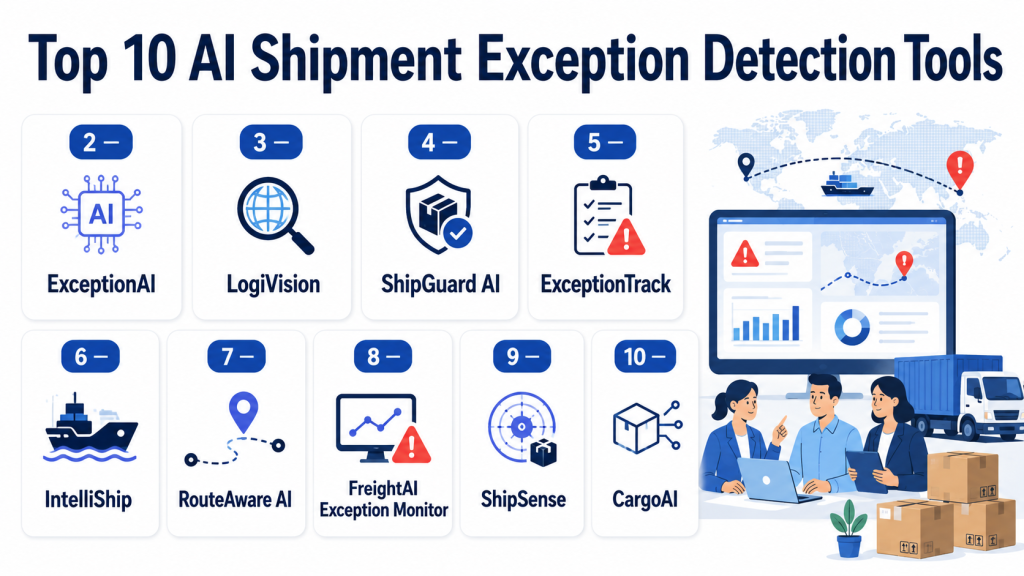
Top 10 AI Shipment Exception Detection Tools
#1 — ShipAI Insights
One-line verdict: Best for large e-commerce and enterprise logistics teams needing predictive shipment exception alerts.
Short description: ShipAI Insights leverages AI to monitor real-time shipments across carriers and geographies, alerting teams to exceptions before they escalate.
Standout Capabilities
- Predicts delays using historical carrier and real-time traffic data
- Detects potential damages via IoT sensor analytics
- Automated exception routing to operations teams
- Customizable SLA monitoring dashboards
- Multimodal input support: GPS, IoT, OCR
- Advanced root-cause analysis recommendations
- AI-driven operational insights for inventory planning
AI-Specific Depth
- Model support: Proprietary / BYO model support
- RAG / knowledge integration: ERP and TMS connectors
- Evaluation: Regression testing, human review
- Guardrails: Policy checks, anomaly validation
- Observability: Traces, latency, cost metrics
Pros
- High predictive accuracy
- Robust integration ecosystem
- Automated alerting reduces manual monitoring
Cons
- Higher cost for smaller teams
- Initial setup complexity
- Proprietary model limits custom AI experimentation
Security & Compliance
- SSO, RBAC, audit logs, encryption
- Data residency and retention controls
- Certifications: Not publicly stated
Deployment & Platforms
- Web, Cloud, Hybrid
- Windows/macOS/Linux clients optional
Integrations & Ecosystem
- APIs and SDKs for ERP, TMS
- Connector library for major carriers
- Extensible workflow automation
- Webhooks for alerts
Pricing Model
- Usage-based tiered plans, enterprise contracts
- Not publicly stated
Best-Fit Scenarios
- High-volume e-commerce shipping
- 3PL providers managing multiple carriers
- Enterprises with multimodal logistics operations
#2 — ExceptionAI
One-line verdict: Ideal for SMB logistics operations seeking affordable AI anomaly detection with simple dashboards.
Short description: ExceptionAI automates the monitoring of shipments, providing exception alerts with actionable guidance for small to medium businesses.
Standout Capabilities
- Lightweight, cloud-native monitoring
- Rule-based + ML hybrid anomaly detection
- Real-time shipment status tracking
- SMS and email alert channels
- Customizable alert thresholds
AI-Specific Depth
- Model support: Hosted proprietary ML
- RAG / knowledge integration: N/A
- Evaluation: Human review, basic regression
- Guardrails: Preconfigured safety rules
- Observability: Dashboard metrics
Pros
- Easy to deploy
- Cost-efficient for SMBs
- Intuitive interface
Cons
- Limited predictive analytics
- Fewer integrations
- Less flexibility for complex workflows
Security & Compliance
- Standard cloud encryption
- Not publicly stated for certifications
Deployment & Platforms
- Web, Cloud
- Windows/macOS optional
Integrations & Ecosystem
- API access, CSV imports
- Limited ERP/TMS connectors
Pricing Model
- Subscription-based, tiered by shipment volume
- Not publicly stated
Best-Fit Scenarios
- SMBs with regional delivery operations
- Startups expanding logistics
- Retailers managing in-house shipping
#3 — LogiVision
One-line verdict: Designed for mid-market enterprises needing AI-driven visibility and exception analytics across carriers.
Short description: LogiVision provides an integrated platform combining AI, carrier data, and predictive analytics for exception detection and operational insights.
Standout Capabilities
- Carrier-agnostic monitoring
- Predictive delay and damage alerts
- Real-time dashboards with heatmaps
- KPI tracking for SLAs
- Historical trend analysis
- Alert prioritization via risk scoring
- Automated operational recommendations
AI-Specific Depth
- Model support: Proprietary ML / BYO optional
- RAG / knowledge integration: ERP connectors
- Evaluation: Continuous regression, offline testing
- Guardrails: Anomaly verification
- Observability: Detailed latency and cost metrics
Pros
- Comprehensive coverage across carriers
- Actionable insights beyond alerts
- Good scalability
Cons
- Moderate learning curve
- Requires integration effort
- Pricing varies based on shipment volume
Security & Compliance
- SSO/SAML, RBAC, encryption
- Not publicly stated for certifications
Deployment & Platforms
- Web, Cloud, Hybrid
- Desktop dashboards
Integrations & Ecosystem
- APIs, SDKs, ERP connectors
- Webhooks, data export, workflow automation
- Custom carrier integrations possible
Pricing Model
- Tiered subscription with enterprise add-ons
- Not publicly stated
Best-Fit Scenarios
- Mid-market 3PL providers
- Multi-carrier e-commerce platforms
- Enterprises with hybrid logistics operations
#4 — ShipGuard AI
One-line verdict: Enterprise-grade solution for highly regulated industries with stringent compliance requirements.
Short description: ShipGuard AI focuses on compliance-driven exception detection, offering predictive alerts and audit-ready reporting for sensitive logistics operations.
Standout Capabilities
- Regulatory exception monitoring
- End-to-end shipment visibility
- Predictive analytics for delays
- Audit trail and compliance dashboards
- Carrier SLA scoring
- Automated reporting for stakeholders
- Risk-based exception prioritization
AI-Specific Depth
- Model support: Proprietary / BYO model
- RAG / knowledge integration: ERP/TMS connectors
- Evaluation: Regression, human-in-loop
- Guardrails: Policy-based checks
- Observability: Traces, latency, token usage
Pros
- Strong compliance support
- Enterprise-grade reliability
- Multi-carrier support
Cons
- High cost
- Setup complexity
- Learning curve for small teams
Security & Compliance
- SSO, RBAC, encryption, audit logs
- Data retention & residency controls
- Certifications: Not publicly stated
Deployment & Platforms
- Cloud, Hybrid
- Web dashboards
Integrations & Ecosystem
- APIs, ERP/TMS connectors
- Workflow automation
- Carrier data ingestion
Pricing Model
- Enterprise tiered subscription
- Not publicly stated
Best-Fit Scenarios
- Healthcare logistics
- Pharma and regulated goods
- Financial supply chain operations
#5 — ExceptionTrack
One-line verdict: Best for developer teams needing a flexible, API-first exception detection engine.
Short description: ExceptionTrack provides a developer-centric platform enabling custom AI workflows and integration into existing logistics systems.
Standout Capabilities
- API-first design
- Customizable ML pipelines
- Real-time anomaly detection
- Event-driven alerting
- Developer SDKs
- Logging and metrics dashboards
AI-Specific Depth
- Model support: BYO / Open-source
- RAG / knowledge integration: N/A
- Evaluation: Offline tests, regression
- Guardrails: Policy and data checks
- Observability: Traces, latency, token cost
Pros
- Flexible and extensible
- Developer-friendly APIs
- Integration into existing pipelines
Cons
- Requires development expertise
- Limited out-of-the-box dashboards
- Smaller user community
Security & Compliance
- Encryption and role-based access
- Not publicly stated for certifications
Deployment & Platforms
- Cloud / Self-hosted
- Web dashboards, CLI tools
Integrations & Ecosystem
- API-based extensibility
- SDKs for Python/Java/Node
- Event-driven integrations
Pricing Model
- Usage-based, developer tiers
- Not publicly stated
Best-Fit Scenarios
- Logistics tech startups
- Custom workflows in mid-market
- Developer-led integrations
#6 — IntelliShip
One-line verdict: Ideal for global enterprises with complex multi-modal shipment networks requiring AI-driven insights.
Short description: IntelliShip combines predictive analytics and AI-driven exception detection across sea, air, and land shipments worldwide.
Standout Capabilities
- Multi-modal shipment monitoring
- Real-time exception alerts
- Predictive delay scoring
- KPI dashboards for global operations
- SLA compliance monitoring
- Integration with major carriers
AI-Specific Depth
- Model support: Proprietary
- RAG / knowledge integration: ERP/TMS connectors
- Evaluation: Human review and regression
- Guardrails: Policy checks
- Observability: Metrics dashboards
Pros
- Comprehensive global coverage
- Predictive analytics for exceptions
- Multi-carrier support
Cons
- Expensive for smaller businesses
- Initial integration effort
- Requires trained staff
Security & Compliance
- Encryption, SSO, audit logs
- Not publicly stated for certifications
Deployment & Platforms
- Cloud / Hybrid
- Web dashboards
Integrations & Ecosystem
- APIs and ERP/TMS connectors
- Carrier data ingestion
- Workflow automation
Pricing Model
- Tiered enterprise subscription
- Not publicly stated
Best-Fit Scenarios
- Global shipping enterprises
- Multimodal logistics providers
- Large-scale e-commerce operations
#7 — RouteAware AI
One-line verdict: Optimized for last-mile delivery operations seeking predictive exception insights and routing efficiency.
Short description: RouteAware AI focuses on last-mile exceptions, using AI to predict delivery failures and optimize routing in real-time.
Standout Capabilities
- Last-mile delay prediction
- Dynamic rerouting suggestions
- Real-time exception alerts
- Integration with mobile drivers
- SLA scoring dashboards
- Customer notification automation
AI-Specific Depth
- Model support: Proprietary ML
- RAG / knowledge integration: N/A
- Evaluation: Regression, field testing
- Guardrails: Predefined safety rules
- Observability: Metrics and latency
Pros
- Tailored for last-mile operations
- Real-time actionable alerts
- Mobile integration support
Cons
- Focused only on last-mile
- Limited multi-carrier visibility
- Subscription cost can be high for SMBs
Security & Compliance
- Encryption, RBAC
- Not publicly stated for certifications
Deployment & Platforms
- Cloud / Mobile apps
- Web dashboards
Integrations & Ecosystem
- Mobile SDKs
- ERP/TMS connectors
- Webhooks and API access
Pricing Model
- Subscription-based, per route/shipment
- Not publicly stated
Best-Fit Scenarios
- E-commerce last-mile logistics
- Food/grocery delivery
- Regional courier networks
#8 — FreightAI Exception Monitor
One-line verdict: Best for freight forwarders and 3PLs needing automated exception monitoring across global shipments.
Short description: FreightAI Exception Monitor automates anomaly detection for sea, air, and land freight, supporting proactive corrective actions.
Standout Capabilities
- Multi-carrier, multi-mode monitoring
- Predictive exception scoring
- Carrier SLA dashboards
- Automated alert routing
- Historical trend analysis
- KPI reporting
AI-Specific Depth
- Model support: Proprietary / BYO optional
- RAG / knowledge integration: ERP connectors
- Evaluation: Human-in-loop regression
- Guardrails: Anomaly verification
- Observability: Cost & latency metrics
Pros
- Enterprise-grade coverage
- Predictive analytics
- SLA tracking dashboards
Cons
- Moderate complexity
- Enterprise pricing
- Learning curve for smaller teams
Security & Compliance
- Encryption, audit logging
- Not publicly stated for certifications
Deployment & Platforms
- Cloud / Hybrid
- Web dashboards
Integrations & Ecosystem
- APIs, ERP connectors
- Workflow automation
- Carrier integrations
Pricing Model
- Tiered subscription
- Not publicly stated
Best-Fit Scenarios
- 3PL providers
- Freight forwarding companies
- Large-scale global shipping
#9 — ShipSense
One-line verdict: Developer-friendly AI tool for predictive shipment exception monitoring and API-first integrations.
Short description: ShipSense offers predictive exception detection with flexible APIs for integration into existing logistics and warehouse platforms.
Standout Capabilities
- API-first design
- Predictive delay and damage alerts
- Webhooks for notifications
- Multi-carrier support
- Historical trend analysis
AI-Specific Depth
- Model support: BYO / Proprietary
- RAG / knowledge integration: N/A
- Evaluation: Regression, human review
- Guardrails: Policy checks
- Observability: Latency and cost tracking
Pros
- Flexible and API-driven
- Developer-friendly
- Integrates into existing platforms
Cons
- Limited out-of-the-box dashboards
- Requires technical expertise
- Smaller user community
Security & Compliance
- Encryption, RBAC
- Not publicly stated for certifications
Deployment & Platforms
- Cloud / Self-hosted
- Web dashboard and CLI
Integrations & Ecosystem
- API integrations
- SDKs for Python/Node
- Webhooks and workflow automation
Pricing Model
- Usage-based / subscription
- Not publicly stated
Best-Fit Scenarios
- Developer teams
- Custom logistics pipelines
- Mid-market shipping operations
#10 — CargoAI
One-line verdict: Enterprise-grade AI platform for predictive exception detection and global shipment visibility.
Short description: CargoAI combines AI analytics, anomaly detection, and operational insights for enterprises managing high-volume global shipments.
Standout Capabilities
- Global shipment monitoring
- Predictive delay detection
- Carrier SLA dashboards
- Historical trend insights
- Automated alerts and routing
- Integration with ERP/TMS systems
- Multi-modal shipment support
AI-Specific Depth
- Model support: Proprietary
- RAG / knowledge integration: ERP connectors
- Evaluation: Human-in-loop regression
- Guardrails: Policy checks
- Observability: Cost and latency metrics
Pros
- Comprehensive global visibility
- Predictive exception detection
- Enterprise-grade integrations
Cons
- High cost for small teams
- Setup complexity
- Requires trained operations staff
Security & Compliance
- SSO/SAML, encryption, audit logs
- Data retention controls
- Certifications: Not publicly stated
Deployment & Platforms
- Cloud / Hybrid
- Web dashboards
Integrations & Ecosystem
- APIs and SDKs
- ERP/TMS connectors
- Workflow automation
Pricing Model
- Enterprise subscription
- Not publicly stated
Best-Fit Scenarios
- Large global shippers
- Multi-modal logistics providers
- Enterprises with complex supply chains
Comparison Table
| Tool Name | Best For | Deployment | Model Flexibility | Strength | Watch-Out | Public Rating |
|---|---|---|---|---|---|---|
| ShipAI Insights | Large e-commerce | Cloud / Hybrid | Proprietary / BYO | Predictive alerts | Costly for SMB | N/A |
| ExceptionAI | SMB logistics | Cloud | Hosted | Simple deployment | Limited integrations | N/A |
| LogiVision | Mid-market | Cloud / Hybrid | Proprietary / BYO | Multi-carrier visibility | Learning curve | N/A |
| ShipGuard AI | Regulated industries | Cloud / Hybrid | Proprietary / BYO | Compliance & audit | High cost | N/A |
| ExceptionTrack | Developer teams | Cloud / Self-hosted | BYO / Open-source | Flexible APIs | Requires dev expertise | N/A |
| IntelliShip | Global enterprise | Cloud / Hybrid | Proprietary | Multi-modal shipments | Expensive | N/A |
| RouteAware AI | Last-mile delivery | Cloud / Mobile | Proprietary | Real-time last-mile alerts | Limited multi-carrier | N/A |
| FreightAI Exception Monitor | 3PL / Freight | Cloud / Hybrid | Proprietary / BYO | SLA dashboards | Enterprise pricing | N/A |
| ShipSense | Developer-first | Cloud / Self-hosted | BYO / Proprietary | API-first | Limited dashboards | N/A |
| CargoAI | Enterprise | Cloud / Hybrid | Proprietary | Global visibility | High cost | N/A |
Scoring & Evaluation (Transparent Rubric)
Scoring is comparative and highlights strengths relative to category peers. Weighted totals reflect buyer priorities for predictive accuracy, AI reliability, integrations, cost, and support.
| Tool | Core | Reliability/Eval | Guardrails | Integrations | Ease | Perf/Cost | Security/Admin | Support | Weighted Total |
|---|---|---|---|---|---|---|---|---|---|
| ShipAI Insights | 9 | 9 | 8 | 9 | 8 | 8 | 8 | 8 | 8.7 |
| ExceptionAI | 7 | 7 | 7 | 6 | 9 | 8 | 7 | 7 | 7.3 |
| LogiVision | 8 | 8 | 8 | 8 | 7 | 8 | 8 | 7 | 7.9 |
| ShipGuard AI | 8 | 9 | 9 | 8 | 7 | 7 | 9 | 8 | 8.2 |
| ExceptionTrack | 7 | 8 | 7 | 7 | 8 | 7 | 7 | 6 | 7.3 |
| IntelliShip | 9 | 8 | 8 | 9 | 7 | 7 | 8 | 7 | 8.0 |
| RouteAware AI | 8 | 8 | 7 | 7 | 8 | 7 | 7 | 7 | 7.4 |
| FreightAI Exception Monitor | 8 | 8 | 8 | 8 | 7 | 7 | 8 | 7 | 7.9 |
| ShipSense | 7 | 8 | 7 | 7 | 8 | 7 | 7 | 6 | 7.2 |
| CargoAI | 9 | 9 | 8 | 9 | 7 | 7 | 8 | 7 | 8.1 |
Top 3 for Enterprise: ShipAI Insights, CargoAI, IntelliShip
Top 3 for SMB: ExceptionAI, RouteAware AI, ExceptionTrack
Top 3 for Developers: ExceptionTrack, ShipSense, ExceptionAI
Which AI Shipment Exception Detection Tool Is Right for You?
Solo / Freelancer
- Lightweight SaaS with simple dashboards, e.g., ExceptionAI.
- Focus on single carrier or regional shipping.
- Use API-enabled alerts for personal projects.
SMB
- ExceptionAI or RouteAware AI for last-mile or regional coverage.
- Focus on affordability and simplicity.
- Integrate minimally with existing TMS or ERP.
Mid-Market
- LogiVision or FreightAI for multi-carrier visibility.
- Require predictive analytics and SLA tracking.
- Moderate customization and dashboards for operations.
Enterprise
- ShipAI Insights, CargoAI, or IntelliShip for global scale.
- Multi-modal, multi-carrier, and predictive alerts.
- Compliance and enterprise-grade integrations critical.
Regulated industries
- ShipGuard AI for healthcare, pharma, finance.
- Audit trails, policy-based checks, and compliance dashboards.
- Strong guardrails and human review built in.
Budget vs premium
- SMBs: ExceptionAI, RouteAware AI.
- Premium: ShipAI Insights, CargoAI, IntelliShip.
- Evaluate ROI based on shipment volume and SLA importance.
Build vs buy
- DIY anomaly detection feasible with ExceptionTrack or ShipSense.
- Build only if high developer expertise exists and custom pipelines are essential.
- Buy for enterprise-level scale and predictive analytics.
Implementation Playbook (30 / 60 / 90 Days)
30 days: Pilot
- Identify high-risk shipment lanes.
- Integrate selected AI tool with TMS.
- Configure alerts and dashboards.
- Establish evaluation metrics for accuracy and latency.
60 days: Harden
- Validate exception detection accuracy.
- Add guardrails and security controls.
- Train staff on dashboards and operational workflows.
- Conduct red teaming for prompt injection and anomalies.
90 days: Optimize
- Monitor cost and latency metrics.
- Refine predictive models and thresholds.
- Implement governance and audit reporting.
- Scale across carriers and regions.
Common Mistakes & How to Avoid Them
- Ignoring prompt injection vulnerabilities
- Skipping model evaluation and regression testing
- Unmanaged data retention policies
- Lack of observability or dashboard clarity
- Underestimating cost spikes
- Over-automation without human review
- Vendor lock-in without abstraction
- Insufficient training for staff
- Poor SLA configuration
- Ignoring multi-carrier integration requirements
- Not tracking KPI performance
- Overlooking compliance reporting
- Using single data source for anomalies
- Failing to update AI models regularly
FAQs
1- What data is required for AI shipment exception detection?
Typically shipment status, carrier data, GPS/IoT sensors, weather, and customs information feed the AI models for accurate predictions.
2- Can I use my own AI models?
Many tools support BYO models or open-source models; otherwise, proprietary hosted models are common.
3- How is data privacy maintained?
Tools implement encryption, SSO/RBAC, and data residency policies. Buyers should confirm compliance with regulations.
4- Is real-time monitoring possible?
Yes, modern solutions offer real-time alerts and dashboards for immediate exception detection.
5- What integrations are typically supported?
ERP, TMS, e-commerce platforms, API/SDK access, webhooks, and carrier-specific connectors.
6- How are predictions evaluated?
Regression tests, offline evaluations, and human review ensure reliability.
7- Are there guardrails against false alerts?
Yes, policy checks, anomaly validation, and threshold configuration help prevent spurious alerts.
8- What deployment options exist?
Cloud, hybrid, or self-hosted, depending on the tool and enterprise requirements.
9- How is pricing structured?
Commonly usage-based, tiered subscription, or enterprise contracts. Exact pricing varies.
10- Can I use these tools for single-carrier operations?
Yes, SMB-focused tools like ExceptionAI can monitor single-carrier or regional shipments effectively.
11- How scalable are these platforms?
Enterprise tools like CargoAI and ShipAI Insights scale across regions, carriers, and shipment modes.
12- Do these tools support regulatory reporting?
Tools like ShipGuard AI provide audit-ready compliance dashboards for regulated industries.
Conclusion
AI shipment exception detection tools have evolved to handle global, multi-modal logistics with predictive accuracy and enterprise-grade reliability. Selection depends on company size, shipment complexity, regulatory requirements, and budget. While SMBs may favor lightweight, easy-to-deploy platforms like ExceptionAI, enterprises benefit from predictive, compliance-focused solutions like ShipAI Insights or CargoAI. Effective adoption requires careful evaluation, integration planning, and continuous monitoring.

Find Trusted Cardiac Hospitals
Compare heart hospitals by city and services — all in one place.
Explore Hospitals