
Introduction
AI Store Footfall Forecasting platforms use artificial intelligence to predict the number of visitors to retail stores, integrating historical footfall data, POS transactions, weather patterns, promotions, and other external factors. These forecasts help retailers optimize staffing, inventory, marketing campaigns, and overall store operations.
In 2026+, accurate footfall forecasting has become critical due to omnichannel operations, seasonal and event-driven traffic, and complex consumer behavior. AI tools can process large datasets in real time, simulate scenarios, anticipate customer peaks, and provide actionable recommendations for operational and strategic decision-making.
Real-world use cases include:
- Scheduling staff during peak hours to reduce labor costs.
- Planning inventory replenishment based on anticipated store traffic.
- Measuring the impact of marketing campaigns and promotions on store visits.
- Optimizing store layout and customer flow for better experience.
- Preparing for seasonal spikes, public holidays, and local events.
- Integrating footfall predictions with loyalty and CRM programs for targeted offers.
Evaluation Criteria for Buyers: Prediction accuracy, real-time adaptability, integration with POS/ERP/WMS/workforce management, multichannel support, scalability, guardrails for operational limits, scenario simulation, observability, ease of use, privacy and compliance, and vendor support.
Best for: Retail chains, operations managers, workforce planners, and category managers at mid-market to enterprise-level stores with multiple locations or high footfall volume.
Not ideal for: Small shops with limited data, single-location stores, or retailers without structured POS or footfall data collection.
What’s Changed in AI Store Footfall Forecasting in 2026+
- Agentic AI workflows allow automatic adjustment of staffing, inventory, and promotions based on forecasts.
- Multimodal data inputs now combine POS, Wi-Fi sensors, cameras, weather, events, and loyalty program data.
- Real-time forecasting enables dynamic operational adjustments throughout the day.
- Guardrails and operational constraints enforce staffing limits and occupancy thresholds.
- Privacy-first architectures comply with GDPR and other local regulations.
- Hybrid/BYO model support reduces latency and cost while allowing proprietary models.
- Observability dashboards track prediction accuracy, latency, and model performance.
- Scenario simulations for events, promotions, and weather changes allow proactive planning.
- Integration with workforce and inventory management systems ties predictions to actionable workflows.
- Continuous evaluation and risk monitoring ensure model accuracy and reduce drift.
Quick Buyer Checklist (Scan-Friendly)
- Real-time footfall predictions
- Integration with POS, ERP, WMS, workforce systems
- Multimodal data support (cameras, Wi-Fi, weather, events)
- Guardrails for staffing and occupancy
- Scenario simulation for promotions, holidays, and events
- Observability dashboards with KPI tracking
- Model flexibility: hosted, BYO, hybrid
- AI evaluation, back-testing, and validation
- Cost and latency optimization
- Privacy, compliance, and data governance
- Multi-store and multiregion support
- Actionable recommendations for staffing and inventory
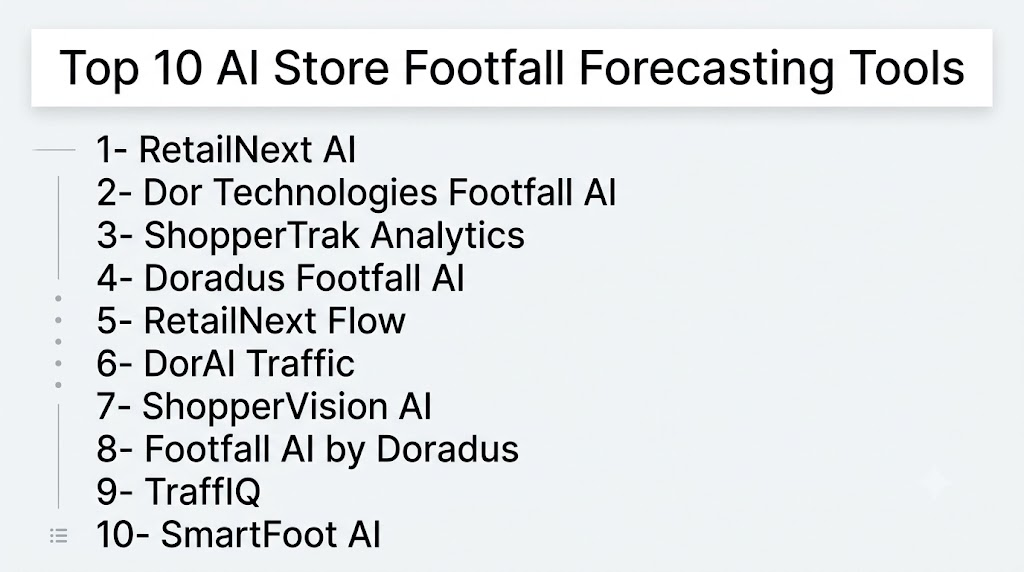
Top 10 AI Store Footfall Forecasting Tools
1- RetailNext AI
One-line verdict: Best for enterprise retailers requiring omnichannel footfall forecasts and actionable operational dashboards.
Short description: RetailNext AI predicts store traffic using sensors, POS, and online activity, helping optimize staffing, inventory, and marketing campaigns.
Standout Capabilities
- Omnichannel footfall prediction
- Hourly and daily traffic forecasts
- Event and promotion impact modeling
- Scenario simulation for peak periods
- Workforce and inventory integration
AI-Specific Depth
- Model support: Proprietary
- RAG / knowledge integration: POS, CRM, ERP
- Evaluation: Continuous validation
- Guardrails: Staffing and occupancy thresholds
- Observability: KPI dashboards
Pros
- Enterprise-grade analytics
- Highly accurate forecasts
- Actionable operational insights
Cons
- Requires significant data infrastructure
- Premium pricing tier
- Learning curve for staff
Security & Compliance
SSO, encryption, audit logs; Certifications: Not publicly stated
Deployment & Platforms
Cloud, Web
Integrations & Ecosystem
POS, workforce management, CRM, dashboards
Pricing Model
Subscription; Not publicly stated
Best-Fit Scenarios
- Large multichannel stores
- Event-driven footfall
- Staffing and inventory planning
2- Dor Technologies Footfall AI
One-line verdict: Mid-market solution focused on predictive staffing and inventory optimization.
Short description: Dor Footfall AI uses POS and Wi-Fi data to forecast traffic, aiding operational planning and resource allocation.
Standout Capabilities
- Hourly footfall prediction
- Staff scheduling recommendations
- Inventory planning alerts
- Event and weather impact modeling
AI-Specific Depth
- Model support: Proprietary hosted
- RAG / knowledge integration: POS/WMS connectors
- Evaluation: Regression and back-testing
- Guardrails: Occupancy and staffing thresholds
- Observability: KPI dashboards
Pros
- Easy deployment for mid-market retailers
- Actionable staff and inventory recommendations
- Predictive alerts for traffic anomalies
Cons
- Limited scalability for large chains
- Minimal advanced analytics
- No BYO model support
Security & Compliance
Encryption; Not publicly stated
Deployment & Platforms
Cloud, Web
Integrations & Ecosystem
POS, WMS, workforce management
Pricing Model
Subscription; Not publicly stated
Best-Fit Scenarios
- Regional retail chains
- Mid-market staffing and promotions
- Event planning
3- ShopperTrak Analytics
One-line verdict: Ideal for retailers needing footfall forecasts with behavioral insights.
Short description: Uses sensors, cameras, and POS data to forecast traffic and improve staffing, inventory, and store layout.
Standout Capabilities
- Footfall and behavior analytics
- Heatmaps and customer flow analysis
- Event and promotion impact simulation
- Scenario modeling for staffing
AI-Specific Depth
- Model support: Proprietary
- RAG / knowledge integration: POS, ERP connectors
- Evaluation: Historical back-testing
- Guardrails: Staffing and occupancy thresholds
- Observability: KPI dashboards
Pros
- Combines footfall with behavioral insights
- Supports scenario modeling
- Provides operational recommendations
Cons
- Requires sensors/camera infrastructure
- Premium cost
- Staff training required
Security & Compliance
Encryption, audit logs; Not publicly stated
Deployment & Platforms
Cloud, Web
Integrations & Ecosystem
POS, workforce, CRM
Pricing Model
Subscription; Not publicly stated
Best-Fit Scenarios
- Large urban retail stores
- Event-driven locations
- Omnichannel operations
4- Doradus Footfall AI
One-line verdict: SMB-friendly tool providing actionable footfall predictions with minimal setup.
Short description: Predicts hourly footfall to guide staffing, inventory, and promotions for smaller chains.
Standout Capabilities
- Hourly and daily traffic forecasts
- Staff scheduling suggestions
- Event and weather adjustment
- Lightweight dashboards
AI-Specific Depth
- Model support: Hosted proprietary
- RAG / knowledge integration: POS, workforce
- Evaluation: Back-testing
- Guardrails: Occupancy and staffing thresholds
- Observability: Dashboards
Pros
- Quick deployment
- Low cost
- Simple actionable insights
Cons
- Limited analytics depth
- Not scalable for enterprise
- Minimal BYO options
Security & Compliance
Encryption; Not publicly stated
Deployment & Platforms
Cloud, Web
Integrations & Ecosystem
POS, workforce
Pricing Model
Subscription; Not publicly stated
Best-Fit Scenarios
- Small retail chains
- Staff scheduling and promotions
- SMB operations
5- RetailNext Flow
One-line verdict: Great for omnichannel stores needing real-time footfall predictions.
Short description: Combines sensors, POS, and AI analytics to forecast traffic and optimize store operations.
Standout Capabilities
- Real-time hourly footfall forecasts
- Scenario simulation for promotions/events
- Staffing and layout recommendations
- KPI dashboards
AI-Specific Depth
- Model support: Proprietary
- RAG / knowledge integration: POS, ERP
- Evaluation: Continuous validation
- Guardrails: Staffing and occupancy limits
- Observability: Real-time dashboards
Pros
- Omnichannel-ready
- Real-time actionable insights
- Integrated operational dashboards
Cons
- Infrastructure required
- Premium pricing
- Learning curve
Security & Compliance
Encryption, role-based access; Not publicly stated
Deployment & Platforms
Cloud, Web, Mobile
Integrations & Ecosystem
POS, workforce, CRM, sensors
Pricing Model
Subscription; Not publicly stated
Best-Fit Scenarios
- Multichannel stores
- Event-based footfall planning
- Layout optimization
6- DorAI Traffic
One-line verdict: Mid-market tool focused on staffing optimization and event impact.
Short description: Uses AI to predict hourly footfall for better staffing and inventory planning.
Standout Capabilities
- Hourly traffic forecasts
- Staff scheduling recommendations
- Event-based footfall analysis
- POS/Wi-Fi integration
AI-Specific Depth
- Model support: Hosted proprietary
- RAG / knowledge integration: POS, workforce
- Evaluation: Regression testing
- Guardrails: Occupancy limits
- Observability: Dashboard KPIs
Pros
- Lightweight
- Real-time alerts
- Easy integration
Cons
- Limited scenario simulation
- Less analytical depth
- No BYO models
Security & Compliance
Encryption; Not publicly stated
Deployment & Platforms
Cloud, Web
Integrations & Ecosystem
POS, workforce tools
Pricing Model
Subscription; Not publicly stated
Best-Fit Scenarios
- Mid-market chains
- Staff scheduling
- Promotions planning
7- ShopperVision AI
One-line verdict: Combines footfall with behavioral insights for operational decision-making.
Short description: Predicts traffic using sensors and POS data, enabling better staffing and inventory management.
Standout Capabilities
- Flow analysis
- Heatmaps
- Footfall + behavior predictions
- Event and promotion scenario modeling
- KPI dashboards
AI-Specific Depth
- Model support: Proprietary
- RAG / knowledge integration: POS, CRM
- Evaluation: Historical validation
- Guardrails: Occupancy thresholds
- Observability: Flow vs forecast metrics
Pros
- Behavioral insights
- Omnichannel support
- Operational recommendations
Cons
- Sensor dependency
- Setup complexity
- Cost
Security & Compliance
Encrypted storage; Not publicly stated
Deployment & Platforms
Cloud, Web
Integrations & Ecosystem
POS, CRM, workforce
Pricing Model
Subscription; Not publicly stated
Best-Fit Scenarios
- Urban retail stores
- Event-heavy locations
- Customer flow optimization
8- Footfall AI by Doradus
One-line verdict: SMB-friendly, actionable predictions with lightweight dashboards.
Short description: Predicts store traffic using POS or basic sensor data.
Standout Capabilities
- Hourly predictions
- Staffing and inventory suggestions
- Event/weather adjustments
- Lightweight dashboards
AI-Specific Depth
- Model support: Proprietary
- RAG / knowledge integration: POS, workforce
- Evaluation: Back-testing
- Guardrails: Staffing and occupancy
- Observability: Dashboards
Pros
- Quick deployment
- Low cost
- Simple insights
Cons
- Limited analytics
- SMB-only scale
- No BYO
Security & Compliance
Encryption; Not publicly stated
Deployment & Platforms
Cloud, Web
Integrations & Ecosystem
POS, workforce
Pricing Model
Subscription; Not publicly stated
Best-Fit Scenarios
- SMB chains
- Staff scheduling
- Promotions planning
9- TraffIQ
One-line verdict: Enterprise-ready, scenario simulation for multi-location forecasting.
Short description: Predicts footfall across stores using sensors, POS, and event data.
Standout Capabilities
- Multi-store forecasting
- Scenario simulation
- Event/weather modeling
- Staffing recommendations
- KPI dashboards
AI-Specific Depth
- Model support: Proprietary
- RAG / knowledge integration: POS, ERP
- Evaluation: Historical validation
- Guardrails: Occupancy/staff limits
- Observability: Dashboard metrics
Pros
- Enterprise-grade
- Scenario simulations
- Multi-store analytics
Cons
- Data infrastructure needed
- Premium cost
- Complexity
Security & Compliance
Encrypted storage; Not publicly stated
Deployment & Platforms
Cloud, Web
Integrations & Ecosystem
POS, workforce, CRM
Pricing Model
Subscription; Not publicly stated
Best-Fit Scenarios
- Multi-location retail chains
- Event-heavy stores
- Omnichannel operations
10- SmartFoot AI
One-line verdict: Real-time operational insights for mid-market and enterprise stores.
Short description: Forecasts store traffic and adjusts staffing, inventory, and promotions in real-time.
Standout Capabilities
- Real-time hourly and daily predictions
- Staff scheduling recommendations
- Scenario modeling for promotions and events
- KPI dashboards
- Integration with POS/CRM
AI-Specific Depth
- Model support: Proprietary
- RAG / knowledge integration: POS, ERP, CRM
- Evaluation: Regression and historical testing
- Guardrails: Occupancy/staffing thresholds
- Observability: Real-time dashboards
Pros
- Real-time insights
- Operational recommendations
- Scenario modeling
Cons
- Sensor/POS integration required
- Premium cost
- No BYO models
Security & Compliance
SSO, encryption; Not publicly stated
Deployment & Platforms
Cloud, Web, Mobile
Integrations & Ecosystem
POS, workforce, CRM
Pricing Model
Subscription; Not publicly stated
Best-Fit Scenarios
- Mid-market chains
- Event-based planning
- Real-time operations
Comparison Table
| Tool | Best For | Deployment | Model Flexibility | Strength | Watch-Out | Public Rating |
|---|---|---|---|---|---|---|
| RetailNext AI | Enterprise | Cloud | Proprietary | Omnichannel forecasts | Premium | N/A |
| Dor Technologies | Mid-market | Cloud | Proprietary | Staff & inventory predictions | Limited scale | N/A |
| ShopperTrak Analytics | Large retail | Cloud | Proprietary | Footfall + behavior | Sensor infrastructure | N/A |
| Doradus Footfall AI | SMB | Cloud | Proprietary | Lightweight & actionable | Limited analytics | N/A |
| RetailNext Flow | Omnichannel | Cloud | Proprietary | Real-time predictions | Premium | N/A |
| DorAI Traffic | Mid-market | Cloud | Proprietary | Staffing optimization | Minimal scenario simulation | N/A |
| ShopperVision AI | Urban stores | Cloud | Proprietary | Behavioral insights | Sensor dependency | N/A |
| Footfall AI by Doradus | SMB | Cloud | Proprietary | Quick insights | SMB-only scale | N/A |
| TraffIQ | Enterprise | Cloud | Proprietary | Multi-store simulation | Complexity | N/A |
| SmartFoot AI | Mid-market | Cloud | Proprietary | Real-time operations | Sensor/POS integration | N/A |
Scoring & Evaluation (Weighted)
| Tool | Core | Reliability | Guardrails | Integrations | Ease | Perf/Cost | Security | Support | Weighted Total |
|---|---|---|---|---|---|---|---|---|---|
| RetailNext AI | 9 | 9 | 9 | 9 | 7 | 8 | 8 | 7 | 8.6 |
| Dor Technologies | 8 | 8 | 8 | 7 | 8 | 8 | 7 | 7 | 7.8 |
| ShopperTrak Analytics | 9 | 9 | 8 | 8 | 7 | 8 | 8 | 7 | 8.2 |
| Doradus Footfall AI | 7 | 7 | 7 | 6 | 9 | 7 | 7 | 7 | 7.2 |
| RetailNext Flow | 8 | 8 | 8 | 8 | 7 | 8 | 7 | 7 | 7.8 |
| DorAI Traffic | 7 | 7 | 7 | 7 | 8 | 7 | 7 | 7 | 7.3 |
| ShopperVision AI | 8 | 8 | 8 | 8 | 7 | 8 | 7 | 7 | 7.8 |
| Footfall AI by Doradus | 7 | 7 | 7 | 6 | 8 | 7 | 7 | 7 | 7.1 |
| TraffIQ | 9 | 9 | 9 | 9 | 6 | 8 | 8 | 7 | 8.3 |
| SmartFoot AI | 8 | 8 | 8 | 8 | 7 | 8 | 7 | 7 | 7.9 |
Top 3 Enterprise: RetailNext AI, TraffIQ, ShopperTrak Analytics
Top 3 SMB/Mid-market: Doradus Footfall AI, Dor Technologies, Footfall AI by Doradus
Top 3 Real-time/Operational: RetailNext Flow, SmartFoot AI, DorAI Traffic
Which AI Store Footfall Forecasting Tool Is Right for You?
Solo / Freelancer
- Doradus Footfall AI, Footfall AI by Doradus
SMB
- Dor Technologies, SmartFoot AI
Mid-Market
- DorAI Traffic, RetailNext Flow
Enterprise
- RetailNext AI, ShopperTrak Analytics, TraffIQ
Regulated Industries
- Enterprise platforms with audit logs and guardrails (RetailNext AI, TraffIQ)
Budget vs Premium
- Budget: SMB-focused tools
- Premium: RetailNext AI, TraffIQ, ShopperTrak Analytics
Build vs Buy
- Build internally if strong analytics team exists; otherwise buy for integrated predictions, real-time updates, and scenario simulation.
Implementation Playbook (30 / 60 / 90 Days)
30 Days: Pilot stores, integrate historical POS and sensor data, define KPIs, run initial forecasts.
60 Days: Expand deployment to more stores, integrate workforce and inventory, validate forecasts.
90 Days: Optimize real-time adjustments, scenario planning, dashboards, and governance metrics.
Common Mistakes & How to Avoid Them
- Using incomplete historical data
- Skipping scenario simulation
- Ignoring guardrails for occupancy or staffing
- Over-reliance on AI without human oversight
- Not integrating POS or workforce data
- Neglecting privacy compliance
- Failing to validate prediction accuracy
- Limited real-time observability
- Over-automation without contingency
- Ignoring cost and latency
- Using models without scenario testing
- Lack of dashboards for operational KPIs
FAQs
- What is AI Store Footfall Forecasting?
AI-based prediction of store traffic to optimize staffing, inventory, and operations. - Do these tools replace store managers?
No — they provide predictive insights; humans make final decisions. - How accurate are forecasts?
Accuracy depends on data quality, sensor deployment, and model evaluation. - Can tools handle multiple locations?
Yes, enterprise platforms forecast across multi-store chains. - Is real-time prediction possible?
Many tools update predictions dynamically throughout the day. - Do I need sensors or cameras?
Multimodal data improves accuracy; some SMB tools use POS data only. - Are these suitable for small stores?
SMB-focused tools provide actionable insights without complex infrastructure. - How do guardrails work?
Enforce staffing, occupancy, and safety thresholds. - Can these integrate with scheduling tools?
Yes — most integrate with workforce management and POS systems. - Do they forecast promotions’ impact?
Yes, scenario simulations include promotions and events. - Is BYO model supported?
Some enterprise tools allow proprietary AI model integration. - What about data privacy?
Encryption, audit logs, and retention policies help maintain compliance.
Conclusion
AI Store Footfall Forecasting tools enable retailers to anticipate traffic, optimize staffing, inventory, and marketing, and improve customer experience. Choosing the right tool depends on store size, operational complexity, and data maturity. Start with shortlisting, run pilots, validate predictions and guardrails, and scale with real-time monitoring.

Find Trusted Cardiac Hospitals
Compare heart hospitals by city and services — all in one place.
Explore Hospitals
The article provides a helpful vendor checklist, but it misses the brutal operational and architectural realities of deploying multi-modal AI systems across hundreds of distributed, physical retail endpoints. From a Platform Engineering and SRE perspective, the real make-or-break factors are edge architecture and data pipeline resilience. Retail store WAN connections are notoriously unstable; any platform requiring real-time data streaming will fail without localized edge compute, automated store-and-forward caching, and deterministic batch-backfilling to prevent downstream ML pipelines from being poisoned by delayed data. Furthermore, these physical environments suffer from “silent” infrastructure failures—such as a promotional display blocking a camera lens or a Wi-Fi sensor dropping its power state—which standard model drift metrics completely miss. True enterprise-grade viability requires specialized sensor-health observability to instantly isolate hardware failures from actual traffic anomalies, coupled with zero-knowledge data processing that tokenizes MAC addresses and blurs optical frames at the edge before data ever crosses the network to trigger compliance and privacy liabilities.
While feature matrices are helpful for procurement, they often gloss over the brutal operational realities of deploying multi-modal AI systems across hundreds of distributed, physical retail endpoints. From a Platform Engineering and SRE perspective, the real make-or-break factors aren’t the dashboards, but how these tools handle edge architecture and data resilience. Retail store WAN connections are notoriously flakey, meaning any platform requiring continuous, heavy data streaming will crumble without localized edge processing, automated store-and-forward caching, and deterministic data-backfilling to keep downstream ML pipelines from being poisoned. Furthermore, these environments suffer from “silent” physical failures—like a new promotional display blocking a camera view or a Wi-Fi sensor dropping its power state—which standard model drift detection completely misses. True enterprise readiness requires robust sensor observability to flag anomalous, flatlined hardware signals instantly, coupled with localized, zero-knowledge processing to blur frames and tokenize data at the edge before anything traverses the network and triggers massive compliance liabilities under local privacy laws.