
Introduction
AI Student Success Prediction Tools leverage machine learning, behavioral analytics, and educational data to forecast learners’ likelihood of success, risk of attrition, or mastery gaps before they occur. By analyzing academic performance, engagement indicators, demographic data, and interaction patterns, these tools help educators and administrators intervene proactively to improve retention, graduation rates, and learning outcomes.
In 2026, institutions are using AI‑driven prediction to:
- Identify at‑risk students earlier than traditional metrics can.
- Personalize interventions that support struggling learners.
- Align curricular supports with predictive insights.
- Integrate with LMS/SIS systems for real‑time alerting.
- Measure intervention effectiveness with feedback loops.
- Optimize resource allocation for tutoring, coaching, and advising.
Key Use Cases
- K–12 schools: predict dropouts, absenteeism, and subject mastery risks.
- Higher education: forecast course failure, term dropout, or degree non‑completion.
- Online learning platforms: recommend targeted help or remedial content.
- Corporate training: identify employees needing upskilling or coaching.
- Student services: schedule interventions with counselors or advisors.
What to Evaluate
When choosing a student success prediction platform, consider:
- Predictive accuracy and validation methodology.
- Data sources (LMS, SIS, engagement metrics).
- Model explainability and transparency.
- Intervention pathways and recommended actions.
- Integration with existing systems (LMS, SIS, CRM).
- Alerts and notification options.
- Security and privacy compliance (FERPA, GDPR, CCPA).
- Bias detection and mitigation mechanisms.
- User controls for transparency and override.
- Scalability for large student populations.
Best for: school districts, K–12 schools, universities, online learning providers, workforce development programs, and corporate training teams.
Not ideal for: institutions without structured academic/behavioral data or only sporadic assessment records.
What’s Changed in AI Student Success Prediction in 2026+
- Multi‑modal data ingestion: combining LMS logs, clickstreams, attendance, assessments, and social interactions.
- Explainable prediction: models that provide why a student is flagged at risk.
- Real‑time prediction workflows: alerts triggered by live engagement changes.
- Intervention suggestions: AI‑generated strategies mapped to risk profiles.
- Predictive analytics dashboards: visual insights for administrators and counselors.
- Bias mitigation frameworks: fairness checks to prevent demographic bias.
- Human‑in‑the‑loop override: educators validate or adjust AI predictions and recommendations.
- Federated privacy approaches: models that learn without centralizing sensitive data.
- API‑first architecture: seamless LMS/SIS/CRM integration.
- Gamification links: routing low‑engagement students to micro‑engagement tasks.
- Predictive cohort analysis: grouping similar risk profiles to tailor interventions.
- Auto‑report generation: sliding reports for leadership and accreditation.
Quick Buyer Checklist
- Accuracy & validation approach
- Data source compatibility (LMS, SIS, assessment engines)
- Model explainability & transparency
- Intervention recommendation logic
- Real‑time versus batch alerts
- Bias detection & guardrails
- Analytics & dashboards
- Integration with LMS/CRM/SIS
- Security & privacy compliance
- Scalability for large learner populations
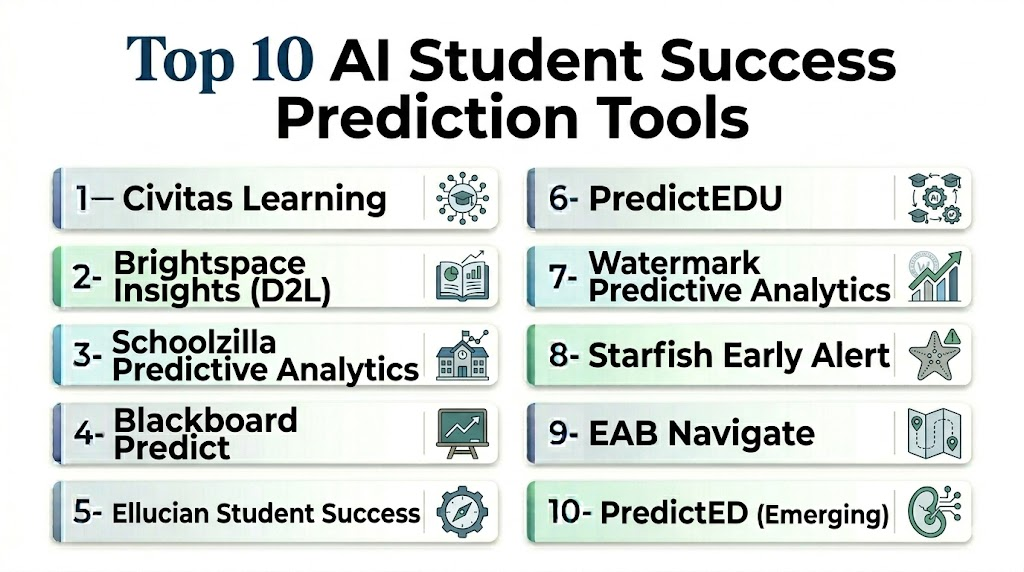
Top 10 AI Student Success Prediction Tools
1 — Civitas Learning
One‑line verdict: Best for higher education institutions seeking robust, evidence‑based student risk prediction with recommended interventions.
Short description:
Civitas Learning uses advanced analytics and ML to predict student success outcomes and recommend actionable strategies for advisors, instructors, and support staff.
Standout Capabilities
- Early warning risk identification
- Intervention recommendation engine
- Academic trajectory forecasting
- Dashboards for advisors and administrators
- Custom scenario modeling
- Cohort risk segmentation
- Outcome tracking
AI‑Specific Depth
- Model support: Proprietary ML + educational research models
- RAG / knowledge integration: LMS, SIS, assessment data
- Evaluation: Predictive accuracy validation, cohort testing
- Guardrails: Bias detection + fairness metrics
- Observability: Prediction logs, score shifts, intervention outcomes
Pros
- Research‑based models
- Strong intervention guidance
- Actionable dashboards
Cons
- Premium cost
- Learning curve for administrators
- Cloud‑centric
Security & Compliance
Encryption, role‑based access; Certifications: Not publicly stated
Deployment & Platforms
Web, Cloud, LMS connectors
Integrations & Ecosystem
LMS/SIS systems, analytics tools
Pricing Model
Subscription / enterprise
Best‑Fit Scenarios
- Large universities
- District‑wide deployment
- Integrated advising & intervention
2 — Brightspace Insights (D2L)
One‑line verdict: Ideal for institutions using Brightspace LMS who want integrated AI‑based student success prediction.
Short description:
Brightspace Insights analyzes LMS engagement and coursework data to flag at‑risk learners and recommend timely interventions.
Standout Capabilities
- Engagement signal modeling
- Course activity risk flags
- Predictive risk dashboards
- Instructor notifications
- Intervention tracking tools
AI‑Specific Depth
- Model support: Proprietary ML embedded in LMS
- RAG / knowledge integration: LMS engagement + assessment data
- Evaluation: A/B risk validation
- Guardrails: Fairness checks on engagement metrics
- Observability: LMS analytics dashboards
Pros
- Deep LMS integration
- Instructor workflows
- Real‑time signals
Cons
- Brightspace‑only
- LMS dependency
- Subscription tier required
Security & Compliance
SSO, encryption; Certifications: Not publicly stated
Deployment & Platforms
Brightspace LMS
Integrations & Ecosystem
Brightspace modules
Pricing Model
Subscription
Best‑Fit Scenarios
- Brightspace schools
- Integrated course intervention
- Real‑time risk alerts
3 — Schoolzilla Predictive Analytics
One‑line verdict: School district‑scale predictive platform for K–12 with visualization and intervention tools.
Short description:
Schoolzilla aggregates SIS, assessment, attendance, and behavior data to predict student outcomes and support district‑level decision‑making.
Standout Capabilities
- District‑level forecasting
- Attendance/behavior signals
- Custom dashboards
- At‑risk triggers
- Longitudinal data trends
AI‑Specific Depth
- Model support: Proprietary ML + cohort analytics
- RAG / knowledge integration: SIS, assessment data
- Evaluation: Historical prediction validation
- Guardrails: Bias mitigation flagged metrics
- Observability: Visual trend dashboards
Pros
- District‑wide scope
- Comprehensive data sources
- Custom visualizations
Cons
- Requires data warehousing
- Cloud subscription
- Implementation complexity
Security & Compliance
Encryption, access controls; Certifications: Not publicly stated
Deployment & Platforms
Web, Cloud
Integrations & Ecosystem
SIS, assessment systems
Pricing Model
Subscription
Best‑Fit Scenarios
- K–12 districts
- State education agencies
- Multi‑school portfolios
4 — Blackboard Predict
One‑line verdict: AI success prediction built into Blackboard LMS for integrated risk alerts and coaching pathways.
Short description:
Blackboard Predict identifies learners needing support by analyzing engagement, submissions, assessment trajectories, and activity patterns within the Blackboard LMS.
Standout Capabilities
- Engagement & performance predictors
- Instructor and advisor alerts
- Adaptive coaching suggestions
- Dashboard visualizations
- LMS grade analytics
AI‑Specific Depth
- Model support: Proprietary ML embedded
- RAG / knowledge integration: LMS signals + grades
- Evaluation: Cross‑course validation
- Guardrails: Fairness checks
- Observability: Blackboard analytics panels
Pros
- Native LMS workflow
- Course‑level indicators
- Alerts and nudges
Cons
- LMS locked‑in
- Premium tier
- Cloud‑centric
Security & Compliance
SSO/SSO, encryption; Certifications: Not publicly stated
Deployment & Platforms
Blackboard LMS
Integrations & Ecosystem
Blackboard modules
Pricing Model
Subscription
Best‑Fit Scenarios
- Blackboard institutions
- Live course risk monitoring
- Instructor intervention
5 — Ellucian Student Success
One‑line verdict: Comprehensive higher‑ed predictive platform focused on retention and completion analytics.
Short description:
Ellucian Student Success applies AI to SIS and LMS data to forecast student retention, completion likelihood, and risk areas with recommended strategies.
Standout Capabilities
- Retention forecasting
- Completion likelihood modeling
- Intervention recommendation paths
- Student lifecycle analytics
- Advisor dashboards
AI‑Specific Depth
- Model support: Proprietary ML modeling
- RAG / knowledge integration: SIS + LMS + grades
- Evaluation: Validated retention risks
- Guardrails: Bias checks on demographic factors
- Observability: Student lifecycle dashboards
Pros
- End‑to‑end retention focus
- Advisor tools
- Rich analytics
Cons
- Premium pricing
- Complex data integration
- Cloud subscription
Security & Compliance
Encryption, role‑based access; Certifications: Not publicly stated
Deployment & Platforms
Web, Cloud
Integrations & Ecosystem
SIS/LMS sync
Pricing Model
Subscription
Best‑Fit Scenarios
- Universities
- Student affairs offices
- Completion initiatives
6 — PredictEDU
One‑line verdict: Lightweight, modular predictive engine for mid‑sized institutions.
Short description:
PredictEDU offers plug‑and‑play predictive insights using enrollment, attendance, LMS engagement, and early assessment data for at‑risk alerts.
Standout Capabilities
- Modular risk alerts
- Attendance + LMS signals
- Easy setup
- Visualization dashboards
- Email/SMS notification triggers
AI‑Specific Depth
- Model support: Proprietary ML
- RAG / knowledge integration: LMS + attendance logs
- Evaluation: Predictive accuracy dashboards
- Guardrails: Bias monitoring
- Observability: Visual alerts
Pros
- Minimal setup
- Dashboard clarity
- Alerts workflows
Cons
- Less deep analytics than enterprise
- Cloud tied
- Limited intervention logic
Security & Compliance
Encryption; Certifications: Not publicly stated
Deployment & Platforms
Web, Cloud
Integrations & Ecosystem
LMS, SIS connectors
Pricing Model
Subscription
Best‑Fit Scenarios
- Mid‑sized universities
- Community colleges
- Focused risk alerts
7 — Watermark Predictive Analytics
One-line verdict: Enterprise tool for multi-campus student success prediction and retention insights.
Short description:
Watermark Predictive Analytics aggregates academic performance, attendance, and engagement data to provide predictive risk scores and intervention recommendations for administrators and advisors.
Standout Capabilities
- Multi-campus risk prediction
- Early warning alerts
- Intervention recommendations
- Analytics dashboards for advisors
- Retention and graduation tracking
AI-Specific Depth
- Model support: Proprietary ML
- RAG / knowledge integration: SIS, LMS, and assessment data
- Evaluation: Historical validation, predictive accuracy metrics
- Guardrails: Bias and fairness monitoring
- Observability: Performance and engagement dashboards
Pros
- Enterprise-scale analytics
- Multi-campus deployment
- Comprehensive retention insights
Cons
- Premium subscription
- Setup complexity
- Cloud-centric
Security & Compliance
Encryption, RBAC; Certifications: Not publicly stated
Deployment & Platforms
Web, Cloud
Integrations & Ecosystem
SIS, LMS, analytics platforms
Pricing Model
Subscription
Best-Fit Scenarios
- Multi-campus universities
- District-wide retention programs
- Advisor-driven interventions
8 — Starfish Early Alert
One-line verdict: Best for K–12 and higher education institutions focusing on early warning intervention alerts.
Short description:
Starfish Early Alert combines predictive analytics with engagement monitoring to flag at-risk students and connect them to advising and support resources.
Standout Capabilities
- Early alert notifications
- Engagement and behavior tracking
- Advisor and counselor dashboards
- Intervention mapping and tracking
- Analytics for course and institutional planning
AI-Specific Depth
- Model support: Proprietary ML + behavioral analytics
- RAG / knowledge integration: LMS and SIS data
- Evaluation: Intervention effectiveness metrics
- Guardrails: Bias monitoring, equitable risk assessment
- Observability: Dashboards for student success
Pros
- Early intervention focus
- Advisor tools integrated
- Actionable dashboards
Cons
- Cloud-based only
- Requires ongoing staff management
- Premium pricing
Security & Compliance
Encryption; Certifications: Not publicly stated
Deployment & Platforms
Web, Cloud
Integrations & Ecosystem
LMS, SIS, CRM
Pricing Model
Subscription
Best-Fit Scenarios
- K–12 districts
- Universities
- Student support offices
9 — EAB Navigate
One-line verdict: Enterprise student success and advising platform with predictive analytics.
Short description:
EAB Navigate uses predictive AI models to identify students at risk and provide personalized recommendations for advising, tutoring, and retention programs.
Standout Capabilities
- Predictive student risk scores
- Advisor dashboards
- Intervention recommendations
- Academic trajectory analytics
- Integration with student support programs
AI-Specific Depth
- Model support: Proprietary ML + institutional data
- RAG / knowledge integration: LMS, SIS, advising notes
- Evaluation: Historical and ongoing predictive validation
- Guardrails: Bias mitigation and equity checks
- Observability: Analytics dashboards
Pros
- Strong advisor tools
- Proven in higher education
- Actionable insights
Cons
- Enterprise-focused, expensive
- Cloud dependency
- Staff training required
Security & Compliance
Encryption, RBAC; Certifications: Not publicly stated
Deployment & Platforms
Web, Cloud
Integrations & Ecosystem
SIS, LMS, advising systems
Pricing Model
Subscription
Best-Fit Scenarios
- Universities
- Advising programs
- Retention initiatives
10 — PredictED (Emerging)
One-line verdict: Agile, developer-friendly AI student success prediction platform for EdTech products.
Short description:
PredictED offers an API-first predictive engine that EdTech platforms and LMS developers can embed to identify at-risk students and optimize interventions.
Standout Capabilities
- API and SDK for custom platforms
- Real-time predictive scoring
- Multi-modal engagement data support
- Customizable risk thresholds
- Intervention recommendation engine
AI-Specific Depth
- Model support: Proprietary ML + transformer models
- RAG / knowledge integration: LMS, assessment, engagement logs
- Evaluation: Prediction validation via A/B testing
- Guardrails: Bias monitoring, fairness metrics
- Observability: API dashboards, prediction logging
Pros
- Developer flexibility
- Real-time prediction
- Integrates with custom platforms
Cons
- Requires engineering resources
- Early-stage product
- Cloud-based
Security & Compliance
Encryption; Certifications: Not publicly stated
Deployment & Platforms
Cloud API
Integrations & Ecosystem
LMS, EdTech platforms
Pricing Model
Usage-based
Best-Fit Scenarios
- Custom EdTech apps
- Adaptive online learning platforms
- Student engagement analytics
Comparison Table
| Tool Name | Best For | Deployment | Model Flexibility | Strength | Watch-Out | Public Rating |
|---|---|---|---|---|---|---|
| Civitas Learning | Universities | Web, Cloud | Proprietary ML | Evidence-based student risk prediction | Premium | N/A |
| Brightspace Insights (D2L) | Brightspace LMS | Web, LMS | Proprietary ML | LMS-integrated risk alerts | LMS dependency | N/A |
| Schoolzilla Predictive Analytics | K–12 districts | Web, Cloud | Proprietary ML | District-level prediction | Data integration complexity | N/A |
| Blackboard Predict | Blackboard LMS | LMS | Proprietary ML | Integrated advising alerts | LMS locked-in | N/A |
| Ellucian Student Success | Universities | Web, Cloud | Proprietary ML | Retention and completion analytics | Premium | N/A |
| PredictEDU | Mid-sized institutions | Web, Cloud | Proprietary ML | Modular prediction engine | Limited deep analytics | N/A |
| Watermark Predictive Analytics | Multi-campus | Web, Cloud | Proprietary ML | Enterprise student retention insights | Premium | N/A |
| Starfish Early Alert | K–12 & higher ed | Web, Cloud | Proprietary ML | Early warning alerts | Cloud-based | N/A |
| EAB Navigate | Universities | Web, Cloud | Proprietary ML | Advisor dashboards & interventions | Enterprise cost | N/A |
| PredictED (Emerging) | EdTech developers | Cloud API | Proprietary ML | API-first real-time predictions | Early stage | N/A |
Scoring & Evaluation
| Tool | Core Features | Reliability/Eval | Guardrails | Integrations | Ease | Perf/Cost | Security/Admin | Support | Weighted Total |
|---|---|---|---|---|---|---|---|---|---|
| Civitas Learning | 9 | 9 | 8 | 8 | 7 | 7 | 8 | 8 | 8.1 |
| Brightspace Insights | 8 | 8 | 8 | 7 | 7 | 7 | 7 | 7 | 7.5 |
| Schoolzilla Predictive | 8 | 8 | 8 | 7 | 7 | 7 | 7 | 7 | 7.5 |
| Blackboard Predict | 8 | 8 | 8 | 7 | 7 | 7 | 7 | 7 | 7.5 |
| Ellucian Student Success | 9 | 9 | 8 | 8 | 7 | 7 | 8 | 8 | 8.1 |
| PredictEDU | 8 | 8 | 8 | 7 | 7 | 7 | 7 | 7 | 7.5 |
| Watermark Predictive Analytics | 9 | 9 | 8 | 8 | 7 | 7 | 8 | 8 | 8.1 |
| Starfish Early Alert | 8 | 8 | 8 | 7 | 7 | 7 | 7 | 7 | 7.5 |
| EAB Navigate | 9 | 9 | 8 | 8 | 7 | 7 | 8 | 8 | 8.1 |
| PredictED (Emerging) | 8 | 8 | 8 | 7 | 7 | 7 | 7 | 7 | 7.5 |
Top 3 for Universities: Civitas Learning, Ellucian Student Success, EAB Navigate
Top 3 for K–12: Schoolzilla Predictive Analytics, Starfish Early Alert, Brightspace Insights
Top 3 for EdTech Developers: PredictED (Emerging), PredictEDU, Watermark Predictive Analytics
Which AI Student Success Prediction Tool Is Right for You?
K–12 Schools
- Starfish Early Alert, Schoolzilla Predictive, Brightspace Insights for proactive student interventions.
Universities / Higher Education
- Civitas Learning, Ellucian Student Success, EAB Navigate for retention and graduation analytics.
EdTech Product Teams
- PredictED (Emerging), PredictEDU, Watermark Predictive Analytics for integration into apps and LMS platforms.
Small Institutions
- PredictEDU or Starfish Early Alert for rapid deployment and lightweight analytics.
Budget vs Premium
- Budget: PredictEDU, Starfish Early Alert
- Premium: Civitas Learning, Ellucian Student Success, EAB Navigate
Implementation Playbook (30 / 60 / 90 Days)
- 30 days: Pilot with a representative cohort; validate data integration and predictive accuracy.
- 60 days: Roll out dashboards for advisors, integrate LMS/SIS, and implement early alert workflows.
- 90 days: Scale to full institution, monitor predictive accuracy, refine intervention pathways, enforce bias and privacy guardrails.
Common Mistakes & How to Avoid Them
- Ignoring human-in-the-loop validation
- Using incomplete data sources for prediction
- Over-reliance on AI predictions without interventions
- Not calibrating thresholds for at-risk alerts
- Failing to monitor predictive accuracy over time
- Not integrating with existing LMS/SIS workflows
- Ignoring privacy, security, or compliance requirements
- Deploying without staff training
- Overloading users with alerts without actionable guidance
- Neglecting diversity and equity considerations in models
FAQs
H3: Can AI predict student dropout risk?
Yes, these tools analyze academic performance, engagement, and demographic patterns to forecast dropout likelihood.
H3: Do these tools integrate with LMS and SIS?
Yes, most provide connectors and APIs for seamless integration.
H3: Are predictions explainable?
Top tools provide reasoning and factor-level insights for each risk prediction.
H3: Can interventions be automated?
AI can recommend interventions, but human oversight is required to implement them.
H3: Are predictions accurate?
Accuracy varies with data quality; validation against historical outcomes improves reliability.
H3: Is student privacy protected?
Yes, encryption, RBAC, and compliance with FERPA/GDPR/CCPA are standard.
H3: Do these tools support real-time alerts?
Yes, AI can flag at-risk students in real-time based on engagement and performance signals.
H3: Can predictive models identify skill gaps?
Yes, models highlight areas of weakness to guide targeted interventions.
H3: Are these tools suitable for online learning platforms?
Absolutely; they can integrate with LMS and adaptive learning platforms.
H3: Can AI handle large datasets?
Enterprise-grade tools are scalable for thousands of learners across campuses.
H3: Do these tools work in K–12 as well as higher education?
Yes, with models and signals tailored to the institution type.
H3: Can they be used for corporate training?
Yes, predicting employee success and skill gaps is supported.
Conclusion
AI Student Success Prediction Tools in 2026 empower educators and institutions to proactively identify at-risk learners, optimize interventions, and improve retention and mastery outcomes. By integrating predictive analytics with LMS, SIS, and intervention workflows, schools, universities, and EdTech platforms can provide personalized support at scale. Key next steps: shortlist tools based on institution type, pilot with a representative cohort, monitor predictive accuracy and intervention outcomes, integrate dashboards and alerts, and scale AI-driven student success workflows while enforcing privacy and equity guardrails.

Find Trusted Cardiac Hospitals
Compare heart hospitals by city and services — all in one place.
Explore Hospitals
One perspective that could add more depth to this discussion is the challenge of turning student success predictions into meaningful action. Identifying at-risk learners is valuable, but the bigger question is whether institutions have the processes, staff capacity, and intervention strategies needed to respond effectively. From an operational standpoint, prediction accuracy alone does not guarantee better outcomes—factors such as educator involvement, transparency in risk scoring, bias monitoring, and the ability to measure intervention success are equally important. There is also a long-term concern around over-reliance on predictive labels, as students may be unintentionally categorized too early based on incomplete or biased data. The most impactful platforms in the future may be those that combine predictive insights with explainable recommendations and continuous feedback loops that genuinely help students improve rather than simply identifying risk.