
Introduction
AI Supply Forecasting for materials uses artificial intelligence, machine learning, and historical plus real-time data to predict demand, optimize inventory, reduce stockouts, and improve supply chain efficiency. These platforms help manufacturers, distributors, and retailers manage materials, components, and raw goods by anticipating fluctuations in demand, supplier lead times, and production schedules.
Material shortages or overstock can lead to operational delays, increased costs, wasted storage, and missed revenue opportunities. Traditional forecasting methods often rely on historical trends and manual adjustments, which may fail to capture sudden market changes, supplier variability, or seasonality. AI forecasting platforms combine multiple data sources, detect patterns, and generate predictive recommendations that help planners make better decisions.
These platforms are particularly valuable in industries with complex supply chains, multiple suppliers, long lead times, and high-value or perishable materials. AI forecasting supports not only planning but also procurement, warehouse management, production scheduling, and sustainability objectives.
Why It Matters
Accurate material forecasting directly impacts operational continuity, cost efficiency, and service levels. Overestimating demand leads to excess inventory, tying up capital and storage, while underestimating leads to stockouts, delayed production, and dissatisfied customers. AI enables more accurate, proactive planning across the supply chain.
Real-World Use Cases
- Predicting raw material demand for manufacturing plants
- Optimizing inventory levels for high-value or perishable materials
- Improving procurement planning with lead time variability
- Reducing production downtime caused by material shortages
- Supporting multi-site supply chain planning
- Aligning inventory with fluctuating customer demand
- Scenario analysis for supplier disruptions or market volatility
- Planning safety stock and buffer levels
- Automating replenishment and procurement decisions
- Supporting sustainability initiatives by reducing waste
Evaluation Criteria for Buyers
When evaluating AI Supply Forecasting platforms for materials, consider:
- Accuracy of predictive algorithms and AI models
- Ability to handle multi-site, multi-product forecasts
- Integration with ERP, procurement, warehouse, and MES systems
- Real-time updates based on sales, production, and supplier data
- Scenario planning and “what-if” analysis capabilities
- Alerting for stockouts, delays, or demand spikes
- Support for different materials types, including perishables and high-value items
- Ease of use for planners and supply chain teams
- Security and access controls for sensitive procurement data
- Historical performance analytics and continuous model improvement
- Vendor support, training, and implementation services
- Scalability across products, sites, and geographies
Best For
Manufacturers, distributors, and retailers with complex supply chains, multiple materials or components, long lead times, or high variability in demand. Inventory planners, procurement teams, supply chain analysts, and operations managers benefit most.
Not Ideal For
Small operations with few SKUs, limited suppliers, and simple demand patterns may not require AI forecasting. In such cases, spreadsheet-based or rule-of-thumb planning may suffice. AI is most beneficial where forecasting errors carry significant operational or financial risk.
What’s Changing in AI Supply Forecasting for Materials
- AI models increasingly combine historical sales, production, supplier, and market data
- Predictive analytics now supports lead-time variability and supplier risk
- Scenario planning for market fluctuations, seasonal trends, and disruptions
- Integration with IoT data from warehouses and production systems
- Real-time alerts and dynamic replenishment recommendations
- Incorporation of external signals such as weather, economic trends, and commodity prices
- Self-learning models that improve accuracy over time
- Support for multi-echelon and multi-site inventory planning
- Collaboration features for procurement, production, and finance teams
- AI-driven insights for sustainability and waste reduction
- Visualization dashboards for planners, managers, and executives
- Enhanced automation for order recommendations and replenishment triggers
Quick Buyer Checklist
- Forecasting accuracy and model reliability
- Multi-site and multi-material support
- Integration with ERP, MES, procurement, and warehouse systems
- Real-time data updates and alerts
- Scenario planning and risk assessment
- Automated replenishment recommendations
- Historical performance analytics and model explainability
- Ease of use for supply chain planners
- Security, access control, and data privacy
- Scalability across products, sites, and suppliers
- Support for perishable and high-value materials
- Vendor support and training
- Integration with sustainability KPIs and reporting
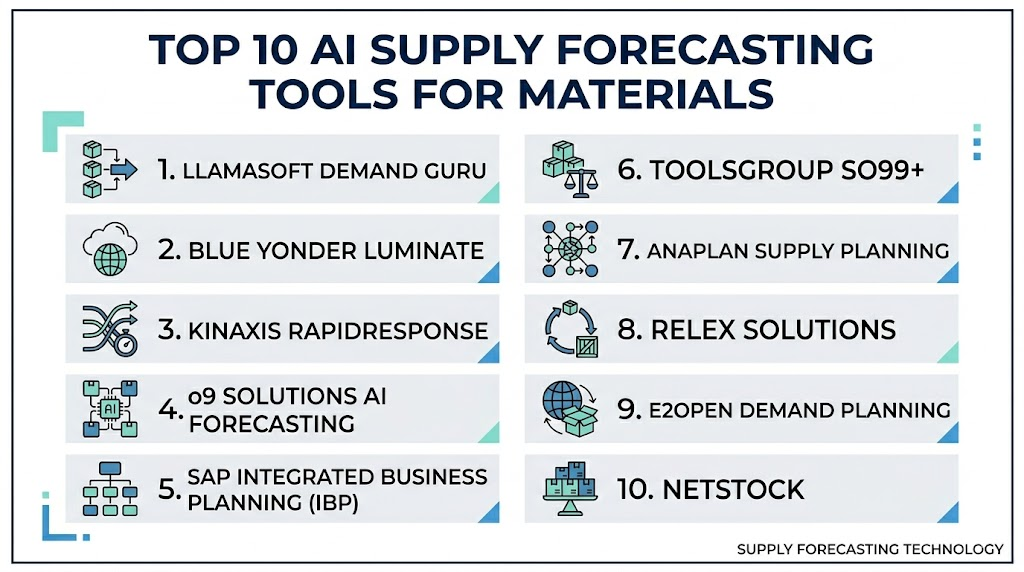
Top 10 AI Supply Forecasting Tools for Materials
1- Llamasoft Demand Guru
One-Line Verdict: Best for enterprises needing AI-driven multi-site material demand forecasting across complex supply chains.
Short Description
Llamasoft Demand Guru combines historical consumption, production, supplier, and external market data to generate AI-powered material demand forecasts. It is designed for multi-site, multi-product operations where accurate planning reduces stockouts and inventory costs.
Standout Capabilities
- Multi-echelon supply chain forecasting
- Scenario-based demand simulations
- Supplier lead-time variability modeling
- AI-driven demand anomaly detection
- Forecast accuracy monitoring
- Integration with ERP and MES systems
- Dashboard visualization for planners
- Automated replenishment recommendations
AI-Specific Depth
- Model support: Proprietary AI models for forecasting
- Knowledge integration: ERP, MES, supplier data, external signals
- Evaluation: Forecast accuracy metrics, error tracking, and model refinement
- Guardrails: Threshold alerts for high-impact stock risks
- Observability: Dashboard KPIs, error reporting, and trend analysis
Pros
- Strong multi-site, multi-product capabilities
- Scenario analysis for supply chain risks
- AI anomaly detection improves forecast reliability
Cons
- Implementation requires ERP/MES integration
- Best for larger enterprises
- Learning curve for planners
Security and Compliance
Enterprise-grade security with RBAC, encryption, and audit logging.
Deployment and Platforms
- Cloud
- Web dashboards
Integrations and Ecosystem
- ERP systems
- MES platforms
- Procurement and warehouse management systems
- Reporting and analytics tools
Pricing Model
Enterprise subscription. Exact pricing not publicly stated.
Best-Fit Scenarios
- Multi-site material demand planning
- Reducing stockouts and inventory costs
- Scenario-based supply chain planning
2- Blue Yonder Luminate
One-Line Verdict: Best for manufacturers seeking AI-driven material demand planning with real-time supply chain insights.
Short Description
Blue Yonder Luminate integrates historical sales, supplier, and operational data to provide AI forecasts for materials and inventory. The platform supports multi-site operations, dynamic adjustments, and scenario analysis to reduce stockouts and optimize inventory levels.
Standout Capabilities
- Multi-site and multi-product forecasting
- Real-time supply chain visibility
- AI-based anomaly detection in demand
- Scenario simulation for supply disruptions
- Dynamic inventory optimization
- Integration with ERP and procurement systems
- Visual dashboards for planners
- Automated replenishment guidance
AI-Specific Depth
- Model support: Proprietary AI forecasting models
- Knowledge integration: ERP, MES, supplier data, market trends
- Evaluation: Forecast accuracy metrics, continuous model retraining
- Guardrails: Thresholds for high-impact forecast deviations
- Observability: Dashboard KPIs, trend tracking, error reporting
Pros
- Strong enterprise-scale forecasting
- Supports scenario-based planning
- Integrates with multiple supply chain data sources
Cons
- May require extensive configuration
- Best suited for large manufacturing operations
- Learning curve for supply chain teams
Security and Compliance
Enterprise-grade access control, encryption, and audit logs.
Deployment and Platforms
- Cloud
- Web dashboards
Integrations and Ecosystem
- ERP and MES systems
- Procurement and warehouse management
- Supply chain analytics platforms
- Reporting tools
Best-Fit Scenarios
- Reducing stockouts across multiple sites
- AI-driven demand anomaly detection
- Scenario-based inventory planning
3- Kinaxis RapidResponse
One-Line Verdict: Best for supply chain teams needing end-to-end AI forecasts and scenario planning.
Short Description
Kinaxis RapidResponse uses AI to forecast material demand and simulate supply chain scenarios. It helps planners optimize inventory, manage supplier variability, and reduce operational risks. The platform is widely used in complex manufacturing networks.
Standout Capabilities
- AI-driven material demand forecasting
- Multi-scenario supply chain simulation
- Supplier risk modeling
- Real-time inventory and demand visibility
- Alerts for forecast deviations
- Integrated dashboards
- Automated replenishment recommendations
- Multi-site planning
AI-Specific Depth
- Model support: Proprietary AI forecasting
- Knowledge integration: ERP, MES, supplier, and market data
- Evaluation: Forecast accuracy tracking and improvement
- Guardrails: Alert thresholds for critical supply risks
- Observability: Dashboards and trend reporting
Pros
- End-to-end supply chain visibility
- Scenario planning and risk simulation
- Reduces forecast errors
Cons
- Implementation complexity
- Best suited for mid-to-large enterprises
- Requires data harmonization across systems
Security and Compliance
Enterprise-grade RBAC, encryption, and audit logging.
Deployment and Platforms
- Cloud
- Web dashboards
Integrations and Ecosystem
- ERP and MES systems
- Procurement and inventory management
- Reporting and analytics platforms
- Supply chain visibility tools
Best-Fit Scenarios
- Enterprise multi-site demand forecasting
- Supply chain scenario analysis
- Risk-aware material planning
4- o9 Solutions AI Forecasting
One-Line Verdict: Best for enterprises needing AI-driven predictive supply planning with scenario analytics.
Short Description
o9 Solutions applies AI models to forecast material demand, optimize inventory, and simulate supply chain scenarios. The platform helps manufacturing and distribution operations respond to market variability while reducing excess inventory.
Standout Capabilities
- Multi-product and multi-site demand forecasting
- AI-based scenario simulations
- Supplier variability modeling
- Predictive inventory optimization
- Real-time alerts and dashboards
- Integration with ERP and procurement systems
- KPI tracking for supply chain efficiency
- Automated recommendations for planners
AI-Specific Depth
- Model support: Proprietary predictive AI
- Knowledge integration: ERP, MES, market trends, supplier data
- Evaluation: Continuous forecast validation and improvement
- Guardrails: Alert thresholds and safety stock guidelines
- Observability: Dashboards and trend analytics
Pros
- Supports complex supply chains
- Predictive and scenario-driven
- Reduces stockouts and overstock
Cons
- Implementation can be time-intensive
- Best for large enterprise operations
- Training required for planners
Security and Compliance
Enterprise-grade access control, encryption, and audit logs.
Deployment and Platforms
- Cloud
- Web dashboards
Integrations and Ecosystem
- ERP and MES systems
- Procurement and warehouse management
- Supply chain analytics platforms
- Reporting dashboards
Best-Fit Scenarios
- Predictive inventory planning
- Multi-site demand forecasting
- Scenario-based risk analysis
5- SAP Integrated Business Planning (IBP)
One-Line Verdict: Best for companies already using SAP ERP seeking integrated AI supply forecasts.
Short Description
SAP IBP integrates with SAP ERP to provide AI-based material demand forecasting, inventory optimization, and scenario analysis. It helps planners predict shortages, reduce inventory costs, and align production with material availability.
Standout Capabilities
- Integrated ERP-based forecasting
- AI predictive models for demand
- Multi-site and multi-product support
- Scenario planning and simulation
- Real-time alerts for material shortages
- Dashboard and KPI visualization
- Replenishment recommendations
- Supplier variability management
AI-Specific Depth
- Model support: Proprietary AI
- Knowledge integration: SAP ERP, MES, and supplier data
- Evaluation: Forecast accuracy monitoring and model retraining
- Guardrails: Alerts for high-risk deviations
- Observability: Dashboards and KPI reporting
Pros
- Deep ERP integration
- Multi-site and multi-material planning
- Strong scenario and alerting capabilities
Cons
- Best suited for SAP ecosystem
- Requires ERP configuration
- Learning curve for planners
Security and Compliance
Enterprise-grade access control, encryption, and audit logs.
Deployment and Platforms
- Cloud
- Web dashboards
Integrations and Ecosystem
- SAP ERP
- MES and procurement systems
- Supply chain analytics dashboards
- Reporting platforms
Best-Fit Scenarios
- SAP-based manufacturing and distribution
- Material demand and inventory optimization
- Multi-site scenario planning
6- ToolsGroup SO99+
One-Line Verdict: Best for AI-powered demand forecasting with inventory optimization and replenishment automation.
Short Description
ToolsGroup SO99+ combines AI forecasting, inventory optimization, and replenishment recommendations. It supports multi-site, multi-product supply chains and helps reduce stockouts while minimizing excess inventory.
Standout Capabilities
- AI demand forecasting
- Inventory optimization
- Replenishment automation
- Multi-product and multi-site support
- Alerts for forecast deviations
- Scenario planning
- KPI dashboards
- Integration with ERP and procurement systems
AI-Specific Depth
- Model support: Proprietary AI forecasting and optimization
- Knowledge integration: ERP, MES, market signals
- Evaluation: Forecast accuracy and performance tracking
- Guardrails: Alert thresholds and review workflows
- Observability: Dashboard visualization and analytics
Pros
- Strong forecasting and inventory optimization
- Supports replenishment automation
- Scalable for large supply chains
Cons
- Implementation requires ERP integration
- Best suited for medium-to-large enterprises
- Training required for planners
Security and Compliance
Enterprise-grade access control, encryption, and audit logging.
Deployment and Platforms
- Cloud
- Web dashboards
Integrations and Ecosystem
- ERP and MES systems
- Procurement and warehouse management
- Analytics and reporting dashboards
- KPI visualization
Best-Fit Scenarios
- Inventory optimization
- Multi-site forecasting
- Automated replenishment planning
7- Anaplan Supply Planning
One-Line Verdict: Best for enterprises seeking collaborative AI supply planning with forecasting and scenario modeling.
Short Description
Anaplan uses AI and predictive analytics to generate supply forecasts, plan inventory, and simulate different demand and supply scenarios. It supports collaboration across procurement, operations, and finance teams.
Standout Capabilities
- AI-driven material demand forecasting
- Multi-scenario supply chain simulation
- Collaboration across teams
- KPI dashboards and alerts
- Replenishment recommendations
- Multi-site planning
- Forecast accuracy monitoring
- ERP and MES integration
AI-Specific Depth
- Model support: Proprietary predictive AI models
- Knowledge integration: ERP, MES, historical demand, supplier data
- Evaluation: Forecast validation, error tracking
- Guardrails: Alert thresholds and workflow approvals
- Observability: Dashboards, KPI tracking, and trend reporting
Pros
- Collaborative planning
- Scenario-based forecasts
- Multi-product and multi-site support
Cons
- Requires ERP integration
- Learning curve for planners
- Implementation time for complex operations
Security and Compliance
Enterprise-grade RBAC, encryption, and audit logs.
Deployment and Platforms
- Cloud
- Web dashboards
Integrations and Ecosystem
- ERP and MES systems
- Procurement and warehouse management
- Analytics dashboards
- Reporting systems
Best-Fit Scenarios
- Collaborative multi-site supply planning
- Scenario-based inventory forecasting
- Multi-product demand simulation
8- RELEX Solutions
One-Line Verdict: Best for retail and manufacturing demand planning with AI inventory and material optimization.
Short Description
RELEX Solutions uses AI to forecast material and product demand, optimize inventory, and plan replenishment. It helps organizations balance inventory levels, reduce stockouts, and improve service levels.
Standout Capabilities
- AI-based demand forecasting
- Inventory optimization
- Multi-location support
- Scenario planning and simulations
- Alerts for shortages and excess inventory
- Dashboard visualization
- ERP integration
- Replenishment recommendations
AI-Specific Depth
- Model support: Proprietary predictive AI
- Knowledge integration: ERP, sales, and supplier data
- Evaluation: Forecast accuracy and model validation
- Guardrails: Threshold alerts for high-impact deviations
- Observability: Dashboard KPIs and analytics
Pros
- Reduces stockouts
- Supports inventory optimization
- Scenario planning available
Cons
- Implementation complexity for multi-site networks
- Best for mid-to-large enterprises
- Training needed for planners
Security and Compliance
Enterprise-grade access control, encryption, and audit logs.
Deployment and Platforms
- Cloud
- Web dashboards
Integrations and Ecosystem
- ERP and MES systems
- Procurement and warehouse systems
- Reporting and analytics dashboards
- KPI visualization
Best-Fit Scenarios
- Retail and manufacturing supply planning
- Inventory optimization
- Multi-location material forecasting
9- E2open Demand Planning
One-Line Verdict: Best for multi-tier supply networks needing AI material demand forecasting.
Short Description
E2open combines AI-driven forecasting, inventory planning, and supply chain collaboration for manufacturers and distributors. It helps anticipate material requirements, optimize stock, and align procurement with demand.
Standout Capabilities
- AI demand forecasting
- Multi-tier supply network support
- Scenario simulations
- Supplier lead-time modeling
- Alerts for forecast deviations
- Inventory and replenishment recommendations
- KPI dashboards
- Integration with ERP and supply chain systems
AI-Specific Depth
- Model support: Proprietary predictive AI
- Knowledge integration: ERP, MES, supplier data, market signals
- Evaluation: Forecast accuracy tracking and simulation validation
- Guardrails: Alert thresholds for high-risk materials
- Observability: Dashboards and trend reporting
Pros
- Strong multi-tier supply chain forecasting
- Scenario analysis and alerts
- Inventory optimization
Cons
- Best suited for large enterprises
- Implementation complexity for multiple sites
- Training required for planners
Security and Compliance
Enterprise-grade access control, encryption, and audit logs.
Deployment and Platforms
- Cloud
- Web dashboards
Integrations and Ecosystem
- ERP and MES systems
- Procurement and warehouse management
- Reporting and analytics platforms
- KPI dashboards
Best-Fit Scenarios
- Multi-tier supply chain demand forecasting
- Material inventory optimization
- Scenario-based risk planning
10- Netstock
One-Line Verdict: Best for SMB manufacturers and distributors needing AI inventory and material forecasting.
Short Description
Netstock provides AI-driven material demand forecasts, inventory optimization, and replenishment recommendations for small and medium-sized businesses. It helps reduce excess inventory and improve availability across multiple locations.
Standout Capabilities
- AI-based demand forecasts
- Inventory optimization
- Replenishment guidance
- Alerts for stockouts and overstock
- Multi-site visibility
- Dashboard analytics
- ERP integration
- Forecast accuracy monitoring
AI-Specific Depth
- Model support: Proprietary predictive AI
- Knowledge integration: ERP, historical demand data
- Evaluation: Forecast accuracy and validation
- Guardrails: Alert thresholds and planner review
- Observability: KPI dashboards and analytics
Pros
- SMB-focused solution
- Quick implementation
- Reduces stockouts and inventory costs
Cons
- Limited advanced scenario planning
- Best for simpler supply chains
- Integration may vary by ERP
Security and Compliance
Enterprise-grade security features including access control and data encryption.
Deployment and Platforms
- Cloud
- Web dashboards
Integrations and Ecosystem
- ERP systems
- Reporting dashboards
- Inventory and procurement systems
Best-Fit Scenarios
Replenishment automation
SMB material forecasting
Inventory optimization
Comparison Table
| Tool Name | Best For | Deployment | Model Flexibility | Strength | Watch-Out | Public Rating |
|---|---|---|---|---|---|---|
| Llamasoft Demand Guru | Enterprise material demand forecasting | Cloud | Proprietary forecasting models | Complex supply network planning | Best for large operations | N/A |
| Blue Yonder Luminate | Real-time supply chain forecasting | Cloud | Proprietary AI models | Enterprise demand visibility | Configuration effort | N/A |
| Kinaxis RapidResponse | Scenario-based supply planning | Cloud | Proprietary AI forecasting | Fast planning response | Requires data harmonization | N/A |
| o9 Solutions AI Forecasting | Predictive planning and decision intelligence | Cloud | AI and optimization models | Scenario analytics depth | Implementation can be significant | N/A |
| SAP Integrated Business Planning | SAP-connected material planning | Cloud | Proprietary AI models | ERP integration strength | Best for SAP ecosystem | N/A |
| ToolsGroup SO99 Plus | Inventory and replenishment optimization | Cloud | Proprietary AI forecasting | Stockout reduction | Planner training needed | N/A |
| Anaplan Supply Planning | Collaborative supply planning | Cloud | Predictive AI models | Cross-team planning | Requires model setup | N/A |
| RELEX Solutions | Retail and manufacturing inventory forecasting | Cloud | Proprietary predictive AI | Inventory optimization | Best for mature planning teams | N/A |
| E2open Demand Planning | Multi-tier supply network forecasting | Cloud | Proprietary predictive AI | Supplier network visibility | Enterprise complexity | N/A |
| Netstock | SMB inventory and material forecasting | Cloud | Proprietary predictive AI | Simple replenishment planning | Less suited for complex enterprises | N/A |
Scoring and Evaluation
The scoring below is a practical comparative guide, not an absolute ranking. Each tool is evaluated based on forecasting depth, AI readiness, inventory optimization, scenario planning, integration strength, usability, security controls, and support maturity. Buyers should validate these scores through a focused pilot using their own material demand history, supplier lead times, inventory records, purchase orders, warehouse data, and production planning needs.
| Tool | Core Features | Reliability and Evaluation | Guardrails | Integrations | Ease of Use | Performance and Cost | Security and Admin | Support | Weighted Total |
| Llamasoft Demand Guru | 9 | 9 | 8 | 9 | 7 | 8 | 8 | 8 | 8.4 |
| Blue Yonder Luminate | 9 | 9 | 8 | 9 | 7 | 8 | 9 | 9 | 8.6 |
| Kinaxis RapidResponse | 9 | 9 | 9 | 9 | 8 | 8 | 9 | 9 | 8.8 |
| o9 Solutions AI Forecasting | 9 | 9 | 9 | 9 | 7 | 8 | 9 | 8 | 8.6 |
| SAP Integrated Business Planning | 9 | 8 | 9 | 10 | 7 | 8 | 9 | 9 | 8.6 |
| ToolsGroup SO99 Plus | 8 | 8 | 8 | 8 | 8 | 8 | 8 | 8 | 8.0 |
| Anaplan Supply Planning | 8 | 8 | 8 | 9 | 8 | 8 | 8 | 8 | 8.2 |
| RELEX Solutions | 8 | 8 | 8 | 8 | 8 | 8 | 8 | 8 | 8.0 |
| E2open Demand Planning | 8 | 8 | 8 | 9 | 7 | 8 | 8 | 8 | 8.1 |
| Netstock | 7 | 7 | 7 | 8 | 9 | 8 | 7 | 8 | 7.6 |
Top 3 for Enterprise
- Kinaxis RapidResponse
- Blue Yonder Luminate
- SAP Integrated Business Planning
Top 3 for SMB
- Netstock
- ToolsGroup SO99 Plus
- RELEX Solutions
Top 3 for Developers
- Anaplan Supply Planning
- o9 Solutions AI Forecasting
- E2open Demand Planning
Which AI Supply Forecasting Tool for Materials Is Right for You
Solo and Freelancer
Solo consultants and independent supply chain advisors usually need tools that can support quick analysis, inventory visibility, and practical planning recommendations. Netstock, Anaplan Supply Planning, and ToolsGroup SO99 Plus can be useful depending on the client environment and planning complexity. The best fit is usually a tool that provides clear dashboards, easy scenario testing, and understandable recommendations without requiring a large enterprise implementation.
SMB
Small and medium businesses should prioritize ease of use, quick deployment, clear inventory alerts, and reliable replenishment recommendations. Netstock is a strong fit for SMB material forecasting, especially when teams want to reduce stockouts and excess inventory without building a complex planning function. ToolsGroup SO99 Plus and RELEX Solutions may also fit growing companies that need stronger forecasting and inventory optimization.
Mid-Market
Mid-market manufacturers and distributors usually need stronger forecasting, better supplier visibility, and deeper ERP integration. ToolsGroup SO99 Plus, RELEX Solutions, Anaplan Supply Planning, and E2open Demand Planning can support material planning teams that need more structure than spreadsheets but may not require the full complexity of the largest enterprise planning suites. These companies should focus on tools that improve forecast accuracy while remaining usable for planners.
Enterprise
Large enterprises need scalable forecasting across materials, suppliers, regions, plants, and product families. Kinaxis RapidResponse, Blue Yonder Luminate, o9 Solutions AI Forecasting, SAP Integrated Business Planning, and Llamasoft Demand Guru are strong candidates for enterprise planning environments. These platforms are better suited for complex networks where demand variability, supplier lead times, inventory policies, and production constraints must be managed together.
Regulated Industries
Regulated industries such as pharmaceuticals, medical devices, aerospace, food production, and chemicals should prioritize traceability, auditability, approval workflows, access controls, and data governance. Material forecasts should be connected with quality, procurement, supplier risk, and production planning workflows. Buyers should verify how forecast changes are reviewed, approved, tracked, and documented.
Budget vs Premium
Budget-conscious teams should start with focused forecasting use cases such as high-value materials, recurring shortages, or excess inventory reduction. SMB-friendly tools can deliver faster value when the goal is better replenishment and inventory visibility. Premium enterprise platforms are better when the company needs multi-site planning, advanced scenario modeling, supplier risk analytics, and integrated business planning across many departments.
Build vs Buy
Building a custom forecasting system can work for organizations with strong data science, supply chain analytics, and ERP integration teams. However, material forecasting requires accurate demand history, lead time modeling, inventory policies, supplier performance data, and continuous monitoring. Buying a proven platform is usually better when the company needs faster deployment, tested forecasting workflows, vendor support, and planning team adoption. A hybrid model can also work by using a commercial forecasting platform and building custom analytics around it.
Implementation Playbook
Implementing AI Supply Forecasting for Materials should be treated as a planning improvement program, not just a software deployment. The goal is to improve forecast accuracy, reduce shortages, reduce excess inventory, and help procurement and production teams make better decisions. A successful rollout requires clean data, planner trust, supplier visibility, and strong collaboration between procurement, operations, finance, production, and supply chain teams.
First Phase
The first phase should focus on a focused pilot with a limited set of materials, suppliers, or production sites. Choose materials that are important enough to create business value but not so complex that the pilot becomes difficult to manage. Good pilot candidates include high-value materials, frequently short materials, long-lead items, or materials with high inventory carrying cost.
Key activities include:
- Select one material group or product family
- Define forecast accuracy baseline
- Collect historical demand and consumption data
- Review supplier lead time records
- Clean inventory and purchase order data
- Define planning rules and service-level goals
- Identify stockout and overstock patterns
- Align procurement, planning, production, finance, and IT teams
- Create basic dashboards for forecast visibility
- Define pilot success metrics
AI-specific tasks include:
- Train forecasting models using historical material data
- Identify demand seasonality and variability
- Detect abnormal demand spikes and drops
- Create forecast confidence levels
- Set alert thresholds for shortage risk
- Validate recommendations with planners
- Document model assumptions and limitations
- Track accepted and rejected forecast recommendations
Success metrics should include:
- Better forecast accuracy
- Fewer stockouts
- Lower excess inventory
- Improved planner productivity
- More reliable replenishment decisions
- Better visibility into supplier lead times
- Faster response to demand changes
- Reduced manual spreadsheet work
Second Phase
The second phase should focus on validation, process integration, and broader planning adoption. Forecasts should become part of regular procurement, inventory, and production planning workflows. The system should not only generate numbers but also help planners understand risk, confidence, and recommended action.
Key activities include:
- Validate forecast outputs against actual material usage
- Compare AI forecasts with existing planning methods
- Improve supplier lead time assumptions
- Add exception alerts for high-risk materials
- Connect forecasts with replenishment workflows
- Train planners on scenario analysis
- Build review routines for forecast changes
- Add finance and operations visibility
- Expand pilot to more material groups
- Standardize forecast review workflows
AI-specific tasks include:
- Monitor forecast error and bias
- Review false shortage alerts
- Detect demand pattern changes
- Refine safety stock recommendations
- Compare model performance by material class
- Add scenario planning for supplier delays
- Track planner overrides and reasons
- Monitor model drift over time
- Add approval workflows for high-impact recommendations
- Improve explainability of forecast drivers
Success metrics should include:
- Reduced forecast error
- Fewer emergency purchases
- Lower inventory imbalance
- Better supplier planning visibility
- Improved production material availability
- Faster planning cycle time
- Higher planner trust
- Better collaboration between procurement and production
Third Phase
The third phase should focus on scaling the forecasting program across more materials, plants, suppliers, and business units. At this stage, organizations should standardize forecasting definitions, planning rules, governance, and performance reviews.
Key activities include:
- Expand forecasting across more materials and sites
- Standardize planning rules and exception workflows
- Connect forecasts with ERP and procurement systems
- Create executive dashboards for inventory and service risk
- Benchmark forecast accuracy across business units
- Build supplier performance visibility
- Align inventory targets with financial goals
- Create continuous improvement routines
- Train additional planning and procurement teams
- Review vendor support and model performance
AI-specific tasks include:
- Scale forecasting models across material classes
- Automate recurring forecast updates where appropriate
- Add supplier risk signals to forecasting workflows
- Improve scenario planning for disruptions
- Monitor model performance by region and site
- Add demand sensing where relevant
- Track forecast confidence over time
- Review security and access controls
- Maintain model documentation and change logs
- Improve recommendations through planner feedback loops
Long-term success metrics should include:
- Higher forecast accuracy
- Lower inventory carrying cost
- Fewer production delays from material shortages
- Lower expediting cost
- Better supplier collaboration
- Stronger service levels
- Lower waste and obsolete stock
- Faster planning cycles
- Better cash flow from inventory optimization
- Stronger supply chain resilience
Common Mistakes and How to Avoid Them
1. Starting With Too Many Materials
Many teams try to forecast every material from the beginning. This creates complexity and makes it difficult to prove value. Start with a focused set of high-impact materials and expand after the model and process are trusted.
2. Ignoring Data Quality
AI forecasting depends on clean demand history, accurate inventory records, supplier lead times, and purchase order data. If the data is incomplete or inconsistent, forecasts will be unreliable. Data preparation should be treated as a core part of the implementation.
3. Using Forecasts Without Planner Review
AI forecasts should support planners, not replace judgment completely. Planners understand supplier behavior, customer context, production priorities, and unusual events. Human review is especially important for high-cost materials and critical supply risks.
4. Treating All Materials the Same
Different materials have different demand patterns, lead times, costs, shelf life, and risk profiles. Forecasting logic should vary by material class. High-value, long-lead, perishable, and fast-moving materials may need different planning approaches.
5. Ignoring Supplier Lead Time Variability
Demand forecasting alone is not enough if supplier lead times are unstable. AI supply forecasting should consider how supplier reliability affects availability. Lead time variability can create shortages even when demand forecasts are accurate.
6. Not Measuring Forecast Bias
A forecast may consistently overestimate or underestimate demand. This bias can create excess inventory or stockouts. Teams should monitor both forecast error and forecast bias to improve planning quality.
7. Weak Integration With ERP Systems
Forecasts are only useful when they connect with procurement, inventory, and production planning workflows. If planners must manually move data between systems, adoption will suffer. ERP integration should be planned early.
8. Overlooking Safety Stock Rules
AI can improve forecasts, but safety stock is still important for uncertain demand and supply risks. Safety stock should be reviewed based on service targets, lead time variability, material criticality, and demand volatility.
9. Ignoring External Demand Signals
Material demand may be affected by customer orders, market changes, promotions, weather, commodity trends, or supplier disruptions. Where relevant, external signals can improve forecasting accuracy. Teams should evaluate which signals are actually useful before adding complexity.
10. Not Explaining Forecast Changes
Planners need to understand why a forecast changed. If the tool only shows a number without drivers, users may not trust it. Explainability helps teams review demand shifts, supplier risks, and recommended actions.
11. Measuring Only Forecast Accuracy
Forecast accuracy is important, but it is not the only success metric. Teams should also measure stockouts, excess inventory, service levels, expediting cost, and production delays. The business outcome matters more than the forecast score alone.
12. Scaling Without Governance
As forecasting expands across materials and sites, governance becomes critical. Define ownership, approval workflows, data rules, exception handling, and model review processes. This keeps forecasting consistent and reliable.
13. Ignoring Planner Adoption
A technically strong forecasting system can fail if planners do not trust or use it. Training, explainability, feedback loops, and practical dashboards are essential. Planners should be involved from the beginning.
14. Expecting AI to Fix Broken Planning Processes
AI can improve forecasting, but it cannot fix poor master data, weak supplier management, unclear inventory policies, or disconnected planning workflows by itself. Forecasting improvement must be part of a broader supply chain planning discipline.
FAQs
1. What is AI Supply Forecasting for Materials?
AI Supply Forecasting for Materials uses artificial intelligence, machine learning, and planning data to predict future material needs. It analyzes demand history, supplier lead times, inventory levels, production plans, and purchasing patterns. The goal is to help companies avoid stockouts, reduce excess inventory, and improve material availability. These tools support procurement, inventory, production, and supply chain planning teams.
2. Why is AI useful for material forecasting?
AI is useful because material demand can change due to production shifts, supplier delays, customer orders, seasonality, and market disruptions. Traditional planning methods may not detect these changes quickly enough. AI can identify patterns, anomalies, and risk signals across large datasets. This helps planners make faster and more accurate decisions.
3. Which companies benefit most from AI material forecasting?
Manufacturers, distributors, retailers, and supply chain organizations with many materials, suppliers, sites, or product families benefit most. AI forecasting is especially useful when material shortages can stop production or excess inventory ties up capital. Companies with long lead times, high-value inventory, or volatile demand usually see strong value. Simple operations with stable demand may not need advanced AI forecasting.
4. What data is needed for AI supply forecasting?
Common data includes historical demand, sales orders, production plans, inventory levels, purchase orders, supplier lead times, stockout history, warehouse records, and material master data. Some companies also use external signals such as market trends, weather, customer demand signals, or commodity information. Data quality is very important. Inaccurate or incomplete data can reduce forecast reliability.
5. Can AI forecasting reduce stockouts?
Yes, AI forecasting can reduce stockouts by predicting future material needs more accurately and identifying shortage risks earlier. It can alert planners when demand changes, supplier delays occur, or inventory levels fall below safe thresholds. However, forecasts must be connected with procurement and replenishment workflows. Action is required to convert predictions into better material availability.
6. Can AI forecasting reduce excess inventory?
Yes, AI can help reduce excess inventory by improving demand predictions and recommending better replenishment quantities. It can identify slow-moving materials, overstock risks, and demand patterns that do not justify high inventory levels. This helps companies free working capital and reduce storage costs. The best results come when forecasting is linked with inventory policies and service-level goals.
7. How does AI handle supplier lead time variability?
AI can analyze supplier performance history and detect patterns in delivery delays or lead time changes. This helps planners adjust safety stock, reorder timing, and risk alerts. Supplier lead time variability is critical because even accurate demand forecasts can fail if materials arrive late. Forecasting tools should include supplier reliability as part of planning.
8. What is scenario planning in material forecasting?
Scenario planning allows teams to test different planning conditions before making decisions. For example, planners can model what happens if demand increases, a supplier is delayed, production changes, or inventory targets shift. AI tools can compare scenarios and show likely risks or trade-offs. This helps teams prepare for uncertainty instead of reacting late.
9. How important is forecast explainability?
Forecast explainability is very important because planners need to understand why the system recommends a change. If a forecast increases or decreases suddenly, users should see the likely drivers. Explainability improves trust and helps planners validate recommendations. It also supports better collaboration between procurement, operations, finance, and production teams.
10. Can AI material forecasting integrate with ERP systems?
Yes, many AI supply forecasting tools integrate with ERP systems, procurement platforms, warehouse systems, and production planning tools. Integration helps ensure forecasts become part of real planning workflows. Without integration, planners may need manual exports and spreadsheet work. Buyers should verify integration options before selecting a platform.
11. Is AI forecasting useful for perishable materials?
Yes, AI forecasting can be very useful for perishable materials because overstock can lead to waste and understock can disrupt production or sales. Forecasting models can help align replenishment with shelf life, demand patterns, and production needs. Perishable materials require careful planning because inventory risk is time-sensitive. The tool should support material-specific planning rules.
12. How should companies measure forecast success?
Companies should measure forecast accuracy, forecast bias, stockouts, service levels, inventory carrying cost, obsolete inventory, expediting cost, and production delays caused by material shortages. It is also useful to track planner adoption and planning cycle time. A good forecast is not only accurate but also useful for business decisions. Success should be measured through both planning quality and operational outcomes.
13. What are the biggest implementation challenges?
Common challenges include poor data quality, weak ERP integration, inconsistent material master data, planner resistance, unclear inventory policies, and supplier lead time uncertainty. Some organizations also struggle because forecasting responsibility is split across procurement, operations, and finance. A successful rollout needs cross-functional ownership and clear governance.
14. Should companies fully automate replenishment decisions?
Full automation may be useful for stable, low-risk materials, but high-value or critical materials should usually include planner review. AI can recommend replenishment actions, but humans should review important exceptions and high-impact changes. A balanced approach allows automation for routine decisions while keeping human oversight for risky decisions. This improves both efficiency and control.
15. What is the future of AI Supply Forecasting for Materials?
The future of AI Supply Forecasting for Materials will include stronger demand sensing, supplier risk prediction, real-time scenario planning, automated replenishment, and better explainability. Forecasting tools will increasingly connect with procurement, production scheduling, inventory optimization, and sustainability workflows. The most valuable systems will help teams make faster decisions while still allowing human review. Companies with clean data and disciplined planning processes will gain the most value.
Conclusion
AI Supply Forecasting for Materials helps organizations improve material availability, reduce stockouts, lower excess inventory, and make planning decisions with greater confidence. The right platform depends on company size, supply chain complexity, ERP environment, supplier variability, material criticality, and planning maturity. Llamasoft Demand Guru, Blue Yonder Luminate, Kinaxis RapidResponse, o9 Solutions AI Forecasting, SAP Integrated Business Planning, ToolsGroup SO99 Plus, Anaplan Supply Planning, RELEX Solutions, E2open Demand Planning, and Netstock each serve different needs across enterprise forecasting, inventory optimization, scenario planning, supplier visibility, and SMB-friendly replenishment.The best approach is to start with a focused pilot around high-impact materials, validate data quality, compare AI forecasts with existing methods, and measure real business outcomes. Shortlist tools that match your planning complexity, integration needs, and user skill level. Pilot the solution with real demand, inventory, supplier, and production data. Verify security, workflow fit, and forecast explainability before scaling. Once the pilot proves value, expand carefully across more materials, sites, and planning teams with strong governance, planner training, and continuous improvement.

Find Trusted Cardiac Hospitals
Compare heart hospitals by city and services — all in one place.
Explore Hospitals
AI forecasting tools improve planning, but their accuracy still heavily depends on clean historical demand data, supplier reliability signals, and external market variability.