
Introduction
AI Surrogate Modeling Tools use artificial intelligence, machine learning, and statistical modeling techniques to create fast approximations of complex simulations, experiments, and computational processes. Instead of repeatedly running expensive simulations or physical experiments, surrogate models learn patterns from existing data and provide faster predictions.
Traditional simulations in engineering, physics, climate science, aerospace, healthcare, and manufacturing can require significant computing resources and long execution times. AI-powered surrogate models help researchers and engineers explore more possibilities, optimize designs, and make faster decisions by replacing time-consuming calculations with efficient predictive models.
As organizations increasingly use digital twins, simulation-driven engineering, and AI-assisted scientific workflows, surrogate modeling has become an important technology for reducing computational costs and accelerating innovation.
Common use cases include:
- Engineering design optimization
- Computational fluid dynamics acceleration
- Digital twin development
- Climate and environmental modeling
- Drug discovery simulations
- Manufacturing process optimization
When evaluating AI Surrogate Modeling Tools, organizations should consider model accuracy, physics integration, simulation compatibility, machine learning flexibility, uncertainty estimation, explainability, scalability, workflow automation, deployment options, security controls, and integration with existing engineering platforms.
Best for: Engineering teams, scientific researchers, aerospace organizations, manufacturing companies, energy providers, automotive companies, universities, simulation specialists, and R&D departments working with computationally expensive models.
Not ideal for: Teams without simulation data, simple analytical problems that do not require approximation, or organizations expecting AI models to completely replace validated simulations without verification.
What’s Changed in AI Surrogate Modeling Tools in 2026+
AI surrogate modeling is evolving as organizations look for faster simulation, improved optimization, and more intelligent scientific workflows.
Key trends include:
- AI-assisted simulation acceleration: Organizations are increasingly using surrogate models to reduce the time required for complex simulations and engineering analysis.
- Foundation models for scientific computing: New AI approaches are improving the ability to learn general patterns from scientific and engineering datasets.
- Physics-informed surrogate models: AI models are increasingly combined with physical laws and domain constraints to improve reliability.
- Digital twin integration: Surrogate models are becoming important components of digital twins by enabling faster predictions of real-world systems.
- Real-time simulation prediction: Organizations are using surrogate models where traditional simulations are too slow for real-time decision-making.
- Multiphysics modeling workflows: AI is helping approximate complex interactions between multiple physical systems.
- Automated model calibration: AI tools are improving the process of adjusting models based on experimental or simulation data.
- Explainable scientific AI: Researchers increasingly require transparency into how surrogate models generate predictions.
- Edge simulation optimization: Lightweight surrogate models are being explored for faster predictions closer to operational environments.
- Cost and compute reduction: Organizations are adopting surrogate modeling to reduce expensive computational workloads.
Quick Buyer Checklist (Scan-Friendly)
Before selecting an AI Surrogate Modeling Tool, evaluate:
- Support for scientific and engineering datasets
- Physics-informed modeling capabilities
- Machine learning model flexibility
- Simulation integration
- Digital twin compatibility
- Multiphysics support
- Data preprocessing capabilities
- Model accuracy evaluation
- Uncertainty estimation
- Explainability features
- Optimization workflows
- Real-time prediction support
- Scalability
- Cloud and self-hosted deployment
- API availability
- Integration with simulation platforms
- Collaboration capabilities
- Version tracking
- Security controls
- Data governance
- Computational efficiency
- Cost management options
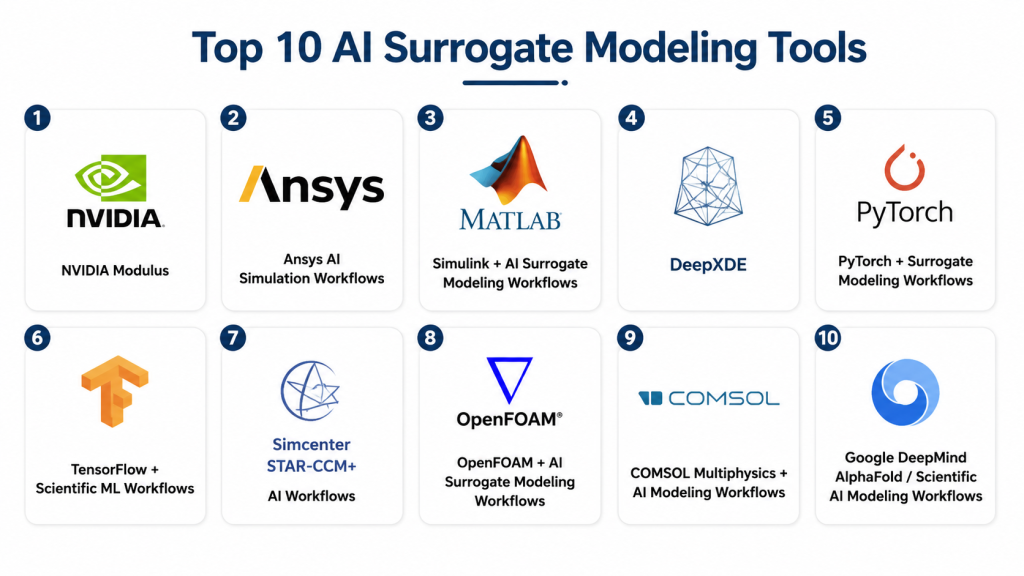
Top 10 AI Surrogate Modeling Tools
#1 — NVIDIA Modulus
One-line verdict: Best for physics-informed AI modeling and scientific simulation acceleration.
Short description (2–3 lines):
NVIDIA Modulus is a physics-informed machine learning framework designed to help researchers and engineers build AI models for scientific computing and simulation workflows.
It supports applications where machine learning is combined with physical knowledge to approximate complex systems.
Standout Capabilities
- Physics-informed neural networks
- Scientific machine learning workflows
- Simulation acceleration
- Engineering modeling
- Differential equation-based modeling
- AI-assisted simulation
- Scientific computing support
AI-Specific Depth (Must Include)
- Model support: Supports machine learning approaches for scientific computing and physics-informed workflows.
- RAG / knowledge integration: Not typically applicable for surrogate modeling workflows.
- Evaluation: Model accuracy requires validation against simulation or experimental results.
- Guardrails: Physics constraints and validation workflows help improve reliability.
- Observability: Depends on connected monitoring and experimentation workflows.
Pros
- Designed specifically for scientific AI applications.
- Supports physics-aware modeling approaches.
- Useful for complex simulation workflows.
Cons
- Requires advanced technical knowledge.
- Best suited for specialized scientific use cases.
- Implementation can require domain expertise.
Security & Compliance
Not publicly stated.
Deployment & Platforms
- Platforms: Development environments and computing infrastructure.
- Deployment: Cloud, self-managed, and research environments vary.
Integrations & Ecosystem
Supports:
- Scientific computing workflows
- Machine learning frameworks
- Simulation environments
- Engineering applications
- Research platforms
Pricing Model
Open-source availability with deployment costs varying based on infrastructure.
Best-Fit Scenarios
- Physics-based simulations
- Engineering research
- Scientific machine learning
#2 — Ansys AI Simulation Workflows
One-line verdict: Best for engineering teams combining simulation expertise with AI acceleration.
Short description (2–3 lines):
Ansys provides engineering simulation solutions that can be combined with AI and machine learning workflows to accelerate design exploration and optimization.
It supports industries that rely on computational modeling and simulation-driven engineering.
Standout Capabilities
- Engineering simulation
- Design optimization
- Simulation data analysis
- AI-assisted workflows
- Multiphysics modeling
- Engineering automation
- Virtual testing
AI-Specific Depth (Must Include)
- Model support: AI capabilities depend on selected simulation and optimization workflows.
- RAG / knowledge integration: Depends on connected engineering knowledge systems.
- Evaluation: Requires comparison against simulation or experimental results.
- Guardrails: Engineering validation processes provide reliability controls.
- Observability: Depends on workflow monitoring capabilities.
Pros
- Strong engineering simulation ecosystem.
- Useful for complex physical systems.
- Supports simulation-driven design.
Cons
- Requires engineering expertise.
- AI capabilities vary by workflow.
- Enterprise implementation may require planning.
Security & Compliance
Not publicly stated.
Deployment & Platforms
- Platforms: Engineering software environments.
- Deployment: Desktop, cloud, and enterprise options vary.
Integrations & Ecosystem
Supports:
- Engineering simulations
- CAD workflows
- Optimization systems
- Research environments
- Industrial applications
Pricing Model
Not publicly stated.
Best-Fit Scenarios
- Product engineering
- Simulation optimization
- Industrial design workflows
#3 — MATLAB Simulink + AI Surrogate Modeling Workflows
One-line verdict: Best for engineers creating custom surrogate models with simulation and mathematical modeling.
Short description (2–3 lines):
MATLAB and Simulink provide computational modeling, simulation, machine learning, and optimization capabilities used for developing surrogate models.
They support engineering teams building predictive approximations of complex systems.
Standout Capabilities
- Mathematical modeling
- Simulation workflows
- Machine learning integration
- Optimization algorithms
- System modeling
- Data analysis
- Engineering experimentation
AI-Specific Depth (Must Include)
- Model support: Supports machine learning workflows and custom surrogate model development.
- RAG / knowledge integration: Requires external implementation.
- Evaluation: Supports comparison between surrogate predictions and simulation results.
- Guardrails: Depends on engineering validation processes.
- Observability: Depends on monitoring implementation.
Pros
- Strong engineering capabilities.
- Flexible model development.
- Supports simulation-based workflows.
Cons
- Requires technical expertise.
- Advanced workflows need customization.
- Licensing requirements may vary.
Security & Compliance
Not publicly stated.
Deployment & Platforms
- Platforms: Desktop and engineering environments.
- Deployment: Desktop, cloud, and enterprise options vary.
Integrations & Ecosystem
Supports:
- Engineering simulations
- Machine learning workflows
- Data analysis tools
- Control systems
- Research applications
Pricing Model
Varies depending on licensing.
Best-Fit Scenarios
- Engineering simulations
- Custom surrogate modeling
- System optimization
#4 — DeepXDE
One-line verdict: Best for researchers developing physics-informed neural network surrogate models.
Short description (2–3 lines):
DeepXDE is an open-source scientific machine learning framework designed for solving differential equations and building physics-informed neural network models.
It helps researchers create surrogate models for complex scientific systems where traditional simulations are computationally expensive.
Standout Capabilities
- Physics-informed neural networks
- Differential equation modeling
- Scientific machine learning
- Simulation approximation
- Research experimentation
- Custom neural network workflows
- Mathematical modeling
AI-Specific Depth (Must Include)
- Model support: Supports neural network-based scientific modeling workflows.
- RAG / knowledge integration: Not typically applicable for surrogate modeling.
- Evaluation: Requires comparison with analytical, simulation, or experimental results.
- Guardrails: Physics equations and constraints provide modeling guidance.
- Observability: Depends on research workflow implementation.
Pros
- Open-source scientific AI framework.
- Useful for physics-informed research.
- Flexible for custom experiments.
Cons
- Requires strong mathematical knowledge.
- Not designed for non-technical users.
- Requires custom development.
Security & Compliance
Not publicly stated.
Deployment & Platforms
- Platforms: Development environments.
- Deployment: Self-managed and cloud environments.
Integrations & Ecosystem
Supports:
- Python scientific workflows
- Machine learning frameworks
- Research simulations
- Mathematical modeling systems
- Academic projects
Pricing Model
Open-source.
Best-Fit Scenarios
- Scientific machine learning research
- Physics-informed modeling
- Academic simulation projects
#5 — PyTorch + Surrogate Modeling Workflows
One-line verdict: Best for developers building custom AI surrogate models with complete model flexibility.
Short description (2–3 lines):
PyTorch is a machine learning framework widely used for developing custom neural networks, including surrogate models for scientific and engineering applications.
Researchers use it to build specialized AI models that approximate complex simulations.
Standout Capabilities
- Custom neural networks
- Deep learning workflows
- Model experimentation
- Scientific AI research
- GPU acceleration
- Custom training pipelines
- Flexible architecture design
AI-Specific Depth (Must Include)
- Model support: Supports custom deep learning and machine learning model development.
- RAG / knowledge integration: Requires external implementation.
- Evaluation: Supports custom model evaluation workflows.
- Guardrails: Depends on model design and validation processes.
- Observability: Requires additional monitoring tools.
Pros
- Highly flexible.
- Large developer ecosystem.
- Supports advanced research workflows.
Cons
- Requires programming expertise.
- No built-in surrogate modeling workflow.
- Requires manual implementation.
Security & Compliance
Not publicly stated.
Deployment & Platforms
- Platforms: Development environments.
- Deployment: Cloud, edge, and self-managed options.
Integrations & Ecosystem
Supports:
- Scientific computing libraries
- AI frameworks
- Simulation pipelines
- Research environments
- Custom applications
Pricing Model
Open-source.
Best-Fit Scenarios
- AI research
- Custom surrogate models
- Advanced engineering workflows
#6 — TensorFlow + Scientific ML Workflows
One-line verdict: Best for teams creating scalable AI surrogate models with machine learning infrastructure.
Short description (2–3 lines):
TensorFlow is an open-source machine learning framework used to build and deploy AI models, including surrogate models for scientific applications.
It provides tools for researchers and engineers developing predictive approximations of complex systems.
Standout Capabilities
- Deep learning models
- Neural network development
- Model training
- Large-scale deployment
- Scientific AI workflows
- Optimization workflows
- Machine learning experimentation
AI-Specific Depth (Must Include)
- Model support: Supports custom AI model development.
- RAG / knowledge integration: Requires external implementation.
- Evaluation: Supports model validation and testing workflows.
- Guardrails: Depends on application design.
- Observability: Requires additional monitoring tools.
Pros
- Mature AI ecosystem.
- Supports scalable deployment.
- Flexible model development.
Cons
- Requires technical expertise.
- Surrogate workflows require customization.
- Not a dedicated scientific simulation tool.
Security & Compliance
Not publicly stated.
Deployment & Platforms
- Platforms: Development and production environments.
- Deployment: Cloud, edge, and self-managed options.
Integrations & Ecosystem
Supports:
- Machine learning platforms
- Scientific computing tools
- Data pipelines
- AI applications
- Cloud infrastructure
Pricing Model
Open-source.
Best-Fit Scenarios
- Custom AI surrogate models
- Research applications
- Production AI systems
#7 — Simcenter STAR-CCM+ AI Workflows
One-line verdict: Best for engineering teams accelerating computational fluid dynamics simulations.
Short description (2–3 lines):
Simcenter STAR-CCM+ is an engineering simulation platform used for complex physical modeling and computational fluid dynamics workflows.
AI and surrogate modeling techniques can be combined with simulation workflows to improve design exploration.
Standout Capabilities
- Computational fluid dynamics
- Engineering simulation
- Design optimization
- Multiphysics analysis
- Simulation automation
- Virtual testing
- Engineering workflows
AI-Specific Depth (Must Include)
- Model support: AI capabilities depend on connected optimization and modeling workflows.
- RAG / knowledge integration: Depends on engineering data systems.
- Evaluation: Simulation validation is required.
- Guardrails: Physics-based simulation provides validation mechanisms.
- Observability: Depends on simulation monitoring workflows.
Pros
- Strong engineering simulation capabilities.
- Useful for complex physical systems.
- Supports simulation-driven development.
Cons
- Requires engineering expertise.
- Expensive computational requirements may apply.
- AI capabilities depend on workflow design.
Security & Compliance
Not publicly stated.
Deployment & Platforms
- Platforms: Engineering computing environments.
- Deployment: Desktop, cloud, and enterprise options vary.
Integrations & Ecosystem
Supports:
- CAD systems
- Engineering simulations
- Optimization workflows
- Industrial applications
- Research environments
Pricing Model
Not publicly stated.
Best-Fit Scenarios
- Aerospace engineering
- Automotive simulation
- Fluid dynamics optimization
#8 — OpenFOAM + AI Surrogate Modeling Workflows
One-line verdict: Best for researchers building open-source simulation and surrogate modeling pipelines.
Short description (2–3 lines):
OpenFOAM is an open-source computational fluid dynamics platform that can be combined with machine learning workflows to create surrogate models.
It is widely used in research environments for simulation-based engineering studies.
Standout Capabilities
- Computational fluid dynamics
- Open-source simulation
- Custom modeling
- Simulation data generation
- Engineering research
- Numerical analysis
- AI integration possibilities
AI-Specific Depth (Must Include)
- Model support: AI capabilities depend on connected machine learning frameworks.
- RAG / knowledge integration: Not typically applicable.
- Evaluation: Requires comparison with simulation outputs.
- Guardrails: Physics-based validation is required.
- Observability: Depends on external monitoring tools.
Pros
- Open-source flexibility.
- Strong research adoption.
- Supports custom workflows.
Cons
- Requires advanced technical knowledge.
- Significant setup effort.
- No built-in AI assistant.
Security & Compliance
Not publicly stated.
Deployment & Platforms
- Platforms: Linux-based scientific computing environments.
- Deployment: Self-managed and cloud environments.
Integrations & Ecosystem
Supports:
- Scientific computing
- Simulation workflows
- Machine learning pipelines
- Engineering research
- Custom applications
Pricing Model
Open-source.
Best-Fit Scenarios
- Academic research
- CFD simulation
- Custom surrogate modeling
#9 — COMSOL Multiphysics + AI Modeling Workflows
One-line verdict: Best for multiphysics simulations combined with AI-assisted approximation techniques.
Short description (2–3 lines):
COMSOL Multiphysics provides simulation capabilities for modeling physical systems across engineering and scientific domains.
AI surrogate workflows can help accelerate repeated simulations and optimization tasks.
Standout Capabilities
- Multiphysics simulation
- Engineering modeling
- Simulation automation
- Optimization workflows
- Physical system analysis
- Research modeling
- Simulation data generation
AI-Specific Depth (Must Include)
- Model support: AI capabilities depend on connected workflows.
- RAG / knowledge integration: Depends on external systems.
- Evaluation: Requires simulation comparison and validation.
- Guardrails: Physics models provide validation support.
- Observability: Depends on workflow monitoring.
Pros
- Strong multiphysics capabilities.
- Useful for scientific modeling.
- Supports complex engineering problems.
Cons
- Requires specialized expertise.
- AI integration requires additional workflows.
- Computational requirements can be high.
Security & Compliance
Not publicly stated.
Deployment & Platforms
- Platforms: Engineering environments.
- Deployment: Desktop and enterprise options vary.
Integrations & Ecosystem
Supports:
- Simulation systems
- Engineering tools
- Research workflows
- Optimization applications
- Scientific computing
Pricing Model
Not publicly stated.
Best-Fit Scenarios
- Multiphysics research
- Engineering optimization
- Scientific simulation
#10 — Google DeepMind AlphaFold / Scientific AI Modeling Workflows
One-line verdict: Best for specialized scientific prediction workflows using advanced AI modeling.
Short description (2–3 lines):
Advanced scientific AI models demonstrate how machine learning can approximate complex biological and scientific processes.
These approaches inspire surrogate modeling workflows in areas where traditional computation is expensive.
Standout Capabilities
- Scientific prediction models
- AI-based approximation
- Complex pattern learning
- Research acceleration
- Biological modeling workflows
- Large-scale AI computation
- Scientific discovery support
AI-Specific Depth (Must Include)
- Model support: Uses specialized AI models designed for scientific applications.
- RAG / knowledge integration: Depends on implementation.
- Evaluation: Scientific validation is required.
- Guardrails: Research validation processes are essential.
- Observability: Depends on deployment environment.
Pros
- Demonstrates advanced scientific AI capabilities.
- Useful for specialized research.
- Shows potential of AI-driven modeling.
Cons
- Not a general surrogate modeling platform.
- Requires specialized expertise.
- Limited applicability outside scientific domains.
Security & Compliance
Not publicly stated.
Deployment & Platforms
- Platforms: Research and computing environments.
- Deployment: Varies.
Integrations & Ecosystem
Supports:
- Scientific research workflows
- AI research environments
- Computational biology applications
- Custom scientific projects
Pricing Model
Not publicly stated.
Best-Fit Scenarios
- Scientific AI research
- Specialized prediction problems
- Advanced modeling workflows
Comparison Table
| Tool Name | Best For | Deployment (Cloud/Self-hosted/Hybrid) | Model Flexibility (Hosted / BYO / Multi-model / Open-source) | Strength | Watch-Out | Public Rating |
|---|---|---|---|---|---|---|
| NVIDIA Modulus | Physics-informed AI modeling | Cloud/Self-managed | Open-source AI framework | Physics-based surrogate modeling | Requires advanced expertise | N/A |
| Ansys AI Simulation Workflows | Engineering simulation acceleration | Desktop/Cloud/Enterprise | Enterprise simulation integrations | Engineering optimization | Complex workflows | N/A |
| MATLAB Simulink Workflows | Custom engineering surrogate models | Desktop/Cloud | Custom ML models | Mathematical modeling flexibility | Requires technical knowledge | N/A |
| DeepXDE | Scientific machine learning research | Self-managed | Open-source | Physics-informed neural networks | Research-focused | N/A |
| PyTorch Surrogate Modeling | Custom AI development | Cloud/Self-managed | Open-source/BYO models | Maximum flexibility | Requires coding | N/A |
| TensorFlow Scientific ML Workflows | Scalable AI model development | Cloud/Edge/Self-managed | Open-source/BYO models | AI ecosystem maturity | Requires implementation effort | N/A |
| Simcenter STAR-CCM+ Workflows | CFD simulation acceleration | Enterprise/Desktop | Engineering simulation workflows | Industrial simulation | Requires expertise | N/A |
| OpenFOAM AI Workflows | Open-source simulation research | Self-managed/Cloud | Open-source/BYO models | Research flexibility | Setup complexity | N/A |
| COMSOL Multiphysics Workflows | Multiphysics simulation | Desktop/Enterprise | Engineering model integrations | Complex physical modeling | High technical requirements | N/A |
| Scientific AI Modeling Workflows | Specialized scientific prediction | Research environments | Specialized AI models | Advanced scientific modeling | Limited general use | N/A |
Scoring & Evaluation (Transparent Rubric)
The following scoring compares AI Surrogate Modeling Tools based on simulation capabilities, AI reliability, evaluation methods, integrations, usability, performance, security, and ecosystem maturity.
The evaluation is comparative rather than absolute. Different organizations may prioritize scientific accuracy, simulation speed, customization, deployment flexibility, or ease of use depending on their research requirements.
| Tool | Core | Reliability/Eval | Guardrails | Integrations | Ease | Perf/Cost | Security/Admin | Support | Weighted Total |
|---|---|---|---|---|---|---|---|---|---|
| NVIDIA Modulus | 9 | 9 | 9 | 8 | 6 | 9 | 8 | 9 | 8.5 |
| Ansys AI Simulation Workflows | 10 | 9 | 10 | 10 | 7 | 8 | 9 | 9 | 9.1 |
| MATLAB Simulink Workflows | 9 | 9 | 9 | 9 | 8 | 8 | 8 | 9 | 8.8 |
| DeepXDE | 8 | 9 | 9 | 8 | 6 | 9 | 7 | 8 | 8.1 |
| PyTorch Surrogate Modeling | 9 | 9 | 8 | 10 | 6 | 10 | 8 | 10 | 8.9 |
| TensorFlow Scientific ML Workflows | 9 | 9 | 8 | 10 | 7 | 9 | 8 | 10 | 8.9 |
| Simcenter STAR-CCM+ Workflows | 10 | 9 | 10 | 9 | 7 | 8 | 9 | 9 | 8.9 |
| OpenFOAM AI Workflows | 8 | 9 | 8 | 9 | 6 | 9 | 7 | 9 | 8.1 |
| COMSOL Multiphysics Workflows | 10 | 9 | 10 | 9 | 7 | 8 | 9 | 9 | 8.9 |
| Scientific AI Modeling Workflows | 8 | 9 | 8 | 8 | 6 | 9 | 7 | 8 | 8.0 |
Top 3 for Enterprise
1. Ansys AI Simulation Workflows
Best suited for engineering organizations requiring validated simulation, optimization, and AI-assisted design workflows.
2. COMSOL Multiphysics Workflows
A strong option for organizations working with complex multiphysics systems and scientific simulations.
3. NVIDIA Modulus
Useful for enterprises exploring physics-informed AI and accelerated scientific computing.
Top 3 for SMB
1. MATLAB Simulink Workflows
Best for engineering teams that need flexible modeling and simulation capabilities.
2. DeepXDE
Suitable for smaller research teams experimenting with physics-informed machine learning.
3. OpenFOAM AI Workflows
Useful for organizations seeking open-source simulation flexibility.
Top 3 for Developers
1. PyTorch Surrogate Modeling
Best for developers creating custom AI surrogate architectures.
2. TensorFlow Scientific ML Workflows
Useful for building scalable machine learning-based simulation systems.
3. DeepXDE
A strong choice for developers working on physics-informed neural networks.
Which AI Surrogate Modeling Tool Is Right for You?
Solo / Freelancer
Individual researchers, students, and developers should focus on:
- Low-cost experimentation
- Flexible development environments
- Open-source availability
- Learning resources
Recommended options:
- DeepXDE
- PyTorch Surrogate Modeling
- OpenFOAM AI Workflows
Solo users usually benefit from frameworks that allow experimentation without requiring expensive enterprise infrastructure.
Important considerations:
- Programming requirements
- Mathematical knowledge
- Available computing resources
- Research goals
SMB
Small and medium organizations should prioritize:
- Faster deployment
- Engineering productivity
- Simulation acceleration
- Manageable complexity
Recommended options:
- MATLAB Simulink Workflows
- DeepXDE
- OpenFOAM AI Workflows
SMBs should evaluate:
- Existing simulation tools
- Team expertise
- Required accuracy
- Infrastructure costs
The ideal solution should improve simulation efficiency without requiring a large AI engineering team.
Mid-Market
Growing organizations require better scalability and integration.
Recommended options:
- MATLAB Simulink Workflows
- NVIDIA Modulus
- COMSOL Multiphysics Workflows
Important requirements:
- Simulation integration
- Model validation
- Data management
- Collaboration features
- Deployment flexibility
Mid-market teams should establish repeatable surrogate modeling processes before scaling across departments.
Enterprise
Large organizations require reliable simulation acceleration with strong engineering validation.
Recommended options:
- Ansys AI Simulation Workflows
- COMSOL Multiphysics Workflows
- NVIDIA Modulus
Enterprise buyers should prioritize:
- Physics accuracy
- Simulation compatibility
- Security controls
- Large-scale deployment
- Engineering workflow integration
For enterprise environments, surrogate modeling should complement validated simulation processes rather than replace them completely.
Regulated Industries (Finance / Healthcare / Public Sector)
Organizations working with sensitive scientific, healthcare, or infrastructure data should focus on:
- Model transparency
- Validation processes
- Data governance
- Reproducibility
- Access controls
Recommended approach:
- Maintain original simulation results.
- Validate surrogate predictions.
- Document model changes.
- Use human review for important decisions.
AI surrogate models should support scientific confidence while maintaining accountability.
Budget vs Premium
Budget Approach
Suitable for:
- Researchers
- Students
- Small engineering teams
Consider:
- Open-source frameworks
- Developer-focused tools
- Custom machine learning libraries
Advantages:
- Lower cost
- High flexibility
- Research customization
Challenges:
- More development effort
- Limited enterprise support
- Requires technical expertise
Premium Enterprise Approach
Suitable for:
- Aerospace organizations
- Automotive companies
- Industrial enterprises
- Research institutions
Advantages:
- Advanced simulation integration
- Enterprise workflows
- Professional support
- Better scalability
Challenges:
- Higher investment
- Complex implementation
Build vs Buy (When to DIY)
Build a custom AI surrogate modeling system when:
- The simulation problem is highly specialized.
- Existing tools cannot represent the required physics.
- Internal AI and engineering expertise exists.
- Full model control is required.
Choose existing platforms when:
- Standard simulation workflows are sufficient.
- Faster deployment is important.
- Validation and support are required.
A hybrid approach is often effective by combining commercial simulation platforms with custom AI models for specialized applications.
Implementation Playbook (30 / 60 / 90 Days)
First 30 Days: Pilot + Success Metrics
The first phase should focus on identifying simulation opportunities and testing surrogate modeling approaches.
Key activities:
- Select a computationally expensive simulation.
- Collect simulation or experimental data.
- Define prediction goals.
- Build initial surrogate models.
- Establish evaluation metrics.
AI-specific tasks:
- Compare surrogate predictions with simulation results.
- Measure accuracy.
- Identify important input parameters.
- Test model performance.
Success metrics:
- Simulation speed improvement
- Prediction accuracy
- Computational cost reduction
- Engineering productivity improvement
First 60 Days: Security + Evaluation
The second phase focuses on reliability and scientific validation.
Key activities:
- Improve model accuracy.
- Establish validation workflows.
- Document model behavior.
- Train technical users.
AI-specific tasks:
- Perform model comparison.
- Evaluate uncertainty.
- Test edge cases.
- Monitor prediction errors.
Security improvements:
- Data access controls
- Model version tracking
- Research data protection
- Workflow documentation
First 90 Days: Optimization + Governance
The final phase focuses on scaling surrogate modeling across teams.
Key activities:
- Integrate surrogate models into engineering workflows.
- Automate predictions.
- Improve deployment processes.
- Establish governance standards.
AI-specific improvements:
- Continuous model evaluation
- Automated retraining workflows
- Performance monitoring
- Cost optimization
- Model lifecycle management
Organizations should create a structured surrogate modeling framework where AI accelerates simulation while maintaining scientific validation and engineering confidence.
Common Mistakes & How to Avoid Them
AI Surrogate Modeling Tools can significantly accelerate simulations, engineering analysis, and scientific research. However, poor implementation can create inaccurate predictions, unreliable models, and incorrect decisions.
Below are common mistakes organizations should avoid:
- Using surrogate models without enough training data AI surrogate models require sufficient high-quality simulation or experimental data. Limited datasets can reduce prediction accuracy.
- Replacing simulations completely with AI models Surrogate models should complement validated simulations rather than eliminate them entirely. Important decisions often require verification using original simulation methods.
- Ignoring physics constraints Purely data-driven models may produce unrealistic outputs. Physics-informed approaches can improve reliability for scientific applications.
- Skipping model validation Surrogate predictions should always be compared against simulation results or experimental measurements before operational use.
- Using poor-quality simulation data Incorrect assumptions, incomplete datasets, or inaccurate simulations can affect surrogate model performance.
- Ignoring uncertainty estimation Organizations should understand where surrogate models are reliable and where additional validation is required.
- Choosing models without considering the scientific problem Different applications such as fluid dynamics, structural analysis, biology, and climate modeling require different approaches.
- Overlooking explainability Researchers often need to understand how AI models generate predictions, especially in scientific and engineering environments.
- Not monitoring model performance over time New operating conditions or additional data may require model updates and retraining.
- Ignoring computational requirements Advanced AI models may require significant computing resources, especially for large simulations.
- Lack of integration with existing simulation workflows Surrogate models provide more value when connected with engineering tools, digital twins, and research platforms.
- Building custom solutions without maintenance planning Custom AI systems may provide flexibility but require ongoing development and technical support.
- Ignoring reproducibility Scientific workflows should maintain model versions, training data records, and evaluation results.
- Using AI outputs without expert review Domain experts should validate important predictions before using them for engineering or scientific decisions.
FAQs
What are AI Surrogate Modeling Tools?
AI Surrogate Modeling Tools use machine learning and artificial intelligence to create fast approximations of complex simulations or physical processes.
They help researchers and engineers make predictions without repeatedly running expensive computational models.
Why is surrogate modeling important?
Many scientific and engineering simulations require significant computing time.
Surrogate models provide faster predictions, enabling quicker experimentation, optimization, and decision-making.
How do AI surrogate models work?
AI surrogate models learn relationships between simulation inputs and outputs using existing simulation or experimental data.
Once trained, they can predict results much faster than traditional simulations.
What industries use AI surrogate modeling?
Common industries include:
- Aerospace
- Automotive
- Manufacturing
- Energy
- Healthcare research
- Climate science
- Robotics
- Engineering design
Are AI surrogate models replacing traditional simulations?
No. Surrogate models are generally used to accelerate and complement traditional simulations.
High-confidence workflows often combine AI predictions with validated simulation methods.
What data is required for surrogate modeling?
Typical requirements include:
- Simulation results
- Experimental measurements
- Engineering parameters
- Historical datasets
- Physical system observations
The quality of training data directly affects model performance.
What are physics-informed surrogate models?
Physics-informed surrogate models combine machine learning with scientific rules, equations, or constraints.
They help improve reliability when physical behavior is important.
Can surrogate models work for real-time applications?
Yes. Because surrogate models are usually faster than full simulations, they can support real-time prediction scenarios.
Examples include digital twins, monitoring systems, and optimization workflows.
How accurate are AI surrogate models?
Accuracy depends on:
- Training data quality
- Model selection
- Physics constraints
- Validation methods
- Complexity of the physical system
Organizations should evaluate models before production use.
Do AI surrogate modeling tools support digital twins?
Many surrogate modeling approaches are used as components of digital twin systems.
They help digital twins provide faster predictions of real-world behavior.
Can developers build custom surrogate models?
Yes. Developers can create custom surrogate models using machine learning frameworks and scientific computing libraries.
This approach provides flexibility but requires technical expertise.
Are open-source surrogate modeling tools available?
Yes. Several open-source frameworks support scientific machine learning and custom surrogate modeling workflows.
They are commonly used in research and experimentation.
How do AI surrogate models improve engineering workflows?
They reduce simulation time, support faster design exploration, and allow teams to evaluate more possible solutions.
Are AI surrogate models secure?
Security depends on the platform, deployment environment, and organizational practices.
Teams should evaluate access controls, data protection, and model governance.
How much do AI Surrogate Modeling Tools cost?
Pricing varies depending on the platform, deployment model, computing requirements, and enterprise features.
Exact pricing details are not publicly stated for many tools.
Should organizations build or buy AI surrogate modeling solutions?
Organizations should build custom solutions when they have unique scientific problems and strong AI engineering capabilities.
Buying existing platforms is often better when simulation integration, support, and faster adoption are priorities.
Conclusion
AI Surrogate Modeling Tools are becoming important technologies for organizations that need faster simulation, improved optimization, and more efficient scientific workflows. By combining artificial intelligence with engineering and scientific knowledge, these tools help reduce computational costs while enabling faster experimentation.The right surrogate modeling solution depends on the organization’s goals, simulation environment, technical expertise, and accuracy requirements. Engineering enterprises may prefer integrated simulation platforms, while researchers and developers may choose flexible open-source frameworks.AI surrogate models should not be treated as simple replacements for physics-based simulations. The most effective approach combines AI acceleration with validation, domain expertise, uncertainty analysis, and responsible model governance.Organizations adopting surrogate modeling should focus on data quality, model accuracy, explainability, integration capabilities, and long-term scalability.

Find Trusted Cardiac Hospitals
Compare heart hospitals by city and services — all in one place.
Explore Hospitals
A practical aspect that could be examined further is how AI surrogate models are managed throughout their lifecycle after deployment. As simulation inputs, operating conditions, and engineering requirements change, surrogate models can gradually lose accuracy if they are not regularly validated and updated. Establishing automated retraining workflows, performance monitoring, version control, and comparison against high-fidelity simulations helps maintain confidence in predictions while ensuring the models continue to deliver reliable results in production engineering environments.