
Introduction
Channel Sales Management Tools are specialized software platforms designed to help businesses manage, optimize, and scale sales through indirect channels such as distributors, resellers, partners, agents, and affiliates. Unlike direct sales tools, these platforms focus on partner enablement, deal registration, incentive management, performance tracking, and collaboration across multiple external stakeholders.
In today’s competitive and globalized markets, many organizations rely heavily on channel partners to expand reach, reduce customer acquisition costs, and accelerate revenue growth. Without the right tools, however, channel sales quickly become fragmented—leading to partner conflict, poor visibility, inconsistent pricing, and missed revenue opportunities.
Real-world use cases include:
- Managing distributor and reseller pipelines
- Preventing channel conflict through deal registration
- Running partner incentive and rebate programs
- Tracking partner performance and ROI
- Onboarding, training, and certifying partners
When choosing a Channel Sales Management Tool, buyers should evaluate partner lifecycle coverage, ease of use for external users, integration with CRM and ERP systems, reporting depth, scalability, and security.
Best for:
Channel Sales Management Tools are ideal for B2B companies, manufacturers, SaaS vendors, telecom providers, IT services firms, and global enterprises that sell through partners. Roles that benefit most include channel managers, partner program leaders, sales operations teams, and revenue leaders.
Not ideal for:
These tools may not be necessary for solo founders, early-stage startups with only direct sales, or small businesses without formal partner programs. In such cases, a lightweight CRM or spreadsheet-based tracking may be sufficient.
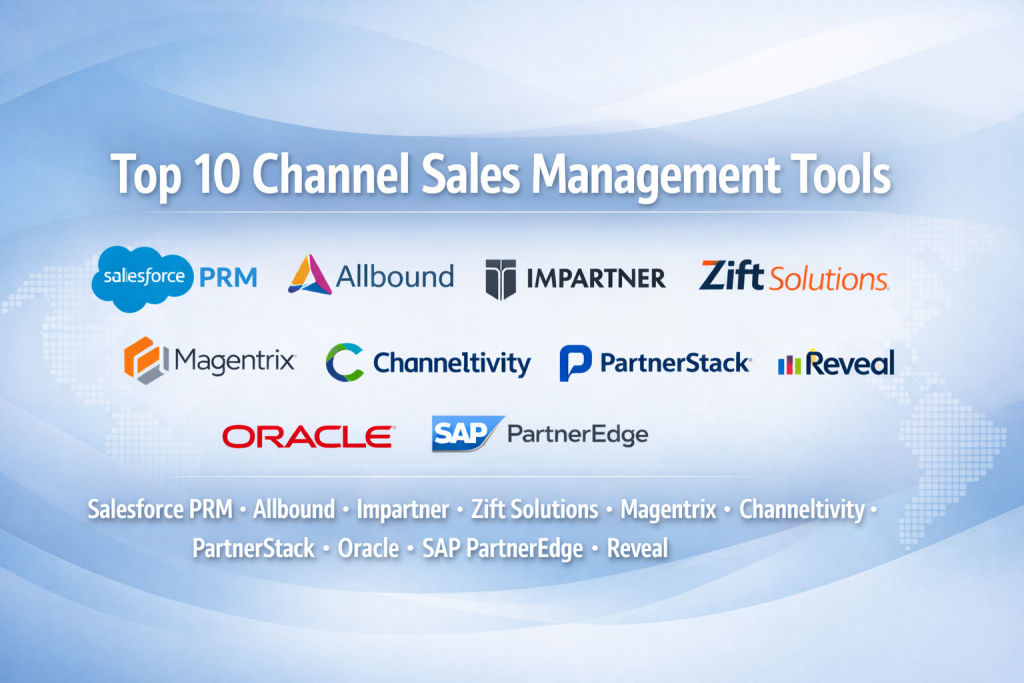
Top 10 Channel Sales Management Tools
1 — Salesforce Partner Relationship Management
Short description:
A powerful enterprise-grade PRM solution built on the Salesforce platform, designed for organizations managing large, complex partner ecosystems.
Key features:
- Partner portals with role-based access
- Deal registration and conflict management
- Lead distribution and co-selling workflows
- Partner performance dashboards
- Incentive and rebate management
- Deep CRM and analytics integration
Pros:
- Extremely scalable and customizable
- Best-in-class reporting and analytics
Cons:
- High implementation and licensing costs
- Requires Salesforce expertise
Security & compliance:
SSO, encryption, audit logs, SOC 2, GDPR, ISO standards.
Support & community:
Extensive documentation, global partner ecosystem, enterprise-grade support.
2 — Allbound
Short description:
A modern PRM platform focused on partner engagement, enablement, and revenue acceleration for mid-market and growing enterprises.
Key features:
- Centralized partner portal
- Deal registration and lead sharing
- Content and training management
- Gamification and incentives
- Real-time partner analytics
Pros:
- Intuitive partner experience
- Fast onboarding for external users
Cons:
- Limited deep CRM customization
- Reporting less advanced than enterprise tools
Security & compliance:
SSO, data encryption, GDPR compliance.
Support & community:
Strong onboarding support, responsive customer success team.
3 — Impartner
Short description:
A comprehensive channel management suite covering the entire partner lifecycle, from recruitment to revenue optimization.
Key features:
- Partner recruitment and onboarding
- Deal registration automation
- Incentives and MDF management
- Certification and training modules
- Advanced channel analytics
Pros:
- End-to-end channel coverage
- Strong automation capabilities
Cons:
- Interface can feel complex
- Setup requires planning and training
Security & compliance:
SOC 2, GDPR, SSO, encryption.
Support & community:
Dedicated account management, enterprise support options.
4 — Zift Solutions
Short description:
A unified channel sales and marketing platform designed for B2B technology companies with multi-tier partner networks.
Key features:
- Partner marketing automation
- Deal registration and lead routing
- Content syndication
- Sales enablement tools
- ROI tracking and analytics
Pros:
- Strong marketing + sales alignment
- Excellent partner engagement tools
Cons:
- Higher learning curve
- Best suited for mature programs
Security & compliance:
GDPR, SOC 2, encryption standards.
Support & community:
Robust documentation, onboarding assistance, enterprise support.
5 — Magentrix
Short description:
A flexible PRM solution built on Salesforce, offering customized partner portals and collaboration tools.
Key features:
- Custom partner portals
- Deal and opportunity management
- Knowledge sharing
- Workflow automation
- Salesforce-native integration
Pros:
- Highly customizable
- Familiar Salesforce environment
Cons:
- Salesforce dependency
- Customization requires technical resources
Security & compliance:
Salesforce security model, SSO, GDPR.
Support & community:
Strong implementation support, smaller user community.
6 — Channeltivity
Short description:
A lightweight and user-friendly channel management tool ideal for SMBs and mid-market companies.
Key features:
- Deal registration
- Partner lead distribution
- Incentive tracking
- Simple reporting dashboards
- Quick setup
Pros:
- Easy to use
- Affordable pricing
Cons:
- Limited advanced analytics
- Not ideal for very large ecosystems
Security & compliance:
Standard encryption, GDPR support.
Support & community:
Highly rated customer support, clear documentation.
7 — PartnerStack
Short description:
A partner ecosystem platform focused on SaaS companies managing affiliates, referrals, and reseller programs.
Key features:
- Automated payouts and commissions
- Partner discovery marketplace
- Performance tracking
- Contract management
- Integration with SaaS tools
Pros:
- Strong for SaaS partner ecosystems
- Simplifies financial operations
Cons:
- Less suitable for manufacturing channels
- Limited customization
Security & compliance:
SOC 2, GDPR, secure payment processing.
Support & community:
Active partner community, onboarding specialists.
8 — Oracle Channel Revenue Management
Short description:
An enterprise-grade channel revenue management solution designed for complex, global channel operations.
Key features:
- Pricing and rebate management
- Distributor performance tracking
- Revenue forecasting
- ERP and CRM integration
- Compliance monitoring
Pros:
- Deep financial and pricing controls
- Strong enterprise governance
Cons:
- High cost and complexity
- Long implementation cycles
Security & compliance:
Enterprise-grade security, SOC, ISO, GDPR.
Support & community:
Global enterprise support, extensive documentation.
9 — SAP PartnerEdge
Short description:
A structured partner management framework integrated with SAP’s enterprise ecosystem.
Key features:
- Partner lifecycle management
- Incentive and rebate programs
- Training and certification
- Performance analytics
- ERP integration
Pros:
- Strong for SAP-centric enterprises
- Robust compliance controls
Cons:
- Limited flexibility outside SAP
- Steep learning curve
Security & compliance:
ISO, GDPR, enterprise security standards.
Support & community:
Global SAP partner network, enterprise support.
10— Reveal
Short description:
A channel intelligence and analytics tool focused on visibility, forecasting, and partner performance insights.
Key features:
- Channel data aggregation
- Predictive analytics
- Performance benchmarking
- CRM integration
- Custom reporting
Pros:
- Strong analytics depth
- Improves channel forecasting accuracy
Cons:
- Limited operational workflows
- Requires clean data sources
Security & compliance:
Data encryption, GDPR support.
Support & community:
Specialized analytics support, smaller user base.
Comparison Table
| Tool Name | Best For | Platform(s) Supported | Standout Feature | Rating |
|---|---|---|---|---|
| Salesforce PRM | Large enterprises | Cloud | Deep CRM integration | N/A |
| Allbound | Mid-market teams | Cloud | Partner engagement UX | N/A |
| Impartner | Global channel programs | Cloud | End-to-end lifecycle | N/A |
| Zift Solutions | Tech companies | Cloud | Marketing automation | N/A |
| Magentrix | Salesforce users | Cloud | Custom portals | N/A |
| Channeltivity | SMBs | Cloud | Ease of use | N/A |
| PartnerStack | SaaS companies | Cloud | Automated payouts | N/A |
| Oracle CRM | Global enterprises | Cloud/On-prem | Pricing & rebates | N/A |
| SAP PartnerEdge | SAP ecosystems | Cloud | ERP alignment | N/A |
| Reveal | Analytics-driven teams | Cloud | Predictive insights | N/A |
Evaluation & Scoring of Channel Sales Management Tools
| Tool | Core Features (25%) | Ease of Use (15%) | Integrations (15%) | Security (10%) | Performance (10%) | Support (10%) | Price/Value (15%) | Total Score |
|---|---|---|---|---|---|---|---|---|
| Salesforce PRM | 24 | 10 | 15 | 10 | 10 | 9 | 8 | 86 |
| Allbound | 20 | 14 | 12 | 9 | 9 | 9 | 12 | 85 |
| Impartner | 22 | 12 | 14 | 10 | 9 | 9 | 10 | 86 |
| Zift Solutions | 21 | 11 | 14 | 9 | 9 | 8 | 10 | 82 |
| Channeltivity | 18 | 15 | 10 | 8 | 8 | 9 | 14 | 82 |
Which Channel Sales Management Tool Is Right for You?
- Solo users & SMBs: Lightweight tools like Channeltivity
- Mid-market companies: Allbound or Impartner
- Large enterprises: Salesforce PRM, Oracle, or SAP
- Budget-conscious teams: Simpler PRM platforms with fast deployment
- Premium solutions: Enterprise platforms with deep customization
- Integration-heavy needs: Salesforce or ERP-native solutions
- High security requirements: Enterprise-grade platforms with audits
Frequently Asked Questions (FAQs)
1. What is a Channel Sales Management Tool?
It helps manage indirect sales through partners, resellers, and distributors.
2. How is it different from a CRM?
CRMs focus on direct sales; channel tools focus on partner ecosystems.
3. Do small businesses need these tools?
Only if they manage active partner programs.
4. Are these tools cloud-based?
Most modern platforms are fully cloud-based.
5. Can partners access these tools directly?
Yes, via secure partner portals.
6. How long does implementation take?
Anywhere from weeks to several months, depending on complexity.
7. Are incentives and rebates supported?
Most mid-market and enterprise tools include them.
8. Do these tools prevent channel conflict?
Yes, through deal registration and rules-based workflows.
9. Are they secure for external users?
Leading tools offer SSO, encryption, and audit logs.
10. What is the biggest mistake buyers make?
Choosing complexity over partner usability.
Conclusion
Channel Sales Management Tools play a critical role in scaling indirect revenue, improving partner relationships, and maintaining visibility across complex ecosystems. The most important factors when choosing a tool are partner experience, integration depth, scalability, and security.
There is no single “best” platform for everyone. The right choice depends on company size, channel maturity, budget, and long-term growth strategy. By aligning tool capabilities with real business needs, organizations can turn their channel partners into a powerful, predictable revenue engine.

Find Trusted Cardiac Hospitals
Compare heart hospitals by city and services — all in one place.
Explore Hospitals
Solid breakdown. The primary architectural divide in channel sales software is between CRM-native portals like Salesforce PRM or Magentrix and standalone, best-of-breed platforms like Impartner, Allbound, or Zift Solutions. CRM extensions provide seamless data inheritance—partner-registered leads instantly convert into native pipeline opportunities without brittle third-party sync connectors. However, standalone PRMs are far better designed for the external partner experience, offering turnkey through-channel marketing automation (TCMA), certification tracking, and multi-tenant access that doesn’t demand dedicated Salesforce developer hours or expensive external community licensing.
Solid comparison. The single biggest reason organizations invest in dedicated partner relationship management tooling is preventing channel conflict. When indirect resellers and direct sales reps clash over accounts, morale tanks and sales cycles stall. Enterprise suites like Salesforce PRM and Impartner excel because their deal registration engines automatically cross reference leads against existing CRM records and enforce strict exclusivity timeframes. That automated protection is what gives resellers the confidence to bring proprietary deals to the table.
Managing multiple sales partners becomes much easier when everyone has clear visibility into targets, deal progress, and performance metrics. The real strength of channel sales management tools lies in helping businesses identify gaps in partner engagement, simplify incentive tracking, and avoid channel conflicts through better coordination. A well-integrated platform can turn partner relationships into a more consistent and scalable source of revenue.
Channel sales management tools help businesses manage partner relationships, track sales performance, and improve collaboration across distribution networks. Features such as partner onboarding, lead tracking, sales analytics, deal registration, and automated reporting can make channel operations more efficient. When comparing different platforms, organizations should consider integration capabilities, ease of use, scalability, and partner performance tracking. Choosing the right solution can strengthen partner engagement, improve sales visibility, and support consistent revenue growth.
Channel sales management tools help businesses manage partner relationships, track sales performance, and improve collaboration across distribution networks. Features such as partner onboarding, lead tracking, sales analytics, incentive management, and performance reporting are useful when comparing different platforms. Businesses should also consider integration capabilities, ease of use, and the flexibility to support different partner types. Choosing the right tool can streamline channel operations, strengthen partner engagement, and improve sales visibility.
Channel sales management tools help businesses manage reseller relationships, track partner performance, and coordinate sales activities across multiple distribution channels. When comparing different platforms, features such as partner onboarding, sales tracking, lead distribution, performance analytics, and commission management are important to consider. These capabilities can improve communication between businesses and their channel partners while providing better visibility into sales results. Integration with CRM systems and automated reporting can further simplify partner management. Choosing the right channel sales solution can strengthen partner collaboration, improve sales efficiency, and support business growth.
Channel sales management tools should help businesses understand whether partners are actually developing new opportunities or simply claiming credit for deals already in progress. I would compare how each platform records lead ownership, partner involvement, and changes in deal status throughout the sales cycle. Clear rules for shared opportunities can prevent disputes between direct sales teams and channel partners, especially when both contribute to closing a contract. This visibility helps managers assess partner performance fairly, reward genuine contributions, and build stronger working relationships without relying on conflicting spreadsheets or email records.
One challenge in channel sales management is knowing which partners are genuinely creating new business rather than claiming credit for deals already in progress. I would look for tools that track partner influence across the sales cycle and make deal-registration rules clear to everyone involved. Without that visibility, two partners may compete for the same opportunity, creating disputes and damaging relationships. Fair attribution, transparent rules, and useful partner-level insights can help companies reward the right behavior and build a healthier sales ecosystem.
Channel sales management tools are more effective when partners have clear access to pricing, sales targets, and updated product information. Real-time visibility can help teams spot gaps before they affect sales performance. I would also check how easily the platform tracks partner leads and prevents duplicate work across sales teams. Simple reports can help managers identify which partners need more support. How can businesses improve partner performance while keeping communication and reporting simple?
Channel sales management tools can help businesses keep track of partners, sales, and shared targets in one place. But the tools are only useful when partners can access the right information without confusion. Clear sales reports, simple training, and regular updates can help teams work better together. Businesses should also check if the tool makes it easy to spot delays and missed targets. How can companies use these tools to build stronger relationships with their sales partners?
Channel sales management tools help businesses coordinate distributors, resellers, and other partners while improving visibility into sales performance and partner engagement. Platforms such as Salesforce Partner Relationship Management, Impartner, and ZINFI offer different approaches to partner onboarding, deal registration, lead distribution, and performance tracking. I think deal registration and channel conflict management are particularly important, since overlapping sales opportunities can create friction between direct sales teams and partners. Strong reporting, automated partner workflows, and clear incentive management can help organizations build more productive partnerships while making it easier to identify which channels contribute the most value.
Channel sales management tools help businesses work with resellers, distributors, and other sales partners. One important feature is showing which partners have active deals and what support they need. This helps teams avoid missed follow-ups and conflicting sales efforts. I would compare how each tool tracks partner leads, training, incentives, and deal approvals. Clear rules for sharing customer information can also prevent channel conflicts. Reports should show which partners bring qualified leads and close sales. The right platform should improve partner communication, make sales progress easier to track, and help businesses build stronger relationships across their sales network.
Choosing the right partner relationship management platform often comes down to how well it bridges corporate workflows with external partner enablement. While robust feature sets and MDF automation look great on paper, the true test is whether partners actually adopt the portal without excessive friction. Integrating these tools cleanly with your existing CRM and marketing stack is essential to maintain accurate pipeline visibility and avoid data silos. It would be interesting to hear how others handle multi-tier partner routing and deal registration conflicts.
Managing channel sales becomes easier when partners have clear access to product information, sales resources, deal registration, and performance updates. When evaluating channel sales management tools, businesses should check how well each platform handles partner onboarding, lead distribution, sales pipeline visibility, and incentive management. Strong reporting can help identify active partners, track regional performance, and spot opportunities that need additional support. It is also important to review integration with existing CRM systems and ensure that partners can use the platform without extensive training. The right tool should improve coordination between internal sales teams and external partners while making channel performance easier to measure and manage.
Channel sales management tools help businesses coordinate partner relationships, track pipeline performance, and maintain consistent visibility across indirect sales channels. Automated deal registration, shared performance dashboards, and streamlined incentive management can reduce channel conflicts while improving accountability. Integrating these tools with CRM and partner portals also helps organizations identify growth opportunities and strengthen collaboration throughout the sales network.
Managing channel sales becomes complicated when several partners pursue the same account or when deal registrations overlap. Without clear rules for ownership, expiration, and conflict resolution, even experienced partners can lose confidence in the program. I’d be interested in how these tools maintain a transparent record of registered opportunities and help channel managers resolve disputes without relying on scattered emails. Clear visibility into partner activity can protect relationships while giving sales leaders a more realistic view of pipeline quality.
Channel sales management tools are most effective when they give businesses and their partners a shared view of leads, sales targets, and deal progress. Accurate partner data and clear rules for lead ownership can help prevent channel conflicts and missed opportunities. I would also look for features that track partner performance, simplify incentive calculations, and integrate with existing CRM systems. Regular feedback from resellers can reveal whether the platform genuinely simplifies their work. How can businesses use these tools to improve partner accountability while keeping channel relationships collaborative and productive?
Choosing the right channel sales management tool really comes down to how well it handles complex partner tiers and data visibility. Many teams overlook how critical seamless CRM integration is until partner onboarding starts dragging. This comparison provides a very practical breakdown for weighing those trade-offs effectively.
One challenge that often appears after deployment is keeping partner records, deal ownership, and commission calculations consistent across CRM, ERP, and partner portals. For example, two partners may claim the same opportunity, or a deal may change ownership after incentives have already been calculated. Teams should define clear rules for resolving conflicts, preserving an audit trail, and recalculating commissions when deal details change. I would also test integration failures, delayed data synchronization, and partner access changes before rolling out the platform across regions. These controls help prevent payment disputes, reduce manual corrections, and keep partner relationships healthy as the sales network grows.
Channel sales management tools work best when partners have clear visibility into leads, sales targets, and deal progress. Accurate data and transparent incentive tracking help prevent channel conflicts and build stronger partner relationships. Regular performance reviews can also show which partners need better training, support, or resources to grow sales.
Working with sales partners works best when everything is easy to use. If a tool is too hard to learn, partners will stop using it. Having clear places to share leads, track sales, and see rewards makes a big difference. Keeping things simple helps teams work well together and close more deals.
One challenge that deserves more attention in channel sales management is preventing deal registration conflicts while keeping partner incentives transparent and fair. While Salesforce PRM and Impartner offer extensive partner lifecycle capabilities, tools like Channeltivity prioritize simplicity and faster adoption.
Managing sales channels effectively requires clear partner communication, accurate performance tracking, and well-coordinated sales activities. This comparison explores how channel sales management tools support partner onboarding, deal registration, incentive tracking, and sales reporting, helping businesses find solutions that strengthen partner relationships and improve visibility across their sales networks.
As a channel program expands, managing changes to partner agreements and incentive structures can become difficult, especially when different regions follow different rules. A platform should maintain a clear history of deal registrations, approval decisions, commission changes, and policy exceptions so teams can explain discrepancies later. It is also important to test how the system handles overlapping claims on the same opportunity and delayed updates from external tools. Addressing these scenarios early can reduce disputes between partners, sales teams, and finance while keeping performance reports trustworthy.
Scaling indirect revenue requires automated data governance across disparate ecosystems. Modern channel management demands bidirectional webhook pipelines to synchronize deal registration, role-based partner access controls, and atomic commission recalculations without introducing data conflicts into core enterprise CRMs.
Channel sales management tools can help businesses understand which partners are driving steady growth and where extra support is needed. I’d look for features that track partner deal registration, prevent duplicate leads, and show progress toward sales targets in one place. Fair lead allocation and clear performance reports can also improve trust between a company and its channel partners.
One challenge in channel sales management is maintaining accurate deal ownership when several partners approach the same customer or work on different stages of the same opportunity. Without clear rules, channel conflicts can damage partner relationships and create unreliable sales forecasts. I would examine whether the platform supports configurable deal-registration windows, transparent ownership history, and approval workflows for disputed opportunities. Another useful consideration is how incentive calculations respond to split deals, revised margins, cancellations, and delayed payments. Testing these situations before rollout can prevent commission disputes and reduce manual reconciliation between sales, finance, and partner teams. A well-managed channel ecosystem depends on making commercial rules predictable and visible, so partners can focus on developing business rather than resolving administrative disagreements.
Evaluating partner relationship platforms solely on feature checklists can be misleading since adoption friction often decides success. Even a robust PRM fails if resellers find onboarding complex or prefer their own workflows. How do you ensure partner engagement stays high after the initial implementation phase?
One challenge that often appears after deployment is keeping partner attribution and deal ownership consistent across CRM, PRM, and ERP systems. When two partners influence the same opportunity, or a distributor submits delayed sales data, teams need clear ownership rules, conflict-resolution workflows, and an auditable record of every change. I would also test how the platform handles duplicate deal registrations, failed integration syncs, and rebate calculations when orders change after approval. These scenarios can affect partner trust and create costly disputes during commission reconciliation. Measuring data quality, synchronization failures, and the time required to resolve channel conflicts would provide a more realistic view of operational performance than feature comparisons alone.
Channel sales management tools can make partner relationships easier to manage, but their real value comes from improving coordination and visibility. Businesses should look for accurate sales tracking, shared reporting, partner onboarding, and clear lead ownership. Integration with CRM systems can help prevent duplicate work and keep everyone aligned on sales progress. It is also important to make the platform simple enough for partners to use consistently. How can companies use these tools to motivate channel partners while maintaining transparency and fair lead distribution?
Channel sales management tools should give businesses and their partners a shared view of leads, deal progress, incentives, and sales performance. When comparing platforms, I would look at lead registration, deal conflict prevention, partner onboarding, co-selling workflows, and visibility into pipeline activity. Clear rules for assigning leads and calculating incentives are especially important because inconsistent processes can damage partner relationships. It is also worth checking whether the platform provides useful partner-level reports, helping teams identify where training, marketing support, or better coordination could improve sales results.
Channel sales management tools are most effective when they give businesses and partners a shared, accurate view of leads, deals, and sales performance. I would check how the platform handles duplicate leads, deal registration conflicts, and changes in partner ownership. Clear rules for lead distribution and commission tracking can prevent disputes and improve accountability. Integration with CRM and inventory systems also helps partners access current product information and sales data. Reliable reporting on partner activity, conversion rates, and pipeline progress can help teams identify gaps and strengthen channel relationships as the network grows.