
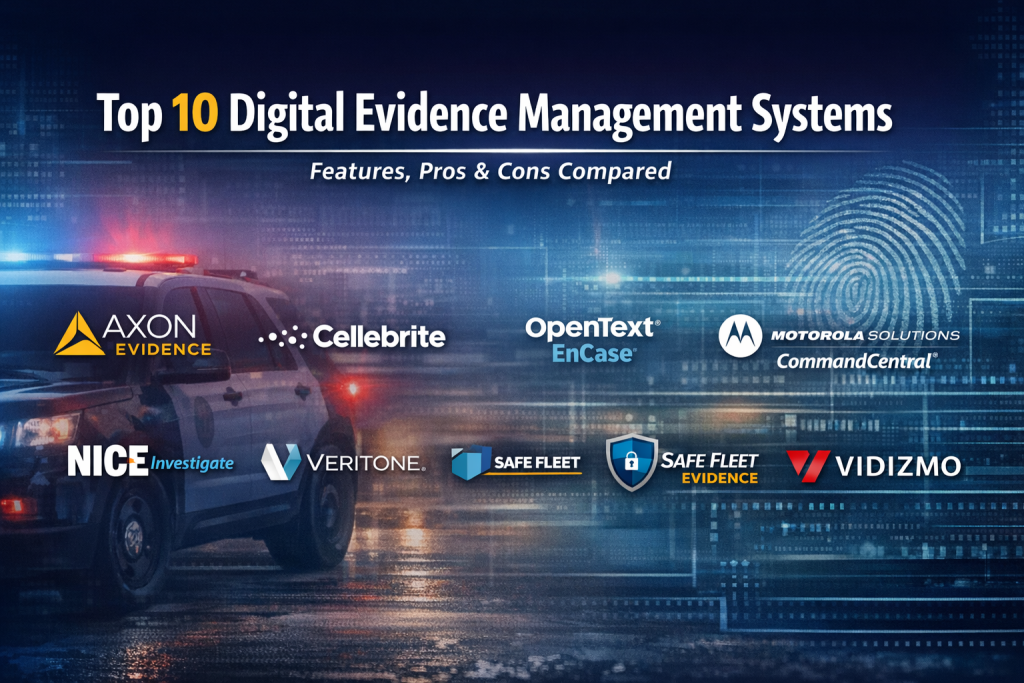
Introduction
Digital Evidence Management Systems (DEMS) are purpose-built platforms designed to collect, store, manage, analyze, and securely share digital evidence such as body-worn camera footage, CCTV video, interview recordings, photos, documents, mobile data, and forensic files. As digital evidence becomes central to investigations, prosecutions, and internal reviews, managing it manually or across fragmented tools is no longer sustainable.
These systems play a critical role in maintaining chain of custody, ensuring evidence integrity, enabling secure collaboration, and meeting strict legal and regulatory requirements. From law enforcement agencies and public safety organizations to private enterprises handling internal investigations, DEMS reduce risk while improving operational efficiency.
Common real-world use cases include:
- Police body-camera and dash-cam evidence handling
- Prosecutorial case preparation and evidence disclosure
- Internal investigations and compliance reviews
- Digital forensics and incident response
- Public safety, transportation, and security operations
What to look for when choosing a DEMS:
- Secure ingestion and immutable storage
- Chain-of-custody tracking and audit logs
- Scalable cloud or hybrid architecture
- Strong access controls and role-based permissions
- Integration with cameras, CAD, RMS, and forensic tools
Best for:
Law enforcement agencies, prosecutors, digital forensic teams, corporate security departments, compliance teams, and organizations that handle sensitive digital evidence at scale.
Not ideal for:
Individuals or small teams with minimal evidence volume, organizations without regulatory obligations, or use cases where basic file storage and sharing tools are sufficient.
Top 10 Digital Evidence Management Systems Tools
1 — Axon Evidence
Short description:
A leading cloud-based digital evidence platform designed primarily for law enforcement and public safety agencies.
Key features
- Secure cloud evidence storage
- Automatic body-camera and dash-cam ingestion
- Chain-of-custody tracking
- Role-based access controls
- Evidence sharing with prosecutors
- AI-assisted redaction and transcription
Pros
- Deep integration with hardware ecosystems
- Highly trusted in public safety
- Scales well for large agencies
Cons
- Premium pricing
- Less flexible outside law enforcement workflows
Security & compliance:
Encryption at rest and in transit, CJIS alignment, audit logs, SSO support
Support & community:
Strong enterprise support, extensive documentation, large user base
2 — Cellebrite
Short description:
A powerful digital evidence platform focused on mobile data, digital forensics, and investigative workflows.
Key features
- Mobile device data ingestion
- Centralized digital evidence repository
- Advanced analytics and timelines
- Secure collaboration and sharing
- Metadata enrichment
- Court-ready exports
Pros
- Industry-leading forensic capabilities
- Excellent investigative depth
- Strong evidentiary workflows
Cons
- Complex for non-technical users
- Higher learning curve
Security & compliance:
Encryption, access controls, audit trails, compliance varies by deployment
Support & community:
Professional training, global enterprise support, forensic expert community
3 — OpenText EnCase
Short description:
An enterprise-grade digital evidence and forensic management solution used by investigators and compliance teams.
Key features
- Central evidence repository
- Forensic data processing
- Legal hold support
- Detailed audit logs
- Evidence lifecycle management
Pros
- Court-tested credibility
- Strong forensic depth
- Enterprise compliance readiness
Cons
- User interface feels dated
- Higher infrastructure overhead
Security & compliance:
ISO-aligned security, encryption, extensive auditing, GDPR support
Support & community:
Enterprise-level support, professional services, smaller community
4 — Motorola Solutions CommandCentral Evidence
Short description:
A public safety-focused digital evidence system tightly integrated with dispatch and incident workflows.
Key features
- Multi-source evidence ingestion
- CAD and RMS integration
- Secure evidence sharing
- Automated retention policies
- Scalable cloud deployment
Pros
- Strong operational integration
- Reliable performance at scale
- Trusted public safety vendor
Cons
- Best suited to Motorola ecosystems
- Less flexible for private sector use
Security & compliance:
CJIS-aligned security, encryption, audit logging, SSO
Support & community:
Dedicated enterprise support, structured onboarding
5 — NICE Investigate
Short description:
An analytics-driven evidence management and investigation platform for complex cases.
Key features
- Evidence correlation and timelines
- AI-driven analytics
- Secure digital evidence storage
- Case management tools
- Cross-source data ingestion
Pros
- Powerful analytical insights
- Strong for complex investigations
- Enterprise-grade scalability
Cons
- Expensive for smaller teams
- Requires training to maximize value
Security & compliance:
Enterprise security controls, encryption, GDPR alignment
Support & community:
Premium enterprise support, professional services
6 — Veritone iDEMS
Short description:
An AI-powered digital evidence management platform optimized for audio, video, and multimedia evidence.
Key features
- AI-based search and transcription
- Multimedia evidence management
- Automated redaction tools
- Cloud-native architecture
- Secure sharing and access control
Pros
- Excellent media intelligence
- Strong automation features
- Modern user experience
Cons
- AI features may require tuning
- Less focus on traditional forensics
Security & compliance:
Encryption, role-based access, compliance varies by deployment
Support & community:
Good documentation, responsive enterprise support
7 — Safe Fleet Evidence
Short description:
A digital evidence solution designed for transportation, schools, and public safety environments.
Key features
- Video and image evidence storage
- Fleet and camera integration
- Chain-of-custody tracking
- Secure cloud hosting
- Configurable retention policies
Pros
- Strong video hardware integration
- Reliable performance
- Practical workflows
Cons
- Limited advanced analytics
- UI less modern
Security & compliance:
Encryption, access controls, audit logging
Support & community:
Industry-focused support, smaller user community
8 — FileOnQ
Short description:
A flexible evidence management system used by both public and private sector organizations.
Key features
- Centralized evidence repository
- Chain-of-custody tracking
- Case and inventory management
- Evidence barcode support
- Custom reporting
Pros
- Flexible and customizable
- Supports physical and digital evidence
- Cost-effective
Cons
- Less advanced media tools
- Interface feels utilitarian
Security & compliance:
Encryption, audit trails, compliance varies
Support & community:
Good onboarding, responsive support
9 — Digital Evidence Vault
Short description:
A secure cloud repository designed for long-term digital evidence storage and access.
Key features
- Immutable evidence storage
- Secure access controls
- Evidence lifecycle tracking
- Simple sharing workflows
- Cloud scalability
Pros
- Strong data integrity focus
- Simple to use
- Reliable storage model
Cons
- Limited analytics
- Basic investigation features
Security & compliance:
Encryption, audit logs, compliance varies by region
Support & community:
Basic support, limited community presence
10 — VIDIZMO
Short description:
A configurable digital evidence and redaction platform for government and enterprise use.
Key features
- Secure evidence ingestion
- AI-based redaction
- Chain-of-custody tracking
- Cloud and on-prem deployment
- Role-based permissions
Pros
- Flexible deployment options
- Strong redaction tools
- Good value for mid-market
Cons
- UI can feel dense
- Advanced features require setup
Security & compliance:
Encryption, audit logs, GDPR alignment, SSO support
Support & community:
Good documentation, enterprise support available
Comparison Table
| Tool Name | Best For | Platform(s) Supported | Standout Feature | Rating |
|---|---|---|---|---|
| Axon Evidence | Law enforcement agencies | Cloud | Hardware ecosystem integration | N/A |
| Cellebrite | Digital forensics teams | Cloud / Hybrid | Mobile data intelligence | N/A |
| OpenText EnCase | Enterprise investigations | On-prem / Hybrid | Forensic credibility | N/A |
| Motorola CommandCentral Evidence | Public safety operations | Cloud | CAD/RMS integration | N/A |
| NICE Investigate | Complex investigations | Cloud | Advanced analytics | N/A |
| Veritone iDEMS | Media-heavy evidence | Cloud | AI search & transcription | N/A |
| Safe Fleet Evidence | Transportation & safety | Cloud | Video hardware support | N/A |
| FileOnQ | Mixed evidence management | Cloud / On-prem | Custom workflows | N/A |
| Digital Evidence Vault | Long-term evidence storage | Cloud | Immutable storage | N/A |
| VIDIZMO | Government & enterprise | Cloud / On-prem | AI redaction | N/A |
Evaluation & Scoring of Digital Evidence Management Systems
| Evaluation Criteria | Weight | Description |
|---|---|---|
| Core features | 25% | Evidence ingestion, storage, custody, sharing |
| Ease of use | 15% | UI clarity, learning curve, workflow efficiency |
| Integrations & ecosystem | 15% | Cameras, CAD, RMS, forensic tools |
| Security & compliance | 10% | Encryption, audits, regulatory readiness |
| Performance & reliability | 10% | Scalability, uptime, data integrity |
| Support & community | 10% | Documentation, training, enterprise support |
| Price / value | 15% | Cost relative to features and scale |
Which Digital Evidence Management Systems Tool Is Right for You?
- Solo users: Lightweight vault-style tools with simple workflows
- SMBs: Flexible platforms with reasonable pricing and basic analytics
- Mid-market: AI-enabled systems with strong integrations and scalability
- Enterprise & public safety: Fully compliant platforms with audit-ready workflows
Budget-conscious vs premium:
Smaller organizations may prioritize value and simplicity, while larger agencies benefit from premium analytics and integrations.
Feature depth vs ease of use:
Advanced analytics often come with complexity—balance investigative power with usability.
Integration & scalability:
Ensure compatibility with cameras, dispatch systems, and future growth needs.
Security & compliance:
Highly regulated environments should prioritize audit logs, encryption, and compliance alignment.
Frequently Asked Questions (FAQs)
1. What is a Digital Evidence Management System?
A platform that securely stores, manages, and tracks digital evidence throughout its lifecycle.
2. Is cloud storage safe for digital evidence?
Yes, when encryption, access controls, and audit logs are properly implemented.
3. Do DEMS support chain of custody?
Most professional systems provide automatic chain-of-custody tracking.
4. Can these tools integrate with body cameras?
Many leading platforms support direct camera and sensor ingestion.
5. Are these systems suitable for courts?
Yes, reputable DEMS are designed to meet legal admissibility standards.
6. How scalable are DEMS platforms?
Cloud-based systems can scale from small teams to national agencies.
7. What security standards should I look for?
Encryption, audit logs, role-based access, and compliance alignment.
8. Are AI features necessary?
Not mandatory, but AI can significantly reduce review and redaction time.
9. Can private companies use DEMS?
Yes, many platforms support corporate investigations and compliance use cases.
10. What is the biggest mistake buyers make?
Choosing a tool without considering long-term scalability and compliance needs.
Conclusion
Digital Evidence Management Systems are no longer optional for organizations handling sensitive digital evidence. The right platform ensures security, integrity, compliance, and operational efficiency while reducing legal and reputational risk.
There is no single “best” solution for everyone. The ideal choice depends on your evidence volume, investigative complexity, regulatory environment, and budget. By focusing on core features, usability, integrations, and compliance readiness, organizations can confidently select a DEMS that supports both today’s needs and future growth.

Find Trusted Cardiac Hospitals
Compare heart hospitals by city and services — all in one place.
Explore Hospitals
Digital evidence management requires a strong focus on data integrity and secure access. Even a small gap in the evidence trail can create serious challenges during an investigation or court review. I would recommend checking whether the system records every access, transfer, and file modification. Proper chain-of-custody tracking and secure backups can help preserve evidence and support accountability.
One area worth exploring is how investigators handle conflicting interpretations of the same digital recording. Automated transcription, speaker identification, and AI-generated summaries can sometimes miss sarcasm, regional accents, overlapping conversations, or important context. Evidence platforms should allow investigators to compare AI-generated results directly with the original recording, flag uncertain outputs, and document human corrections. This is particularly important when multiple investigators review the same material, because an incorrect interpretation introduced during early analysis can influence the direction of an entire case.
Managing voluminous digital evidence from surveillance cameras, mobile forensics, and 911 calls requires automated transcode engines that convert proprietary media formats into viewable browser files. Cryptographic hash verification and auditable chain of custody logs ensure that digital evidence remains fully admissible during judicial courtroom proceedings. Automated redaction tools for faces and license plates save investigative staff hundreds of manual processing hours.
Digital evidence management systems help organizations securely collect, store, organize, and retrieve digital evidence for investigations and legal proceedings. When comparing these systems, I would focus on evidence storage, chain of custody tracking, access controls, audit logs, and secure file sharing. These features can protect evidence integrity, improve investigation workflows, and support accurate documentation. The right system should provide strong security, reliable traceability, and easy evidence management throughout the investigation process.
Digital evidence management systems help organizations securely collect, store, organize, and retrieve electronic evidence. When comparing options, consider file integrity, encryption, access controls, audit trails, chain-of-custody tracking, retention policies, search capabilities, and compliance with relevant privacy and legal requirements.
Digital evidence management systems preserve truth in an era of deepfakes, and this article explains the stakes clearly. What resonates with me is the emphasis on integrity verification and access logging, which establish trust in every file. One tip is to plan storage growth deliberately, because video evidence accumulates quickly. Reliable evidence handling supports justice. Important overview for law enforcement.
Organizations should plan for evidence portability before committing to a long-term platform. Moving to another provider must not break file integrity, metadata, timestamps, or access history. A practical approach is to run regular export tests and check whether archived files open correctly outside the original system. Teams should also confirm that audit records remain complete after migration. These steps help preserve important evidence and prevent long-term dependence on one vendor.
Digital evidence management systems help law enforcement agencies and investigative teams securely collect, store, organize, and manage digital evidence throughout its lifecycle. Features such as chain-of-custody tracking, secure evidence storage, access controls, audit trails, metadata management, and automated reporting are essential for maintaining evidence integrity. When comparing solutions, organizations should evaluate security standards, scalability, integration with forensic tools, compliance support, usability, and data retention capabilities. The right platform can improve investigative efficiency, strengthen accountability, and help ensure that digital evidence remains reliable and admissible in legal proceedings.
Digital evidence management systems must protect files while preserving a clear record of how they were handled. I would compare access controls, audit logs, evidence search, secure sharing, and retention settings. Chain of custody is especially important because investigators may need to show who accessed or transferred an item. The system should also support common evidence formats without changing the original files unexpectedly. Backup and export procedures deserve testing before adoption. A useful platform makes evidence easier to organize and review while helping authorized teams preserve its integrity and demonstrate proper handling.
Digital evidence management systems must preserve the reliability of files collected from phones, computers, cameras, and cloud accounts. When comparing platforms, check whether they can verify file integrity after transfer, maintain original metadata, and support secure evidence exports for different case requirements. It is also worth testing how quickly investigators can retrieve specific items from large evidence collections without weakening access controls.
Digital evidence management systems help organizations securely collect, store, organize, and share digital evidence throughout an investigation. Features like audit trails, access controls, metadata tracking, and chain-of-custody records are essential for maintaining evidence integrity and accountability. Centralized storage can also make it easier for authorized teams to find files and collaborate efficiently. Choosing a reliable system with strong security and clear tracking capabilities can support better investigations while helping organizations meet legal and compliance requirements.
Digital evidence management systems help organizations securely collect, organize, store, and share files such as video footage, photographs, and audio recordings. Maintaining a clear chain of custody, detailed audit logs, and role-based access controls is essential for preserving evidence integrity and supporting legal proceedings. Secure backups, reliable search capabilities, and standardized retention policies also help investigators retrieve relevant materials efficiently while maintaining accountability.
Long-term evidence preservation deserves close attention when evaluating these platforms. Investigations can remain open for years, so organizations need confidence that stored files will remain readable, verifiable, and accessible even after software upgrades or vendor changes. I would check whether the system supports bulk evidence exports with original metadata, cryptographic hashes, audit histories, and documented file formats. Teams should also test how quickly they can retrieve large evidence collections without depending on proprietary viewers or specialized vendor services. A documented exit plan, periodic restoration tests, and clear ownership of exported records can prevent costly disruptions later. These measures help protect the continuity and integrity of evidence throughout its full legal lifecycle.
Solid enterprise comparison. An operational challenge rarely emphasized is petabyte-scale storage cost governance and automated lifecycle retention policies. Maintaining cryptographically verifiable, immutable WORM storage across cold cloud tiers while ensuring legal-hold locks survive multi-region failovers is where most evidence ingestion pipelines face massive architectural and budget strain.
Digital evidence management systems help organizations securely store, organize, review, and share files such as photos, videos, audio recordings, and digital documents. When comparing platforms, check chain-of-custody tracking, access permissions, audit logs, evidence search, and secure sharing options. Maintaining a clear record of every access or transfer helps preserve evidence integrity, support investigations, and make it easier to demonstrate how digital files were handled.
Digital evidence management systems help law enforcement agencies and investigative teams securely store, organize, share, and track digital evidence throughout an investigation. Platforms like Axon Evidence offer secure cloud storage, access controls, and audit trails, helping teams maintain evidence integrity, improve collaboration, and simplify evidence handling from collection through case review.
While selecting a robust Digital Evidence Management System is essential for maintaining chain of custody, the hidden bottleneck often lies in cross-system integration—particularly linking body-cam and mobile extractions directly with existing CAD and RMS workflows. When investigating agencies focus solely on cloud storage capacity without evaluating how smoothly forensic data flows into prosecutorial disclosure pipelines, teams quickly hit operational friction.
A strong digital evidence system needs to do more than store files securely; it must preserve a clear, verifiable chain of custody from collection to court. Automated integrity checks, detailed access logs, and consistent retention policies can help prevent small handling errors from undermining an entire investigation.
Nice overview! I appreciate how the article highlights both strengths and limitations of each solution — really practical for decision-making.