
Introduction
Hospitality Channel Managers are specialized software tools designed to help hotels, resorts, serviced apartments, hostels, and vacation rental businesses manage room availability, pricing, and bookings across multiple online distribution channels from a single, centralized platform. These channels typically include online travel agencies (OTAs), direct booking engines, global distribution systems (GDS), and sometimes corporate or wholesale partners.
In today’s highly competitive hospitality market, properties rarely rely on a single booking source. Guests compare prices across platforms, expect real-time availability, and demand instant confirmations. Manually updating rates and inventory across dozens of channels is not only time-consuming but also prone to costly errors such as overbookings or rate inconsistencies. This is where channel managers play a critical role.
Real-world use cases include syncing inventory between a property management system (PMS) and OTAs, applying dynamic pricing strategies during peak seasons, closing or opening channels instantly, and ensuring rate parity across all platforms. When choosing a hospitality channel manager, users should evaluate ease of use, reliability, integrations with PMS and revenue tools, automation depth, scalability, reporting capabilities, and overall value for money.
Best for:
Hospitality Channel Managers are best suited for hotels, boutique properties, vacation rentals, serviced apartments, and hospitality groups that sell rooms across multiple online channels. They are particularly valuable for revenue managers, front office teams, owners, and operations managers who want centralized control and reduced manual work.
Not ideal for:
Single-room operators or properties that rely exclusively on walk-in guests or one booking channel may not fully benefit from a dedicated channel manager. In such cases, a basic booking tool or manual management may be sufficient.
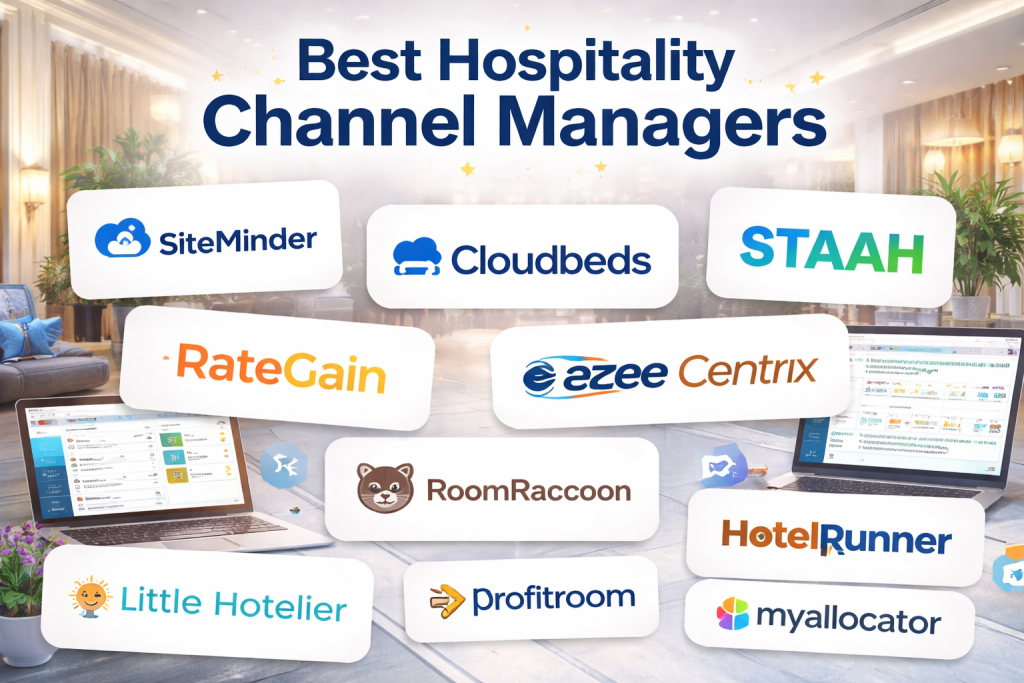
Top 10 Hospitality Channel Managers Tools
1 — SiteMinder
Short description:
SiteMinder is a widely used hospitality channel manager designed for hotels of all sizes, offering broad OTA connectivity and strong automation for rate and inventory distribution.
Key features:
- Real-time two-way channel synchronization
- Connectivity with hundreds of OTAs and booking channels
- Centralized rate and availability management
- Integrated booking engine for direct reservations
- Yield and rate optimization controls
- Multi-property management support
Pros:
- Extremely large distribution network
- Reliable synchronization with minimal downtime
- Suitable for both independent hotels and groups
Cons:
- Pricing can be high for small properties
- Interface may feel complex for beginners
Security & compliance:
Data encryption in transit, GDPR compliance, role-based access controls.
Support & community:
Comprehensive documentation, onboarding assistance, global customer support, strong enterprise support options.
2 — Cloudbeds Channel Manager
Short description:
Cloudbeds combines channel management with property management and booking tools, making it ideal for hospitality businesses seeking an all-in-one platform.
Key features:
- Two-way OTA integration
- Unified dashboard with PMS and channel manager
- Automated rate and inventory updates
- Support for hotels, hostels, and vacation rentals
- Mobile-friendly management interface
- Built-in analytics and performance reports
Pros:
- All-in-one ecosystem reduces tool sprawl
- Intuitive and modern user interface
- Scales well from small to mid-sized properties
Cons:
- Less flexible for highly customized enterprise workflows
- Some advanced features require higher-tier plans
Security & compliance:
Encryption, GDPR alignment, secure role-based permissions.
Support & community:
24/7 support, structured onboarding, active user community, extensive knowledge base.
3 — STAAH Channel Manager
Short description:
STAAH is a powerful channel management solution popular in Asia-Pacific markets, offering strong control over rates and inventory distribution.
Key features:
- Real-time channel updates
- Central rate and availability control
- Multi-property dashboard
- Yield and revenue optimization tools
- Integration with leading PMS platforms
- Channel performance analytics
Pros:
- Strong reliability and uptime
- Excellent support for multi-property operations
- Robust reporting tools
Cons:
- Interface feels dated compared to newer platforms
- Learning curve for non-technical users
Security & compliance:
Standard encryption, GDPR-compliant data handling.
Support & community:
Dedicated account managers, onboarding training, responsive regional support teams.
4 — RateGain Channel Manager
Short description:
RateGain focuses on enterprise-grade distribution, pricing intelligence, and channel management for mid-market and large hospitality brands.
Key features:
- Enterprise-level channel connectivity
- Advanced rate and parity management
- Integration with revenue intelligence tools
- Bulk updates across multiple properties
- Custom reporting and dashboards
- Strong API capabilities
Pros:
- Ideal for hotel chains and groups
- Deep data insights for revenue teams
- Highly customizable workflows
Cons:
- Overpowered for small hotels
- Requires training for effective use
Security & compliance:
SOC-aligned security practices, GDPR compliance, audit trails.
Support & community:
Enterprise onboarding, dedicated support teams, professional services available.
5 — eZee Centrix
Short description:
eZee Centrix is a cost-effective channel manager designed for small to mid-sized hotels seeking simplicity and essential automation.
Key features:
- Two-way OTA connectivity
- Centralized inventory and rate management
- Multi-property support
- Integration with eZee PMS
- Auto stop-sell and restrictions
- Simple reporting tools
Pros:
- Affordable pricing
- Easy to learn and implement
- Good value for independent hotels
Cons:
- Limited advanced analytics
- Fewer enterprise-grade features
Security & compliance:
Standard encryption, GDPR-friendly data practices.
Support & community:
Email and chat support, onboarding assistance, helpful documentation.
6 — RoomRaccoon
Short description:
RoomRaccoon is a modern hospitality platform with an integrated channel manager, focused on boutique hotels and independent properties.
Key features:
- Real-time OTA synchronization
- Integrated PMS and booking engine
- Smart pricing and availability rules
- Automated guest communication triggers
- Performance and revenue dashboards
- Cloud-based access
Pros:
- Clean, user-friendly design
- Strong automation for small teams
- Fast implementation
Cons:
- Limited customization for large enterprises
- Smaller OTA network compared to market leaders
Security & compliance:
Encrypted data storage, GDPR compliance, secure access controls.
Support & community:
Hands-on onboarding, responsive support team, growing user community.
7 — Little Hotelier Channel Manager
Short description:
Little Hotelier is designed specifically for small hotels, B&Bs, and inns, offering simple channel management without technical complexity.
Key features:
- Easy OTA connectivity
- Central availability and pricing updates
- Integrated booking engine
- Mobile-friendly interface
- Basic reporting tools
- Automated reservation syncing
Pros:
- Very easy to use
- Tailored for small properties
- Minimal setup effort
Cons:
- Limited scalability
- Not suitable for complex operations
Security & compliance:
Basic encryption, GDPR-aligned policies.
Support & community:
Helpful support resources, onboarding tutorials, responsive customer service.
8 — Profitroom Channel Manager
Short description:
Profitroom focuses on direct booking growth while offering channel management tools integrated with marketing and CRM capabilities.
Key features:
- OTA rate and inventory synchronization
- Strong direct booking integrations
- Multi-language and multi-currency support
- Campaign and promotion tools
- Performance analytics
- CRM integration
Pros:
- Strong focus on direct revenue
- Marketing-friendly features
- Good for upscale and boutique hotels
Cons:
- Less emphasis on OTA breadth
- May require multiple modules
Security & compliance:
Encrypted communications, GDPR compliance.
Support & community:
Onboarding specialists, documentation, dedicated customer success managers.
9 — HotelRunner Channel Manager
Short description:
HotelRunner offers a flexible channel management platform with strong distribution capabilities and partner connectivity.
Key features:
- Two-way channel connectivity
- Distribution to OTAs and wholesalers
- Centralized pricing control
- B2B network integrations
- Multi-property management
- Analytics and insights
Pros:
- Broad distribution ecosystem
- Good balance between simplicity and power
- Suitable for expanding properties
Cons:
- UI can feel busy
- Reporting depth varies by plan
Security & compliance:
Standard data security measures, GDPR adherence.
Support & community:
Online support resources, onboarding guidance, regional support availability.
10 — MyAllocator
Short description:
MyAllocator is a straightforward channel manager commonly used by hostels and small hospitality businesses.
Key features:
- Real-time OTA updates
- Simple inventory management
- Hostel-focused channel integrations
- Basic reporting tools
- Multi-property access
- Easy setup
Pros:
- Affordable and simple
- Well-suited for hostels
- Minimal training required
Cons:
- Limited advanced features
- Not ideal for large hotels
Security & compliance:
Standard encryption, basic compliance measures.
Support & community:
Email support, knowledge base, onboarding materials.
Comparison Table
| Tool Name | Best For | Platform(s) Supported | Standout Feature | Rating |
|---|---|---|---|---|
| SiteMinder | Hotels & chains | Web-based | Largest OTA network | N/A |
| Cloudbeds | SMB hospitality | Web, mobile | All-in-one platform | N/A |
| STAAH | Multi-property hotels | Web-based | Strong rate control | N/A |
| RateGain | Enterprise groups | Web-based | Revenue intelligence | N/A |
| eZee Centrix | Small hotels | Web-based | Affordable automation | N/A |
| RoomRaccoon | Boutique hotels | Web-based | Modern UX | N/A |
| Little Hotelier | Small properties | Web-based | Simplicity | N/A |
| Profitroom | Direct-focused hotels | Web-based | Direct booking tools | N/A |
| HotelRunner | Growing properties | Web-based | Distribution ecosystem | N/A |
| MyAllocator | Hostels | Web-based | Ease of use | N/A |
Evaluation & Scoring of Hospitality Channel Managers
| Criteria | Weight | Avg Score |
|---|---|---|
| Core features | 25% | High |
| Ease of use | 15% | High |
| Integrations & ecosystem | 15% | Medium–High |
| Security & compliance | 10% | Medium |
| Performance & reliability | 10% | High |
| Support & community | 10% | Medium–High |
| Price / value | 15% | Medium |
Which Hospitality Channel Managers Tool Is Right for You?
- Solo users & small properties: Choose tools like Little Hotelier or MyAllocator for simplicity and affordability.
- SMBs: Cloudbeds, RoomRaccoon, and eZee Centrix offer a strong balance of features and ease of use.
- Mid-market & enterprise: SiteMinder, STAAH, and RateGain provide scalability and advanced controls.
- Budget-conscious users: Look for modular pricing and essential automation rather than enterprise features.
- Integration-heavy environments: Prioritize tools with strong PMS, RMS, and API capabilities.
- Security-focused organizations: Opt for vendors with mature security practices and clear compliance policies.
Frequently Asked Questions (FAQs)
1. What does a hospitality channel manager do?
It synchronizes room availability, pricing, and reservations across multiple booking channels in real time.
2. Can a channel manager prevent overbookings?
Yes, real-time updates significantly reduce the risk of double bookings.
3. Is a channel manager the same as a PMS?
No, but many modern platforms combine both into a single system.
4. Are channel managers expensive?
Costs vary widely based on property size, features, and number of channels.
5. How long does implementation take?
From a few hours for small properties to several weeks for large groups.
6. Do I still need a revenue manager?
Channel managers support revenue strategies but do not replace strategic revenue management.
7. Are these tools secure?
Most reputable providers follow industry-standard security practices.
8. Can I manage multiple properties?
Yes, many tools support multi-property dashboards.
9. What is rate parity?
Maintaining consistent prices across all booking channels.
10. What is the biggest mistake when choosing a channel manager?
Selecting a tool that is either too complex or too limited for your actual needs.
Conclusion
Hospitality Channel Managers are no longer optional tools; they are essential for modern hospitality businesses operating in a multi-channel booking environment. The right solution can save time, reduce errors, improve revenue, and provide much-needed operational clarity.
When choosing a channel manager, focus on reliability, integrations, ease of use, and long-term scalability rather than brand popularity alone. There is no single “best” tool for everyone—the ideal choice depends on property size, budget, technical maturity, and business goals. By aligning your needs with the strengths of the right platform, you can build a more efficient and profitable hospitality operation.

Find Trusted Cardiac Hospitals
Compare heart hospitals by city and services — all in one place.
Explore Hospitals
Hospitality channel managers need to keep room availability and pricing consistent across booking platforms, especially when several reservations arrive close together. A delayed update can lead to overbookings, while an incorrect rate can create confusion for guests and staff. I would check how quickly the system synchronizes inventory, handles booking modifications, and resolves conflicting updates. Reliable synchronization helps hotels maintain accurate listings and avoid problems that can damage guest trust.
Hospitality channel managers help hotels manage room availability, rates, and bookings across multiple online travel platforms. Features like real-time inventory synchronization, automated rate updates, reservation management, and PMS integration can reduce manual work and prevent booking errors. Hotels should also compare reporting capabilities, ease of use, scalability, and integration flexibility before choosing a solution.
The comparison clearly highlights the operational trade-off between all-in-one PMS platforms with native distribution versus dedicated, enterprise-grade channel managers. In high-occupancy properties, the real test of a channel manager is rarely just initial room mapping, but two-way sync latency during flash-demand surges to prevent overbookings and rate parity discrepancies across fragmented OTAs. Factoring in how gracefully the platform handles custom rate restriction logic and real-time mapping updates upfront is what ultimately prevents revenue leaks and front-desk friction down the line.
Hospitality channel managers are most useful when they keep room availability and pricing consistent across different booking platforms. One important factor is how quickly the system updates reservations and prevents double bookings. Hotels should also check how easily it connects with their property management system and booking engine. Clear reports can help managers understand which channels bring more reservations and where updates are needed. I believe reliable synchronization and simple inventory management are essential when choosing a channel manager.
Overbooking and rate parity problems usually come from sync delays, so I’d test how quickly inventory updates reach each channel and what happens when a connection fails. Rule-based rate adjustments by channel, length of stay and demand help, but need regular review. Integration with the property management system avoids double entry. Channel cost reports show where direct-booking promotions deserve effort.
A hotel can have accurate room availability across booking channels and still face operational confusion when guests make special requests through different platforms. For example, a guest might request an early check-in, a specific room arrangement, or an accessibility requirement while booking through an online travel agency. I would be interested in how well hospitality channel managers capture and transfer these details to the property’s reservation or front-desk system. Room inventory synchronization is important, but reservation context should not get lost between systems. If staff have to manually check multiple booking portals to understand guest requirements, the property risks inconsistent service even when the booking itself is confirmed.
Hospitality channel managers help hotels and accommodation providers manage room availability, rates, and bookings across multiple online travel agencies and reservation platforms. Features such as real-time inventory synchronization, centralized rate management, booking updates, overbooking prevention, and performance analytics make distribution management more efficient. When comparing solutions, hospitality businesses should consider integration with property management systems, supported booking channels, synchronization reliability, pricing flexibility, and ease of use. The right platform can reduce manual work, minimize booking conflicts, improve online visibility, and help properties maximize occupancy and revenue.
Hospitality channel managers help hotels and accommodation providers synchronize room availability, rates, and reservations across multiple booking platforms. When comparing solutions, I would focus on real-time inventory updates, pricing controls, booking integrations, reporting, and ease of use. These features can reduce overbooking, save staff time, and improve reservation accuracy. The right channel manager should simplify distribution, keep information consistent across channels, and help hospitality businesses manage bookings more efficiently.
Hotels should verify how a channel manager handles conflicting updates from booking sites and internal reservation systems. Even a brief delay can create problems when room availability changes quickly during peak season. Teams need alerts for failed synchronizations and a clear way to resolve booking differences without relying on manual checks alone. It is also worth testing unusual cases, such as guests extending stays, changing room types, or cancelling close to arrival. Staff should know which system holds the latest confirmed information when integrations disagree. Before making configuration changes, hotels can test them with a small set of rooms and channels to limit disruption. Keeping an audit trail of inventory changes can also help explain how an overbooking occurred. These safeguards make daily reservation management more dependable when systems or booking volumes become unpredictable.
A good channel manager can make daily hotel operations much easier by keeping room availability and rates updated across booking platforms. I think avoiding double bookings is just as important as reaching more guests. Before choosing a tool, hotels should check how well it connects with their existing property management system and how easy it is for staff to use.
A hospitality channel manager helps properties keep room availability and rates aligned across booking channels. When updates arrive late, a property may face double bookings or lost sales. I would compare the speed of inventory updates, support for rate rules, and connections with property management systems. Error alerts are important because a failed sync may not be obvious right away. Teams should also check how easily they can manage different room types and special offers. A useful platform should reduce repeated manual updates and keep information consistent across channels. Reliable syncing and clear error handling matter more than a long list of integrations alone.
Hospitality channel managers help hotels synchronize room availability, rates, and reservations across online travel agencies and direct booking channels. Real-time inventory updates can reduce overbooking while keeping pricing information consistent across distribution platforms. Integrating channel management with property management and revenue systems also improves booking visibility, simplifies daily operations, and helps hospitality businesses respond more effectively to changing demand patterns.
Hotels should evaluate how a channel manager recovers when a booking update fails halfway through the synchronization process. For example, a room may be sold on one OTA while another platform still shows it as available because an update was delayed or rejected. Useful safeguards include automatic reconciliation, clear error logs, and alerts that help staff identify inconsistent inventory before another reservation arrives. I would also test how the system handles simultaneous bookings, cancelled reservations, and temporary API outages during peak demand. Measuring synchronization delays and tracking unresolved booking discrepancies can reveal weaknesses that standard feature comparisons may miss. These checks help hotel teams reduce revenue loss and avoid the manual work that often follows distribution errors.
From an SRE and systems integration standpoint, the critical failure mode is API rate limiting and webhook backpressure during high-demand booking surges. When multiple OTAs push simultaneous reservations, weak channel manager architectures experience race conditions and inventory lock latency, triggering split-brain states and catastrophic double-bookings before PMS synchronization completes.
Hospitality channel managers help hotels and accommodation providers keep room availability, rates, and bookings consistent across multiple travel websites. When comparing tools, consider real-time inventory updates, booking synchronization, pricing controls, reporting, and integration with property management systems. Reliable synchronization can prevent double bookings, reduce manual updates, and help staff manage room inventory more efficiently across different sales channels.
Hospitality channel managers need to keep room availability and pricing consistent across booking websites, especially during busy travel periods. When comparing platforms, check how quickly they update inventory after a cancellation, modification, or direct booking to reduce the risk of double bookings. It is also useful to review how they handle room-type mapping and minimum-stay rules, since small configuration errors can create costly booking problems.
A hospitality channel manager is most effective when room availability, rates, and reservations stay synchronized across all booking platforms. Regularly checking integration accuracy and monitoring failed updates can help prevent overbookings and pricing inconsistencies. Clear reporting also helps hotels adjust distribution strategies based on actual booking performance.
Hospitality channel managers help hotels synchronize room availability, rates, and reservations across online travel agencies and direct booking channels. Platforms like SiteMinder offer centralized channel management and real-time inventory updates, helping properties reduce overbookings, streamline daily operations, and maintain consistent pricing across distribution channels.
This is a very useful comparison because a hospitality channel manager is not just a “listing sync” tool—it directly impacts occupancy, revenue, and guest experience. I like how the post helps readers compare solutions on real operational needs like two-way inventory & rate sync, OTA coverage, booking engine/PMS integration, automated rate rules, multi-property support, and overbooking protection. In practice, the best choice usually comes down to reliability of sync, ease of onboarding, quality of support, and how well the tool fits your pricing strategy (promotions, minimum stay, derived rates, and parity controls). Overall, a clear guide for hotels and homestays to shortlist the right platform with fewer costly mistakes.