
Introduction
Industrial IoT (IIoT) Analytics Platforms are specialized software solutions that collect, process, and analyze data generated by connected industrial devices such as sensors, machines, PLCs, robots, and production lines. These platforms turn raw machine data into actionable insights that help organizations improve efficiency, reduce downtime, enhance safety, and optimize operations.
In modern manufacturing, energy, utilities, oil & gas, transportation, and smart infrastructure, data volumes are massive and continuous. Manual analysis or traditional BI tools are no longer sufficient. IIoT analytics platforms fill this gap by combining real-time data ingestion, advanced analytics, machine learning, and visualization tailored for industrial environments.
Why Industrial IoT Analytics Is Important
- Enables predictive maintenance instead of reactive repairs
- Improves operational efficiency and asset utilization
- Reduces unplanned downtime and maintenance costs
- Enhances quality control and process optimization
- Supports data-driven decision-making at scale
Common Real-World Use Cases
- Predicting equipment failures before breakdowns occur
- Monitoring production KPIs in real time
- Energy consumption optimization
- Quality anomaly detection
- Remote asset monitoring across multiple locations
What to Look for When Choosing an IIoT Analytics Platform
- Real-time and historical data processing
- Native support for industrial protocols
- Advanced analytics and ML capabilities
- Scalability and performance
- Security, compliance, and governance
- Ease of integration with existing OT and IT systems
Best for:
Industrial IoT Analytics Platforms are best suited for manufacturers, plant managers, reliability engineers, operations teams, data engineers, and enterprises managing large-scale physical assets across industries such as manufacturing, utilities, oil & gas, logistics, and smart infrastructure.
Not ideal for:
These platforms may not be ideal for small teams with minimal sensor data, organizations without connected assets, or businesses seeking only basic reporting where traditional BI tools may be sufficient.
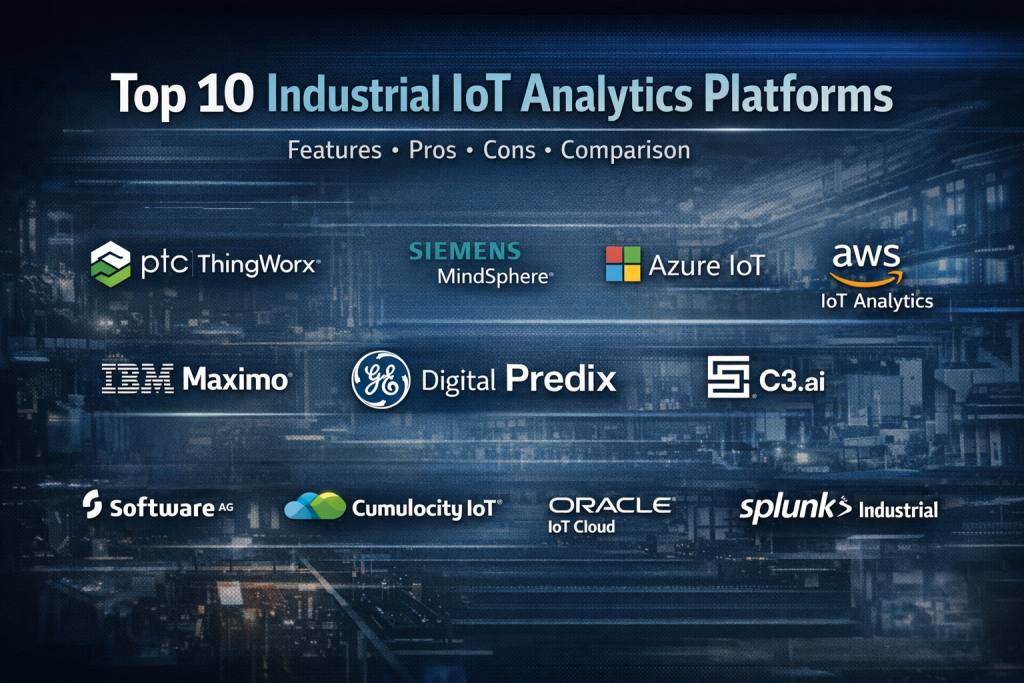
Top 10 Industrial IoT Analytics Platforms Tools
1 — PTC ThingWorx
Short description:
A comprehensive IIoT platform designed for industrial enterprises seeking end-to-end device connectivity, analytics, and digital transformation.
Key features
- Real-time data ingestion from industrial devices
- Built-in analytics and rules engine
- Digital twin modeling
- Strong AR and visualization support
- Edge and cloud deployment options
- Workflow and application development tools
Pros
- Mature and enterprise-grade platform
- Strong ecosystem and partner network
Cons
- Steep learning curve
- Higher cost compared to lightweight solutions
Security & compliance:
SSO, role-based access control, encryption, audit logs, enterprise-grade compliance support.
Support & community:
Extensive documentation, enterprise support plans, active partner ecosystem.
2 — Siemens MindSphere
Short description:
An industrial cloud-based IoT analytics platform optimized for manufacturing and automation environments.
Key features
- Native integration with Siemens industrial hardware
- Real-time asset performance monitoring
- Advanced analytics and AI models
- Cloud-native architecture
- Scalable data management
- App development framework
Pros
- Deep industrial domain expertise
- Strong reliability and performance
Cons
- Best suited for Siemens-centric environments
- Customization can be complex
Security & compliance:
Enterprise security controls, encryption, compliance aligned with global industrial standards.
Support & community:
Professional support, industrial user community, extensive training resources.
3 — Azure IoT Hub & IoT Analytics
Short description:
A cloud-based industrial IoT analytics solution offering scalable ingestion, analytics, and integration with enterprise systems.
Key features
- Massive device connectivity
- Real-time stream processing
- Built-in AI and ML services
- Strong integration with enterprise tools
- Flexible cloud scalability
- Edge computing support
Pros
- Highly scalable and flexible
- Rich analytics ecosystem
Cons
- Requires cloud expertise
- Costs can scale quickly with usage
Security & compliance:
Strong identity management, encryption, SOC 2, ISO, GDPR support.
Support & community:
Excellent documentation, large developer community, enterprise support options.
4 — AWS IoT Analytics
Short description:
A fully managed service for processing and analyzing industrial IoT data at cloud scale.
Key features
- Automated data pipelines
- Time-series data analysis
- Integration with machine learning services
- Serverless architecture
- Edge-to-cloud data processing
- High availability
Pros
- Pay-as-you-go pricing
- Strong reliability and scalability
Cons
- Vendor lock-in risk
- Complex architecture for beginners
Security & compliance:
Encryption, IAM-based access, extensive compliance certifications.
Support & community:
Strong documentation, global community, enterprise-grade support.
5 — IBM Maximo Application Suite
Short description:
An asset-centric IIoT analytics platform focused on predictive maintenance and asset lifecycle management.
Key features
- Predictive maintenance analytics
- Asset performance management
- AI-driven anomaly detection
- Industry-specific data models
- Integration with EAM systems
- Cloud and hybrid deployment
Pros
- Excellent for asset-heavy industries
- Strong AI capabilities
Cons
- Complex implementation
- Higher total cost of ownership
Security & compliance:
Enterprise security controls, audit logs, industry compliance support.
Support & community:
Professional services, enterprise support, extensive documentation.
6 — GE Digital Predix
Short description:
An industrial IoT analytics platform designed for heavy industries and large-scale asset monitoring.
Key features
- Asset-centric analytics
- Digital twin capabilities
- Time-series data management
- Advanced anomaly detection
- Scalable industrial cloud
- Edge analytics
Pros
- Designed for complex industrial assets
- Proven in heavy industries
Cons
- Limited appeal outside industrial sectors
- Customization can be resource-intensive
Security & compliance:
Enterprise-grade security, encryption, compliance-ready architecture.
Support & community:
Dedicated enterprise support, industrial-focused documentation.
7 — C3 AI Platform
Short description:
An AI-first enterprise platform delivering advanced analytics for industrial and operational use cases.
Key features
- AI-driven predictive analytics
- Prebuilt industrial AI models
- Large-scale data integration
- Digital twin support
- Cloud and on-prem deployment
- High-performance analytics engine
Pros
- Strong AI and ML depth
- Suitable for complex use cases
Cons
- Expensive
- Requires skilled teams
Security & compliance:
Enterprise security, encryption, compliance with major standards.
Support & community:
Enterprise support, professional services, structured onboarding.
8 — Software AG Cumulocity IoT
Short description:
A flexible IIoT analytics platform supporting device management, analytics, and application development.
Key features
- Multi-protocol device support
- Real-time analytics
- Edge and cloud deployment
- Custom application framework
- Integration-friendly APIs
- Scalable architecture
Pros
- Flexible and modular
- Strong device management
Cons
- UI can feel dated
- Advanced analytics may require extensions
Security & compliance:
SSO, encryption, role-based access, GDPR-ready.
Support & community:
Good documentation, enterprise support, active user base.
9 — Oracle IoT Cloud Service
Short description:
An enterprise IoT analytics solution tightly integrated with Oracle’s data and application ecosystem.
Key features
- Asset monitoring and analytics
- Real-time data processing
- Integration with ERP and SCM
- Predictive maintenance
- Scalable cloud infrastructure
- Strong reporting tools
Pros
- Excellent enterprise integration
- Strong data governance
Cons
- Less flexible outside Oracle ecosystem
- Licensing complexity
Security & compliance:
Enterprise security controls, audit logs, global compliance certifications.
Support & community:
Enterprise support, documentation, Oracle partner network.
10 — Splunk Industrial Analytics
Short description:
An analytics-driven platform leveraging machine data for industrial monitoring and operational intelligence.
Key features
- Real-time machine data analytics
- Advanced visualization
- Anomaly detection
- Strong log and event correlation
- Scalable analytics engine
- Custom dashboards
Pros
- Powerful analytics and visualization
- Flexible data ingestion
Cons
- High licensing costs
- Requires tuning for industrial use
Security & compliance:
SSO, encryption, audit logging, compliance-ready.
Support & community:
Large community, strong documentation, enterprise support.
Comparison Table
| Tool Name | Best For | Platform(s) Supported | Standout Feature | Rating |
|---|---|---|---|---|
| PTC ThingWorx | Industrial enterprises | Cloud, Edge | Digital twins | N/A |
| Siemens MindSphere | Manufacturing | Cloud | Industrial integration | N/A |
| Azure IoT Analytics | Large-scale IoT | Cloud, Edge | Cloud scalability | N/A |
| AWS IoT Analytics | Data-intensive IoT | Cloud, Edge | Serverless pipelines | N/A |
| IBM Maximo | Asset-heavy industries | Cloud, Hybrid | Predictive maintenance | N/A |
| GE Predix | Heavy industries | Cloud, Edge | Asset analytics | N/A |
| C3 AI Platform | AI-driven enterprises | Cloud, On-prem | Advanced AI models | N/A |
| Cumulocity IoT | Flexible IIoT | Cloud, Edge | Device management | N/A |
| Oracle IoT Cloud | Oracle customers | Cloud | ERP integration | N/A |
| Splunk Industrial | Machine data analytics | Cloud, On-prem | Visualization | N/A |
Evaluation & Scoring of Industrial IoT Analytics Platforms
| Criteria | Weight | Score (Avg) |
|---|---|---|
| Core features | 25% | High |
| Ease of use | 15% | Medium |
| Integrations & ecosystem | 15% | High |
| Security & compliance | 10% | High |
| Performance & reliability | 10% | High |
| Support & community | 10% | Medium–High |
| Price / value | 15% | Medium |
Which Industrial IoT Analytics Platform Is Right for You?
- Solo users & SMBs: Lightweight, cloud-native platforms with lower setup complexity
- Mid-market companies: Balanced solutions offering scalability and integrations
- Enterprises: Full-featured platforms with strong security, AI, and support
Budget-conscious teams should focus on modular pricing and cloud-based services, while premium buyers may prioritize advanced AI, digital twins, and enterprise support.
If ease of use is critical, choose platforms with prebuilt dashboards. For deep analytics, prioritize AI-driven platforms. Highly regulated industries must emphasize security, auditability, and compliance.
Frequently Asked Questions (FAQs)
- What is an Industrial IoT Analytics Platform?
It is software that analyzes data from industrial devices to improve operations and decision-making. - Do these platforms support real-time analytics?
Yes, most provide real-time and historical data analysis. - Are IIoT platforms secure?
Leading platforms offer encryption, access control, and compliance features. - Can SMBs use industrial IoT analytics?
Yes, but simpler and cloud-based solutions are often better suited. - Do I need data scientists to use these tools?
Not always; many platforms offer no-code or low-code analytics. - What industries benefit most?
Manufacturing, energy, utilities, logistics, and transportation. - How long does implementation take?
From weeks for cloud solutions to months for enterprise deployments. - Can these platforms integrate with ERP systems?
Yes, most support integration with enterprise systems. - Are on-prem deployments available?
Some platforms support on-prem or hybrid models. - What is the biggest mistake buyers make?
Choosing overly complex platforms without clear use cases.
Conclusion
Industrial IoT Analytics Platforms play a critical role in transforming raw machine data into business value. The right platform can dramatically improve reliability, efficiency, and operational insight.
There is no universal “best” solution. The ideal choice depends on industry, scale, budget, analytics maturity, and integration needs. By focusing on real-world use cases, security, scalability, and long-term value, organizations can confidently select a platform that supports their industrial digital transformation journey.

Find Trusted Cardiac Hospitals
Compare heart hospitals by city and services — all in one place.
Explore Hospitals
Industrial IoT analytics becomes much more useful when sensor readings are connected to actual equipment operating conditions. A temperature increase, for example, may be normal during a heavy production cycle but concerning when the machine is idle. I would look for platforms that combine sensor data with maintenance records, machine states, and production schedules. This context helps engineers distinguish normal variations from early signs of equipment failure and avoid unnecessary maintenance alerts.
Spot on. An IIoT analytics deployment stalls if it cannot seamlessly bridge the gap between plant floor Operational Technology (OT) and enterprise IT. Legacy machinery relies on an assortment of serial protocols, fieldbuses, and industrial standards like Modbus, PROFIBUS, and OPC UA. Without robust edge protocol abstraction layers (such as Kepware or Litmus) to normalize disparate register maps into structured, contextualized JSON/Parquet schemas before ingestion, time-series databases become littered with cryptic register numbers rather than human-readable sensor variables, paralyzing predictive maintenance workflows.
One practical addition: before comparing platforms, teams should validate whether their existing PLCs, historians, and edge devices can reliably feed the platform—poor data quality and inconsistent tagging often derail predictive-maintenance projects more than the analytics engine itself. Starting with one high-value asset and a measurable downtime or energy KPI makes it much easier to prove ROI and avoid choosing an overly complex enterprise stack.
Industrial IoT analytics platforms help manufacturers and industrial operators transform data from connected machines, sensors, and equipment into actionable insights. Capabilities such as real-time monitoring, predictive maintenance, anomaly detection, edge analytics, and integration with existing industrial systems can improve equipment reliability and operational efficiency. I believe scalability, interoperability with industrial protocols, data security, and the ability to process data close to its source are important factors when comparing these platforms. The right solution should help organizations move beyond basic monitoring toward proactive decision-making, reducing unplanned downtime, optimizing resource utilization, and improving overall industrial performance.
Industrial IoT analytics platforms can help teams spot equipment problems before they cause costly downtime. However, sensor data is only useful when readings are accurate and arrive on time. I would check how well the platform handles missing data, unusual readings, and alerts from multiple machines. Connecting analytics with maintenance records can also help teams understand recurring failures. How can manufacturers turn sensor data into useful actions without overwhelming teams with alerts?
Industrial IoT analytics platforms can help teams spot equipment problems before they cause costly downtime. However, sensor data is only useful when readings are accurate and arrive on time. I would check how well the platform handles missing data, unusual readings, and alerts from multiple machines. Connecting analytics with maintenance records can also help teams understand recurring failures. How can manufacturers turn sensor data into useful actions without overwhelming teams with alerts?
Industrial IoT analytics platforms help businesses monitor equipment, analyze sensor data, and improve operational efficiency. Features like real-time monitoring, predictive maintenance, and automated alerts help identify issues early. When comparing platforms, organizations should consider scalability, data integration, security, and reporting capabilities. These solutions can reduce downtime and optimize industrial processes. Choosing the right platform supports smarter, data-driven decisions.
Connecting factory floor sensors to cloud analytics is super helpful for predicting equipment breakdowns before they happen. While heavy enterprise platforms offer deep digital twin modeling for massive manufacturing plants, cloud-native services make it much easier to scale data pipelines without a huge setup headache. Reviewing the feature breakdown helps you figure out which tool matches your plant’s operational goals.
Industrial IoT analytics platforms turn machine and sensor data into useful operational insights. They can help teams monitor equipment, spot faults, and plan maintenance. Buyers should compare device support, alert quality, data processing, and integration with factory systems. Testing missing readings and unusual sensor values is also important. Too many false alerts can distract staff from real problems. A reliable platform helps organizations improve equipment performance, reduce downtime, and make better use of data from connected machines.
Industrial IoT platforms should be assessed on how well they handle older machines that use different protocols and data formats. Connecting new sensors is often straightforward, but integrating legacy controllers can require custom gateways and ongoing maintenance. I would check whether the platform can normalize data from different equipment without losing important timing or measurement details. Teams should also test what happens when a gateway restarts or buffers readings during a network outage. These checks can reduce integration surprises and help maintain reliable analytics across mixed industrial environments.
Industrial IoT analytics platforms can help manufacturers identify equipment problems earlier, understand production patterns, and reduce unplanned downtime. When evaluating different solutions, I would focus on support for industrial protocols, edge data processing, predictive maintenance, anomaly detection, and integration with existing control systems. The ability to analyze sensor data close to the equipment can be especially useful when network connectivity is limited or immediate action is required. Security also deserves careful attention because connecting operational technology to analytics systems introduces additional risks. Testing a platform with real sensor readings and known equipment issues can help determine whether its insights are accurate, timely, and practical for maintenance and production teams.
Industrial IoT analytics platforms help manufacturers turn sensor data into practical insights for equipment performance, production efficiency, and predictive maintenance. Edge processing, reliable connectivity, and integration with existing industrial systems are essential for detecting anomalies without overwhelming teams with unnecessary alerts. Strong data governance and scalable analytics also enable organizations to reduce downtime, optimize resource usage, and make more informed operational decisions.
Industrial IoT analytics platforms are most useful when they turn sensor data into timely actions that improve equipment reliability and production efficiency. Beyond dashboard features, teams should evaluate data quality, edge processing capabilities, and integration with existing industrial systems. Predictive maintenance alerts are valuable only when they are accurate enough to help technicians act before failures occur. I would also recommend testing how the platform handles network interruptions and missing sensor readings. How can manufacturers balance real-time monitoring with reliable predictions when operating conditions and sensor quality vary across facilities?
Industrial IoT analytics platforms are most valuable when sensor data leads to clear action on the factory floor. Teams should check how well a platform detects equipment changes, supports predictive maintenance, and handles gaps in incoming data. Linking alerts to maintenance workflows can help prevent unexpected downtime and improve equipment performance over time.
One practical factor often overlooked in Industrial IoT analytics is how reliably platforms process sensor data when factory networks experience latency or temporary connectivity failures. While PTC ThingWorx supports digital twins and IBM Maximo focuses on predictive maintenance, edge processing capabilities and integration with existing industrial systems deserve equal attention.
When selecting an Industrial IoT analytics platform, comparing feature sets and trade-offs is only half the battle. Evaluating how effectively these platforms handle edge processing versus cloud aggregation often determines success in real-time environments. It would be insightful to see how scalability holds up when integrating diverse legacy machinery with modern time-series databases.
Industrial IoT analytics can help factories spot equipment problems before they turn into costly production stoppages. One detail worth checking is how each platform handles sensor readings that suddenly become unrealistic or disappear altogether, since faulty data can trigger misleading alerts. Combining data quality checks with maintenance records can help teams decide whether a warning needs immediate attention.
A practical issue in industrial analytics is maintaining trustworthy data when equipment operates under imperfect conditions. Sensors can produce incorrect readings, gateways may lose network connectivity, and machines can report events with different timestamps. These problems can distort predictive maintenance results even when the analytics platform itself works correctly. Engineering teams should evaluate how each solution detects missing data, handles delayed events, and preserves records during offline periods. It is also useful to test recovery after a gateway reconnects, especially when buffered events arrive out of order. Clear data-quality indicators and alerts can help maintenance teams distinguish genuine equipment problems from faulty telemetry. Addressing these scenarios early can prevent misleading predictions and improve confidence in operational decisions.
Industrial IoT analytics platforms help manufacturers turn sensor readings and equipment data into insights that support predictive maintenance and smarter production planning. Looking at real-time data processing, anomaly detection, scalability, and integration with industrial systems helps businesses compare solutions that improve equipment visibility, reduce downtime, and strengthen operational performance.
Deploying industrial IoT analytics requires robust edge intelligence to process high-frequency sensor telemetry locally, preventing network saturation while syncing critical anomaly alerts with cloud platforms for automated predictive maintenance workflows.
This is an outstanding analysis of the Industrial IoT landscape. As Industry 4.0 continues to evolve, having a clear comparison of platforms like Azure IoT, AWS IoT SiteWise, and GE Digital is essential for organizations looking to scale their digital transformation. The breakdown of pros and cons provides exactly the kind of clarity needed for strategic decision-making. Great work!