
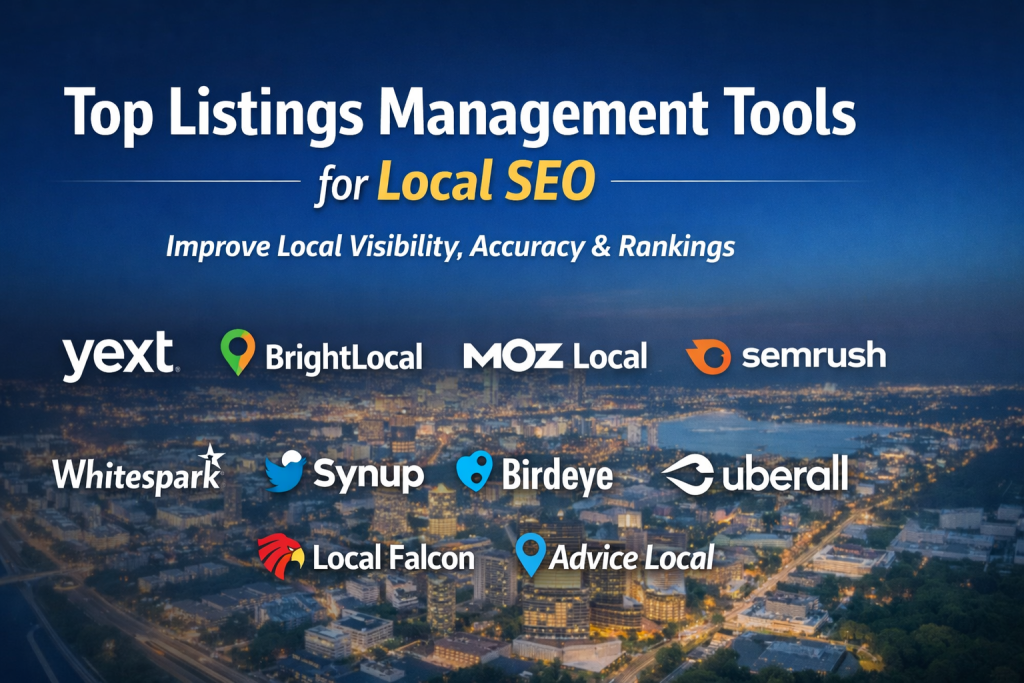
Introduction
Listings Management Tools for Local SEO are platforms designed to create, update, distribute, and monitor business information (such as name, address, phone number, categories, hours, and attributes) across online directories, search engines, maps, and local platforms. These tools ensure that a business’s local presence remains accurate, consistent, and discoverable wherever customers search.
In today’s local-first digital behavior, inconsistent or outdated listings directly impact search rankings, customer trust, and foot traffic. Search engines rely heavily on listing accuracy to validate business legitimacy, while users expect real-time correctness—especially for hours, locations, and services.
Why Listings Management Is Important
- Improves local search visibility and rankings
- Prevents customer confusion caused by inconsistent data
- Enhances trust signals for search engines and users
- Saves time by centralizing updates across platforms
- Supports multi-location scalability
Key Real-World Use Cases
- Multi-location businesses managing hundreds of stores
- Franchises enforcing brand consistency
- Agencies managing listings for multiple clients
- Local SMBs improving map and local pack visibility
What to Look for When Choosing a Listings Management Tool
- Directory coverage and distribution network
- Data accuracy and suppression of duplicates
- Bulk and multi-location management
- Integrations with reviews, analytics, and CRM tools
- Reporting, monitoring, and alerts
- Ease of use and onboarding
Best for:
Local businesses, franchises, agencies, retail chains, healthcare providers, hospitality brands, and service-based companies that rely on local discovery and foot traffic.
Not ideal for:
Purely online businesses, single-page websites without physical locations, or organizations that do not depend on local search visibility.
Top 10 Listings Management Tools (Local SEO) Tools
1 — Yext
Short description:
A powerful enterprise-grade listings and digital knowledge management platform built for large brands and multi-location businesses.
Key features:
- Centralized business data management
- Real-time updates across major directories
- Duplicate suppression and data cleansing
- Local analytics and performance insights
- API-first architecture for integrations
- Brand control and governance tools
Pros:
- Extremely fast listing propagation
- Excellent enterprise scalability
- Strong analytics and reporting
Cons:
- Premium pricing
- Feature-rich interface can feel complex
Security & compliance:
SSO, encryption in transit and at rest, GDPR compliant, SOC 2-aligned controls
Support & community:
Dedicated account managers, enterprise onboarding, extensive documentation
2 — BrightLocal
Short description:
A popular all-in-one Local SEO platform designed for SMBs and agencies.
Key features:
- Listings audit and citation tracking
- Citation building and cleanup
- Local rank tracking
- Google Business Profile monitoring
- White-label reporting
- Competitor insights
Pros:
- Excellent value for money
- Easy-to-use interface
- Strong reporting for agencies
Cons:
- Limited real-time sync compared to enterprise tools
- Smaller directory network
Security & compliance:
GDPR compliant, standard encryption, role-based access
Support & community:
Email and chat support, active SEO community, strong learning resources
3 — Moz Local
Short description:
A trusted listings distribution tool focused on accuracy and consistency across major aggregators.
Key features:
- Automated listings distribution
- Data consistency monitoring
- Duplicate listing detection
- Listing health score
- Simple dashboard
- Integration with Moz ecosystem
Pros:
- Reliable data accuracy
- Simple onboarding
- Strong brand credibility
Cons:
- Limited advanced features
- Less customizable reporting
Security & compliance:
GDPR compliant, encryption at rest and in transit
Support & community:
Knowledge base, ticket support, strong SEO community backing
4 — Semrush (Listing Management)
Short description:
A comprehensive marketing platform with built-in local listings management for SMBs and marketers.
Key features:
- Listings distribution and monitoring
- Duplicate suppression
- Local SEO tracking
- Integration with keyword and competitor tools
- Automated suggestions
- Multi-location support
Pros:
- Unified marketing platform
- Strong analytics ecosystem
- Good scalability for SMBs
Cons:
- Listings features are not standalone
- Learning curve for new users
Security & compliance:
SSO, GDPR compliant, SOC 2-aligned processes
Support & community:
24/7 support, large global user community, training resources
5 — Whitespark
Short description:
A specialist Local SEO toolset focused on citation building and local visibility.
Key features:
- Manual citation building
- Citation audits
- Local rank tracking
- Reputation monitoring
- Competitor analysis
- Niche directory discovery
Pros:
- High-quality manual citations
- Strong local expertise
- Excellent educational resources
Cons:
- Slower turnaround for manual services
- Limited automation
Security & compliance:
Standard encryption, GDPR compliant
Support & community:
Email support, strong blog and learning resources
6 — Synup
Short description:
An automated listings, reputation, and local analytics platform for growing businesses.
Key features:
- Automated listings sync
- Review monitoring and responses
- Local analytics dashboards
- Duplicate suppression
- Multi-location management
- API access
Pros:
- Affordable for SMBs
- Good automation balance
- Simple UI
Cons:
- Reporting depth is moderate
- Smaller directory network
Security & compliance:
Encryption, GDPR compliant, role-based access
Support & community:
Chat and email support, onboarding assistance
7 — Birdeye
Short description:
A customer experience platform with strong listings and reputation management capabilities.
Key features:
- Listings management and sync
- Review generation and monitoring
- Messaging and surveys
- Local insights dashboards
- Multi-location workflows
- Brand governance tools
Pros:
- Strong reputation + listings combo
- Scales well for franchises
- Automation-driven workflows
Cons:
- Higher cost for advanced features
- Interface can feel busy
Security & compliance:
SSO, SOC 2, GDPR compliant
Support & community:
Dedicated success managers, onboarding, enterprise support
8 — Uberall
Short description:
An enterprise-focused local marketing platform combining listings, reviews, and local engagement.
Key features:
- Global listings distribution
- Local page optimization
- Review and reputation tools
- Store locator integration
- Location performance analytics
- Workflow automation
Pros:
- Excellent for global brands
- Strong local engagement features
- Robust analytics
Cons:
- Enterprise pricing
- Requires onboarding support
Security & compliance:
SSO, GDPR compliant, enterprise-grade security controls
Support & community:
Dedicated enterprise support, onboarding teams
9 — Local Falcon
Short description:
A geo-grid ranking and local visibility tool that complements listings management efforts.
Key features:
- Geo-based rank tracking
- Visual local pack maps
- Competitor comparison
- Shareable reports
- Location-based insights
- Google Business Profile tracking
Pros:
- Unique visual ranking insights
- Excellent for agencies
- Easy to interpret data
Cons:
- Not a full listings manager
- Requires complementary tools
Security & compliance:
Standard encryption, GDPR compliant
Support & community:
Email support, growing user community
10 — Advice Local
Short description:
A local marketing automation platform focused on listings accuracy and local trust signals.
Key features:
- Listings distribution
- Duplicate suppression
- Trust and visibility reporting
- Review monitoring
- Multi-location support
- Agency-friendly dashboards
Pros:
- Affordable pricing
- Clear reporting
- Good SMB focus
Cons:
- Limited advanced customization
- Smaller integration ecosystem
Security & compliance:
GDPR compliant, encryption in place
Support & community:
Email support, onboarding resources
Comparison Table
| Tool Name | Best For | Platform(s) Supported | Standout Feature | Rating |
|---|---|---|---|---|
| Yext | Enterprise, global brands | Web, API | Real-time listings sync | N/A |
| BrightLocal | SMBs, agencies | Web | White-label reporting | N/A |
| Moz Local | SMBs | Web | Data accuracy scoring | N/A |
| Semrush | Marketers, SMBs | Web | Unified SEO ecosystem | N/A |
| Whitespark | Local SEO specialists | Web | Manual citation quality | N/A |
| Synup | Growing SMBs | Web, API | Affordable automation | N/A |
| Birdeye | Franchises, CX teams | Web, Mobile | Listings + reputation | N/A |
| Uberall | Large enterprises | Web, API | Local engagement workflows | N/A |
| Local Falcon | Agencies | Web | Geo-grid rank visualization | N/A |
| Advice Local | SMBs, agencies | Web | Trust-based reporting | N/A |
Evaluation & Scoring of Listings Management Tools (Local SEO)
| Criteria | Weight | Score Explanation |
|---|---|---|
| Core features | 25% | Coverage, sync speed, accuracy |
| Ease of use | 15% | UI, onboarding, learning curve |
| Integrations & ecosystem | 15% | CRM, analytics, APIs |
| Security & compliance | 10% | SSO, GDPR, SOC controls |
| Performance & reliability | 10% | Sync reliability, uptime |
| Support & community | 10% | Documentation, support quality |
| Price / value | 15% | ROI relative to cost |
Which Listings Management Tools (Local SEO) Tool Is Right for You?
- Solo users: Simple tools with audits and basic distribution
- SMBs: Affordable platforms with automation and reporting
- Mid-market: Tools balancing automation, analytics, and scalability
- Enterprise: Platforms with governance, APIs, and real-time sync
Budget-conscious vs premium:
Lower-cost tools work well for small footprints, while premium tools deliver speed, scale, and governance.
Feature depth vs ease of use:
Advanced tools provide control but require onboarding; simpler tools are faster to adopt.
Integration and scalability:
APIs and multi-location workflows matter as businesses grow.
Security and compliance:
Essential for healthcare, finance, and regulated industries.
Frequently Asked Questions (FAQs)
- What is listings management in Local SEO?
It is the process of managing and syncing business information across online directories and platforms. - Do listings really affect local rankings?
Yes, accuracy and consistency are major trust signals for search engines. - How often should listings be updated?
Any time business information changes, updates should be immediate. - Are free listings tools enough?
They work for very small businesses but lack automation and monitoring. - Can I manage listings manually?
Yes, but it is time-consuming and error-prone at scale. - Do these tools handle duplicate listings?
Most professional tools include suppression or cleanup features. - Are listings tools safe to use?
Reputable tools use encryption and comply with data regulations. - How long before I see results?
Typically within weeks, depending on directory sync speed. - Do agencies benefit from listings tools?
Yes, especially with white-label reporting and bulk management. - Is there one best tool for everyone?
No, the best tool depends on size, budget, and business needs.
Conclusion
Listings Management Tools are foundational to Local SEO success. They ensure accuracy, improve visibility, and protect brand trust across search and directory ecosystems. While some tools excel at enterprise-scale control and real-time updates, others focus on affordability and simplicity for SMBs.
The most important takeaway is that there is no universal winner. The right choice depends on business size, number of locations, budget, compliance needs, and how deeply local search impacts revenue. Selecting a tool that aligns with your specific goals will always outperform chasing the most popular name.

Find Trusted Cardiac Hospitals
Compare heart hospitals by city and services — all in one place.
Explore Hospitals
Listings management tools help businesses keep their name, address, phone number, and opening hours consistent across online directories. Even small differences in business details can confuse customers and affect local search visibility. Regular checks for duplicate or outdated listings can help maintain accurate information. Teams should also look for tools that make review monitoring and location updates easier, especially when managing several business locations.
One challenge with local listings management is handling business changes that affect only certain locations. For example, a franchise may temporarily close one branch, change its holiday hours, or discontinue a service at a specific outlet while other branches continue operating normally. Managing these exceptions without accidentally overwriting information across all locations requires location-level permissions, approval workflows, and reliable change tracking. This becomes particularly important for franchises and businesses operating across multiple cities.
For listings management tools, I’d pay attention to how they handle conflicting business information across directories—not just how many platforms they can publish to. A location may have a different phone number, holiday hours, or even a duplicate profile on one directory, and pushing updates without resolving those conflicts can spread inaccurate details further. It’s useful to check whether the tool flags duplicate listings, tracks edits made directly on publisher sites, and provides a clear history of changes and approval ownership. For businesses with many branches, local teams also need some flexibility to update location-specific details without overriding brand-wide standards. Keeping listings accurate over time is a continuous governance task, not simply a one-time distribution exercise.
Listings management tools can make local SEO much easier, but keeping business information accurate across directories is only part of the challenge. I would also evaluate how quickly a platform detects conflicting NAP details, duplicate profiles, and unauthorized edits, since these issues can undermine local visibility and customer trust. For businesses with many locations, bulk updates are useful only when they include approval workflows and clear location-level ownership. It is worth checking how reliably the tool syncs with major directories and reports failed or delayed updates instead of treating every submission as successful. Strong monitoring, audit history, and integration with review management can help teams maintain consistent local presence while reducing repetitive work.
Managing distributed business listings requires continuous API synchronization to prevent consumer-submitted edits from overwriting canonical store hours on maps. Tools that lock core NAP (Name, Address, Phone) data while enabling regional managers to post local updates strike the right balance between brand control and local relevance. Consolidated duplicate listing suppression is what directly lifts organic local map pack visibility.
Listings management tools help businesses maintain accurate location details across search engines, maps, directories, and review platforms. When comparing options, consider bulk listing updates, duplicate detection, NAP consistency, local search tracking, review monitoring, location-level reporting, and integration with business profiles.
Listings management tools quietly power local discoverability, and this article explains their role well. I like the emphasis on consistency across directories, since conflicting information confuses both search engines and customers. One practical note is to monitor reviews alongside listings, because reputation and accuracy influence each other. Local visibility is a compounding advantage. Clear and actionable overview.
Listings management tools help businesses manage their online business information across search engines, directories, and local platforms. When comparing these tools, I would focus on listing accuracy, bulk updates, duplicate detection, review monitoring, and local SEO reporting. These features can improve online visibility, maintain consistent business details, and make local search management easier. The right tool should offer reliable data synchronization, easy management of multiple locations, and useful insights into local search performance.
Listings management tools help businesses maintain accurate and consistent business information across search engines, online directories, maps, and local discovery platforms. Features such as centralized listing updates, duplicate detection, review monitoring, location management, local SEO analytics, and automated synchronization can improve online visibility. When comparing solutions, businesses should consider directory coverage, update accuracy, multi-location support, reporting capabilities, integration options, and pricing. The right platform can strengthen local search presence, improve customer trust, reduce manual listing management, and make it easier for potential customers to discover nearby businesses.
Listings platforms need a reliable way to resolve edits when several sources provide different business details. For example, a directory might overwrite a recently approved change with an older phone number or schedule. Setting clear update priorities and recording every change helps teams trace where incorrect information came from. Regular audits across connected directories can catch errors that remain unnoticed between sync cycles. This reduces customer confusion and saves time spent correcting the same listing across multiple platforms.
Listings management tools help businesses keep their names, addresses, phone numbers, and opening hours consistent across online directories. Small errors can confuse customers and affect local search visibility. I would compare directory coverage, duplicate detection, review monitoring, and update speed. Teams should test how the tool handles holiday hours and changes to business details. It is also useful to check whether updates reach every supported directory or need manual action. Clear reports can reveal listings that still need attention. The right platform should reduce repeated work and help customers find accurate business information wherever they search.
Listings management tools help businesses maintain accurate names, addresses, phone numbers, and operating hours across multiple online directories. Consistent information, duplicate detection, and review monitoring can strengthen local search visibility while making it easier for customers to find reliable business details. Regular profile updates and integration with local SEO reporting also help organizations track listing performance and maintain a consistent presence across digital platforms.
Listings management tools help businesses keep their name, address, phone number, and other details correct across online directories. They make it easier to update information and improve local search visibility. I think accurate listings and regular updates are important for building customer trust. These tools can also help businesses reach more local customers. Choosing the right platform makes managing online listings simpler and faster.
For businesses with many locations, controlling who can change listing information is just as important as distributing updates. A local manager might correct holiday hours while the central team updates a phone number, creating conflicts if both changes reach different directories at different times. A useful platform should support location-level permissions, approval workflows, and a clear history of changes. Teams should also be able to identify which directories rejected an update and retry failed submissions without overwriting newer information. Testing these scenarios before a large rollout can prevent outdated details from lingering online and reduce the manual effort needed to keep every location accurate.
Listings management tools help businesses keep their name, address, phone number, and opening hours consistent across directories and local search platforms. When comparing options, check how quickly they detect duplicate listings, process location updates, and flag incorrect information published by third-party sources. Tracking listing accuracy across individual branches can help multi-location businesses protect local search visibility and prevent customers from arriving with outdated details.
Propagating NAP (Name, Address, Phone) consistency across hundreds of legacy directory endpoints requires robust asynchronous job retry queues and rate-limit backoff handling. Without automated discrepancy detection and payload validation before syndication, API schema drifts on upstream publishers can silently corrupt branch metadata, directly harming local pack search visibility.
Listings management tools help businesses keep their name, address, phone number, opening hours, and other details consistent across online directories. When comparing platforms, check directory coverage, duplicate listing detection, review monitoring, bulk updates, and local search reporting. Regularly checking business details and responding to customer reviews can improve local visibility and help potential customers find accurate information before visiting or calling.
Listings management tools help businesses maintain accurate names, addresses, phone numbers, opening hours, and other details across online directories and local search platforms. Solutions like Yext offer centralized listing updates, location data management, and monitoring features, helping businesses improve local search visibility, reduce inconsistent information, and make it easier for customers to find them online.
Maintaining exact NAP consistency across directories is only half the battle; managing sudden platform API changes and automated listing overwrites requires constant vigilance. Automated suppression tools save immense time, but periodic manual audits are still essential to catch stubborn duplicates before they harm local rankings.
Listings management works best when businesses treat accuracy as an ongoing task rather than a one-time setup. Regularly checking duplicate profiles, holiday hours, and location-specific details can prevent customer confusion and strengthen local search trust.