
Introduction
Loan Servicing Platforms are specialized software systems designed to manage the entire post-origination lifecycle of a loan. Once a loan is approved and disbursed, servicing begins—covering repayment schedules, interest calculations, escrow management, borrower communications, compliance reporting, collections, and payoff processing. These platforms act as the operational backbone for lenders, ensuring loans remain accurate, compliant, and profitable throughout their lifespan.
In today’s lending environment—marked by regulatory scrutiny, digital-first borrowers, and growing loan volumes—manual or fragmented servicing processes are no longer sustainable. Loan Servicing Platforms help lenders automate complex calculations, reduce errors, improve borrower experience, and maintain regulatory compliance across multiple loan products such as mortgages, personal loans, auto loans, student loans, and commercial credit.
Key real-world use cases include monthly billing and statements, interest accrual and adjustments, delinquency tracking, collections workflows, escrow and tax handling, borrower self-service portals, and regulatory audits.
When choosing a Loan Servicing Platform, buyers should evaluate loan type coverage, automation depth, configurability, scalability, compliance readiness, integration capabilities, reporting strength, and total cost of ownership—not just feature lists.
Best for:
Banks, NBFCs, credit unions, fintech lenders, mortgage servicers, auto lenders, student loan administrators, and enterprises managing large or complex loan portfolios.
Not ideal for:
Very small lenders with minimal loan volumes, short-term manual lending programs, or organizations that only require basic accounting tools rather than full servicing automation.
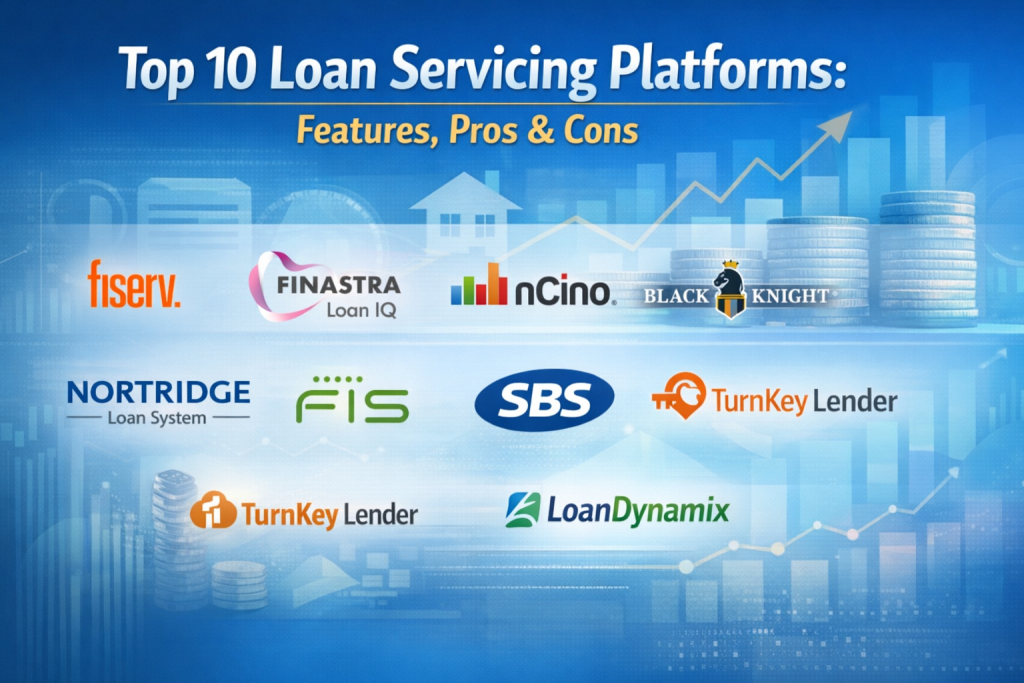
Top 10 Loan Servicing Platforms Tools
1 — Fiserv Loan Servicing
Short description:
A comprehensive, enterprise-grade loan servicing solution used by large banks and credit unions to manage high-volume, regulated loan portfolios.
Key features
- End-to-end loan lifecycle servicing
- Automated payment processing and interest calculations
- Escrow, tax, and insurance management
- Advanced compliance and regulatory reporting
- Multi-loan product support (consumer, mortgage, commercial)
- High-volume transaction processing
Pros
- Proven reliability at enterprise scale
- Strong regulatory and compliance coverage
- Deep integration with core banking systems
Cons
- High implementation and licensing costs
- Long deployment timelines
- Less flexible for smaller teams
Security & compliance: SOC 2-aligned controls, encryption, audit trails, regulatory reporting
Support & community: Enterprise onboarding, dedicated account teams, strong documentation
2 — Finastra Loan IQ
Short description:
A global-standard loan servicing platform focused on complex commercial, syndicated, and corporate loans.
Key features
- Syndicated and bilateral loan servicing
- Complex interest and fee structures
- Multi-currency and multi-entity support
- Lifecycle event automation
- Strong accounting and reconciliation
- Global regulatory readiness
Pros
- Industry leader for complex loans
- Highly configurable for large institutions
- Strong international support
Cons
- Steep learning curve
- Expensive for non-enterprise users
- Overkill for simple consumer lending
Security & compliance: Enterprise-grade security, audit logs, regional compliance frameworks
Support & community: Professional services-led support, extensive training resources
3 — nCino Loan Servicing
Short description:
A cloud-native loan servicing solution built for modern banks and credit unions seeking digital transformation.
Key features
- Cloud-based servicing workflows
- Real-time loan data visibility
- Integrated borrower management
- Automation across servicing tasks
- Scalable architecture
- Strong analytics and reporting
Pros
- Modern UI and user experience
- Faster implementation than legacy systems
- Strong ecosystem integrations
Cons
- Premium pricing
- Limited customization for niche products
- Dependent on cloud strategy alignment
Security & compliance: Encryption, role-based access, compliance-ready architecture
Support & community: Strong onboarding, active customer community, enterprise support
4 — Black Knight Loan Servicing
Short description:
A market-leading mortgage-focused loan servicing platform trusted by large residential lenders.
Key features
- Mortgage payment and escrow management
- Delinquency and loss mitigation tools
- Compliance monitoring and reporting
- Borrower communications and portals
- High-volume servicing automation
Pros
- Deep mortgage domain expertise
- Highly trusted by large lenders
- Strong regulatory tooling
Cons
- Mortgage-centric focus
- Less suitable for non-mortgage loans
- High cost structure
Security & compliance: SOC-aligned controls, audit trails, data encryption
Support & community: Dedicated mortgage servicing support teams
5 — LoanPro
Short description:
A flexible API-first loan servicing platform designed for fintechs and modern digital lenders.
Key features
- API-driven servicing architecture
- Customizable repayment schedules
- Real-time transaction processing
- Support for diverse loan products
- Developer-friendly integrations
- Automated compliance workflows
Pros
- Highly flexible and configurable
- Ideal for fintech innovation
- Fast deployment
Cons
- Requires technical expertise
- Less out-of-the-box reporting
- Smaller enterprise footprint
Security & compliance: Encryption, audit logs, configurable compliance controls
Support & community: Strong technical documentation, responsive support
6 — Nortridge Loan System
Short description:
A mature, configurable loan servicing platform supporting consumer, commercial, and specialty lenders.
Key features
- Multi-loan product servicing
- Custom rules and calculations
- Built-in collections and servicing workflows
- Accounting and reporting modules
- Deployment flexibility
Pros
- Highly configurable without heavy coding
- Broad loan type support
- Strong mid-market fit
Cons
- Dated user interface
- Longer setup process
- Limited modern UX features
Security & compliance: Standard encryption, audit trails, role-based access
Support & community: Established documentation, phone and email support
7 — FIS Loan Servicing
Short description:
An enterprise loan servicing solution integrated into broader core banking ecosystems.
Key features
- Full lifecycle servicing automation
- Core banking integration
- Advanced accounting and reconciliation
- High availability and scalability
- Regulatory reporting
Pros
- Enterprise reliability
- Strong financial controls
- Global scalability
Cons
- Expensive licensing
- Long implementation cycles
- Less agile customization
Security & compliance: SOC-aligned security, encryption, compliance reporting
Support & community: Enterprise-grade support, professional services
8 — SBS Loan Servicing
Short description:
A modular loan servicing platform designed for banks and lenders seeking flexibility and compliance.
Key features
- Modular servicing components
- Multi-product loan support
- Regulatory compliance tools
- Integration-friendly architecture
- Reporting and analytics
Pros
- Modular and scalable
- Strong European compliance strength
- Flexible deployment
Cons
- Complex configuration
- Limited SMB appeal
- UI varies by module
Security & compliance: GDPR-ready, audit trails, encryption
Support & community: Structured onboarding, regional support teams
9 — TurnKey Lender Servicing
Short description:
A digital-first loan servicing platform optimized for fintechs and fast-growing lenders.
Key features
- Automated repayment management
- Borrower self-service portals
- Integrated collections workflows
- Multi-loan product support
- Cloud-based deployment
Pros
- Quick setup
- Strong borrower experience
- Competitive pricing
Cons
- Less suitable for very large enterprises
- Limited complex loan handling
- Reporting depth varies
Security & compliance: Encryption, access controls, compliance configurations
Support & community: Responsive support, guided onboarding
10 — LoanDynamix Servicing
Short description:
A flexible loan servicing platform supporting consumer and commercial lenders with configurable workflows.
Key features
- Loan payment processing
- Interest and fee management
- Servicing workflow automation
- Reporting and dashboards
- Integration APIs
Pros
- Flexible configurations
- Suitable for mid-sized lenders
- Balanced feature set
Cons
- Smaller ecosystem
- Limited global presence
- Customization may require effort
Security & compliance: Standard encryption, audit logs
Support & community: Documentation and customer support available
Comparison Table
| Tool Name | Best For | Platform(s) Supported | Standout Feature | Rating |
|---|---|---|---|---|
| Fiserv Loan Servicing | Large banks | Web / Enterprise | Regulatory depth | N/A |
| Finastra Loan IQ | Corporate & syndicated loans | Web / Enterprise | Complex loan handling | N/A |
| nCino | Digital banks | Cloud | Modern UX | N/A |
| Black Knight | Mortgage lenders | Web | Mortgage expertise | N/A |
| LoanPro | Fintech lenders | Cloud / API | API-first design | N/A |
| Nortridge | Mid-market lenders | Web | Configurability | N/A |
| FIS | Global enterprises | Web / Enterprise | Core banking integration | N/A |
| SBS | Regulated banks | Web | Modular compliance | N/A |
| TurnKey Lender | SMB fintechs | Cloud | Fast deployment | N/A |
| LoanDynamix | Mid-sized lenders | Web | Balanced features | N/A |
Evaluation & Scoring of Loan Servicing Platforms
| Criteria | Weight | Evaluation Notes |
|---|---|---|
| Core features | 25% | Breadth of servicing, automation depth |
| Ease of use | 15% | UI clarity, learning curve |
| Integrations & ecosystem | 15% | APIs, core system compatibility |
| Security & compliance | 10% | Auditability, regulatory readiness |
| Performance & reliability | 10% | Scalability, uptime |
| Support & community | 10% | Onboarding, documentation |
| Price / value | 15% | ROI vs total cost |
Which Loan Servicing Platforms Tool Is Right for You?
- Solo users / SMBs: Look for cloud-based, fast-deploy platforms with intuitive UI and predictable pricing.
- Mid-market lenders: Prioritize configurability, reporting depth, and integration flexibility.
- Enterprises: Focus on compliance, scalability, auditability, and vendor stability.
- Budget-conscious teams: Avoid over-engineered enterprise tools.
- Premium solutions: Choose platforms with strong automation and compliance coverage.
- Feature depth vs ease: Complex loans need depth; consumer lending values usability.
- Security requirements: Heavily regulated lenders should prioritize audit logs and compliance controls.
Frequently Asked Questions (FAQs)
- What is a Loan Servicing Platform?
It manages loans after disbursement, including payments, interest, compliance, and borrower communications. - How is it different from loan origination software?
Origination handles application and approval; servicing manages the loan lifecycle post-disbursement. - Do small lenders need loan servicing software?
Yes, if loan volumes grow or compliance requirements increase. - Can one platform service multiple loan types?
Many platforms support consumer, mortgage, and commercial loans, but depth varies. - How long does implementation take?
From weeks for cloud tools to months for enterprise platforms. - Are these platforms compliant with regulations?
Most provide compliance tools, but responsibility remains with the lender. - Is cloud-based servicing secure?
Yes, when supported by encryption, access controls, and audits. - Do platforms support borrower portals?
Most modern tools include borrower self-service capabilities. - What is the biggest mistake buyers make?
Choosing based on features alone without considering scale and complexity. - Can platforms integrate with accounting systems?
Yes, integration support is common but varies in depth.
Conclusion
Loan Servicing Platforms are no longer optional—they are mission-critical systems for lenders aiming to scale efficiently, remain compliant, and deliver a strong borrower experience. The right platform reduces operational risk, automates complexity, and supports sustainable growth.
There is no single “best” Loan Servicing Platform for everyone. The ideal choice depends on loan complexity, organizational size, regulatory exposure, technical maturity, and budget. By aligning platform capabilities with real operational needs, lenders can confidently select a solution that delivers long-term value rather than short-term convenience.

Find Trusted Cardiac Hospitals
Compare heart hospitals by city and services — all in one place.
Explore Hospitals
Loan servicing platforms need to handle changes in repayment terms without losing the original loan history. For example, when a borrower receives a revised payment schedule, the system should update future dues while keeping previous transactions and outstanding balances accurate. I would pay attention to payment allocation rules, interest recalculation, and reconciliation between bank transactions and borrower accounts. These details help prevent balance errors and make loan records easier to audit.
Loan servicing platforms help financial institutions manage repayment schedules, borrower accounts, payment processing, and loan documentation. Features like automated payment tracking, interest calculations, delinquency management, customer communication, and compliance reporting can improve operational efficiency. Lenders should also evaluate data security, system integration, scalability, and reporting accuracy before selecting a suitable platform.
Loan servicing platforms should make it easier for lenders to manage payments, customer records, and loan accounts throughout the loan period. One important factor is how well the system handles payment tracking, overdue reminders, and interest calculations. Teams should also check whether it supports accurate statements and smooth integration with accounting systems. Clear payment histories can help reduce confusion for both lenders and borrowers. I believe automation and accurate record management are essential when choosing a loan servicing platform.
Loan servicing platforms help financial institutions manage payments, customer accounts, repayment schedules, and loan-related communications throughout the lending lifecycle. When comparing solutions, I would prioritize payment processing automation, accurate account tracking, regulatory compliance features, and integration with existing financial systems. Flexible reporting and automated reminders can also help reduce manual work and improve the borrower experience. Choosing the right platform can streamline servicing operations while supporting more consistent and transparent loan management.
Loan servicing platforms are judged in the edge cases: partial payments, deferments, modifications and escrow changes. I’d test how flexibly the system handles them and how clear the audit trail is. Borrower self-service portals reduce call volume. Regulatory disclosures and reporting need ongoing updates, so check how the vendor keeps up. Reliable payment processing and reconciliation matter most.
While legacy mainstays like Fiserv LoanServ and ICE MSP still dominate high-volume mortgage and enterprise banking portfolios, their reliance on batch file transfers often creates data latency that slows down real-time customer support and reconciliation. Modern API-first platforms like LoanPro and Mambu offer a massive operational advantage by providing instant webhook event triggers and flexible ledger configurations that seamlessly connect into automated payment rails and fintech CRMs. For growing lenders, the real architectural priority should be ensuring the servicing platform can ingest daily multi-channel payments and dynamically calculate interest or fees in real time without requiring manual end-of-day batch interventions.
When assessing loan servicing platforms, I would examine how effectively they handle payments received through different channels, especially when a borrower makes several partial payments within the same billing cycle. The system should apply each payment according to the agreed allocation rules for principal, interest, fees, and overdue amounts. It should also identify duplicate transactions, failed payment reversals, and payments that cannot immediately be matched to an account. A clear transaction-level history is essential for resolving disputes and reconciling financial records. These capabilities help servicing teams maintain accurate outstanding balances and prevent small payment-processing errors from creating larger problems in borrower accounts.
Loan servicing platforms help financial institutions manage the complete loan lifecycle, from account setup and payment processing to collections and customer support. Features such as automated payment scheduling, interest calculations, repayment tracking, delinquency management, borrower portals, and regulatory reporting can simplify complex servicing operations. When comparing platforms, lenders should consider loan type flexibility, automation capabilities, integration with core banking systems, data security, and scalability. The right solution can reduce administrative overhead, improve repayment visibility, strengthen borrower communication, and support more accurate and efficient loan management.
Loan servicing platforms help financial institutions manage repayment schedules, process payments, track account activity, and handle borrower requests. When comparing solutions, I would focus on payment processing, automated reminders, compliance support, reporting, and integration with existing financial systems. These features can reduce administrative work and improve the borrower experience. The right platform should ensure accurate account management, simplify routine servicing tasks, and support secure, efficient loan operations.
Loan servicing systems need careful validation when teams correct transactions or update past account details. A change to an installment date can affect interest totals, penalty charges, customer statements, and financial reports. I would test how the platform handles missed payments, reversed transfers, partial settlements, and duplicate payment notifications. Every adjustment should preserve the original record and show who made the change and why. Finance teams also need reliable reconciliation reports to spot differences between servicing records and bank transactions. It is useful to check whether historical balances can be rebuilt during audits or customer complaints. Recovery procedures should prevent incomplete batch jobs from leaving accounts in an inconsistent state. These checks can uncover serious issues before the platform handles live customer accounts.
Loan servicing platforms help lenders manage repayments, payment schedules, customer records, and account updates more efficiently. Automating routine tasks can reduce manual errors and make it easier to keep loan information accurate. Features like payment tracking, delinquency alerts, and clear reporting are valuable for both lenders and borrowers. A dependable platform can simplify daily operations and provide customers with a smoother loan repayment experience.
Loan servicing platforms need to make payment tracking clear and reliable throughout the loan lifecycle. Automated reminders can reduce missed payments, but accurate account records and clear payment histories matter just as much. I would compare how each platform handles interest calculations, repayment schedules, overdue accounts, and customer requests. Integration with accounting and payment systems can also reduce manual work. Another important factor is audit history, especially when teams need to explain a balance or correct an error. A useful platform should improve efficiency while keeping customer information secure and making every transaction easy to trace.
Loan servicing platforms help financial institutions manage repayment schedules, payment processing, account updates, and borrower communications throughout the loan lifecycle. Automated reminders and accurate transaction tracking can reduce administrative errors while improving transparency for customers. Strong reporting capabilities and integration with accounting and compliance systems also support timely reconciliation, consistent regulatory oversight, and more efficient handling of changing borrower needs.
Loan servicing migrations need careful validation because even small data discrepancies can affect borrower balances, interest calculations, and future payment schedules. Before switching platforms, teams should reconcile principal balances, accrued interest, payment histories, fees, and outstanding arrears against the existing system. I would also recommend running both systems in parallel for a defined period and comparing their outputs across different loan types and repayment scenarios. Automated checks should flag mismatches before they reach customer statements or accounting reports. A documented rollback plan is equally important if migration results fail validation. These controls can help lenders avoid costly corrections and protect borrower trust during major system transitions.
From an engineering reliability standpoint, asynchronous payment reconciliation and idempotency handling are critical. If your servicing engine lacks transactional outbox patterns and resilient webhook retries against core banking rails, ledger drift during peak batch payment processing creates massive financial audit risks and costly manual rollbacks.
Loan servicing platforms help lenders manage repayment schedules, payment processing, customer accounts, and overdue balances throughout a loan’s lifecycle. When comparing solutions, consider automated payment tracking, interest calculations, compliance reporting, borrower communication, and integration with accounting systems. Strong audit trails and timely payment alerts can reduce processing errors, improve customer service, and help lenders maintain accurate loan records.
Loan servicing platforms should handle changes in repayment schedules accurately while keeping every account record consistent. When comparing tools, check how they process partial payments, payment reversals, and overdue account adjustments without creating reconciliation problems. Clear tracking of borrower communications and account history is also important, as it helps servicing teams resolve disputes and explain how each balance was calculated.
Beyond evaluating features and API flexibility, choosing the right platform often hinges on how seamlessly it handles exception workflows like mid-cycle payment adjustments and escrow variances. For growing lenders, prioritizing a system with robust automation in those areas can prevent significant manual overhead down the line.
Loan servicing platforms need to do more than automate repayments; they should also help lenders maintain accurate account records and communicate clearly with borrowers. Automated reconciliation, timely payment reminders, and early delinquency alerts can reduce manual errors and improve servicing efficiency. Strong audit trails and flexible repayment workflows are equally important for handling exceptions consistently.
Loan servicing platforms help financial institutions manage payment processing, repayment schedules, borrower communication, and account updates throughout the loan lifecycle. Solutions like Mambu offer configurable lending workflows and digital account management capabilities, helping lenders streamline operations, improve borrower experiences, and maintain better visibility into loan portfolios.