
Introduction
Model Serving Platforms are tools that deploy machine learning and AI models as scalable, reliable services for real‑time and batch inference. These platforms abstract away infrastructure complexity, handle load balancing, latency requirements, monitoring, versioning, scaling, and operational concerns, enabling teams to serve models into applications, APIs, and workflows.
As organizations build intelligent products and services, model serving becomes a crucial layer of the AI stack. Real‑world use cases include real‑time recommendation APIs, fraud detection services, personalized content generation, customer support automation, predictive maintenance, and AI‑driven user insights. Serving platforms make it possible to handle large volumes of inference traffic while ensuring high availability, performance, governance, and observability.
Buyers evaluating platforms should consider latency and throughput, batch vs real‑time capabilities, model versioning, scalability, ease of deployment, observability and metrics, security, CI/CD integration, hybrid/multi‑cloud support, and cost management.
Best for: ML engineers, AI platform teams, CTOs, data science teams in mid‑market and enterprise environments deploying models into production
Not ideal for: teams only conducting offline batch scoring with no deployment needs or minimal inference demands
What’s Changed in Model Serving Platforms
- Standardized APIs and interfaces for serving diverse model types
- Support for multi‑modal inference workloads
- Auto‑scaling of serving endpoints based on demand
- Streamlined CI/CD integration for model deployments
- Built‑in A/B testing and canary releases
- Observability dashboards with latency, throughput, and error metrics
- Integration with feature stores and monitoring systems
- Security guardrails including encryption, authentication, authorization
- Support for serverless serving and microservices
- Cost optimization tools for dynamic resource allocation
- Batch and real‑time serving in unified pipelines
- Support for open‑source and proprietary model stacks
Quick Buyer Checklist
- Real‑time inference support
- Batch scoring capabilities
- Auto‑scaling and load balancing
- Model versioning
- Observability and monitoring
- Security: authentication, authorization, encryption
- CI/CD and deployment automation
- Support for open‑source and custom models
- Multi‑cloud and hybrid deployment
- Cost and latency optimization
- Guardrails for runtime safety
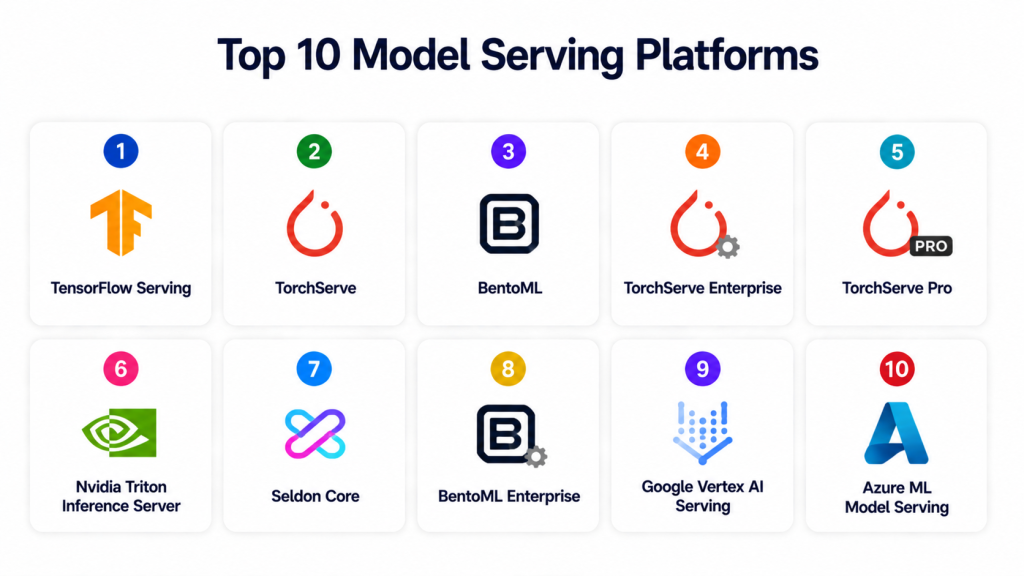
Top 10 Model Serving Platforms
1 — TensorFlow Serving
One‑line verdict: Best for TensorFlow model deployments with high performance and low overhead.
Short description: TensorFlow Serving is a high‑performance serving system designed to serve TensorFlow models with support for model versioning and efficient inference.
Standout Capabilities
- Optimized for TensorFlow models
- Model versioning and rollbacks
- High‑performance serving
- gRPC and REST APIs
- Efficient resource utilization
AI‑Specific Depth
- Model support: TensorFlow native, limited non‑TensorFlow
- RAG / knowledge integration: N/A
- Evaluation: Benchmarking and load testing
- Guardrails: Basic API rate limits
- Observability: Metrics via Prometheus, logs
Pros
- High performance for TensorFlow
- Simple setup
- Widely supported
Cons
- Limited non‑TensorFlow support
- Needs orchestration for multi‑model serving
- No built‑in UI
Security & Compliance
- Supports encryption/TLS
- Certifications: N/A
Deployment & Platforms
- Linux containers
- Cloud / On‑prem
Integrations & Ecosystem
- Prometheus
- Kubernetes
- CI/CD pipelines
Pricing Model
Open‑source
Best‑Fit Scenarios
- TensorFlow production workflows
- High‑performance serving clusters
- Lightweight serving infrastructure
2 — TorchServe
One‑line verdict: Ideal for serving PyTorch models with extensibility and multi‑model support.
Short description: TorchServe provides model serving for PyTorch with modular architecture and support for custom handlers.
Standout Capabilities
- PyTorch native support
- Custom handler support
- Multi‑model serving
- Metrics and logging
- REST and gRPC interfaces
AI‑Specific Depth
- Model support: PyTorch
- RAG / knowledge integration: N/A
- Evaluation: Performance benchmarking
- Guardrails: Custom routing and limits
- Observability: Logging and metrics
Pros
- PyTorch native
- Custom behavior handlers
- Scales with cluster
Cons
- Limited non‑PyTorch support
- Manual scaling required
- Lacks enterprise UI
Security & Compliance
- TLS support
- Certifications: N/A
Deployment & Platforms
- Cloud / On‑prem
Integrations & Ecosystem
- Kubernetes
- Monitoring tools
- CI/CD
Pricing Model
Open‑source
Best‑Fit Scenarios
- PyTorch model production
- Custom inference logic
- Scalable microservices
3 — BentoML
One‑line verdict: Best for framework‑agnostic model serving with strong packaging and deployment workflows.
Short description: BentoML is a model serving toolkit that packages models from diverse frameworks and deploys them as microservices with observability and CI/CD integration.
Standout Capabilities
- Framework‑agnostic model packaging
- Deployment to cloud, containers, serverless
- Built‑in metrics and logs
- REST and gRPC endpoints
- Model versioning
AI‑Specific Depth
- Model support: Multi‑framework (TensorFlow, PyTorch, Scikit‑Learn, etc.)
- RAG / knowledge integration: Custom connectors
- Evaluation: Load testing and canary
- Guardrails: API gateway integration
- Observability: Metrics dashboards
Pros
- Flexible deployment targets
- Simple packaging
- Good documentation
Cons
- Some features need orchestration layers
- Basic governance features
- Requires additional cost tools for monitoring
Security & Compliance
- TLS, authentication support
- Certifications: N/A
Deployment & Platforms
- Cloud, containers, serverless
Integrations & Ecosystem
- Kubernetes
- CI/CD pipelines
- Monitoring tools
Pricing Model
Open‑source + enterprise offerings
Best‑Fit Scenarios
- Framework‑diverse teams
- Microservice serving
- Cloud and serverless deployments
4 — TorchServe Enterprise
One‑line verdict: Enterprise‑ready serving with governance and management tooling.
Short description: TorchServe Enterprise extends open‑source TorchServe with governance, monitoring, security, and scaling features for enterprise usage.
Standout Capabilities
- Multi‑tenant serving
- Security and access control
- Scaling and auto‑balancing
- Monitoring and dashboards
- Enterprise support
AI‑Specific Depth
- Model support: PyTorch
- RAG / knowledge integration: Enterprise connectors
- Evaluation: Health and performance tests
- Guardrails: RBAC and policy controls
- Observability: Dashboards
Pros
- Enterprise support
- Governance and security
- Easy scaling
Cons
- Higher cost
- PyTorch focus
- Enterprise onboarding requires expertise
Security & Compliance
- SSO, role access
- Certifications: Varies
Deployment & Platforms
- Cloud / Hybrid
Integrations & Ecosystem
- CI/CD
- Monitoring systems
- Business systems
Pricing Model
Enterprise subscription
Best‑Fit Scenarios
- Large production teams
- Security and governance required
- Enterprise scale
5 — TorchServe Pro
One‑line verdict: Strong choice for managed PyTorch serving with advanced metrics.
Short description: TorchServe Pro builds on open‑source with metrics, logging, and deployment automation for teams serving PyTorch at scale.
Standout Capabilities
- Enhanced observability
- Automated scaling
- Model lifecycle management
- Logging and metrics
- API gateway integration
AI‑Specific Depth
- Model support: PyTorch
- RAG / knowledge integration: N/A
- Evaluation: Benchmarks and live tests
- Guardrails: Policy controls
- Observability: Dashboards
Pros
- Better metrics than open‑source
- Easy scaling
- Integrated logging
Cons
- PyTorch focus
- Pricing
- Less flexible than framework‑agnostic
Security & Compliance
- Encryption and access controls
- Certifications: Varies
Deployment & Platforms
- Cloud / Hybrid
Integrations & Ecosystem
- Monitoring systems
- CI/CD
- Logging tools
Pricing Model
Subscription
Best‑Fit Scenarios
- Teams with PyTorch workload
- Performance monitoring
- Managed scaling
6 — Nvidia Triton Inference Server
One‑line verdict: Excellent for high‑performance, multi‑model GPU serving.
Short description: Triton Inference Server provides optimized serving for deep learning and machine learning models on GPU and CPU with multi‑framework support.
Standout Capabilities
- Multi‑framework support
- GPU‑optimized serving
- Dynamic batching
- Metrics and logging
- Model versioning
AI‑Specific Depth
- Model support: TensorFlow, PyTorch, ONNX, XGBoost, etc.
- RAG / knowledge integration: N/A
- Evaluation: Load and performance tests
- Guardrails: API limits
- Observability: Prometheus metrics
Pros
- High throughput on GPU
- Multi‑framework
- Scalable
Cons
- GPU cost
- Complex configs
- Requires infrastructure knowledge
Security & Compliance
- TLS support
- Certifications: N/A
Deployment & Platforms
- Cloud / On‑prem
Integrations & Ecosystem
- GPUs, Kubernetes
- Monitoring systems
- CI/CD
Pricing Model
Open‑source
Best‑Fit Scenarios
- GPU‑intensive serving
- Multi‑framework stacks
- High‑volume inference
7 — Seldon Core
One‑line verdict: Great for Kubernetes‑native multi‑model serving with extensibility.
Short description: Seldon Core enables serving of many model types on Kubernetes with built‑in scaling, metrics, and monitoring.
Standout Capabilities
- Kubernetes‑native serving
- Multi‑model support
- Scaling and autoscaling
- Metrics and dashboards
- Canaries and A/B testing
AI‑Specific Depth
- Model support: Multi‑framework
- RAG / knowledge integration: Connectors
- Evaluation: Canary testing
- Guardrails: Policy control via Kubernetes
- Observability: Dashboards
Pros
- Flexible for many models
- Scales with Kubernetes
- Strong ecosystem
Cons
- Requires Kubernetes skills
- Setup complexity
- Monitoring setup needed
Security & Compliance
- RBAC, TLS
- Certifications: N/A
Deployment & Platforms
- Kubernetes
Integrations & Ecosystem
- Prometheus
- Grafana
- CI/CD
Pricing Model
Open‑source
Best‑Fit Scenarios
- Kubernetes infrastructures
- Multi‑model stacks
- Scalable deployments
8 — BentoML Enterprise
One‑line verdict: Best enterprise option for framework‑agnostic serving with governance.
Short description: BentoML Enterprise extends open‑source BentoML with governance, security, monitoring, and enterprise support.
Standout Capabilities
- Model governance
- Access controls
- Scalability
- Monitoring and metrics
- Deployment automation
AI‑Specific Depth
- Model support: Multi‑framework
- RAG / knowledge integration: Connectors
- Evaluation: Policy and performance tests
- Guardrails: Role‑based access
- Observability: Dashboards
Pros
- Enterprise features
- Framework flexibility
- Governance and security
Cons
- Enterprise cost
- Setup complexity
- Requires support
Security & Compliance
- RBAC, encryption, audit trails
- Certifications: Varies
Deployment & Platforms
- Cloud / Hybrid
Integrations & Ecosystem
- CI/CD
- Monitoring platforms
- Logging tools
Pricing Model
Enterprise subscription
Best‑Fit Scenarios
- Enterprise governance
- Multi‑framework teams
- Secure deployments
9 — Google Vertex AI Serving
One‑line verdict: Best for managed serving with auto‑scaling and cloud integration.
Short description: Vertex AI Serving provides model serving with auto‑scaling, monitoring, security, and integration with cloud services.
Standout Capabilities
- Auto‑scaling
- Managed monitoring
- Latency and throughput metrics
- Versioning
- Security controls
AI‑Specific Depth
- Model support: Hosted + BYO
- RAG / knowledge integration: Cloud data sources
- Evaluation: Performance tests
- Guardrails: Policy enforcement
- Observability: Cloud dashboards
Pros
- Managed service
- Auto‑scaling
- Easy integration
Cons
- Cloud lock‑in
- Cost
- Less flexibility than self‑hosted
Security & Compliance
- Cloud security suite
- Certifications: Cloud provider
Deployment & Platforms
- Cloud
Integrations & Ecosystem
- Cloud data sources
- CI/CD
- Monitoring tools
Pricing Model
Usage‑based
Best‑Fit Scenarios
- Managed deployments
- Cloud‑centric teams
- Auto‑scaling needs
10 — Azure ML Model Serving
One‑line verdict: Strong choice for enterprise cloud serving with integrated security and monitoring.
Short description: Azure ML serving provides scalable, secure model serving with cloud monitoring, CI/CD integration, and enterprise governance.
Standout Capabilities
- Managed endpoints
- Security and compliance
- Monitoring and logging
- Auto‑scaling
- Integration with cloud services
AI‑Specific Depth
- Model support: BYO + hosted
- RAG / knowledge integration: Cloud datasets
- Evaluation: Latency and load testing
- Guardrails: Security and access control
- Observability: Dashboards
Pros
- Managed service
- Enterprise security
- Easy deployment
Cons
- Cloud lock‑in
- Cost at scale
- Less portable
Security & Compliance
- Enterprise controls
- Certifications: Cloud provider
Deployment & Platforms
- Cloud
Integrations & Ecosystem
- Cloud services
- CI/CD
- Monitoring
Pricing Model
Usage‑based
Best‑Fit Scenarios
- Enterprise cloud deployments
- Compliance needs
- Auto‑scaling and monitoring
Comparison Table
| Tool | Best For | Deployment | Model Flexibility | Strength | Watch‑Out | Public Rating |
|---|---|---|---|---|---|---|
| TensorFlow Serving | TF models | Cloud / On‑prem | TensorFlow | Performance | Framework limit | N/A |
| TorchServe | PyTorch apps | Cloud / On‑prem | PyTorch | Custom handlers | Limited frameworks | N/A |
| BentoML | Framework‑agnostic serving | Cloud / Serverless | Multi‑framework | Flexible deployment | Needs orchestration | N/A |
| TorchServe Enterprise | Enterprise PyTorch | Cloud / Hybrid | PyTorch | Governance | Cost | N/A |
| TorchServe Pro | Managed PyTorch | Cloud / Hybrid | PyTorch | Metrics | Less flexible | N/A |
| Triton | GPU serving | Cloud / On‑prem | Multi‑framework | GPU optimized | Complex | N/A |
| Seldon Core | Kubernetes serving | Kubernetes | Multi‑framework | Scalability | Requires K8s | N/A |
| BentoML Enterprise | Enterprise multi | Cloud / Hybrid | Multi‑framework | Governance | Cost | N/A |
| Vertex AI Serving | Managed cloud | Cloud | Hosted + BYO | Auto‑scaling | Cloud lock‑in | N/A |
| Azure ML Serving | Enterprise cloud | Cloud | Hosted + BYO | Security | Cloud lock‑in | N/A |
Scoring & Evaluation
| Tool | Core | Reliability | Guardrails | Integrations | Ease | Perf/Cost | Security/Admin | Support | Total |
|---|---|---|---|---|---|---|---|---|---|
| TensorFlow Serving | 9 | 8 | 7 | 7 | 7 | 8 | 7 | 7 | 7.6 |
| TorchServe | 8 | 7 | 7 | 7 | 8 | 7 | 7 | 7 | 7.3 |
| BentoML | 9 | 8 | 8 | 8 | 7 | 8 | 7 | 7 | 7.8 |
| TorchServe Enterprise | 9 | 9 | 9 | 8 | 7 | 8 | 8 | 8 | 8.2 |
| TorchServe Pro | 8 | 8 | 8 | 8 | 7 | 8 | 8 | 7 | 7.8 |
| Triton | 9 | 9 | 8 | 8 | 7 | 9 | 7 | 7 | 8.0 |
| Seldon Core | 9 | 8 | 8 | 8 | 7 | 8 | 8 | 7 | 7.9 |
| BentoML Enterprise | 9 | 9 | 9 | 9 | 7 | 8 | 9 | 8 | 8.4 |
| Vertex AI Serving | 9 | 9 | 9 | 9 | 8 | 8 | 9 | 8 | 8.5 |
| Azure ML Serving | 9 | 9 | 9 | 9 | 8 | 8 | 9 | 8 | 8.5 |
Top 3 for Enterprise: Vertex AI Serving, Azure ML Serving, BentoML Enterprise
Top 3 for SMB: TensorFlow Serving, TorchServe, Seldon Core
Top 3 for Developers: BentoML, Triton, TorchServe Pro
Which Model Serving Platform Is Right for You
Solo / Freelancer
Use TensorFlow Serving or TorchServe for quick production setups.
SMB
BentoML or Seldon Core balance features and cost.
Mid‑Market
Triton or TorchServe Pro provide scalable performance.
Enterprise
Vertex AI Serving, Azure ML Serving, or BentoML Enterprise offer full managed services and governance.
Regulated Industries
Enterprise cloud offerings provide compliance controls out of the box.
Budget vs Premium
Open‑source tools for budget teams; managed services for premium support.
Build vs Buy
Open‑source and DIY tools give flexibility; enterprise services reduce ops burden.
Implementation Playbook
30 Days: Pilot key models, test performance and scale.
60 Days: Harden security, integrate monitoring, automate deployment.
90 Days: Scale to multiple services, establish governance, optimize cost.
Common Mistakes & How to Avoid Them
- Deploying without monitoring
- No version control for models
- Ignoring latency requirements
- Not planning auto‑scaling
- Poor cost visibility
- Weak security controls
- No CI/CD integration
- Skipping drift detection
- Missing guardrails
- Lack of rollback strategies
- Siloed deployments
- Ignoring multi‑cloud needs
- Poor observability
- No performance benchmarking
FAQs
1. What is a Model Serving Platform?
It is a system that deploys models as scalable APIs with monitoring, versioning, and routing.
2. Do these platforms support real‑time inference?
Yes, most support both real‑time and batch serving.
3. Can I use open‑source models?
Yes, many platforms support BYO open‑source models.
4. How is security handled?
Through encryption, authentication, authorization, and access controls.
5. Do they integrate with CI/CD?
Yes, integration with CI/CD enables automated deployments.
6. What is auto‑scaling?
Adjusting resource allocation based on demand automatically.
7. Can I monitor latency and errors?
Most platforms provide monitoring dashboards and logs.
8. What deployment options exist?
Cloud, on‑prem, hybrid, and serverless are supported depending on platform.
9. Are GPU‑based deployments supported?
Yes, platforms like Triton optimize GPU serving.
10. Do these tools support canary releases?
Some platforms support canary testing and A/B deployment.
11. What is model versioning?
Tracking and managing multiple versions of the same model.
12. How do I control cost?
Through cost dashboards, token usage tracking, and auto‑scaling.
Conclusion
Model Serving Platforms enable reliable, scalable, secure delivery of AI and ML models into production systems. Enterprises benefit from managed services like Vertex AI Serving and Azure ML Serving, while developers and smaller teams can use BentoML, TensorFlow Serving, TorchServe, and Seldon Core. Evaluate latency, cost control, governance, and observability when choosing a platform. Early pilots, integrated monitoring, and automated deployment pipelines ensure robust and scalable model serving.

Find Trusted Cardiac Hospitals
Compare heart hospitals by city and services — all in one place.
Explore Hospitals
Excellent comparison of model serving platforms with clear features and practical insights.
Very useful for AI and MLOps teams managing scalable model deployment workflows.