
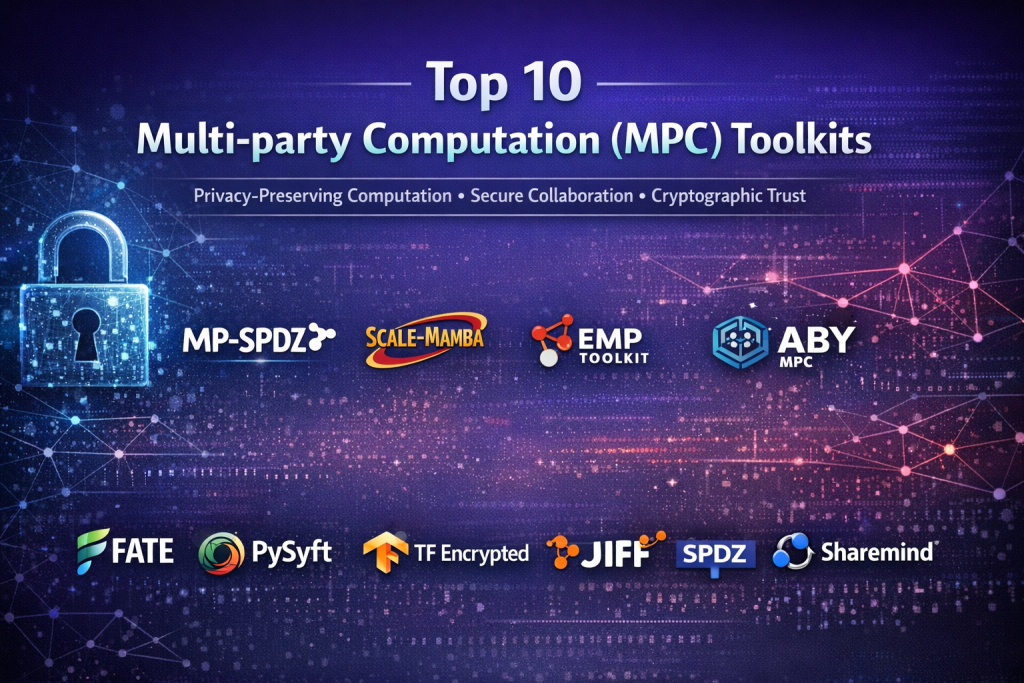
Introduction
Multi-party Computation (MPC) toolkits enable multiple parties to jointly compute results over their private data without revealing that data to one another. In a world where data collaboration is essential but privacy regulations are tightening, MPC has emerged as a foundational privacy-preserving technology alongside homomorphic encryption and secure enclaves.
MPC is important because it allows organizations to unlock insights from sensitive data—financial records, healthcare data, user behavior, or cryptographic keys—without creating a single point of exposure. This capability is increasingly critical in regulated industries, cross-company analytics, decentralized finance, and secure AI training.
Real-world use cases include:
- Secure key management in crypto custody
- Privacy-preserving data analytics across organizations
- Confidential machine learning training and inference
- Fraud detection without sharing raw customer data
- Joint risk modeling in finance and insurance
When choosing an MPC toolkit, users should evaluate cryptographic robustness, performance, ease of integration, supported protocols, scalability, and security guarantees. The maturity of documentation, community adoption, and enterprise readiness are equally important.
Best for:
Cryptography engineers, blockchain developers, security teams, fintech firms, healthcare analytics teams, AI researchers, and enterprises handling highly sensitive data.
Not ideal for:
Teams without cryptographic expertise, low-risk applications where traditional encryption is sufficient, or use cases requiring real-time latency at massive scale without optimization.
Top 10 Multi-party Computation (MPC) Toolkits Tools
1 — MP-SPDZ
Short description:
A research-grade MPC framework supporting a wide range of secure computation protocols, widely used in academia and advanced industry research.
Key features
- Supports arithmetic and boolean MPC
- Multiple protocols (SPDZ, MASCOT, semi-honest, malicious)
- High performance for complex computations
- Python-like high-level language
- Flexible backend compilation
- Active and passive security models
Pros
- Extremely powerful and flexible
- Strong academic validation
Cons
- Steep learning curve
- Limited enterprise tooling
Security & compliance: Cryptographically strong MPC; compliance varies by deployment
Support & community: Strong academic community, limited commercial support
2 — SCALE-MAMBA
Short description:
An MPC framework focused on malicious security and scalable performance, often used for high-assurance secure computations.
Key features
- Actively secure MPC protocols
- Optimized preprocessing
- Strong adversarial resistance
- Designed for large computations
- Flexible deployment models
Pros
- High security guarantees
- Efficient at scale
Cons
- Complex setup
- Less beginner-friendly
Security & compliance: Strong cryptographic guarantees; compliance varies
Support & community: Research-oriented documentation and community
3 — EMP Toolkit
Short description:
A collection of MPC libraries optimized for two-party and multi-party computation, emphasizing performance.
Key features
- Multiple MPC primitives
- Highly optimized C++ implementation
- Support for boolean and arithmetic circuits
- Benchmark-friendly design
- Modular components
Pros
- Excellent performance
- Well-structured libraries
Cons
- Low-level development required
- Smaller enterprise ecosystem
Security & compliance: Protocol-level security; compliance depends on usage
Support & community: Active academic contributors
4 — ABY
Short description:
A specialized MPC framework optimized for two-party secure computation with mixed protocols.
Key features
- Arithmetic, boolean, and Yao sharing
- Efficient protocol switching
- Optimized for low latency
- Open research-driven design
- Strong benchmarking results
Pros
- Very efficient for 2PC
- Well-studied cryptography
Cons
- Limited to two parties
- Not enterprise-ready out of the box
Security & compliance: Cryptographic security; compliance varies
Support & community: Academic support and documentation
5 — FATE
Short description:
A federated learning platform with MPC components, designed for privacy-preserving machine learning.
Key features
- MPC-based secure aggregation
- Federated learning workflows
- Large-scale ML support
- Modular architecture
- Strong industry adoption
Pros
- Ideal for privacy-preserving ML
- Production-oriented
Cons
- Heavy infrastructure
- Less general-purpose MPC
Security & compliance: GDPR-aligned design; enterprise controls vary
Support & community: Active open-source and enterprise adoption
6 — PySyft
Short description:
A Python-centric framework enabling MPC and federated learning for data science teams.
Key features
- Python-friendly APIs
- MPC and federated learning
- Secure data sharing abstractions
- Integration with ML workflows
- Rapid prototyping support
Pros
- Easy for data scientists
- Strong educational resources
Cons
- Performance overhead
- Still evolving maturity
Security & compliance: Privacy-focused design; compliance varies
Support & community: Active community and learning materials
7 — TF Encrypted
Short description:
An MPC-based extension to TensorFlow enabling secure machine learning computation.
Key features
- MPC-backed TensorFlow graphs
- Secure inference and training
- Familiar ML development model
- Research-grade cryptography
- Protocol abstraction layer
Pros
- Natural fit for ML teams
- Strong conceptual model
Cons
- Performance trade-offs
- Limited long-term maintenance
Security & compliance: Cryptographic security; compliance varies
Support & community: Research-driven, limited enterprise support
8 — Jiff
Short description:
A JavaScript-based MPC library focused on web and educational use cases.
Key features
- Browser-compatible MPC
- Easy setup for demos
- Flexible protocol options
- Client-server MPC models
- Teaching-friendly design
Pros
- Accessible and simple
- Great for prototyping
Cons
- Not enterprise-grade
- Performance limitations
Security & compliance: MPC security; compliance N/A
Support & community: Small but active academic community
9 — SPDZ
Short description:
A foundational MPC protocol family that underpins many modern MPC frameworks.
Key features
- Malicious security
- Offline/online computation split
- Proven cryptographic foundations
- Flexible arithmetic computation
- Widely cited protocol
Pros
- Strong theoretical guarantees
- Highly extensible
Cons
- Not a turnkey toolkit
- Requires deep cryptographic expertise
Security & compliance: Strong cryptographic security; compliance varies
Support & community: Academic research community
10 — Sharemind
Short description:
A commercial MPC platform designed for secure data analytics across organizations.
Key features
- Production-ready MPC engine
- Secure data collaboration
- Performance-optimized architecture
- Enterprise deployment models
- Audit-friendly workflows
Pros
- Enterprise-ready
- Strong real-world adoption
Cons
- Commercial licensing
- Less open customization
Security & compliance: Enterprise-grade security; compliance varies by deployment
Support & community: Professional enterprise support
Comparison Table
| Tool Name | Best For | Platform(s) Supported | Standout Feature | Rating |
|---|---|---|---|---|
| MP-SPDZ | Advanced MPC research | Linux | Multi-protocol support | N/A |
| SCALE-MAMBA | High-assurance MPC | Linux | Malicious security | N/A |
| EMP Toolkit | Performance-critical MPC | C++ | Speed optimization | N/A |
| ABY | Two-party computation | C++ | Mixed protocol switching | N/A |
| FATE | Privacy-preserving ML | Distributed | Federated MPC | N/A |
| PySyft | Data science teams | Python | Ease of use | N/A |
| TF Encrypted | Secure ML | TensorFlow | ML-native MPC | N/A |
| Jiff | Web-based MPC | JavaScript | Browser MPC | N/A |
| SPDZ | Cryptography research | Protocol-level | Strong theory | N/A |
| Sharemind | Enterprise analytics | Multi-platform | Production readiness | N/A |
Evaluation & Scoring of Multi-party Computation (MPC) Toolkits
| Tool | Core Features (25%) | Ease of Use (15%) | Integrations (15%) | Security (10%) | Performance (10%) | Support (10%) | Price / Value (15%) | Total |
|---|---|---|---|---|---|---|---|---|
| MP-SPDZ | 23 | 8 | 10 | 9 | 9 | 7 | 12 | 78 |
| SCALE-MAMBA | 22 | 7 | 9 | 10 | 9 | 7 | 11 | 75 |
| EMP Toolkit | 21 | 9 | 9 | 9 | 10 | 7 | 12 | 77 |
| ABY | 18 | 10 | 8 | 8 | 9 | 7 | 13 | 73 |
| FATE | 20 | 12 | 13 | 8 | 8 | 9 | 12 | 82 |
| PySyft | 18 | 14 | 12 | 7 | 7 | 9 | 13 | 80 |
| TF Encrypted | 17 | 11 | 11 | 8 | 7 | 7 | 12 | 73 |
| Jiff | 14 | 13 | 8 | 6 | 6 | 6 | 14 | 67 |
| SPDZ | 19 | 6 | 7 | 10 | 8 | 6 | 11 | 67 |
| Sharemind | 22 | 13 | 14 | 9 | 9 | 10 | 10 | 87 |
Which Multi-party Computation (MPC) Toolkits Tool Is Right for You?
- Solo developers & researchers: MP-SPDZ, EMP Toolkit
- SMBs & ML teams: PySyft, FATE
- Mid-market analytics: FATE, Sharemind
- Enterprises & regulated industries: Sharemind
Budget-conscious: Open-source toolkits with in-house expertise
Premium solutions: Commercial platforms with enterprise support
Feature depth vs ease: Research frameworks offer depth; ML-focused tools offer usability
Security needs: Malicious-secure protocols for high-risk environments
Frequently Asked Questions (FAQs)
1. What problem does MPC solve?
It allows joint computation on private data without revealing the data itself.
2. Is MPC production-ready?
Yes, but mainly for specialized, high-value use cases.
3. Is MPC slower than traditional computation?
Generally yes, but optimization can reduce overhead significantly.
4. Do I need cryptography expertise?
Most toolkits require moderate to advanced cryptographic knowledge.
5. Is MPC compliant with GDPR?
It supports privacy principles but compliance depends on implementation.
6. Can MPC replace encryption?
No, it complements encryption for collaborative computation.
7. Is MPC suitable for AI training?
Yes, especially in federated and privacy-sensitive ML.
8. How many parties can MPC support?
From two parties to dozens, depending on protocol.
9. What are common mistakes?
Ignoring performance trade-offs and underestimating complexity.
10. Are there alternatives to MPC?
Yes—homomorphic encryption, secure enclaves, and data anonymization.
Conclusion
Multi-party Computation toolkits play a critical role in enabling privacy-preserving collaboration across organizations and systems. While the technology is powerful, it is also complex, making careful tool selection essential.
The right MPC toolkit depends on use case complexity, security requirements, performance expectations, and team expertise. There is no universal winner—only the best fit for your specific goals.

Find Trusted Cardiac Hospitals
Compare heart hospitals by city and services — all in one place.
Explore Hospitals
Multi-Party Computation (MPC) toolkits enable multiple parties to perform computations on sensitive data without revealing their private inputs to one another. They are particularly valuable in privacy-preserving analytics, secure financial transactions, collaborative machine learning, and cryptographic key management. When comparing toolkits, important factors include security guarantees, supported protocols, computational overhead, scalability, developer experience, and integration with existing systems. Choosing the right MPC solution requires balancing privacy requirements with performance and implementation complexity, helping organizations collaborate securely while minimizing unnecessary exposure of confidential information.
Multi-party computation toolkits make it possible for organizations to collaborate on sensitive data without revealing each party’s private inputs. When comparing options, I’d look closely at supported protocols, communication overhead, and how well the toolkit handles failures when participants disconnect. Developer documentation and integration with existing systems can also make implementation much smoother. Testing with realistic data sizes and network conditions is essential to understand whether the privacy benefits fit the application’s performance requirements.
Multi-party computation toolkits enable organizations to perform joint computations on sensitive data without requiring participants to reveal their private inputs. Their practical value depends on protocol security, communication overhead, scalability, and compatibility with existing data workflows. Evaluating performance under realistic workloads and maintaining strong key management practices can help teams adopt MPC for privacy-preserving analytics, financial collaboration, and secure data sharing.
Multi-party computation allows several parties to work with sensitive data without revealing their private inputs to one another. This can be useful when organizations need to collaborate but cannot freely share raw information. However, the security benefits must be weighed against implementation effort, communication costs, and performance needs. Teams should check which protocols the toolkit supports and whether it fits their threat model. Clear key management and careful testing are also important. A small proof of concept can help reveal practical limits before a wider rollout. The best choice should provide the needed privacy without making the overall workflow too difficult to maintain.
Another important consideration for MPC deployments is how teams manage cryptographic keys throughout their lifecycle. Organizations need clear procedures for key rotation, participant replacement, and recovery when a key becomes unavailable. They should also test whether a failed participant can rejoin securely without forcing every party to restart the full workflow. Monitoring job duration, communication overhead, and resource usage can help identify bottlenecks as participation grows. Planning these details early makes privacy-preserving computations more practical to operate and support at scale.
When adopting an MPC toolkit, teams should also examine how they manage cryptographic keys throughout their lifecycle. Key creation, secure storage, rotation, and revocation need clear ownership and repeatable procedures. A lost or exposed key can disrupt trust even when the computation protocol works as expected. It is useful to test recovery procedures and define how participants respond when a key must be replaced. Teams should also document which parties can approve sensitive configuration changes. Planning these controls early makes the system easier to audit and safer to operate as more participants join.
For real-world MPC deployments, interoperability between independently managed participants deserves careful attention. Each organization may use different infrastructure, software versions, network policies, and operational procedures, which can cause protocol sessions to fail even when the underlying cryptography is sound. Teams should test version compatibility, message timeouts, participant disconnections, and recovery behavior before handling sensitive workloads. It is also important to establish a shared process for updating protocol parameters and investigating failed computations without exposing private inputs through logs or diagnostics. These operational checks can help organizations avoid fragile integrations and make cross-company privacy-preserving workflows more dependable as the number of participants grows.
Multi-party computation (MPC) toolkits allow multiple parties to perform joint computations without revealing their private inputs to one another. When comparing solutions, teams should assess cryptographic security, protocol efficiency, communication overhead, and compatibility with their programming environment. Thorough testing under realistic workloads and careful key management can help ensure both strong privacy and reliable performance.
Enabling distributed cryptographic calculations directly over encrypted inputs allows multi-party computation toolkits to facilitate cross-organization data analysis, collaborative fraud modeling, and confidential machine learning without ever exposing raw proprietary data or private keys to participating entities.
Multi-Party Computation (MPC) toolkits help organizations perform joint computations while keeping each participant’s sensitive data private. When comparing options, I would focus on security guarantees, performance, protocol support, and integration flexibility. These features can help teams collaborate on data analysis without directly sharing confidential information. The right toolkit should balance strong privacy protection with practical performance and implementation needs.
One critical factor when deploying MPC in production is how the system behaves when one participant becomes unavailable during a computation. Network interruptions, delayed responses, or a participant restarting midway can leave a distributed job incomplete and waste significant computing resources. Before selecting a toolkit, I would test its recovery behavior, timeout handling, and ability to resume or safely restart interrupted sessions. Teams should also define how participants authenticate each other, rotate cryptographic keys, and verify protocol compatibility before exchanging sensitive data. Measuring communication overhead under realistic network conditions is essential because network delays can dominate computation time. These checks help determine whether an MPC solution can support dependable cross-organization workflows beyond controlled laboratory environments.
Multi-party computation toolkits are valuable when organizations need to collaborate on sensitive data without exposing their private inputs to one another. When comparing solutions, I would look closely at the supported protocols, communication overhead, security assumptions, and ease of integration with existing systems. Performance testing under realistic network conditions is especially important because secure computation can become expensive as the number of participants grows. Clear documentation and independent security reviews can also help teams assess implementation risks. How do organizations balance strong privacy guarantees with the performance requirements of real-world MPC applications?
Evaluating MPC frameworks really highlights the delicate balance between high-assurance security and developer usability. While research-grade toolkits like MP-SPDZ offer incredible flexibility across protocols, bridging that gap for production environments remains a major hurdle for engineering teams. Often, the biggest bottleneck isn’t just the cryptographic overhead, but managing the communication rounds and network latency at scale. Finding a toolkit that streamlines protocol selection without sacrificing malicious security guarantees is key to wider enterprise adoption.
Multi-party computation toolkits are useful when organizations need to work with sensitive data without revealing each participant’s private inputs. A key comparison point is how a toolkit handles a participant dropping out or sending invalid data during a computation, since these failures can interrupt the entire workflow. Testing security guarantees alongside communication overhead and recovery behavior helps teams judge whether an MPC solution is practical for real-world workloads, not just small demonstrations.
A helpful comparison for teams exploring Multi-Party Computation (MPC) toolkits and privacy-preserving data security. MPC allows multiple parties to perform joint computations without revealing their private inputs, making it useful for secure data sharing and collaborative analytics. One project worth exploring is MP-SPDZ, an open-source framework that supports different MPC protocols and provides a flexible environment for researchers and developers working on secure computation.