
Introduction
Nonconformance Management Tools are specialized software solutions designed to identify, document, track, analyze, and resolve nonconformances—situations where processes, products, or services fail to meet defined standards, regulations, or internal requirements. These tools are a critical part of modern quality management systems (QMS), especially in regulated and process-driven industries.
In real-world operations, nonconformances can arise from manufacturing defects, audit findings, customer complaints, safety incidents, supplier issues, or process deviations. Without a structured system, organizations risk repeated errors, compliance failures, financial loss, and reputational damage. Nonconformance Management Tools provide a centralized, auditable, and data-driven way to move from issue detection to root cause analysis and corrective action.
When choosing a nonconformance management tool, buyers should evaluate:
- Depth of nonconformance tracking and workflows
- Root cause analysis and corrective/preventive action (CAPA) integration
- Ease of use for frontline teams
- Reporting, analytics, and audit readiness
- Integration with existing QMS, ERP, or MES systems
- Security, compliance, and scalability
Best for:
Quality managers, compliance officers, operations leaders, manufacturing teams, healthcare administrators, auditors, and regulated organizations ranging from small manufacturers to global enterprises in industries such as manufacturing, healthcare, life sciences, automotive, aerospace, food & beverage, and energy.
Not ideal for:
Very small teams with minimal compliance needs, early-stage startups without formal quality systems, or organizations that only need basic issue tracking rather than structured nonconformance and compliance workflows.
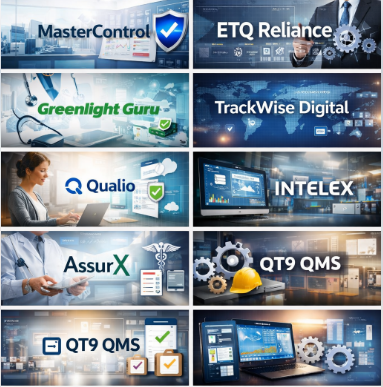
Top 10 Nonconformance Management Tools
1 — MasterControl
Short description:
A leading enterprise-grade quality management platform designed for highly regulated industries with complex nonconformance and compliance requirements.
Key features:
- End-to-end nonconformance tracking and workflows
- Integrated CAPA and root cause analysis
- Audit management and regulatory reporting
- Advanced analytics and dashboards
- Electronic signatures and approval controls
- Strong document control integration
Pros:
- Extremely robust compliance capabilities
- Trusted by regulated global enterprises
Cons:
- High cost compared to mid-market tools
- Steeper learning curve for new users
Security & compliance:
Strong enterprise security, encryption, audit logs, ISO-aligned workflows, GDPR support.
Support & community:
Enterprise onboarding, dedicated account management, professional training resources.
2 — ETQ Reliance
Short description:
A flexible, configurable quality management system with powerful nonconformance and issue management capabilities.
Key features:
- Configurable nonconformance workflows
- CAPA and complaint handling
- Risk-based quality management
- Real-time reporting and dashboards
- Supplier quality integration
- Workflow automation
Pros:
- Highly customizable without heavy coding
- Scales well across industries
Cons:
- Customization can require expert setup
- UI can feel complex for casual users
Security & compliance:
SSO, role-based access, audit trails, ISO and GDPR-ready.
Support & community:
Strong documentation, implementation partners, enterprise support.
3 — Greenlight Guru
Short description:
A quality management platform purpose-built for medical device companies and regulated healthcare manufacturing.
Key features:
- Nonconformance and deviation tracking
- CAPA and risk management integration
- Design control alignment
- Audit-ready reporting
- Guided compliance workflows
Pros:
- Excellent fit for medical device regulations
- User-friendly compared to heavy enterprise QMS
Cons:
- Narrow industry focus
- Less suitable for non-healthcare sectors
Security & compliance:
HIPAA-aware design, ISO-aligned workflows, audit logs.
Support & community:
High-quality onboarding, strong educational resources, responsive support.
4 — TrackWise Digital
Short description:
An enterprise digital quality platform designed to manage nonconformances at global scale.
Key features:
- Centralized nonconformance management
- CAPA, audit, and complaint handling
- Configurable workflows
- Advanced analytics and reporting
- Integration with enterprise systems
Pros:
- Designed for large, complex organizations
- Strong global compliance support
Cons:
- Implementation can be time-consuming
- Premium pricing tier
Security & compliance:
Enterprise-grade security, validation support, GDPR readiness.
Support & community:
Dedicated enterprise support, professional services, extensive documentation.
5 — Qualio
Short description:
A modern, cloud-based quality management system focused on simplicity and speed for growing regulated teams.
Key features:
- Nonconformance and deviation tracking
- CAPA workflows
- Document control integration
- Simple audit readiness tools
- Clean, intuitive UI
Pros:
- Fast onboarding and ease of use
- Ideal for scaling teams
Cons:
- Less customization than large enterprise tools
- Limited advanced analytics
Security & compliance:
Encryption, role-based access, audit trails, GDPR support.
Support & community:
Strong onboarding, helpful support team, growing user community.
6 — Intelex Quality Management
Short description:
A configurable quality and EHS platform with strong nonconformance and incident management capabilities.
Key features:
- Nonconformance and incident tracking
- CAPA and root cause analysis
- Configurable forms and workflows
- Real-time dashboards
- Mobile-friendly reporting
Pros:
- Flexible across industries
- Strong analytics capabilities
Cons:
- Configuration requires planning
- Interface may feel busy
Security & compliance:
SSO, encryption, audit trails, ISO-aligned workflows.
Support & community:
Enterprise support, training resources, implementation consultants.
7 — AssurX
Short description:
A modular quality management solution built for highly regulated manufacturing and life sciences environments.
Key features:
- Nonconformance and deviation management
- Integrated CAPA
- Audit and supplier quality modules
- Validation-ready workflows
- Compliance reporting
Pros:
- Strong compliance depth
- Modular design for tailored deployments
Cons:
- UI feels dated
- Requires structured implementation
Security & compliance:
Validation support, audit trails, encryption, regulatory alignment.
Support & community:
Dedicated enterprise support and professional services.
8 — QT9 QMS
Short description:
An all-in-one QMS solution offering practical nonconformance management for manufacturing-focused organizations.
Key features:
- Nonconformance tracking
- CAPA management
- Supplier quality tools
- Real-time dashboards
- Training and document control
Pros:
- Good value for money
- Strong manufacturing focus
Cons:
- Limited customization
- UI is functional but not modern
Security & compliance:
Role-based access, audit trails, ISO-aligned features.
Support & community:
Responsive customer support, helpful onboarding materials.
9 — MangoApps QMS
Short description:
A collaborative quality management platform combining nonconformance tracking with team communication.
Key features:
- Nonconformance and issue tracking
- Collaborative workflows
- Task and document management
- Reporting dashboards
- Cloud-based access
Pros:
- Strong collaboration features
- Easy adoption for teams
Cons:
- Less depth for highly regulated industries
- Limited advanced compliance tooling
Security & compliance:
Encryption, access controls, GDPR-ready.
Support & community:
Good documentation, responsive support, smaller community.
10 — SafetyCulture
Short description:
A mobile-first operations and quality platform emphasizing inspections and issue resolution.
Key features:
- Nonconformance detection via inspections
- Issue tracking and corrective actions
- Mobile reporting
- Real-time analytics
- Templates and automation
Pros:
- Extremely easy to use
- Strong frontline adoption
Cons:
- Less formal nonconformance workflows
- Limited enterprise compliance depth
Security & compliance:
Encryption, role-based access, audit logs.
Support & community:
Extensive knowledge base, large user community, responsive support.
Comparison Table
| Tool Name | Best For | Platform(s) Supported | Standout Feature | Rating |
|---|---|---|---|---|
| MasterControl | Regulated enterprises | Web, Cloud | Regulatory depth | N/A |
| ETQ Reliance | Configurable QMS needs | Web, Cloud | Workflow flexibility | N/A |
| Greenlight Guru | Medical devices | Web, Cloud | Industry specialization | N/A |
| TrackWise Digital | Global enterprises | Web, Cloud | Scalability | N/A |
| Qualio | Growing regulated teams | Web, Cloud | Ease of use | N/A |
| Intelex | Quality & EHS | Web, Cloud | Analytics | N/A |
| AssurX | Life sciences | Web | Compliance focus | N/A |
| QT9 QMS | Manufacturing SMBs | Web, Cloud | Value for money | N/A |
| MangoApps QMS | Collaborative teams | Web, Cloud | Collaboration | N/A |
| SafetyCulture | Frontline operations | Web, Mobile | Mobile-first design | N/A |
Evaluation & Scoring of Nonconformance Management Tools
| Tool | Core Features (25%) | Ease of Use (15%) | Integrations (15%) | Security (10%) | Performance (10%) | Support (10%) | Price/Value (15%) | Overall |
|---|---|---|---|---|---|---|---|---|
| MasterControl | 24 | 10 | 14 | 10 | 9 | 9 | 8 | 84 |
| ETQ Reliance | 23 | 11 | 14 | 9 | 9 | 9 | 9 | 84 |
| Greenlight Guru | 22 | 13 | 12 | 9 | 9 | 9 | 10 | 84 |
| TrackWise Digital | 24 | 10 | 14 | 10 | 9 | 8 | 7 | 82 |
| Qualio | 20 | 14 | 11 | 8 | 8 | 9 | 11 | 81 |
Which Nonconformance Management Tool Is Right for You?
- Solo users or very small teams: Lightweight tools or inspection-driven platforms
- SMBs: QT9 QMS, Qualio, SafetyCulture
- Mid-market: ETQ Reliance, Intelex
- Enterprise: MasterControl, TrackWise Digital, AssurX
Budget-conscious: Focus on ease of use and bundled features
Premium buyers: Prioritize compliance depth and scalability
Feature depth vs ease: Heavy regulation favors depth; fast-growing teams favor usability
Integrations: Essential if tied to ERP, MES, or supplier systems
Security & compliance: Mandatory for regulated industries
Frequently Asked Questions (FAQs)
1. What is a nonconformance?
A nonconformance is any failure to meet defined standards, procedures, or regulations.
2. How do nonconformance tools differ from basic issue trackers?
They include compliance workflows, audit trails, and CAPA integration.
3. Are these tools only for manufacturing?
No, they are used in healthcare, energy, aerospace, and services.
4. Do small companies need nonconformance tools?
Only if compliance, audits, or quality risks are present.
5. How long does implementation take?
From weeks for simple tools to months for enterprise platforms.
6. Are these tools cloud-based?
Most modern tools are cloud-based.
7. Do they support audits?
Yes, audit readiness is a core benefit.
8. Is training required?
Yes, especially for enterprise-grade platforms.
9. Can they integrate with CAPA systems?
Most include built-in CAPA or integrations.
10. What is the biggest mistake buyers make?
Overbuying complexity or underestimating compliance needs.
Conclusion
Nonconformance Management Tools play a vital role in protecting quality, ensuring compliance, and driving continuous improvement. The right tool helps organizations move beyond reactive fixes toward structured, preventive quality management.
There is no single “best” solution for everyone. The ideal choice depends on industry regulations, organization size, process maturity, budget, and integration needs. By aligning tool capabilities with real operational requirements, organizations can turn nonconformance management from a compliance burden into a strategic advantage.

Find Trusted Cardiac Hospitals
Compare heart hospitals by city and services — all in one place.
Explore Hospitals
Nonconformance management tools help organizations identify, document, and resolve quality issues across business operations. Features like corrective and preventive action (CAPA) tracking, root cause analysis, audit management, automated workflows, and compliance reporting can improve quality control. Businesses should also evaluate customization, traceability, integration capabilities, and reporting flexibility when selecting the right platform.
Nonconformance management works best when teams focus on fixing root causes rather than closing individual reports. Linking corrective actions with clear ownership, deadlines, and verification steps helps prevent recurring issues. Tracking trends over time also helps organizations improve quality and maintain consistent standards.
One thing organizations should focus on when selecting a nonconformance management tool is how well it helps teams find the actual cause of repeated issues. Simply recording defects is not enough if the same problems keep happening. Teams should look for clear root cause tracking, CAPA follow-ups, and easy reporting. It is also important to make the reporting process simple for frontline workers so they can record issues without delays. Linking quality records with supplier and production data can make investigations more useful and help prevent future problems.
Nonconformance management tools help organizations identify, document, and resolve deviations from established quality standards and procedures. When comparing platforms, I would focus on root cause analysis, corrective and preventive action tracking, audit trails, workflow automation, and reporting capabilities. Integration with quality management systems can make it easier to track recurring issues and monitor corrective actions through completion. The right solution can improve accountability, reduce repeat problems, and support continuous quality improvement.
Nonconformance tools are valuable when they connect issues to root cause and corrective action instead of just recording them. Trend analysis by supplier, line or defect type helps prioritize. I’d check how containment actions are tracked and whether effectiveness checks are enforced before closure. Simple reporting for operators encourages early detection.
The primary operational tension across nonconformance platforms is between heavy, audit-first QMS suites (like MasterControl, ETQ Reliance, or TrackWise) and agile, shop-floor-first capture tools. While enterprise platforms provide ironclad 21 CFR Part 11 electronic signatures and regulatory-ready CAPA integration, their bureaucratic workflows often discourage line workers from logging minor deviations in real time. Conversely, lightweight or mobile-first solutions drive higher reporting compliance on the manufacturing floor, but they frequently require custom integration to prevent data silos when material disposition or scrap requires immediate hold signals in ERP and MES systems. Quality engineering teams evaluating these platforms should prioritize seamless automated containment—such as instantly freezing suspect inventory lots across the supply chain—over post-incident reporting depth alone.
One aspect I would consider when selecting nonconformance management software is how effectively it identifies recurring problems across different production lines, departments, or locations. A single defect may appear minor, but similar issues occurring repeatedly can indicate a larger process weakness. The tool should allow teams to connect related nonconformance records, examine trends, and distinguish isolated incidents from systemic issues. It should also support root cause analysis with supporting evidence rather than simply recording a corrective action and marking the case as closed. This helps quality teams determine whether an improvement has actually reduced recurrence and whether the same corrective measure should be applied elsewhere in the organization.
Nonconformance management tools help organizations identify, document, investigate, and resolve deviations from established quality standards and procedures. Features such as automated issue tracking, root cause analysis, corrective and preventive action (CAPA) workflows, audit trails, risk assessment, and compliance reporting make quality management more structured and transparent. When comparing platforms, businesses should evaluate workflow customization, integration with existing quality management systems, reporting capabilities, regulatory support, and scalability. The right solution can reduce recurring quality issues, improve accountability, strengthen compliance, and support continuous improvement across business operations.
Nonconformance management tools help businesses identify quality issues, document problems, and track corrective actions until they are resolved. Keeping records organized makes it easier to find recurring issues and prevent the same mistakes from happening again. Features like root cause analysis, audit trails, and corrective action tracking are valuable for maintaining quality standards. A practical tool can help teams improve processes, reduce waste, and support continuous improvement.
Nonconformance management tools help organizations identify quality issues, document deviations, and track corrective actions across business processes. When comparing solutions, I would focus on issue tracking, root cause analysis, corrective action workflows, audit trails, and reporting capabilities. These features can improve accountability, prevent recurring problems, and support consistent quality standards. The right tool should simplify issue resolution, strengthen compliance, and help teams maintain continuous quality improvement.
Nonconformance tools should make it easy to manage cases that involve several departments or external suppliers. A quality issue may require input from production, procurement, engineering, and compliance before anyone can approve a final resolution. The system should show pending tasks, blocked approvals, and overdue responses without forcing teams to chase updates through email. It is also important to preserve evidence when responsibility moves between people or departments. Clear escalation rules can prevent urgent defects from sitting unnoticed in a queue. Reviewing delays by team and case type can help managers remove process bottlenecks and resolve quality issues more consistently.
Nonconformance management tools help teams record when a product, process, or service fails to meet a requirement. Recording the issue is only the first step; teams must also find its cause and prevent it from happening again. I would compare corrective action tracking, root-cause analysis, audit trails, and links with quality systems. Clear ownership and due dates help keep follow-up work moving. It is also useful to track repeated issues across sites or teams. A good tool should turn quality problems into lessons that support safer, more consistent work.
Nonconformance management tools help organizations document quality deviations, investigate root causes, and track corrective actions until issues are resolved. Standardized workflows and automated notifications improve accountability while reducing the risk of recurring failures. Integrating these systems with audits, quality management, and supplier records also strengthens traceability, supports regulatory compliance, and encourages continuous improvement across operational processes.
Closing a nonconformance record does not necessarily mean the underlying problem has been solved. Quality teams need a way to verify whether corrective actions produce lasting improvements under normal operating conditions. For example, a supplier may correct a defective batch, but the same issue could return in later deliveries. Tracking repeat incidents by product, supplier, production line, and root cause can reveal patterns that individual case reports miss. I would also look for workflows that require measurable acceptance criteria and evidence before an action is marked effective. Reviewing defect rates over a defined period after closure helps teams distinguish completed paperwork from genuine quality improvement. This makes the system more useful for preventing recurring failures and guiding future process changes.
Nonconformance tools create operational drag when isolated from engineering pipelines. SRE teams must automatically pipe automated test suite regressions and production canary failures directly into CAPA workflows, preventing defective code artifacts from bypassing formal audits.
Nonconformance management tools help organizations record quality issues, investigate root causes, and track corrective actions until teams resolve them. When comparing platforms, businesses should evaluate workflow automation, audit trails, reporting, and integration with quality management systems. Tracking recurring issues and verifying whether corrective actions work can reduce repeat failures, improve product consistency, and support continuous improvement.
Nonconformance management tools are more valuable when they help teams identify why a quality issue occurred, not just record the defect. Comparing how each platform assigns corrective actions, tracks root-cause investigations, and verifies whether fixes actually worked can make a real difference. I would also look for links between recurring issues and specific suppliers, production batches, or processes, as these patterns can help prevent the same problem from returning.
Effective nonconformance management depends on finding the root cause of recurring defects rather than simply closing individual cases. Linking corrective actions to verified outcomes, supplier records, and audit findings helps teams prevent repeat issues and improve product quality.
Nonconformance management tools help organizations document quality issues, investigate root causes, assign corrective actions, and prevent recurring problems. Platforms like ETQ Reliance provide nonconformance tracking, CAPA workflows, audit management, and quality reporting, helping teams improve traceability, standardize corrective processes, and maintain stronger quality control across operations.