
Introduction
OTA (Over-The-Air) Model Update Platforms for Edge AI enable organizations to remotely deliver, manage, validate, and maintain machine learning models running on edge devices. These platforms help businesses update AI models without manually accessing every deployed device, making large-scale edge AI operations more efficient and manageable.
Unlike traditional software updates, AI model updates require additional lifecycle controls. Organizations need to track model versions, test performance, manage deployment stages, monitor accuracy, and quickly roll back unsuccessful updates. OTA model management platforms provide the operational foundation required to maintain reliable AI systems after deployment.
With the growth of edge AI adoption, companies are deploying intelligent models across industrial equipment, robotics, autonomous systems, smart cameras, healthcare devices, vehicles, and IoT products. These environments require secure update mechanisms, device management, low-latency operations, and strong governance.
Common use cases include:
- Industrial AI systems and smart manufacturing
- Autonomous vehicles and robotics
- Edge-based computer vision applications
- Healthcare and medical AI devices
- IoT products with embedded intelligence
- Smart monitoring and security systems
When evaluating OTA Model Update Platforms for Edge AI, organizations should consider model versioning, secure deployment, device fleet management, rollback capabilities, AI evaluation workflows, observability, hardware compatibility, scalability, privacy controls, deployment flexibility, and integration with existing MLOps pipelines.
Best for: AI engineering teams, IoT companies, robotics organizations, automotive businesses, industrial enterprises, healthcare technology providers, and companies managing large fleets of AI-powered edge devices.
Not ideal for: Organizations running only cloud-based AI applications, small projects with very few devices, or teams where AI models rarely require updates after deployment.
What’s Changed in OTA Model Update Platforms for Edge AI in 2026+
OTA model management for Edge AI is evolving as organizations move from experimental AI deployments toward production-scale intelligent systems.
Key trends include:
- Automated AI lifecycle management: Companies are connecting model development, testing, approval, deployment, monitoring, and updating into continuous workflows.
- Secure AI model delivery: Security is becoming a primary requirement because AI models are now valuable operational assets. Organizations need controlled delivery pipelines to prevent unauthorized changes.
- Edge AI observability: Modern teams require visibility into model accuracy, device health, inference performance, latency, resource consumption, and deployment status.
- Automated rollback capabilities: Production AI systems need the ability to quickly revert to previous model versions when performance issues appear.
- Model evaluation before deployment: Enterprises are adopting testing frameworks to validate AI models before pushing updates to thousands of devices.
- Hybrid cloud-edge architectures: Many organizations are combining centralized cloud management with local AI processing on edge devices.
- Smaller and optimized AI models: Edge environments increasingly require compressed models that deliver strong performance with limited compute, memory, and power.
- Federated learning workflows: Privacy-focused organizations are exploring distributed learning approaches where devices contribute improvements without sharing sensitive raw data.
- Zero-trust device management: Authentication, authorization, secure communication, and update verification are becoming standard requirements.
- AI governance and compliance tracking: Enterprises need better visibility into who approved updates, which model version is deployed, and how AI behavior changes over time.
Quick Buyer Checklist (Scan-Friendly)
Before selecting an OTA Model Update Platform for Edge AI, evaluate:
- Support for machine learning model deployment
- AI model version management
- Automated OTA update workflows
- Device fleet management capabilities
- Secure model delivery mechanisms
- Rollback and recovery support
- Edge hardware compatibility
- Cloud, self-hosted, or hybrid deployment options
- Support for custom AI models
- Integration with MLOps pipelines
- Model testing and evaluation workflows
- AI performance monitoring
- Device health monitoring
- Data privacy and retention controls
- Encryption and authentication capabilities
- Offline update support
- API and SDK availability
- CI/CD pipeline integration
- Deployment approval workflows
- Auditability and administration controls
- Vendor lock-in risks
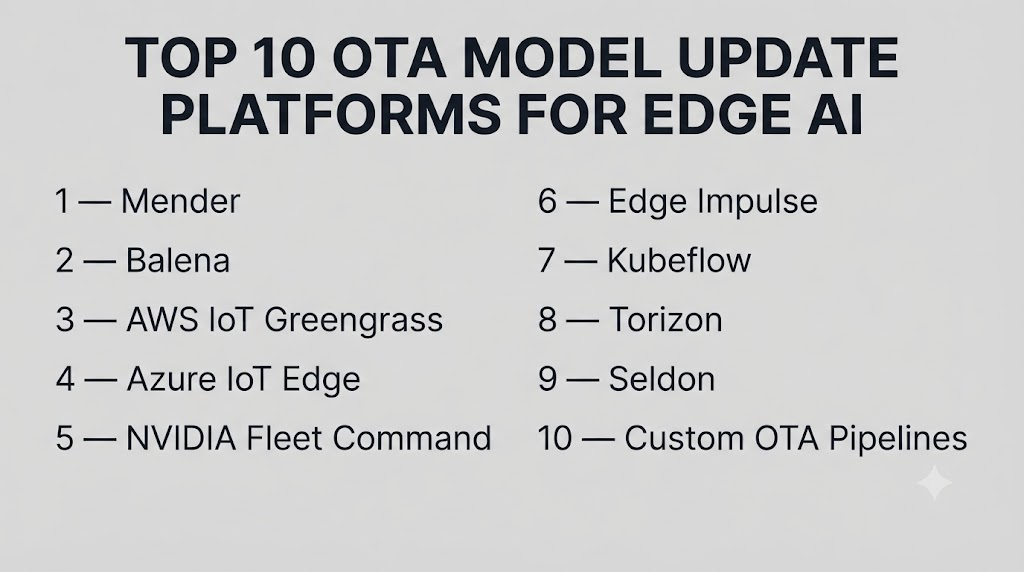
Top 10 OTA Model Update Platforms for Edge AI
#1 — Mender
One-line verdict: Best for embedded product teams requiring secure OTA updates and reliable device lifecycle management.
Short description (2–3 lines):
Mender is an OTA update platform focused on managing software updates for connected embedded devices. It helps organizations remotely deploy updates, control device versions, and recover from failed deployments.
It is commonly used in embedded Linux environments where reliability and secure update workflows are important.
Standout Capabilities
- Secure over-the-air update workflows
- Device fleet management
- Software version control
- Deployment scheduling
- Rollback capabilities
- Embedded Linux support
- Remote device operations
- Update reliability management
AI-Specific Depth (Must Include)
- Model support: AI model deployment depends on the application architecture and integration approach.
- RAG / knowledge integration: N/A
- Evaluation: Requires external AI testing and validation workflows before deployment.
- Guardrails: Provides update security mechanisms; AI-specific safety controls depend on implementation.
- Observability: Device-level monitoring is supported; AI model performance monitoring depends on additional integrations.
Pros
- Strong focus on secure OTA deployment.
- Suitable for embedded AI products.
- Reliable rollback and recovery workflows.
Cons
- More focused on device updates than complete AI lifecycle management.
- Requires embedded engineering expertise.
- Additional tools may be required for AI evaluation and monitoring.
Security & Compliance
Security features depend on deployment configuration. Specific certifications are not publicly stated.
Deployment & Platforms
- Platforms: Embedded Linux devices and connected hardware environments.
- Deployment: Cloud and self-hosted options vary.
Integrations & Ecosystem
Mender integrates with embedded development workflows and device management environments.
Common integrations include:
- Embedded Linux systems
- IoT platforms
- CI/CD pipelines
- Device management tools
- Development environments
Pricing Model
Not publicly stated.
Best-Fit Scenarios
- Embedded AI products
- Industrial edge devices
- Connected hardware fleets
#2 — Balena
One-line verdict: Best for developers managing application deployments across distributed edge device fleets.
Short description (2–3 lines):
Balena provides infrastructure for deploying and managing applications on connected edge devices. It simplifies remote updates through container-based workflows and centralized device management.
It is commonly used by developers building IoT and edge computing products.
Standout Capabilities
- Remote application deployment
- Device fleet management
- Container-based workflows
- Hardware flexibility
- Remote monitoring
- Developer-friendly deployment processes
- Edge application lifecycle management
AI-Specific Depth (Must Include)
- Model support: AI model support depends on deployed applications and connected ML frameworks.
- RAG / knowledge integration: N/A
- Evaluation: Requires external AI evaluation pipelines.
- Guardrails: Depends on application-level implementation.
- Observability: Provides device monitoring capabilities; AI monitoring depends on integrations.
Pros
- Easy deployment workflow for edge developers.
- Supports flexible hardware environments.
- Simplifies remote device management.
Cons
- Not specifically designed for complete AI model lifecycle management.
- Enterprise governance features may require additional solutions.
- Requires technical knowledge for advanced deployments.
Security & Compliance
Not publicly stated.
Deployment & Platforms
- Platforms: Linux-based edge devices.
- Deployment: Cloud-managed edge environments.
Integrations & Ecosystem
Balena supports:
- Container-based applications
- IoT devices
- Edge hardware
- Development tools
- APIs
Pricing Model
Not publicly stated.
Best-Fit Scenarios
- IoT startups
- Edge AI developers
- Small and medium device fleets
#3 — AWS IoT Greengrass
One-line verdict: Best for organizations building cloud-connected edge AI systems with large device deployments.
Short description (2–3 lines):
AWS IoT Greengrass enables organizations to run applications and machine learning workloads locally on edge devices while maintaining cloud connectivity.
It supports distributed edge deployments where centralized management and local processing are both required.
Standout Capabilities
- Cloud-edge communication
- Local AI execution
- Device management
- Remote deployment workflows
- IoT integration
- Edge application lifecycle management
- Distributed computing support
AI-Specific Depth (Must Include)
- Model support: Supports machine learning deployments through connected cloud and edge workflows.
- RAG / knowledge integration: N/A
- Evaluation: Depends on connected ML testing workflows.
- Guardrails: Security controls depend on implementation and configuration.
- Observability: Monitoring depends on connected cloud services and integrations.
Pros
- Strong cloud-edge ecosystem.
- Suitable for large IoT deployments.
- Supports enterprise-scale device management.
Cons
- Best suited for organizations already using cloud infrastructure.
- Requires cloud engineering expertise.
- Architecture can become complex at scale.
Security & Compliance
Security capabilities depend on configuration. Specific certifications vary by service.
Deployment & Platforms
- Platforms: Supported edge devices vary.
- Deployment: Hybrid cloud-edge.
Integrations & Ecosystem
Supports:
- Cloud services
- IoT systems
- Machine learning pipelines
- Edge applications
- APIs
Pricing Model
Usage-based pricing model.
Best-Fit Scenarios
- Industrial IoT
- Connected products
- Enterprise edge AI deployments
#4 — Azure IoT Edge
One-line verdict: Best for enterprises managing AI-powered edge devices through hybrid cloud infrastructure.
Short description (2–3 lines):
Azure IoT Edge enables organizations to deploy cloud-managed workloads, analytics applications, and machine learning models closer to where data is generated.
It helps enterprises manage distributed edge devices while maintaining centralized control and monitoring.
Standout Capabilities
- Cloud-to-edge application deployment
- Remote device management
- AI workload execution
- Edge module management
- Local data processing
- Hybrid cloud-edge architecture
- Enterprise integration capabilities
- Device monitoring workflows
AI-Specific Depth (Must Include)
- Model support: Supports machine learning deployments through connected Azure AI and ML workflows.
- RAG / knowledge integration: N/A
- Evaluation: Depends on connected AI testing and validation workflows.
- Guardrails: Depends on implementation and connected security services.
- Observability: Supports monitoring through connected cloud monitoring solutions.
Pros
- Strong enterprise cloud integration.
- Suitable for large-scale IoT deployments.
- Supports hybrid AI architectures.
Cons
- Requires Azure ecosystem knowledge.
- Can be complex for smaller teams.
- Costs depend on infrastructure usage.
Security & Compliance
Security capabilities depend on configuration and connected services. Specific certifications vary by service.
Deployment & Platforms
- Platforms: Linux-based edge devices and supported IoT hardware.
- Deployment: Hybrid cloud-edge.
Integrations & Ecosystem
Azure IoT Edge integrates with:
- Cloud services
- Machine learning workflows
- IoT platforms
- Enterprise applications
- Monitoring systems
Pricing Model
Usage-based pricing.
Best-Fit Scenarios
- Enterprise IoT deployments
- Industrial edge AI systems
- Hybrid cloud environments
#5 — NVIDIA Fleet Command
One-line verdict: Best for enterprises operating AI workloads across GPU-powered edge infrastructure.
Short description (2–3 lines):
NVIDIA Fleet Command provides centralized management capabilities for deploying and operating AI applications at the edge.
It is designed for organizations running advanced AI workloads that require optimized infrastructure management.
Standout Capabilities
- AI workload deployment
- Edge infrastructure management
- GPU-enabled AI operations
- Centralized AI application control
- Remote deployment workflows
- Enterprise edge management
- AI infrastructure monitoring
AI-Specific Depth (Must Include)
- Model support: Supports AI applications through NVIDIA ecosystem tools. Specific model compatibility varies.
- RAG / knowledge integration: N/A
- Evaluation: Depends on connected AI validation workflows.
- Guardrails: Security controls depend on deployment configuration.
- Observability: Infrastructure and workload monitoring capabilities vary.
Pros
- Strong support for enterprise AI infrastructure.
- Suitable for high-performance edge AI workloads.
- Supports centralized management.
Cons
- Best suited for NVIDIA-based environments.
- Requires specialized infrastructure expertise.
- May be excessive for smaller deployments.
Security & Compliance
Not publicly stated.
Deployment & Platforms
- Platforms: GPU-powered edge infrastructure.
- Deployment: Cloud-managed edge environments.
Integrations & Ecosystem
Supports:
- AI applications
- GPU infrastructure
- Edge computing systems
- Machine learning workflows
- Enterprise deployments
Pricing Model
Not publicly stated.
Best-Fit Scenarios
- Industrial AI platforms
- Large-scale edge deployments
- Computer vision systems
#6 — Edge Impulse
One-line verdict: Best for developers building optimized machine learning models for resource-constrained edge devices.
Short description (2–3 lines):
Edge Impulse provides an edge machine learning development platform for collecting data, training models, testing performance, and deploying AI applications.
It is commonly used for embedded AI applications where efficiency and hardware optimization are important.
Standout Capabilities
- Edge ML development workflows
- Model optimization
- Sensor data processing
- Embedded deployment
- Data collection pipelines
- Hardware compatibility
- Machine learning experimentation
- Performance testing
AI-Specific Depth (Must Include)
- Model support: Supports edge machine learning workflows with different model development approaches.
- RAG / knowledge integration: N/A
- Evaluation: Provides model testing and validation workflows.
- Guardrails: AI safety controls depend on implementation.
- Observability: Depends on connected monitoring solutions.
Pros
- Designed specifically for edge AI development.
- Supports optimized models for limited hardware.
- Good developer experience.
Cons
- Less focused on enterprise device fleet management.
- Large-scale governance requires additional systems.
- Advanced deployments may require customization.
Security & Compliance
Not publicly stated.
Deployment & Platforms
- Platforms: Embedded devices, sensors, edge hardware.
- Deployment: Cloud-assisted development with edge deployment.
Integrations & Ecosystem
Supports:
- Embedded hardware
- Sensors
- ML frameworks
- Development environments
- Edge applications
Pricing Model
Not publicly stated.
Best-Fit Scenarios
- Embedded AI products
- IoT applications
- Edge ML prototypes
#7 — Kubeflow
One-line verdict: Best for advanced AI teams building custom machine learning lifecycle workflows.
Short description (2–3 lines):
Kubeflow is an open-source machine learning platform built around Kubernetes workflows.
Although it is not a dedicated OTA update platform, it can support edge AI model lifecycle management when combined with deployment systems.
Standout Capabilities
- ML pipeline automation
- Model training workflows
- Model deployment management
- Experiment tracking
- Kubernetes integration
- Custom workflow development
- Open-source flexibility
AI-Specific Depth (Must Include)
- Model support: Supports multiple machine learning frameworks.
- RAG / knowledge integration: Depends on implementation.
- Evaluation: Supports custom AI evaluation pipelines.
- Guardrails: Requires additional implementation.
- Observability: Depends on Kubernetes monitoring tools.
Pros
- Highly customizable.
- Strong MLOps ecosystem.
- Suitable for complex AI workflows.
Cons
- Requires Kubernetes expertise.
- Higher operational complexity.
- Not specifically designed for OTA device updates.
Security & Compliance
Depends on deployment configuration.
Deployment & Platforms
- Platforms: Kubernetes environments.
- Deployment: Self-hosted or cloud Kubernetes.
Integrations & Ecosystem
Supports:
- ML frameworks
- Kubernetes
- CI/CD systems
- Cloud platforms
- Data workflows
Pricing Model
Open-source.
Best-Fit Scenarios
- Enterprise AI teams
- Custom ML infrastructure
- Advanced edge AI workflows
#8 — Torizon
One-line verdict: Best for industrial embedded systems requiring reliable device lifecycle management.
Short description (2–3 lines):
Torizon provides an embedded Linux platform focused on managing software lifecycle operations for connected industrial devices.
It supports remote updates and container-based application deployment.
Standout Capabilities
- Embedded Linux support
- Remote software updates
- Container deployment
- Industrial device management
- Hardware support
- Device lifecycle workflows
- Application management
AI-Specific Depth (Must Include)
- Model support: AI model deployment depends on application architecture.
- RAG / knowledge integration: N/A
- Evaluation: Requires external AI testing workflows.
- Guardrails: Security depends on implementation.
- Observability: Device monitoring varies.
Pros
- Strong industrial focus.
- Suitable for embedded devices.
- Reliable update workflows.
Cons
- Requires embedded development knowledge.
- AI lifecycle features require additional tools.
- Less focused on AI-specific management.
Security & Compliance
Not publicly stated.
Deployment & Platforms
- Platforms: Embedded Linux devices.
- Deployment: Edge environments.
Integrations & Ecosystem
Supports:
- Industrial hardware
- Embedded applications
- Containers
- IoT systems
- Device management workflows
Pricing Model
Not publicly stated.
Best-Fit Scenarios
- Industrial AI devices
- Manufacturing systems
- Embedded products
#9 — Seldon
One-line verdict: Best for organizations requiring ML model monitoring and lifecycle governance.
Short description (2–3 lines):
Seldon provides machine learning deployment and monitoring capabilities for managing models throughout production environments.
It supports organizations that need visibility into model performance and operational behavior.
Standout Capabilities
- Model deployment
- ML monitoring
- Model governance
- Performance tracking
- Enterprise ML workflows
- Kubernetes support
- Lifecycle management
AI-Specific Depth (Must Include)
- Model support: Supports machine learning model deployment workflows.
- RAG / knowledge integration: Depends on connected systems.
- Evaluation: Supports model monitoring and evaluation processes.
- Guardrails: Depends on implementation.
- Observability: Strong focus on model monitoring.
Pros
- Strong MLOps capabilities.
- Useful for AI governance.
- Supports enterprise model operations.
Cons
- Requires ML operations expertise.
- Not a dedicated OTA device platform.
- Edge deployment requires additional architecture.
Security & Compliance
Not publicly stated.
Deployment & Platforms
- Platforms: Cloud-native environments.
- Deployment: Hybrid possible.
Integrations & Ecosystem
Supports:
- Kubernetes
- ML pipelines
- Monitoring tools
- Cloud platforms
- APIs
Pricing Model
Not publicly stated.
Best-Fit Scenarios
- Enterprise AI operations
- Model governance
- Hybrid ML environments
#10 — Custom OTA Pipelines
One-line verdict: Best for engineering teams needing complete control over AI model update workflows.
Short description (2–3 lines):
Custom OTA pipelines use CI/CD automation, version control, testing frameworks, and deployment systems to create tailored AI update workflows.
They are commonly used by organizations with specialized edge AI requirements.
Standout Capabilities
- Fully customizable workflows
- Integration with existing DevOps processes
- Automated testing
- Version management
- Custom deployment logic
- Flexible architecture
- Internal governance control
AI-Specific Depth (Must Include)
- Model support: Depends on selected AI frameworks and infrastructure.
- RAG / knowledge integration: N/A
- Evaluation: Custom evaluation pipelines can be implemented.
- Guardrails: Must be designed and maintained internally.
- Observability: Requires integrated monitoring solutions.
Pros
- Maximum flexibility.
- Avoids dependency on a single OTA vendor.
- Fits specialized AI products.
Cons
- Requires engineering resources.
- Higher maintenance responsibility.
- Security depends on implementation quality.
Security & Compliance
Depends on architecture and internal controls.
Deployment & Platforms
- Platforms: Cloud, edge, and hybrid environments.
- Deployment: Custom.
Integrations & Ecosystem
Supports:
- Source control systems
- CI/CD pipelines
- ML platforms
- Cloud services
- Device management systems
Pricing Model
Varies.
Best-Fit Scenarios
- Advanced engineering teams
- Specialized AI products
- Large custom deployments
Comparison Table
| Tool Name | Best For | Deployment (Cloud/Self-hosted/Hybrid) | Model Flexibility (Hosted / BYO / Multi-model / Open-source) | Strength | Watch-Out | Public Rating |
|---|---|---|---|---|---|---|
| Mender | Embedded OTA model and software updates | Cloud/Self-hosted | BYO model / Custom integration | Secure device updates | Requires embedded expertise | N/A |
| Balena | Edge device fleet management | Cloud-managed | BYO model / Custom applications | Developer-friendly deployments | Limited AI lifecycle management | N/A |
| AWS IoT Greengrass | Cloud-connected edge AI | Hybrid | Hosted ecosystem / BYO integration | Cloud-edge connectivity | AWS dependency | N/A |
| Azure IoT Edge | Enterprise edge AI management | Hybrid | Hosted ecosystem / BYO integration | Enterprise scalability | Azure complexity | N/A |
| NVIDIA Fleet Command | GPU-powered edge AI operations | Cloud-managed | Multi-model ecosystem | AI infrastructure management | Hardware requirements | N/A |
| Edge Impulse | Embedded AI development | Cloud + Edge | Custom models / ML frameworks | Edge optimization | Less fleet governance | N/A |
| Kubeflow | Custom ML lifecycle workflows | Self-hosted | Open-source / BYO models | MLOps flexibility | Operational complexity | N/A |
| Torizon | Industrial embedded devices | Edge | Custom applications | Device lifecycle management | Limited AI-specific tools | N/A |
| Seldon | ML monitoring and governance | Hybrid | Multi-model workflows | Model observability | Not OTA-focused | N/A |
| Custom OTA Pipelines | Engineering-driven deployments | Hybrid | Full flexibility | Complete customization | Higher maintenance effort | N/A |
Scoring & Evaluation (Transparent Rubric)
The scoring below compares OTA Model Update Platforms for Edge AI based on practical deployment requirements. The evaluation considers AI lifecycle support, update reliability, security capabilities, integration options, usability, performance management, and operational scalability.
Scores are comparative and should be adjusted according to specific business requirements, device environments, and AI deployment goals.
| Tool | Core | Reliability/Eval | Guardrails | Integrations | Ease | Perf/Cost | Security/Admin | Support | Weighted Total |
|---|---|---|---|---|---|---|---|---|---|
| Mender | 9 | 8 | 8 | 8 | 8 | 8 | 9 | 8 | 8.3 |
| Balena | 8 | 7 | 7 | 8 | 9 | 8 | 7 | 8 | 7.9 |
| AWS IoT Greengrass | 9 | 8 | 8 | 10 | 7 | 8 | 9 | 9 | 8.6 |
| Azure IoT Edge | 9 | 8 | 8 | 10 | 7 | 8 | 9 | 9 | 8.6 |
| NVIDIA Fleet Command | 9 | 8 | 8 | 9 | 7 | 8 | 8 | 8 | 8.3 |
| Edge Impulse | 8 | 8 | 7 | 8 | 9 | 8 | 7 | 8 | 8.0 |
| Kubeflow | 9 | 9 | 7 | 10 | 5 | 8 | 7 | 9 | 8.1 |
| Torizon | 8 | 7 | 8 | 8 | 7 | 8 | 8 | 8 | 7.8 |
| Seldon | 8 | 9 | 8 | 9 | 7 | 8 | 8 | 8 | 8.2 |
| Custom OTA Pipelines | 9 | 8 | 7 | 10 | 6 | 9 | 7 | 7 | 8.0 |
Top 3 for Enterprise
1. AWS IoT Greengrass
Best suited for enterprises requiring cloud-connected edge management, scalable device operations, and integration with broader cloud infrastructure.
2. Azure IoT Edge
A strong choice for organizations already operating enterprise workloads with hybrid cloud requirements.
3. NVIDIA Fleet Command
Suitable for organizations running advanced AI workloads that require optimized edge infrastructure.
Top 3 for SMB
1. Balena
A practical option for smaller teams needing easier fleet management and remote deployment workflows.
2. Edge Impulse
Useful for organizations developing embedded AI products and optimized machine learning models.
3. Mender
Suitable for companies requiring reliable OTA updates for connected hardware products.
Top 3 for Developers
1. Edge Impulse
Best for developers building optimized AI models for embedded and edge environments.
2. Balena
Good choice for developers managing application deployments across multiple devices.
3. Custom OTA Pipelines
Ideal for engineering teams requiring complete control over deployment workflows.
Which OTA Model Update Platform for Edge AI Is Right for You?
Solo / Freelancer
Individual developers should prioritize simplicity, documentation, flexibility, and low operational complexity.
Recommended options:
- Edge Impulse
- Balena
- Custom OTA Pipelines
Important selection factors:
- Easy device onboarding
- Developer-friendly APIs
- Hardware compatibility
- Simple testing workflows
- Low maintenance requirements
For solo developers, building a highly complex enterprise OTA architecture is usually unnecessary unless the product is expected to scale significantly.
SMB
Small and medium businesses need reliable deployment without creating a large operations team.
Recommended options:
- Mender
- Balena
- Edge Impulse
SMBs should focus on:
- Device fleet visibility
- Secure updates
- Cost control
- Deployment reliability
- Future scalability
A platform that is easy to operate is often more valuable than one with excessive enterprise complexity.
Mid-Market
Growing companies usually require stronger governance, automation, and monitoring.
Recommended options:
- AWS IoT Greengrass
- Azure IoT Edge
- NVIDIA Fleet Command
Important capabilities:
- Automated deployment workflows
- Model version tracking
- Performance monitoring
- Integration with ML pipelines
- Controlled rollout strategies
Mid-market companies should prepare their OTA architecture before device numbers increase significantly.
Enterprise
Large organizations require secure, scalable, and highly controlled AI model management.
Recommended options:
- AWS IoT Greengrass
- Azure IoT Edge
- NVIDIA Fleet Command
Enterprise buyers should prioritize:
- Multi-device management
- Security controls
- Auditability
- Approval workflows
- Deployment monitoring
- Rollback automation
For enterprise AI operations, OTA management becomes a critical part of AI governance.
Regulated Industries (Finance / Healthcare / Public Sector)
Organizations operating in regulated environments should carefully evaluate:
- Data protection
- Device authentication
- Model approval processes
- Audit trails
- Secure update mechanisms
- Human review workflows
Recommended approach:
- Validate models before production deployment.
- Use staged rollouts.
- Maintain complete deployment history.
- Monitor AI behavior after updates.
Budget vs Premium
Budget Approach
Suitable for:
- Startups
- Research teams
- Small device fleets
Consider:
- Open-source tools
- Developer-focused platforms
- Custom pipelines
Advantages:
- Lower initial cost
- Greater flexibility
- More customization
Challenges:
- More internal engineering effort
- Security responsibility remains internal
- Maintenance overhead
Premium Enterprise Approach
Suitable for:
- Industrial deployments
- Large fleets
- Mission-critical systems
Advantages:
- Better governance
- Enterprise support
- Easier scalability
- Stronger operational controls
Challenges:
- Higher investment
- More platform dependency
Build vs Buy (When to DIY)
Build a custom OTA pipeline when:
- Deployment requirements are highly specialized.
- Internal engineering expertise exists.
- Full control over architecture is important.
- Existing DevOps infrastructure can support maintenance.
Choose an established OTA platform when:
- Faster deployment is required.
- Security requirements are high.
- Device fleets are expanding quickly.
- Operational reliability is critical.
A hybrid strategy is often effective, where organizations combine managed OTA platforms with custom AI lifecycle components.
Implementation Playbook (30 / 60 / 90 Days)
First 30 Days: Pilot + Success Metrics
The first phase should focus on understanding requirements and validating the deployment process.
Key activities:
- Identify target edge devices.
- Select initial AI models.
- Define update requirements.
- Choose pilot environments.
- Establish baseline performance metrics.
AI-specific tasks:
- Create model evaluation criteria.
- Define accuracy targets.
- Test model compatibility.
- Document deployment workflows.
Success metrics:
- Update completion rate
- Model performance after deployment
- Rollback success rate
- Device availability
- Deployment time
First 60 Days: Harden Security + Evaluation
The second phase focuses on improving reliability and operational safety.
Key activities:
- Implement secure update workflows.
- Add approval processes.
- Establish monitoring systems.
- Validate failure scenarios.
- Improve access management.
AI-specific tasks:
- Build evaluation pipelines.
- Test model behavior.
- Compare model versions.
- Monitor accuracy changes.
- Create incident response procedures.
Security improvements:
- Device authentication
- Encryption
- Access controls
- Update verification
- Audit tracking
First 90 Days: Optimize Cost, Latency + Governance
The final phase prepares the system for production scale.
Key activities:
- Expand device coverage.
- Optimize update frequency.
- Reduce bandwidth usage.
- Improve deployment automation.
- Establish governance processes.
AI-specific improvements:
- Continuous model evaluation
- Performance monitoring
- Drift detection
- Resource optimization
- Automated reporting
At this stage, organizations should have a complete process for managing AI models from development to edge deployment.
Part 4 will continue with Common Mistakes, 12+ FAQs, Conclusion, and 5 hashtags.
write part 4
Common Mistakes & How to Avoid Them
Deploying AI models to edge devices requires more than simply creating an update pipeline. Many organizations face operational, security, and performance issues because they underestimate the complexity of managing AI models after deployment.
Below are common mistakes organizations should avoid:
- Updating AI models without proper validation Deploying a new model directly to production devices without testing can reduce accuracy or create unexpected behavior. Organizations should validate models through controlled environments before large-scale rollout.
- Ignoring rollback capabilities Every OTA model update process should include recovery options. If a new model performs poorly, teams need a reliable way to return devices to a previous stable version.
- Treating AI models like traditional software AI models change behavior based on data, accuracy, and environment. Organizations should track model versions, evaluation results, and deployment history separately from normal software updates.
- Lack of model version management Without proper version tracking, teams may not know which model is running on specific devices. Clear version management improves troubleshooting and governance.
- Skipping evaluation before deployment AI models should be tested against real-world scenarios before reaching production devices. Evaluation helps identify accuracy issues, performance problems, and unexpected outputs.
- Ignoring edge hardware limitations Edge devices often have limited memory, processing power, and storage. Models that work well in development environments may require optimization before deployment.
- Poor device inventory management Organizations need accurate information about deployed devices, locations, hardware versions, and current model versions.
- No monitoring after deployment A successful update does not guarantee long-term success. Teams should monitor model performance, device health, latency, and failures after deployment.
- Ignoring security of OTA pipelines Unauthorized model updates can create operational and security risks. Secure authentication, update verification, and controlled access are essential.
- Overlooking connectivity challenges Many edge devices operate in environments with unstable or limited connectivity. Update systems should support reliable delivery strategies.
- No staged deployment strategy Sending updates to every device at once increases risk. Organizations should use gradual rollouts, pilot groups, and controlled deployment stages.
- Creating unnecessary vendor dependency Organizations should consider portability, open standards, and flexible architectures to reduce long-term dependency risks.
- Ignoring AI model drift Real-world environments change over time. Organizations should monitor whether deployed models continue performing effectively.
- No incident response process Teams should define what happens when updates fail, devices become unavailable, or model performance decreases.
FAQs
What is an OTA Model Update Platform for Edge AI?
An OTA Model Update Platform for Edge AI allows organizations to remotely deliver, manage, monitor, and update machine learning models running on distributed edge devices.
These platforms help maintain AI systems after deployment without requiring physical device access.
Why are OTA updates important for Edge AI?
Edge AI systems are often deployed across many locations and devices. OTA updates allow organizations to improve models, fix issues, and maintain performance efficiently.
How are AI model updates different from software updates?
Software updates typically change application functionality, while AI model updates change the decision-making behavior of systems.
AI updates require additional testing, validation, and monitoring because model behavior can change with new versions.
Can OTA platforms update custom AI models?
Yes, many OTA platforms can support custom AI models, but compatibility depends on the framework, hardware environment, and deployment architecture.
Are OTA model updates secure?
Secure OTA systems usually include authentication, encryption, update verification, and controlled deployment processes.
Security depends on how the platform is configured and managed.
Can organizations roll back failed AI model updates?
Many OTA platforms support rollback capabilities, allowing teams to restore previous model versions when problems occur.
Exact rollback features vary between platforms.
Do OTA platforms support edge devices without constant internet access?
Some edge environments support delayed synchronization, offline workflows, or intermittent connectivity scenarios.
Capabilities depend on the platform and deployment design.
How do companies test AI models before OTA deployment?
Organizations typically use:
- Offline evaluation
- Simulation testing
- Pilot deployments
- Performance benchmarks
- Real-world validation
Testing helps reduce risks before deploying models widely.
Can OTA platforms manage thousands of AI devices?
Many enterprise-focused platforms are designed to support large device fleets.
Scalability depends on infrastructure, deployment architecture, and operational requirements.
Are OTA Model Update Platforms useful for healthcare devices?
Yes, healthcare organizations can use OTA management approaches for connected medical AI systems, but they require strong privacy, security, and validation processes.
What is the difference between firmware OTA and AI model OTA?
Firmware OTA updates the underlying device software, while AI model OTA updates the machine learning logic used by the device.
Both may be managed together in advanced edge systems.
Can organizations combine OTA platforms with MLOps tools?
Yes. Many organizations combine OTA platforms with MLOps workflows for training, testing, version management, and deployment automation.
How can companies reduce OTA deployment risks?
Organizations can reduce risks by using:
- Staged rollouts
- Model validation
- Monitoring
- Rollback strategies
- Security reviews
- Approval workflows
Should companies build their own OTA model update system?
Building a custom system may make sense for organizations with specialized requirements and strong engineering teams.
However, established platforms can reduce operational complexity for many businesses.
Conclusion
OTA Model Update Platforms for Edge AI are becoming essential as organizations deploy intelligent systems across distributed environments. Managing AI models after deployment requires more than delivering new files to devices; it requires secure updates, version control, evaluation workflows, monitoring, and governance.The best platform depends on the organization’s requirements, including device scale, AI complexity, hardware environment, security expectations, and operational maturity.Developer-focused teams may prefer flexible solutions that provide customization, while enterprises may require managed platforms with stronger operational controls. Industrial and mission-critical deployments need reliable updates, rollback capabilities, and continuous monitoring.Organizations should evaluate platforms based on their complete AI lifecycle requirements rather than only update functionality. A strong OTA strategy connects model development, testing, deployment, monitoring, and improvement into one continuous process.

Find Trusted Cardiac Hospitals
Compare heart hospitals by city and services — all in one place.
Explore Hospitals
Love this breakdown, can’t help but see that Avocado OS (www.avocadolinux.org) is missing from the list. Immutable, deterministic, open source. OTA + fleet observability with Peridio Core.
A key consideration that could be explored further is the operational reliability of OTA model updates in large-scale edge deployments. Delivering a new AI model is only part of the process—organizations also need mechanisms to verify update integrity, monitor deployment success, and safely roll back to previous versions if unexpected issues arise. Combining staged rollouts, device health monitoring, and model performance tracking helps reduce operational risk while ensuring edge systems remain stable and responsive across diverse hardware environments.