
Introduction
Public Relations (PR) platforms are specialized software solutions designed to help organizations manage media relations, brand reputation, press coverage, and stakeholder communication at scale. In today’s fast-moving digital environment—where news spreads instantly across online publications, social media, and search engines—manual PR efforts are no longer sufficient. PR platforms centralize outreach, media monitoring, press release distribution, journalist databases, analytics, and reporting into one structured system.
These platforms are important because brand perception directly impacts trust, revenue, and long-term growth. Whether it’s a startup announcing funding, an enterprise managing crisis communication, or a marketing team measuring share of voice, PR tools provide visibility, control, and measurable outcomes.
Key real-world use cases
- Managing journalist and influencer relationships
- Distributing press releases at scale
- Monitoring brand mentions and media sentiment
- Measuring PR impact with analytics and reporting
- Handling crisis communications proactively
When choosing a PR platform, buyers should evaluate media database quality, monitoring accuracy, reporting depth, integrations, ease of use, scalability, and compliance standards.
Best for:
PR professionals, communications managers, marketing leaders, startups, SMBs, enterprises, agencies, and brands operating in media-sensitive industries like technology, finance, healthcare, and consumer products.
Not ideal for:
Solo creators, very small local businesses with no media outreach needs, or teams focused only on social media scheduling rather than earned media and reputation management.
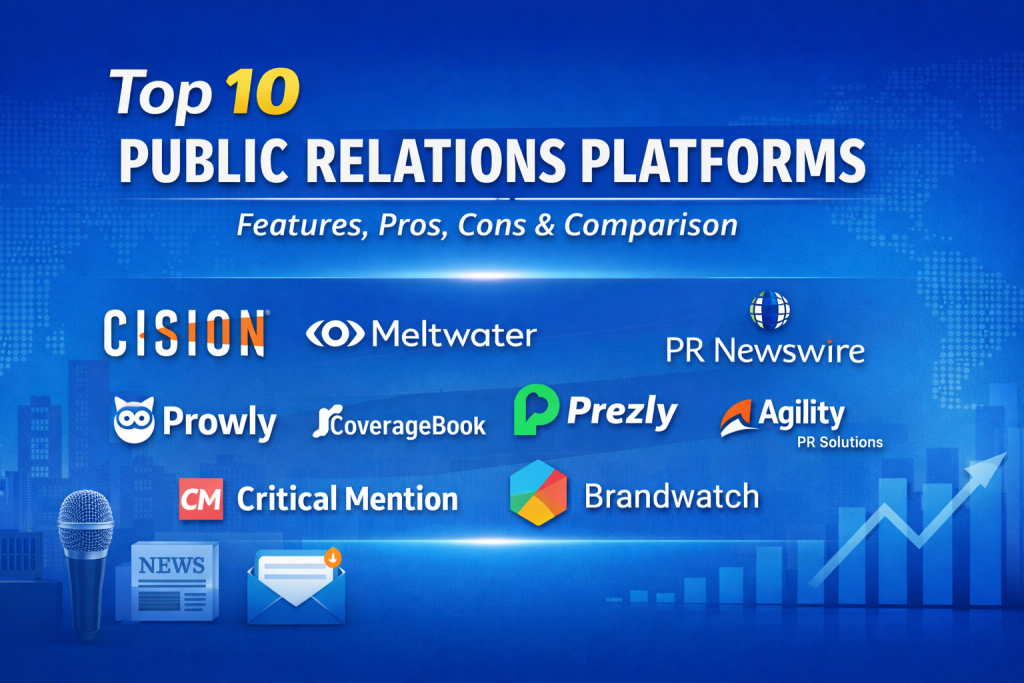
Top 10 Public Relations (PR) Platforms Tools
1 — Cision
Short description:
Cision is one of the most comprehensive PR and media intelligence platforms, designed for enterprise-scale communications and global media outreach.
Key features:
- Global journalist and media database
- Press release distribution and tracking
- Media monitoring across news, online, and social
- Sentiment analysis and share of voice metrics
- Advanced reporting and dashboards
- Influencer identification tools
Pros:
- Extremely large and detailed media database
- Strong analytics and reporting capabilities
Cons:
- High cost for smaller teams
- Steeper learning curve
Security & compliance:
SOC 2, GDPR-compliant, enterprise-grade access controls.
Support & community:
Dedicated account managers, enterprise onboarding, extensive documentation.
2 — Meltwater
Short description:
Meltwater focuses on real-time media intelligence, brand monitoring, and PR analytics with strong AI-driven insights.
Key features:
- Real-time media monitoring
- Global media and influencer database
- Social listening and analytics
- Custom dashboards and alerts
- PR performance measurement
- Competitive benchmarking
Pros:
- Excellent monitoring speed and accuracy
- Intuitive dashboards
Cons:
- Pricing not transparent
- Limited customization in some reports
Security & compliance:
GDPR-compliant, encrypted data handling.
Support & community:
Onboarding specialists, live support, training resources.
3 — Muck Rack
Short description:
Muck Rack is a modern PR platform built around journalist relationships, pitching, and media monitoring.
Key features:
- Verified journalist profiles
- Media pitching and tracking
- News and social media monitoring
- Alerts for brand and competitor mentions
- Simple reporting tools
Pros:
- Highly accurate journalist data
- Clean, easy-to-use interface
Cons:
- Less robust analytics than enterprise tools
- Limited global coverage compared to Cision
Security & compliance:
GDPR-compliant, secure access controls.
Support & community:
Strong customer success team, helpful documentation.
4 — PR Newswire
Short description:
PR Newswire specializes in press release distribution with wide reach across media outlets and industries.
Key features:
- High-reach press release distribution
- Targeted industry and geographic circuits
- Engagement and visibility analytics
- Multimedia press release support
- Editorial calendars
Pros:
- Unmatched distribution reach
- Trusted by major media outlets
Cons:
- Very expensive pricing model
- Limited CRM-style PR management
Security & compliance:
Enterprise security standards, GDPR-ready.
Support & community:
Dedicated support teams, onboarding assistance.
5 — Prowly
Short description:
Prowly is a PR management platform tailored for SMBs and growing teams, focusing on media relations and press rooms.
Key features:
- Media contact database
- Press release creation and outreach
- Online newsroom builder
- Coverage tracking and reports
- Collaboration tools
Pros:
- Affordable compared to enterprise tools
- Simple and user-friendly
Cons:
- Smaller media database
- Limited advanced analytics
Security & compliance:
GDPR-compliant, standard SaaS security.
Support & community:
Email and chat support, onboarding guides.
6 — CoverageBook
Short description:
CoverageBook focuses on turning PR coverage into visually appealing, easy-to-share reports.
Key features:
- Automated PR coverage reports
- Metrics for reach and engagement
- Custom branded reports
- Shareable links and PDFs
- Simple media tracking
Pros:
- Excellent reporting presentation
- Saves significant reporting time
Cons:
- Not a full PR management platform
- No press distribution
Security & compliance:
Standard SaaS security, GDPR-ready.
Support & community:
Responsive support, tutorials, help center.
7 — Prezly
Short description:
Prezly combines media relations CRM with storytelling tools for modern PR teams.
Key features:
- PR CRM for journalist relationships
- Press release creation and pitching
- Online newsroom hosting
- Email engagement tracking
- Collaboration workflows
Pros:
- Strong relationship-focused design
- Clean storytelling tools
Cons:
- Limited advanced analytics
- Smaller media database
Security & compliance:
GDPR-compliant, encrypted communications.
Support & community:
Good documentation, onboarding support.
8 — Agility PR Solutions
Short description:
Agility PR Solutions provides media databases, outreach, and monitoring for PR professionals.
Key features:
- Media contact database
- Press outreach and tracking
- Media monitoring tools
- Reporting dashboards
- Campaign performance insights
Pros:
- Balanced feature set
- Reasonable pricing tiers
Cons:
- UI feels dated
- Less advanced AI insights
Security & compliance:
GDPR-compliant, role-based access.
Support & community:
Email and phone support, onboarding assistance.
9 — Critical Mention
Short description:
Critical Mention specializes in broadcast, online, and social media monitoring with real-time alerts.
Key features:
- TV, radio, and online monitoring
- Real-time alerts
- Media clip archiving
- Competitive analysis
- Reporting dashboards
Pros:
- Strong broadcast monitoring
- Fast alerting system
Cons:
- Limited PR CRM features
- Reporting customization is basic
Security & compliance:
Enterprise-grade security, GDPR-ready.
Support & community:
Dedicated support teams, training sessions.
10 — Brandwatch
Short description:
Brandwatch focuses on consumer intelligence and social listening, widely used for reputation and sentiment analysis.
Key features:
- Advanced social listening
- Sentiment and trend analysis
- Media and consumer insights
- Custom dashboards
- AI-powered data analysis
Pros:
- Deep analytics and insights
- Excellent for reputation management
Cons:
- Complex setup
- High cost
Security & compliance:
SOC 2, GDPR-compliant, enterprise security.
Support & community:
Enterprise onboarding, analyst support, training resources.
Comparison Table
| Tool Name | Best For | Platform(s) Supported | Standout Feature | Rating |
|---|---|---|---|---|
| Cision | Enterprise PR teams | Web | Largest media database | N/A |
| Meltwater | Media intelligence | Web | Real-time monitoring | N/A |
| Muck Rack | Journalist outreach | Web | Verified journalist profiles | N/A |
| PR Newswire | Press distribution | Web | Global distribution reach | N/A |
| Prowly | SMB PR teams | Web | Ease of use | N/A |
| CoverageBook | PR reporting | Web | Visual reports | N/A |
| Prezly | Relationship management | Web | PR CRM focus | N/A |
| Agility PR Solutions | Mid-market teams | Web | Balanced features | N/A |
| Critical Mention | Broadcast monitoring | Web | TV & radio tracking | N/A |
| Brandwatch | Reputation analytics | Web | Advanced sentiment analysis | N/A |
Evaluation & Scoring of Public Relations (PR) Platforms
| Criteria | Weight | Description |
|---|---|---|
| Core features | 25% | Media database, outreach, monitoring |
| Ease of use | 15% | Learning curve and usability |
| Integrations & ecosystem | 15% | CRM, marketing, analytics tools |
| Security & compliance | 10% | Data protection standards |
| Performance & reliability | 10% | Accuracy and uptime |
| Support & community | 10% | Help resources and responsiveness |
| Price / value | 15% | ROI relative to cost |
Which Public Relations (PR) Platforms Tool Is Right for You?
- Solo users: Lightweight tools or reporting-focused platforms
- SMBs: Prowly or Prezly for affordability and simplicity
- Mid-market: Meltwater or Agility PR Solutions
- Enterprise: Cision, Brandwatch, or PR Newswire
Budget-conscious teams should prioritize usability and core features, while premium buyers gain value from deep analytics and global reach. Security-sensitive industries must focus on compliance and data governance.
Frequently Asked Questions (FAQs)
- What is a PR platform?
A PR platform helps manage media relations, press outreach, monitoring, and analytics. - Do startups need PR software?
Yes, if they engage with journalists or manage brand reputation actively. - Are PR platforms expensive?
Costs vary widely, from affordable SMB tools to premium enterprise solutions. - Can PR platforms replace agencies?
They complement agencies but don’t fully replace strategic expertise. - Is media monitoring included?
Most platforms offer monitoring, though depth varies. - How long does implementation take?
Anywhere from a few days to several weeks, depending on complexity. - Do these tools support global media?
Enterprise platforms usually offer strong international coverage. - Are they GDPR-compliant?
Most modern PR platforms are GDPR-ready. - What’s the biggest mistake buyers make?
Overpaying for features they don’t use. - Can PR impact be measured accurately?
Yes, with metrics like reach, sentiment, and share of voice.
Conclusion
Public Relations (PR) platforms have become essential for managing brand reputation, media relationships, and communication strategy in a data-driven world. The right tool depends on team size, budget, required features, and industry sensitivity. There is no single universal winner—only the best fit for your specific goals. By focusing on usability, coverage quality, analytics depth, and compliance, organizations can select a PR platform that delivers real, measurable impact.

Find Trusted Cardiac Hospitals
Compare heart hospitals by city and services — all in one place.
Explore Hospitals
One thing worth considering when selecting a PR platform is how well it connects media coverage to actual business outcomes. Tracking mentions and reach is useful, but understanding referral traffic, audience engagement, sentiment shifts, and share of voice gives a much clearer picture of campaign effectiveness. I’d also recommend testing journalist database accuracy and monitoring relevance before committing to an annual subscription. How do these platforms perform when measuring long-term brand trust rather than just short-term media visibility?
One often-overlooked challenge in PR operations is managing press release corrections after distribution. If a company discovers an incorrect statistic, outdated executive quote, or inaccurate product detail, the correction needs to reach every outlet that received the original announcement. PR teams should maintain version histories, track correction acknowledgements, and identify which media contacts published outdated information. This is important for protecting brand credibility and avoiding confusion when announcements involve financial results, regulatory updates, or sensitive company information.
When evaluating PR platforms, I’d look closely at how they measure the quality and relevance of media coverage—not just the number of mentions or estimated reach. A placement in a highly relevant publication with meaningful audience engagement may deliver more value than a much larger mention that barely reaches the intended audience. It’s also useful to check whether the platform can connect outreach activity with resulting coverage, identify duplicate syndication, and distinguish earned media from paid or owned content. For crisis communications, timely alerts and clear source context matter just as much as reporting dashboards. The strongest PR tools help teams understand what their coverage actually achieved and make better decisions about future media relationships.
PR platforms are most valuable when they help communications teams build meaningful media relationships while making campaign results easier to measure. I would pay close attention to the accuracy and freshness of journalist databases, since outdated contact details can undermine even a well-targeted pitch. Media monitoring should also cover relevant online, print, broadcast, and social channels, with enough filtering to distinguish genuine coverage from irrelevant mentions. Another important factor is whether reporting goes beyond reach and impressions to show sentiment, message alignment, and potential business impact. For teams managing sensitive announcements or crisis communications, reliable alerts, collaboration workflows, and clear approval controls can be just as important as the size of the media database.
Media outreach success has shifted away from spamming massive media contact lists toward targeted pitching supported by past journalist publication history. Platforms that integrate press release wire syndication with interactive multimedia newsrooms generate far higher engagement from tier-one journalists. Measuring pitch impact through referral traffic and backlink quality provides much stronger business attribution than vanity impression numbers.
Public relations platforms help teams manage media outreach, build journalist relationships, distribute press releases, and monitor brand coverage. When comparing tools, consider media database accuracy, contact segmentation, press release distribution, coverage monitoring, campaign tracking, reporting, collaboration, and integration with communication systems.
Public relations platforms have modernized media outreach, and this article rounds up the leading options well. What resonates with me is the focus on relationship management over blast pitching, because journalists reward relevance and respect. One practical tip is to measure outcomes like coverage quality rather than email opens, which flatter without informing. PR works best as relationship building. Well framed comparison.
Public relations platforms help businesses plan media outreach, manage press releases, build journalist relationships, and track campaign results. When comparing these platforms, I would focus on media contact databases, press release distribution, email outreach, media monitoring, and performance reporting. These features can help PR teams organize campaigns, reach relevant journalists, and measure media coverage more effectively. The right platform should offer accurate media contacts, simple campaign management, and clear insights into PR performance.
Public relations (PR) platforms help organizations manage media relationships, distribute announcements, monitor brand coverage, and measure the impact of communication campaigns. Features such as media contact databases, press release distribution, journalist outreach, media monitoring, sentiment analysis, and campaign reporting can streamline PR activities. When comparing solutions, businesses should consider media database quality, audience reach, monitoring accuracy, reporting capabilities, workflow automation, and pricing. The right platform can improve media engagement, strengthen brand visibility, simplify campaign management, and help PR teams measure communication outcomes more effectively.
PR reporting becomes more dependable when teams can trace how each media mention enters the system and changes over time. Incorrect source matching or missed updates can quietly affect campaign metrics and client reports. Keeping an audit trail of manual edits, corrected mentions, and removed duplicates helps teams explain unexpected results. It is also worth checking how platforms handle deleted articles and revised publication dates. These checks help maintain accurate reporting and give stakeholders more confidence in campaign decisions.
Public relations platforms help teams manage media contacts, prepare outreach, and track coverage. A large contact list is not enough if the information is outdated or poorly matched to the story. I would compare journalist databases, media monitoring, campaign tracking, and reporting. Teams should check whether contact details stay current and whether coverage reports separate meaningful results from simple mentions. Collaboration features can also help teams coordinate approvals and deadlines. It is worth testing how easily the platform finds relevant journalists for a specific topic. A useful PR tool should support targeted communication and make campaign results easier to understand.
Public relations platforms help communication teams manage media contacts, distribute press releases, monitor coverage, and measure campaign outcomes from a centralized workspace. Media database accuracy, journalist relationship tracking, and timely coverage alerts can improve outreach while keeping communication efforts organized. Combining these capabilities with sentiment analysis and performance reporting also helps teams evaluate public response, refine messaging, and maintain consistent brand communication across channels.
Public relations platforms help businesses share news, connect with journalists, and manage media coverage. They make it easier to organize press releases and track how people respond to company announcements. I think media contact management and coverage reports are useful features for PR teams. These tools can save time and help businesses communicate their messages clearly. Choosing the right platform can make PR work more organized and effective.
PR teams should examine how accurately a platform connects media coverage with actual changes in audience perception. A mention count or positive sentiment score can be misleading when automated analysis misses sarcasm, context, regional language, or the difference between reporting a story and endorsing a brand. Teams should review a sample of classified coverage manually and compare results across languages and media types. It is also useful to track message accuracy, audience response, and changes in coverage over time rather than relying only on estimated reach. These checks help communication teams make better decisions during campaigns and avoid treating automated reports as a complete picture of public opinion.
PR platforms should help communications teams reach relevant journalists while keeping outreach organized and measurable. When comparing tools, check the accuracy of journalist contact details, how well media lists can be segmented by beat, and whether follow-up history is visible across the team. Tracking which pitches lead to meaningful coverage can help PR professionals refine their messaging and build stronger media relationships over time.
Syndicating press wires and ingesting live broadcast feeds requires resilient event-driven architectures. Without distributed message queues, automated rate limiting, and real-time webhook retries, sudden breaking-news cycles can overwhelm downstream sentiment analysis engines and delay critical crisis-response alerts during high-stakes brand coverage events.
Public relations platforms help teams manage media contacts, distribute press releases, track brand coverage, and measure campaign results. When comparing tools, consider journalist databases, media monitoring, outreach personalization, coverage reporting, and integration with existing communication workflows. Keeping contact lists current and tracking which stories generate meaningful engagement can help PR teams build stronger media relationships and improve future campaigns.
Public relations platforms help businesses manage media contacts, distribute press releases, monitor brand coverage, and measure the impact of communications campaigns. Tools like Muck Rack offer journalist discovery, media monitoring, and PR reporting features, helping teams build stronger media relationships, track relevant coverage, and make more informed decisions about their outreach strategies.
Moving beyond basic email pitching to dedicated relationship platforms makes a huge difference when outreach volume scales. Maintaining up-to-date journalist contact details prevents campaigns from bouncing and protects your team’s sender reputation over time. Finding that sweet spot between a massive global database and workflow simplicity is usually the hardest part.
A PR platform delivers the most value when it connects accurate media monitoring with meaningful outreach and measurable results. Tracking sentiment alongside the quality of coverage helps teams understand whether their campaigns are building trust, not just generating mentions.