
Introduction
Real Estate Leasing Management Tools are specialized software platforms designed to manage the entire lifecycle of a lease—from marketing vacant units and screening tenants to lease execution, rent tracking, renewals, and compliance reporting. In today’s fast-moving real estate environment, manual spreadsheets and disconnected systems simply can’t keep up with the complexity of modern leasing operations.
These tools help landlords, property managers, and real estate firms reduce errors, speed up leasing cycles, improve tenant experience, and stay compliant with financial and regulatory requirements. Whether managing ten residential units or a nationwide commercial portfolio, leasing software centralizes data, automates workflows, and provides real-time visibility into performance.
Common real-world use cases include:
- Managing multi-property lease portfolios
- Automating lease renewals and rent escalations
- Tracking compliance and audit readiness
- Integrating leasing with accounting and property management
- Improving tenant onboarding and communication
What to look for when choosing a tool:
- Lease abstraction and automation depth
- Ease of use for leasing teams and tenants
- Integration with accounting, CRM, and property systems
- Security, compliance, and audit readiness
- Scalability for portfolio growth
Best for:
Property managers, real estate owners, leasing teams, commercial real estate firms, REITs, and growing real estate portfolios that need structured, compliant, and scalable lease operations.
Not ideal for:
Single-property owners with minimal leasing activity, very small landlords who only need basic rent tracking, or teams already locked into all-in-one accounting systems with limited leasing needs.
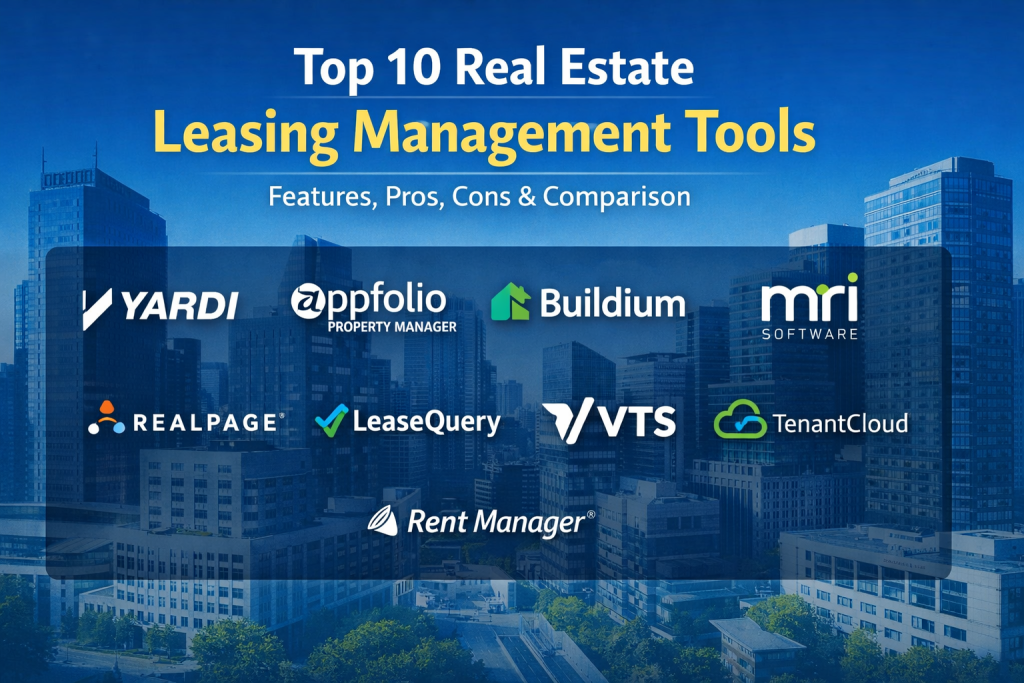
Top 10 Real Estate Leasing Management Tools
1 — Yardi
Short description:
A comprehensive real estate platform offering enterprise-grade leasing, accounting, and property management for residential and commercial portfolios.
Key features
- End-to-end lease lifecycle management
- Automated rent escalations and renewals
- Integrated accounting and financial reporting
- Tenant portals and online leasing
- Advanced analytics and portfolio dashboards
- Commercial and residential support
Pros
- Extremely robust and scalable
- Strong reporting and compliance capabilities
Cons
- Steep learning curve
- Higher cost for smaller portfolios
Security & compliance: SOC 2, GDPR support, encryption, role-based access
Support & community: Enterprise onboarding, extensive documentation, global support network
2 — AppFolio
Short description:
A modern, user-friendly leasing and property management platform designed for growing residential portfolios.
Key features
- Online leasing and digital applications
- Lease templates and automation
- Built-in accounting and reporting
- Tenant screening and communication
- Mobile-friendly dashboards
- Automated renewals and notices
Pros
- Clean, intuitive interface
- Fast implementation
Cons
- Limited deep commercial features
- Less customization for enterprise needs
Security & compliance: Encryption, role-based access, GDPR support
Support & community: Strong onboarding, responsive customer support
3 — Buildium
Short description:
A popular leasing management solution tailored for SMB residential property managers and associations.
Key features
- Lease tracking and document storage
- Online rent payments and renewals
- Vacancy and applicant management
- Automated late fees and reminders
- Owner and tenant portals
Pros
- Affordable for small teams
- Easy to learn
Cons
- Limited enterprise reporting
- Not ideal for complex commercial leases
Security & compliance: Standard encryption, audit logs
Support & community: Knowledge base, live support, active user community
4 — MRI Software
Short description:
An enterprise-grade leasing and property management platform widely used in commercial real estate and REITs.
Key features
- Advanced lease abstraction
- Commercial lease accounting
- Flexible reporting and analytics
- Portfolio-level insights
- Deep ERP and CRM integrations
Pros
- Excellent for complex commercial leases
- Highly configurable
Cons
- Implementation can be lengthy
- Premium pricing
Security & compliance: SOC 2, GDPR, strong audit controls
Support & community: Enterprise-level support and consulting
5 — Entrata
Short description:
A unified leasing and property management platform focused on residential and student housing.
Key features
- Digital leasing workflows
- Lease document automation
- Resident portals and messaging
- Integrated marketing tools
- Performance dashboards
Pros
- Strong resident experience
- All-in-one ecosystem
Cons
- Less suitable for pure commercial portfolios
- Customization limitations
Security & compliance: GDPR support, encryption
Support & community: Training programs, dedicated account support
6 — RealPage
Short description:
A data-driven leasing and revenue management solution for large residential portfolios.
Key features
- Lease pricing optimization
- Automated renewals and notices
- Demand forecasting
- Centralized lease data
- Compliance reporting
Pros
- Powerful analytics
- Ideal for large portfolios
Cons
- Complex setup
- Costly for smaller firms
Security & compliance: SOC 2, GDPR, enterprise security controls
Support & community: Enterprise onboarding and analytics support
7 — LeaseQuery
Short description:
A specialized platform focused on lease accounting and compliance for finance-driven teams.
Key features
- Lease abstraction and classification
- Accounting standard compliance tracking
- Audit-ready reporting
- Portfolio-level insights
- Integration with ERP systems
Pros
- Excellent for compliance
- Finance-friendly workflows
Cons
- Not a full leasing operations tool
- Limited tenant interaction
Security & compliance: SOC 2, encryption, audit logs
Support & community: Strong documentation and accounting expertise
#8 — VTS
Short description:
A leasing and deal-management platform designed for commercial landlords and brokers.
Key features
- Lease pipeline tracking
- Deal analytics
- CRM-style tenant management
- Portfolio performance insights
- Market benchmarking
Pros
- Excellent visibility into leasing activity
- Strong analytics
Cons
- Not an accounting tool
- Requires integration with other systems
Security & compliance: Enterprise security, GDPR support
Support & community: Training resources and account managers
9 — TenantCloud
Short description:
A lightweight, affordable leasing tool for independent landlords and small property managers.
Key features
- Lease templates and tracking
- Online applications
- Rent collection
- Maintenance requests
- Basic reporting
Pros
- Budget-friendly
- Quick setup
Cons
- Limited scalability
- Basic analytics
Security & compliance: Standard encryption
Support & community: Email support and help center
#10 — Rent Manager
Short description:
A flexible leasing and property management platform suitable for mid-market and growing portfolios.
Key features
- Custom lease workflows
- Automated renewals
- Integrated accounting
- Reporting and dashboards
- Multi-property support
Pros
- Highly customizable
- Strong mid-market fit
Cons
- Interface feels dated
- Training required
Security & compliance: Role-based access, audit trails
Support & community: Training programs and support desk
Comparison Table
| Tool Name | Best For | Platform(s) Supported | Standout Feature | Rating |
|---|---|---|---|---|
| Yardi | Enterprise portfolios | Web, Cloud | End-to-end real estate suite | N/A |
| AppFolio | Growing residential teams | Web, Mobile | Ease of use | N/A |
| Buildium | SMB property managers | Web | Affordable leasing | N/A |
| MRI Software | Commercial real estate | Web | Lease abstraction | N/A |
| Entrata | Residential portfolios | Web, Mobile | Resident experience | N/A |
| RealPage | Large residential firms | Web | Revenue optimization | N/A |
| LeaseQuery | Finance & compliance teams | Web | Lease accounting | N/A |
| VTS | Commercial leasing teams | Web | Deal analytics | N/A |
| TenantCloud | Independent landlords | Web | Low cost | N/A |
| Rent Manager | Mid-market portfolios | Web | Custom workflows | N/A |
Evaluation & Scoring of Real Estate Leasing Management Tools
| Criteria | Weight | Average Score |
|---|---|---|
| Core features | 25% | High |
| Ease of use | 15% | Medium-High |
| Integrations & ecosystem | 15% | Medium |
| Security & compliance | 10% | High |
| Performance & reliability | 10% | High |
| Support & community | 10% | Medium-High |
| Price / value | 15% | Medium |
Which Real Estate Leasing Management Tool Is Right for You?
- Solo users: Simple tools like TenantCloud focus on affordability and ease
- SMBs: Buildium or AppFolio balance features and usability
- Mid-market: Rent Manager offers flexibility and customization
- Enterprise: Yardi, MRI Software, or RealPage handle complexity and scale
Budget-conscious vs premium:
Lower-cost tools suit small portfolios, while enterprise platforms justify cost with automation and analytics.
Feature depth vs ease of use:
Advanced tools offer power but require training; simpler tools prioritize speed.
Integration & scalability:
Growing portfolios should prioritize open APIs and accounting integrations.
Security & compliance:
Finance-heavy or regulated environments need audit logs and compliance reporting.
Frequently Asked Questions (FAQs)
- What is a leasing management tool?
Software that manages lease creation, tracking, renewals, and compliance. - Are these tools only for large companies?
No, options exist for solo landlords through enterprises. - Do they replace accounting software?
Some do; others integrate with accounting systems. - How long does implementation take?
From days for SMB tools to months for enterprise platforms. - Are tenant portals important?
Yes, they improve communication and reduce admin work. - Can they handle commercial leases?
Select tools specialize in complex commercial terms. - Is data secure?
Most modern tools offer encryption and access controls. - Do they support renewals automatically?
Yes, many automate notices and escalations. - What is lease abstraction?
Extracting key terms from lease documents for reporting. - Is customization possible?
Mid-market and enterprise tools offer more flexibility.
Conclusion
Real Estate Leasing Management Tools have become essential infrastructure for modern property operations. The right platform can reduce risk, save time, and unlock portfolio insights—but no single tool fits everyone.
When choosing, focus on your portfolio size, lease complexity, compliance needs, and growth plans. The best solution is the one that aligns with your operational reality—not the most expensive or feature-packed option.

Find Trusted Cardiac Hospitals
Compare heart hospitals by city and services — all in one place.
Explore Hospitals
Lease renewals are an interesting area where automation alone cannot replace good decision-making. A tenant may have a perfect payment history but still be considering relocation because of maintenance problems, changing space requirements, or rising operating costs. Leasing platforms could provide more value by connecting renewal timelines with maintenance records, tenant communication history, and occupancy trends. This would help property managers identify retention risks before tenants make their final decision.
Leasing management tools can help property teams handle tenant details, lease documents, rent schedules, and renewal dates more efficiently. A useful platform should make it easy to track each lease from the first inquiry to renewal or closure. Automated reminders can reduce missed deadlines and improve communication with tenants. Teams should also check document storage, reporting options, and integration with their existing property management systems before choosing a tool.
One area worth evaluating in leasing management software is how reliably it handles the full lease lifecycle—not just the initial application and digital signature. Renewal dates, rent escalations, notice periods, amendments, security deposits, and move-out reconciliations can become difficult to track across a growing portfolio. I’d also check whether the platform maintains a clear audit trail when lease terms or tenant records change, and whether financial data can be reconciled with the organization’s accounting system without manual work. A polished tenant portal is useful, but preventing missed deadlines and inconsistent lease records is what really reduces operational risk for property managers.
Leasing management platforms can streamline the tenant journey, but the real test is how well they handle exceptions and ongoing property operations. I would compare the reliability of applicant screening, document workflows, e-signatures, and lease renewal reminders, especially when managing multiple properties with different terms. Integrations between leasing, accounting, maintenance, and payment systems are important because disconnected records can create avoidable disputes or reconciliation work. It is also worth checking how platforms manage sensitive applicant data, access permissions, and retention policies. A useful solution should give property teams clear visibility into each lease’s status while making the process straightforward for both tenants and owners.
Real estate leasing management tools help property managers streamline lease administration, tenant communication, rent tracking, and document management. This article provides a useful comparison of platforms based on automation, reporting, payment processing, and tenant management features. When choosing a solution, businesses should consider scalability, ease of use, integration capabilities, and overall cost. The right leasing management software can reduce administrative work, improve tenant experiences, and make property operations more efficient.
Commercial property management software proves its worth by automating complex lease indexing calculations, CAM reconciliations, and critical renewal notification cadences without spreadsheet risk. Centralizing tenant communications, maintenance ticketing, and payment tracking in a single portal reduces friction and speeds up monthly rent collections. Integrating leasing data directly with asset financial models gives portfolio directors clear visibility into occupancy trends and future cash yields.
Real estate leasing management tools help property managers handle tenant records, lease agreements, rent payments, and renewal schedules. When comparing platforms, consider tenant screening, digital lease signing, payment tracking, maintenance management, document storage, automated reminders, reporting, and accounting integrations.
Real estate leasing management tools coordinate transactions worth millions, and this comparison covers the workflow demands well. What stands out to me is the focus on document management and tenant communication, which consume most of a leasing team day. One suggestion is to prioritize mobile access, since agents work in the field constantly. Smoother leasing processes close deals faster. Useful guide for property teams.
Real estate leasing management tools help property owners and managers handle rental listings, tenant applications, lease agreements, and rent collection from one platform. When comparing these tools, I would focus on lease tracking, tenant communication, payment management, document storage, and reporting features. These capabilities can reduce administrative work, improve tenant coordination, and make lease management more organized. The right tool should offer simple workflows, accurate records, and reliable support for different property management needs.
Real estate leasing management tools help property owners and managers streamline the entire leasing lifecycle, from listing properties and managing tenant applications to handling lease agreements and renewals. Features such as digital lease management, tenant screening, rent tracking, document storage, maintenance requests, and automated reminders can simplify daily operations. When comparing platforms, businesses should consider ease of use, automation capabilities, financial reporting, integration options, scalability, and data security. The right solution can reduce administrative workload, improve tenant communication, minimize paperwork, and provide better visibility into property leasing operations.
Managing lease changes requires more than updating a few fields in the system. Adjustments to rent, renewal dates, or termination conditions must stay consistent across billing and accounting records. Keeping a clear history of revisions and approvals helps teams trace how each agreement changed. Testing unusual cases, such as mid-term rent changes, can uncover errors before invoices reach tenants. These controls also give property managers better evidence when resolving payment disputes or reviewing contract history.
Real estate leasing management tools help property teams organize tenant applications, lease agreements, rent schedules, and renewal activities in one centralized system. Automated reminders, digital document storage, and payment tracking can reduce administrative delays while improving communication between landlords and tenants. Integrating these platforms with accounting and property management systems also strengthens financial visibility, supports accurate recordkeeping, and makes it easier to manage growing rental portfolios.
Real estate leasing management tools help property managers handle leases, rent payments, and tenant records in one place. They make it easier to track lease dates and send payment reminders on time. I think automated documents and clear tenant communication are useful features. These tools can reduce paperwork and save time for property managers. Choosing the right software can make leasing tasks easier and keep property records organized.
Real estate leasing management tools help teams track properties, tenants, leases, renewals, and rent payments. Accurate dates and records can prevent missed deadlines and reduce administrative work. I would compare document storage, renewal reminders, payment tracking, maintenance requests, and financial reporting. Teams should test how the platform handles lease amendments and changes to tenant details. Access controls matter when several staff members manage different properties. It is also useful to check whether tenants can submit requests through a simple portal. A good system should keep lease information organized and make routine tasks easier for both property managers and tenants.
Moving lease data into a new platform requires more than importing documents and tenant details. Contract dates, rent schedules, escalation clauses, deposit balances, and renewal terms must retain their original meaning after migration. I would recommend reconciling a sample of migrated records against signed agreements and testing complex leases separately before switching over. Teams should also keep a clear record of corrections and assign ownership for resolving discrepancies. This validation step can prevent incorrect rent calculations, missed renewal deadlines, and financial reporting errors that may remain hidden until they affect tenants or accounting teams.
Real estate leasing management tools should help property teams track lease obligations from tenant onboarding through renewal or move-out. When comparing platforms, check how they handle rent escalation clauses, security deposit deductions, and renewal deadlines across different properties. A clear record of lease amendments and tenant communications can also reduce disputes and help managers avoid missing important contractual obligations.
Synchronizing dynamic lease terms and payment schedules across distributed enterprise systems often leads to severe state discrepancies. Without robust schema validation, idempotent webhooks, and transactional consistency between leasing portals and core ERP ledgers, managing automated renewals and billing reconciliation at scale creates substantial manual overhead.
Real estate leasing management tools help property teams organize lease agreements, track rent payments, manage renewals, and communicate with tenants. When comparing platforms, look at document storage, automated reminders, payment tracking, vacancy reporting, and integration with accounting systems. Keeping lease dates and tenant records accurate can prevent missed renewals, reduce administrative work, and give property managers a clearer view of occupancy and rental income.
Real estate leasing management tools help property managers handle tenant applications, lease agreements, rent tracking, and renewal reminders from one central platform. Solutions like Buildium offer tenant management, online payments, and lease administration features, helping property teams reduce paperwork, stay organized, and manage rental properties more efficiently.
Choosing between platforms like Buildium and enterprise options like Yardi really highlights how crucial it is to match portfolio size with tool complexity. While feature lists are helpful, the learning curve and hidden add-on costs often dictate whether a system actually saves time or creates operational friction. It would be interesting to see how these platforms handle integrations with third-party accounting stacks as portfolios scale.
Endpoint telemetry becomes far more useful when teams can correlate device activity with identity and network events, helping them detect threats that isolated alerts might miss. Retention policies and clear alert priorities are equally important for keeping investigations efficient without overwhelming security teams.