
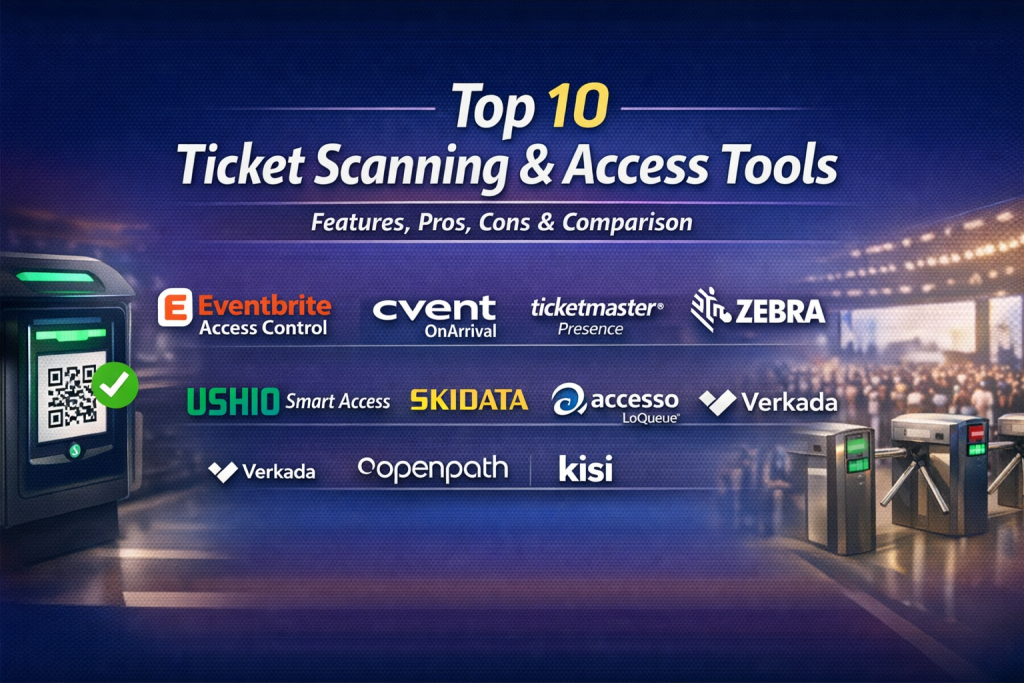
Introduction
Ticket Scanning & Access Tools are specialized software and hardware-enabled platforms designed to validate tickets, control entry points, and manage attendee access at events, venues, workplaces, and gated facilities. These tools typically support QR codes, barcodes, RFID, NFC, and mobile passes, ensuring only authorized individuals gain entry.
In today’s fast-paced, high-volume environments—such as concerts, conferences, stadiums, corporate campuses, and transport hubs—manual ticket checking is no longer practical. Speed, accuracy, fraud prevention, and real-time visibility are now critical. Modern ticket scanning tools eliminate bottlenecks at entrances, reduce human error, and provide organizers with live attendance data.
Real-world use cases include event check-ins, VIP access control, multi-gate venue management, season passes, employee access, and crowd analytics. Many platforms now integrate with CRM, payment systems, turnstiles, facial recognition, and analytics dashboards.
When choosing a Ticket Scanning & Access Tool, buyers should evaluate scan speed, offline functionality, scalability, device compatibility, security standards, reporting depth, and ease of deployment. The right tool can dramatically improve guest experience while strengthening operational control.
Best for:
Event organizers, stadium operators, conference managers, theme parks, transportation authorities, corporate security teams, and venues handling medium to very large crowds.
Not ideal for:
Very small gatherings with manual check-ins, informal events without tickets, or organizations that do not require controlled access or attendee tracking.
Top 10 Ticket Scanning & Access Tools
1 — Eventbrite Access Control
Short description:
A widely used event entry and ticket scanning solution built into the Eventbrite ecosystem, ideal for small to large public events.
Key features
- Mobile QR and barcode scanning
- Offline scanning mode
- Real-time attendee sync
- Multi-entrance support
- Fraud and duplicate entry detection
- Attendee search and manual check-in
Pros
- Very easy to set up and use
- Strong ecosystem for event marketing
Cons
- Limited customization for complex access rules
- Best suited mainly for Eventbrite tickets
Security & compliance:
GDPR compliant, encrypted ticket data, basic access logs
Support & community:
Extensive documentation, email support, large user community
2 — Cvent OnArrival
Short description:
Enterprise-grade check-in and access solution designed for conferences, trade shows, and large corporate events.
Key features
- High-speed QR and badge scanning
- RFID and NFC badge support
- Multi-session access control
- On-site badge printing
- Real-time attendance dashboards
- Integration with CRM and marketing tools
Pros
- Excellent for large, complex events
- Deep reporting and analytics
Cons
- Higher cost
- Requires training for full utilization
Security & compliance:
SOC 2, GDPR, enterprise encryption standards
Support & community:
Dedicated enterprise support, onboarding specialists
3 — Ticketmaster Presence
Short description:
A powerful access control system used in major stadiums and large-scale entertainment venues worldwide.
Key features
- High-volume barcode and RFID scanning
- Turnstile and gate hardware integration
- Anti-fraud ticket validation
- Mobile and paper ticket support
- Real-time crowd flow monitoring
- Venue-wide access zoning
Pros
- Proven at massive scale
- Strong fraud prevention capabilities
Cons
- Not accessible for small events
- Vendor lock-in
Security & compliance:
Advanced encryption, GDPR, internal security audits
Support & community:
Enterprise-only support with on-site assistance
4 — Zebra Technologies Access Control
Short description:
A hardware-focused solution combining rugged scanners with enterprise access management software.
Key features
- Industrial-grade barcode and RFID scanners
- High-speed scanning accuracy
- Integration with access control systems
- Works in harsh environments
- Long battery life devices
- Real-time validation
Pros
- Extremely reliable hardware
- Excellent for stadiums and transport hubs
Cons
- Hardware investment required
- Software flexibility varies
Security & compliance:
Enterprise-grade encryption, ISO standards (varies by deployment)
Support & community:
Strong enterprise support, hardware documentation
5 — Ushio Smart Access
Short description:
A modern access platform focusing on secure entry management using QR, NFC, and smart credentials.
Key features
- Mobile QR and NFC scanning
- Smart gate integration
- Time-based access rules
- Real-time audit trails
- Cloud-based management
- Visitor management support
Pros
- Clean, modern interface
- Strong access rule customization
Cons
- Smaller ecosystem
- Limited third-party integrations
Security & compliance:
Encryption in transit and at rest, GDPR support
Support & community:
Responsive support, smaller user community
6 — Skidata Access
Short description:
A global leader in access solutions for stadiums, ski resorts, and large venues.
Key features
- RFID and barcode access control
- Turnstile and gate automation
- High-throughput entry processing
- Multi-venue support
- Centralized access dashboards
- Long-term credential management
Pros
- Extremely scalable
- Proven in high-traffic environments
Cons
- Expensive setup
- Hardware-centric approach
Security & compliance:
ISO standards, encrypted access credentials
Support & community:
Global enterprise support network
7 — Accesso LoQueue
Short description:
A guest-experience-focused access and ticket scanning platform for attractions and theme parks.
Key features
- Mobile ticket scanning
- Virtual queuing integration
- Timed entry management
- Guest flow optimization
- Real-time capacity tracking
- Multi-attraction access rules
Pros
- Excellent guest experience focus
- Reduces physical queues
Cons
- Not ideal for generic events
- Specialized use cases
Security & compliance:
GDPR compliant, encrypted ticket data
Support & community:
Dedicated client support, training resources
8 — Verkada Access Control
Short description:
A cloud-native access and scanning solution combining cameras, credentials, and entry management.
Key features
- QR and mobile credential access
- Cloud-managed entry points
- Video-linked access logs
- Real-time monitoring
- Role-based permissions
- API integrations
Pros
- Unified security platform
- Strong audit and visibility features
Cons
- Premium pricing
- Best suited for enterprises
Security & compliance:
SOC 2, GDPR, strong encryption
Support & community:
Enterprise support, detailed documentation
9 — Openpath
Short description:
A mobile-first access control and scanning solution popular with modern workplaces and venues.
Key features
- Mobile QR and Bluetooth access
- Touchless entry
- Cloud-based management
- Real-time access logs
- Multi-location support
- Visitor access workflows
Pros
- Very user-friendly
- Fast deployment
Cons
- Less event-centric features
- Hardware dependency
Security & compliance:
SOC 2, GDPR, encrypted credentials
Support & community:
Strong customer support and onboarding
10 — Kisi
Short description:
A flexible access control platform suitable for offices, venues, and hybrid event environments.
Key features
- QR and mobile access
- Role-based permissions
- Cloud dashboards
- Visitor access scheduling
- API integrations
- Audit logging
Pros
- Flexible and scalable
- Clean user interface
Cons
- Limited native event ticketing
- Requires integrations
Security & compliance:
SOC 2, GDPR, encrypted access data
Support & community:
Good documentation, active support channels
Comparison Table
| Tool Name | Best For | Platform(s) Supported | Standout Feature | Rating |
|---|---|---|---|---|
| Eventbrite Access Control | Small–mid events | iOS, Android, Web | Easy setup | N/A |
| Cvent OnArrival | Large conferences | iOS, Android, Web | Enterprise analytics | N/A |
| Ticketmaster Presence | Stadiums & arenas | Proprietary | Massive scale | N/A |
| Zebra Access Control | Industrial venues | Hardware + software | Rugged reliability | N/A |
| Ushio Smart Access | Smart venues | Web, Mobile | Rule-based access | N/A |
| Skidata Access | High-traffic venues | Hardware + software | Turnstile automation | N/A |
| Accesso LoQueue | Theme parks | Web, Mobile | Virtual queuing | N/A |
| Verkada Access Control | Enterprises | Cloud, Mobile | Video-linked logs | N/A |
| Openpath | Modern workplaces | Mobile, Cloud | Touchless entry | N/A |
| Kisi | Hybrid environments | Web, Mobile | API flexibility | N/A |
Evaluation & Scoring of Ticket Scanning & Access Tools
| Tool | Core Features (25%) | Ease of Use (15%) | Integrations (15%) | Security (10%) | Performance (10%) | Support (10%) | Price/Value (15%) | Total |
|---|---|---|---|---|---|---|---|---|
| Eventbrite | 20 | 14 | 10 | 7 | 8 | 7 | 12 | 78 |
| Cvent | 24 | 11 | 14 | 9 | 9 | 9 | 10 | 86 |
| Ticketmaster | 25 | 10 | 12 | 9 | 10 | 9 | 8 | 83 |
| Zebra | 22 | 9 | 11 | 8 | 10 | 8 | 9 | 77 |
| Ushio | 19 | 13 | 9 | 7 | 8 | 7 | 11 | 74 |
| Skidata | 24 | 9 | 12 | 8 | 10 | 9 | 8 | 80 |
| Accesso | 21 | 12 | 10 | 7 | 8 | 8 | 10 | 76 |
| Verkada | 23 | 12 | 13 | 9 | 9 | 9 | 8 | 83 |
| Openpath | 20 | 14 | 11 | 9 | 8 | 8 | 11 | 81 |
| Kisi | 19 | 14 | 12 | 9 | 8 | 8 | 12 | 82 |
Which Ticket Scanning & Access Tools Tool Is Right for You?
- Solo users & small events: Lightweight tools with mobile scanning and minimal setup
- SMBs: Cloud-based platforms with analytics and basic integrations
- Mid-market: Tools offering multi-gate control, role-based access, and reporting
- Enterprise: Hardware-integrated, high-throughput, and compliance-ready platforms
Budget-conscious teams should prioritize ease of use and mobile scanning, while premium buyers benefit from automation, analytics, and security depth. Integration and scalability become critical as venue size and attendee volume grow.
Frequently Asked Questions (FAQs)
1. Do ticket scanning tools work offline?
Most modern tools support offline scanning with automatic sync once connectivity returns.
2. Can these tools prevent ticket fraud?
Yes, they detect duplicate scans and invalid credentials in real time.
3. Are mobile phones sufficient for scanning?
For small to mid events, yes. Large venues often use dedicated hardware.
4. How fast is ticket scanning?
Typically under one second per ticket with optimized systems.
5. Do these tools support RFID?
Many enterprise solutions support RFID and NFC credentials.
6. Can access rules be time-based?
Yes, advanced tools allow session- or time-restricted access.
7. Are these tools GDPR compliant?
Most reputable vendors follow GDPR and data protection standards.
8. Can they integrate with turnstiles?
Enterprise and venue-focused tools commonly support turnstile integration.
9. Do they provide attendance analytics?
Yes, including entry times, peak hours, and flow metrics.
10. What is the biggest mistake buyers make?
Underestimating future scale and choosing tools that cannot grow with demand.
Conclusion
Ticket Scanning & Access Tools are no longer just about checking tickets—they are critical infrastructure for security, efficiency, and guest experience. From simple mobile scanners to enterprise-grade access ecosystems, the market offers solutions for every scale and use case.
The most important factors when choosing a tool are reliability, speed, security, scalability, and usability. There is no universal “best” option—only the tool that best aligns with your event size, budget, access complexity, and long-term goals. Choosing wisely ensures smoother operations, happier attendees, and stronger control over access at every entry point.

Find Trusted Cardiac Hospitals
Compare heart hospitals by city and services — all in one place.
Explore Hospitals
Ticket scanning systems need to handle sudden entry surges without slowing down queues or losing scan records. When devices work offline, they must prevent the same ticket from being accepted at multiple entrances. Teams should also confirm that cancellations and ticket changes reach every scanner quickly. Backup procedures for dead batteries, damaged devices, and manual entry checks are equally important. Testing these situations before a large event can help avoid confusion at the gates.
Ticket scanning and access tools help event organizers manage entry efficiently while reducing queues and preventing duplicate or unauthorized admissions. Real-time validation, offline scanning support, and centralized attendee records are especially useful when handling large crowds or unreliable network connections. Integrating these systems with ticketing platforms and attendance analytics also improves operational visibility, strengthens access control, and creates a smoother experience for visitors.
Ticket scanning and access tools help event organizers manage entry more efficiently and reduce long queues at busy venues. Features like QR code validation, real-time attendance tracking, and duplicate ticket detection can make a big difference during large events. I think offline scanning support is also valuable when internet connectivity is unreliable. Choosing a reliable system helps improve security while creating a smoother entry experience for both staff and attendees.
Ticket scanning and access tools help event teams verify entry and manage crowd flow. Fast scanning matters, but reliable duplicate detection and offline support can be just as important. I would compare barcode or QR scanning speed, access rules, reporting, and integration with ticket sales systems. Teams should test poor network conditions and cases where a ticket has already been used. Clear error messages help staff resolve entry problems without creating long queues. It is also useful to check how quickly access data updates across different gates. A good system should support secure entry, accurate attendance records, and a smoother experience for guests.
Ticket scanning and access tools can help event organizers manage entry without long queues or confusion. I think having fast scanning, real-time ticket checks, and clear entry reports can make a big difference during busy events. Offline support is also useful when the network is weak. Choosing a tool that is easy for staff to use can help keep entry smooth and organized.
For busy venues, access control also needs a reliable process for resolving conflicting entry records. When several gates operate with weak connectivity, different scanners may accept the same ticket before their data reaches the central system. Teams should test how the platform reconciles delayed scans, handles conflicting timestamps, and flags suspicious repeat entries after synchronization. It is also worth checking whether supervisors can review disputed check-ins without losing the original audit trail. These details matter during peak arrivals, when staff cannot pause entry to investigate every inconsistency. Testing these scenarios before a major event can help prevent access disputes and provide more dependable attendance records for post-event reporting.
Ticket scanning and access tools need to keep entry lines moving while preventing the same ticket from being used more than once. When comparing platforms, check how they handle offline scanning, duplicate QR codes, and last-minute ticket transfers. Real-time entry counts and clear rejection reasons can help event staff resolve genuine attendee problems quickly without weakening access controls.
At high-throughput ingress points, network partitions test scanning architectures severely. Relying strictly on real-time cloud validation creates dangerous physical queue build-ups during cell tower outages. Deploying local edge gateways with peer-to-peer eventual consistency and cryptographically signed offline tokens is mandatory for uninterrupted physical access reliability.
Ticket scanning and access tools help event organizers verify tickets, control entry points, and manage attendee flow during busy events. When comparing platforms, consider QR and barcode scanning speed, offline functionality, duplicate-ticket detection, real-time attendance reports, and integration with ticketing systems. Testing scanners at venue entrances before the event can prevent delays, identify access issues early, and create a smoother check-in experience for attendees.
Ticket scanning and access management tools help event organizers verify tickets, speed up attendee entry, and prevent duplicate scans or unauthorized access. Platforms like Ticket Tailor offer mobile ticket scanning and check-in features, helping teams manage entry queues efficiently, monitor attendance, and deliver a smoother experience for event visitors.
Beyond choosing the right software features, handling internet connectivity dropouts at outdoor venues or high-density gates is often the real make-or-break factor—having a robust offline sync mode is non-negotiable for seamless entry.
Offline scanning and reliable synchronization are essential for busy events, especially when multiple gates operate with unstable internet connections. Clear staff permissions, duplicate-ticket alerts, and real-time capacity tracking can further improve security while keeping entry lines moving smoothly.
This is a great, easy‑to‑understand comparison of ticket scanning and access tools! I appreciate how the article breaks down each option’s features, strengths, and limitations — it makes it simple to see which tools might work best for different events or venues. For anyone looking to improve check‑in efficiency, security, and attendee experience, this guide gives practical insights without overwhelming you. Very useful overview!