
Introduction
A Yard Management System (YMS) is a specialized logistics software designed to manage, track, and optimize the movement of trailers, containers, trucks, and assets within a logistics yard, distribution center, or manufacturing facility. While Transportation Management Systems (TMS) focus on movement between locations and Warehouse Management Systems (WMS) manage inside-the-warehouse operations, YMS fills the critical visibility gap between the gate and the dock.
In modern supply chains, yards are no longer passive parking spaces. They are dynamic, high-traffic operational zones where delays, congestion, or poor coordination can quickly disrupt warehouse throughput and transportation schedules. A robust YMS enables real-time visibility, gate automation, dock scheduling, trailer tracking, and labor coordination—reducing dwell time, demurrage costs, detention fees, and safety risks.
Real-world use cases include:
- High-volume distribution centers managing hundreds of daily trailer moves
- Manufacturing plants coordinating inbound raw materials and outbound finished goods
- Retail and e-commerce fulfillment centers requiring fast dock-to-yard synchronization
- 3PLs managing shared yards across multiple customers
When evaluating YMS tools, buyers should focus on:
- Real-time yard visibility and asset tracking
- Integration with WMS, TMS, ERP, and gate hardware
- Ease of use for gate clerks, yard jockeys, and supervisors
- Scalability for peak seasons and multi-site operations
- Security, compliance, and reliability
Best for:
Yard Management Systems are ideal for logistics managers, yard supervisors, warehouse operations leaders, transportation planners, and supply chain executives in mid-market to enterprise organizations across retail, manufacturing, food & beverage, automotive, e-commerce, and 3PL industries.
Not ideal for:
Very small warehouses with minimal yard activity, facilities with fewer than a handful of daily trailer moves, or operations where a basic WMS or manual processes already provide sufficient visibility.
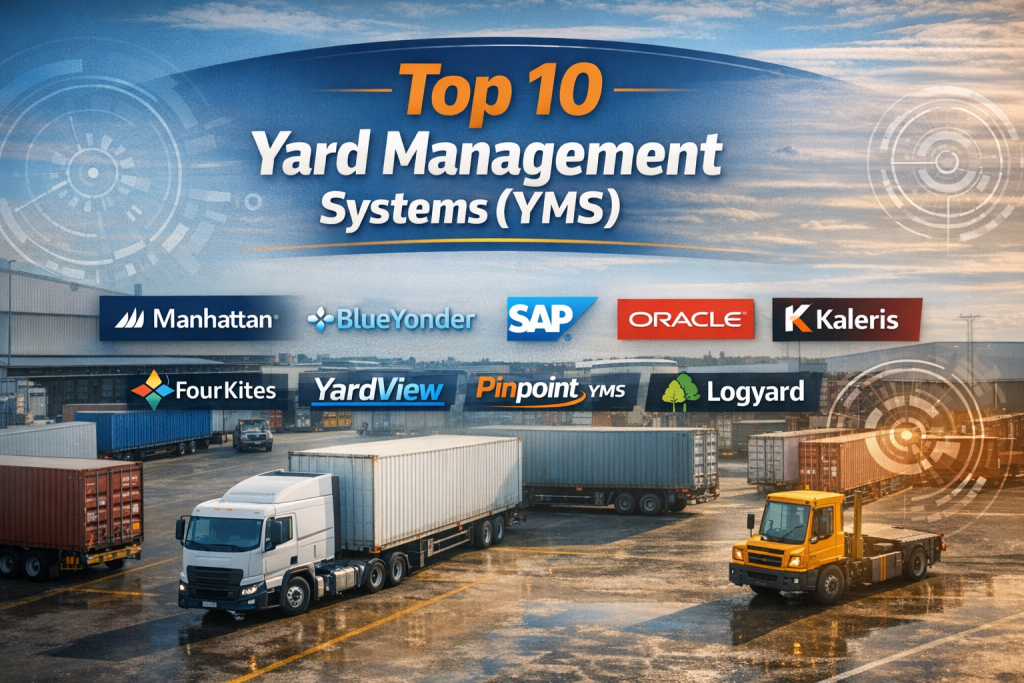
Top 10 Yard Management Systems (YMS) Tools
1 — Manhattan Associates Yard Management
Short description:
An enterprise-grade YMS designed for complex, high-volume yards that require deep integration with WMS and TMS operations.
Key features:
- Real-time trailer and yard asset visibility
- Advanced dock and gate appointment scheduling
- Yard task orchestration and labor management
- Native integration with Manhattan WMS and TMS
- Yard automation and IoT/RFID support
- Exception management and operational analytics
Pros:
- Extremely robust for large-scale operations
- Strong optimization and orchestration capabilities
- Proven in global enterprise deployments
Cons:
- High cost of ownership
- Longer implementation timelines
- Overkill for small or simple yards
Security & compliance:
Enterprise-grade security, SSO, role-based access, audit logs, GDPR-ready, ISO-aligned practices.
Support & community:
Strong enterprise support, detailed documentation, professional services-led onboarding.
2 — Blue Yonder Yard Management
Short description:
A data-driven YMS focused on predictive insights and tight coordination between yard, warehouse, and transportation operations.
Key features:
- End-to-end yard visibility
- AI-driven yard and dock prioritization
- Gate automation and appointment management
- Integration with Blue Yonder WMS/TMS
- Real-time alerts and exception handling
- Yard performance analytics
Pros:
- Strong AI and analytics capabilities
- Excellent for demand-driven supply chains
- Scales well for complex environments
Cons:
- UI can feel complex for frontline users
- Implementation requires expert configuration
Security & compliance:
SSO, encryption at rest and in transit, audit trails, GDPR compliance.
Support & community:
Enterprise support model, strong consulting ecosystem, structured training programs.
3 — SAP Yard Logistics
Short description:
A tightly integrated YMS module for organizations already standardized on SAP’s logistics and ERP ecosystem.
Key features:
- Gate-in and gate-out automation
- Yard bin and storage location management
- Dock appointment and resource scheduling
- Native SAP EWM and TM integration
- Real-time process monitoring
- Exception and delay handling
Pros:
- Seamless SAP ecosystem integration
- Strong process control and governance
- Trusted by global enterprises
Cons:
- SAP dependency limits flexibility
- Steep learning curve
- Customization can be complex
Security & compliance:
SAP enterprise security, role-based access, audit logs, GDPR and ISO-aligned controls.
Support & community:
Extensive documentation, global partner network, enterprise-grade support.
4 — Oracle Yard Management
Short description:
A cloud-focused YMS optimized for organizations running Oracle Transportation and Warehouse solutions.
Key features:
- Cloud-native yard visibility
- Dock and gate scheduling
- Trailer tracking and yard task management
- Tight integration with Oracle SCM Cloud
- Real-time notifications and alerts
- Performance dashboards
Pros:
- Strong cloud scalability
- Unified Oracle SCM experience
- Reliable performance
Cons:
- Best suited for Oracle-centric environments
- Limited flexibility outside Oracle ecosystem
Security & compliance:
SSO, encryption, audit logging, GDPR-ready, enterprise cloud security standards.
Support & community:
Oracle enterprise support, structured onboarding, extensive documentation.
5 — Kaleris Yard Management
Short description:
A YMS specialist focused on real-time execution, asset visibility, and yard automation.
Key features:
- Real-time yard execution and tracking
- Gate automation and self-service kiosks
- Dock and yard task optimization
- RFID and IoT integrations
- Yard analytics and reporting
- Multi-yard visibility
Pros:
- Purpose-built YMS expertise
- Strong automation capabilities
- Flexible deployment options
Cons:
- UI may feel dated in places
- Advanced features require configuration
Security & compliance:
SSO support, encryption, audit logs, GDPR-ready.
Support & community:
Dedicated YMS-focused support teams, solid documentation.
6 — FourKites Yard Works
Short description:
A modern YMS extension built on real-time transportation visibility and predictive analytics.
Key features:
- Real-time yard and dock visibility
- Predictive arrival and dwell time analytics
- Dock scheduling optimization
- Carrier and driver collaboration
- Yard performance dashboards
Pros:
- Excellent real-time visibility
- Strong predictive insights
- User-friendly interface
Cons:
- Requires FourKites platform adoption
- Less suitable as a standalone YMS
Security & compliance:
SSO, encryption, GDPR compliance, enterprise-grade cloud security.
Support & community:
Strong customer success focus, intuitive onboarding resources.
7— YardView
Short description:
A practical, easy-to-adopt YMS aimed at improving yard visibility without heavy complexity.
Key features:
- Trailer and asset tracking
- Gate activity monitoring
- Dock door visibility
- Yard inventory management
- Configurable alerts and reports
Pros:
- Simple and intuitive
- Faster implementation
- Cost-effective
Cons:
- Limited advanced analytics
- Less suitable for mega-enterprise yards
Security & compliance:
Role-based access, encryption, standard compliance practices.
Support & community:
Responsive customer support, straightforward documentation.
8 — Pinpoint YMS
Short description:
A modular YMS designed for mid-market operations seeking flexibility and quick ROI.
Key features:
- Yard and dock management
- Trailer movement tracking
- Appointment scheduling
- Mobile-friendly yard workflows
- Configurable business rules
Pros:
- Flexible and configurable
- Good balance of features and usability
- Faster time to value
Cons:
- Limited global enterprise footprint
- Fewer advanced AI features
Security & compliance:
Encryption, role-based access, GDPR-ready controls.
Support & community:
Hands-on onboarding, responsive mid-market support.
9 — Logyard
Short description:
A YMS focused on visibility, compliance, and operational control for industrial and logistics yards.
Key features:
- Yard inventory visibility
- Gate and checkpoint control
- Safety and compliance tracking
- Yard movement history
- Reporting and analytics
Pros:
- Strong compliance focus
- Simple operational workflows
- Reliable performance
Cons:
- UI less modern
- Limited advanced optimization
Security & compliance:
Audit trails, role-based access, GDPR-ready.
Support & community:
Documentation-driven support, regional customer base.
10 — C3 Solutions
Short description:
A dock and yard-centric solution emphasizing scheduling accuracy and operational transparency.
Key features:
- Dock and yard appointment scheduling
- Real-time trailer status tracking
- Carrier collaboration tools
- Yard performance metrics
- Configurable workflows
Pros:
- Strong dock-to-yard coordination
- Easy to use for planners and supervisors
- Good visibility for carriers
Cons:
- Limited deep AI optimization
- Best paired with external WMS/TMS
Security & compliance:
SSO support, encryption, GDPR-aligned controls.
Support & community:
Well-documented onboarding, responsive customer service.
Comparison Table
| Tool Name | Best For | Platform(s) Supported | Standout Feature | Rating |
|---|---|---|---|---|
| Manhattan Associates YMS | Large enterprises | Cloud / On-prem | End-to-end yard orchestration | N/A |
| Blue Yonder YMS | Complex supply chains | Cloud | AI-driven optimization | N/A |
| SAP Yard Logistics | SAP-centric enterprises | Cloud / On-prem | Native SAP integration | N/A |
| Oracle YMS | Oracle SCM users | Cloud | Unified SCM visibility | N/A |
| Kaleris | Automation-heavy yards | Cloud / Hybrid | Real-time yard execution | N/A |
| FourKites Yard Works | Visibility-focused ops | Cloud | Predictive yard analytics | N/A |
| YardView | Mid-size operations | Cloud | Simplicity and speed | N/A |
| Pinpoint YMS | Mid-market | Cloud | Flexible configuration | N/A |
| Logyard | Compliance-driven yards | Cloud / On-prem | Safety and audit tracking | N/A |
| C3 Solutions | Dock-centric yards | Cloud | Scheduling precision | N/A |
Evaluation & Scoring of Yard Management Systems (YMS)
| Criteria | Weight | Manhattan | Blue Yonder | SAP | Oracle | Kaleris | FourKites | YardView | Pinpoint | Logyard | C3 |
|---|---|---|---|---|---|---|---|---|---|---|---|
| Core features | 25% | 5 | 5 | 4.5 | 4.5 | 4.5 | 4 | 3.5 | 4 | 3.5 | 4 |
| Ease of use | 15% | 3.5 | 3.5 | 3 | 3.5 | 3.5 | 4.5 | 4.5 | 4 | 3.5 | 4 |
| Integrations | 15% | 5 | 5 | 5 | 5 | 4 | 4 | 3.5 | 3.5 | 3 | 3.5 |
| Security & compliance | 10% | 5 | 4.5 | 5 | 5 | 4 | 4 | 3.5 | 3.5 | 4 | 4 |
| Performance & reliability | 10% | 5 | 4.5 | 4.5 | 4.5 | 4 | 4 | 3.5 | 4 | 3.5 | 4 |
| Support & community | 10% | 4.5 | 4.5 | 5 | 4.5 | 4 | 4.5 | 4 | 4 | 3.5 | 4 |
| Price / value | 15% | 3 | 3.5 | 3 | 3.5 | 3.5 | 4 | 4.5 | 4 | 4 | 4 |
Which Yard Management Systems (YMS) Tool Is Right for You?
- Solo users & SMBs: Look for simplicity, fast deployment, and affordability (YardView, Pinpoint).
- Mid-market companies: Balance configurability and usability with moderate automation (C3 Solutions, Kaleris).
- Enterprises: Prioritize scalability, deep integrations, and advanced optimization (Manhattan, Blue Yonder, SAP).
- Budget-conscious teams: Avoid heavy enterprise platforms if yard complexity is moderate.
- Premium solutions: Ideal when yard congestion directly impacts revenue and service levels.
- Integration-heavy environments: Choose tools aligned with your ERP, WMS, or TMS stack.
- Security-sensitive industries: Favor vendors with strong compliance, auditability, and role controls.
Frequently Asked Questions (FAQs)
1. What problem does a YMS solve that WMS cannot?
YMS manages assets and movements in the yard, while WMS focuses inside the warehouse.
2. Can YMS work without RFID or IoT?
Yes, many systems support manual and barcode-based tracking.
3. How long does YMS implementation take?
From a few weeks for mid-market tools to several months for enterprise platforms.
4. Is YMS only for large enterprises?
No, many modern YMS tools target mid-sized and growing operations.
5. Does YMS reduce detention and demurrage costs?
Yes, by improving visibility and reducing dwell time.
6. Can YMS integrate with gate kiosks and cameras?
Most enterprise-grade solutions support gate automation.
7. Is YMS cloud-based?
The majority of modern YMS tools are cloud-native.
8. What are common implementation mistakes?
Ignoring yard process redesign and underestimating change management.
9. How secure are YMS platforms?
Most offer enterprise-grade security, but controls vary by vendor.
10. Do I need YMS if my yard is small?
If yard congestion impacts operations, even small yards can benefit.
Conclusion
Yard Management Systems play a critical role in modern logistics by transforming yards from operational blind spots into highly visible, optimized control points. The right YMS can reduce congestion, improve safety, accelerate dock turns, and unlock measurable cost savings.
There is no universal “best” YMS. The ideal choice depends on yard complexity, integration needs, budget, and operational maturity. By aligning tool capabilities with real-world requirements, organizations can turn yard operations into a competitive advantage rather than a bottleneck.

Find Trusted Cardiac Hospitals
Compare heart hospitals by city and services — all in one place.
Explore Hospitals
Yard management systems can make a real difference when they provide accurate visibility into vehicle and trailer movements. One area worth checking is how well the system manages dock scheduling and unexpected arrival delays. I would also suggest connecting yard activities with warehouse and transportation systems to avoid communication gaps. Real-time updates can help reduce waiting times and keep daily operations running smoothly.
One often overlooked challenge in yard management is coordinating human decisions with automated yard assignments. For example, a system may assign a trailer to a particular dock based on availability, but the yard supervisor may need to change that decision because of damaged goods, unloading priorities, driver restrictions, or equipment limitations. YMS platforms should support flexible manual overrides while recording why changes were made and how they affect subsequent assignments. This balance between automation and on-ground judgment is important because actual warehouse operations rarely follow perfectly predictable schedules.
Optimizing logistics yard operations depends on real-time trailer visibility using RFID or GPS tracking to eliminate time wasted by spotter drivers hunting for lost containers. Seamless integration between the YMS and warehouse management software (WMS) ensures priority inbound loads move directly to empty bay doors. Automating gate check-in workflows reduces truck turnaround times and protects facilities from carrier detention penalty fees.
Yard Management Systems (YMS) help warehouses and distribution centers manage trailer movements, dock assignments, vehicle check-ins, and yard activities. When comparing these systems, I would focus on real-time vehicle tracking, dock scheduling, gate management, inventory visibility, and integration with warehouse systems. These features can reduce yard congestion, improve turnaround times, and support smoother logistics operations. The right system should provide accurate tracking, flexible scheduling, and clear visibility into daily yard activities.
Yard Management Systems (YMS) help warehouses and distribution centers coordinate truck movements, dock schedules, trailer locations, and yard activities. When comparing options, consider real-time asset visibility, gate management, appointment scheduling, dock coordination, automation, reporting, and integration with warehouse and transportation management systems.
Yard management systems orchestrate the space between road and warehouse, and this article explains that often neglected link well. What stands out to me is the focus on appointment scheduling and gate control, since congestion in the yard ripples everywhere. One suggestion is to integrate yard data with warehouse systems, because trailers are inventory too. Efficient yards shorten overall cycle times. Practical read for logistics managers.
Yard Management Systems (YMS) help warehouses, distribution centers, and logistics operations coordinate vehicle movement and manage activities within the yard. Features such as dock scheduling, trailer tracking, gate management, real-time visibility, automated check-in, and yard inventory monitoring can improve operational efficiency. When comparing solutions, businesses should evaluate integration with Warehouse Management Systems (WMS) and Transportation Management Systems (TMS), scalability, reporting capabilities, automation options, and ease of use. The right YMS can reduce vehicle waiting times, minimize yard congestion, improve asset utilization, and create smoother warehouse and transportation workflows.
Yard operations can become unreliable when actual trailer movements are not recorded promptly. A driver might change a parking location, but the system could still show the previous position. This creates confusion during dock allocation and shipment planning. Teams should make movement updates easy through mobile devices and review unmatched records regularly. Analysing these errors can help identify where staff training or process changes are needed.
A yard management system can improve the flow of trailers, trucks, and goods around a busy warehouse or distribution center. I would compare gate check-in, yard visibility, dock scheduling, location tracking, and links with warehouse systems. Real-time accuracy matters because outdated trailer locations can create delays and extra movements. The platform should also handle exceptions, such as late arrivals or a change in dock assignment. Staff need a clear interface that works under pressure. The best system helps teams reduce waiting time, improve space use, and coordinate yard activity with the wider supply chain.
Yard management systems can reduce congestion when teams have a clear view of trailers, dock assignments, and vehicle movements. During comparison, check whether the software supports gate check-in, real-time yard maps, and quick reassignment when a truck arrives late or a dock becomes unavailable. Integration with warehouse and transportation systems is also important so dispatchers do not have to reconcile conflicting shipment statuses manually.
Yard Management Systems help warehouses and distribution centers coordinate trailer movements, dock assignments, and vehicle arrivals more efficiently. Features like real-time yard visibility, gate check-in automation, and dock scheduling can reduce congestion and minimize delays. Integration with warehouse and transportation management systems also helps teams maintain accurate information across operations. Choosing a YMS that fits the facility’s workflow can improve asset visibility, make better use of available space, and support smoother supply chain operations.
Yard management systems help warehouses and distribution centers coordinate trailer movements, dock assignments, and vehicle scheduling with greater visibility. Real-time yard tracking, automated check-in, and integration with warehouse management systems can reduce congestion and improve turnaround times. Accurate inventory location data and clear communication between drivers, gate staff, and warehouse teams are essential for minimizing delays and maintaining smooth logistics operations.
Yard operations often depend on scanners, mobile devices, cameras, and network connections working together throughout a busy shift. If connectivity drops or tracking equipment stops sending updates, staff may lose an accurate view of trailer locations and accidentally assign the same task twice. Before selecting a YMS, I would test its offline procedures, recovery behavior, and ability to reconcile manual updates after connectivity returns. It is also important to define a fallback process for gate entry and trailer movements without losing a reliable activity history. Testing these scenarios during peak workloads can reveal weaknesses that standard feature demonstrations rarely expose. This preparation helps facilities maintain safe, predictable operations even when technology does not work as expected.
A common operational failure point in yard automation is network dead zones disrupting gate-kiosk telemetry and mobile tablet syncs. Platform engineers must enforce store-and-forward offline syncing protocols and robust edge IoT gateways so yard jockeys can execute critical trailer spotting moves seamlessly without dropping state during intermittent Wi-Fi coverage dropouts.
Yard management systems help warehouses and distribution centers track trailers, schedule dock appointments, and coordinate vehicle movement across yard areas. When comparing platforms, look at real-time location tracking, gate check-in, dock scheduling, carrier communication, and integration with warehouse or transportation systems. Monitoring trailer dwell time and dock utilization can help teams identify bottlenecks, reduce vehicle waiting, and improve the flow of goods through busy facilities.
Yard Management Systems help warehouses and distribution centers coordinate truck arrivals, manage trailer movements, assign dock doors, and reduce congestion in busy yards. Platforms like Körber offer supply chain execution and yard management capabilities, helping logistics teams improve shipment visibility, reduce vehicle waiting times, and keep warehouse operations running smoothly.
While selecting the right YMS software is essential for bridging the gap between the gate and the dock, the real bottleneck often lies in frontline adoption and yard workflow alignment. Technology alone won’t eliminate congestion if drivers, yard jockeys, and gate clerks aren’t trained to use real-time visibility tools consistently.
A YMS delivers the most value when real-time yard visibility translates into smoother coordination between gate teams, drivers, and warehouse staff. Tracking trailer dwell time and measuring dock turnaround before and after implementation can help teams identify bottlenecks and prove actual operational improvements.