
Introduction
In today’s rapidly evolving digital landscape, the demand for DevOps professionals who can bridge the gap between development and operations continues to surge. Organizations are no longer just looking for people who can write scripts or manage servers; they need experts who can ship software faster, deploy safely, and maintain resilient systems.
While a certification serves as a valuable signal of your commitment and technical foundational knowledge, it is only one piece of the puzzle. The true power of a certification is unlocked when it is paired with hands-on experience and a genuine understanding of how tools integrate into real-world production environments. Whether you are a student, a software developer, or a system administrator, choosing the right path depends entirely on your specific career goals. At DevOpsSchool, we believe that structured learning is the foundation of long-term confidence. This guide will help you navigate the complex world of DevOps certifications to build a career that is both impactful and sustainable.
Why DevOps Certifications Matter
Certifications are often debated in the tech community, but when approached strategically, they provide several distinct advantages:
- Skill Validation: They offer a structured framework to ensure you haven’t missed critical concepts in a rapidly moving field.
- Structured Learning: Exams force you to study topics you might otherwise skip, ensuring a well-rounded technical base.
- Industry Recognition: They act as a standardized benchmark for recruiters and hiring managers globally.
- Career Confidence: Passing a rigorous exam validates that you possess the technical depth to handle professional challenges.
- Continuous Development: The process of preparing for an exam encourages you to stay updated with the latest tools and best practices.
Important Note: Certifications support your experience; they do not replace it. Your ability to troubleshoot a broken pipeline in production will always outweigh the badge on your resume.
How to Choose the Right DevOps Certification
Do not choose a certification simply because it is popular. Evaluate your options based on these criteria:
- Current Experience Level: Are you a beginner or an experienced systems engineer? Start where your knowledge has gaps.
- Career Goals: Are you targeting SRE roles, Cloud Engineering, or Platform Engineering? Each requires different deep-dives.
- Technical Background: If you are a developer, focus on CI/CD and automation. If you come from an operations background, focus on cloud architecture and infrastructure.
- Platform Preference: If your target company uses Azure, prioritize Microsoft-based DevOps certifications.
- Budget and Time: Align your certification path with your current capacity to ensure you can dedicate the time required for hands-on lab work.
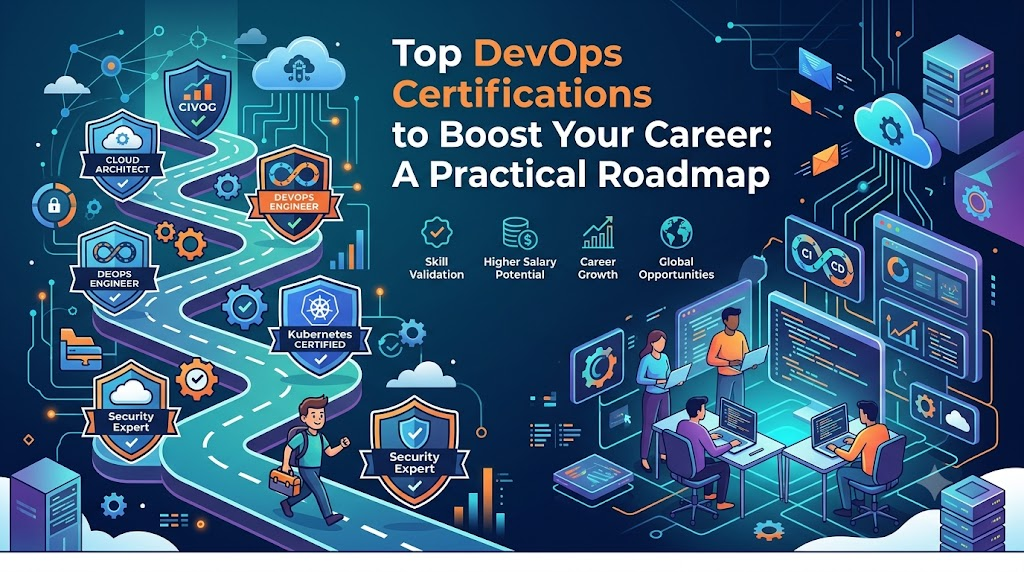
DevOps Certification Roadmap
A successful DevOps journey is cumulative. Each stage builds on the previous one:
- Linux Fundamentals: Understand the OS where 90% of DevOps happens.
- Git & Version Control: Learn to collaborate and track changes.
- Networking Basics: Understand DNS, HTTP/HTTPS, and firewalls.
- Shell Scripting: Master Bash or Python for automation.
- Docker: Learn to containerize applications.
- CI/CD Fundamentals: Master Jenkins, GitLab, or GitHub Actions.
- Cloud Platform Certification: Gain expertise in AWS, Azure, or GCP.
- Terraform / Infrastructure as Code (IaC): Automate your infrastructure provisioning.
- Kubernetes Certification: Orchestrate and manage container clusters.
- Monitoring & Observability: Learn tools like Prometheus and Grafana.
- DevSecOps: Integrate security into your automated pipelines.
- Platform Engineering / SRE: Focus on reliability and internal developer platforms.
- Advanced DevOps Architect Certifications: Validate holistic system design skills.
Top DevOps Certifications
| Certification | Best For | Skill Level | Key Skills Covered | Recommended After |
| Linux Essentials | Beginners | Entry | CLI, Permissions, Users | None |
| HashiCorp Terraform Associate | Infrastructure Engineers | Intermediate | IaC, Provisioning, State | Cloud Basics |
| Certified Kubernetes Administrator (CKA) | K8s Operators | Advanced | Cluster Mgmt, Networking | Docker & K8s Basics |
| AWS/Azure/GCP DevOps Engineer | Cloud Specialists | Advanced | Cloud-Native Pipelines, IaC | Cloud Associate Certs |
| Certified Kubernetes Security Specialist (CKS) | DevSecOps Pros | Expert | Cluster Security, Policy | CKA |
Skills You Should Build Alongside Certifications
| Skill | Why It Matters | Practical Project Idea |
| Linux | Foundation for all servers | Build a LAMP stack from scratch |
| Networking | Understand connectivity issues | Set up a private virtual network |
| Scripting | Automate repetitive tasks | Write a script to backup logs |
| Docker | Containerization standards | Containerize a Python web app |
| Kubernetes | Managing scale | Deploy a multi-tier microservice |
| IaC | Reproducible infrastructure | Provision a VPC using Terraform |
| CI/CD | Automated delivery | Build a pipeline for auto-deploy |
| Monitoring | System health visibility | Set up a dashboard for metrics |
Building a Hands-On Portfolio
Certifications prove you know the theory; a portfolio proves you can build.
- Home Lab: Use a hypervisor (like VirtualBox or Proxmox) or cloud free-tier to host your own infrastructure.
- GitHub Repositories: Document your code, configurations, and IaC templates.
- CI/CD Pipeline Projects: Build a complete “Hello World” app that tests and deploys automatically.
- Documentation: Write technical blogs or README files explaining how you solved a problem.
Study Strategy for Certification Success
- Weekly Learning Plan: Dedicate 10-15 hours per week.
- Practice Labs: Spend 70% of your time in a terminal or console.
- Read Documentation: Official docs (e.g., Kubernetes.io) are better than any summary.
- Mock Exams: Use these to identify weak areas, not just to memorize answers.
- Revision: Revisit fundamentals regularly; they are the most common source of interview failures.
Measuring Certification Readiness
| Metric | Why It Matters | Career Benefit |
| Labs Completed | Shows hands-on experience | Builds real-world problem solving |
| Mock Exam Scores | Validates theoretical knowledge | Reduces exam-day anxiety |
| GitHub Activity | Shows consistent effort | Acts as a visual resume |
| Cloud Projects | Proves capability in production tools | Directly relevant to job requirements |
| Troubleshooting | Proves you can fix what breaks | Critical for SRE and DevOps roles |
Common Certification Challenges
| Challenge | Impact | Recommended Solution |
| Theoretical Study Only | Inability to pass technical interviews | Pair every concept with a lab |
| Overwhelmed by Tools | Lack of depth in any single area | Master one cloud provider first |
| Memorizing Answers | Failure on the job | Focus on understanding why |
| Ignoring Fundamentals | Brittle skills | Revisit Linux/Networking basics |
Best Practices
- Master Fundamentals First: Never skip Linux or networking.
- Build While Studying: Create a project for every certification you earn.
- Consistency: Daily, smaller study sessions are better than weekend marathons.
- Community: Join forums and study groups; DevOps is a collaborative field.
- Keep Evolving: The industry changes; your learning must be continuous.
Real-World Example: The “Career Pivot” Case Study
Candidate: A system administrator with 3 years of experience.
Goal: Transition to a DevOps Engineer role.
- Phase 1 (Months 1-2): Focused on Linux CLI and Bash scripting. Built a local automation project.
- Phase 2 (Months 3-4): Earned an AWS Cloud Practitioner certification. Deployed a static website using S3 and CloudFront.
- Phase 3 (Months 5-6): Learned Terraform. Created a repeatable infrastructure setup on AWS.
- Phase 4 (Months 7-8): Earned the CKA certification. Deployed a containerized app to a K8s cluster.
- Result: Used these projects as the core of their resume and portfolio, successfully landing a Junior DevOps role.
Common Beginner Mistakes
- Chasing “Badges”: Collecting certifications without understanding how they connect.
- Ignoring Linux: Thinking cloud consoles replace the need for the CLI.
- Avoiding Troubleshooting: Getting frustrated when code doesn’t work (this is actually where the learning happens!).
- Comparing Progress: Everyone learns at different speeds; focus on your own roadmap.
Future of DevOps Certifications
The industry is moving toward Platform Engineering, AIOps, and GitOps. Expect future certifications to emphasize:
- Internal Developer Platforms (IDPs).
- AI-assisted pipeline debugging.
- Security as a native component of the workflow.
Practical Certification Checklist
- Strengthen Linux Skills: Be comfortable in the shell.
- Learn Git Workflows: Master branching and PRs.
- Build Docker Projects: Package your own applications.
- Practice CI/CD: Automate a deployment.
- Learn Kubernetes: Understand basic objects and scheduling.
- Deploy Cloud Applications: Use a major provider (AWS/Azure/GCP).
- Study IaC: Master Terraform or CloudFormation.
- Build a Public Portfolio: Document everything on GitHub.
- Schedule Exams: Only when you have completed a related project.
FAQs (15 Questions)
- Which DevOps certification should beginners start with?Start with Linux+ or a basic cloud certification (like AWS Cloud Practitioner) to build a foundation.
- Do certifications guarantee a job?No. They provide the knowledge and credential to get an interview, but your projects and experience get you the job.
- Is Kubernetes certification worth pursuing?Yes, CKA is highly respected and demonstrates deep understanding of orchestration.
- How important are cloud certifications?Extremely important. Most DevOps work is cloud-native today.
- Should I learn Linux before Kubernetes?Yes. Kubernetes runs on Linux; you cannot debug K8s without knowing Linux.
- How many certifications do I need?Quality over quantity. 2-3 highly relevant certifications are better than 10 obscure ones.
- How can I prepare while working full-time?Use a structured 1-hour-a-day approach. Focus on small, consistent progress.
- What projects should I build alongside study?Build a CI/CD pipeline, deploy a web app on K8s, or automate cloud infrastructure provisioning.
- Is coding required for DevOps?Basic scripting (Python/Bash) is essential. Software engineering skills are a huge bonus.
- Do I need a CS degree?Not necessarily, but you must have a logical, engineering-driven mindset.
- Which cloud provider should I pick?AWS is the market leader, but Azure is excellent for enterprise roles. Pick one and get proficient.
- How do I maintain certifications?Most require recertification every 2-3 years, or by taking advanced exams.
- Is DevSecOps a separate field?It is a specialization within DevOps. Focus on security after you understand basic DevOps.
- How long to become job-ready?Usually 6-9 months of dedicated study and practice for a career changer.
- Can I use AI to help me study?Use AI to explain concepts, but never use it to cheat on practice exams or labs.
Final Thoughts
DevOps is not a destination; it is a mindset of continuous improvement. The certifications you choose should be stepping stones that allow you to build better systems and foster stronger engineering cultures. Focus on the “why” and “how” behind the tools, keep your hands on the keyboard, and always prioritize learning by doing. Your portfolio is your best professional asset—let your certifications be the proof of the foundation you’ve built.

Find Trusted Cardiac Hospitals
Compare heart hospitals by city and services — all in one place.
Explore Hospitals