
Introduction
Data Governance Platforms are structured software solutions designed to help organizations define, manage, monitor, and enforce rules around data usage, quality, security, and ownership across the entire data lifecycle. As businesses generate massive volumes of data from cloud systems, applications, customers, and partners, governing that data has become critical—not optional.
Without proper governance, organizations face data inconsistency, regulatory risks, security gaps, and low trust in analytics. Data Governance Platforms bring clarity by establishing data ownership, standard definitions, quality controls, lineage visibility, and policy enforcement across departments.
In real-world scenarios, these platforms are used to ensure regulatory compliance (GDPR, HIPAA, SOC 2), improve data quality for analytics and AI, enable secure data sharing, and support enterprise-wide digital transformation initiatives. They help bridge the gap between IT, data teams, and business users by creating a shared understanding of data.
When evaluating Data Governance Platforms, users should look for metadata management, data cataloging, lineage tracking, policy enforcement, role-based access control, automation, scalability, and strong integration capabilities. Ease of adoption and alignment with existing data ecosystems are equally important.
Best for:
Data Governance Platforms are best suited for data leaders, compliance teams, data engineers, analytics teams, and enterprises in regulated industries such as finance, healthcare, insurance, telecom, retail, and SaaS. They are especially valuable for mid-market to large organizations managing complex, distributed data environments.
Not ideal for:
They may not be ideal for very small teams or startups with minimal data complexity, limited regulatory exposure, or simple reporting needs. In such cases, lightweight data catalogs or basic access controls may be sufficient.
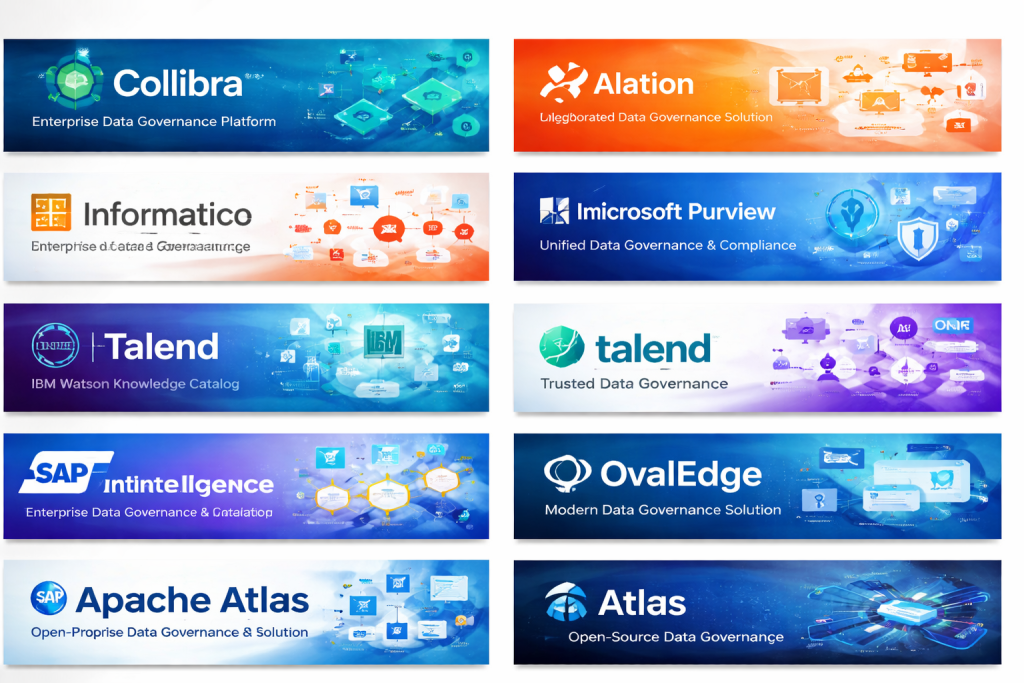
Top 10 Data Governance Platforms Tools
1 — Collibra
Short description:
Collibra is an enterprise-grade data governance platform focused on metadata management, policy enforcement, and data stewardship at scale.
Key features
- Centralized data catalog and business glossary
- End-to-end data lineage visualization
- Automated data quality workflows
- Policy and rule management
- Role-based access control and stewardship workflows
- Integration with major cloud and BI platforms
Pros
- Strong governance framework for large enterprises
- Excellent metadata and lineage depth
- Mature workflow automation
Cons
- Steep learning curve for new users
- Higher cost compared to alternatives
Security & compliance
SSO, encryption, audit logs, GDPR, SOC 2, ISO standards
Support & community
Enterprise-grade support, extensive documentation, structured onboarding, professional services available
2 — Informatica Axon Data Governance
Short description:
Informatica Axon provides comprehensive data governance tightly integrated with Informatica’s data management ecosystem.
Key features
- Business glossary and metadata intelligence
- Automated data lineage and impact analysis
- Policy management and compliance tracking
- Integration with Informatica Data Quality tools
- AI-powered insights for governance
Pros
- Deep integration with Informatica stack
- Strong compliance and lineage capabilities
- Trusted by regulated enterprises
Cons
- Best value only if using Informatica ecosystem
- Complex deployment for smaller teams
Security & compliance
SSO, encryption, GDPR, HIPAA, SOC 2
Support & community
Strong enterprise support, training programs, global partner network
3 — Alation Data Governance App
Short description:
Alation combines data cataloging with collaborative governance to help organizations build data trust and literacy.
Key features
- Intelligent data catalog with AI-driven discovery
- Business glossary and stewardship workflows
- Data lineage and usage analytics
- Collaboration and certification features
- Policy documentation and enforcement
Pros
- Excellent user experience for business users
- Strong collaboration and adoption focus
- Fast time to value
Cons
- Advanced governance requires add-ons
- Pricing may be high for smaller organizations
Security & compliance
SSO, encryption, audit logs, GDPR, SOC 2
Support & community
Strong onboarding, active user community, responsive support
4 — Microsoft Purview
Short description:
Microsoft Purview is a unified data governance and compliance solution designed for organizations using Microsoft and cloud ecosystems.
Key features
- Automated data discovery and classification
- End-to-end data lineage
- Built-in compliance and risk management
- Native integration with Azure services
- Unified data catalog and glossary
Pros
- Seamless integration with Microsoft stack
- Strong compliance capabilities
- Competitive pricing for Azure users
Cons
- Less flexible outside Microsoft ecosystem
- UI can feel complex initially
Security & compliance
Azure AD SSO, encryption, GDPR, ISO, SOC 2
Support & community
Extensive documentation, large community, enterprise support plans
5 — IBM Watson Knowledge Catalog
Short description:
IBM Watson Knowledge Catalog focuses on AI-driven governance, data quality, and policy enforcement within IBM’s data platform.
Key features
- AI-assisted data discovery and classification
- Business glossary and metadata management
- Data quality rules and monitoring
- Policy and access governance
- Integration with IBM Cloud Pak for Data
Pros
- Strong AI and automation features
- Robust data quality controls
- Enterprise-grade scalability
Cons
- Best suited for IBM-centric environments
- Setup can be complex
Security & compliance
SSO, encryption, GDPR, HIPAA, SOC 2
Support & community
Enterprise support, extensive documentation, IBM partner ecosystem
6 — Talend Data Governance
Short description:
Talend Data Governance emphasizes data quality, integrity, and trust as part of Talend’s broader data integration platform.
Key features
- Data catalog and business glossary
- Built-in data quality checks
- Metadata-driven governance workflows
- Integration with ETL and cloud data platforms
- Stewardship and collaboration tools
Pros
- Strong data quality focus
- Good balance of governance and integration
- Flexible deployment options
Cons
- UI can feel dated
- Less advanced lineage compared to leaders
Security & compliance
SSO, encryption, GDPR, SOC 2
Support & community
Good documentation, enterprise support, active user base
7 — Ataccama ONE
Short description:
Ataccama ONE is a unified platform combining data governance, quality, and master data management.
Key features
- Unified metadata and governance framework
- Automated data quality and profiling
- Business glossary and lineage
- AI-powered anomaly detection
- Scalable governance workflows
Pros
- All-in-one governance and quality solution
- Strong automation capabilities
- Suitable for complex data environments
Cons
- Learning curve for non-technical users
- Smaller ecosystem compared to giants
Security & compliance
SSO, encryption, GDPR, ISO, SOC 2
Support & community
Enterprise support, structured onboarding, growing community
8 — SAP Data Intelligence (Governance)
Short description:
SAP Data Intelligence supports governance across SAP and non-SAP data landscapes with strong enterprise controls.
Key features
- Metadata management and lineage
- Policy enforcement and compliance tracking
- Integration with SAP analytics and ERP
- Data orchestration and monitoring
- Enterprise-grade scalability
Pros
- Ideal for SAP-heavy organizations
- Strong operational governance
- Reliable enterprise performance
Cons
- Less intuitive UI
- High cost for non-SAP users
Security & compliance
SSO, encryption, GDPR, ISO, SOC 2
Support & community
Strong enterprise support, SAP partner network
9 — OvalEdge
Short description:
OvalEdge is a modern data governance platform focused on data cataloging, lineage, and stewardship automation.
Key features
- Automated metadata harvesting
- End-to-end data lineage
- Data quality and stewardship workflows
- Business glossary and tagging
- Integration with cloud and BI tools
Pros
- Cost-effective enterprise alternative
- Fast implementation
- Strong lineage visualization
Cons
- Smaller ecosystem
- Advanced features still evolving
Security & compliance
SSO, encryption, GDPR, SOC 2
Support & community
Responsive support, good documentation, growing adoption
10— Apache Atlas
Short description:
Apache Atlas is an open-source data governance and metadata framework used in big data and Hadoop ecosystems.
Key features
- Metadata management and classification
- Data lineage tracking
- Policy framework integration
- Extensible open-source architecture
- Integration with big data platforms
Pros
- No licensing cost
- Highly customizable
- Strong for technical teams
Cons
- Requires engineering effort
- Limited UI and business usability
Security & compliance
Varies / N/A (depends on implementation)
Support & community
Active open-source community, documentation-driven support
Comparison Table
| Tool Name | Best For | Platform(s) Supported | Standout Feature | Rating |
|---|---|---|---|---|
| Collibra | Large enterprises | Cloud / On-prem | Governance workflows | N/A |
| Informatica Axon | Regulated enterprises | Cloud / Hybrid | Metadata intelligence | N/A |
| Alation | Data-driven teams | Cloud | Collaboration & catalog | N/A |
| Microsoft Purview | Microsoft users | Cloud | Native Azure integration | N/A |
| IBM Watson KC | AI-driven governance | Cloud / Hybrid | AI-assisted governance | N/A |
| Talend | Data quality-focused teams | Cloud / Hybrid | Quality-first governance | N/A |
| Ataccama ONE | Unified governance | Cloud / Hybrid | All-in-one platform | N/A |
| SAP Data Intelligence | SAP enterprises | Cloud / Hybrid | SAP ecosystem strength | N/A |
| OvalEdge | Mid-market & enterprise | Cloud | Cost-effective governance | N/A |
| Apache Atlas | Technical teams | On-prem / Cloud | Open-source flexibility | N/A |
Evaluation & Scoring of Data Governance Platforms
| Tool | Core Features (25%) | Ease of Use (15%) | Integrations (15%) | Security (10%) | Performance (10%) | Support (10%) | Price (15%) | Total Score |
|---|---|---|---|---|---|---|---|---|
| Collibra | 23 | 12 | 14 | 9 | 9 | 9 | 10 | 86 |
| Informatica Axon | 24 | 11 | 15 | 9 | 9 | 9 | 9 | 85 |
| Alation | 22 | 14 | 13 | 9 | 8 | 9 | 10 | 85 |
| Microsoft Purview | 21 | 13 | 14 | 9 | 9 | 8 | 12 | 86 |
| IBM Watson KC | 22 | 11 | 13 | 9 | 9 | 9 | 9 | 81 |
Which Data Governance Platforms Tool Is Right for You?
- Solo users & small teams: Lightweight tools or open-source options like Apache Atlas
- SMBs: OvalEdge, Talend for balanced cost and features
- Mid-market: Alation, Ataccama ONE for usability and depth
- Enterprise: Collibra, Informatica, Microsoft Purview, SAP
Budget-conscious: Open-source or mid-market tools
Premium solutions: Enterprise platforms with compliance depth
Ease of use: Alation, Microsoft Purview
Deep governance: Collibra, Informatica
Scalability: Enterprise-focused platforms
Compliance-heavy environments: Microsoft, IBM, SAP, Informatica
Frequently Asked Questions (FAQs)
1. What is a Data Governance Platform?
It is software that helps organizations manage data ownership, quality, security, and compliance.
2. Why is data governance important?
It ensures data accuracy, regulatory compliance, and trust in analytics.
3. Do small companies need data governance tools?
Only if data complexity or compliance requirements justify it.
4. Are these tools cloud-based?
Most support cloud, hybrid, or on-prem deployments.
5. How long does implementation take?
From weeks for small deployments to months for enterprise rollouts.
6. Do they support GDPR and HIPAA?
Most enterprise tools do; always verify based on use case.
7. Are open-source tools reliable?
Yes, but they require more engineering effort.
8. Can these tools integrate with BI platforms?
Most integrate with popular analytics and cloud tools.
9. What is the biggest mistake in governance adoption?
Focusing on tools without defining clear governance processes.
10. Is there one best platform for everyone?
No. The best choice depends on data scale, budget, and compliance needs.
Conclusion
Data Governance Platforms play a critical role in helping organizations control, trust, and maximize the value of their data. From metadata management and lineage tracking to compliance enforcement and collaboration, these tools provide the foundation for responsible data-driven decision-making.
The most important takeaway is that there is no universal “best” platform. Enterprises with strict compliance needs may prioritize depth and control, while growing teams may value ease of use and faster adoption. Budget, ecosystem fit, scalability, and governance maturity should guide the final decision.
By aligning platform capabilities with business goals, organizations can build a strong, sustainable data governance strategy that supports analytics, AI, and long-term growth.

Find Trusted Cardiac Hospitals
Compare heart hospitals by city and services — all in one place.
Explore Hospitals
This article provides a clear and useful comparison of the top data governance platforms, helping readers understand the key features that support compliance, data quality, and policy management across complex systems. The explanation of strengths and limitations makes it easier for both beginners and experienced professionals to evaluate tools based on their specific needs, such as metadata management, access controls, and integration with existing data environments. By focusing on practical differences and real-world considerations rather than just listing names, this post serves as a valuable reference for anyone looking to choose the right data governance solution to improve trust and control over their organization’s data. Great resource for making informed decisions!