
Introduction
Investor Relations Platforms are specialized digital tools designed to help companies manage, streamline, and professionalize communication with investors, analysts, regulators, and other financial stakeholders. These platforms centralize critical activities such as earnings communications, investor presentations, regulatory disclosures, shareholder engagement, and performance reporting—all in one secure, structured environment.
In today’s data-driven and compliance-heavy business landscape, effective investor relations is no longer optional. Public companies, pre-IPO firms, and fast-growing private organizations must deliver accurate, timely, and transparent information while maintaining trust and credibility. Manual processes, spreadsheets, and ad-hoc communication often lead to errors, delays, and compliance risks. Investor Relations Platforms solve this by automating workflows, ensuring consistency, and enabling real-time insights into investor engagement.
Common real-world use cases include:
- Managing earnings calls, reports, and announcements
- Tracking shareholder ownership and engagement
- Ensuring regulatory compliance and disclosure accuracy
- Centralizing IR websites, presentations, and filings
- Supporting IPO readiness and ongoing public reporting
When choosing an Investor Relations Platform, users should evaluate feature depth, ease of use, security, compliance readiness, analytics, integrations, scalability, and long-term value. The right platform not only simplifies IR operations but also strengthens investor confidence.
Best for:
Investor Relations Platforms are best suited for public companies, pre-IPO firms, CFOs, IR managers, finance leaders, legal teams, and executive leadership in industries such as technology, finance, healthcare, energy, manufacturing, and large-scale enterprises.
Not ideal for:
These tools may be unnecessary for very early-stage startups, small privately held businesses with no external investors, or organizations with minimal reporting and compliance needs, where simpler communication tools or basic financial reporting software may suffice.
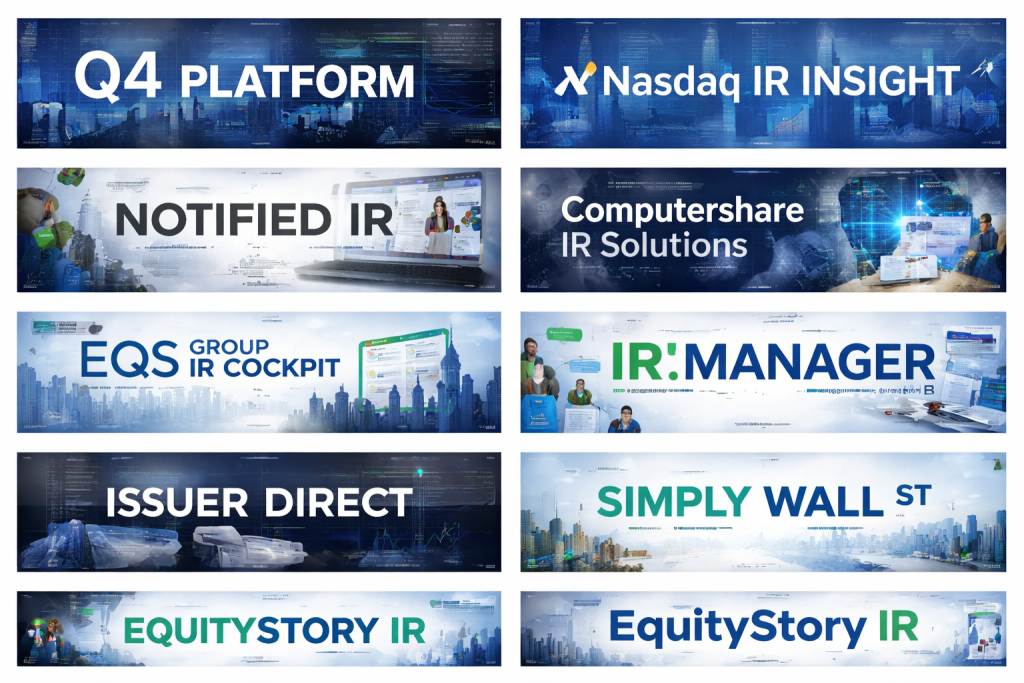
Top 10 Investor Relations Platforms Tools
1 — Q4 Platform
Short description:
Q4 Platform is a comprehensive investor relations solution built for public companies and IR teams seeking advanced analytics, engagement insights, and end-to-end IR workflow management.
Key features:
- Investor website management and hosting
- Advanced investor engagement analytics
- Earnings event and webcast management
- CRM-style investor contact tracking
- Shareholder intelligence and ownership data
- Reporting and benchmarking tools
Pros:
- Strong analytics and data-driven insights
- Well-suited for enterprise IR teams
Cons:
- Premium pricing
- May be complex for smaller teams
Security & compliance:
SSO, encryption, GDPR support, SOC-aligned controls
Support & community:
Enterprise onboarding, dedicated account managers, strong documentation
2 — Nasdaq IR Insight
Short description:
Nasdaq IR Insight is a data-focused investor relations platform designed to help companies understand investor behavior and optimize outreach strategies.
Key features:
- Shareholder and ownership analysis
- Market intelligence and peer benchmarking
- Investor targeting tools
- Event and earnings support
- CRM functionality for IR teams
Pros:
- Deep market and investor data
- Strong integration with market intelligence
Cons:
- Heavily data-centric, less content-focused
- Learning curve for non-analytical users
Security & compliance:
Enterprise-grade security, GDPR compliant
Support & community:
Professional support, training resources, enterprise service options
3 — Notified IR (formerly Intrado)
Short description:
Notified IR focuses on investor communications, earnings calls, and regulatory disclosure workflows for public companies.
Key features:
- Earnings calls and webcasts
- Press release and disclosure distribution
- Investor website tools
- Compliance-focused workflows
- Multimedia content management
Pros:
- Excellent for earnings communications
- Reliable event delivery
Cons:
- Limited advanced analytics
- Less flexible customization
Security & compliance:
SOC-aligned controls, encryption, GDPR-ready
Support & community:
Strong onboarding, live event support, responsive helpdesk
4 — Computershare IR Solutions
Short description:
Computershare IR Solutions combines shareholder services with investor relations tools, making it ideal for regulated and global enterprises.
Key features:
- Shareholder registry integration
- Meeting and voting management
- Regulatory reporting support
- Investor communications tools
- Global market coverage
Pros:
- Strong compliance and governance support
- Global scalability
Cons:
- UI can feel dated
- Less agile for modern IR marketing
Security & compliance:
High compliance standards, GDPR, ISO-aligned
Support & community:
Enterprise-grade global support, compliance experts available
5 — EQS Group IR COCKPIT
Short description:
EQS Group IR COCKPIT is a modular investor relations and compliance platform widely used in European markets.
Key features:
- Disclosure and compliance management
- Investor and analyst database
- IR website and content tools
- Reporting and documentation workflows
- Regulatory deadline tracking
Pros:
- Strong compliance automation
- Modular and customizable
Cons:
- Primarily Europe-focused
- Interface can feel complex
Security & compliance:
GDPR-first design, ISO certifications
Support & community:
Regional support teams, structured onboarding
6 — InvestorHub
Short description:
InvestorHub focuses on community-style engagement, helping companies communicate directly with investors and retail shareholders.
Key features:
- Investor community forums
- Direct Q&A and messaging
- Announcement distribution
- Analytics on investor sentiment
- Mobile-friendly engagement tools
Pros:
- Excellent retail investor engagement
- Simple and intuitive
Cons:
- Limited enterprise reporting tools
- Less suitable for complex compliance needs
Security & compliance:
Standard encryption, GDPR-ready
Support & community:
Good onboarding support, active user community
7 — IR.Manager
Short description:
IR.Manager is a streamlined investor relations management platform focused on communication efficiency and transparency.
Key features:
- IR website management
- Investor contact database
- News and disclosure publishing
- Analytics and reporting
- Workflow automation
Pros:
- Clean interface
- Cost-effective for mid-sized companies
Cons:
- Limited advanced analytics
- Fewer third-party integrations
Security & compliance:
Encryption, role-based access, GDPR support
Support & community:
Email and ticket-based support, solid documentation
8 — Issuer Direct
Short description:
Issuer Direct provides an all-in-one IR and compliance solution, combining communications, filings, and analytics.
Key features:
- SEC and regulatory filing support
- Earnings calls and webcasts
- Investor website tools
- Shareholder analytics
- Compliance monitoring
Pros:
- Strong regulatory coverage
- Integrated compliance workflows
Cons:
- UI could be more modern
- Customization limitations
Security & compliance:
SOC-aligned controls, encryption, regulatory compliance support
Support & community:
Dedicated support teams, compliance specialists
9 — Simply Wall St (IR Tools)
Short description:
Simply Wall St offers visual analytics and simplified investor insights, increasingly used by IR teams for storytelling.
Key features:
- Visual financial analysis
- Investor-friendly dashboards
- Market comparisons
- Data-driven storytelling tools
- Performance summaries
Pros:
- Excellent visual clarity
- Easy for non-financial audiences
Cons:
- Not a full IR management suite
- Limited compliance features
Security & compliance:
Standard security practices, GDPR-ready
Support & community:
Online documentation, community-driven resources
10 — EquityStory IR
Short description:
EquityStory IR is a European-focused investor relations platform offering communication, disclosure, and compliance tools.
Key features:
- Regulatory disclosure management
- IR website hosting
- Investor targeting and CRM
- Event and earnings support
- Reporting tools
Pros:
- Strong compliance alignment
- Flexible IR communication tools
Cons:
- Regional focus
- Smaller ecosystem
Security & compliance:
GDPR-compliant, ISO-aligned processes
Support & community:
Dedicated support, regional expertise
Comparison Table
| Tool Name | Best For | Platform(s) Supported | Standout Feature | Rating |
|---|---|---|---|---|
| Q4 Platform | Enterprise IR teams | Web-based | Investor engagement analytics | N/A |
| Nasdaq IR Insight | Data-driven IR teams | Web-based | Market intelligence | N/A |
| Notified IR | Earnings communications | Web-based | Webcasts & disclosures | N/A |
| Computershare IR | Global enterprises | Web-based | Shareholder services | N/A |
| EQS Group IR COCKPIT | Compliance-heavy firms | Web-based | Regulatory automation | N/A |
| InvestorHub | Retail investor engagement | Web, Mobile | Investor community | N/A |
| IR.Manager | Mid-sized companies | Web-based | Simplicity | N/A |
| Issuer Direct | Compliance-focused firms | Web-based | Filing & IR integration | N/A |
| Simply Wall St | Visual storytelling | Web-based | Financial visualization | N/A |
| EquityStory IR | European IR teams | Web-based | Disclosure management | N/A |
Evaluation & Scoring of Investor Relations Platforms
| Tool | Core Features (25%) | Ease of Use (15%) | Integrations (15%) | Security (10%) | Performance (10%) | Support (10%) | Price/Value (15%) | Total Score |
|---|---|---|---|---|---|---|---|---|
| Q4 Platform | 23 | 12 | 13 | 9 | 9 | 9 | 10 | 85 |
| Nasdaq IR Insight | 22 | 11 | 14 | 9 | 9 | 8 | 10 | 83 |
| Notified IR | 21 | 13 | 11 | 8 | 9 | 9 | 11 | 82 |
| Computershare IR | 22 | 10 | 12 | 10 | 9 | 9 | 9 | 81 |
| EQS Group IR | 21 | 11 | 12 | 9 | 8 | 8 | 10 | 79 |
Which Investor Relations Platforms Tool Is Right for You?
Choosing the right Investor Relations Platform depends on scale, complexity, budget, and regulatory exposure.
- Solo users or small teams: Look for simple, cost-effective tools like IR.Manager or InvestorHub
- SMBs and mid-market firms: Platforms such as Issuer Direct or EquityStory provide balance
- Enterprise organizations: Q4 Platform, Nasdaq IR Insight, or Computershare IR offer depth and scalability
Budget-conscious teams should prioritize usability and essential features, while premium buyers may value analytics, benchmarking, and automation.
If integrations and scalability are critical, enterprise-grade platforms are preferable.
Highly regulated industries should prioritize security, audit trails, and compliance automation.
Frequently Asked Questions (FAQs)
1. What is an Investor Relations Platform?
It is a tool that centralizes investor communication, reporting, analytics, and compliance workflows.
2. Are Investor Relations Platforms only for public companies?
No. Pre-IPO and late-stage private companies also benefit significantly.
3. How long does implementation usually take?
Anywhere from a few weeks to several months, depending on complexity.
4. Do these platforms replace IR teams?
No. They support and enhance IR teams, not replace them.
5. Are these platforms secure?
Most offer enterprise-grade security, encryption, and compliance controls.
6. Can they integrate with financial systems?
Many support integrations, though depth varies by vendor.
7. Are they suitable for global investors?
Yes, especially platforms with multilingual and regional compliance support.
8. What is the biggest mistake buyers make?
Choosing based on brand rather than actual workflow needs.
9. Are there alternatives to full IR platforms?
Yes, but they often lack compliance and analytics depth.
10. How do I measure ROI?
Improved efficiency, reduced risk, better investor engagement, and time savings.
Conclusion
Investor Relations Platforms play a critical role in building trust, ensuring transparency, and maintaining regulatory compliance in today’s financial environment. From managing earnings communications to analyzing investor engagement, these tools bring structure and clarity to complex IR workflows.
When selecting a platform, focus on your organization’s size, regulatory needs, budget, and long-term growth plans. There is no single “best” solution for everyone—the right choice depends on your specific context, stakeholders, and goals. By aligning features with real-world requirements, companies can transform investor relations from a reactive function into a strategic advantage.

Find Trusted Cardiac Hospitals
Compare heart hospitals by city and services — all in one place.
Explore Hospitals
Investor relations platforms help organizations maintain transparent communication with shareholders, analysts, and potential investors through accurate, accessible financial information. Features such as earnings management, investor targeting, contact tracking, and regulatory disclosure support can make reporting more efficient and consistent. Integrating these capabilities with reliable financial data sources also helps teams strengthen stakeholder relationships and communicate corporate performance with greater confidence.
Investor relations platforms should make it easy to trace who reviewed, changed, and approved each public statement. Clear permissions and reliable audit logs can reduce the risk of conflicting figures or premature disclosures. Teams should also confirm that website content matches approved financial records before publishing earnings updates. Backup procedures matter when a webcast fails or a critical announcement faces a technical delay. Keeping exportable records and tracking approval errors can help companies prepare for audits and future platform changes.
Investor relations platforms can help companies share important updates and keep communication with investors organized. I think having accurate financial information and timely announcements in one place can make a real difference. It is also useful to track investor questions and feedback so companies can respond more effectively. Clear and consistent communication helps build trust over time.
Investor relations platforms help companies share updates and manage communication with investors. The right system should make information easy to find while protecting sensitive material. I would compare contact management, meeting schedules, document sharing, reporting, and access controls. Accurate records of investor questions and follow-ups can also help teams maintain consistent communication. Teams should test how the platform handles different access levels and prepares materials for reporting periods. Integration with existing data sources may reduce manual work. A useful platform should support clear, timely communication and help teams understand investor engagement without creating extra administrative effort.
Investor relations teams also need a reliable way to manage the full lifecycle of financial content. When several departments prepare presentations, earnings releases, and website updates, outdated figures or conflicting statements can slip into published materials. A shared approval workflow should track document versions, identify the source of each financial figure, and prevent unapproved changes from reaching public channels. I would also test how the platform handles last-minute corrections, scheduled announcements, and access restrictions during sensitive reporting periods. Maintaining a clear record of who reviewed and published each item can make investigations easier if an error occurs. These controls help companies keep investor communications consistent while reducing the risk of avoidable disclosure mistakes.
Investor relations platforms should help companies deliver consistent, timely information to investors while keeping sensitive materials properly controlled. When comparing options, check how they manage earnings-call registration, investor questions, shareholder data, and distribution of financial disclosures. A reliable audit trail for document access and communication history is also valuable, helping IR teams prepare for reporting periods and respond accurately to investor requests.
From a platform engineering perspective, high-traffic earnings releases expose serious availability risks. Third-party IR portals frequently lack multi-region failover and CDN origin-shielding against sudden read surges. Integrating immutable S3 publishing pipelines with automated DNS failover is critical to avoid embarrassing downtime during strict regulatory disclosure windows.
Investor relations platforms help public companies manage shareholder communications, organize investor data, share financial disclosures, and prepare for earnings calls and corporate events. Solutions like Q4 offer investor websites, engagement analytics, and communication tools, helping IR teams strengthen transparency, understand investor interests, and manage stakeholder relationships more efficiently.
Choosing the right investor relations platform often comes down to balancing deep analytical tools with seamless compliance workflows. While enterprise suites like Q4 or Nasdaq IR Insight offer incredible market intelligence, smaller IR teams can easily get bogged down by the sheer complexity. How do you find the sweet spot between advanced shareholder data and day-to-day usability.
A well-designed IVR should focus on resolving caller needs quickly, not just automating every step. Testing real call journeys, keeping menu options short, and providing an easy route to a live agent can make a significant difference to customer satisfaction and reduce abandoned calls.
This comparison is helpful because it explains investor relations platforms in a practical way, not just as “tools for announcements.” I liked that it highlights the real work behind IR—keeping filings and presentations organized, managing approvals, updating the investor website, tracking engagement, and supporting earnings calls without last-minute confusion. The pros and cons also make it easier to choose, because a small company may only need a clean IR site and basic analytics, while larger teams often need stronger workflows, security controls, and audit trails for compliance. One smart step before finalizing any platform is to test a full cycle (press release → approvals → website update → reporting) to see if the process stays smooth under deadline pressure.