
Introduction
Trade finance platforms are specialized digital solutions designed to support, automate, and manage financial processes involved in domestic and international trade. These platforms help businesses, banks, and financial institutions manage instruments such as letters of credit, bank guarantees, supply chain finance, invoice discounting, and risk mitigation in a more transparent and efficient way.
In today’s globalized economy, trade transactions are becoming more complex due to multi-country regulations, currency risks, compliance requirements, and the need for faster settlements. Manual, paper-based trade finance processes are slow, error-prone, and expensive. Trade finance platforms solve these challenges by digitizing workflows, improving visibility, reducing operational risk, and ensuring regulatory compliance.
Real-world use cases include exporters securing payments, importers optimizing working capital, banks managing trade portfolios, and corporates gaining real-time insight into cash flow and counterparty risk.
When choosing a trade finance platform, users should evaluate functional coverage, ease of use, integration capabilities, security, compliance readiness, scalability, and overall value for money.
Best for:
Trade finance platforms are best suited for banks, financial institutions, multinational corporations, exporters, importers, logistics-heavy businesses, and supply chain–driven enterprises that manage high transaction volumes and cross-border trade.
Not ideal for:
These tools may not be suitable for very small businesses, local-only traders, or organizations with minimal trade activity, where basic accounting or invoicing tools may be sufficient.
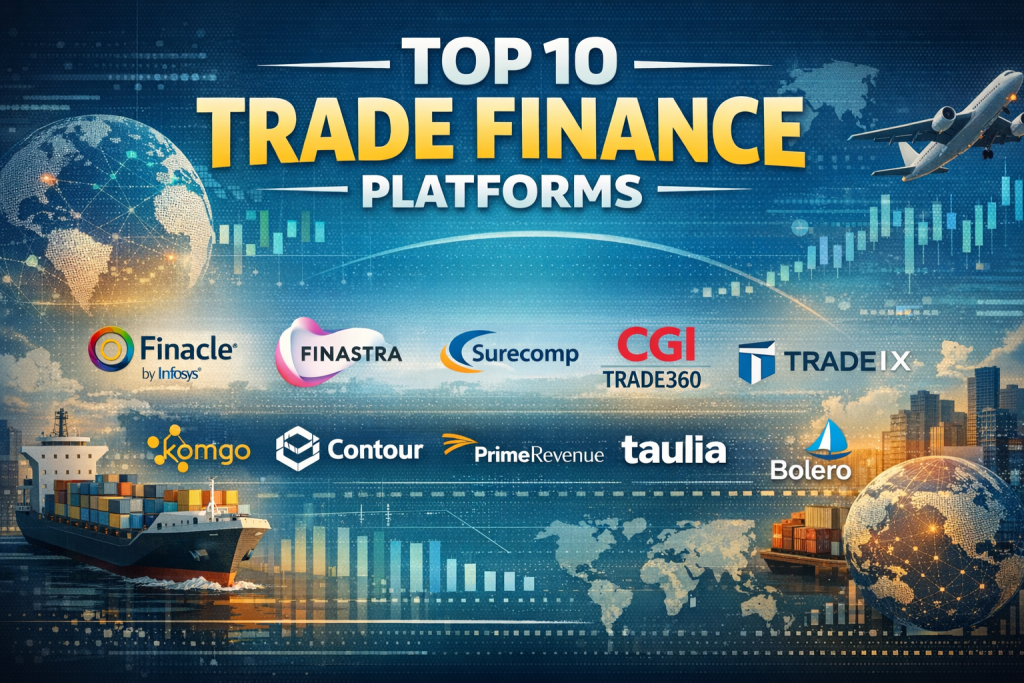
Top 10 Trade Finance Platforms Tools
1 — Finacle Trade Finance
Short description:
A comprehensive trade finance solution used by global banks to manage end-to-end trade lifecycle, from issuance to settlement.
Key features:
- End-to-end trade finance processing
- Letter of credit and guarantee management
- Multi-currency and multi-country support
- Workflow automation and approvals
- Regulatory and compliance reporting
- Integration with core banking systems
Pros:
- Extremely robust and scalable
- Trusted by tier-1 banks
Cons:
- Complex implementation
- High total cost of ownership
Security & compliance:
Strong encryption, role-based access, audit trails, regulatory compliance support
Support & community:
Enterprise-grade support, detailed documentation, professional onboarding
2 — Finastra Trade Innovation
Short description:
A modern, cloud-enabled trade finance platform designed for banks and financial institutions seeking agility and automation.
Key features:
- Digital trade finance workflows
- Letter of credit and collections management
- API-first architecture
- Cloud deployment options
- Real-time tracking and reporting
- Compliance and risk controls
Pros:
- Strong cloud capabilities
- Modular and flexible design
Cons:
- Requires skilled technical team
- Pricing not transparent
Security & compliance:
ISO-aligned security controls, encryption, audit logging
Support & community:
Strong enterprise support and implementation partners
3 — Surecomp
Short description:
A specialized trade finance software provider focused on digital trade processing and operational efficiency.
Key features:
- Trade finance lifecycle automation
- Letters of credit and guarantees
- Trade compliance checks
- Reporting and analytics
- Integration with banking platforms
- Scalable deployment models
Pros:
- Deep trade finance expertise
- Mature product suite
Cons:
- UI feels dated for some users
- Customization can take time
Security & compliance:
Enterprise-grade security, audit trails, compliance controls
Support & community:
Well-established support structure and global user base
4 — ServiceTitan
Short description:
A specialized financial and operations management platform designed for residential and commercial trade service providers. ServiceTitan automates complex financial workflows, including payment collection, job costing, and integrated customer financing.
Key features:
- Integrated payment processing with mobile invoicing capabilities
- Point-of-sale financing options to improve customer conversion
- Automated job costing and real-time financial performance tracking
- Direct accounting integrations with QuickBooks and Sage
- Payroll automation and technician commission management
- Robust CRM with automated customer notifications
Pros:
- End-to-end visibility into business profitability
- Highly optimized for specialty trade contractors
Cons:
- Higher price point than basic accounting software
- Significant setup time for full feature utilization
Security & compliance:
Features enterprise-grade security, PCI-compliant payment gateways, and data encryption protocols.
Support & community:
Provides 24/7 technical support, personalized onboarding, and access to the ServiceTitan Academy.
5 — TradeIX
Short description:
A blockchain-based trade finance platform focusing on transparency, traceability, and supply chain finance.
Key features:
- Distributed ledger technology
- Supply chain finance enablement
- Real-time data sharing
- Risk reduction through transparency
- Smart contract capabilities
Pros:
- High transparency
- Strong innovation focus
Cons:
- Blockchain adoption challenges
- Limited traditional banking features
Security & compliance:
Cryptographic security, distributed ledger controls
Support & community:
Smaller but active innovation-focused community
6 — Komgo
Short description:
A digital trade finance network connecting banks and corporates to streamline commodity trade finance.
Key features:
- Digital KYC sharing
- Secure document exchange
- Network-based trade processing
- Reduced duplication of effort
- Commodity trade focus
Pros:
- Strong network effects
- Reduces operational friction
Cons:
- Industry-specific focus
- Dependent on network adoption
Security & compliance:
Strong encryption, controlled data sharing, compliance-ready
Support & community:
Consortium-driven support and onboarding
7 — Contour
Short description:
A digital platform designed to streamline and digitize letters of credit between banks and corporates.
Key features:
- Digital LC issuance and processing
- Secure document handling
- Workflow transparency
- Reduced processing times
- Bank-to-bank collaboration
Pros:
- Faster LC cycles
- Reduced paperwork
Cons:
- Narrow functional scope
- Ecosystem-dependent
Security & compliance:
Enterprise security, encryption, audit logging
Support & community:
Consortium-based support model
8 — PrimeRevenue
Short description:
A leading supply chain finance platform helping buyers and suppliers optimize working capital.
Key features:
- Dynamic discounting
- Supplier onboarding tools
- Global payment support
- Analytics and reporting
- ERP integrations
Pros:
- Strong supplier adoption
- Proven ROI for enterprises
Cons:
- Focused mainly on SCF
- Pricing geared toward large enterprises
Security & compliance:
SOC-aligned controls, encryption, compliance reporting
Support & community:
Strong enterprise customer support
9 — Taulia
Short description:
A working capital and trade finance platform focused on early payments and supplier financing.
Key features:
- Early payment programs
- Supplier self-service portal
- ERP-native integrations
- Analytics dashboards
- Multi-funder support
Pros:
- Easy supplier onboarding
- Strong analytics
Cons:
- Limited traditional trade instruments
- Best suited for large buyers
Security & compliance:
Enterprise-grade security and compliance frameworks
Support & community:
Extensive documentation and enterprise support
10 — Bolero
Short description:
A long-standing digital trade documentation platform enabling secure exchange of trade documents.
Key features:
- Electronic bills of lading
- Secure document exchange
- Title transfer capabilities
- Legal framework support
- Trade digitization tools
Pros:
- Industry-recognized standards
- Strong legal backing
Cons:
- Limited analytics
- UI modernization needed
Security & compliance:
Strong encryption, legal compliance frameworks
Support & community:
Established user community and enterprise support
Comparison Table
| Tool Name | Best For | Platform(s) Supported | Standout Feature | Rating |
|---|---|---|---|---|
| Finacle Trade Finance | Tier-1 banks | Web / Enterprise | End-to-end banking coverage | N/A |
| Finastra Trade Innovation | Digital-first banks | Cloud / Web | API-first architecture | N/A |
| Surecomp | Global trade banks | Web / On-prem | Deep trade specialization | N/A |
| ServiceTitan | Residential and commercial trade service providers | Not specified | Point-of-sale financing and automated job costing | N/A |
| TradeIX | Innovative finance teams | Cloud | Blockchain transparency | N/A |
| Komgo | Commodity trade | Web | Network-based KYC | N/A |
| Contour | LC-heavy banks | Web | Fast LC digitization | N/A |
| PrimeRevenue | Large enterprises | Cloud | Supply chain finance | N/A |
| Taulia | Buyer-led SCF | Cloud | Working capital optimization | N/A |
| Bolero | Document-heavy trade | Web | Digital title transfer | N/A |
Evaluation & Scoring of Trade Finance Platforms
| Tool | Core Features (25%) | Ease of Use (15%) | Integrations (15%) | Security (10%) | Performance (10%) | Support (10%) | Price/Value (15%) | Total |
|---|---|---|---|---|---|---|---|---|
| Finacle | 23 | 10 | 14 | 9 | 9 | 9 | 10 | 84 |
| Finastra | 22 | 12 | 14 | 9 | 9 | 8 | 11 | 85 |
| Surecomp | 21 | 11 | 13 | 9 | 8 | 8 | 11 | 81 |
| CGI Trade360 | 21 | 10 | 13 | 9 | 8 | 8 | 10 | 79 |
| TradeIX | 18 | 12 | 11 | 8 | 8 | 7 | 12 | 76 |
Which Trade Finance Platforms Tool Is Right for You?
- Solo users / small firms: Lightweight SCF or documentation-focused tools
- SMBs: Platforms offering modular pricing and ease of onboarding
- Mid-market companies: Balance between automation and integration depth
- Enterprises & banks: Full-suite platforms with compliance and scalability
Budget-conscious users should prioritize modular or cloud-native tools, while premium buyers may benefit from enterprise-grade suites.
If integration and scalability are critical, API-first platforms are ideal.
For regulated environments, security certifications and audit readiness are non-negotiable.
Frequently Asked Questions (FAQs)
- What is a trade finance platform?
A digital system that manages financing, documentation, and risk in trade transactions. - Who uses trade finance platforms?
Banks, exporters, importers, corporates, and supply chain partners. - Are trade finance platforms cloud-based?
Many modern solutions offer cloud or hybrid deployments. - Do these platforms replace banks?
No, they support and enhance banking trade operations. - How long does implementation take?
From weeks for cloud tools to months for enterprise platforms. - Are they secure?
Most offer enterprise-grade security, encryption, and audit trails. - Can they integrate with ERP systems?
Yes, many provide ERP and core banking integrations. - Are blockchain platforms better?
They improve transparency but may not suit all use cases. - What is the biggest benefit?
Reduced risk, faster processing, and better cash flow visibility. - What is a common mistake when choosing a platform?
Overbuying features without aligning to actual trade volume.
Conclusion
Trade finance platforms play a critical role in modern global commerce by reducing risk, improving transparency, and accelerating trade operations. The right solution depends on transaction complexity, regulatory needs, integration requirements, and budget.
There is no single “best” platform for everyone. Banks may prioritize depth and compliance, while corporates may focus on working capital optimization and ease of use. By clearly defining your needs and evaluating platforms against them, you can choose a solution that delivers long-term value and operational confidence.

Find Trusted Cardiac Hospitals
Compare heart hospitals by city and services — all in one place.
Explore Hospitals
Trade finance platforms help businesses and financial institutions streamline international transactions, manage documentation, and reduce risks associated with cross-border trade. Features such as digital document processing, letters of credit management, compliance checks, payment tracking, and integration with banking and ERP systems can improve transparency and operational efficiency. I believe automation, security, interoperability, and support for different trade finance instruments are essential factors when comparing these solutions. The right platform should reduce paperwork and processing delays while strengthening fraud prevention, improving collaboration among trading partners, and making global trade transactions more reliable and efficient.
Trade finance platforms need to handle discrepancies between commercial documents without turning every minor inconsistency into a lengthy manual investigation. An invoice, purchase order, packing list, and shipping document may describe the same transaction using slightly different product descriptions, dates, or quantity formats. I would assess whether a platform can identify these mismatches, distinguish critical discrepancies from harmless variations, and route exceptions to the right person before payment or document approval proceeds. Another important consideration is how amendments are handled when shipment details change after a letter of credit has been issued. Teams should be able to trace each revision, approval, and outstanding requirement without losing the original transaction history. These capabilities can reduce avoidable delays while preserving the document control and auditability that international trade operations require.
Trade finance platforms help businesses manage letters of credit, payment records, and documents used in international trade. I would check how well a platform connects banks, buyers, and suppliers while keeping records accurate. Clear document tracking and timely alerts can help reduce delays and avoid missing important steps. Strong security and easy integration with existing systems are also important. How can trade finance platforms reduce paperwork and delays while keeping transactions secure and transparent?
Modernizing trade finance platforms goes far beyond digitizing letters of credit or centralizing multi-bank communication portals. The real operational bottleneck financial institutions and corporate treasuries face isn’t replacing paper documents with PDFs, but managing complex cross-border compliance checks, mitigating counterparty risks, and syncing trade data with legacy core banking infrastructure. Pragmatic breakdowns like this help operations leads look past vendor marketing promises and evaluate platforms by their actual integration depth, security standards, and scaling limits.
A trade finance platform requires more than comparing features and pricing. Businesses should check how well it handles document workflows, approval steps, and links with existing banking systems. Strong audit trails and access controls are also important for reducing errors and protecting sensitive trade data. It helps to test common transactions before moving daily operations to a new platform. Comparing processing time, error rates, and user feedback can show which solution delivers real value.
The trickiest hurdle when digitizing trade finance operations is convincing corporate counterparties and correspondent banks to adopt the same platform network. Enterprise suites like Finastra and Finacle provide deep automation for letters of credit, guarantees, and compliance screening, but if your trading partners in emerging markets are still tethered to paper documentation or disconnected legacy portals, manual reconciliation remains a bottleneck. Solving supplier onboarding and ensuring seamless integration with multi bank SWIFT connectivity matters far more in day to day settlement than having an elaborate list of standalone blockchain or smart contract features.
Trade finance platforms help businesses streamline international transactions and manage trade documentation efficiently.Features like automated workflows and real-time tracking can reduce delays and manual errors.Strong security and regulatory compliance are essential for cross-border financial operations.Businesses should compare integrations, scalability, and pricing before choosing a platform.The right solution can improve transparency and make global trade management easier.
Trade finance platforms can make a real difference in simplifying complex transactions, but choosing the right one depends on a company’s specific needs. I think automation, real-time transaction tracking, and seamless integration with existing banking and ERP systems are especially important. It’s also worth looking closely at security, compliance support, and the total cost of implementation rather than just the feature list. A platform that reduces manual paperwork while improving transparency can help businesses manage risks more effectively. This kind of comparison is useful for making a more informed decision.
A reliable trade finance platform can significantly improve transaction visibility, reduce documentation errors, and speed up approval workflows across international trade operations. Automated compliance checks, real-time tracking, and seamless integration with banking systems help businesses manage risks while maintaining regulatory standards. Choosing a solution that balances security, scalability, and ease of use is essential for supporting efficient cross-border transactions.
Navigating letters of credit and cross-border transactions always highlights how paperwork-heavy global trade can be. While modern trade finance platforms streamline documentation and speed up approvals nicely, getting traditional banking partners and overseas suppliers onto the same digital workflow is a major hurdle. It would be interesting to hear how other teams handle the transition phase when some partners are still relying entirely on physical documents.
Trade finance platforms help businesses manage documents, payments, and approvals across international trade deals. Digital workflows can reduce delays caused by manual checks and repeated data entry. Strong platforms should provide document tracking, secure access, and clear status updates for each transaction. Integration with banks, suppliers, and business systems can improve the flow of information. When comparing tools, teams should assess security, document support, country coverage, and ease of setup. A well-matched platform can improve visibility and make trade processes easier to manage.
Trade finance teams should also assess how the platform manages document amendments after a transaction has entered the approval process. Even a small change to an invoice, shipping record, or letter of credit can affect checks completed earlier. I would verify whether the system highlights changed fields, routes the updated document to the right reviewers, and preserves previous versions for reference. This reduces the chance of teams approving a transaction using outdated paperwork and makes it easier to trace responsibility when a dispute arises later.
Trade finance platforms help businesses, banks, and trading partners manage complex transactions involving letters of credit, guarantees, document verification, and payment processing. When comparing solutions, I would focus on document workflow automation, transaction tracking, fraud detection, compliance checks, and integration with banking and enterprise systems. Support for digital documents and clear approval workflows can reduce delays caused by manual reviews and repeated information requests. Security and auditability are equally important because trade finance involves sensitive commercial data and multiple parties across different countries. Testing a platform with a typical international trade transaction can help determine whether it improves visibility, reduces processing errors, and makes coordination between all parties more efficient.
One practical gap in trade finance platform comparisons is how smoothly electronic trade documents move between banks, exporters, and shipping partners that use different systems. While Bolero focuses on digital documentation and Finastra Trade Innovation emphasizes API-based workflows, interoperability and legal acceptance across jurisdictions are equally important.
Trade finance platforms can help businesses, banks, and suppliers manage complex transactions with greater transparency and fewer manual delays. When comparing solutions, I would focus on document automation, real-time transaction tracking, risk checks, and integration with banking and enterprise systems. Strong audit trails and secure document handling are especially important when multiple parties operate across different countries. Support for digital workflows can also reduce errors and speed up approvals. How can trade finance platforms improve cross-border transaction efficiency while maintaining security and trust between all parties?
Trade finance platforms can reduce delays when banks, exporters, and importers share accurate documents through one secure system. Teams should check how well a platform handles letters of credit, payment tracking, document verification, and integration with existing banking tools. Strong audit trails and clear approval workflows also help prevent errors, reduce fraud risks, and keep cross-border transactions moving smoothly.
Transitioning from paper-based letters of credit to digital platforms fundamentally changes how organizations manage working capital and counterparty risks. While enterprise solutions like Finacle or Finastra offer deep compliance for major banks, mid-market corporates often see faster ROI by focusing on API-first integration and supplier onboarding. Evaluating platforms against actual transaction volume rather than headline feature lists helps prevent costly over-customization.
A practical challenge in trade finance is maintaining consistent transaction records across multiple organizations and systems. A bank may approve a letter of credit while an updated shipping document remains pending in another system, creating delays and uncertainty for everyone involved. Teams should evaluate how platforms manage conflicting records, document revisions, delayed partner responses, and transactions that remain incomplete beyond expected deadlines. Clear exception queues, ownership rules, and escalation alerts can help operations teams resolve these cases before they affect payment or shipment schedules. I would also test whether the platform preserves a complete history of document changes and approval decisions for later audits. These capabilities matter because successful digital trade finance depends not only on faster processing, but also on resolving exceptions reliably across organizational boundaries.
Trade finance often involves invoices, shipping documents, and bank approvals that must match before a transaction can move forward. A useful platform should flag missing or inconsistent paperwork early and show who needs to resolve each issue. This can reduce back-and-forth between exporters, importers, and banks while helping teams avoid costly delays in releasing payments or goods.
Digitizing Letters of Credit (LCs) and receivables financing requires platforms to solve complex cross-institution trust and integration barriers. Resilient trade finance platforms depend on secure SWIFT/ISO 20022 messaging pipelines, auditable distributed ledger or cryptographic verification for digital title transfers (such as electronic Bills of Lading), and seamless ERP/core-banking webhooks to automate settlement reconciliation while mitigating multi-party counterparty risk.
Trade finance platforms help businesses manage international payments, trade documents, and bank transactions with better visibility. One key area to assess is how well a platform tracks each transaction from document submission to final settlement. Missing paperwork or mismatched details can delay payments and create extra work for finance teams. I would check how the system flags discrepancies and supports compliance checks before transactions move forward. Integration with banking systems and enterprise software can also reduce manual data entry. Clear audit trails are valuable when teams need to review decisions or resolve disputes. The right platform should improve accuracy, reduce delays, and make cross-border trade easier to manage.
Trade finance platforms help businesses manage international transactions, coordinate documentation, and improve visibility across import and export operations. Comparing digital document processing, payment tracking, compliance checks, and integration with banking systems helps organizations identify solutions that reduce manual work, minimize delays, and support smoother cross-border trade.
Trade finance platforms can significantly reduce delays caused by manual documentation and fragmented communication between banks, exporters, and importers. I’d focus on features like real-time transaction tracking, automated document processing, fraud prevention, and integration with existing banking systems. Security and compliance are especially important when handling sensitive financial records across borders. The right platform should improve transparency and speed without adding complexity to already demanding trade workflows.