
Introduction
Emergency Services Records Management (RMS) systems are the digital backbone of modern public safety operations. These platforms are designed to securely capture, manage, search, and analyze incident reports, arrests, citations, evidence records, and administrative data generated by law enforcement, fire departments, EMS agencies, and other emergency services.
In a real-world environment where accuracy, speed, and accountability can directly impact public safety outcomes, RMS solutions help agencies replace paper-based or fragmented systems with a centralized, compliant, and searchable source of truth. They support everything from daily incident reporting and case follow-ups to long-term crime analysis, legal discovery, and regulatory compliance.
Key use cases include:
- Incident and case reporting
- Arrest, citation, and booking records
- Evidence and property tracking
- Records requests and audits
- Data sharing with CAD, jail, court, and analytics systems
When evaluating RMS tools, buyers should look at data integrity, usability in high-pressure environments, integration with CAD and mobile systems, security controls, reporting depth, scalability, and long-term vendor reliability.
Best for:
Emergency Services RMS tools are best suited for law enforcement agencies, fire and rescue departments, EMS organizations, public safety authorities, dispatch centers, and government bodies of all sizes—from small municipal departments to large statewide or national agencies.
Not ideal for:
These systems are generally not necessary for private security firms, non-emergency service providers, or organizations without regulatory reporting requirements, where lighter case management or document systems may be more appropriate.
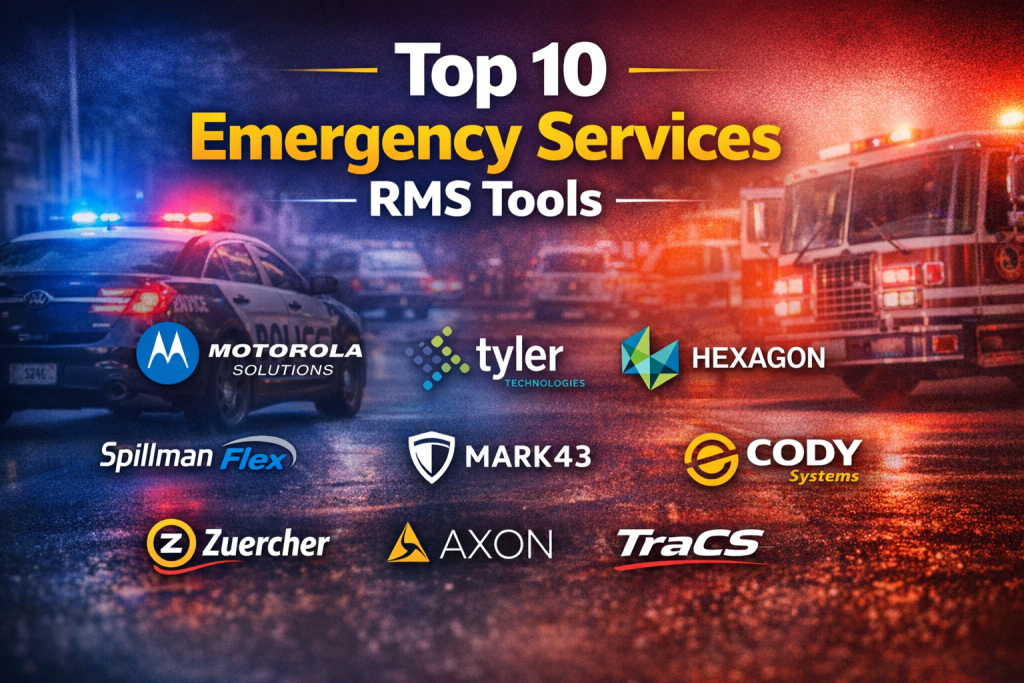
Top 10 Emergency Services Records Management (RMS) Tools
1 — Motorola Solutions (PremierOne RMS)
Short description:
A comprehensive, enterprise-grade RMS designed for large law enforcement and public safety agencies requiring deep integration and scalability.
Key features:
- Incident, arrest, citation, and case management
- Tight integration with CAD and dispatch systems
- Advanced reporting and analytics
- Mobile-first officer reporting
- Role-based access controls
- Evidence and property tracking
Pros:
- Extremely robust and scalable
- Strong ecosystem for public safety workflows
Cons:
- High cost compared to smaller vendors
- Longer implementation cycles
Security & compliance:
Strong encryption, audit logs, CJIS-aligned controls, enterprise-grade access management.
Support & community:
Dedicated enterprise support, extensive documentation, professional services available.
2 — Tyler Technologies (New World RMS)
Short description:
A widely adopted RMS focused on law enforcement, fire, and EMS agencies within local and regional governments.
Key features:
- Case-based reporting framework
- Integrated fire and EMS records
- Configurable workflows
- Built-in analytics dashboards
- Mobile data capture
- Court and justice system integrations
Pros:
- Strong government-sector focus
- Flexible configuration options
Cons:
- UI can feel dated for some users
- Customization may require vendor support
Security & compliance:
CJIS compliance support, encryption at rest and in transit, detailed audit trails.
Support & community:
Structured onboarding, government-focused support teams, training programs.
3 — Hexagon Safety & Infrastructure (OnCall Records)
Short description:
An integrated RMS solution designed for agencies that prioritize real-time operations and situational awareness.
Key features:
- Unified CAD and RMS experience
- Incident-to-case continuity
- Mobile-first design
- Real-time data synchronization
- Advanced mapping and analytics
- Multi-agency collaboration tools
Pros:
- Excellent operational visibility
- Strong CAD-RMS integration
Cons:
- Higher learning curve
- Best suited for mid-to-large agencies
Security & compliance:
CJIS-aligned architecture, encryption, access auditing.
Support & community:
Enterprise onboarding, documentation, regional support teams.
4 — CentralSquare Technologies (RMS Suite)
Short description:
A modular RMS platform supporting police, fire, and EMS agencies with configurable reporting tools.
Key features:
- Incident and case reporting
- Evidence and property modules
- Configurable forms and workflows
- Integrated analytics
- Mobile access
- Multi-jurisdiction support
Pros:
- Modular design
- Strong mid-market fit
Cons:
- Some modules require add-ons
- Reporting depth varies by configuration
Security & compliance:
Encryption, CJIS support, configurable access controls.
Support & community:
Vendor-led training, customer success teams, knowledge base.
5 — Spillman Technologies (Flex RMS)
Short description:
A proven RMS solution focused on law enforcement agencies needing reliability and long-term vendor stability.
Key features:
- Incident and offense reporting
- Case management workflows
- Citation and warrant tracking
- Mobile reporting tools
- Court and jail integrations
- Historical data analysis
Pros:
- Mature and stable platform
- Trusted by many agencies
Cons:
- UI modernization can lag
- Limited flexibility for niche workflows
Security & compliance:
CJIS-aligned security controls, audit logging, encryption.
Support & community:
Dedicated support teams, structured training programs.
6 — Mark43
Short description:
A modern, cloud-native RMS built for agencies seeking agility, mobility, and rapid deployment.
Key features:
- Cloud-first RMS architecture
- Mobile and offline reporting
- Real-time data updates
- API-driven integrations
- Customizable workflows
- Analytics and dashboards
Pros:
- Modern user experience
- Faster deployments
Cons:
- Cloud-only may not suit all agencies
- Premium pricing tier
Security & compliance:
Strong encryption, CJIS compliance support, role-based access.
Support & community:
High-touch onboarding, responsive support, modern documentation.
7 — CODY Systems
Short description:
A flexible RMS emphasizing customization and cost efficiency for small to mid-sized agencies.
Key features:
- Customizable report templates
- Case and incident management
- Integrated analytics
- Court and jail data exchange
- Mobile access
- Modular licensing
Pros:
- High configurability
- Cost-effective for smaller agencies
Cons:
- UI less polished than newer platforms
- Limited enterprise-scale features
Security & compliance:
Encryption, audit logs, CJIS alignment varies by deployment.
Support & community:
Responsive support, training resources, smaller user community.
8 — Zuercher Technologies
Short description:
An RMS platform known for deep reporting and strong integration across justice systems.
Key features:
- Incident, arrest, and citation records
- Evidence and property management
- Integrated jail and court modules
- Advanced reporting tools
- Mobile reporting
- Data sharing features
Pros:
- Strong justice ecosystem integration
- Detailed reporting capabilities
Cons:
- Complex configuration
- Longer onboarding timelines
Security & compliance:
CJIS-aligned security, encryption, detailed audit trails.
Support & community:
Structured enterprise support, training-led onboarding.
9 — Axon (Records)
Short description:
A modern RMS tightly integrated with digital evidence, body cameras, and officer tools.
Key features:
- Incident and case reporting
- Native evidence integration
- Mobile-first design
- Real-time collaboration
- Analytics dashboards
- Cloud-based deployment
Pros:
- Seamless evidence workflows
- Intuitive user experience
Cons:
- Best value when used with Axon ecosystem
- Less flexible for non-Axon integrations
Security & compliance:
Strong encryption, CJIS support, access logging.
Support & community:
Modern documentation, enterprise support, active user base.
10 — TraCS
Short description:
A specialized RMS focused on traffic enforcement, crash reporting, and roadside data capture.
Key features:
- Crash and citation reporting
- Mobile roadside data entry
- State and federal reporting formats
- Analytics for traffic safety
- Integration with RMS platforms
- Offline-first workflows
Pros:
- Excellent for traffic-focused agencies
- Strong compliance reporting
Cons:
- Narrower scope than full RMS suites
- Limited general case management
Security & compliance:
Encryption, CJIS alignment varies by jurisdiction.
Support & community:
Focused documentation, niche user community, vendor-led support.
Comparison Table
| Tool Name | Best For | Platform(s) Supported | Standout Feature | Rating |
|---|---|---|---|---|
| Motorola Solutions | Large enterprise agencies | Web, Mobile | End-to-end public safety ecosystem | N/A |
| Tyler Technologies | Local & regional governments | Web, Mobile | Government justice integration | N/A |
| Hexagon | Real-time operations | Web, Mobile | CAD-RMS continuity | N/A |
| CentralSquare | Mid-market agencies | Web, Mobile | Modular RMS design | N/A |
| Spillman | Traditional law enforcement | Web, Mobile | Stability and reliability | N/A |
| Mark43 | Cloud-first agencies | Web, Mobile | Modern UX | N/A |
| CODY Systems | Small–mid agencies | Web, Mobile | High configurability | N/A |
| Zuercher | Justice system integration | Web, Mobile | Deep reporting | N/A |
| Axon | Evidence-driven agencies | Web, Mobile | Native evidence workflows | N/A |
| TraCS | Traffic enforcement | Mobile, Web | Crash reporting | N/A |
Evaluation & Scoring of Emergency Services RMS
| Criteria | Weight | Description |
|---|---|---|
| Core features | 25% | Breadth of records, reporting, workflows |
| Ease of use | 15% | Officer-friendly UI and workflows |
| Integrations & ecosystem | 15% | CAD, evidence, courts, analytics |
| Security & compliance | 10% | Encryption, audits, regulatory support |
| Performance & reliability | 10% | Stability under high-volume use |
| Support & community | 10% | Training, responsiveness, documentation |
| Price / value | 15% | Cost vs capabilities |
Which Emergency Services RMS Tool Is Right for You?
- Solo or small agencies: Look for configurable, cost-effective tools like CODY Systems.
- Mid-market departments: Modular platforms like CentralSquare or Spillman balance depth and cost.
- Enterprise agencies: Motorola Solutions, Tyler Technologies, or Hexagon offer scalability and ecosystem depth.
- Budget-conscious buyers: Prioritize modular licensing and essential features over premium analytics.
- Security-driven agencies: Choose vendors with strong CJIS alignment and audit controls.
- Integration-heavy environments: Favor API-driven or ecosystem-rich platforms.
Frequently Asked Questions (FAQs)
- What is an RMS in emergency services?
It is a system for managing incident, case, and operational records securely and efficiently. - Is RMS different from CAD?
Yes. CAD handles dispatch; RMS manages records after and around incidents. - Do small agencies need RMS software?
Yes, especially for compliance, reporting accuracy, and efficiency. - Are RMS systems cloud-based?
Many modern systems are cloud-first, but on-prem options still exist. - How long does implementation take?
Ranges from weeks for small agencies to months for large enterprises. - Is mobile access important?
Yes. Mobile reporting improves accuracy and reduces paperwork. - How secure are RMS platforms?
Most support encryption, audit logs, and CJIS-aligned controls. - Can RMS integrate with body cameras?
Some platforms offer native or API-based evidence integrations. - Are these systems customizable?
Customization varies by vendor and pricing tier. - What is the biggest buying mistake?
Choosing complexity over usability for frontline officers.
Conclusion
Emergency Services Records Management systems are mission-critical platforms that support accountability, efficiency, and public trust. While features and capabilities vary widely, the most important factors remain usability under pressure, data accuracy, security, and long-term scalability.
There is no single “best” RMS for every agency. The right choice depends on agency size, operational complexity, budget, integration needs, and regulatory environment. By aligning tool capabilities with real-world workflows, emergency services organizations can ensure their RMS investment delivers lasting value.

Find Trusted Cardiac Hospitals
Compare heart hospitals by city and services — all in one place.
Explore Hospitals