
Introduction
AI Agent Assist for Support Reps platforms help customer support agents handle conversations faster, more accurately, and with better consistency. These tools use artificial intelligence to provide real-time suggestions, automate repetitive tasks, surface relevant knowledge articles, summarize conversations, and guide agents during customer interactions across voice, chat, and email channels.
Support organizations are under increasing pressure to deliver faster response times, personalized experiences, and higher customer satisfaction while managing growing ticket volumes and rising operational costs. AI agent assist tools are becoming a core layer in modern support operations because they reduce agent workload, improve productivity, shorten onboarding time, and help teams maintain consistent support quality at scale.
Why It Matters
Modern customer support teams need more than ticketing systems and static knowledge bases. AI-powered agent assist platforms help organizations:
- Reduce average handling time
- Improve first-contact resolution
- Assist new support agents during live interactions
- Automate repetitive support workflows
- Improve customer satisfaction
- Reduce support escalations
- Improve compliance and consistency
- Scale support operations efficiently
Real World Use Cases
- Real-time response recommendations during customer chats
- AI-generated support summaries after calls or tickets
- Knowledge article recommendations during conversations
- Automatic ticket classification and routing
- Escalation risk detection
- Compliance monitoring for support interactions
- AI-powered translation and multilingual assistance
- Coaching and training support for new agents
Evaluation Criteria for Buyers
Organizations evaluating AI Agent Assist platforms should focus on:
- Real-time assistance accuracy
- Omnichannel support coverage
- AI summarization quality
- Integration with CRM and help desk systems
- AI governance and guardrails
- Workflow automation capabilities
- Human review controls
- Data privacy and retention settings
- AI observability and reporting
- Scalability across teams and regions
- Multilingual support quality
- Deployment flexibility
Best for: customer support centers, SaaS companies, telecom providers, ecommerce businesses, BPO operations, financial services, healthcare support teams, and enterprises handling large support volumes.
Not ideal for: very small teams with low ticket volume, businesses using only email support with minimal automation needs, or organizations without centralized customer support operations.
What’s Changed in AI Agent Assist for Support Reps
- Real-time AI copilots are now common across support operations
- AI tools can automatically draft responses during live interactions
- Multimodal AI combines chat, voice, screen activity, and CRM data
- AI-generated summaries are reducing manual documentation work
- More platforms now support AI workflow orchestration
- Support teams increasingly require AI observability dashboards
- Prompt injection defense is becoming important for customer-facing AI
- Enterprises demand stronger retention and governance controls
- AI-powered coaching is improving agent onboarding speed
- Human approval workflows are replacing fully autonomous support AI
- BYO model flexibility is growing across enterprise deployments
- Cost and latency optimization are now major buying considerations
Quick Buyer Checklist
- Does the platform provide real-time support assistance
- Can it integrate with existing CRM and help desk systems
- Does it support voice, chat, email, and messaging channels
- Are AI summaries accurate and customizable
- Does it support multilingual conversations
- Are AI guardrails and approval workflows available
- Can admins configure retention and governance settings
- Does it provide observability and reporting dashboards
- Are APIs available for workflow customization
- Does the platform support scalable enterprise deployments
- Can the system track AI cost and latency metrics
- Are knowledge integrations available
- Is human review included for sensitive workflows
- Can exported data reduce vendor lock-in risks
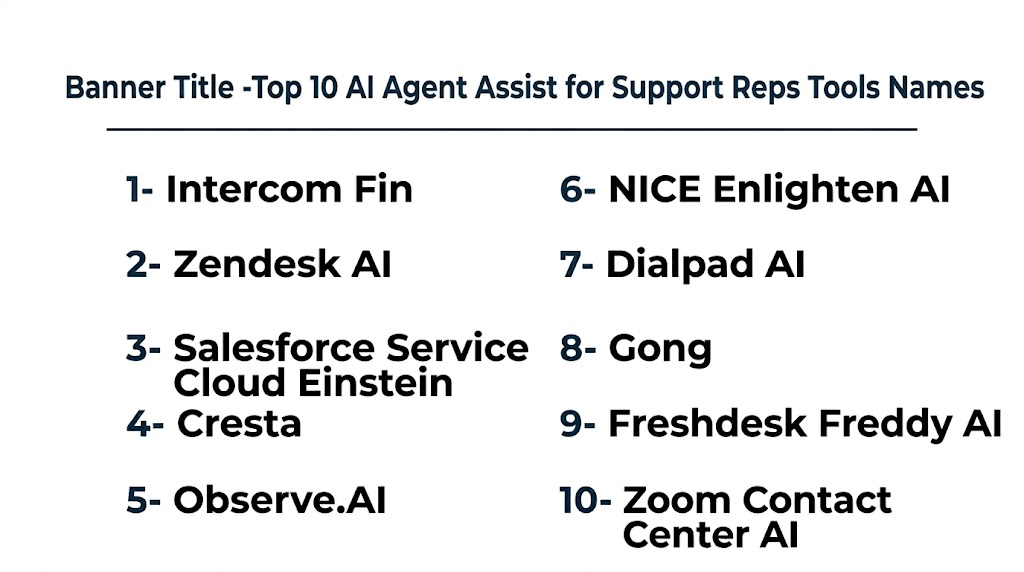
Top 10 AI Agent Assist for Support Reps Tools Names
1- Intercom Fin
2- Zendesk AI
3- Salesforce Service Cloud Einstein
4- Cresta
5- Observe.AI
6- NICE Enlighten AI
7- Dialpad AI
8- Gong
9- Freshdesk Freddy AI
10- Zoom Contact Center AI
Top 10 AI Agent Assist for Support Reps Tools
1- Intercom Fin
One-line verdict: Best for AI-first customer support automation and digital support workflows.
Short Description
Intercom Fin is designed to help support teams automate customer interactions and assist agents with AI-powered workflows. It combines conversational AI, knowledge retrieval, and support automation into a unified platform.
Standout Capabilities
- AI-generated support replies
- Knowledge-grounded conversations
- Real-time support assistance
- Workflow automation
- Omnichannel support
- AI-generated summaries
- Ticket prioritization
- Customer context awareness
AI-Specific Depth
- Model support: Hosted AI services
- RAG and knowledge integration: Native knowledge integrations
- Evaluation: AI interaction analytics
- Guardrails: Human escalation workflows
- Observability: Workflow analytics dashboards
Pros
- Fast deployment
- Strong automation workflows
- Modern user experience
Cons
- Less ideal for voice-heavy support
- Governance flexibility varies
- AI quality depends on knowledge accuracy
Security & Compliance
Supports enterprise administration, configurable retention controls, and access management settings.
Deployment & Platforms
- Web
- Mobile applications
- Cloud deployment
Integrations & Ecosystem
Intercom integrates with customer support and CRM ecosystems to centralize customer interactions and automate workflows.
- Salesforce
- Slack
- HubSpot
- Zendesk
- APIs
- Knowledge systems
Pricing Model
Usage-based and seat-based SaaS pricing.
Best-Fit Scenarios
- SaaS customer support
- AI self-service initiatives
- Digital-first businesses
2- Zendesk AI
One-line verdict: Best for organizations already operating support workflows inside Zendesk.
Short Description
Zendesk AI adds AI-powered assistance, workflow automation, ticket summaries, and response suggestions directly into Zendesk support environments.
Standout Capabilities
- AI-generated ticket summaries
- Intent detection
- Automated ticket routing
- AI response recommendations
- Workflow automation
- Omnichannel support
- Support analytics
- Knowledge recommendations
AI-Specific Depth
- Model support: Hosted AI services
- RAG and knowledge integration: Native Zendesk knowledge integration
- Evaluation: QA and support analytics
- Guardrails: Human approval workflows
- Observability: Reporting dashboards
Pros
- Easy onboarding
- Strong Zendesk ecosystem integration
- Good omnichannel capabilities
Cons
- Limited outside Zendesk ecosystem
- Advanced customization varies
- Less analytics depth than specialist platforms
Security & Compliance
Supports enterprise governance controls, configurable retention settings, and admin management.
Deployment & Platforms
- Web
- iOS
- Android
- Cloud deployment
Integrations & Ecosystem
- Slack
- Salesforce
- Jira
- Shopify
- APIs
- Marketplace applications
Pricing Model
Tiered SaaS subscription.
Best-Fit Scenarios
- Zendesk support environments
- SMB support teams
- Fast AI deployment projects
3- Salesforce Service Cloud Einstein
One-line verdict: Best for enterprises combining CRM intelligence with AI-assisted support workflows.
Short Description
Salesforce Service Cloud Einstein integrates AI-powered support assistance, CRM workflows, and automation into enterprise customer support operations.
Standout Capabilities
- AI-generated summaries
- Predictive support insights
- Case routing automation
- CRM-native workflows
- AI copilots
- Omnichannel orchestration
- Workflow automation
- Knowledge recommendations
AI-Specific Depth
- Model support: Hosted AI and BYO flexibility within ecosystem
- RAG and knowledge integration: Strong CRM integrations
- Evaluation: Workflow analytics and operational reporting
- Guardrails: Enterprise governance controls
- Observability: Enterprise dashboards
Pros
- Deep CRM integration
- Enterprise scalability
- Large ecosystem
Cons
- Operational complexity
- Premium pricing
- Requires Salesforce expertise
Security & Compliance
Supports RBAC, governance workflows, audit logging, retention controls, and encryption.
Deployment & Platforms
- Web
- Mobile applications
- Cloud deployment
Integrations & Ecosystem
- Salesforce ecosystem
- Slack
- MuleSoft
- Service platforms
- APIs
- Enterprise workflows
Pricing Model
Enterprise SaaS pricing with AI add-ons.
Best-Fit Scenarios
- CRM-centric enterprises
- Large support organizations
- AI-powered service operations
4- Cresta
One-line verdict: Best for real-time AI coaching and live support assistance during customer conversations.
Short Description
Cresta helps support agents during live customer interactions using AI-generated recommendations, workflow assistance, and real-time coaching.
Standout Capabilities
- Real-time AI guidance
- Live workflow assistance
- AI-generated suggestions
- Agent coaching
- Escalation prediction
- Knowledge surfacing
- Conversation summaries
- Productivity analytics
AI-Specific Depth
- Model support: Hosted AI services
- RAG and knowledge integration: Knowledge connectors available
- Evaluation: Workflow analytics
- Guardrails: Human review workflows
- Observability: Operational dashboards
Pros
- Excellent live support guidance
- Strong productivity improvements
- Modern support workflows
Cons
- Enterprise-focused pricing
- Requires workflow planning
- Smaller ecosystem than larger vendors
Security & Compliance
Supports governance controls, access management, and encryption settings.
Deployment & Platforms
- Web
- Cloud deployment
Integrations & Ecosystem
- Salesforce
- Zendesk
- NICE
- Genesys
- APIs
- Contact center systems
Pricing Model
Enterprise subscription pricing.
Best-Fit Scenarios
- Real-time support coaching
- AI-assisted contact centers
- Agent productivity optimization
5- Observe.AI
One-line verdict: Best for AI-powered QA automation and support performance management.
Short Description
Observe.AI combines AI support analytics with coaching, compliance monitoring, and automated quality assurance workflows for support teams.
Standout Capabilities
- Automated QA scoring
- Real-time coaching
- Speech analytics
- Compliance monitoring
- Sentiment analysis
- AI-driven scorecards
- Escalation alerts
- Agent performance insights
AI-Specific Depth
- Model support: Proprietary AI models
- RAG and knowledge integration: CRM integrations
- Evaluation: AI-driven QA workflows
- Guardrails: Compliance-focused workflows
- Observability: Support analytics dashboards
Pros
- Strong QA automation
- Excellent coaching workflows
- Good compliance features
Cons
- Contact-center-focused deployments
- Enterprise-oriented pricing
- Complex customization for advanced workflows
Security & Compliance
Supports access management, governance workflows, audit controls, and retention policies.
Deployment & Platforms
- Web
- Cloud deployment
Integrations & Ecosystem
- Five9
- Genesys
- Zendesk
- Salesforce
- NICE
- APIs
Pricing Model
Enterprise SaaS licensing.
Best-Fit Scenarios
- Contact center QA automation
- Compliance-sensitive support operations
- Support coaching programs
6- NICE Enlighten AI
One-line verdict: Best for enterprises needing advanced AI analytics and operational intelligence.
Short Description
NICE Enlighten AI delivers enterprise-grade customer support analytics, workforce optimization, and AI-powered support intelligence across multiple channels.
Standout Capabilities
- Predictive customer insights
- Speech analytics
- Workforce optimization
- Omnichannel analytics
- AI-driven coaching
- Customer journey analysis
- Compliance monitoring
- Automated QA workflows
AI-Specific Depth
- Model support: Hosted AI services
- RAG and knowledge integration: Enterprise CRM integrations
- Evaluation: QA and operational evaluation
- Guardrails: Governance-focused workflows
- Observability: Enterprise analytics dashboards
Pros
- Strong enterprise scalability
- Mature analytics capabilities
- Advanced governance controls
Cons
- Complex implementation
- Premium enterprise pricing
- Requires operational maturity
Security & Compliance
Supports encryption, RBAC, governance controls, audit logging, and configurable retention settings.
Deployment & Platforms
- Cloud
- Hybrid deployment
- Web administration
Integrations & Ecosystem
- NICE CXone
- Salesforce
- Microsoft Dynamics
- ServiceNow
- APIs
- Workforce systems
Pricing Model
Enterprise licensing model.
Best-Fit Scenarios
- Global support operations
- Enterprise contact centers
- Governance-heavy environments
7- Dialpad AI
One-line verdict: Best for growing support teams needing affordable AI-powered communication assistance.
Short Description
Dialpad AI combines cloud communications, AI-powered assistance, and customer support analytics into a unified collaboration platform.
Standout Capabilities
- Real-time transcription
- AI summaries
- Live sentiment analysis
- Workflow automation
- Unified communications
- Omnichannel support
- AI coaching
- Support analytics
AI-Specific Depth
- Model support: Hosted AI
- RAG and knowledge integration: CRM and workspace integrations
- Evaluation: Support analytics workflows
- Guardrails: Varies / N/A
- Observability: Operational dashboards
Pros
- Easy deployment
- Good value for SMBs
- Unified communication workflows
Cons
- Limited enterprise governance depth
- Customization flexibility varies
- Less advanced analytics than specialist vendors
Security & Compliance
Supports SSO, encryption, and enterprise administration settings.
Deployment & Platforms
- Web
- Windows
- macOS
- iOS
- Android
- Cloud deployment
Integrations & Ecosystem
- Salesforce
- Zendesk
- Google Workspace
- Microsoft 365
- HubSpot
- APIs
Pricing Model
Tiered SaaS subscription.
Best-Fit Scenarios
- SMB support operations
- Unified communications environments
- Fast-growing startups
8- Gong
One-line verdict: Best for enterprises requiring advanced support analytics and customer interaction intelligence.
Short Description
Gong analyzes customer conversations to provide operational insights, AI-powered coaching, workflow automation, and support intelligence across customer-facing teams.
Standout Capabilities
- AI-generated summaries
- Customer interaction analytics
- Agent coaching recommendations
- Sentiment detection
- Support performance dashboards
- Escalation risk monitoring
- Cross-channel visibility
- Operational reporting
AI-Specific Depth
- Model support: Hosted AI services
- RAG and knowledge integration: CRM and support integrations
- Evaluation: QA analytics and conversation scoring
- Guardrails: Varies / N/A
- Observability: Analytics dashboards
Pros
- Strong analytics depth
- Mature support intelligence workflows
- Excellent coaching features
Cons
- Premium pricing
- Complex onboarding
- Advanced workflows require planning
Security & Compliance
Supports governance controls, encryption, RBAC, retention settings, and audit functionality.
Deployment & Platforms
- Web
- Cloud deployment
- Mobile support
Integrations & Ecosystem
- Salesforce
- Zendesk
- HubSpot
- Slack
- Zoom
- APIs
Pricing Model
Enterprise subscription pricing.
Best-Fit Scenarios
- Enterprise support analytics
- Customer experience optimization
- AI-powered coaching initiatives
9- Freshdesk Freddy AI
One-line verdict: Best for SMB support teams seeking simple AI-powered workflow automation.
Short Description
Freshdesk Freddy AI helps support teams automate ticket management, generate AI-powered suggestions, and improve support productivity using conversational AI features.
Standout Capabilities
- Ticket summarization
- AI-powered suggestions
- Workflow automation
- Automated ticket classification
- Omnichannel support
- Knowledge recommendations
- Agent assistance
- Support analytics
AI-Specific Depth
- Model support: Hosted AI
- RAG and knowledge integration: Native Freshdesk integrations
- Evaluation: Support analytics
- Guardrails: Human approval workflows
- Observability: Reporting dashboards
Pros
- Easy to use
- SMB-friendly deployment
- Strong automation workflows
Cons
- Less enterprise depth
- Advanced governance varies
- Limited customization compared to enterprise platforms
Security & Compliance
Supports access management, retention controls, and encryption settings.
Deployment & Platforms
- Web
- Mobile applications
- Cloud deployment
Integrations & Ecosystem
- Slack
- Microsoft Teams
- Shopify
- Jira
- APIs
- Freshworks ecosystem
Pricing Model
Tiered SaaS pricing.
Best-Fit Scenarios
- SMB support operations
- AI ticket automation
- Customer support productivity improvements
10- Zoom Contact Center AI
One-line verdict: Best for organizations already standardized on Zoom communication infrastructure.
Short Description
Zoom Contact Center AI combines omnichannel support capabilities with AI-generated summaries, sentiment analysis, and real-time support assistance.
Standout Capabilities
- Real-time transcription
- AI-generated summaries
- Omnichannel support
- Sentiment analysis
- Live support assistance
- Supervisor dashboards
- Voice analytics
- Unified collaboration workflows
AI-Specific Depth
- Model support: Hosted AI models
- RAG and knowledge integration: Knowledge integrations available
- Evaluation: QA and support analytics
- Guardrails: Varies / N/A
- Observability: Operational dashboards
Pros
- Strong Zoom ecosystem integration
- Unified collaboration workflows
- Easy deployment for Zoom users
Cons
- Ecosystem dependency
- Limited developer flexibility
- Advanced customization varies
Security & Compliance
Supports enterprise access controls, encryption, and retention management settings.
Deployment & Platforms
- Web
- iOS
- Android
- Cloud deployment
Integrations & Ecosystem
- Zoom Workplace
- Salesforce
- Zendesk
- ServiceNow
- APIs
- CRM systems
Pricing Model
Tiered enterprise pricing.
Best-Fit Scenarios
- Zoom-centric organizations
- Distributed support teams
- Omnichannel support operations
Comparison Table
| Tool Name | Best For | Deployment | Model Flexibility | Strength | Watch-Out | Public Rating |
|---|---|---|---|---|---|---|
| Intercom Fin | AI self-service | Cloud | Hosted | Automation workflows | Less voice-focused | N/A |
| Zendesk AI | Zendesk environments | Cloud | Hosted | Native workflows | Ecosystem dependency | N/A |
| Salesforce Service Cloud Einstein | CRM-centric enterprises | Cloud | Hosted and BYO | CRM integration | Operational complexity | N/A |
| Cresta | Real-time coaching | Cloud | Hosted | Live guidance | Enterprise pricing | N/A |
| Observe.AI | QA automation | Cloud | Hosted | Coaching analytics | Contact center focus | N/A |
| NICE Enlighten AI | Enterprise analytics | Cloud and Hybrid | Hosted | Governance depth | Complexity | N/A |
| Dialpad AI | SMB support teams | Cloud | Hosted | Unified communications | Limited advanced analytics | N/A |
| Gong | Enterprise analytics | Cloud | Hosted | Conversation insights | Premium pricing | N/A |
| Freshdesk Freddy AI | SMB automation | Cloud | Hosted | Simplicity | Less enterprise depth | N/A |
| Zoom Contact Center AI | Zoom environments | Cloud | Hosted | Unified collaboration | Ecosystem dependency | N/A |
Scoring & Evaluation
These scores are comparative and designed to help organizations evaluate platform maturity across AI assistance, governance, workflow automation, integrations, and operational scalability.
| Tool | Core | Reliability Eval | Guardrails | Integrations | Ease | Performance Cost | Security Admin | Support | Weighted Total |
|---|---|---|---|---|---|---|---|---|---|
| Intercom Fin | 8 | 7 | 7 | 8 | 9 | 8 | 7 | 8 | 7.9 |
| Zendesk AI | 8 | 7 | 7 | 9 | 9 | 8 | 8 | 8 | 8.1 |
| Salesforce Service Cloud Einstein | 9 | 8 | 8 | 10 | 6 | 7 | 9 | 8 | 8.3 |
| Cresta | 8 | 8 | 7 | 8 | 8 | 7 | 8 | 7 | 7.9 |
| Observe.AI | 9 | 8 | 8 | 8 | 7 | 7 | 8 | 8 | 8.0 |
| NICE Enlighten AI | 9 | 9 | 8 | 9 | 6 | 7 | 9 | 8 | 8.3 |
| Dialpad AI | 7 | 7 | 6 | 8 | 9 | 8 | 7 | 7 | 7.5 |
| Gong | 9 | 8 | 7 | 9 | 8 | 7 | 8 | 8 | 8.1 |
| Freshdesk Freddy AI | 7 | 7 | 6 | 8 | 9 | 8 | 7 | 7 | 7.4 |
| Zoom Contact Center AI | 8 | 7 | 7 | 8 | 8 | 8 | 8 | 7 | 7.8 |
Top 3 for Enterprise
1- NICE Enlighten AI
2- Salesforce Service Cloud Einstein
3- Gong
Top 3 for SMB
1- Zendesk AI
2- Freshdesk Freddy AI
3- Dialpad AI
Top 3 for Developers
1- Salesforce Service Cloud Einstein
2- Zendesk AI
3- Intercom Fin
Which AI Agent Assist for Support Reps Tool Is Right for You
Solo Freelancer
Freelancers and very small teams generally benefit more from lightweight support automation tools instead of enterprise AI support platforms.
SMB
SMBs should prioritize ease of deployment, affordability, and automation capabilities. Zendesk AI, Freshdesk Freddy AI, and Dialpad AI are strong choices for growing teams.
Mid-Market
Mid-market organizations benefit from stronger analytics and coaching features. Gong, Cresta, and Observe.AI are good options for scaling support operations.
Enterprise
Large enterprises require governance, scalability, observability, and advanced workflow automation. NICE Enlighten AI and Salesforce Service Cloud Einstein are strong enterprise choices.
Regulated Industries
Healthcare, finance, and public sector organizations should prioritize retention controls, governance, audit logging, and human review workflows.
Budget vs Premium
Budget-focused buyers should consider ecosystem-native platforms for easier deployment. Premium solutions provide deeper analytics and stronger governance.
Build vs Buy
Organizations with mature AI engineering teams may consider custom AI support systems. Most companies benefit more from buying established solutions due to integration and governance complexity.
Implementation Playbook 30 60 90 Days
First 30 Days
- Select pilot support teams
- Define measurable KPIs
- Validate CRM integrations
- Benchmark support performance
- Configure governance settings
- Establish human review processes
First 60 Days
- Expand rollout across teams
- Implement AI evaluation workflows
- Configure retention policies
- Add hallucination testing
- Improve workflow automation
- Monitor AI latency and operational costs
First 90 Days
- Scale globally
- Build advanced reporting dashboards
- Optimize inference costs
- Strengthen governance workflows
- Establish incident response plans
- Expand automation carefully with oversight
Common Mistakes & How to Avoid Them
- Deploying AI without quality benchmarks
- Ignoring hallucination risks
- Over-automating customer interactions
- Weak governance planning
- No visibility into AI costs
- Poor observability setup
- No human review process
- Weak access management
- Skipping multilingual testing
- Vendor lock-in without export options
- No workflow version control
- Assuming AI recommendations are always accurate
- Failing to train support agents properly
FAQs
1- What is AI Agent Assist for Support Reps
AI Agent Assist platforms help support agents during customer interactions by providing AI-generated suggestions, summaries, workflow automation, and knowledge recommendations.
2- Can AI agent assist replace human support agents
Most platforms are designed to augment human agents rather than replace them completely. Human oversight remains critical for sensitive customer interactions.
3- Are these tools suitable for SMBs
Yes. Several platforms are designed specifically for SMB support environments and focus on affordability and easy deployment.
4- Do these tools support multilingual conversations
Many enterprise platforms support multilingual transcription and AI assistance, although accuracy varies across languages.
5- Why are AI guardrails important
Guardrails help reduce hallucinations, unsafe responses, and compliance risks in customer support environments.
6- Can organizations use their own AI models
Some vendors support BYO AI models or integrations with external AI ecosystems. Availability depends on the platform.
7- How do these platforms improve support productivity
They reduce repetitive work, automate summaries, improve response quality, and provide real-time assistance during conversations.
8- What integrations should buyers prioritize
CRM systems, help desk platforms, knowledge bases, collaboration tools, and workflow automation systems are the most important integrations.
9- Are self-hosted deployments available
Most AI agent assist platforms focus on cloud deployments, although some enterprise vendors support hybrid models.
10- What are the biggest deployment risks
Major risks include poor governance, weak AI evaluation, unmanaged retention policies, and over-automation without oversight.
11- How important is observability in AI support systems
Observability helps organizations monitor AI reliability, latency, usage costs, and operational performance across support workflows.
12- Can these tools reduce support costs
Yes. Automation, workflow optimization, and AI assistance can significantly reduce operational overhead when implemented correctly.
Conclusion
AI Agent Assist for Support Reps platforms are rapidly becoming essential for modern customer support operations. These tools help organizations improve productivity, reduce operational costs, automate repetitive tasks, and deliver better customer experiences through real-time AI assistance and workflow automation. The best platform depends on organizational size, support complexity, governance requirements, and existing technology investments. SMBs often prioritize simplicity and affordability, while enterprises focus on scalability, observability, compliance, and governance. Before deploying any solution, organizations should shortlist relevant platforms, run controlled pilots using real support interactions, validate AI accuracy and governance capabilities, and scale gradually with strong human oversight and operational monitoring.

Find Trusted Cardiac Hospitals
Compare heart hospitals by city and services — all in one place.
Explore Hospitals
The article is useful for comparing AI agent-assist tools, but in real-world support environments the main challenge is not suggesting replies—it’s how well those suggestions fit into fast-moving, high-pressure conversations without breaking workflow. Many tools struggle with context switching, outdated knowledge base data, and over-reliance on templates that don’t match real customer edge cases. A more practical approach is to tightly integrate agent assist with live CRM data, continuously updated knowledge bases, and strong human override controls so agents stay in control while still benefiting from AI support.