
Introduction
AI Personalized Care Plan Tools are healthcare intelligence systems that use artificial intelligence to design, adapt, and continuously optimize patient specific care plans based on clinical history, real time health data, lifestyle patterns, wearable device inputs, and treatment response. These platforms help clinicians move from static treatment protocols to dynamic, personalized care pathways that evolve with each patient.
Why it matters is because modern healthcare is shifting toward value based care where outcomes, not volume, define success. Patients today often suffer from multiple chronic conditions, and static treatment plans fail to adjust to changing health conditions. AI based personalized care planning helps close this gap by continuously recommending the right intervention at the right time.
Real world use cases include chronic disease management, post surgery rehabilitation planning, oncology treatment optimization, mental health care planning, elderly care coordination, medication adherence optimization, lifestyle intervention planning, and hospital discharge follow up programs.
Evaluation criteria for buyers include personalization accuracy, integration with EHR systems, real time data processing, clinical explainability, workflow automation, patient engagement capability, interoperability, scalability, data privacy, and compliance readiness.
Best for: hospitals, digital health platforms, insurance companies, chronic care management programs, and care coordination teams
Not ideal for: small clinics without structured patient data systems or organizations without digital care workflows
What Changed in AI Personalized Care Planning
- Shift from static treatment plans to adaptive AI driven care plans
- Strong integration with wearable and remote monitoring data
- Increased use of predictive and prescriptive AI models
- Growth of patient centric digital health ecosystems
- Strong adoption of multimodal patient data analysis
- Continuous care optimization instead of episodic care
- Integration of behavioral and lifestyle data into planning
- Rise of explainable AI in clinical decision support
- Expansion of hospital at home and hybrid care models
- Strong regulatory focus on patient safety and transparency
- AI driven care pathway automation
- Improved interoperability with EHR systems
Quick Buyer Checklist
- EHR integration capability
- Real time care plan updates
- Predictive and prescriptive AI support
- Patient engagement tools
- Workflow automation for clinicians
- Data privacy and compliance readiness
- Multimodal data integration
- Explainable AI outputs
- Scalability across patient populations
- Vendor lock in risk
- Cost efficiency
- Clinical validation support
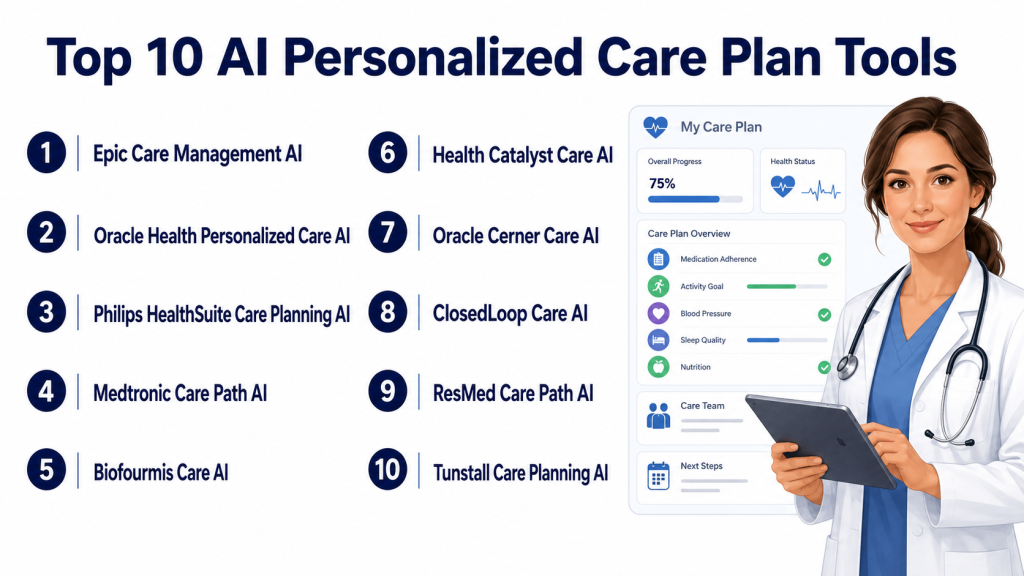
Top 10 AI Personalized Care Plan Tools
1- Epic Care Management AI
Short Description
Epic Care Management AI is embedded within Epic’s healthcare ecosystem and helps clinicians build and adjust personalized care plans directly inside electronic health records. It enables real time updates based on patient data and clinical workflows.
Standout Capabilities
- EHR native care planning
- Real time care updates
- Clinical decision support
- Patient risk stratification
- Care pathway automation
- Population health integration
- Workflow embedded recommendations
AI Specific Depth
- Model support: Proprietary
- RAG integration: Not publicly stated
- Evaluation: Clinical validation workflows
- Guardrails: Healthcare governance
- Observability: Monitoring dashboards
Pros
- Deep EHR integration
- High clinician adoption
- Strong enterprise reliability
Cons
- Closed ecosystem
- Limited customization
- Complex deployment
Security and Compliance
Healthcare grade encryption, audit logging, and role based access control. Certifications not publicly stated.
Deployment and Platforms
Cloud and enterprise hospital systems
Integrations and Ecosystem
- Clinical workflows
- Care coordination tools
- Population health systems
Pricing Model
Not publicly stated
Best Fit Scenarios
- Large hospital networks
- Academic medical centers
- Epic based ecosystems
2- Oracle Health Personalized Care AI
Short Description
Oracle Health Personalized Care AI delivers enterprise scale intelligent care planning by combining predictive analytics with clinical data to generate personalized care pathways for patients.
Standout Capabilities
- Predictive care pathways
- Population health modeling
- Clinical decision support
- Large scale patient analytics
- Risk based care planning
- Real time updates
AI Specific Depth
- Model support: Proprietary
- RAG integration: Not publicly stated
- Evaluation: Healthcare validation systems
- Guardrails: Governance frameworks
- Observability: Analytics dashboards
Pros
- Highly scalable
- Strong enterprise focus
- Advanced analytics
Cons
- Complex setup
- High cost
- Requires mature data systems
Security and Compliance
Enterprise healthcare controls supported
Deployment and Platforms
Cloud enterprise systems
Integrations and Ecosystem
- Healthcare databases
- Clinical systems
Pricing Model
Enterprise subscription
Best Fit Scenarios
- Large hospital networks
- Multi hospital systems
- Insurance driven care models
3- Philips HealthSuite Care Planning AI
Short Description
Philips HealthSuite Care Planning AI uses connected health data and predictive intelligence to design adaptive care plans for patients in chronic and acute care settings.
Standout Capabilities
- Connected care planning
- Device driven insights
- Chronic disease management
- Real time care adjustments
- Hospital at home support
- Predictive care pathways
AI Specific Depth
- Model support: Proprietary
- RAG integration: Not publicly stated
- Evaluation: Clinical validation systems
- Guardrails: Healthcare compliance
- Observability: Monitoring dashboards
Pros
- Strong device integration
- Reliable clinical ecosystem
- Good scalability
Cons
- Enterprise complexity
- Limited flexibility
- High infrastructure needs
Security and Compliance
Healthcare grade compliance systems supported
Deployment and Platforms
Cloud hybrid healthcare systems
Integrations and Ecosystem
- Medical devices
- Hospital systems
Pricing Model
Enterprise subscription
Best Fit Scenarios
- Chronic care programs
- Remote patient management
- Large hospitals
4- Medtronic Care Path AI
Short Description
Medtronic Care Path AI focuses on chronic disease care planning using connected medical devices and predictive analytics to adjust care plans in real time.
Standout Capabilities
- Device integrated care planning
- Chronic disease pathways
- Predictive alerts
- Clinical decision support
- Remote monitoring integration
- Personalized interventions
AI Specific Depth
- Model support: Proprietary
- RAG integration: Not publicly stated
- Evaluation: Clinical validation workflows
- Guardrails: Healthcare safety systems
- Observability: Monitoring dashboards
Pros
- Strong clinical reliability
- Deep device ecosystem
- High accuracy monitoring
Cons
- Narrow healthcare focus
- Limited flexibility
- Ecosystem dependency
Security and Compliance
Healthcare security and compliance systems supported
Deployment and Platforms
Cloud healthcare platforms
Integrations and Ecosystem
- Medical devices
- Hospital systems
Pricing Model
Not publicly stated
Best Fit Scenarios
- Cardiac care
- Diabetes management
- Chronic disease programs
5- Biofourmis Care AI
Short Description
Biofourmis Care AI delivers digital therapeutic driven personalized care plans using AI analytics and patient behavioral data for continuous care optimization.
Standout Capabilities
- Digital therapeutic integration
- Predictive care pathways
- Behavioral health insights
- Remote patient monitoring integration
- Personalized interventions
- Continuous care optimization
AI Specific Depth
- Model support: Proprietary
- RAG integration: Not publicly stated
- Evaluation: Continuous learning systems
- Guardrails: Healthcare compliance
- Observability: Patient dashboards
Pros
- Strong predictive intelligence
- Personalized care focus
- Modern AI architecture
Cons
- Complex ecosystem
- High dependency on platform
- Enterprise focus
Security and Compliance
Healthcare compliant systems supported
Deployment and Platforms
Cloud platform
Integrations and Ecosystem
- Wearables
- Hospital systems
Pricing Model
Subscription based
Best Fit Scenarios
- Chronic care management
- Post acute care
- Digital health providers
6- Health Catalyst Care AI
Short Description
Health Catalyst Care AI uses healthcare analytics and predictive modeling to design personalized care plans for population health and value based care programs.
Standout Capabilities
- Population health modeling
- Care pathway optimization
- Predictive analytics
- Clinical performance tracking
- Care coordination support
- Data driven insights
AI Specific Depth
- Model support: Proprietary and partner based
- RAG integration: Not publicly stated
- Evaluation: Healthcare analytics validation
- Guardrails: Governance workflows
- Observability: Reporting dashboards
Pros
- Strong analytics capability
- Population health focus
- Data driven care planning
Cons
- Requires data maturity
- Complex implementation
- Learning curve
Security and Compliance
Healthcare governance supported
Deployment and Platforms
Cloud and hybrid systems
Integrations and Ecosystem
- EHR systems
- Data warehouses
Pricing Model
Enterprise subscription
Best Fit Scenarios
- Value based care
- Population health teams
7- Oracle Cerner Care AI
Short Description
Oracle Cerner Care AI enables personalized care planning using integrated EHR data and AI driven clinical recommendations for large healthcare systems.
Standout Capabilities
- EHR integrated care planning
- Predictive patient pathways
- Clinical decision support
- Population health analytics
- Real time updates
- Workflow automation
AI Specific Depth
- Model support: Proprietary
- RAG integration: Not publicly stated
- Evaluation: Clinical validation systems
- Guardrails: Healthcare governance
- Observability: Analytics dashboards
Pros
- Strong EHR integration
- Enterprise scalability
- Reliable clinical workflows
Cons
- Complex setup
- Limited customization
- High cost
Security and Compliance
Enterprise healthcare compliance supported
Deployment and Platforms
Cloud healthcare systems
Integrations and Ecosystem
- Clinical systems
- Hospital databases
Pricing Model
Enterprise subscription
Best Fit Scenarios
- Large hospitals
- Insurance driven care systems
- Healthcare networks
8- ClosedLoop Care AI
Short Description
ClosedLoop Care AI provides explainable machine learning based care planning tools that help clinicians build transparent and personalized treatment plans.
Standout Capabilities
- Explainable AI care planning
- Predictive patient insights
- Care gap detection
- Risk based recommendations
- Population health analytics
- Transparent decision making
AI Specific Depth
- Model support: Multi model systems
- RAG integration: Not publicly stated
- Evaluation: Monitoring tools
- Guardrails: Governance workflows
- Observability: Full tracking
Pros
- High explainability
- Trust focused AI
- Modern architecture
Cons
- New platform
- Data readiness required
- Limited ecosystem
Security and Compliance
Healthcare governance supported
Deployment and Platforms
Cloud systems
Integrations and Ecosystem
- EHR systems
Pricing Model
Subscription model
Best Fit Scenarios
- AI driven hospitals
- Data driven care teams
- Predictive care programs
9- ResMed Care Path AI
Short Description
ResMed Care Path AI focuses on respiratory care and sleep disorder management by using connected devices and AI analytics to personalize patient care plans.
Standout Capabilities
- Respiratory care optimization
- Sleep apnea management
- Device integrated care plans
- Patient adherence tracking
- Predictive alerts
- Clinical reporting
AI Specific Depth
- Model support: Proprietary
- RAG integration: Not publicly stated
- Evaluation: Clinical validation systems
- Guardrails: Healthcare compliance
- Observability: Monitoring dashboards
Pros
- Strong respiratory focus
- High clinical accuracy
- Reliable device ecosystem
Cons
- Narrow medical domain
- Limited general use
- Device dependency
Security and Compliance
Healthcare compliant systems supported
Deployment and Platforms
Cloud healthcare systems
Integrations and Ecosystem
- Respiratory devices
- Hospital systems
Pricing Model
Not publicly stated
Best Fit Scenarios
- Sleep clinics
- COPD management
- Respiratory care programs
10- Tunstall Care Planning AI
Short Description
Tunstall Care Planning AI focuses on elderly care and assisted living environments by combining AI alerts with personalized care plans for home and residential care.
Standout Capabilities
- Elderly care planning
- Risk detection alerts
- Home care integration
- Emergency response systems
- Personalized care pathways
- Care coordination tools
AI Specific Depth
- Model support: Proprietary
- RAG integration: Not publicly stated
- Evaluation: Safety validation systems
- Guardrails: Care safety rules
- Observability: Monitoring dashboards
Pros
- Strong elderly care focus
- Easy deployment
- Reliable alert systems
Cons
- Limited AI depth
- Narrow application scope
- Basic analytics
Security and Compliance
Healthcare safety compliance supported
Deployment and Platforms
Cloud and hybrid systems
Integrations and Ecosystem
- Home care devices
- Healthcare systems
Pricing Model
Subscription based
Best Fit Scenarios
- Elderly care programs
- Assisted living facilities
- Home healthcare
Comparison Table
| Tool | Best For | Deployment | Strength | Watch Out |
|---|---|---|---|---|
| Epic | Enterprise hospitals | Cloud | EHR integration | Lock-in |
| Oracle Health | Large systems | Cloud | Scalability | Complexity |
| Philips | Chronic care | Hybrid | Device integration | Cost |
| Medtronic | Cardiac care | Cloud | Clinical accuracy | Narrow scope |
| Biofourmis | Digital health | Cloud | Predictive AI | Ecosystem lock |
| Health Catalyst | Population health | Hybrid | Analytics | Data maturity |
| Cerner | Hospitals | Cloud | EHR integration | Complexity |
| ClosedLoop | AI teams | Cloud | Explainability | Data readiness |
| ResMed | Respiratory | Cloud | Device precision | Narrow domain |
| Tunstall | Elderly care | Hybrid | Safety alerts | Limited AI depth |
Scoring Table
| Tool | Core | Reliability | Guardrails | Integrations | Ease | Performance | Security | Support | Total |
|---|---|---|---|---|---|---|---|---|---|
| Epic | 9 | 9 | 9 | 9 | 8 | 8 | 9 | 9 | 8.8 |
| Oracle | 9 | 8 | 8 | 8 | 7 | 8 | 9 | 8 | 8.2 |
| Philips | 9 | 9 | 9 | 9 | 8 | 9 | 9 | 9 | 8.9 |
| Medtronic | 8 | 9 | 8 | 8 | 8 | 9 | 9 | 8 | 8.4 |
| Biofourmis | 9 | 8 | 8 | 8 | 8 | 9 | 8 | 8 | 8.3 |
| Health Catalyst | 8 | 8 | 8 | 8 | 7 | 8 | 8 | 8 | 7.9 |
| Cerner | 9 | 8 | 8 | 9 | 7 | 8 | 9 | 8 | 8.3 |
| ClosedLoop | 9 | 8 | 8 | 8 | 8 | 8 | 8 | 7 | 8.1 |
| ResMed | 8 | 9 | 8 | 8 | 7 | 8 | 9 | 8 | 8.2 |
| Tunstall | 7 | 8 | 7 | 7 | 9 | 7 | 8 | 7 | 7.6 |
Which Tool Is Right for You
Enterprise
Epic Care AI
Oracle Health Care AI
Philips HealthSuite Care AI
SMB Healthcare Providers
Health Catalyst
ClosedLoop AI
Tunstall Care AI
Mid Market
Biofourmis
ResMed
Medtronic Care AI
Developers
ClosedLoop AI
Biofourmis
Regulated Healthcare
Epic
Oracle
Philips
Build vs Buy
Build only if strong clinical AI and data engineering capability exists otherwise enterprise tools are safer and faster.
Implementation Playbook
30 Days
- Define care goals
- Validate patient data
- Run pilot program
- Select patient groups
60 Days
- Integrate EHR workflows
- Enable AI recommendations
- Train clinical teams
- Set governance rules
90 Days
- Scale care plans
- Optimize AI accuracy
- Enable monitoring systems
- Expand use cases
Common Mistakes
- Poor data integration
- No clinician involvement
- Over automation of care
- Lack of explainability
- Weak governance
- Ignoring patient behavior
- Alert overload
- Integration complexity
- No monitoring systems
- Vendor lock in issues
FAQs
1. What is AI personalized care planning
It uses AI to create and optimize patient specific treatment plans.
2. Why is it important
It improves outcomes through personalized treatment strategies.
3. What data is used
Clinical records, devices, lifestyle data.
4. Is it accurate
Depends on data quality and AI model.
5. Does it replace doctors
No it supports clinical decisions.
6. Is cloud required
Mostly yes.
7. How long does setup take
Weeks to months.
8. Key success metric
Improved patient outcomes.
9. Can small clinics use it
Limited use without infrastructure.
10. Is explainability required
Yes for clinical trust.
11. Can we build it
Yes with strong ML teams.
12. Biggest challenge
Data integration and workflow adoption.
Conclusion
AI Personalized Care Plan Tools are transforming healthcare by enabling dynamic, adaptive, and patient centered treatment strategies that continuously evolve based on real time health data and predictive intelligence. They improve chronic disease management, reduce hospital readmissions, and enhance patient outcomes by enabling proactive care delivery. The right platform depends on organizational scale, data maturity, and clinical workflow readiness, where enterprise solutions like Epic, Oracle, and Philips offer strong scalability and governance while modern AI platforms like Biofourmis and ClosedLoop AI provide flexibility and innovation, making success dependent on proper tool selection, strong integration, clinical validation, and gradual scaling.

Find Trusted Cardiac Hospitals
Compare heart hospitals by city and services — all in one place.
Explore Hospitals
A useful addition would be care plan interoperability and real-world clinician adoption, since personalization only works when plans integrate smoothly into EHR workflows and are actually usable in day-to-day clinical practice.