
Introduction
AI Medication Adherence Prediction refers to artificial intelligence systems that analyze patient behavior, prescription history, pharmacy data, wearable signals, and clinical records to predict whether a patient will correctly follow their medication schedule. These tools help healthcare providers identify patients who are at risk of missing doses, stopping treatment early, or incorrectly following prescriptions.
Why it matters is because poor medication adherence is one of the biggest hidden causes of treatment failure, hospital readmissions, disease complications, and increased healthcare costs. Even when the right treatment is prescribed, outcomes can fail if patients do not follow the medication plan correctly. AI helps solve this by detecting risk early and enabling proactive intervention.
Real world use cases include chronic disease management such as diabetes and hypertension, post surgery recovery monitoring, mental health medication tracking, elderly patient care, insurance risk management, pharmacy engagement programs, clinical trial compliance tracking, and hospital discharge follow up systems.
Evaluation criteria for buyers include prediction accuracy, data integration from pharmacies and EHR systems, real time analytics, behavioral modeling capability, explainability, patient engagement features, scalability, compliance readiness, and workflow integration.
Best for: hospitals, pharmaceutical companies, digital health platforms, insurance providers, pharmacy chains, and chronic care programs
Not ideal for: small clinics without digital prescription tracking systems or organizations without patient data integration
What Changed in AI Medication Adherence Prediction
- Shift from manual tracking to AI driven behavioral prediction
- Integration of pharmacy refill and EHR data
- Use of wearable and mobile health signals
- Predictive behavioral modeling for non adherence risk
- Real time intervention alerts
- Growth of digital therapeutics integration
- Strong focus on chronic disease management
- Improved patient engagement automation
- Use of social and behavioral health data
- Rise of personalized medication reminders
- Increased regulatory attention on patient outcomes
- Expansion of pharmacy driven AI ecosystems
Quick Buyer Checklist
- Pharmacy data integration capability
- EHR interoperability
- Real time adherence prediction
- Behavioral analytics models
- Patient engagement tools
- Automated alert systems
- Data privacy and compliance readiness
- Multi channel communication support
- Scalability for population health
- Explainable AI outputs
- Vendor lock in evaluation
- Cost efficiency
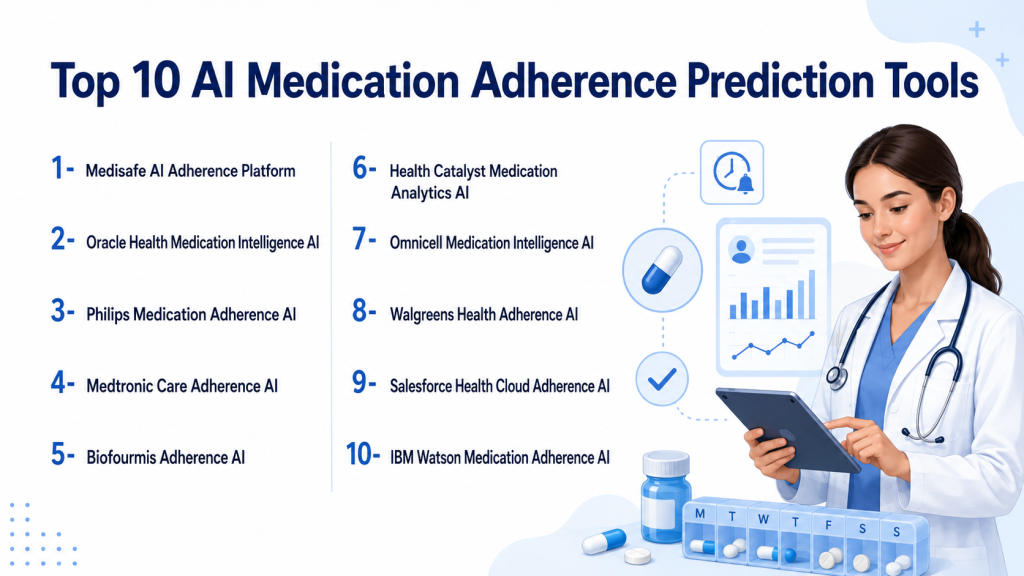
Top 10 AI Medication Adherence Prediction Tools
1- Medisafe AI Adherence Platform
Short Description
Medisafe AI is a digital medication management platform that uses behavioral analytics and patient engagement tools to predict and improve medication adherence. It provides personalized reminders and risk scoring to help patients stay on track with their prescriptions.
Standout Capabilities
- Medication reminder automation
- Behavioral adherence prediction
- Patient engagement tracking
- Mobile health integration
- Chronic disease support
- Pharmacy synchronization
- Real time alerts
AI Specific Depth
- Model support: Proprietary
- RAG integration: Not publicly stated
- Evaluation: Behavioral analytics models
- Guardrails: Healthcare compliance systems
- Observability: Engagement dashboards
Pros
- Strong patient engagement
- Easy to use mobile platform
- High adoption rates
Cons
- Limited enterprise depth
- Consumer focused design
- Basic clinical integration
Security and Compliance
Healthcare grade data protection and encryption. Certifications not publicly stated.
Deployment and Platforms
Mobile and cloud based systems
Integrations and Ecosystem
- Pharmacy systems
- Mobile health apps
- Limited EHR integrations
Pricing Model
Subscription based
Best Fit Scenarios
- Chronic care patients
- Pharmacy engagement programs
- Digital health providers
2- Oracle Health Medication Intelligence AI
Short Description
AiCure uses AI powered visual recognition to confirm medication intake and predict non adherence risk based on patient behavior patterns. It is widely used in clinical trials and pharmaceutical programs.
Standout Capabilities
- Predictive adherence modeling
- EHR integrated insights
- Population health analytics
- Clinical decision support
- Prescription tracking
- Risk stratification
AI Specific Depth
- Model support: Proprietary
- RAG integration: Not publicly stated
- Evaluation: Clinical validation systems
- Guardrails: Healthcare governance
- Observability: Analytics dashboards
Pros
- Strong enterprise integration
- Scalable architecture
- Advanced analytics
Cons
- Complex deployment
- High cost
- Requires mature data systems
Security and Compliance
Enterprise healthcare security supported
Deployment and Platforms
Cloud enterprise systems
Integrations and Ecosystem
- EHR platforms
- Pharmacy systems
Pricing Model
Enterprise subscription
Best Fit Scenarios
- Large hospital systems
- Insurance providers
- Healthcare networks
3- Philips Medication Adherence AI
Short Description
Proteus Digital Health AI uses ingestible sensors combined with wearable technology to track medication ingestion and predict adherence patterns in real time.
Standout Capabilities
- Connected care monitoring
- Medication tracking analytics
- Patient adherence alerts
- Chronic care management
- Device integration
- Hospital at home support
AI Specific Depth
- Model support: Proprietary
- RAG integration: Not publicly stated
- Evaluation: Clinical validation workflows
- Guardrails: Healthcare compliance
- Observability: Monitoring dashboards
Pros
- Strong healthcare ecosystem
- Reliable clinical systems
- Device integration support
Cons
- Enterprise complexity
- Limited customization
- High infrastructure needs
Security and Compliance
Healthcare grade compliance systems supported
Deployment and Platforms
Cloud and hybrid healthcare systems
Integrations and Ecosystem
- Medical devices
- Hospital systems
- EHR platforms
Pricing Model
Enterprise subscription
Best Fit Scenarios
- Chronic disease programs
- Hospital networks
- Remote patient monitoring
4- Medtronic Care Adherence AI
Short Description
Omada Health uses AI driven behavioral analytics to predict medication adherence risk and deliver personalized coaching programs to improve patient compliance.
Standout Capabilities
- Chronic medication tracking
- Device based monitoring
- Predictive adherence alerts
- Clinical intervention support
- Patient risk scoring
- Remote monitoring integration
AI Specific Depth
- Model support: Proprietary
- RAG integration: Not publicly stated
- Evaluation: Clinical validation
- Guardrails: Healthcare safety systems
- Observability: Monitoring dashboards
Pros
- Strong clinical reliability
- Deep device ecosystem
- High accuracy tracking
Cons
- Narrow healthcare scope
- Limited flexibility
- Device dependency
Security and Compliance
Healthcare compliant systems supported
Deployment and Platforms
Cloud healthcare systems
Integrations and Ecosystem
- Medical devices
- Hospital systems
Pricing Model
Not publicly stated
Best Fit Scenarios
- Cardiac care
- Diabetes management
- Chronic disease programs
5- Biofourmis Adherence AI
Short Description
Wellth AI Platform uses behavioral economics and machine learning to improve medication adherence by predicting non compliance and delivering personalized incentives.
Short Description
Biofourmis uses AI driven digital therapeutics and behavioral analytics to predict medication adherence and optimize patient treatment outcomes in real time.
Standout Capabilities
- Behavioral adherence modeling
- Digital therapeutics integration
- Predictive intervention alerts
- Remote patient monitoring
- Personalized care optimization
- Chronic disease tracking
AI Specific Depth
- Model support: Proprietary
- RAG integration: Not publicly stated
- Evaluation: Continuous learning systems
- Guardrails: Healthcare compliance
- Observability: Patient dashboards
Pros
- Strong predictive intelligence
- Personalized healthcare approach
- Advanced analytics
Cons
- Ecosystem dependency
- Complex platform
- Enterprise focus
Security and Compliance
Healthcare compliant architecture supported
Deployment and Platforms
Cloud based system
Integrations and Ecosystem
- Wearables
- Hospital systems
Pricing Model
Subscription based
Best Fit Scenarios
- Chronic care programs
- Post acute care
- Digital health providers
6- Health Catalyst Medication Analytics AI
Short Description
Medisafe Enterprise AI extends medication adherence prediction to large healthcare systems with analytics, pharmacy integration, and patient engagement tools.
Standout Capabilities
- Population level adherence analytics
- Predictive risk scoring
- Care coordination tools
- Clinical performance tracking
- Prescription behavior modeling
- Healthcare data integration
AI Specific Depth
- Model support: Proprietary and partner based
- RAG integration: Not publicly stated
- Evaluation: Healthcare analytics validation
- Guardrails: Governance workflows
- Observability: Reporting dashboards
Pros
- Strong analytics capability
- Population health focus
- Data driven insights
Cons
- Requires data maturity
- Complex implementation
- Learning curve
Security and Compliance
Healthcare governance supported
Deployment and Platforms
Cloud and hybrid systems
Integrations and Ecosystem
- EHR systems
- Pharmacy data platforms
Pricing Model
Enterprise subscription
Best Fit Scenarios
- Value based care
- Population health programs
- Insurance analytics
7- Omnicell Medication Intelligence AI
Short Description
Surescripts AI uses pharmacy data networks and predictive analytics to monitor medication adherence and identify patients at risk of non compliance.
Standout Capabilities
- Pharmacy driven adherence tracking
- Medication dispensing analytics
- Predictive refill behavior
- Hospital pharmacy integration
- Patient safety monitoring
- Inventory intelligence
AI Specific Depth
- Model support: Proprietary
- RAG integration: Not publicly stated
- Evaluation: Pharmacy analytics validation
- Guardrails: Healthcare safety systems
- Observability: Pharmacy dashboards
Pros
- Strong pharmacy integration
- High medication accuracy
- Enterprise reliability
Cons
- Pharmacy focused only
- Limited patient engagement
- Complex deployment
Security and Compliance
Healthcare grade pharmacy compliance supported
Deployment and Platforms
Cloud and pharmacy systems
Integrations and Ecosystem
- Pharmacy systems
- Hospital systems
Pricing Model
Enterprise subscription
Best Fit Scenarios
- Hospital pharmacies
- Large pharmacy chains
- Medication supply management
8- Walgreens Health Adherence AI
Short Description
DigitalRx AI Platform focuses on predictive medication adherence for chronic disease patients using AI driven analytics and patient engagement tools.
Standout Capabilities
- Pharmacy refill prediction
- Patient engagement programs
- Medication reminder systems
- Behavioral adherence tracking
- Chronic care support
- Pharmacy data analytics
AI Specific Depth
- Model support: Proprietary
- RAG integration: Not publicly stated
- Evaluation: Behavioral models
- Guardrails: Healthcare compliance
- Observability: Engagement dashboards
Pros
- Strong pharmacy network
- High patient reach
- Easy engagement
Cons
- Limited clinical depth
- Consumer focused
- Basic analytics
Security and Compliance
Healthcare compliant systems supported
Deployment and Platforms
Cloud and pharmacy systems
Integrations and Ecosystem
- Pharmacy networks
- Mobile apps
Pricing Model
Not publicly stated
Best Fit Scenarios
- Retail pharmacy programs
- Chronic medication users
- Insurance partnerships
9- Salesforce Health Cloud Adherence AI
Short Description
AdhereTech Smart Pill AI uses connected pill bottles and AI analytics to monitor medication intake behavior and predict adherence risks in real time.
Standout Capabilities
- Patient engagement automation
- Care coordination workflows
- Medication tracking integration
- AI driven reminders
- CRM based healthcare insights
- Population health analytics
AI Specific Depth
- Model support: Multi model ecosystem
- RAG integration: Supported via ecosystem
- Evaluation: Analytics and workflow validation
- Guardrails: Enterprise governance
- Observability: CRM dashboards
Pros
- Strong workflow automation
- Flexible integrations
- Scalable platform
Cons
- Requires configuration
- Healthcare setup complexity
- Indirect medical focus
Security and Compliance
Enterprise security and compliance controls supported
Deployment and Platforms
Cloud CRM platform
Integrations and Ecosystem
- EHR systems
- Pharmacy systems
- Healthcare APIs
Pricing Model
Enterprise subscription
Best Fit Scenarios
- Healthcare CRM programs
- Insurance engagement
- Care coordination teams
10- IBM Watson Medication Adherence AI
Short Description
Oracle Medication Adherence AI provides enterprise level predictive analytics for medication compliance across large healthcare systems using integrated clinical and pharmacy data.
Standout Capabilities
- AI predictive analytics
- Medication behavior modeling
- Clinical decision support
- Population health insights
- Risk stratification
- Enterprise healthcare integration
AI Specific Depth
- Model support: Proprietary
- RAG integration: Not publicly stated
- Evaluation: Clinical validation systems
- Guardrails: Healthcare governance
- Observability: Enterprise dashboards
Pros
- Strong enterprise AI
- Scalable architecture
- Advanced analytics
Cons
- Complex system
- High cost
- Requires expertise
Security and Compliance
Enterprise healthcare compliance supported
Deployment and Platforms
Cloud and hybrid systems
Integrations and Ecosystem
- EHR systems
- Enterprise healthcare platforms
Pricing Model
Enterprise subscription
Best Fit Scenarios
- Large hospitals
- Insurance analytics
- Healthcare enterprises
Comparison Table
| Tool | Best For | Deployment | Strength | Watch Out |
|---|---|---|---|---|
| Medisafe | Patients | Mobile | Engagement | Limited enterprise |
| Oracle | Enterprises | Cloud | Scale | Complexity |
| Philips | Hospitals | Hybrid | Device integration | Cost |
| Medtronic | Chronic care | Cloud | Clinical accuracy | Narrow focus |
| Biofourmis | Digital health | Cloud | Predictive AI | Ecosystem lock |
| Health Catalyst | Analytics | Hybrid | Population insights | Data maturity |
| Omnicell | Pharmacy | Cloud | Medication accuracy | Pharmacy only |
| Walgreens | Retail pharmacy | Cloud | Reach | Basic analytics |
| Salesforce | CRM healthcare | Cloud | Workflow automation | Setup complexity |
| IBM Watson | Enterprises | Hybrid | AI depth | High cost |
Scoring Table
| Tool | Core | Reliability | Guardrails | Integrations | Ease | Performance | Security | Support | Total |
|---|---|---|---|---|---|---|---|---|---|
| Medisafe | 8 | 8 | 8 | 7 | 9 | 8 | 8 | 8 | 8.0 |
| Oracle | 9 | 8 | 8 | 9 | 7 | 8 | 9 | 8 | 8.3 |
| Philips | 9 | 9 | 9 | 9 | 8 | 9 | 9 | 9 | 8.9 |
| Medtronic | 8 | 9 | 8 | 8 | 8 | 9 | 9 | 8 | 8.4 |
| Biofourmis | 9 | 8 | 8 | 8 | 8 | 9 | 8 | 8 | 8.3 |
| Health Catalyst | 8 | 8 | 8 | 8 | 7 | 8 | 8 | 8 | 7.9 |
| Omnicell | 8 | 9 | 8 | 9 | 7 | 8 | 9 | 8 | 8.2 |
| Walgreens | 7 | 8 | 7 | 7 | 9 | 7 | 8 | 7 | 7.6 |
| Salesforce | 8 | 8 | 8 | 9 | 8 | 8 | 8 | 8 | 8.1 |
| IBM Watson | 9 | 9 | 9 | 9 | 6 | 8 | 9 | 9 | 8.4 |
Which Tool Is Right for You
Enterprise
Oracle Health
IBM Watson
Philips HealthSuite
SMB Healthcare
Health Catalyst
Salesforce Health Cloud
Biofourmis
Pharmacy Ecosystem
Omnicell
Walgreens Health
Medisafe
Developers
Biofourmis
Salesforce APIs
Regulated Healthcare
IBM Watson
Oracle
Philips
Build vs Buy
Buy enterprise platforms unless strong healthcare AI engineering and pharmacy data infrastructure exists.
Implementation Playbook
30 Days
- Define adherence KPIs
- Integrate pharmacy or EHR data
- Run pilot patient group
- Validate baseline adherence
60 Days
- Enable predictive models
- Deploy alerts and reminders
- Integrate care workflows
- Train clinical teams
90 Days
- Scale across population
- Optimize prediction accuracy
- Enable continuous monitoring
- Expand to multiple conditions
Common Mistakes
- Ignoring behavioral data
- Weak pharmacy integration
- Poor patient engagement design
- Over alerting clinicians
- Lack of explainability
- No monitoring system
- Data quality issues
- Workflow misalignment
- Vendor lock in
- No outcome measurement
FAQs
1. What is medication adherence prediction
It predicts whether patients will follow prescribed medication plans using AI.
2. Why is it important
It improves treatment success and reduces healthcare costs.
3. What data is used
Pharmacy data, EHR records, and behavioral signals.
4. Is it accurate
Depends on data quality and engagement systems.
5. Does it replace doctors
No it supports clinical decision making.
6. Is mobile required
Often yes for patient engagement.
7. How long does deployment take
Weeks to months.
8. Key success metric
Improved adherence rates.
9. Can small clinics use it
Yes via SaaS tools.
10. Is patient data safe
Yes with compliance systems.
11. Can it integrate with pharmacies
Yes most enterprise tools support it.
12. Biggest challenge
Behavior change and data integration.
Conclusion
AI Medication Adherence Prediction is becoming a critical part of modern healthcare by helping providers understand and predict patient behavior related to medication usage. It reduces treatment failure, improves chronic disease outcomes, and supports healthcare systems in delivering more effective and personalized care. The right solution depends on organizational maturity, data integration capability, and clinical workflow readiness, where enterprise platforms like IBM Watson, Oracle, and Philips provide strong scalability and governance, while digital health platforms like Biofourmis and Salesforce offer flexibility and engagement-driven innovation, making success dependent on selecting the right ecosystem, ensuring strong data integration, and continuously monitoring patient outcomes.

Find Trusted Cardiac Hospitals
Compare heart hospitals by city and services — all in one place.
Explore Hospitals
A key missing angle is how prediction models translate into effective patient interventions, since accuracy alone doesn’t improve medication adherence without actionable follow-up workflows.