
Introduction
AI no-show prediction tools utilize machine learning algorithms, demographic analysis, and historical behavioral datasets to calculate the statistical probability that a patient will miss a scheduled healthcare appointment. By processing factors such as past attendance patterns, appointment lead times, transportation access, historical weather conditions, and patient demographic profiles, these systems generate risk scores for every calendar slot. This technology allows health systems to pivot from a one-size-fits-all reminder strategy to a highly targeted approach, ensuring resources are focused on high-risk cohorts before they miss their care.
Why It Matters
Missed appointments—commonly known as no-shows—represent a major financial and clinical crisis for health systems, causing empty schedule gaps, lost provider revenue, and disrupted patient treatment plans. When patients miss critical screenings or follow-ups, their health outcomes often decline, leading to more expensive emergency interventions later. Traditional scheduling systems lack the foresight to intervene effectively, often sending generic reminders that high-risk individuals ignore. Predictive AI tools transform calendar management by identifying vulnerable patients who need extra support, such as transportation assistance or direct human outreach, thereby increasing slot utilization and improving long-term population health.
Real-World Use Cases
- Targeted Intervention Triage: Automatically tagging high-risk appointments for manual human outreach or personalized concierge confirmation calls.
- Smart Overbooking Logic: Safely scheduling multiple patients into high-risk slots based on the calculated probability that at least one person will miss the appointment, balancing clinic throughput.
- Dynamic Reminder Cadencing: Increasing the frequency and urgency of automated text, email, or voice reminders specifically for individuals flagged as high-risk.
- Transportation Coordination: Integrating with ride-share APIs to automatically offer subsidized transport options when a high-risk patient is identified.
- No-Show Trend Analytics: Mapping out specific clinic locations, provider types, or times of day where attendance probability is lowest to optimize overall template design.
Evaluation Criteria
When purchasing an AI no-show prediction tool, healthcare operations and IT leaders should evaluate solutions based on the following criteria:
- EHR and Scheduling Integration: How seamlessly the software reads existing calendar data and writes risk scores or intervention tasks back into the primary practice management system.
- Model Explainability: The system capability to explain why a specific patient is flagged as high-risk, allowing billing and front-desk staff to trust the data.
- Historical Data Weighting: The platform effectiveness at learning from your specific institutional data versus relying on generic, industry-wide behavioral averages.
- Automated Workflow Orchestration: The capability to trigger downstream actions—like sending a specific SMS template or creating a follow-up task—automatically when a risk threshold is hit.
- Data Privacy and Residency: Alignment with medical data safety standards and the availability of zero-data-retention processing pipelines.
- System Latency: The speed at which the predictive engine evaluates new appointments added to the calendar.
- Performance Analytics: Centralized dashboards monitoring the success rate of no-show mitigation efforts and the overall impact on schedule fill rates.
- Compliance and Auditability: The presence of detailed logs tracking how no-show risk scores were generated and how they were acted upon by clinic staff.
- Best for: Multi-facility medical networks, high-volume ambulatory clinics, behavioral health centers, and community health organizations experiencing significant appointment leakage.
- Not ideal for: Small cash-only boutique practices with extremely high attendance rates or organizations using completely manual paper-based scheduling systems.
What’s Changed in AI No-Show Prediction
The landscape of appointment attendance intelligence has evolved beyond simple rule-based reminder sequences. The following trends define the market today:
- Agentic Outreach Workflows: Modern tools deploy independent software agents that not only predict no-shows but also execute outreach tasks, such as calling patients or negotiating reschedule dates autonomously.
- Multimodal Behavioral Analysis: Systems integrate diverse datasets—including transit delay indices, socioeconomic zip code data, and past clinical engagement history—to build comprehensive attendance risk profiles.
- Advanced Explainability Engines: New platforms provide staff with clear natural language reasons for high-risk flags, making it easier to tailor the human intervention.
- Strict Prompt-Injection Defense: Robust security barriers protect core predictive pipelines, ensuring unstructured text inside patient notes cannot manipulate attendance risk scores.
- Zero-Data-Retention Safeguards: Enterprise solutions process sensitive demographic data instantly through ephemeral pipelines, ensuring zero persistence of patient files for secondary model training.
- Local Model Routing: Hybrid architectures route standard, low-risk booking confirmations to efficient, fast models while sending high-risk, complex cohort assessments to deeper reasoning networks to balance cost and performance.
- Granular Process Traceability: Administration dashboards allow compliance teams to trace exactly which behavioral features led the AI to flag a specific patient as high-risk.
- Locally Hosted and Hybrid Architectures: To satisfy strict institutional governance, vendors increasingly offer hybrid models that process risk analytics entirely within the secure cloud perimeter of the health system.
Quick Buyer Checklist (Scan-Friendly)
Before shortlisting vendors, ensure your team can answer these fundamental questions:
- Data Governance: Does the vendor offer an absolute zero-data-retention policy for patient demographic and appointment history files?
- Model Learning: Does the engine improve over time by training on your specific clinic data, or is it a static model trained on generic datasets?
- EHR Interoperability: Can the tool pull and push data directly via native APIs, or does it require a secondary integration layer or manual file imports?
- Explainable Flags: Can staff quickly understand the logic behind a high-risk score to inform their intervention strategy?
- Proactive Interventions: Does the system trigger automated, tailored responses to high-risk patients, or does it only provide a dashboard view?
- System Latency: How fast is the risk score updated when a patient record is modified or a new appointment is booked?
- Lock-In Risk: Are your custom outreach logic, communication templates, and intervention hierarchies transportable if you shift to a different platform?
- Access Management: Does the tool integrate with enterprise single sign-on and enforce role-based access controls for your scheduling teams?
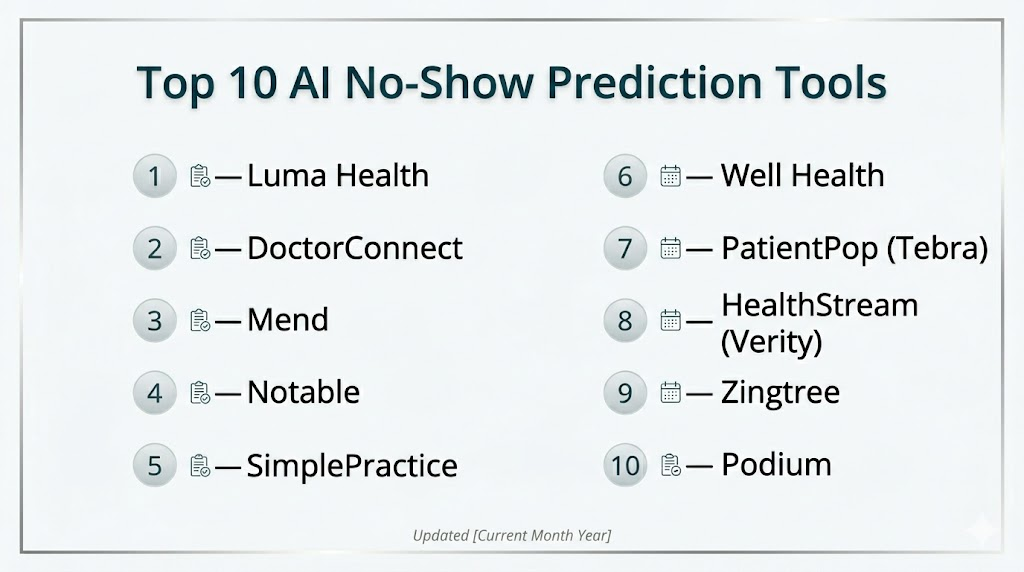
Top 10 AI No-Show Prediction Tools
#1 — Luma Health
Short description: Luma Health offers an enterprise patient success platform with a highly mature predictive scheduling layer. It focuses on closing care gaps and reducing no-shows through personalized, automated patient communication pathways.
Standout Capabilities
- Highly sophisticated risk modeling based on deep longitudinal patient engagement history.
- Automated text and voice intervention pathways triggered by high-risk flags.
- Native, bi-directional scheduling sync with major inpatient and outpatient health records.
- Digital intake workflows that confirm appointment details and capture necessary consent forms early.
- Centralized dashboards measuring the efficacy of intervention attempts against no-show reductions.
AI-Specific Depth
- Model support: Predictive machine learning frameworks analyzing patient attendance and communication history.
- RAG / knowledge integration: Real-time data parsing against live clinic templates and patient databases.
- Evaluation: Continuous performance auditing comparing predicted no-show rates against actual attendance outcomes.
- Guardrails: Structural rules blocking automated outreach on accounts flagged as sensitive or restricted.
- Observability: Granular central metrics tracking channel-specific engagement and slot fill velocities.
Pros
- Unmatched capacity to scale across massive health systems and diversified service lines.
- Highly effective at automating the entire no-show mitigation loop from risk flag to successful rescheduling.
- Strong security and compliance record built over a long history of institutional deployments.
Cons
- Requires disciplined organizational alignment to adopt automated outreach workflows at scale.
- Premium investment tier reflects its focus on large-scale enterprise hospital architectures.
- Complex feature sets can require focused management efforts for small clinical teams.
Security & Compliance
Maintains top-tier corporate safety frameworks, featuring single sign-on authentication, robust audit logging, and full data encryption at rest and in transit.
Deployment & Platforms
- Scalable cloud-native enterprise infrastructure.
Integrations & Ecosystem
Features extensive native data links with dominant healthcare record platforms, supporting real-time calendar read and write actions.
Pricing Model
Custom enterprise subscription frameworks scaled by facility footprint, provider count, and active software module usage.
Best-Fit Scenarios
- Large health networks needing to unify no-show prediction with patient messaging and intake.
- Organizations prioritizing deep native EHR data connectivity to maintain calendar consistency.
- Groups aiming to reduce administrative no-show management through mature, proven automated workflows.
#2 — DoctorConnect
Short description: DoctorConnect specializes in automated appointment reminders and predictive scheduling intelligence. Its platform emphasizes reducing no-shows by using personalized, multi-channel outreach combined with smart backfill waitlist tools.
Standout Capabilities
- Multi-channel reminder delivery across SMS, email, and voice calls.
- Automated smart waitlist backfilling triggered by cancellation signals.
- Behavioral risk stratification prioritizing personalized follow-ups for high-risk patients.
- Real-time dashboard visibility into patient confirmation status and upcoming schedule gaps.
- Custom outreach message editing allowing clinics to tailor tone based on appointment type.
AI-Specific Depth
- Model support: Machine learning engines optimized for predicting appointment attendance and channel response.
- RAG / knowledge integration: Bi-directional sync with practice management schedule templates.
- Evaluation: Ongoing data loops validating outreach response success rates.
- Guardrails: Internal validation walls protecting against excessive message frequency or message timing conflicts.
- Observability: Comprehensive logging tracks message delivery, open rates, and confirmation clicks.
Pros
- Highly responsive reminder delivery improves patient confirmation rates significantly.
- Exceptionally easy to deploy, making it a fast-win for outpatient clinics.
- Effectively automates the most frustrating parts of front-desk scheduling work.
Cons
- Analytics modules focus primarily on messaging response and scheduling status, not complex clinical text parsing.
- Deep hospital-wide enterprise integration paths are less broad than massive EHR-native suites.
- Requires manual oversight to calibrate specific message cadences if your practice is highly diverse.
Security & Compliance
Adheres to core healthcare safety mandates, including encrypted messaging streams and secure access controls for staff.
Deployment & Platforms
- Cloud-delivered software platform.
Integrations & Ecosystem
Integrates with popular outpatient practice management systems via standard data exchange hooks.
Pricing Model
Subscription-based models scaled by practice provider counts or monthly visit volumes.
Best-Fit Scenarios
- Outpatient medical groups seeking a reliable, fast-to-deploy tool to lower no-show rates.
- Clinics wanting to unify appointment reminders with a waitlist backfill engine.
- Practices prioritizing affordability and ease of use over complex predictive modeling.
#3 — Mend
Short description: Mend combines a highly accurate predictive no-show scoring engine with a patient engagement and telehealth platform. It is engineered to identify risks early, allowing for timely, personalized interventions that keep attendance rates high.
Standout Capabilities
- Proprietary predictive no-show scoring engine with high documented accuracy.
- Automated intervention sequences tailored for high-risk patient cohorts.
- Integrated telehealth platform allowing easy rescheduling to virtual visits if physical attendance is risky.
- Multilingual communication options that broaden outreach effectiveness.
- Real-time tracking of intervention outcomes, measuring attendance lift clearly.
AI-Specific Depth
- Model support: Custom predictive algorithms trained specifically on patient attendance and telehealth engagement metrics.
- RAG / knowledge integration: Real-time data syncs with practice scheduling grids.
- Evaluation: Continuous calibration checking model attendance risk predictions against finalized appointment data.
- Guardrails: Logic check boundaries ensuring intervention messages match the patient contact preferences.
- Observability: Clean, simple executive reporting charting saved clinical hours and no-show reductions.
Pros
- Predictive accuracy allows for highly targeted, effective outreach strategies.
- Seamless transition to virtual care options helps save appointments that would otherwise miss.
- Highly intuitive interface requires minimal training for scheduling staff.
Cons
- Advanced analytics configuration requires initial focus to tailor risk parameters to your unique clinic population.
- Not designed for tracking complex physical clinical inventory or non-appointment facility assets.
- Primary software focus is behavioral and outpatient, making it less suited for massive inpatient hospital grids.
Security & Compliance
Complies with strict health privacy standards, offering secure transmission pathways and user access auditing.
Deployment & Platforms
- Cloud-native platform accessible across mobile and desktop web environments.
Integrations & Ecosystem
Connects with market-leading outpatient health records via standard communication protocols.
Pricing Model
Tiered monthly subscription frameworks based on clinician seat volume.
Best-Fit Scenarios
- Behavioral health and outpatient groups valuing highly accurate no-show risk insights.
- Organizations seeking a combined telehealth and scheduling tool to maximize visit flexibility.
- Teams needing to prove no-show reduction ROI through transparent performance tracking.
#4 — Notable
Short description: Notable provides a digital assistant platform that automates patient intake and scheduling workflows. It uses intelligent automation to proactively manage no-shows by combining intake verification with smart scheduling follow-ups.
Standout Capabilities
- Proactive scheduling verification checks that validate insurance and patient intent before the slot.
- Automated task orchestration that triggers intervention workflows for high-risk flags.
- Intelligent patient self-scheduling engines that guide individuals toward best-fit times.
- Seamless background documentation updates to electronic health records.
- Enterprise analytics monitoring attendance health and administrative productivity metrics.
AI-Specific Depth
- Model support: Machine learning frameworks configured for visit-specific scheduling and intake logic.
- RAG / knowledge integration: Direct interaction with active health record rulesets and scheduling templates.
- Evaluation: Comparative data tracking measuring model outcomes against finalized attendance data.
- Guardrails: Validation boundaries preventing the submission of incomplete demographic files during intake.
- Observability: Clear visual interfaces charting operational task completions and scheduling gains.
Pros
- Exceptional depth in linking no-show prevention with the broader pre-visit intake process.
- Highly tailored automated models minimize the risk of generic, irrelevant communication.
- Strong corporate enterprise deployment framework fits the demands of large hospital systems.
Cons
- Implementation involves structured technical coordination with IT teams to capture enterprise rules perfectly.
- Investment tier reflects its advanced, enterprise-grade architecture focus.
- Requires a strong organizational commitment to digital-first patient access workflows.
Security & Compliance
Maintains strict corporate safety guidelines, incorporating advanced encryption, access auditing, and complete system record tracking.
Deployment & Platforms
- Cloud-native enterprise software infrastructure.
Integrations & Ecosystem
Features mature data connectors for major enterprise record platforms, supporting real-time interactions.
Pricing Model
Custom enterprise contracts tailored to organization footprint, scale, and feature utilization.
Best-Fit Scenarios
- Large medical enterprises needing to automate intake alongside no-show prevention.
- Networks looking to improve revenue integrity through pre-visit insurance and demographic verification.
- Systems aiming to transition administrative teams to complex care coordination roles.
#5 — SimplePractice
Short description: SimplePractice is a straightforward, all-in-one practice management tool for solo practitioners and small behavioral health groups. It includes automated reminders and basic scheduling tools that serve as a strong baseline for attendance management.
Standout Capabilities
- Unified ecosystem for appointment scheduling, billing, and automated reminders.
- Simple client portals for secure communication and appointment confirmations.
- Automated reminder sequences keeping client calendars synced without manual work.
- Streamlined custom availability settings tailored for independent practice workflows.
- Secure video visit hosting integrated natively into the scheduling interface.
AI-Specific Depth
- Model support: Basic automation rulesets optimized for standard reminder workflows.
- RAG / knowledge integration: Localized lookups tracking internal provider availability templates.
- Evaluation: Simple user engagement logs tracking confirmation clicks.
- Guardrails: Static template rules preventing booking conflicts within provider grids.
- Observability: Basic dashboard metrics showing session totals and visit statuses.
Pros
- Incredibly fast to set up for independent practitioners needing minimal configuration.
- Provides a unified, low-cost platform for all administrative and billing basics.
- Highly approachable, intuitive layout ensures zero technical barriers for office staff.
Cons
- Lacks complex predictive demand forecasting or advanced behavioral no-show scoring models.
- Not architected for multi-site facility resource scheduling or massive hospital grid management.
- Limited customization options for advanced, multi-department team outreach hierarchies.
Security & Compliance
Adheres to essential privacy guidelines, featuring encrypted data pathways and secure user authentication.
Deployment & Platforms
- Cloud-delivered software platform.
Integrations & Ecosystem
Self-contained system with structured data routing tailored for small practice accounting setups.
Pricing Model
Predictable flat monthly subscription frameworks per provider seat.
Best-Fit Scenarios
- Solo counselors, therapists, and small private-practice behavioral health groups.
- Practitioners seeking an immediate, all-in-one administrative and attendance tool.
- Small specialty offices prioritizing simple configuration steps over deep predictive analytics.
#6 — Well Health
Short description: Well Health provides an intelligent patient communication platform designed for large health systems. It excels at bridging communication gaps, offering an AI-powered outreach engine that helps clinics reduce no-shows through smart, conversational patient engagement.
Standout Capabilities
- Conversational AI outreach engine managing complex, two-way appointment conversations.
- Smart logic that recognizes intent, allowing patients to book, reschedule, or cancel via text.
- High-volume messaging engine capable of handling enterprise-level outreach campaigns.
- Unified patient engagement dashboards mapping attendance history and messaging responses.
- Integration capabilities with major enterprise electronic health records.
AI-Specific Depth
- Model support: Natural language processing networks specialized for healthcare messaging and patient intent.
- RAG / knowledge integration: Real-time data syncs with health system appointment grids.
- Evaluation: Continuous response analysis tracking which message templates improve attendance outcomes.
- Guardrails: Internal validation boundaries preventing messages to restricted or sensitive patient categories.
- Observability: Centralized visual logs tracking delivery metrics, engagement patterns, and conversion gains.
Pros
- Exceptional capacity to handle complex, multi-turn conversations through conversational text.
- Scalability fits the requirements of massive, multi-site corporate healthcare systems.
- Improves patient satisfaction by offering a modern, easy-to-use digital booking experience.
Cons
- Configuration of advanced logic pathways requires dedicated administrative setup time.
- Premium investment scale reflects its advanced enterprise corporate architecture focus.
- Standalone message-driven workflow management requires clear team coordination.
Security & Compliance
Adheres to strict enterprise safety standards, utilizing encrypted messaging flows, access logs, and full single sign-on support.
Deployment & Platforms
- Cloud-native enterprise software infrastructure.
Integrations & Ecosystem
Features mature native connectors for major electronic health systems, supporting direct-write calendar actions.
Pricing Model
Enterprise licensing structures scaled to organization footprint and transaction volumes.
Best-Fit Scenarios
- Massive health systems needing a central conversational front door for patient communications.
- Organizations wanting to move away from one-way reminders toward two-way appointment conversations.
- Teams prioritizing high-volume, multi-channel engagement across diverse patient populations.
#7 — PatientPop (Tebra)
Short description: PatientPop provides a comprehensive practice growth platform that includes robust automated scheduling and attendance management. It focuses on patient acquisition and retention, using automated reminders to keep calendars full and no-show rates low.
Standout Capabilities
- Online booking portals optimized for search and conversion, keeping calendar slots full.
- Automated reminder loops for appointments, reducing no-show rates through proactive alerts.
- Centralized dashboard managing patient communications, reviews, and booking statuses.
- Integrated digital intake tools capturing patient details before the appointment arrives.
- Practice performance analytics tracking overall growth, attendance, and patient satisfaction metrics.
AI-Specific Depth
- Model support: Machine learning algorithms configured for appointment conversion and retention.
- RAG / knowledge integration: Direct sync paths with common practice management scheduling templates.
- Evaluation: Tracking engagement metrics against attendance outcomes for messaging templates.
- Guardrails: Validation boundaries preventing the booking of invalid or unavailable slot times.
- Observability: Visual dashboards charting new appointment requests and reminder confirmations.
Pros
- Strong focus on driving new patient growth alongside maintaining existing calendars.
- User-friendly interface makes it easy for small and mid-sized offices to use effectively.
- Consolidates practice growth, scheduling, and attendance management into one platform.
Cons
- Predictive modeling is less deep for complex multi-site hospital resource management than enterprise tools.
- Enterprise EHR integration breadth is narrower compared to industry-native engagement suites.
- Primarily outpatient-focused, making it less suitable for high-acuity inpatient rounding environments.
Security & Compliance
Maintains essential healthcare data safety standards, using encrypted pathways and secure storage layers.
Deployment & Platforms
- Cloud-delivered software platform accessible through desktop and mobile browsers.
Integrations & Ecosystem
Connects with dominant practice management software through standard data interface routes.
Pricing Model
Tiered subscription packages scaled around clinic scale and feature activation.
Best-Fit Scenarios
- Outpatient medical groups looking to combine practice growth tools with scheduling attendance.
- Practices wanting to improve their online booking and reminder automation simultaneously.
- Organizations prioritizing a unified growth platform over specialized no-show modeling.
#8 — HealthStream (Verity)
Short description: HealthStream, through its Verity and engagement tools, offers an enterprise-grade platform for managing patient access and experience. It leverages data-driven insights to optimize scheduling attendance across large health networks.
Standout Capabilities
- Enterprise-level scheduling and engagement analytics tracking patient access metrics.
- Personalized communication pathways focused on reducing appointment no-shows.
- Centralized reporting tools mapping out organizational-wide attendance health trends.
- Scalable engagement campaigns supporting large-scale, enterprise patient outreach efforts.
- Integration frameworks built for complex hospital record infrastructures.
AI-Specific Depth
- Model support: Machine learning architectures trained for enterprise resource and access optimization.
- RAG / knowledge integration: Native sync connectivity with major health record scheduling grids.
- Evaluation: Continuous performance benchmarking tracking outreach success across distinct hospital lines.
- Guardrails: Corporate policy guardrails regulating message timing, frequency, and contact exclusions.
- Observability: Comprehensive executive reporting charting access velocity, no-show trends, and utilization metrics.
Pros
- Unmatched platform stability and scale for massive, diversified healthcare organizations.
- Highly sophisticated reporting tools allow for deep-dive access health analytics.
- Proven history managing complex credentialing and patient engagement workflows.
Cons
- Deployment cycles are lengthy due to the immense scale and complexity of the platform.
- Entry financial investment sits at a premium tier reflecting its enterprise-focused architecture.
- Maximizing value requires dedicated administrative and IT focus to govern data properly.
Security & Compliance
Maintains absolute institutional safety standards, including enterprise single sign-on, audit logs, and complete data isolation.
Deployment & Platforms
- Scalable cloud-native enterprise infrastructure.
Integrations & Ecosystem
Offers mature data connectors for major enterprise hospital systems, ensuring stable record synchronization.
Pricing Model
Custom corporate enterprise licensing contracts tailored to organization footprint and organizational scale.
Best-Fit Scenarios
- Massive, multi-facility hospital systems requiring an enterprise-grade patient access framework.
- Networks prioritizing deep data analytics to manage organizational attendance performance.
- Large groups looking for a stable, legacy-proven provider for patient engagement and credentialing.
#9 — Zingtree
Short description: Zingtree specializes in automated decision-tree workflows and conversational support. While not a native EHR scheduling tool, its agentic capabilities allow clinics to automate complex patient booking triage, helping deflect no-shows by qualifying appointments upfront.
Standout Capabilities
- Automated decision-tree pathways guiding patients through booking, triage, or reschedule steps.
- Conversational logic layers that intelligently qualify appointments before they are confirmed.
- Integration potential with existing software tools to trigger booking or reminder events.
- Visual builder interface allowing office leads to customize the triage logic paths easily.
- Reporting and analytics dashboards tracking decision tree completion and drop-off points.
AI-Specific Depth
- Model support: Deterministic decision frameworks combined with automated logic routing nodes.
- RAG / knowledge integration: Direct webhooks connecting to practice management or scheduling event hooks.
- Evaluation: Path drop-off tracking highlighting where patients quit the booking workflow.
- Guardrails: Internal validation boundaries preventing illogical triage or incorrect resource bookings.
- Observability: Visual node-based logging detailing the journey patients take through booking flows.
Pros
- Highly flexible, allowing you to map out custom intake or rescheduling logic unique to your specialty.
- Empowers non-technical clinic staff to build sophisticated, logic-driven appointment triage flows.
- Effectively filters bookings, preventing patients from scheduling slots that they will ultimately miss.
Cons
- Requires dedicated effort to map out logical triage paths during the initial setup.
- Does not function as a standalone EHR calendar manager, needing integration for live calendar writes.
- Focuses on logic pathways rather than deep predictive no-show risk modeling.
Security & Compliance
Maintains healthcare-appropriate safety standards, using secure encryptions, access logs, and user permissions.
Deployment & Platforms
- Cloud-delivered software platform.
Integrations & Ecosystem
Provides robust API tools and webhooks to trigger actions across other medical applications.
Pricing Model
Flexible subscription models scaled by platform usage or agent count.
Best-Fit Scenarios
- Practices wanting to build highly custom triage or booking qualification workflows.
- Operations aiming to automate complex appointment logic that generic tools cannot handle.
- Teams prioritizing a highly flexible, build-it-yourself logical framework for patient access.
#10 — Podium
Short description: Podium is a leading multi-channel customer engagement tool that has become popular in outpatient medicine. It optimizes no-show mitigation through fast, text-based interactions, helping practices maintain high attendance through reliable, rapid communication.
Standout Capabilities
- Unified inbox aggregating all patient text, email, and social media messaging interactions.
- Automated text reminder pathways that secure appointment confirmations consistently.
- Integrated review management engine that generates feedback after attended visits.
- Fast, mobile-first team collaboration tools for front-desk messaging work.
- Simple scheduling links that can be dropped into patient text messages easily.
AI-Specific Depth
- Model support: Machine learning frameworks configured for intent classification and text processing.
- RAG / knowledge integration: Sync connections with practice calendars via text-based reminders.
- Evaluation: Response tracking measuring text message engagement against scheduling outcomes.
- Guardrails: Automated filtering blocking messaging to sensitive or restricted account profiles.
- Observability: Clear visual metrics charting messaging volumes and patient confirmation rates.
Pros
- Extremely fast to deploy, making it a reliable quick-win for outpatient offices.
- Patients strongly prefer the modern, rapid text-based communication format over old calling lines.
- Increases practice visibility and reputation through integrated review management.
Cons
- Lacks complex, longitudinal clinical predictive no-show scoring models found in medical-first suites.
- Primarily focused on engagement, meaning it lacks native integration into deep surgical or inpatient scheduling logic.
- Feature sets prioritize outpatient service growth rather than managing heavy hospital resource logistics.
Security & Compliance
Adheres to standard privacy laws, utilizing secure encrypted transmission lines and user session safety blocks.
Deployment & Platforms
- Cloud-native software platform accessible across mobile and desktop environments.
Integrations & Ecosystem
Connects with major outpatient practice management systems via standard data hooks.
Pricing Model
Subscription-based pricing models scaled by business footprint and location counts.
Best-Fit Scenarios
- Outpatient medical groups wanting to modernize patient communication through text-first engagement.
- Practices aiming to unify appointment reminders, reputation management, and patient messaging.
- Offices prioritizing a fast, intuitive tool to keep attendance high without complex AI modeling.
Comparison Table
| Tool Name | Best For | Deployment | Model Flexibility | Strength | Watch-Out | Public Rating |
| Luma Health | Enterprise-wide attendance sync | Cloud-Native | Predictive Engagement AI | Unmatched engagement depth | Requires long-term rule mapping | N/A |
| DoctorConnect | Automated text/voice reminders | Cloud-Native | Attendance Modeling | Excellent waitlist backfilling | Analytics are reminder-focused | N/A |
| Mend | Telehealth-integrated attendance | Cloud-Native | No-Show Prediction | Seamless virtual care switch | Analytics require setup focus | N/A |
| Notable | Intake and scheduling automation | Enterprise Cloud | Visit-Specific ML Models | Deep EHR-native data syncing | Corporate deployment timelines | N/A |
| SimplePractice | Solo behavioral therapists | Cloud / Mobile | Basic Reminder Rules | All-in-one simple workflow | No complex predictive modeling | N/A |
| Well Health | Enterprise patient conversations | Cloud-Native | Intent-Based NLP | Conversational engagement strength | Premium price scale | N/A |
| PatientPop | Growth and attendance combined | Cloud-Native | Retention Logic Models | Balances growth with reminders | Less deep resource forecasting | N/A |
| HealthStream | Enterprise hospital health metrics | Enterprise Cloud | Enterprise ML Architectures | Granular access analytics | Premium price, long setup | N/A |
| Zingtree | Custom appointment triage | Cloud / API | Decision-Tree Pathways | Build-it-yourself triage logic | No native calendar management | N/A |
| Podium | Text-first communication | Cloud / Mobile | Messaging Intent AI | Rapid text-based confirmation | Light predictive modeling | N/A |
Scoring & Evaluation (Transparent Rubric)
The scoring presented in the rubric below reflects comparative evaluations based on target audience fit, feature depth, and architectural focus. No tool scores perfectly across every dimension because engineering priorities involve trade-offs—for instance, maximizing simplicity often means reducing complex enterprise administrative capabilities.
| Tool | Core Features (20%) | Reliability/Eval (15%) | Guardrails (10%) | Integrations (15%) | Ease of Use (10%) | Perf/Cost (15%) | Security/Admin (10%) | Support (5%) | Weighted Total |
| Luma Health | 10 | 9 | 9 | 10 | 8 | 8 | 10 | 9 | 9.15 |
| DoctorConnect | 9 | 9 | 9 | 9 | 9 | 9 | 9 | 8 | 8.90 |
| Mend | 8 | 9 | 8 | 8 | 9 | 9 | 8 | 8 | 8.45 |
| Notable | 9 | 10 | 9 | 9 | 8 | 7 | 9 | 8 | 8.55 |
| SimplePractice | 6 | 6 | 7 | 4 | 10 | 10 | 7 | 8 | 7.15 |
| Well Health | 9 | 9 | 9 | 9 | 8 | 7 | 9 | 8 | 8.55 |
| PatientPop | 8 | 8 | 8 | 8 | 9 | 8 | 8 | 8 | 8.10 |
| HealthStream | 9 | 9 | 9 | 9 | 7 | 7 | 10 | 8 | 8.45 |
| Zingtree | 8 | 8 | 8 | 8 | 8 | 9 | 8 | 7 | 7.95 |
| Podium | 8 | 8 | 8 | 8 | 9 | 9 | 8 | 8 | 8.20 |
Top 3 for Enterprise
- Luma Health
- Notable
- HealthStream (Verity)
Top 3 for SMB
- DoctorConnect
- Well Health
- Podium
Top 3 for Developers
- Luma Health
- Notable
- Zingtree
Which AI No-Show Prediction Tool Is Right for You
Solo / Freelancer
If you run an independent practice with no dedicated administrative staff, bypass expensive enterprise automation networks entirely. Prioritize all-in-one software suites that handle every clinical, scheduling, and billing step in a single interface. Tools like SimplePractice are ideal, as they combine booking, video visits, and simple automated text reminders into one layout that requires no complex configuration.
SMB
For regional medical associations and mid-sized outpatient groups, target tools that bridge the gap between calendar management and text-based outreach. Platforms like DoctorConnect or Podium match this category best, offering intuitive, fast-to-deploy text reminder engines, automated no-show waitlist triggers, and highly responsive communication portals that prevent front-desk staff from getting overwhelmed by basic booking tasks.
Mid-Market
Multi-site ambulatory centers and growing surgical groups require software that integrates no-show prevention with insurance tracking and intake data. Platforms like Mend or PatientPop provide the ideal mid-market choice, offering a balanced mix of predictive attendance modeling, virtual telehealth switches, and multi-channel reminders that help managers stabilize their revenue while tracking performance metrics across clinic sites.
Enterprise
Massive, multi-site health systems, integrated delivery networks, and high-volume billing organizations must prioritize bidirectional data syncing, single sign-on parameters, and centralized data protection at the top of their evaluation rubrics. Industry leaders like Luma Health, Notable, or HealthStream deliver the necessary processing scale, multi-department visibility, and highly auditable record logs required to maintain schedule integrity at enterprise volume.
Regulated Industries
For medical research groups, government-operated diagnostic facilities, or high-security clinical environments, absolute traceability and data isolation are mandatory. Select advanced attendance analytical platforms that offer dedicated private cloud environments and clear zero-data-retention parameters, ensuring that patient demographic profiles or appointment notes are processed safely and never saved for third-party model training.
Budget vs. Premium
If limiting software spend is your primary goal, deploying lightweight text-first messaging utilities that automate basic reminders is a highly cost-effective strategy. However, if your long-term goal is capturing the massive revenue lost to empty scheduling slots, investing in a premium, predictive no-show modeling platform that triggers intelligent intervention sequences offers a far higher structural return on investment.
Build vs. Buy
Building a custom no-show prediction engine internally using raw machine learning code is exceptionally difficult due to the shifting complexities of patient attendance behavior and calendar data volatility. Purchasing an established, specialized vendor utility ensures that professional data engineers maintain model accuracy, manage privacy compliance, and sync with electronic records, letting your internal teams concentrate entirely on providing clinical excellence.
Implementation Playbook (30 / 60 / 90 Days)
A successful rollout requires balancing software template testing with staff operational adaptation. Use this tactical pipeline to map your deployment:
30 Days: Pilot & Success Metrics
- Technical Task: Integrate the chosen no-show analytics tool with a controlled data stream tracking a high-volume outpatient service line.
- AI Evaluation: Run the software predictive models in a passive shadow mode to verify attendance risk precision against finalized appointment outcomes.
- Success Metric: Verify that the system can screen thousands of calendar entries and generate risk scores in less than a few minutes without interfering with staff workflows.
60 Days: Harden Security, Evaluation & Rollout
- Technical Task: Enable institutional single sign-on parameters and establish precise role-based view privileges across billing teams.
- AI Evaluation: Configure the software intervention triggers, ensuring that flagged high-risk patients flow into automated outreach messaging queues automatically.
- Success Metric: Achieve a measurable lift in confirmed attendance rates of at least twenty percent within the pilot group prior to wider expansion.
90 Days: Optimize Cost/Latency, Governance & Scale
- Technical Task: Deploy the attendance prediction platform completely across all remaining medical departments and facility networks.
- AI Evaluation: Execute structured security validation tests to confirm that automated outreach agents function safely without hitting communication spam boundaries.
- Success Metric: Confirm that a high majority of target high-risk appointments are successfully processed through the intervention workflow, resulting in consistent calendar fill stabilization.
Common Mistakes & How to Avoid Them
- Over-Automation Without Human Intervention Paths: Relying entirely on automated text responses for high-risk patients without providing clear escalations to front-desk staff. Always build warm-transfer paths.
- Ignoring Data Retention Disclosures: Failing to confirm if your software provider records sensitive patient attendance histories for secondary model development. Require explicit zero-data-retention terms.
- Skipping Service-Line Validation Trials: Assuming an attendance model configured for general outpatient wellness works perfectly for intense behavioral therapy sessions. Execute focused validation checks by service line.
- Relying on Outdated Attendance Data: Selecting a vendor that updates its modeling logic only once a year. Patient behavior shifts constantly; verify that your tool utilizes dynamic, self-training algorithms.
- Ignoring Localized Out-of-State Constraints: Focusing strictly on national trends while ignoring regional transport or weather patterns that drive local no-show rates. Customize your risk parameters.
- Failing to Track Manual Intervention Success: Neglecting to log when staff successfully change a no-show outcome through manual effort. Tracking these touchpoints reveals where your AI model needs calibration.
- Embedding Outreach Logic in Closed Formats: Saving your custom intervention sequences inside a closed, proprietary vendor script layout that prevents data extraction if you switch vendors later.
- Overwhelming Patients with Excessive Message Blasts: Launching too many overlapping reminder streams across text, voice, and email, which triggers opt-out requests. Keep cadence frequencies coordinated.
- Overlooking Backend EHR Sync Errors: Failing to verify that automated cancellations write back to your primary medical record grids immediately. Delayed syncing results in lost slot recovery.
- Neglecting Administrative Staff Coaching: Deploying an advanced prediction tool without teaching office teams how to monitor and resolve the risk queues flagged by the system.
FAQs
1. How do AI no-show prediction tools analyze attendance probability?
The software utilizes machine learning models trained on millions of historical clinical encounters, comparing current patient booking details, geographical data, past attendance history, and external transit patterns to calculate a risk probability score.
2. Can these systems trigger personalized outreach sequences for high-risk patients?
Yes. When a patient is flagged as high-risk, the platform can automatically trigger tailored intervention pathways, such as sending more frequent reminders, offering subsidized ride-shares, or alerting a human staff member to call.
3. What is the standard accuracy rate for modern no-show prediction models?
When provided with high-quality, long-term historical data, top-tier predictive engines routinely identify high-risk attendance cohorts with documented accuracy rates exceeding 80%, allowing for effective, proactive schedule management.
4. Do these tools require custom software development for our EHR?
No. Most professional solutions offer native data connectors or modern application programming interfaces that link seamlessly with dominant enterprise health records, avoiding expensive custom development cycles.
5. How does the system handle a patient who is identified as a no-show risk?
The software automates a pre-configured response—often escalating to a combination of more persistent digital reminders and, if necessary, routing the appointment to a human staff member for personalized confirmation.
6. Is sensitive patient demographic data protected during attendance modeling?
Yes. Professional health software utilizes enterprise-grade end-to-end encryptions, secure tenant separations, and strict access controls, with industry leaders offering contractually guaranteed zero-data-retention terms.
7. What happens if a high-risk patient reschedules or cancels in advance?
The software maintains a live sync link with your practice scheduling grid; the moment an appointment status changes to “rescheduled” or “canceled,” the platform pauses outreach automatically and initiates waitlist backfill triggers.
8. Can these predictive tools help manage shared facility resource capacity?
Yes. Advanced enterprise configurations analyze risk patterns across diverse facility sites, identifying when to block or open specific resource availability to maintain overall organizational attendance balance.
9. How do we measure the return on investment of these no-show tools?
By mapping “predicted no-show” flags against “finalized attendance” logs, platforms generate clear performance metrics showing the exact count of saved slots and estimated revenue protection generated by the software interventions.
10. Can these platforms support multi-channel communication strategies?
Yes. The most effective systems coordinate communication across text, voice, and email, optimizing the delivery channel for each specific patient cohort to maximize the confirmation probability score.
11. Do we need specialized local hardware for attendance prediction?
No. Most professional tools are delivered as cloud-native software-as-a-service utilities accessible via standard desktop web browsers or mobile smartphone interfaces, avoiding local IT hardware overhead.
12. What is the typical pricing framework for predictive no-show software?
Solutions generally operate on tiered monthly subscription models based on provider count or location volume, while enterprise health systems typically utilize custom contracts configured around facility footprints and active transaction totals.
Conclusion
AI no-show prediction software marks a profound transition toward autonomous, data-driven schedule stabilization in modern medical administration. By identifying vulnerable appointment slots and managing risk-based patient outreach systematically, these tools shield institutional clinical capacity and prevent the systemic loss of care access.Because the most effective deployment strategy hinges on your current patient volume, calendar integration quality, and team communication workflows, avoiding one-size-fits-all software paths is essential. To build a secure, high-yield operation, map your primary attendance blockers, pilot a predictive tool within a core clinic line, mandate strict data protection perimeters, and scale your automated scheduling stabilization pipelines across your entire healthcare enterprise.

Find Trusted Cardiac Hospitals
Compare heart hospitals by city and services — all in one place.
Explore Hospitals
A valuable addition would be discussing prediction bias and intervention effectiveness, since no-show models can unintentionally reinforce disparities if reminder strategies and patient accessibility factors are not considered.