
Introduction
AI Healthcare Interoperability Mapping FHIR Assistants are AI-powered tools that automate the mapping of patient data from electronic health records, laboratory systems, and other healthcare sources into standardized FHIR resources. They reduce manual effort, increase data accuracy, and ensure compliance with interoperability standards.
This is important because healthcare organizations increasingly rely on real-time, integrated data for patient care, population health management, analytics, and telehealth. With AI FHIR assistants, hospitals, clinics, insurers, and telehealth platforms can achieve faster normalization, reduce errors, and enable seamless cross-system sharing. These tools improve operational efficiency, support AI-driven healthcare initiatives, and help maintain regulatory compliance.
Real-world use cases include:
- Migrating legacy EHR data to FHIR-compliant formats
- Normalizing lab and imaging data for clinical decision support
- Integrating data across multiple hospitals, clinics, and labs
- Enabling payer-provider interoperability and claims processing
- Supporting telehealth applications with standardized patient records
- Powering population health analytics and AI-driven predictive insights
Evaluation Criteria for Buyers:
- Mapping accuracy and FHIR compliance
- AI model reliability and hallucination prevention
- Guardrails and prompt injection protection
- Deployment flexibility and scalability
- Integration with EHRs, LIS, and analytics tools
- Observability, monitoring, and auditing capabilities
- Data privacy, residency, and retention controls
- Cost, latency, and throughput optimization
- Governance and audit features
- Ease of use for clinical and technical teams
- Vendor support and community resources
- BYO model and multi-modal AI capabilities
Best for: Hospitals, labs, healthcare IT teams, insurers, and telehealth platforms needing accurate, scalable FHIR mapping.
Not ideal for: Small clinics with minimal integration needs or organizations requiring only occasional manual mapping.
What’s Changed in AI Healthcare Interoperability Mapping FHIR Assistants
- Agentic workflows automate mapping suggestions and corrections
- Support for multimodal inputs including text, CSV, JSON, and HL7 messages
- Hybrid model routing with proprietary, open-source, and BYO models
- Continuous evaluation pipelines improve AI reliability and mapping accuracy
- Prompt injection defenses protect AI mapping engines
- Data residency, retention, and privacy controls meet regulatory standards
- Cost and latency optimization for batch and streaming workflows
- Observability dashboards track latency, token usage, and costs
- Governance frameworks enforce policy, audit, and security compliance
- Continuous validation against live FHIR endpoints
- Versioned templates allow safe rollbacks
- Enterprise-scale integrations with EHRs, LIS, and RPA pipelines
Quick Buyer Checklist
- Verify data privacy and retention policies
- Determine hosted, BYO, or open-source AI model requirements
- Evaluate RAG connectors and vector database compatibility
- Test mapping datasets for accuracy and reliability
- Enable guardrails and anomaly detection
- Assess latency, throughput, and cost controls
- Confirm auditability, RBAC, and administrative capabilities
- Consider vendor lock-in and migration flexibility
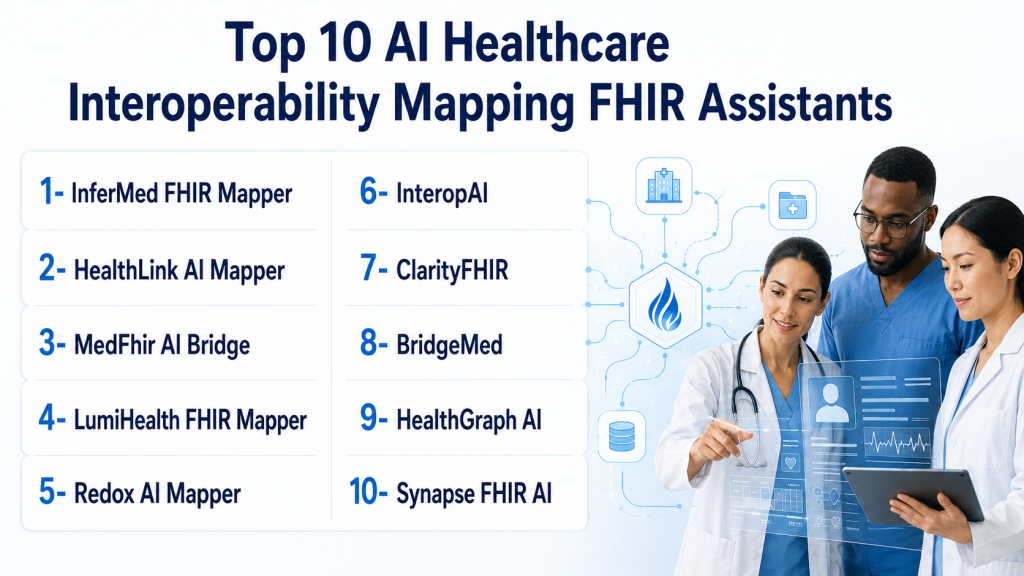
Top 10 AI Healthcare Interoperability Mapping FHIR Assistants
1- InferMed FHIR Mapper
One-line verdict: Best for hospitals and labs needing AI-driven FHIR mapping with enterprise-grade accuracy.
Short description: Automates mapping from EHR and lab data to FHIR resources with AI suggestions and confidence scoring. Supports collaborative workflows, audit-ready logs, and versioned templates to ensure accurate interoperability.
Standout Capabilities
- Automatic HL7 to FHIR mapping with AI suggestions
- Supports JSON, XML, and CSV formats
- Continuous FHIR compliance validation
- Version-controlled templates for rollback
- Collaborative workflows for multiple users
- Audit-ready logs for governance
AI-Specific Depth
- Model support: Proprietary AI and BYO model
- RAG / knowledge integration: Connectors to EHRs and LIS
- Evaluation: Regression tests and human review
- Guardrails: Policy enforcement and prompt injection defense
- Observability: Latency, token usage, and cost tracking
Pros
- Reduces manual mapping effort
- Enterprise-ready with governance support
- Integrates with multiple EHR and lab systems
Cons
- Onboarding complexity for smaller clinics
- Limited BYO model flexibility
- Higher license cost for small deployments
Security & Compliance
- SSO, RBAC, encryption, audit logs, residency and retention controls
- Certifications: Not publicly stated
Deployment & Platforms
- Web-based, Cloud, Hybrid
Integrations & Ecosystem
- Connects with Epic, Cerner, Allscripts, LIS platforms
- REST APIs, SDKs for Python and Java
- Batch and streaming pipelines
Pricing Model
- Tiered enterprise license with optional usage-based fees
- Not publicly stated
Best-Fit Scenarios
- Large hospital networks
- Multi-lab integrations
- Enterprise analytics pipelines
2- HealthLink AI Mapper
One-line verdict: Ideal for mid-sized clinics and payers needing automated FHIR mapping with compliance dashboards.
Short description: Provides AI-assisted mapping with governance and compliance monitoring. Helps insurers and clinics standardize datasets while reducing manual effort, ensuring faster integration and audit-ready outputs.
Standout Capabilities
- Hybrid rule-based and AI mapping engine
- Automated compliance reporting
- Batch and streaming FHIR conversion
- Connector library for EHRs and APIs
- Multi-format import/export support
AI-Specific Depth
- Model support: Open-source and proprietary hybrid
- RAG / knowledge integration: N/A
- Evaluation: Regression testing with human validation
- Guardrails: Policy enforcement and anomaly detection
- Observability: Token usage and latency metrics
Pros
- Streamlined compliance reporting
- Flexible deployment
- Handles small and large datasets
Cons
- Manual intervention for complex mappings
- UI can be unintuitive
- Limited AI model options
Security & Compliance
- Audit logs, RBAC, encryption, SSO
- Certifications: Not publicly stated
Deployment & Platforms
- Cloud, Web, Windows
Integrations & Ecosystem
- Supports major EHRs, LIS, and RPA pipelines
- REST APIs and SDKs
- Webhooks and event triggers
Pricing Model
- Subscription-based per seat
- Not publicly stated
Best-Fit Scenarios
- Mid-market insurers
- Multi-clinic interoperability
- FHIR compliance audits
3- MedFhir AI Bridge
One-line verdict: Suited for developers building custom AI-assisted FHIR pipelines across multiple systems.
Short description: API-driven tool with AI mapping suggestions for EHR and lab data. Enables automated normalization, multi-source integration, and flexible pipelines for developers building scalable FHIR workflows.
Standout Capabilities
- REST and GraphQL API support
- CLI and SDK for automation
- Extensible mapping rules with AI guidance
- Versioned templates and rollback
- Detailed logging and error reporting
AI-Specific Depth
- Model support: BYO models with multi-model routing
- RAG / knowledge integration: Internal knowledge bases
- Evaluation: Regression testing with human review
- Guardrails: Validation rules and anomaly detection
- Observability: Latency, error rates, and cost per request
Pros
- Highly customizable for integrations
- Open API enables automation
- Handles multi-source data pipelines
Cons
- Requires developer expertise
- Limited dashboards
- Smaller community
Security & Compliance
- Encryption, audit logs, RBAC
- Certifications: Not publicly stated
Deployment & Platforms
- Cloud, Self-hosted, Web, Linux
Integrations & Ecosystem
- API-first integration
- SDKs for Python, Node.js, Java
- HL7 v2/v3 and FHIR endpoints
Pricing Model
- Usage-based and open-source options
- Not publicly stated
Best-Fit Scenarios
- Custom FHIR pipelines
- AI-driven predictive analytics
- Multi-EHR integration projects
4- LumiHealth FHIR Mapper
One-line verdict: Best for multi-hospital networks needing scalable and accurate AI-assisted FHIR mapping.
Short description: Automates FHIR conversions with AI suggestions and templates for hospitals requiring consistent data across multiple sites. Reduces manual effort and ensures reliable interoperability.
Standout Capabilities
- Scalable mapping across hospitals
- Pre-built templates with AI assistance
- Versioned templates for rollback
- Collaborative review workflows
- Audit logs for governance
AI-Specific Depth
- Model support: Proprietary AI
- RAG / knowledge integration: Connectors to EHRs and LIS
- Evaluation: Regression and human validation
- Guardrails: Policy enforcement
- Observability: Latency and cost metrics
Pros
- Scales for large networks
- Reduces errors
- Supports collaboration
Cons
- Limited BYO support
- Staff training required
- Higher licensing cost
Security & Compliance
- Encryption, audit logs, RBAC
- Certifications: Not publicly stated
Deployment & Platforms
- Cloud, Web
Integrations & Ecosystem
- APIs and SDKs for EHR integration
- Batch and streaming pipelines
Pricing Model
- Subscription-based
- Not publicly stated
Best-Fit Scenarios
- Large hospital networks
- Multi-site lab integration
- Enterprise analytics pipelines
5- Redox AI Mapper
One-line verdict: Ideal for EHR integrators requiring deep interoperability and flexible deployment.
Short description: API-first AI mapping solution with real-time FHIR normalization. Supports multiple EHRs and data formats with audit-ready pipelines to ensure compliance and efficiency.
Standout Capabilities
- Real-time mapping engine
- Multi-format and multi-source support
- Connector library for EHRs and APIs
- Versioned templates
- Audit-ready mapping logs
AI-Specific Depth
- Model support: Proprietary AI
- RAG / knowledge integration: Connectors to internal systems
- Evaluation: Regression and human review
- Guardrails: Policy enforcement and anomaly detection
- Observability: Latency, errors, cost
Pros
- Real-time mapping
- Strong integration
- Scalable architecture
Cons
- Licensing cost
- Limited BYO support
- Learning curve
Security & Compliance
- Audit logs, RBAC, encryption, SSO
- Certifications: Not publicly stated
Deployment & Platforms
- Cloud, Hybrid, Web
Integrations & Ecosystem
- APIs, SDKs, HL7 and FHIR endpoints
- Event-driven pipelines
Pricing Model
- Subscription-based
- Not publicly stated
Best-Fit Scenarios
- EHR integration projects
- Real-time interoperability
- Multi-source data pipelines
6- InteropAI
One-line verdict: Best for labs and diagnostic centers requiring fast AI-assisted FHIR mapping.
Short description: Focused on automated mapping for lab and diagnostic data. Reduces manual effort while ensuring FHIR compliance and auditability for small-to-medium healthcare organizations.
Standout Capabilities
- Batch mapping engine for lab results
- AI-driven suggestions
- Versioned templates
- Audit logs and reporting
- API integration for LIS
AI-Specific Depth
- Model support: Open-source AI
- RAG / knowledge integration: N/A
- Evaluation: Human validation and regression
- Guardrails: Policy enforcement
- Observability: Mapping latency and error tracking
Pros
- Quick lab data mapping
- Reduces errors
- Supports batch processing
Cons
- Limited EHR connectors
- Smaller support community
- Less suitable for enterprise networks
Security & Compliance
- Encryption and RBAC
- Certifications: Not publicly stated
Deployment & Platforms
- Cloud, Web
Integrations & Ecosystem
- APIs for LIS
- Batch processing pipelines
- SDK support for Python
Pricing Model
- Subscription-based
- Not publicly stated
Best-Fit Scenarios
- Lab networks
- Diagnostic centers
- Small-to-mid clinic interoperability
7- ClarityFHIR
One-line verdict: Lightweight solution for clinics and SMEs needing easy-to-deploy FHIR mapping.
Short description: Provides automated FHIR mapping with simple dashboards, basic AI suggestions, and integration with common EHRs. Ideal for small healthcare organizations or pilot projects.
Standout Capabilities
- Easy onboarding for small teams
- Lightweight mapping engine
- FHIR R4 support
- Simple dashboard for monitoring
- Template-based AI suggestions
AI-Specific Depth
- Model support: BYO or proprietary AI
- RAG / knowledge integration: N/A
- Evaluation: Basic validation
- Guardrails: Limited
- Observability: Basic dashboards
Pros
- Easy to deploy
- Simple UI
- Affordable for small clinics
Cons
- Limited AI sophistication
- Fewer integrations
- Not enterprise-ready
Security & Compliance
- Encryption and audit logs
- Certifications: Not publicly stated
Deployment & Platforms
- Cloud, Web
Integrations & Ecosystem
- Basic EHR connectors
- REST APIs
- Limited SDK support
Pricing Model
- Subscription-based
- Not publicly stated
Best-Fit Scenarios
- Small clinics
- Local healthcare networks
- Early-stage telehealth platforms
8- BridgeMed
One-line verdict: Best for enterprise hospitals needing secure and audit-ready AI mapping workflows.
Short description: Enterprise-grade FHIR mapping solution with AI assistance, full audit logs, and compliance features. Scalable pipelines and collaborative workflows for large hospitals requiring reliable, auditable mapping.
Standout Capabilities
- Full audit-ready workflows
- Versioned templates with rollback
- Policy enforcement
- AI suggestions with confidence scoring
- Multi-EHR integration
AI-Specific Depth
- Model support: Proprietary AI
- RAG / knowledge integration: Connectors to EHRs
- Evaluation: Regression testing with human validation
- Guardrails: Strong policy enforcement
- Observability: Latency and cost dashboards
Pros
- Enterprise-ready
- Secure and auditable
- Handles multi-hospital networks
Cons
- Higher cost
- Requires training
- Limited BYO flexibility
Security & Compliance
- SSO, RBAC, encryption, audit logs, retention controls
- Certifications: Not publicly stated
Deployment & Platforms
- Hybrid, Cloud, Web
Integrations & Ecosystem
- APIs and SDKs for EHR and LIS
- HL7 and FHIR endpoints
- Batch and streaming pipelines
Pricing Model
- Subscription-based
- Not publicly stated
Best-Fit Scenarios
- Large hospital networks
- Enterprise EHR integration
- Auditable mapping pipelines
9- HealthGraph AI
One-line verdict: Suited for multi-source AI pipelines and telehealth integrations.
Short description: Integrates multiple sources including labs, EHRs, and patient monitoring devices. AI-assisted mapping ensures FHIR compliance while supporting telehealth and population health analytics.
Standout Capabilities
- Multimodal FHIR mapping
- AI normalization across sources
- Versioned templates
- Telehealth platform integration
- Audit logs and reporting
AI-Specific Depth
- Model support: Multi-model routing
- RAG / knowledge integration: Connectors to internal knowledge bases
- Evaluation: Regression and human review
- Guardrails: Policy enforcement
- Observability: Latency and cost metrics
Pros
- Handles multiple data sources
- Supports telehealth integration
- Scalable pipelines
Cons
- Limited prebuilt templates
- Learning curve for non-technical staff
- Smaller enterprise community
Security & Compliance
- Encryption and RBAC
- Certifications: Not publicly stated
Deployment & Platforms
- Cloud, Web
Integrations & Ecosystem
- APIs for EHR and monitoring devices
- SDKs for automation
- Event-driven pipelines
Pricing Model
- Subscription-based
- Not publicly stated
Best-Fit Scenarios
- Telehealth platforms
- Population health analytics
- Multi-source data pipelines
10- Synapse FHIR AI
One-line verdict: Focused on remote monitoring and telehealth, suitable for AI-driven interoperability.
Short description: Automates FHIR mapping for remote monitoring devices and telehealth platforms. Offers AI-assisted normalization, templates, and dashboards for efficient healthcare data integration.
Standout Capabilities
- FHIR mapping for IoT and wearable data
- AI normalization for telehealth
- Versioned templates
- Real-time monitoring and alerts
- Batch and streaming processing
AI-Specific Depth
- Model support: Open-source and proprietary AI
- RAG / knowledge integration: Connectors to telehealth and EHR systems
- Evaluation: Regression testing and human review
- Guardrails: Policy enforcement
- Observability: Latency, cost, and token usage
Pros
- Supports telehealth and IoT devices
- Real-time mapping
- Scalable for remote monitoring
Cons
- Smaller support community
- Requires technical integration
- Limited out-of-the-box templates
Security & Compliance
- Encryption and audit logs
- Certifications: Not publicly stated
Deployment & Platforms
- Cloud, Self-hosted, Web
Integrations & Ecosystem
- APIs and SDKs for telehealth, EHR, and wearable data
- Batch and streaming pipelines
- Event-driven automation
Pricing Model
- Subscription-based
- Not publicly stated
Best-Fit Scenarios
- Remote patient monitoring
- Telehealth platforms
- Multi-device integration
Comparison Table
| Tool Name | Best For | Deployment | Model Flexibility | Strength | Watch-Out | Public Rating |
|---|---|---|---|---|---|---|
| InferMed FHIR Mapper | Hospitals/Labs | Cloud/Hybrid | Proprietary + BYO | Accurate mapping | Costly for small clinics | N/A |
| HealthLink AI Mapper | Payers/Clinics | Cloud/Web | Open-source + Proprietary | Compliance reporting | UI complexity | N/A |
| MedFhir AI Bridge | Developers | Cloud/Self-hosted | BYO + Multi-model | Developer flexibility | Requires dev expertise | N/A |
| LumiHealth FHIR Mapper | Multi-hospital networks | Cloud | Proprietary | Scalable | Limited BYO | N/A |
| Redox AI Mapper | EHR integrators | Cloud | Proprietary | Integration depth | Licensing cost | N/A |
| InteropAI | Labs/Diagnostics | Cloud | Open-source | Fast automation | Limited analytics | N/A |
| ClarityFHIR | Clinics & SMEs | Web/Cloud | BYO | Lightweight | Fewer features | N/A |
| BridgeMed | Enterprise hospitals | Hybrid | Proprietary | Audit-ready | Onboarding effort | N/A |
| HealthGraph AI | Multi-source pipelines | Cloud | Multi-model | Multimodal mapping | Limited templates | N/A |
| Synapse FHIR AI | Telehealth & IoT | Cloud/Self-hosted | Open-source | Remote monitoring | Small community | N/A |
Scoring & Evaluation
Weighted scoring is comparative based on key criteria:
| Tool | Core | Reliability | Guardrails | Integrations | Ease | Perf/Cost | Security | Support | Weighted Total |
|---|---|---|---|---|---|---|---|---|---|
| InferMed | 9 | 9 | 8 | 9 | 8 | 8 | 9 | 8 | 8.7 |
| HealthLink | 8 | 8 | 7 | 8 | 7 | 7 | 8 | 7 | 7.5 |
| MedFhir | 8 | 8 | 7 | 9 | 7 | 7 | 8 | 6 | 7.5 |
| LumiHealth | 8 | 8 | 7 | 8 | 7 | 7 | 7 | 7 | 7.4 |
| Redox | 8 | 7 | 7 | 9 | 7 | 7 | 7 | 6 | 7.3 |
| InteropAI | 7 | 7 | 6 | 7 | 7 | 7 | 7 | 6 | 6.8 |
| ClarityFHIR | 7 | 6 | 6 | 6 | 8 | 7 | 6 | 6 | 6.5 |
| BridgeMed | 8 | 8 | 8 | 8 | 6 | 7 | 8 | 7 | 7.4 |
| HealthGraph AI | 8 | 8 | 7 | 8 | 7 | 7 | 7 | 6 | 7.2 |
| Synapse FHIR AI | 7 | 7 | 7 | 7 | 7 | 7 | 7 | 6 | 6.9 |
Top 3 Enterprise: InferMed, BridgeMed, Redox
Top 3 SMB: ClarityFHIR, HealthLink, InteropAI
Top 3 Developers: MedFhir, HealthGraph, Synapse
Which AI Healthcare Interoperability Mapping FHIR Assistant Tool Is Right for You
Solo / Freelancer
ClarityFHIR or MedFhir AI Bridge for experimentation or pilot projects.
SMB
HealthLink AI Mapper or InteropAI provides automated mapping with compliance dashboards.
Mid-Market
LumiHealth FHIR Mapper or Synapse FHIR AI supports multi-site integration and population health workflows.
Enterprise
InferMed FHIR Mapper, BridgeMed, and Redox AI Mapper deliver scalable, secure, and auditable mapping pipelines.
Regulated industries
Tools with strong guardrails, observability, and audit capabilities such as InferMed or BridgeMed are recommended.
Budget vs premium
Open-source or BYO options reduce costs but require technical skills; premium tools offer full support and service.
Build vs buy
Developers can DIY with MedFhir AI Bridge; enterprises benefit from managed vendor solutions.
Implementation Playbook
- 30 days: Pilot datasets, test mapping accuracy, set monitoring dashboards
- 60 days: Harden security, enforce guardrails, expand connectors, conduct regression evaluation
- 90 days: Optimize cost and latency, implement governance, scale mapping workflows
- AI-specific tasks include test harnesses, version control, incident handling, and observability dashboards
Common Mistakes & How to Avoid Them
- Ignoring prompt injection risks
- Skipping evaluation or regression testing
- Unmanaged data retention policies
- Lack of observability
- Unexpected AI processing costs
- Over-automation without human oversight
- Vendor lock-in
- Weak guardrails
- Insufficient model routing
- FHIR version mismatches
- Poor integration with analytics pipelines
- Minimal documentation for audits
- Neglecting BYO model validation
FAQs
1. What is an AI Healthcare Interoperability Mapping FHIR Assistant?
It automates mapping EHR, lab, and health data to FHIR resources, reducing manual work.
2. Can I use my own AI models?
Some tools support BYO models while others use proprietary AI; check compatibility.
3. Are these tools HIPAA-compliant?
Enterprise-grade tools provide encryption, RBAC, and audit logs; verification is recommended.
4. Can small clinics use them?
Yes, lightweight cloud-based tools like ClarityFHIR are suitable for small clinics.
5. How is multi-source data handled?
Data from EHRs, labs, and devices is normalized into standard FHIR resources automatically.
6. What guardrails exist?
Policy enforcement, anomaly detection, and human review reduce errors and unsafe outputs.
7. How much does it cost?
Pricing varies: subscription, usage-based, or open-source with enterprise options.
8. Can I deploy on-premises?
Some tools support hybrid or self-hosted deployment for sensitive healthcare data.
9. How is accuracy evaluated?
Regression testing, human review, and monitoring dashboards ensure mapping quality.
10. What integrations are available?
APIs, SDKs, and connectors for EHRs, LIS, and telehealth platforms are standard.
11. How do I avoid vendor lock-in?
Choose open standards, exportable templates, and BYO AI options when possible.
12. Can enterprise hospitals scale with these tools?
Yes, enterprise-grade tools handle multi-hospital, multi-source workflows effectively.
Conclusion
AI Healthcare Interoperability Mapping FHIR Assistants are transforming healthcare data integration by automating FHIR mapping, reducing manual effort, improving accuracy, and enabling scalable, secure, and auditable workflows. Selecting the right tool depends on organization size, technical capabilities, compliance needs, and deployment preferences. Hospitals, labs, and insurers should prioritize mapping accuracy, AI reliability, guardrails, integration flexibility, and observability while balancing cost and scalability. Next steps include shortlisting the tools based on specific requirements, piloting them with representative datasets to validate accuracy and compliance, verifying security, guardrails, and evaluation frameworks, and scaling the selected solution to achieve consistent, standardized, and reliable healthcare data interoperability across all systems.

Find Trusted Cardiac Hospitals
Compare heart hospitals by city and services — all in one place.
Explore Hospitals
A useful addition would be discussing real-world FHIR implementation challenges, since legacy system compatibility and data standardization often become bigger hurdles than the AI layer itself.