
Introduction
AI Adaptive Learning Engines leverage machine learning to provide personalized learning paths for students by dynamically adjusting content, difficulty, and pacing based on performance and engagement. In 2026, these platforms are central to K–12 schools, higher education institutions, corporate training programs, and online learning platforms aiming to optimize learning outcomes and reduce skill gaps.
Real-world use cases include:
- K–12 classrooms: Personalized learning plans for students based on strengths and weaknesses.
- Higher education: Adaptive tutoring in STEM, humanities, and professional courses.
- Corporate training: Tailored skill development programs for employees.
- Language learning: Customizable pathways for learners at different levels.
- Test preparation: Adaptive practice and review for exams like SAT, GRE, or certification tests.
- Special education: Individualized content for learners with diverse needs.
What buyers should evaluate:
- Quality of adaptive algorithms
- Multi-subject and multi-modal support (text, video, interactive exercises)
- Integration with LMS and classroom management systems
- Real-time vs batch learning path updates
- Analytics dashboards for instructors and administrators
- Multi-platform availability (web, iOS, Android)
- Offline and online functionality
- Scalability for large cohorts
- AI explainability and transparency
- Security, privacy, and compliance
Best for: K–12 schools, colleges, online learning platforms, corporate training, and language learning apps.
Not ideal for: Small-scale tutoring or static content platforms where adaptive learning is unnecessary.
What’s Changed in AI Adaptive Learning Engines in 2026+
- Real-time adaptive content based on learner performance
- Multi-modal AI support (text, video, interactive simulations)
- Personalized learning paths for large cohorts
- Integration with LMS and classroom management platforms
- Multi-language support for global learners
- Gamification and engagement optimization using AI
- Predictive analytics to identify struggling learners
- Reinforcement learning for adaptive difficulty adjustment
- Cloud and offline hybrid access
- Analytics dashboards for teachers and administrators
- Privacy-aware AI with GDPR/CCPA compliance
- Integration with skill assessment and certification frameworks
Quick Buyer Checklist
- Accuracy of adaptive algorithms
- Multi-subject coverage and depth
- Multi-modal content support
- Integration with LMS and classroom systems
- Real-time adaptation vs batch updates
- Analytics and reporting dashboards
- Scalability for large student populations
- Offline and mobile access
- Security and privacy compliance
- Gamification and engagement features
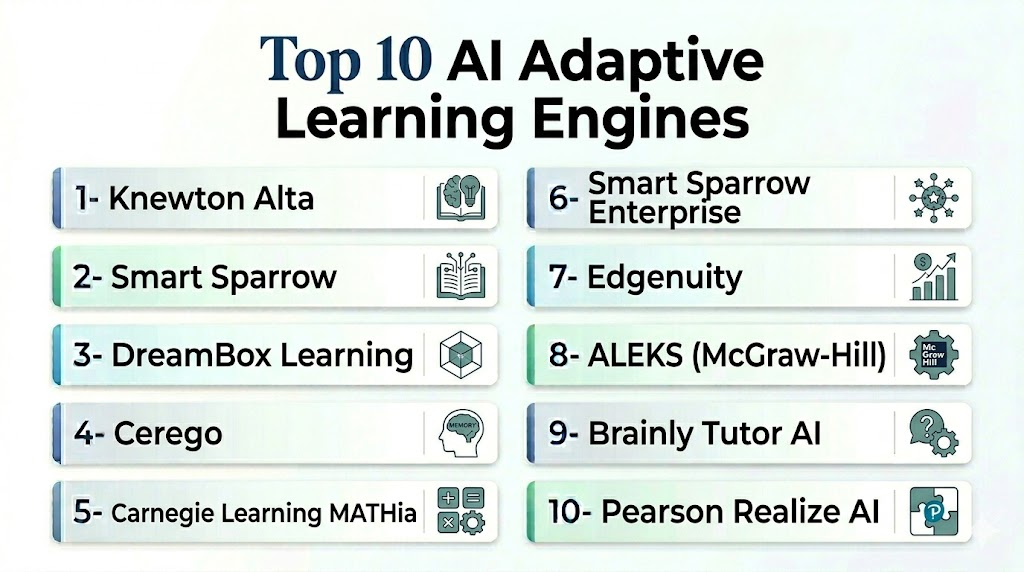
Top 10 AI Adaptive Learning Engines
1- Knewton Alta
One-line verdict: Best for higher education and adaptive STEM courses with ML-driven personalization.
Short description:
Knewton Alta provides adaptive learning pathways, personalized content, and analytics for students and educators.
Standout Capabilities
- Multi-subject adaptive learning
- Personalized learning paths
- Real-time assessment and feedback
- Analytics dashboards
- Integration with LMS and online platforms
AI-Specific Depth
- Model support: Proprietary ML
- RAG / knowledge integration: N/A
- Evaluation: Adaptive learning metrics
- Guardrails: Ensures curriculum alignment
- Observability: Teacher dashboards
Pros
- Personalized learning at scale
- Real-time feedback
- LMS integration
Cons
- Premium subscription
- Cloud-dependent
- Learning curve for instructors
Security & Compliance
Encryption, SSO; Certifications: Not publicly stated
Deployment & Platforms
Web, iOS, Android, Cloud
Integrations & Ecosystem
LMS APIs, classroom dashboards
Pricing Model
Subscription
Best-Fit Scenarios
- College STEM courses
- Online K–12 platforms
- Corporate training programs
2- Smart Sparrow
One-line verdict: Ideal for adaptive course creation with personalized student learning paths.
Short description:
Smart Sparrow allows instructors to create adaptive courses with AI-powered recommendations and performance analytics.
Standout Capabilities
- Adaptive course creation tools
- Real-time student progress tracking
- Multi-modal content support
- Analytics dashboards
- Integration with LMS
AI-Specific Depth
- Model support: Proprietary ML
- RAG / knowledge integration: N/A
- Evaluation: Student engagement metrics
- Guardrails: Curriculum alignment
- Observability: Dashboard analytics
Pros
- Flexible course creation
- Adaptive learning paths
- Real-time progress tracking
Cons
- Cloud-only
- Premium cost
- Learning curve for instructors
Security & Compliance
Varies / N/A
Deployment & Platforms
Web, Cloud
Integrations & Ecosystem
LMS, APIs
Pricing Model
Subscription
Best-Fit Scenarios
- Higher education
- Corporate training
- Online adaptive courses
3- DreamBox Learning
One-line verdict: AI-driven adaptive learning for K–8 math education.
Short description:
DreamBox adapts math lessons in real-time based on student responses and provides teachers with analytics dashboards.
Standout Capabilities
- Real-time adaptive math instruction
- Multi-device access
- Interactive exercises
- Analytics dashboards for teachers
- Gamified learning experiences
AI-Specific Depth
- Model support: Proprietary ML
- RAG / knowledge integration: N/A
- Evaluation: Student mastery tracking
- Guardrails: Ensures grade-appropriate content
- Observability: Teacher dashboards
Pros
- K–8 focus
- Gamified learning
- Real-time adaptation
Cons
- Limited to math
- Cloud-based
- Premium subscription
Security & Compliance
Encryption; Certifications: Not publicly stated
Deployment & Platforms
Web, iOS, Android
Integrations & Ecosystem
LMS, classroom management tools
Pricing Model
Subscription
Best-Fit Scenarios
- K–8 math instruction
- Homeschooling
- Online learning platforms
4- Cerego
One-line verdict: Personalized learning engine with adaptive memory retention and spaced repetition.
Short description:
Cerego uses AI to optimize learning schedules, adapt content difficulty, and track knowledge retention.
Standout Capabilities
- Adaptive spaced repetition
- Multi-subject coverage
- Real-time progress tracking
- Analytics dashboards
- LMS integration
AI-Specific Depth
- Model support: Proprietary ML
- RAG / knowledge integration: N/A
- Evaluation: Retention and engagement metrics
- Guardrails: Curriculum alignment
- Observability: Instructor dashboards
Pros
- Optimizes memory retention
- Adaptive scheduling
- Analytics-rich platform
Cons
- Focused on retention
- Cloud subscription
- Limited offline features
Security & Compliance
Varies / N/A
Deployment & Platforms
Web, iOS, Android
Integrations & Ecosystem
LMS, APIs
Pricing Model
Subscription
Best-Fit Scenarios
- Corporate training
- K–12 adaptive learning
- Higher education courses
5- Carnegie Learning MATHia
One-line verdict: AI-powered adaptive math platform for K–12 with personalized instruction.
Short description:
MATHia delivers individualized problem sets, monitors student progress, and adapts lessons using AI algorithms.
Standout Capabilities
- Adaptive math instruction
- Real-time feedback
- Step-by-step problem-solving guidance
- Teacher dashboards
- Multi-platform support
AI-Specific Depth
- Model support: Proprietary ML
- RAG / knowledge integration: N/A
- Evaluation: Student mastery tracking
- Guardrails: Ensures alignment with curriculum
- Observability: Teacher dashboards
Pros
- Proven STEM adaptive platform
- Personalized instruction
- Teacher analytics
Cons
- Math-only
- Cloud-based
- Premium pricing
Security & Compliance
Encryption, SSO; Certifications: Not publicly stated
Deployment & Platforms
Web, iOS, Android, Cloud
Integrations & Ecosystem
LMS, classroom dashboards
Pricing Model
Subscription
Best-Fit Scenarios
- K–12 math instruction
- Homeschooling
- Online adaptive learning
6- Smart Sparrow Enterprise
One-line verdict: Enterprise AI engine for adaptive course creation and assessment.
Short description:
Provides AI-based adaptive course creation, learning paths, and analytics dashboards for higher education and corporate training.
Standout Capabilities
- Adaptive course creation
- Real-time performance feedback
- Multi-modal content
- Analytics dashboards
- Integration with LMS
AI-Specific Depth
- Model support: Proprietary ML
- RAG / knowledge integration: N/A
- Evaluation: Student progress and engagement
- Guardrails: Alignment with learning objectives
- Observability: Analytics dashboards
Pros
- Enterprise-focused
- Scalable
- Adaptive learning paths
Cons
- Cloud-based
- Premium pricing
- Setup complexity
Security & Compliance
Varies / N/A
Deployment & Platforms
Web, Cloud
Integrations & Ecosystem
LMS, APIs
Pricing Model
Subscription
Best-Fit Scenarios
- Universities
- Corporate training
- Online platforms
7- Edgenuity
One-line verdict: K–12 adaptive learning platform for personalized instruction and assessments.
Short description:
Edgenuity delivers AI-adaptive lessons with progress tracking, assessments, and teacher dashboards.
Standout Capabilities
- Adaptive lesson plans
- Real-time student feedback
- Multi-subject K–12 coverage
- Analytics dashboards
- LMS integration
AI-Specific Depth
- Model support: Proprietary ML
- RAG / knowledge integration: N/A
- Evaluation: Student mastery
- Guardrails: Prevents incorrect guidance
- Observability: Teacher dashboards
Pros
- Multi-subject K–12
- Real-time adaptation
- Scalable
Cons
- Cloud-only
- Premium pricing
- Limited higher ed content
Security & Compliance
Encryption; Certifications: Not publicly stated
Deployment & Platforms
Web, iOS, Android, Cloud
Integrations & Ecosystem
LMS, APIs
Pricing Model
Subscription
Best-Fit Scenarios
- K–12 schools
- Tutoring centers
- Online adaptive learning
8- ALEKS (McGraw-Hill)
One-line verdict: Adaptive learning platform focusing on math and science education.
Short description:
ALEKS provides AI-based personalized pathways, assessment-driven learning, and progress tracking dashboards.
Standout Capabilities
- Adaptive math and science instruction
- Real-time feedback
- Multi-platform support
- Analytics dashboards for instructors
- LMS integration
AI-Specific Depth
- Model support: Proprietary ML
- RAG / knowledge integration: N/A
- Evaluation: Mastery tracking
- Guardrails: Ensures curriculum alignment
- Observability: Teacher dashboards
Pros
- Strong STEM coverage
- Personalized learning
- Analytics-rich
Cons
- STEM-only focus
- Premium pricing
- Cloud-dependent
Security & Compliance
Varies / N/A
Deployment & Platforms
Web, iOS, Android, Cloud
Integrations & Ecosystem
LMS, classroom dashboards
Pricing Model
Subscription
Best-Fit Scenarios
- K–12 STEM education
- Online tutoring
- College prep
9- Brainly Tutor AI
One-line verdict: AI-powered K–12 adaptive tutoring and homework help.
Short description:
Combines AI explanations with peer guidance to provide stepwise solutions and adaptive homework support.
Standout Capabilities
- Stepwise AI explanations
- Peer verification
- Multi-subject coverage
- Adaptive hints
- Analytics dashboards
AI-Specific Depth
- Model support: Proprietary ML
- RAG / knowledge integration: N/A
- Evaluation: Step correctness validation
- Guardrails: Prevents inaccurate suggestions
- Observability: Student dashboards
Pros
- Multi-subject support
- Stepwise guidance
- Mobile-friendly
Cons
- Peer answers vary in quality
- Cloud-dependent
- Limited offline support
Security & Compliance
Encryption; Certifications: Not publicly stated
Deployment & Platforms
Web, iOS, Android, Cloud
Integrations & Ecosystem
LMS, classroom apps
Pricing Model
Free + subscription
Best-Fit Scenarios
- K–12 learners
- Study groups
- Online tutoring platforms
10- Pearson Realize AI
One-line verdict: Adaptive platform with personalized learning and assessment for K–12 students.
Short description:
Pearson Realize AI delivers AI-powered adaptive learning, stepwise guidance, and analytics dashboards.
Standout Capabilities
- Adaptive lesson plans
- Real-time assessment and feedback
- Multi-subject support
- Analytics dashboards
- LMS integration
AI-Specific Depth
- Model support: Proprietary ML
- RAG / knowledge integration: N/A
- Evaluation: Student mastery tracking
- Guardrails: Curriculum alignment
- Observability: Teacher dashboards
Pros
- Multi-subject adaptive learning
- Real-time feedback
- Analytics-rich dashboards
Cons
- Cloud subscription
- Premium pricing
- Limited offline use
Security & Compliance
Varies / N/A
Deployment & Platforms
Web, iOS, Android, Cloud
Integrations & Ecosystem
LMS, classroom apps
Pricing Model
Subscription
Best-Fit Scenarios
- K–12 schools
- Tutoring centers
- Online adaptive platforms
Comparison Table
| Tool Name | Best For | Deployment | Model Flexibility | Strength | Watch-Out | Public Rating |
|---|---|---|---|---|---|---|
| Knewton Alta | Higher education | Web, iOS, Android | Proprietary ML | Adaptive STEM courses | Premium subscription | N/A |
| Smart Sparrow | Higher education, corporate | Web, Cloud | Proprietary ML | Flexible adaptive course creation | Learning curve for instructors | N/A |
| DreamBox Learning | K–8 math | Web, iOS, Android | Proprietary ML | Real-time adaptive math | Math-only | N/A |
| Cerego | Corporate training, K–12 | Web, iOS, Android | Proprietary ML | Spaced repetition + retention | Limited content for non-STEM | N/A |
| Carnegie Learning MATHia | K–12 math | Web, iOS, Android | Proprietary ML | Personalized STEM tutoring | Cloud-dependent | N/A |
| Smart Sparrow Enterprise | Universities, corporate | Web, Cloud | Proprietary ML | Enterprise adaptive learning | Premium cost | N/A |
| Edgenuity | K–12 | Web, iOS, Android | Proprietary ML | Multi-subject adaptive lessons | Limited higher ed | N/A |
| ALEKS (McGraw-Hill) | K–12, STEM | Web, iOS, Android | Proprietary ML | Mastery-based adaptive learning | STEM-only | N/A |
| Brainly Tutor AI | K–12 | Web, iOS, Android | Proprietary ML | AI + peer guidance | Peer answers vary | N/A |
| Pearson Realize AI | K–12 | Web, iOS, Android | Proprietary ML | Curriculum-aligned adaptive lessons | Cloud subscription | N/A |
Scoring & Evaluation
| Tool | Core Features | Reliability/Eval | Guardrails | Integrations | Ease | Perf/Cost | Security/Admin | Support | Weighted Total |
|---|---|---|---|---|---|---|---|---|---|
| Knewton Alta | 9 | 9 | 8 | 8 | 8 | 8 | 8 | 8 | 8.3 |
| Smart Sparrow | 8 | 8 | 8 | 7 | 7 | 7 | 7 | 7 | 7.4 |
| DreamBox Learning | 9 | 8 | 8 | 7 | 8 | 8 | 7 | 7 | 7.8 |
| Cerego | 8 | 8 | 8 | 7 | 7 | 7 | 7 | 7 | 7.4 |
| Carnegie Learning MATHia | 9 | 9 | 8 | 8 | 8 | 8 | 8 | 8 | 8.3 |
| Smart Sparrow Enterprise | 8 | 8 | 8 | 7 | 7 | 7 | 7 | 7 | 7.4 |
| Edgenuity | 8 | 8 | 8 | 7 | 7 | 7 | 7 | 7 | 7.3 |
| ALEKS | 9 | 9 | 8 | 7 | 8 | 8 | 7 | 7 | 8.0 |
| Brainly Tutor AI | 8 | 8 | 7 | 7 | 8 | 7 | 7 | 7 | 7.4 |
| Pearson Realize AI | 8 | 8 | 8 | 7 | 7 | 7 | 7 | 7 | 7.3 |
Top 3 for Enterprise: Knewton Alta, Carnegie Learning MATHia, ALEKS
Top 3 for SMB / Schools: Smart Sparrow, DreamBox Learning, Edgenuity
Top 3 for K–12 Students: Brainly Tutor AI, Pearson Realize AI, DreamBox Learning
Which AI Adaptive Learning Engine Is Right for You?
Solo / Freelance Educators
- DreamBox Learning, Brainly Tutor AI, Quizlet AI for small-scale or individual learner support.
Schools / K–12 Institutions
- DreamBox Learning, Edgenuity, Pearson Realize AI for multi-subject adaptive learning across students.
Higher Education / Universities
- Knewton Alta, Smart Sparrow Enterprise, Carnegie Learning MATHia for STEM-heavy adaptive courses.
Corporate Training / Upskilling
- Cerego, Smart Sparrow Enterprise, Knewton Alta for employee skill development and knowledge retention.
Budget vs Premium
- Budget: DreamBox Learning, Brainly Tutor AI, Edgenuity
- Premium: Knewton Alta, Smart Sparrow Enterprise, Carnegie Learning MATHia
Implementation Playbook (30 / 60 / 90 Days)
- 30 days: Pilot with representative learners; evaluate adaptive algorithm accuracy and content alignment.
- 60 days: Integrate with LMS, enable dashboards for teachers/administrators, and optimize multi-modal content.
- 90 days: Scale across student cohorts, monitor learning progress, refine AI recommendations, enforce privacy and compliance.
Common Mistakes & How to Avoid Them
- Deploying without assessing student needs
- Ignoring multi-modal learning preferences
- Failing to track analytics and engagement
- Using default content without alignment to curriculum
- Cloud-only dependency without offline options
- Skipping privacy and compliance evaluation
- Underestimating complexity for teachers and administrators
- Focusing on a single subject
- Not monitoring AI recommendation outcomes
- Not providing teacher/parent dashboards for feedback
FAQs
H3: Can AI adaptive engines personalize learning for each student?
Yes, AI adapts content, difficulty, and pace based on individual learner performance and engagement.
H3: Do these platforms support multiple subjects?
Yes, top platforms cover math, science, language arts, coding, and more.
H3: Are analytics available for teachers and administrators?
Yes, most platforms provide dashboards with engagement, progress, and mastery metrics.
H3: Can these platforms integrate with LMS?
Yes, they support API and LMS integration for seamless classroom management.
H3: Are mobile apps available?
Yes, most AI adaptive platforms support iOS, Android, and web access.
H3: Do they support offline learning?
Some platforms provide offline content and exercises, though cloud access is recommended for full AI functionality.
H3: Can adaptive engines be used for test prep?
Yes, AI can generate adaptive practice questions and simulate exam conditions.
H3: Are these platforms suitable for corporate training?
Yes, platforms like Cerego and Knewton Alta provide adaptive skill development for employees.
H3: Is AI explainability provided?
Most platforms provide explanations for recommendations, stepwise guidance, and feedback for transparency.
H3: Do these apps support gamification?
Yes, gamified elements are included to increase engagement and motivation.
H3: Can AI suggest skill gaps?
Yes, predictive analytics identify areas where learners need additional practice or support.
H3: Do these tools require technical expertise?
No, they are designed to be user-friendly for teachers, students, and administrators.
Conclusion
AI Adaptive Learning Engines in 2026 provide personalized, multi-subject, and scalable learning experiences for K–12, higher education, and corporate learners. These platforms optimize engagement, improve retention, and integrate seamlessly with LMS and classroom systems. Selecting the right engine depends on learner demographics, subject focus, and deployment needs. Key next steps: shortlist platforms, pilot with representative learners, monitor analytics and learning outcomes, integrate with LMS, and scale adaptive AI-driven learning paths with dashboards and privacy safeguards.

Find Trusted Cardiac Hospitals
Compare heart hospitals by city and services — all in one place.
Explore Hospitals
An important angle that could strengthen this discussion is understanding whether adaptive learning engines are improving educational results or mainly optimizing the learning experience. Although these platforms are effective at customizing lesson flow, adjusting difficulty levels, and identifying weak areas, meaningful progress depends on whether students actually gain stronger understanding and retention over time. In practical settings, adaptive systems tend to perform best when combined with well-designed educational content and active instructor involvement rather than functioning independently. From an implementation perspective, institutions should also consider how clearly these platforms explain learning recommendations, how much flexibility teachers have to adjust them, and whether student improvement can be measured consistently. Over time, the most impactful solutions may be those that blend intelligent adaptation with educator guidance and measurable learning success instead of focusing only on personalization.