
Introduction
AI Curriculum Generation Tools use machine learning, natural language processing, and pedagogical models to automate the design, sequencing, and personalization of learning curricula. These platforms analyze learner profiles, standards (like Common Core or CBSE), historical performance data, and content repositories to generate tailored lesson plans, adaptive learning paths, assessments, and instructional resources.
By 2026, curriculum generation has shifted from static textbooks and manual planning to dynamic, data‑driven learning journeys that adapt to individual students’ needs, learning pace, and mastery level. This evolution matters because personalized curricula are proven to improve learning outcomes, close achievement gaps, and support competency‑based education at scale.
Real‑World Use Cases
- K–12 schools: Dynamic, standards‑aligned lesson plans tailored to classroom cohorts.
- Higher education: Course frameworks and modular curricula for diverse majors.
- Corporate training: Skill‑based curriculums that update with role requirements.
- Test preparation: Iterative curricula that adapt to strengths/weaknesses.
- Homeschooling / private tutors: Bespoke learning paths for individual learners.
- EdTech platforms: Automated curriculum generation integrated with LMS ecosystems.
What Buyers Should Evaluate
- Standards alignment (local/national)
- Personalization and adaptation engine quality
- Assessment and mastery tracking integration
- Multi‑modal content (text, video, simulations)
- LMS and SIS integration
- Analytics and reporting dashboards
- AI guardrails for bias and accuracy
- Cross‑platform availability (Web, mobile)
- Content export and authoring flexibility
- Security, privacy, and compliance
Best for: school districts, higher ed institutions, corporate learning teams, EdTech platforms, and curriculum designers.
Not ideal for: small tutoring centers with one‑off lesson needs or educators who prefer fully manual curriculum design without tech tools.
What’s Changed in AI Curriculum Generation Tools in 2026+
- Standards‑aware AI: tools that automatically map outcomes to national/state standards.
- Learning science‑informed models: reinforcement learning to optimize sequence and spacing.
- Adaptive decision rules: curriculum adjusts in real time based on learner data.
- Assessment‑linked pathways: automatic scaffolded quizzes tied to learning objectives.
- Interoperability: seamless LMS/SIS integration for data‑driven curriculum feedback loops.
- Multi‑modal support: embeddings for video, text, simulations, and problem sets.
- Skill taxonomy alignment: mapping content to skill frameworks (e.g., ISTE, SkillsFuture).
- Collaborative authoring: AI co‑design with educators, not replacement.
- Bias guardrails: preventing content gaps and ensuring equitable recommendations.
- Analytics dashboards: heatmaps of learning trajectories and mastery trends.
- Predictive analytics: early warning for at‑risk learners based on curriculum engagement.
- Hybrid deployment: cloud and on‑prem options for privacy‑first institutions.
Quick Buyer Checklist
- Standards alignment (US/India/EU/local)
- Pedagogical AI model quality
- Multi‑modal content generation
- LMS/SIS integration & data sync
- Assessment + adaptive pathways
- User roles & teacher controls
- Analytics & dashboards
- AI guardrails & bias mitigation
- Deployment flexibility
- Security & privacy compliance
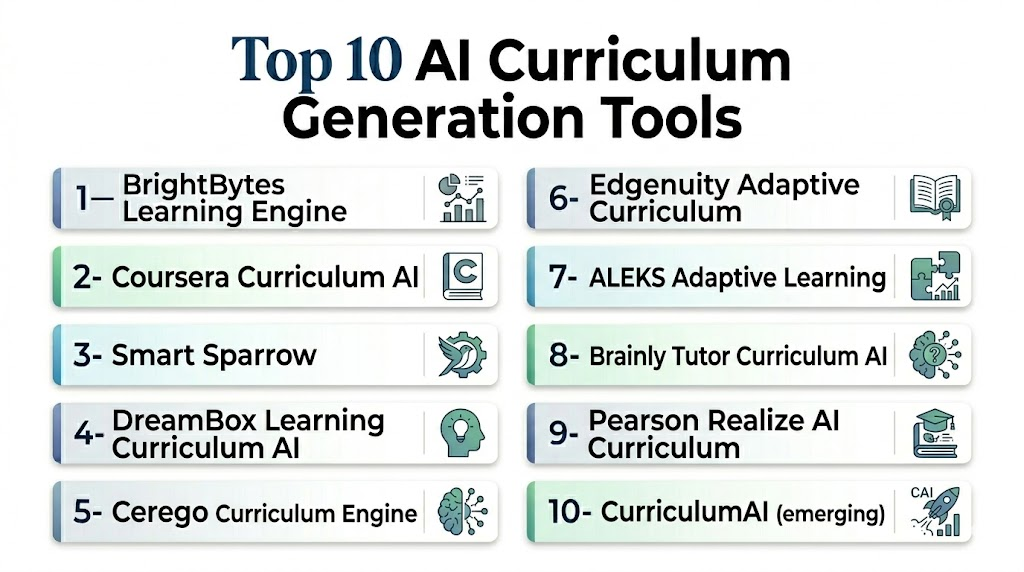
Top 10 AI Curriculum Generation Tools
1 — BrightBytes Learning Engine
One‑line verdict: Best for K–12 districts needing standards‑aligned, adaptive curriculum generation at scale.
Short description:
BrightBytes uses AI to generate curricula mapped to state/national standards, incorporates assessments, and sequences learning modules based on student performance data.
Standout Capabilities
- Standards alignment (state/national)
- Adaptive sequencing based on learner data
- Auto‑generated lesson plans + assessments
- Predictive analytics for at‑risk learners
- Teacher dashboard & customization modes
- Multi‑modal resource recommendations
- Scaffolded learning paths
- Collaborative authoring features
AI‑Specific Depth
- Model support: Proprietary ML + pedagogical models
- RAG / knowledge integration: LMS + repository connectors
- Evaluation: Curriculum effectiveness tracking
- Guardrails: Bias mitigation + standards compliance
- Observability: Mastery heatmaps + engagement analytics
Pros
- Strong standards compliance
- Scales for large districts
- Data‑driven adjustments
Cons
- Premium cost
- Setup time for initial mapping
- Cloud‑centric
Security & Compliance
SSO, encryption, RBAC; Certifications: Not publicly stated
Deployment & Platforms
Web, Cloud, Mobile (viewing)
Integrations & Ecosystem
LMS, SIS, content repositories
Pricing Model
Subscription / enterprise tiers
Best‑Fit Scenarios
- Large K–12 districts
- State curriculum planning
- Data‑informed classroom practice
2 — Coursera Curriculum AI
One‑line verdict: Ideal for higher education and professional learning program design with AI guidance.
Short description:
Coursera’s Curriculum AI assists universities and corporate academies to generate course sequences, learning modules, and assessments tailored to learner goals.
Standout Capabilities
- Course sequence optimization
- Skill‑based mapping to learning outcomes
- Automated assessment + rubric creation
- Integration with LMS and enterprise platforms
- Multi‑discipline content templates
- Analytics dashboards
AI‑Specific Depth
- Model support: Proprietary ML + pedagogical APIs
- RAG / knowledge integration: LMS, external repositories
- Evaluation: Learning outcome alignment
- Guardrails: Accuracy checks on generated rubrics
- Observability: Engagement & outcome analytics
Pros
- Suited for universities & corporates
- Integrates with learning platforms
- Skill and competency focus
Cons
- Less K–12 focused
- Premium subscription
- LMS integration effort required
Security & Compliance
SSO, encryption; Certifications: Not publicly stated
Deployment & Platforms
Web, Cloud
Integrations & Ecosystem
LMS, HR systems
Pricing Model
Subscription
Best‑Fit Scenarios
- Higher education programs
- Corporate learning academies
- Professional upskilling curricula
3 — Smart Sparrow
One‑line verdict: Best for educators who want flexible AI‑supported adaptive curriculum authoring.
Short description:
Smart Sparrow combines adaptive learning AI with authoring tools, enabling teachers and institutions to co‑create personalized curricula.
Standout Capabilities
- Course and module authoring
- Adaptive learning recommendations
- Multi‑modal content support
- Real‑time learner feedback integration
- Analytics dashboards
AI‑Specific Depth
- Model support: Proprietary ML
- RAG / knowledge integration: LMS connectors
- Evaluation: Engagement & performance scoring
- Guardrails: Content quality checks
- Observability: Usage and mastery analytics
Pros
- Educator control + AI assistance
- Flexible content modes
- Real‑time adaptation
Cons
- Cloud subscription
- Learning curve for creators
- Requires content library
Security & Compliance
Encryption; Certifications: Not publicly stated
Deployment & Platforms
Web, Cloud
Integrations & Ecosystem
LMS, content sources
Pricing Model
Subscription
Best‑Fit Scenarios
- Teacher‑led curriculum design
- Personalized learning pathways
- Adaptive course modules
4 — DreamBox Learning Curriculum AI
One‑line verdict: AI curriculum engine focused on K–12 math with dynamic sequencing.
Short description:
DreamBox synthesizes performance data to generate adaptive math curricula that adjust pacing, difficulty, and practice content.
Standout Capabilities
- Adaptive math curriculum generation
- Real‑time student response integration
- Gamified progression
- Teacher dashboards
- Analytics insights
AI‑Specific Depth
- Model support: Proprietary ML
- RAG / knowledge integration: LMS + internal analytics
- Evaluation: Mastery and progression scoring
- Guardrails: Alignment to standards
- Observability: Performance dashboards
Pros
- Strong math focus
- Adaptive sequencing works well
- Engaging learning design
Cons
- Math‑only
- Cloud‑centric
- Not full subject suite
Security & Compliance
Encryption; Certifications: Not publicly stated
Deployment & Platforms
Web, iOS, Android
Integrations & Ecosystem
LMS, classroom systems
Pricing Model
Subscription
Best‑Fit Scenarios
- K–12 math curricula
- Adaptive learning classrooms
- Personalized practice
5 — Cerego Curriculum Engine
One‑line verdict: Best for memory‑optimized adaptive curricula across subjects.
Short description:
Cerego uses AI to generate learning paths that optimize retention and spaced repetition within curricula spanning multiple topics.
Standout Capabilities
- Adaptive spaced‑repetition learning
- Cross‑subject curriculum generation
- Retention and engagement metrics
- LMS connectors
- Analytics dashboards
AI‑Specific Depth
- Model support: Proprietary ML
- RAG / knowledge integration: LMS + content sources
- Evaluation: Retention effectiveness
- Guardrails: Content pacing checks
- Observability: Retention analytics
Pros
- Strong retention optimization
- Multi‑subject capabilities
- Data‑backed pacing
Cons
- Focused on retention (not design)
- Cloud subscription
- Needs content sources
Security & Compliance
Encryption; Certifications: Not publicly stated
Deployment & Platforms
Web, iOS, Android
Integrations & Ecosystem
LMS, APIs
Pricing Model
Subscription
Best‑Fit Scenarios
- Corporate training
- K–12 adaptive pathways
- Higher ed concept mastery
6 — Edgenuity Adaptive Curriculum
One‑line verdict: Comprehensive K–12 adaptive curriculum engine with assessment integration.
Short description:
Edgenuity automates curriculum design and sequencing while integrating assessments, analytics, and progress reporting.
Standout Capabilities
- Full K–12 curriculum generation
- Adaptive pacing
- Integrated assessments
- Teacher dashboards
- Multi‑modal support
AI‑Specific Depth
- Model support: Proprietary ML
- RAG / knowledge integration: LMS sync
- Evaluation: Mastery tracking
- Guardrails: Standards alignment
- Observability: Classroom analytics
Pros
- Full K–12 suite
- Assessment linkage
- Analytics rich
Cons
- Cloud subscription
- Premium cost
- Less flexible than open authoring
Security & Compliance
Encryption; Certifications: Not publicly stated
Deployment & Platforms
Web, iOS, Android
Integrations & Ecosystem
LMS, SIS
Pricing Model
Subscription
Best‑Fit Scenarios
- K–12 districts
- Curriculum + assessment workflows
- Personalized pacing
7 — ALEKS Adaptive Learning
One‑line verdict: Strong STEM curriculum generation with mastery‑based sequencing.
Short description:
ALEKS uses AI to generate adaptive learning paths that focus on concept mastery in math and science subjects.
Standout Capabilities
- Mastery‑based sequencing
- Real‑time concept diagnostics
- Multi‑platform access
- Analytics dashboards
AI‑Specific Depth
- Model support: Proprietary ML
- RAG / knowledge integration: LMS integration
- Evaluation: Mastery diagnostics
- Guardrails: Curriculum alignment
- Observability: Progress dashboards
Pros
- Deep STEM sequencing
- Mastery focus
- Works well for remediation
Cons
- STEM‑focused
- Cloud subscription
- Cost
Security & Compliance
Encryption; Certifications: Not publicly stated
Deployment & Platforms
Web, iOS, Android
Integrations & Ecosystem
LMS, classroom tools
Pricing Model
Subscription
Best‑Fit Scenarios
- K–12 STEM
- College foundations
- Adaptive practice
8 — Brainly Tutor Curriculum AI
One‑line verdict: AI‑enhanced homework + curriculum generation hybrid for K–12.
Short description:
Brainly combines AI homework help with curriculum suggestions, stepwise explanations, and adaptive modules based on learner questions.
Standout Capabilities
- Curriculum module suggestions
- Stepwise AI hints
- Peer validation
- Mobile‑first access
AI‑Specific Depth
- Model support: Proprietary ML
- RAG / knowledge integration: LMS connectors
- Evaluation: Accuracy monitoring
- Guardrails: Moderation filters
- Observability: Usage analytics
Pros
- Mobile friendly
- Multi‑subject coverage
- Combines help + curriculum
Cons
- Less formal curriculum design
- Peer quality variability
- Cloud reliance
Security & Compliance
Encryption; Certifications: Not publicly stated
Deployment & Platforms
Web, iOS, Android
Integrations & Ecosystem
LMS, classroom apps
Pricing Model
Free + subscription
Best‑Fit Scenarios
- K–12 blended learning
- Homework + curriculum guidance
- Quick adaptive support
9 — Pearson Realize AI Curriculum
One‑line verdict: Enterprise‑ready K–12 adaptive curriculum engine with strong analytics.
Short description:
Pearson Realize AI generates lesson sequences, pacing guides, and assessments aligned to standards with real‑time analytics.
Standout Capabilities
- Full adaptive curriculum generation
- Standards alignment
- Analytics dashboards
- Assessment integration
AI‑Specific Depth
- Model support: Proprietary ML
- RAG / knowledge integration: LMS + Pearson content
- Evaluation: Mastery and pacing metrics
- Guardrails: Standards compliance
- Observability: Administrator dashboards
Pros
- Standards aligned
- Analytics rich
- Enterprise focused
Cons
- Premium cost
- Cloud only
- Setup effort
Security & Compliance
SSO, encryption; Certifications: Not publicly stated
Deployment & Platforms
Web, iOS, Android
Integrations & Ecosystem
LMS, SIS
Pricing Model
Subscription
Best‑Fit Scenarios
- District‑wide adoption
- K–12 standards alignment
- Admin analytics
10 — CurriculumAI (emerging)
One‑line verdict: Agile AI curriculum generator for EdTech platforms and app developers.
Short description:
CurriculumAI provides APIs and SDKs to embed adaptive curriculum design into learning apps and marketplaces.
Standout Capabilities
- API‑first curriculum generation
- Modular content assembly
- Skill framework mapping
- Developer tools
AI‑Specific Depth
- Model support: Proprietary ML models + open tokens
- RAG / knowledge integration: Connectors to content repos
- Evaluation: API analytics
- Guardrails: Developer content validation
- Observability: API usage dashboards
Pros
- API extensibility
- Embeddable engine
- Developer centric
Cons
- Requires technical integration
- Early stage
- Community/marketplace still growing
Security & Compliance
Encryption; Certifications: Not publicly stated
Deployment & Platforms
Cloud API
Integrations & Ecosystem
APIs, SDKs
Pricing Model
Usage based
Best‑Fit Scenarios
- EdTech product teams
- Custom learning apps
- Marketplace integrations
Comparison Table
| Tool Name | Best For | Deployment | Model Flexibility | Strength | Watch‑Out | Public Rating |
|---|---|---|---|---|---|---|
| BrightBytes Learning Engine | K–12 districts | Web, Mobile | Proprietary ML | Standards aligned | Premium | N/A |
| Coursera Curriculum AI | Higher ed & corporate | Web, Cloud | Proprietary ML | Skill‑based paths | LMS effort | N/A |
| Smart Sparrow | Educator co‑authoring | Web, Cloud | Proprietary ML | Adaptive authoring | Cloud only | N/A |
| DreamBox Learning Curriculum AI | K–12 math | Web, Mobile | Proprietary ML | Adaptive sequencing | Math only | N/A |
| Cerego Curriculum Engine | Retention focus | Web, Mobile | Proprietary ML | Spaced repetition | Retention first | N/A |
| Edgenuity Adaptive Curriculum | Full K–12 suite | Web, Mobile | Proprietary ML | Integrated assessments | Premium | N/A |
| ALEKS Adaptive Learning | STEM focus | Web, Mobile | Proprietary ML | Mastery sequencing | Subject limited | N/A |
| Brainly Tutor Curriculum AI | Homework + curriculum | Web, Mobile | Proprietary ML | Mobile friendly | Less formal design | N/A |
| Pearson Realize AI Curriculum | K–12 enterprise | Web, Mobile | Proprietary ML | Analytics rich | Cloud only | N/A |
| CurriculumAI (emerging) | EdTech developers | Cloud API | Proprietary ML | API‑first | Early stage | N/A |
Scoring & Evaluation
| Tool | Core Features | Reliability/Eval | Guardrails | Integrations | Ease | Perf/Cost | Security/Admin | Support | Weighted Total |
|---|---|---|---|---|---|---|---|---|---|
| BrightBytes | 9 | 8 | 8 | 8 | 7 | 7 | 8 | 8 | 8.0 |
| Coursera | 8 | 8 | 8 | 8 | 7 | 7 | 8 | 7 | 7.6 |
| Smart Sparrow | 8 | 8 | 8 | 7 | 7 | 7 | 7 | 7 | 7.4 |
| DreamBox | 9 | 8 | 8 | 7 | 8 | 8 | 7 | 7 | 8.0 |
| Cerego | 8 | 8 | 8 | 7 | 7 | 7 | 7 | 7 | 7.4 |
| Edgenuity | 8 | 8 | 8 | 8 | 7 | 7 | 7 | 7 | 7.5 |
| ALEKS | 9 | 8 | 8 | 7 | 8 | 7 | 7 | 7 | 7.8 |
| Brainly Tutor | 8 | 7 | 7 | 7 | 8 | 7 | 7 | 7 | 7.3 |
| Pearson Realize | 8 | 8 | 8 | 8 | 7 | 7 | 8 | 8 | 7.8 |
| CurriculumAI | 7 | 7 | 7 | 8 | 7 | 7 | 7 | 7 | 7.1 |
Top 3 for Enterprise: BrightBytes, DreamBox, Pearson Realize
Top 3 for EdTech Platforms: Coursera Curriculum AI, Smart Sparrow, CurriculumAI
Top 3 for K–12 Classrooms: DreamBox, Edgenuity, ALEKS
Which AI Curriculum Generation Tool Is Right for You?
Solo Educators
- Smart Sparrow and CurriculumAI for flexible authoring and embedded curriculum support.
Schools / K–12 Districts
- BrightBytes, Edgenuity, Pearson Realize for standards alignment and analytics.
Higher Education
- Coursera Curriculum AI or Smart Sparrow Enterprise for course sequencing and mastery alignment.
Corporate Training
- Coursera Curriculum AI or Cerego for skills progression and retention.
EdTech Product Teams
- CurriculumAI for embed‑first design and API‑driven curriculum engines.
Budget vs Premium
- Budget: Smart Sparrow, CurriculumAI
- Premium: BrightBytes, Pearson Realize, ALEKS
Implementation Playbook (30 / 60 / 90 Days)
- 30 days: Pilot with representative learner groups; generate initial curriculum modules mapped to standards.
- 60 days: Integrate with LMS/SIS, enable teacher dashboards, run engagement and mastery analytics.
- 90 days: Scale across full cohorts, refine adaptive pathways, enforce guardrails, extend multi‑modal content.
Common Mistakes & How to Avoid Them
- Ignoring standards alignment
- Over‑customizing without AI validation
- Skipping analytics monitoring
- Using one subject only
- Cloud‑only deployment without offline fallback
- Failing to enforce AI guardrails
- Not integrating with classroom workflows
- Ignoring teacher co‑authoring workflows
- Overlooking multi‑modal support
- Underestimating privacy/compliance needs
FAQs
Can AI generate curricula aligned to standards?
Yes — top engines automatically map-generated curricula to national/state standards.
Can these tools generate assessments?
Yes, most generate aligned assessments and feedback loops.
Do they support multi‑modal content?
Yes — text, video, simulations, and interactive exercises are supported.
Can AI adapt curricula in real time?
Yes, based on learner performance and mastery data.
Are they compatible with LMS?
Yes — all top tools provide LMS/SIS integration.
Do these engines protect privacy?
Yes — encryption, SSO, and compliance are standard.
Can small institutions use them?
Yes — lighter tools like Smart Sparrow and CurriculumAI are suited for smaller use cases.
Do they require training?
Some features have learning curves, but most provide guided onboarding.
Is AI content always accurate?
AI is generally reliable, but teacher review is advisable.
Do they work offline?
Some tools provide offline access, though cloud enhances full AI capability.
Can curricula be exported?
Most allow export to LMS or printable formats.
Are analytics dashboards included?
Yes, reporting and mastery insights are standard.
Conclusion
AI Curriculum Generation Tools in 2026 empower educators, institutions, and EdTech platforms to design adaptive, standards‑aligned, and personalized curricula at scale. By combining pedagogical models with ML adaptation and deep analytics, these engines transform learning pathways for students across K–12, higher ed, and corporate training. The key to success lies in choosing the right tool for your audience (students, teachers, admins), integrating with learning workflows, and continuously refining adaptive pathways with real‑time insights.

Find Trusted Cardiac Hospitals
Compare heart hospitals by city and services — all in one place.
Explore Hospitals
One perspective that could add more depth to this discussion is the challenge of maintaining curriculum quality as AI-generated learning paths become more common. While these tools can significantly reduce planning time and personalize educational experiences, the larger question is how institutions ensure that generated curricula remain accurate, balanced, and aligned with long-term learning goals. In real educational settings, curriculum design often requires subject expertise, contextual adjustments, and continuous updates that automation alone may not fully address. From an implementation standpoint, factors such as educator review, version control, standards validation, and flexibility to adapt content over time deserve more attention. In the long run, the most effective curriculum generation platforms may be those that combine automation with strong teacher involvement and transparent content governance rather than relying entirely on AI-generated recommendations.