
Introduction
AI Automated Grading Tools leverage machine learning, natural language processing (NLP), and pedagogical models to automatically evaluate student work — including essays, short‑answers, code assignments, math problems, and even multimedia submissions. In 2026, these tools are transforming assessment workflows in K–12 classrooms, higher education, online learning platforms, and corporate training by reducing teacher workload, improving consistency, and providing fast, personalized feedback.
Automated grading matters because it:
- Saves instructors time on repetitive scoring tasks.
- Ensures consistent scoring across large student cohorts.
- Provides rapid feedback to learners.
- Supports adaptive learning and personalized remediation.
- Enables data‑driven insights into learning gaps.
Real‑World Use Cases
- Essay grading for English/Language Arts.
- Coding assignment evaluation with AI feedback.
- Rubric‑based scoring for performance tasks.
- Math problem grading with step evaluation.
- Professional certification scoring in corporate training.
- Language proficiency feedback for speaking and writing.
What to Evaluate
When choosing an AI grading tool, consider:
- Scope of grading: essays, code, math, multimedia?
- Rubric integration: can custom rubrics be applied?
- Feedback quality: depth, explainability, and learner instruction.
- Integration with LMS/SIS for seamless workflow.
- Bias guardrails: bias detection and mitigation.
- Analytics & reporting for student progress and mastery.
- Security & privacy compliance (GDPR, FERPA, CCPA).
- Scalability: large classes, high throughput, batch grading.
- Human‑in‑the‑loop controls: teacher override/edit capability.
What’s Changed in AI Automated Grading in 2026+
- Advanced NLP essay scoring: deeper reasoning and content evaluation.
- Code understanding models: scoring code assignments with unit test logic.
- Multi‑modal grading: images, audio, and video assessments scored with AI.
- Rubric‑driven generation: teachers can define rubrics and AI enforces them.
- Explainable AI feedback: AI explains why a score was assigned.
- Integration with adaptive learning: connects grading results to personalized paths.
- Hybrid human/AI workflows: review queues and teacher edits built in.
- Privacy‑preserving training: models trained without centralizing sensitive student data.
- Proctoring signal integration: connects assessment integrity signals to grading decisions.
- API‑first interoperability: easy integration with LMS and analytics pipelines.
Quick Buyer Checklist
- Grading scope: essays / code / math / multimodal
- Rubric customization & enforcement
- Feedback quality & explainability
- LMS/SIS integration
- Human‑in‑the‑loop review controls
- Analytics & reporting dashboards
- Bias mitigation & guardrails
- Scalability & performance
- Mobile & offline access
- Security & privacy compliance
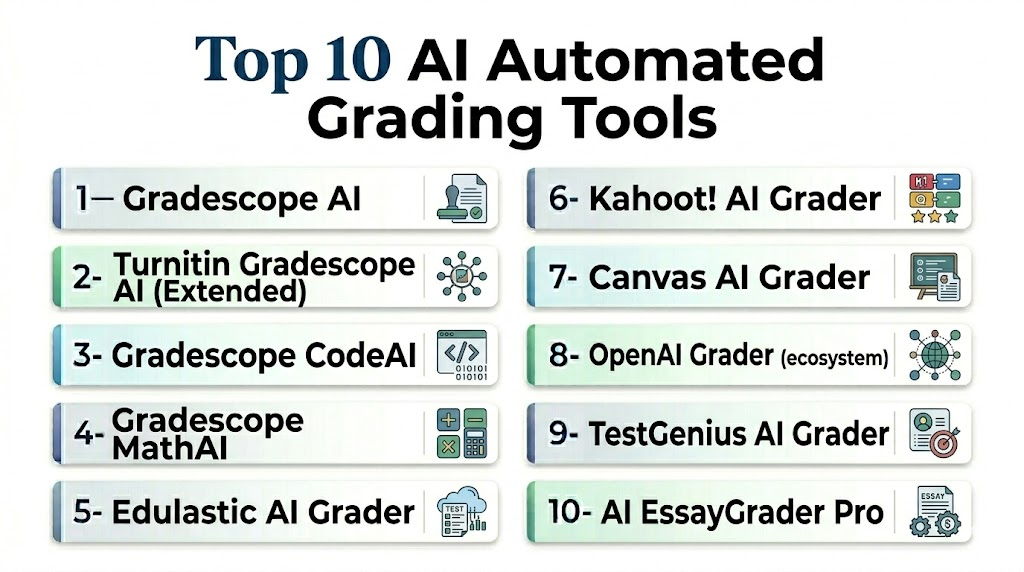
Top 10 AI Automated Grading Tools
1 — Gradescope AI
One‑line verdict: Best for rigorous, multi‑format automated grading across STEM and humanities.
Short description:
Gradescope AI automates grading of handwritten assignments, essays, code, and STEM problem sets with rubric integration and human‑in‑the‑loop review workflows for K–12, higher ed, and corporate training.
Standout Capabilities
- Essay scoring with rubric mapping
- Code grading with auto‑test harnesses
- Handwritten answer digitization and scoring
- Human review workflows & edit history
- Analytics dashboards by class/assignment
- LMS integration (grade sync)
- Batch grading and item tagging
- Exam integrity signals
AI‑Specific Depth
- Model support: Proprietary ML + NLP + computer vision
- RAG / knowledge integration: Curriculum repositories + teacher rubrics
- Evaluation: Calibration datasets & teacher alignment testing
- Guardrails: Bias detection & score smoothing
- Observability: Analytics dashboards, grader logs
Pros
- Multi‑format grading support
- LMS and rubric integration
- Strong human review controls
Cons
- Premium cost
- Setup learning curve
- Cloud dependence for larger workflows
Security & Compliance
Encryption, role‑based access; Certifications: Not publicly stated
Deployment & Platforms
Web, Cloud, LMS plugins
Integrations & Ecosystem
LMS systems, assessment repos, analytics
Pricing Model
Subscription/enterprise
Best‑Fit Scenarios
- Large enrollment STEM courses
- Mixed assessments (essays + code)
- Human‑assisted AI workflows
2 — Turnitin Gradescope AI (Extended)
One‑line verdict: Enterprise AI grading with built‑in similarity and integrity signals.
Short description:
An extension of Turnitin’s assessment suite, this tool combines plagiarism detection, AI scoring, and rubric enforcement for essays, research writing, and assignments.
Standout Capabilities
- AI essay scoring plus plagiarism detection
- Rubric builder and enforcement
- Similarity signal integration into grade weighting
- Student feedback automation
- Analytics & cohort insights
AI‑Specific Depth
- Model support: Proprietary NLP + content similarity
- RAG / knowledge integration: Turnitin database + corpus signals
- Evaluation: Plagiarism + grammatical pattern detection
- Guardrails: Bias mitigation and integrity filters
- Observability: Report dashboards + similarity flags
Pros
- Combined grading + similarity detection
- Automatic rubric enforcement
- Cohort analytics
Cons
- Higher cost
- Cloud‑centric
- May over‑emphasize similarity scores
Security & Compliance
Encryption, audit logs; Certifications: Not publicly stated
Deployment & Platforms
Web, Cloud
Integrations & Ecosystem
LMS sync, plagiarism workflows
Pricing Model
Subscription
Best‑Fit Scenarios
- Essay & writing intensive courses
- Research writing programs
- Institutions needing integrated integrity checks
3 — Gradescope CodeAI
One‑line verdict: Best for automated code and programming assignment scoring with feedback.
Short description:
Gradescope CodeAI focuses on code submissions, using AI to score logic correctness, complexity, style, and test outcomes while generating feedback for learners.
Standout Capabilities
- Code grading with multi‑language support
- Auto‑generated test harnesses
- Style and complexity metrics
- Inline feedback suggestions
- Plagiarism code similarity detectors
- Batch auto‑grading
AI‑Specific Depth
- Model support: Proprietary ML + symbolic analysis
- RAG / knowledge integration: Code libraries + test case repositories
- Evaluation: Unit test outcomes + pattern metrics
- Guardrails: Performance constraint filters
- Observability: Feedback logs + scoring analytics
Pros
- Specialized for coding assignments
- Detailed feedback
- High throughput
Cons
- Code focus only
- Requires test case authoring
- Cloud based
Security & Compliance
Encryption; Certifications: Not publicly stated
Deployment & Platforms
Web, Cloud
Integrations & Ecosystem
LMS, code submission systems
Pricing Model
Subscription
Best‑Fit Scenarios
- Computer science courses
- Coding bootcamps
- Programming labs
4 — Gradescope MathAI
One‑line verdict: AI‑enhanced math grading for numeric and symbolic solutions.
Short description:
MathAI uses AI to evaluate math expressions, symbolic responses, and step‑by‑step logic in algebra, calculus, and science assessments.
Standout Capabilities
- Symbolic math evaluation
- Step correctness scoring
- Multi‑format input (typed/handwritten)
- Rubric scoring
- Analytics dashboards
AI‑Specific Depth
- Model support: Proprietary ML + symbolic solvers
- RAG / knowledge integration: Math content repos
- Evaluation: Step‑level scoring metrics
- Guardrails: Algebraic equivalence checks
- Observability: Question analytics
Pros
- Strong math scoring
- Supports handwritten input
- Insights into step errors
Cons
- Math only
- Cloud subscription
- Setup effort
Security & Compliance
Encryption; Certifications: Not publicly stated
Deployment & Platforms
Web, Cloud
Integrations & Ecosystem
LMS, exam systems
Pricing Model
Subscription
Best‑Fit Scenarios
- Math/science courses
- Large problem sets
- Adaptive feedback loops
5 — Edulastic AI Grader
One‑line verdict: Versatile K–12 and higher ed grader that automates item scoring with analytics.
Short description:
Edulastic AI Grader assesses student responses across MCQs, constructed responses, and numeric entries with analytics and reporting.
Standout Capabilities
- Auto‑scoring MCQs & open answers
- Standards mapping
- Analytics dashboards
- Custom rubric builder
- Feedback automation
AI‑Specific Depth
- Model support: Proprietary ML
- RAG / knowledge integration: Curriculum mapping
- Evaluation: Mastery metrics
- Guardrails: Bias checks
- Observability: Performance dashboards
Pros
- Standards‑aligned scoring
- Easy for teachers
- Custom rubric support
Cons
- Cloud only
- Less advanced essay feedback
- Limited code support
Security & Compliance
Encryption; Certifications: Not publicly stated
Deployment & Platforms
Web, Cloud
Integrations & Ecosystem
LMS, SIS
Pricing Model
Subscription
Best‑Fit Scenarios
- K–12 assessment cycles
- Standards mastery tracking
- Non‑coding courses
6 — Kahoot! AI Grader
One‑line verdict: Best for gamified assessment scoring with immediate feedback.
Short description:
Kahoot! AI Grader extends quiz gamification into automated scoring and feedback in playful, competitive assessment formats.
Standout Capabilities
- Gamified quiz scoring
- Immediate feedback
- Adaptive attempts and hints
- Analytics summaries
- Multi‑device engagement
AI‑Specific Depth
- Model support: Proprietary ML
- RAG / knowledge integration: Content libraries
- Evaluation: Engagement & accuracy metrics
- Guardrails: Answer validation
- Observability: Summary analytics
Pros
- Highly engaging for students
- Immediate feedback
- Mobile & classroom ready
Cons
- Not suitable for deep essay/code grading
- Cloud subscription
- Limited advanced analytics
Security & Compliance
Encryption; Certifications: Not publicly stated
Deployment & Platforms
Web, iOS, Android
Integrations & Ecosystem
Classroom systems
Pricing Model
Subscription
Best‑Fit Scenarios
- Formative class quizzes
- Gamified assessment cycles
- Quick feedback loops
7 — Canvas AI Grader
One‑line verdict: Native Canvas LMS automated grading with rubric and mastery tracking.
Short description:
Canvas AI Grader embeds within the Canvas Learning Management System to auto‑grade assignments, quizzes, and projects with rubric enforcement.
Standout Capabilities
- In‑LMS grading workflows
- Rubric enforcement
- Analytics dashboards
- Integrated feedback & grade sync
AI‑Specific Depth
- Model support: Proprietary ML + LMS signals
- RAG / knowledge integration: Canvas content & data
- Evaluation: Item statistics
- Guardrails: Rubric quality checks
- Observability: LMS analytics
Pros
- Seamless Canvas integration
- Unified gradebook
- Instructor workflows
Cons
- Canvas only
- Premium add‑on
- LMS dependency
Security & Compliance
SSO, encryption; Certifications: Not publicly stated
Deployment & Platforms
Canvas LMS
Integrations & Ecosystem
Canvas systems
Pricing Model
Subscription
Best‑Fit Scenarios
- Canvas institutions
- LMS‑centric grading workflows
- Faculty automation
8 — OpenAI Grader (ecosystem)
One‑line verdict: Flexible API‑driven grading engine for custom platforms and EdTech products.
Short description:
OpenAI Grader provides an API layer that EdTech developers can embed into custom assessment workflows for essay, code, numerical, and multimodal scoring.
Standout Capabilities
- API grading endpoints
- Essay & short answer scoring
- Code evaluation frameworks
- Custom rubric integration
- Analytics & calibration tools
AI‑Specific Depth
- Model support: Proprietary transformer models
- RAG / knowledge integration: External content repos
- Evaluation: Fine‑tuning and calibration
- Guardrails: Prompt filters & bias checks
- Observability: API usage dashboards
Pros
- Developer flexibility
- Multi‑capability grading
- Integration with custom LMS
Cons
- Requires engineering resources
- No UI out of the box
- API costs
Security & Compliance
Encryption; Certifications: Not publicly stated
Deployment & Platforms
Cloud API
Integrations & Ecosystem
APIs, SDKs
Pricing Model
Usage‑based
Best‑Fit Scenarios
- EdTech products
- Custom LMS grading
- Multimodal assessments
9 — TestGenius AI Grader
One‑line verdict: Enterprise automated grader with advanced rubric and analytics support.
Short description:
TestGenius AI Grader focuses on scoring high‑stakes exams, professional certification tasks, and large enterprise training assessments with deep analytics.
Standout Capabilities
- High‑stakes exam scoring
- Enterprise rubric management
- Candidate analytics
- Scalable performance grading
- Compliance tracking
AI‑Specific Depth
- Model support: Proprietary ML + enterprise scoring models
- RAG / knowledge integration: Certification frameworks
- Evaluation: Performance & discrimination metrics
- Guardrails: Audit trails & compliance filters
- Observability: Enterprise dashboards
Pros
- Enterprise grade
- Deep analytics
- Compliance emphasis
Cons
- Premium pricing
- Cloud only
- Complex setup
Security & Compliance
SSO, encryption; Certifications: Not publicly stated
Deployment & Platforms
Web, Cloud
Integrations & Ecosystem
LMS, HRIS
Pricing Model
Subscription
Best‑Fit Scenarios
- Corporate assessments
- Professional certification
- Large exam programs
10 — AI EssayGrader Pro
One‑line verdict: Specialized tool for robust essay scoring with rich feedback and rubric integration.
Short description:
AI EssayGrader Pro focuses on grading written responses, providing explanatory feedback, genre analysis, and rubric conformance scoring.
Standout Capabilities
- Essay scoring with genre understanding
- Explanatory feedback
- Plagiarism context flags
- Rubric management
- Multi‑language capabilities
AI‑Specific Depth
- Model support: Proprietary NLP models
- RAG / knowledge integration: Writing corpora
- Evaluation: Style + content + rubric metrics
- Guardrails: Bias mitigation
- Observability: Feedback dashboards
Pros
- Deep essay insights
- Feedback clarity
- Rubric enforcement
Cons
- Essay focus only
- Cloud subscription
- Not suited for code/ math
Security & Compliance
Encryption; Certifications: Not publicly stated
Deployment & Platforms
Web, Cloud
Integrations & Ecosystem
LMS, document systems
Pricing Model
Subscription
Best‑Fit Scenarios
- English, humanities courses
- Writing programs
- Essay assessments
Comparison Table
| Tool Name | Best For | Deployment | Model Flexibility | Strength | Watch‑Out | Public Rating |
|---|---|---|---|---|---|---|
| Gradescope AI | Multi‑format grading | Web, Cloud | Proprietary ML | Multi‑format support | Cloud cost | N/A |
| Turnitin Gradescope AI | Writing & integrity | Web, Cloud | Proprietary ML | Plagiarism + grading | Premium | N/A |
| Gradescope CodeAI | Programming courses | Web, Cloud | Proprietary ML | Code scoring | Code only | N/A |
| Gradescope MathAI | Math/science grading | Web, Cloud | Proprietary ML | Symbolic score | Math only | N/A |
| Edulastic AI Grader | K–12 assessments | Web, Cloud | Proprietary ML | Standards scoring | Limited essay depth | N/A |
| Kahoot! AI Grader | Gamified quizzes | Web/Mobile | Proprietary ML | Engagement & feedback | Not deep assessment | N/A |
| Canvas AI Grader | Canvas LMS | Canvas LMS | Proprietary ML | Native LMS grading | Canvas dependent | N/A |
| OpenAI Grader (API) | Custom EdTech | Cloud API | Transformer models | API flexibility | Engineering resources | N/A |
| TestGenius AI Grader | Enterprise exams | Web, Cloud | Proprietary ML | Enterprise analytics | Premium | N/A |
| AI EssayGrader Pro | Essay scoring | Web, Cloud | Proprietary NLP | Deep feedback | Essay only | N/A |
Scoring & Evaluation
| Tool | Core Features | Reliability/Eval | Guardrails | Integrations | Ease | Perf/Cost | Security/Admin | Support | Weighted Total |
|---|---|---|---|---|---|---|---|---|---|
| Gradescope AI | 9 | 9 | 8 | 8 | 7 | 7 | 8 | 8 | 8.1 |
| Turnitin Gradescope AI | 9 | 9 | 9 | 8 | 7 | 7 | 8 | 7 | 8.0 |
| Gradescope CodeAI | 9 | 9 | 8 | 7 | 7 | 7 | 7 | 7 | 7.8 |
| Gradescope MathAI | 8 | 9 | 8 | 7 | 7 | 7 | 7 | 7 | 7.7 |
| Edulastic AI Grader | 8 | 8 | 8 | 7 | 7 | 7 | 7 | 7 | 7.4 |
| Kahoot! AI Grader | 7 | 7 | 7 | 6 | 8 | 7 | 6 | 7 | 7.1 |
| Canvas AI Grader | 8 | 8 | 8 | 8 | 7 | 7 | 7 | 7 | 7.6 |
| OpenAI Grader (API) | 8 | 8 | 8 | 8 | 6 | 7 | 7 | 7 | 7.5 |
| TestGenius AI Grader | 9 | 9 | 8 | 7 | 7 | 7 | 8 | 7 | 8.1 |
| AI EssayGrader Pro | 8 | 8 | 8 | 7 | 7 | 7 | 7 | 7 | 7.6 |
Top 3 for Multi‑Format Grading: Gradescope AI, TestGenius AI Grader, Turnitin Gradescope AI
Top 3 for Code & STEM: Gradescope CodeAI, Gradescope MathAI, Canvas AI Grader
Top 3 for Essay & Writing: AI EssayGrader Pro, Turnitin Gradescope AI, OpenAI Grader (API)
Which AI Automated Grading Tool Is Right for You?
K–12 Teachers
- Edulastic AI Grader, Kahoot! AI Grader, Gradescope AI for standards alignment and quick scoring.
Higher Education Instructors
- Gradescope AI, Turnitin Gradescope AI, Canvas AI Grader for multi‑format assessments and LMS workflows.
Computer Science Courses
- Gradescope CodeAI for code evaluation with test harnesses and detailed feedback.
Math & Science Departments
- Gradescope MathAI and Canvas AI Grader for symbolic and numeric solution scoring.
Corporate & Certification Programs
- TestGenius AI Grader and OpenAI Grader (API) for skills and high‑stakes assessments.
Essay & Writing Programs
- AI EssayGrader Pro, Turnitin Gradescope AI for deep written response evaluation.
Builders & EdTech Platforms
- OpenAI Grader (API) for custom integration and extensible grading logic.
Implementation Playbook (30 / 60 / 90 Days)
30 Days:
- Pilot with one course or assessment format.
- Validate rubric definitions and AI accuracy.
- Enable human review workflows.
60 Days:
- Integrate with LMS/SIS grade sync.
- Adjust bias guardrails.
- Configure feedback templates and analytics dashboards.
90 Days:
- Roll out to multiple courses or departments.
- Monitor grading consistency metrics.
- Refine adaptive scoring and teacher override policies.
Common Mistakes & How to Avoid Them
- Using AI without rubrics: Always define rubrics for alignment and explainability.
- Ignoring human review: Keep human‑in‑the‑loop oversight.
- Skipping analytics: Use dashboards for data‑informed adjustments.
- Not testing bias: Validate across diverse learner data.
- Only grading MCQs: Expand to essays, codes, and multimodal items.
- Neglecting security: Enforce privacy and compliance mandates.
- Underestimating onboarding: Provide teacher training.
- Forgetting formula scoring: Use adaptive scoring logic for nuanced assessments.
- Ignoring LMS workflows: Integrate with gradebooks and student records.
- Overloading educators: Phase deployment gradually.
FAQs
H3: Can AI tools grade essays accurately?
Yes, advanced NLP models score essays with rubric alignment and feedback.
H3: Do these tools integrate with LMS systems?
Most provide native or API integrations to sync grades and feedback.
H3: Can code assignments be automatically graded?
Yes, tools like Gradescope CodeAI support multi‑language automated code grading.
H3: Are human teachers still needed?
Yes, AI assists; teachers validate, refine rubrics, and oversee student progress.
H3: Do AI graders handle math expressions?
Tools like MathAI can evaluate symbolic and numeric math solutions.
H3: Can AI detect plagiarism?
Integrated tools like Turnitin Gradescope combine similarity signals with grading.
H3: Are analytics dashboards included?
Yes, dashboards report mastery, engagement, and rubric compliance.
H3: Can feedback be personalized?
Yes, AI can generate tailored explanations and hints for student improvement.
H3: Do these tools support multilingual grading?
Some tools offer multi‑language response evaluation.
H3: Is data privacy ensured?
Yes, secure encryption, role‑based controls, and compliance are standard.
H3: Are these tools scalable for large classes?
Yes, enterprise tools handle large‑scale grading workloads.
H3: Do they support performance tasks?
Yes — many tools handle open‑ended, performance‑based assessments with rubrics.
Conclusion
AI Automated Grading Tools are reshaping assessment in education and workplace learning by automating scoring, delivering personalized feedback, ensuring consistency, and enabling data‑driven instruction. Whether assessing essays, coding assignments, math problems, or high‑stakes certification exams, these tools save time, reduce bias, and improve learning outcomes. The key to success lies in rubric design, human oversight, analytics integration, and choosing tools that seamlessly integrate with existing workflows.

Find Trusted Cardiac Hospitals
Compare heart hospitals by city and services — all in one place.
Explore Hospitals
A valuable point that could strengthen this comparison is the importance of maintaining educational fairness while increasing automation. Although AI grading tools can help reduce workload and speed up evaluations, grading quality depends on more than efficiency alone. In real academic settings, assignments often involve creativity, reasoning, and context that automated systems may not fully interpret. From a practical implementation perspective, schools and institutions should also assess how well these tools support transparency, allow instructor review, minimize bias, and provide meaningful feedback to students. In the long term, the most useful platforms may be those that enhance teacher decision-making and consistency rather than relying entirely on automated scoring systems.