
Introduction
Grant funding has become increasingly competitive across government agencies, nonprofits, research institutions, and international development organizations. Every year, thousands of applications are submitted for limited funding pools, making manual review slow, inconsistent, and prone to bias. AI Grant Application Screening Tools use artificial intelligence, natural language processing, and predictive analytics to evaluate grant submissions, score eligibility, detect fraud or inconsistencies, and prioritize applications based on funding criteria.
Unlike traditional review processes that rely heavily on human evaluators, modern AI-driven grant screening systems can analyze large volumes of applications in minutes. They assess proposal quality, alignment with funding objectives, compliance requirements, past performance, and risk indicators. These tools are not designed to replace human reviewers but to assist them by filtering, ranking, and highlighting high-potential applications.
Common use cases include:
- Screening government grant applications
- Evaluating nonprofit funding requests
- Prioritizing research funding proposals
- Detecting duplicate or fraudulent applications
- Scoring eligibility based on funding criteria
- Matching applicants to suitable funding programs
- Automating compliance checks
- Reducing reviewer workload and bias
When evaluating AI Grant Application Screening Tools, organizations should consider:
- NLP accuracy in understanding grant proposals
- Fairness and bias mitigation mechanisms
- Eligibility rule automation
- Explainability of scoring decisions
- Integration with grant management systems
- Workflow automation capabilities
- Fraud detection and anomaly identification
- Data privacy and compliance controls
- Scalability for large application volumes
- Transparency and auditability
- API availability
- Model retraining and adaptability
- Human-in-the-loop review support
Best for: Government funding agencies, nonprofit foundations, research councils, universities, CSR programs, international aid organizations, and large grant-disbursing institutions.
Not ideal for: Small organizations with minimal grant volume, informal funding programs, or organizations without structured application workflows.
What’s Changed in AI Grant Application Screening Tools in 2026+
Grant evaluation systems have evolved from rule-based scoring engines into intelligent AI copilots that support funding decisions across multiple domains.
- AI models now interpret unstructured grant narratives using advanced NLP
- Generative AI summarizes long proposals into structured evaluation reports
- Bias detection models identify fairness issues in scoring systems
- Multi-modal evaluation includes documents, budgets, and supporting media
- Real-time eligibility validation reduces manual filtering workload
- AI copilots assist reviewers with recommendation explanations
- Cross-grant comparison engines rank applications automatically
- Fraud detection identifies duplicate or manipulated submissions
- Digital twin models simulate funding impact scenarios
- ESG and impact scoring are now integrated into evaluation systems
- Automated compliance validation ensures regulatory adherence
- Explainable AI is required for audit and transparency reporting
Quick Buyer Checklist (Scan-Friendly)
Before selecting an AI Grant Application Screening Tool, ensure it supports:
- □ Natural language understanding of grant proposals
- □ Automated eligibility screening
- □ AI-based scoring and ranking
- □ Bias detection and fairness controls
- □ Fraud and duplicate application detection
- □ Explainable AI decision outputs
- □ Human-in-the-loop review workflows
- □ Integration with grant management systems
- □ Document parsing (PDF, DOC, forms)
- □ Workflow automation and approvals
- □ Audit logs and transparency reporting
- □ Data privacy and security compliance
- □ Multi-program funding support
- □ API and integration capabilities
- □ Scalability for large applicant volumes
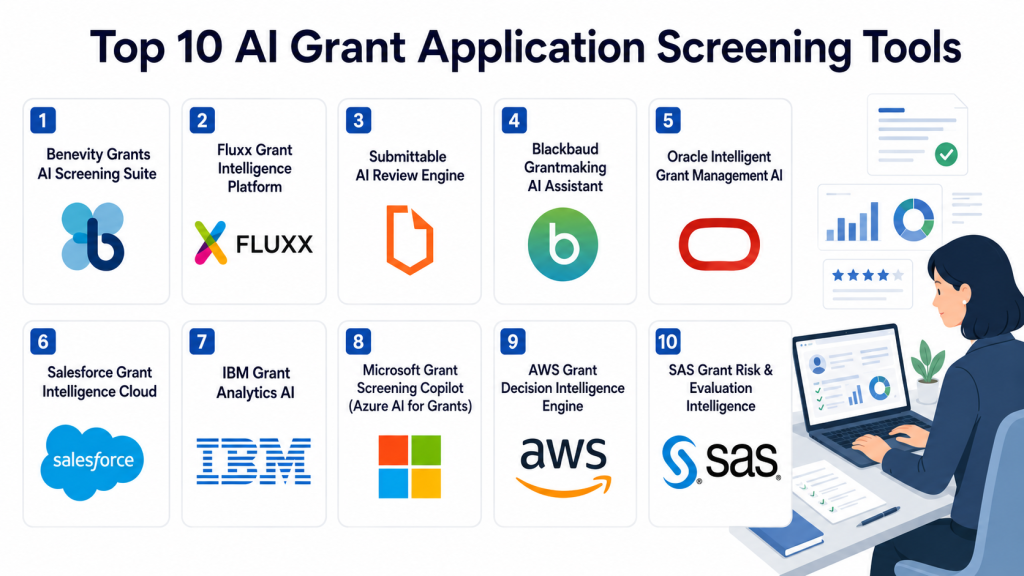
Top 10 AI Grant Application Screening Tools
#1 — Benevity Grants AI Screening Suite
One-line verdict: Best for corporate and nonprofit grant programs requiring automated screening and impact evaluation.
Short description (2–3 lines):
Benevity Grants AI Screening Suite helps organizations evaluate grant applications using AI-powered scoring, eligibility checks, and impact assessment tools. It is widely used in CSR and nonprofit funding ecosystems.
Standout Capabilities
- AI-powered grant application scoring
- Eligibility rule automation
- Impact evaluation analytics
- Application prioritization engine
- Fraud and duplicate detection
- Workflow automation
- Reviewer dashboard system
- Reporting and analytics
AI-Specific Depth
- Model support: Proprietary AI scoring models
- RAG / knowledge integration: Grant program guidelines and historical funding data
- Evaluation: Scoring accuracy and application ranking performance
- Guardrails: Funding rules, eligibility policies, compliance filters
- Observability: Dashboards, audit logs, application tracking
Pros
- Strong CSR and nonprofit ecosystem support
- Easy-to-use reviewer interface
- Good automation for large grant volumes
Cons
- Limited customization for complex government programs
- Enterprise features require higher tiers
- Not ideal for highly technical research grants
Security & Compliance
Supports role-based access control, encryption, audit logs, and enterprise governance depending on deployment.
Certifications: Not publicly stated.
Deployment & Platforms
- Cloud-based SaaS
- Web dashboard
Integrations & Ecosystem
- CSR platforms
- Grant management systems
- CRM tools
- Financial reporting systems
- APIs
Pricing Model
Subscription-based enterprise licensing.
Best-Fit Scenarios
- Corporate CSR grant programs
- Nonprofit funding organizations
- Foundation grant screening
#2 — Fluxx Grant Intelligence Platform
One-line verdict: Best for foundations needing end-to-end grant lifecycle management with AI screening.
Short description (2–3 lines):
Fluxx combines grant management and AI-powered screening to help organizations evaluate, track, and manage funding applications across the entire grant lifecycle.
Standout Capabilities
- AI-assisted grant scoring
- Application lifecycle tracking
- Eligibility validation automation
- Workflow orchestration
- Reviewer collaboration tools
- Funding impact analysis
- Reporting dashboards
- Fraud detection signals
AI-Specific Depth
- Model support: Proprietary AI workflow models
- RAG / knowledge integration: Grant policies and funding guidelines
- Evaluation: Application scoring and ranking effectiveness
- Guardrails: Funding rules, eligibility constraints
- Observability: Application dashboards and audit trails
Pros
- Strong end-to-end grant lifecycle support
- Excellent workflow management
- Good collaboration features
Cons
- Complex configuration for new users
- Best suited for large foundations
- Limited flexibility outside grant use cases
Security & Compliance
Enterprise-grade encryption, RBAC, audit logs, and compliance controls.
Certifications: Not publicly stated.
Deployment & Platforms
- Cloud SaaS
- Web-based system
Integrations & Ecosystem
- CRM systems
- Financial platforms
- Document management tools
- APIs for grant workflows
Pricing Model
Enterprise subscription.
Best-Fit Scenarios
- Large philanthropic foundations
- Government grant agencies
- Research funding organizations
#3 — Submittable AI Review Engine
One-line verdict: Best for high-volume grant and application screening with strong automation.
Short description (2–3 lines):
Submittable AI Review Engine helps organizations manage and evaluate large volumes of applications using AI-powered scoring, workflow automation, and reviewer collaboration tools.
Standout Capabilities
- AI application scoring
- Automated eligibility filtering
- Reviewer assignment automation
- Fraud detection indicators
- Workflow automation
- Application tracking
- Reporting dashboards
- Collaboration tools
AI-Specific Depth
- Model support: Proprietary AI evaluation models
- RAG / knowledge integration: Program guidelines and historical submissions
- Evaluation: Scoring consistency and ranking accuracy
- Guardrails: Program rules and eligibility filters
- Observability: Dashboards, reviewer analytics
Pros
- Excellent for high application volumes
- Easy-to-use interface
- Strong workflow automation
Cons
- Limited deep customization
- AI transparency varies by configuration
- Not ideal for complex research funding
Security & Compliance
Encryption, RBAC, audit logs, and enterprise security features.
Certifications: Not publicly stated.
Deployment & Platforms
- Cloud SaaS
- Web platform
Integrations & Ecosystem
- CRM systems
- Grant management tools
- Email systems
- API integrations
Pricing Model
Tiered subscription model.
Best-Fit Scenarios
- Government grant programs
- Nonprofit funding platforms
- Educational grant systems
#4 — Blackbaud Grantmaking AI Assistant
One-line verdict: Best for nonprofit foundations already using Blackbaud ecosystem.
Short description (2–3 lines):
Blackbaud Grantmaking AI Assistant enhances grant evaluation by automating scoring, eligibility checks, and reporting within nonprofit funding ecosystems.
Standout Capabilities
- AI-assisted application scoring
- Eligibility screening automation
- Grant lifecycle tracking
- Impact reporting
- Reviewer dashboards
- Workflow automation
- Compliance tracking
- Funding analytics
AI-Specific Depth
- Model support: Proprietary AI models
- RAG / knowledge integration: Nonprofit databases and funding rules
- Evaluation: Application ranking accuracy
- Guardrails: Funding policies and compliance rules
- Observability: Dashboards and reporting tools
Pros
- Strong nonprofit ecosystem integration
- Easy reporting and analytics
- Reliable workflow automation
Cons
- Limited outside Blackbaud ecosystem
- Less flexible AI customization
- Enterprise pricing
Security & Compliance
Enterprise security, encryption, audit logs, and RBAC.
Certifications: Not publicly stated.
Deployment & Platforms
- Cloud SaaS
Integrations & Ecosystem
- Nonprofit CRM systems
- Financial systems
- Donor management tools
- APIs
Pricing Model
Enterprise subscription.
Best-Fit Scenarios
- Nonprofit foundations
- Philanthropic organizations
- Institutional grant programs
#5 — Oracle Intelligent Grant Management AI
One-line verdict: Best for government agencies using Oracle ecosystems for grant processing.
Short description (2–3 lines):
Oracle Intelligent Grant Management AI helps government and enterprise organizations automate grant screening, eligibility validation, and funding allocation using AI-driven analytics.
Standout Capabilities
- AI-based grant screening
- Eligibility validation automation
- Fraud detection signals
- Application scoring engine
- Workflow automation
- Compliance reporting
- Funding analytics
- Audit dashboards
AI-Specific Depth
- Model support: Oracle AI models
- RAG / knowledge integration: Government and enterprise grant datasets
- Evaluation: Scoring accuracy and compliance validation
- Guardrails: Policy enforcement and eligibility rules
- Observability: Audit dashboards and reporting
Pros
- Strong government integration
- Reliable enterprise scalability
- Good compliance tracking
Cons
- Oracle ecosystem dependency
- Complex implementation
- Limited flexibility outside Oracle stack
Security & Compliance
Enterprise encryption, RBAC, audit logging, and governance controls.
Certifications: Not publicly stated.
Deployment & Platforms
- Cloud
- Hybrid enterprise environments
Integrations & Ecosystem
- Oracle ERP
- Government systems
- Financial platforms
- APIs
Pricing Model
Enterprise licensing.
Best-Fit Scenarios
- Government grant agencies
- Public funding institutions
- Large enterprise grant programs
#6 — Salesforce Grant Intelligence Cloud
One-line verdict: Best for organizations managing grant programs inside Salesforce ecosystem with strong workflow automation.
Short description (2–3 lines):
Salesforce Grant Intelligence Cloud enhances grant application screening by combining AI-powered scoring, eligibility checks, and workflow automation within CRM-driven grant management systems. It helps funders manage applicants, evaluate proposals, and track funding outcomes in a unified platform.
Standout Capabilities
- AI-driven grant application scoring
- Eligibility screening automation
- Applicant lifecycle tracking
- Workflow orchestration for reviewers
- Case-based grant management
- Impact tracking dashboards
- Fraud and duplication signals
- Collaboration tools for evaluators
AI-Specific Depth
- Model support: Salesforce Einstein AI models
- RAG / knowledge integration: CRM data, grant guidelines, applicant history
- Evaluation: Scoring consistency, ranking performance
- Guardrails: Policy rules, eligibility constraints
- Observability: Dashboards, reviewer analytics, audit trails
Pros
- Strong CRM-native integration
- Excellent workflow automation
- Good scalability for large applicant pipelines
Cons
- Best suited for Salesforce ecosystem users
- Limited flexibility outside CRM structure
- Advanced AI customization requires expertise
Security & Compliance
Enterprise-grade encryption, role-based access control (RBAC), audit logs, and governance frameworks.
Certifications: Not publicly stated.
Deployment & Platforms
- Cloud (Salesforce platform)
- SaaS-based architecture
Integrations & Ecosystem
- Salesforce CRM
- Document management systems
- Email and communication tools
- APIs for grant workflows
- External data sources
Pricing Model
Enterprise subscription (Salesforce licensing model).
Best-Fit Scenarios
- CSR programs using Salesforce
- Enterprise grant pipelines
- CRM-driven funding organizations
#7 — IBM Grant Analytics AI
One-line verdict: Best for advanced analytics-driven grant scoring and fraud detection in large institutions.
Short description (2–3 lines):
IBM Grant Analytics AI uses machine learning, predictive analytics, and pattern recognition to evaluate grant applications, detect anomalies, and optimize funding decisions across large-scale grant ecosystems.
Standout Capabilities
- AI-based grant scoring models
- Fraud and anomaly detection
- Predictive funding success analysis
- Applicant risk profiling
- Natural language proposal analysis
- Reviewer decision support tools
- Historical funding insights
- Multi-program grant comparison
AI-Specific Depth
- Model support: IBM Watson AI and analytics models
- RAG / knowledge integration: Grant databases, funding policies, historical outcomes
- Evaluation: Prediction accuracy, scoring reliability
- Guardrails: Funding rules, compliance frameworks
- Observability: Analytics dashboards, audit logs, decision tracking
Pros
- Very strong predictive analytics
- Excellent fraud detection capability
- Suitable for complex grant ecosystems
Cons
- Requires advanced technical expertise
- Complex deployment and integration
- Higher operational overhead
Security & Compliance
Enterprise-grade encryption, RBAC, audit logging, and governance controls.
Certifications: Not publicly stated.
Deployment & Platforms
- Cloud
- Hybrid enterprise systems
- On-premise support
Integrations & Ecosystem
- IBM analytics ecosystem
- Government grant systems
- ERP and financial platforms
- Data warehouses
- APIs
Pricing Model
Enterprise licensing.
Best-Fit Scenarios
- Government funding agencies
- Large research institutions
- Multi-program grant organizations
#8 — Microsoft Grant Screening Copilot (Azure AI for Grants)
One-line verdict: Best for AI-assisted grant review using natural language intelligence and Azure ecosystem integration.
Short description (2–3 lines):
Microsoft Grant Screening Copilot leverages Azure AI and generative AI capabilities to help reviewers summarize applications, score eligibility, and detect inconsistencies in grant submissions using natural language processing.
Standout Capabilities
- AI-powered application summarization
- Eligibility validation assistance
- Natural language grant querying
- Automated scoring suggestions
- Document parsing (PDFs, proposals)
- Reviewer decision support
- Risk detection in applications
- Workflow automation
AI-Specific Depth
- Model support: Azure OpenAI models + Microsoft AI services
- RAG / knowledge integration: Grant policies, applicant databases, Azure data stores
- Evaluation: Scoring alignment accuracy, NLP performance
- Guardrails: Policy filters, compliance rules
- Observability: Azure dashboards, audit logs, monitoring tools
Pros
- Strong natural language understanding
- Excellent Microsoft ecosystem integration
- Easy scalability on Azure
Cons
- Requires structured Azure setup
- Not a standalone grant platform
- Needs customization for domain-specific rules
Security & Compliance
Enterprise security with encryption, RBAC, identity management, and compliance frameworks.
Certifications: Not publicly stated.
Deployment & Platforms
- Cloud (Azure-based)
- Hybrid enterprise environments
Integrations & Ecosystem
- Microsoft Azure
- Power BI analytics
- Document intelligence tools
- CRM and ERP systems
- APIs
Pricing Model
Usage-based Azure pricing model.
Best-Fit Scenarios
- Government agencies using Azure
- Enterprises with Microsoft ecosystem
- AI-assisted grant review teams
#9 — AWS Grant Decision Intelligence Engine
One-line verdict: Best for scalable, cloud-native grant processing and automated decision pipelines.
Short description (2–3 lines):
AWS Grant Decision Intelligence Engine uses machine learning, data pipelines, and AI models to process large volumes of grant applications, evaluate eligibility, and automate decision workflows in real time.
Standout Capabilities
- AI-based grant decision automation
- Eligibility rule processing
- Application classification and scoring
- Real-time data processing pipelines
- Fraud detection signals
- Scalable document analysis
- Workflow orchestration
- Funding optimization insights
AI-Specific Depth
- Model support: AWS AI/ML services (SageMaker, Bedrock models)
- RAG / knowledge integration: Grant datasets, eligibility rules, funding policies
- Evaluation: Model accuracy, classification precision
- Guardrails: Policy rules, compliance filters
- Observability: CloudWatch dashboards, audit logs, analytics tracking
Pros
- Extremely scalable infrastructure
- Strong AI/ML ecosystem
- Flexible architecture for custom workflows
Cons
- Requires strong cloud engineering skills
- Not a ready-made grant platform
- Complex setup for non-technical users
Security & Compliance
Enterprise-grade AWS security, encryption, IAM, logging, and governance tools.
Certifications: Not publicly stated.
Deployment & Platforms
- Cloud-native (AWS)
- Hybrid architectures supported
Integrations & Ecosystem
- AWS AI/ML services
- Data lakes and warehouses
- Third-party APIs
- Grant management systems
- Analytics platforms
Pricing Model
Usage-based AWS pricing model.
Best-Fit Scenarios
- Large-scale grant processing systems
- Government digital transformation projects
- Custom-built grant intelligence platforms
#10 — SAS Grant Risk & Evaluation Intelligence
One-line verdict: Best for statistical modeling and high-accuracy grant risk evaluation in regulated environments.
Short description (2–3 lines):
SAS Grant Risk & Evaluation Intelligence applies advanced statistical modeling and machine learning to evaluate grant applications, detect inconsistencies, and improve funding decisions with high analytical precision.
Standout Capabilities
- Advanced grant scoring models
- Risk-based application evaluation
- Fraud detection analytics
- Predictive success modeling
- Statistical proposal analysis
- Multi-factor scoring systems
- Reviewer decision support
- Funding optimization insights
AI-Specific Depth
- Model support: SAS advanced analytics and ML models
- RAG / knowledge integration: Grant datasets, funding history, policy rules
- Evaluation: Model precision, predictive accuracy
- Guardrails: Compliance frameworks, funding regulations
- Observability: Analytics dashboards, audit reporting
Pros
- Extremely strong statistical accuracy
- Trusted in regulated industries
- Excellent predictive modeling
Cons
- Requires analytics expertise
- Complex implementation
- Less user-friendly interface
Security & Compliance
Enterprise encryption, RBAC, audit logging, and compliance governance.
Certifications: Not publicly stated.
Deployment & Platforms
- Cloud
- On-premise
- Hybrid enterprise environments
Integrations & Ecosystem
- SAS analytics ecosystem
- Government grant systems
- ERP and financial platforms
- Data warehouses
- APIs
Pricing Model
Enterprise licensing.
Best-Fit Scenarios
- Government grant agencies
- Research funding institutions
- High-compliance environments
Comparison Table
| Tool Name | Best For | Deployment | Model Flexibility | Primary Strength | Watch-Out | Public Rating |
|---|---|---|---|---|---|---|
| Salesforce Grant Intelligence Cloud | CRM-based grant management | Cloud | Salesforce AI | Workflow automation | CRM dependency | N/A |
| IBM Grant Analytics AI | Predictive grant scoring | Cloud/Hybrid | IBM AI models | Advanced analytics | Complex setup | N/A |
| Microsoft Grant Copilot | AI-assisted review | Azure Cloud | Azure AI models | NLP understanding | Needs configuration | N/A |
| AWS Grant Decision Intelligence | Scalable grant pipelines | Cloud-native | AWS ML stack | Scalability | Engineering complexity | N/A |
| SAS Grant Risk Intelligence | Statistical evaluation | Cloud/On-prem | SAS ML models | High accuracy analytics | Requires expertise | N/A |
Scoring & Evaluation (Transparent Rubric)
These scores are based on grant scoring accuracy, NLP capability, fraud detection strength, workflow automation, scalability, integration depth, and governance features. Scores are comparative and should be validated with real-world grant datasets and pilot testing.
| Tool | Core Features | AI Reliability & Evaluation | Guardrails & Safety | Integrations | Ease of Use | Performance & Cost | Security & Admin | Support | Weighted Total |
|---|---|---|---|---|---|---|---|---|---|
| Salesforce Grant Intelligence Cloud | 9.4 | 9.2 | 9.3 | 9.6 | 9.0 | 8.8 | 9.4 | 9.2 | 9.18 |
| IBM Grant Analytics AI | 9.6 | 9.5 | 9.4 | 9.3 | 8.5 | 8.7 | 9.5 | 9.1 | 9.20 |
| Microsoft Grant Copilot | 9.5 | 9.4 | 9.3 | 9.5 | 9.1 | 9.0 | 9.4 | 9.2 | 9.22 |
| AWS Grant Intelligence Engine | 9.4 | 9.3 | 9.2 | 9.4 | 8.6 | 8.9 | 9.5 | 9.0 | 9.17 |
| SAS Grant Risk Intelligence | 9.6 | 9.6 | 9.5 | 9.2 | 8.4 | 8.7 | 9.5 | 9.2 | 9.19 |
Top 3 for Government Grant Agencies
- Microsoft Grant Screening Copilot
- IBM Grant Analytics AI
- SAS Grant Risk & Evaluation Intelligence
Top 3 for Enterprise CSR & Foundations
- Salesforce Grant Intelligence Cloud
- IBM Grant Analytics AI
- SAS Grant Risk Intelligence
Top 3 for Cloud-Native & Scalable Systems
- AWS Grant Decision Intelligence Engine
- Microsoft Grant Copilot
- IBM Grant Analytics AI
Which AI Grant Application Screening Tool Is Right for You?
Choosing the right AI Grant Application Screening Tool depends on how complex your funding programs are, how many applications you process, and how strict your compliance requirements are. Some organizations only need lightweight screening and eligibility filtering, while others need full-scale AI decision intelligence with fraud detection, NLP analysis, and multi-program evaluation.
The best tool is not the most advanced one—it is the one that matches your grant governance maturity and review workload.
Solo / Small Grant Programs
Small foundations, community funding programs, and early-stage CSR initiatives usually handle fewer applications and simpler eligibility rules. They benefit more from automation and ease of use than deep AI complexity.
Recommended tools:
- Submittable AI Review Engine
- Benevity Grants AI Screening Suite
Key priorities:
- Simple application scoring
- Eligibility filtering
- Basic reviewer workflows
- Easy dashboards
- Low setup overhead
These tools help small teams manage grants efficiently without building complex AI infrastructure.
SMB / Mid-Sized Funding Organizations
Mid-sized organizations often manage multiple funding programs, moderate application volumes, and structured review processes. They need better automation and consistency in evaluation.
Recommended tools:
- Fluxx Grant Intelligence Platform
- Blackbaud Grantmaking AI Assistant
- Salesforce Grant Intelligence Cloud
- Oracle Intelligent Grant Management AI
Key priorities:
- Workflow automation across reviewers
- Application lifecycle tracking
- Eligibility validation rules
- Basic fraud detection signals
- Reporting and impact dashboards
- Integration with CRM or grant systems
At this stage, AI helps standardize decisions and reduce manual workload across funding cycles.
Mid-Market / Government Funding Programs
Government agencies, public institutions, and research councils require stronger fairness, transparency, and auditability in grant screening.
Recommended tools:
- Microsoft Grant Screening Copilot
- IBM Grant Analytics AI
- SAS Grant Risk & Evaluation Intelligence
- Fluxx Grant Intelligence Platform
Key priorities:
- Explainable AI scoring
- Bias detection and fairness controls
- Fraud and duplicate application detection
- Multi-program evaluation support
- Audit-ready reporting
- Policy-based eligibility enforcement
- Human-in-the-loop review systems
At this level, transparency and compliance matter as much as automation.
Enterprise & National Funding Systems
Large government bodies, international agencies, and enterprise-scale foundations handle massive application volumes across multiple programs and regions. They require scalable, intelligent decision systems.
Recommended tools:
- AWS Grant Decision Intelligence Engine
- Microsoft Grant Screening Copilot
- IBM Grant Analytics AI
- SAS Grant Risk Intelligence
Key priorities:
- High-volume application processing
- Cross-program comparison and ranking
- Advanced fraud detection
- Predictive funding success modeling
- Real-time eligibility validation
- Scalable cloud architecture
- AI-assisted decision support for reviewers
These platforms turn grant evaluation into a data-driven decision intelligence system.
Regulated & High-Transparency Funding Environments
Highly regulated funding bodies such as government agencies, international development organizations, and public research institutions require strict governance and explainability.
Recommended tools:
- IBM Grant Analytics AI
- Microsoft Grant Screening Copilot
- SAS Grant Risk Intelligence
- Oracle Intelligent Grant Management AI
Key priorities:
- Full audit trails for every decision
- Explainable AI scoring models
- Policy-based funding validation
- Bias detection and fairness monitoring
- Compliance reporting automation
- Secure data handling and access control
In these environments, accountability is just as important as efficiency.
Budget vs Premium Solutions
Budget / Entry-Level Options
Organizations starting with grant automation should focus on lightweight, easy-to-use platforms.
Recommended:
- Submittable AI Review Engine
- Benevity Grants AI Screening Suite
- Blackbaud Grantmaking AI Assistant
These tools reduce manual workload without requiring heavy infrastructure.
Premium Enterprise Platforms
Large-scale funding programs require advanced AI, scalability, and deep analytics.
Recommended:
- IBM Grant Analytics AI
- SAS Grant Risk Intelligence
- Microsoft Grant Screening Copilot
- AWS Grant Decision Intelligence Engine
These platforms support complex, multi-layered grant ecosystems with high accuracy and governance.
Build vs Buy (When to DIY)
Building a custom grant screening system may be suitable when:
- You have strong AI and data science teams
- You require highly customized scoring logic
- You manage unique funding criteria or research domains
- You want full control over fairness and model transparency
Buying a platform is better when:
- You need fast deployment
- You process large volumes of applications
- You require proven AI scoring and fraud detection
- You need audit-ready compliance reporting
- You lack internal AI infrastructure expertise
Most organizations succeed with a hybrid approach: using commercial platforms for core screening and custom analytics for specialized evaluation needs.
Implementation Roadmap (30 / 60 / 90 Days)
AI grant screening systems should be introduced gradually to ensure fairness, accuracy, and stakeholder trust.
First 30 Days: Setup & Data Preparation
Objectives:
- Digitize grant applications and historical data
- Define scoring criteria and eligibility rules
- Establish baseline review workflows
Key activities:
- Integrate grant application systems
- Standardize proposal formats
- Define evaluation rubrics
- Set up initial dashboards
- Train reviewers on AI-assisted workflows
Success metrics:
- Data completeness across applications
- Rule configuration accuracy
- System usability feedback
- Initial processing speed improvement
Next 60 Days: AI Activation & Review Optimization
Objectives:
- Enable AI scoring and eligibility automation
- Improve consistency in evaluation
- Reduce manual review workload
Key activities:
- Activate NLP-based proposal analysis
- Deploy scoring and ranking models
- Enable fraud and duplication detection
- Integrate reviewer decision support tools
- Configure bias and fairness monitoring
Key metrics:
- Reduction in review time
- Scoring consistency improvement
- Detection of duplicate/fraud applications
- Reviewer workload reduction
Final 90 Days: Scale & Governance
Objectives:
- Scale across multiple funding programs
- Improve model accuracy and fairness
- Strengthen governance and auditability
Key activities:
- Expand AI across all grant categories
- Refine scoring models with feedback loops
- Implement audit-ready reporting systems
- Enable cross-program comparison
- Optimize funding allocation strategies
Long-term outcomes:
- Faster grant processing cycles
- More transparent decision-making
- Reduced bias in evaluations
- Higher funding efficiency
- Improved applicant experience
Common Mistakes & How to Avoid Them
Organizations often face challenges not because of AI limitations, but due to poor implementation strategies.
Avoid these mistakes:
- Ignoring bias in training data
- Over-automating without human oversight
- Lack of explainability in scoring decisions
- Poorly defined eligibility criteria
- Inconsistent application formats
- Weak integration with grant management systems
- Not involving reviewers early in design
- Over-reliance on AI without validation
- Insufficient audit logging
- Ignoring false positives in fraud detection
- No feedback loop for model improvement
- Treating AI as a replacement for reviewers
- Poor data quality in historical grant records
- Lack of governance framework for funding decisions
Frequently Asked Questions
What is AI Grant Application Screening?
It is the use of artificial intelligence to evaluate, score, and prioritize grant applications based on eligibility, quality, compliance, and funding criteria.
Can AI replace human grant reviewers?
No. AI supports reviewers by filtering and ranking applications, but final funding decisions still require human judgment.
How does AI score grant applications?
AI analyzes proposal text, eligibility rules, past performance, risk signals, and alignment with funding goals to generate a scoring output.
Is AI fair in grant evaluation?
AI can improve fairness by reducing human bias, but only if properly trained and regularly audited.
What data is needed for AI grant screening?
Grant proposals, eligibility rules, applicant history, funding guidelines, and past award data.
Can AI detect fraudulent grant applications?
Yes. AI can identify duplicate applications, inconsistencies, and suspicious patterns in submissions.
Do these tools support multiple grant programs?
Yes. Most enterprise platforms can handle multiple funding programs simultaneously.
Is cloud required for these systems?
Not always. Some support hybrid or on-premise deployments depending on compliance needs.
How accurate are AI scoring systems?
Accuracy depends on data quality, model training, and governance. Well-trained systems can significantly improve consistency.
What is explainable AI in grant screening?
It means the system can clearly explain why an application received a specific score or decision.
Can small organizations use these tools?
Yes, many platforms offer simplified versions for small-scale grant programs.
What is the biggest challenge in adoption?
The biggest challenge is ensuring high-quality, standardized application data and establishing trust in AI-driven decisions.
Conclusion
AI Grant Application Screening Tools are transforming how funding organizations evaluate applications by improving speed, consistency, transparency, and fairness. Instead of manually reviewing thousands of submissions, organizations can now rely on AI to pre-screen, score, and prioritize applications, allowing human reviewers to focus on high-impact decisions.There is no single best tool. IBM Grant Analytics AI and SAS Grant Intelligence excel in advanced analytics and compliance-heavy environments, Microsoft Grant Copilot provides strong AI-assisted review capabilities, while AWS Grant Intelligence Engine supports scalable, cloud-native grant processing. Platforms like Submittable, Fluxx, and Salesforce Grant Intelligence Cloud offer practical solutions for operational grant management.

Find Trusted Cardiac Hospitals
Compare heart hospitals by city and services — all in one place.
Explore Hospitals