
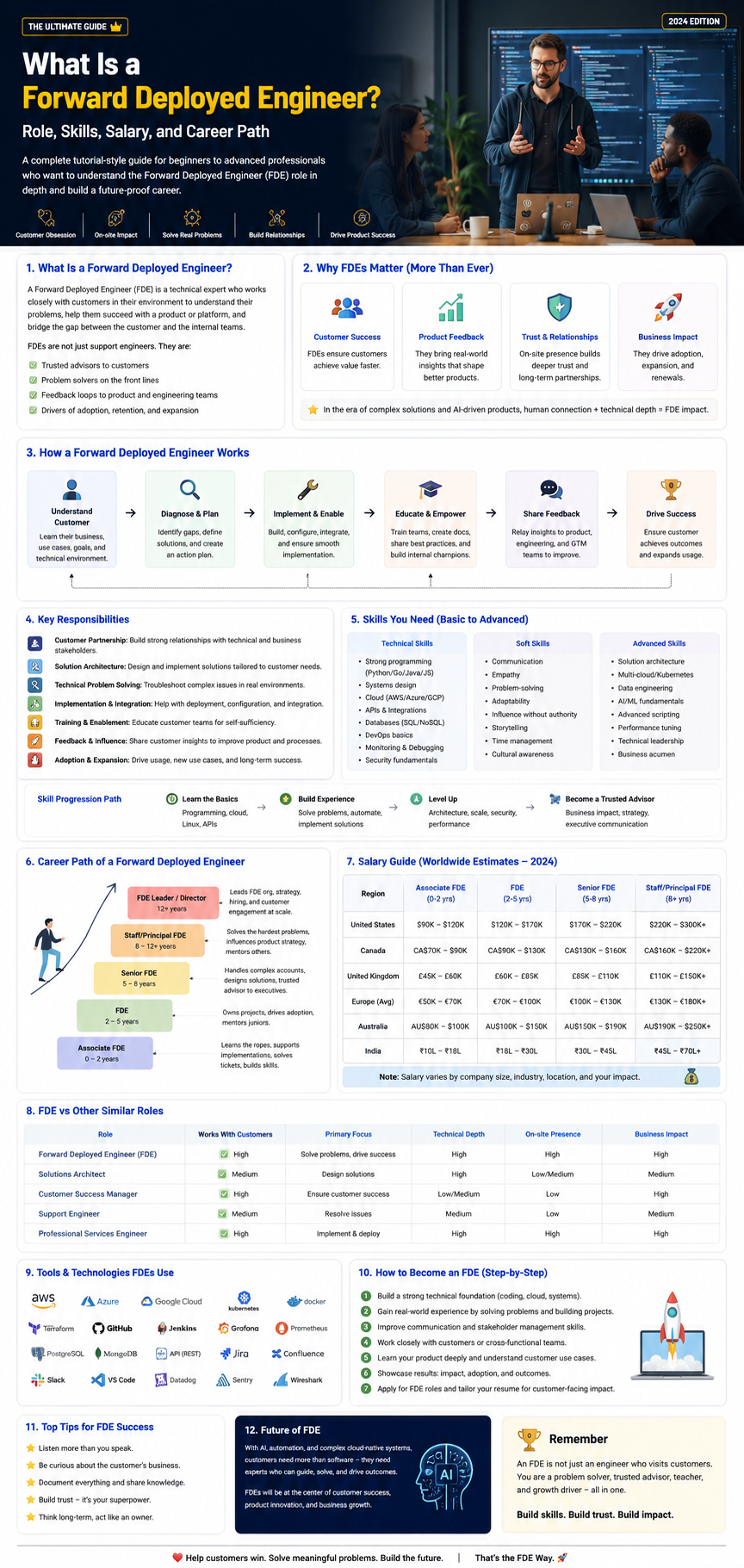
The Complete Basic-to-Advanced Guide for 2026
Simple definition
A Forward Deployed Engineer, often called an FDE, is an engineer who works directly with customers to turn complex technology into real production systems.
In simple words:
A Forward Deployed Engineer is the engineer who leaves the comfort of “building in isolation” and works close to the customer’s real problem, real data, real users, real politics, real security rules, and real business pressure — then builds the solution there.
This role sits between software engineering, solution architecture, product thinking, consulting, customer success, AI engineering, and technical leadership.
OpenAI describes its Forward Deployed Engineers as people who lead end-to-end deployments of frontier models in production, owning discovery, technical scoping, system design, build, and rollout with strategic customers. OpenAI also says success is measured by production adoption, measurable workflow impact, and feedback that improves product and model roadmaps.
Palantir describes its Forward Deployed Software Engineer role as the original blueprint: engineers embedded directly with customers to solve their most pressing problems, working with data, AI, custom applications, architecture, and executive stakeholders.
AWS has now created a dedicated Forward Deployed Engineering organization backed by a $1 billion investment, focused on embedding AI engineers with customers to build agentic AI solutions and leave customers self-sufficient.
So yes, this role is no longer niche. It is becoming one of the most important roles in enterprise AI.
Table of contents
- What is a Forward Deployed Engineer?
- Why the FDE role exists
- Why FDE is trending now
- FDE vs Software Engineer vs Solutions Engineer vs Consultant
- What does a Forward Deployed Engineer actually do?
- The FDE lifecycle
- Core skills required
- AI-era FDE skills
- Typical tools and technologies
- Salary and compensation
- Career path
- How to become an FDE
- Interview preparation
- Portfolio ideas
- Resume positioning
- What makes a great FDE?
- Red flags and misconceptions
- Future of the role
- Final checklist
- FAQ
1. What is a Forward Deployed Engineer?
A Forward Deployed Engineer is a technical builder who works close to the customer environment.
The word forward deployed originally comes from military language. It means someone is placed near the front line, close to where the real action happens.
In technology, the “front line” is not a battlefield. It is the customer’s real operating environment.
That means:
| Normal engineering world | Forward deployed engineering world |
|---|---|
| Build from internal roadmap | Build from real customer pain |
| Work mostly with product managers | Work with customer users, executives, engineers, security, legal, and product teams |
| Ship features to many users | Ship solutions that may start with one strategic customer |
| Measure success by feature delivery | Measure success by business outcome and production adoption |
| Avoid customer chaos | Enter customer chaos and convert it into working software |
A normal software engineer may ask:
What feature should I build?
A Forward Deployed Engineer asks:
What real-world problem is blocking this customer, and what system can I build to solve it fast, safely, and repeatably?
That difference is huge.
2. The best one-line explanation
A Forward Deployed Engineer is:
A software engineer who embeds with customers, understands their real business problem, designs the technical solution, builds production software, drives adoption, and converts field learning into reusable product capability.
That is the heart of the role.
It is not pure coding.
It is not pure consulting.
It is not pure sales.
It is not pure support.
It is engineering under real-world pressure.
3. Why the FDE role exists
Traditional software companies often follow this model:
flowchart LR
    A[Product Team] --> B[Engineering Team]
    B --> C[Generic Product Feature]
    C --> D[Sales Team]
    D --> E[Customer]
    E --> F[Implementation Team]
    F --> G[Support Team]
Code language: CSS (css)
This works when the product is simple and repeatable.
But enterprise AI, data platforms, cybersecurity, infrastructure, and workflow automation are not always simple.
Large customers often have:
| Customer reality | Why it creates FDE demand |
|---|---|
| Messy legacy systems | Someone must integrate with old APIs, databases, identity systems, and workflows |
| Sensitive data | Security, compliance, and governance must be designed correctly |
| Unclear requirements | The customer may not know exactly what they need until they see a working system |
| High business stakes | Failure can affect revenue, safety, legal risk, or public trust |
| Complex adoption | Users must change how they work, not just install software |
| AI uncertainty | Model quality, hallucination risk, latency, cost, and evaluation must be managed |
The FDE exists because the gap between demo and production is now too large.
A demo can impress people.
A production system must survive reality.
That reality includes access control, data quality, latency, audit logs, user adoption, compliance, edge cases, cost, and executives asking, “Did this actually improve the business?”
That is where the Forward Deployed Engineer becomes valuable.
4. Why FDE is trending now
The role is trending because AI has changed the shape of enterprise software.
Before AI, many SaaS products could scale by selling the same workflow to many companies. With AI, the core model may be powerful, but the value often appears only after the system is deeply connected to a customer’s data, tools, people, and workflow.
AWS describes this shift clearly: customers have moved beyond exploring AI and now want AI to become core to how they operate. AWS says its FDE model is designed to compress deployments from months to days and leave customers with both working AI systems and internal capability.
OpenAI’s career page shows Forward Deployed Engineer roles across many global locations, including New York, Seattle, San Francisco, London, Paris, Munich, Madrid, Seoul, Singapore, Tokyo, Sydney, Stockholm, Dublin, and the UAE.
Third-party hiring analyses also report explosive growth in FDE postings. Paraform reported that forward-deployed engineer roles grew 1,165% year-over-year in 2025, citing Live Data Technologies, and said demand was tied to AI deployments that fail without engineers who can build inside customer environments.
The simple reason:
AI is easy to demo, hard to deploy, and even harder to make useful inside a real company.
FDEs are the people companies hire to close that gap.
5. Why AI made this role more important
AI products are different from normal software products.
A traditional app behaves mostly the same way every time. If you click a button, it performs a predictable action.
An AI system behaves probabilistically. It may give different outputs depending on prompt, context, data, model version, tools, retrieval quality, user behavior, and evaluation design.
So enterprise AI deployment needs more than API integration.
It needs:
| AI deployment problem | FDE responsibility |
|---|---|
| Poor prompt quality | Design better workflows, prompts, templates, and guardrails |
| Hallucinations | Add retrieval, citations, validation, evaluations, and human approval |
| Sensitive data | Design permissions, redaction, audit, and governance |
| High latency | Optimize model choice, caching, streaming, and architecture |
| High cost | Track token usage, model routing, batching, and ROI |
| Low adoption | Work with users, redesign workflow, train champions |
| No measurable impact | Define success metrics and build feedback loops |
| Model limitations | Send field feedback to product and research teams |
This is why the modern FDE is often also an AI deployment engineer.
6. FDE in one diagram
flowchart TD
    A[Customer Pain] --> B[Discovery]
    B --> C[Technical Scoping]
    C --> D[Prototype]
    D --> E[Customer Feedback]
    E --> F[Production Build]
    F --> G[Security + Governance]
    G --> H[Rollout]
    H --> I[Adoption + Metrics]
    I --> J[Reusable Product Pattern]
    J --> K[Core Product / Platform]
    K --> A
Code language: CSS (css)
This loop is the magic of the role.
The FDE does not just build one-off custom work. A strong FDE turns customer pain into reusable product learning.
7. What does a Forward Deployed Engineer actually do?
A Forward Deployed Engineer usually owns the full journey from unclear problem to working production system.
Core responsibilities
| Responsibility | Simple explanation |
|---|---|
| Discovery | Understand the real customer problem |
| Technical scoping | Convert business pain into a buildable technical plan |
| Architecture | Design how the system should work |
| Prototyping | Build fast proof-of-concepts |
| Production engineering | Turn prototypes into reliable systems |
| Integration | Connect with customer data, APIs, identity, cloud, and tools |
| AI evaluation | Measure whether AI output is good enough |
| Security and governance | Ensure safe access, auditability, privacy, and compliance |
| Stakeholder management | Communicate with engineers, users, product teams, and executives |
| Adoption | Help users actually use the system |
| Feedback loop | Bring learning back to product, research, and platform teams |
OpenAI’s FDE job description includes owning technical delivery from prototype to stable production, building full-stack systems, embedding with customer teams, scoping work, coding when needed, codifying patterns into tools or playbooks, and sharing feedback that helps research and product teams improve models.
Palantir’s FDSE description includes architecture, large-scale data work, custom applications, direct customer stakeholder engagement, and driving projects from ideation to deployment.
8. A day in the life of an FDE
A normal day may look like this:
| Time | Activity |
|---|---|
| 9:00 AM | Review customer deployment metrics and errors |
| 10:00 AM | Meet customer engineering team to debug integration issue |
| 11:00 AM | Build or review code for a workflow automation feature |
| 12:00 PM | Write technical notes for security approval |
| 1:00 PM | Talk to customer business users about why adoption is low |
| 2:00 PM | Tune AI prompts, retrieval, evals, or tool-calling behavior |
| 3:00 PM | Meet internal product team to share repeated customer patterns |
| 4:00 PM | Prepare rollout plan for next production milestone |
| 5:00 PM | Write runbook, dashboard, or customer-facing deployment summary |
A good FDE constantly switches between:
- Code
- Architecture
- Product thinking
- Customer communication
- Debugging
- Business impact
- Security
- Delivery pressure
This is why the role is exciting — and also why it is not for everyone.
9. FDE vs similar roles
FDE vs Software Engineer
| Area | Software Engineer | Forward Deployed Engineer |
|---|---|---|
| Main focus | Build product features | Build customer-specific production outcomes |
| Customer contact | Low to medium | High |
| Ambiguity | Medium | Very high |
| Coding | High | High, but mixed with scoping and stakeholder work |
| Success metric | Feature shipped, quality, reliability | Adoption, business impact, deployment success |
| Environment | Internal engineering team | Internal team + customer environment |
| Travel | Usually low | Can be medium to high |
| Best fit | Deep product/platform builders | Builders who like real-world mess |
FDE vs Solutions Engineer
| Area | Solutions Engineer | Forward Deployed Engineer |
|---|---|---|
| Main focus | Pre-sales demos, technical validation, customer guidance | Production deployment and custom engineering |
| Coding depth | Light to medium | Medium to heavy |
| Ownership | Often before deal or during evaluation | Often after deal through production |
| Deliverable | Demo, architecture, proof of concept | Working production system |
| Success metric | Deal support, technical win | Business outcome and adoption |
FDE vs Consultant
| Area | Consultant | Forward Deployed Engineer |
|---|---|---|
| Main focus | Advice, strategy, process, implementation | Engineering-led product deployment |
| Output | Slides, recommendations, delivery plan, sometimes implementation | Code, systems, architecture, automation |
| Product feedback loop | Usually weak | Strong |
| Incentive | Project success | Product and customer success |
| Technical depth | Varies | Usually high |
FDE vs Site Reliability Engineer
| Area | SRE | FDE |
|---|---|---|
| Main focus | Reliability and operations | Customer deployment and business outcome |
| Customer-facing | Usually low | High |
| Production systems | Yes | Yes |
| Coding | Automation and reliability tooling | Product, integration, AI, data, workflow |
| Metrics | Uptime, latency, error budget | Adoption, workflow impact, deployment success |
FDE vs AI Engineer
| Area | AI Engineer | Forward Deployed AI Engineer |
|---|---|---|
| Main focus | Build AI-powered features | Deploy AI into customer workflows |
| Customer-facing | Sometimes | Often |
| Work | RAG, agents, prompts, APIs, evals | All of that plus adoption, integration, governance, and business outcome |
| Success | AI feature works | AI feature changes how the customer operates |
10. The FDE operating model
A mature FDE organization usually works like this:
flowchart LR
    C[Customer Team] --> FDE[FDE Pod]
    FDE --> ENG[Core Engineering]
    FDE --> PROD[Product]
    FDE --> RES[Research / AI Model Team]
    FDE --> SEC[Security / GRC]
    FDE --> GTM[Sales / Partnerships]
    ENG --> PLATFORM[Reusable Platform]
    PROD --> ROADMAP[Product Roadmap]
    RES --> MODEL[Model Improvements]
    PLATFORM --> FDE
    ROADMAP --> FDE
    MODEL --> FDE
Code language: CSS (css)
The FDE is the bridge.
Without the FDE, customer feedback may reach product teams too late, too vaguely, or too politically filtered.
With the FDE, feedback becomes concrete:
- “This workflow fails because permissions are too coarse.”
- “The model performs well in English but badly on internal Japanese policy documents.”
- “The customer needs audit logs before legal approval.”
- “The prototype works, but latency kills adoption.”
- “Three customers asked for the same integration. This should become platform capability.”
That is extremely valuable.
11. Types of Forward Deployed Engineers
The title is not always used consistently. Different companies use slightly different names.
| Title | Meaning |
|---|---|
| Forward Deployed Engineer | General title for customer-embedded technical builder |
| Forward Deployed Software Engineer | More coding-heavy version, associated strongly with Palantir |
| Forward Deployed AI Engineer | AI/LLM/agent-focused version |
| Technical Deployment Lead | More delivery and stakeholder-heavy version |
| Platform Engineer, FDE | Builds reusable internal platform capabilities for FDE teams |
| Customer Engineer | Similar role in some cloud or enterprise companies |
| Applied AI Engineer | Sometimes overlaps with FDE in AI companies |
| Solutions Architect | Can overlap, but usually less hands-on production coding |
OpenAI, for example, has several FDE-related titles including Forward Deployed Engineer, Forward Deployed Software Engineer, Platform Engineer for FDE, Platform Engineering Manager for FDE, and Technical Deployment Lead for FDE.
12. Core skills required
A great FDE is a T-shaped engineer.
That means:
- Broad enough to understand many systems
- Deep enough to build serious production software
- Strong enough socially to work with humans under pressure
flowchart TD
    A[FDE Skill Shape] --> B[Deep Engineering Skill]
    A --> C[Broad Customer + Product Skill]
    B --> D[Backend / Frontend / Data / AI / Cloud]
    C --> E[Discovery / Communication / Adoption / Business Impact]
Code language: CSS (css)
Technical skills
| Skill | Why it matters |
|---|---|
| Backend engineering | Most deployments need APIs, services, workers, integrations |
| Frontend engineering | Many FDEs build internal tools, dashboards, workflows |
| Data engineering | Customer data is often messy, fragmented, and critical |
| Cloud infrastructure | Production systems need deployment, networking, security, observability |
| APIs and integration | FDEs connect systems across SaaS, databases, identity, and workflows |
| Security basics | Enterprise deployment requires access control, audit, privacy, and compliance |
| Observability | You need logs, metrics, traces, eval dashboards, and user analytics |
| System design | You must make trade-offs under constraints |
| Scripting and automation | Fast delivery often depends on automation |
| Testing | Production systems need correctness, not demo magic |
AI-era skills
| Skill | Why it matters |
|---|---|
| LLM fundamentals | Understand model behavior, context windows, prompting, limitations |
| RAG | Connect models to trusted customer knowledge |
| Agents and tool calling | Automate workflows across systems |
| Evals | Measure output quality and regression |
| Prompt design | Improve reliability and usability |
| Model routing | Balance cost, quality, latency, and privacy |
| Guardrails | Reduce hallucination, unsafe output, and policy violations |
| AI observability | Monitor quality, latency, cost, and user feedback |
| Human-in-the-loop design | Keep humans in control where needed |
| Governance | Ensure permissions, audit, and compliance |
Human skills
| Skill | Simple explanation |
|---|---|
| Communication | Explain complex technical trade-offs clearly |
| Customer empathy | Understand what users actually need |
| Ambiguity tolerance | Work even when requirements are unclear |
| Judgment | Know when to move fast and when to be careful |
| Ownership | Do not hide behind “not my job” |
| Calm under pressure | Customer escalations can be intense |
| Product sense | Build what creates value, not just what is requested |
| Business understanding | Know how the customer measures success |
| Negotiation | Manage scope, timeline, quality, and expectations |
| Teaching | Leave the customer stronger than before |
13. Typical technology stack
An FDE’s stack depends on the company, but common tools include:
| Category | Examples |
|---|---|
| Languages | Python, TypeScript, JavaScript, Java, Go, Rust, Java, C++ |
| Frontend | React, Next.js, Vue, Angular |
| Backend | FastAPI, Node.js, Spring Boot, Django, Flask |
| Data | SQL, PostgreSQL, Snowflake, BigQuery, Spark, dbt |
| AI | OpenAI APIs, Anthropic APIs, Bedrock, LangGraph, LlamaIndex, vector databases |
| Cloud | AWS, Azure, GCP, Kubernetes, Terraform |
| Identity | Okta, SSO, SAML, OAuth, RBAC |
| Observability | Datadog, Grafana, Prometheus, OpenTelemetry, Sentry |
| DevOps | Docker, CI/CD, GitHub Actions, GitLab CI |
| Security | Secrets management, IAM, audit logs, encryption, policy controls |
| Collaboration | Slack, Notion, Jira, Linear, Confluence |
But tools are not the point.
The real skill is this:
Can you use the right tools to solve the customer’s real problem safely and quickly?
14. The FDE lifecycle in detail
Stage 1: Discovery
The FDE starts by understanding the problem.
Bad discovery sounds like:
What feature do you want?
Good discovery sounds like:
What workflow is broken, who feels the pain, how often does it happen, what is the cost of failure, and how will we know if we fixed it?
Discovery questions:
| Question | Why it matters |
|---|---|
| Who is the real user? | Avoid building only for executives |
| What happens today? | Understand current workflow |
| Where does the process break? | Find the real pain |
| What systems are involved? | Plan integration |
| What data is needed? | Identify access and quality issues |
| What is the business impact? | Define ROI |
| What security rules apply? | Avoid late blockers |
| What does success look like? | Set measurable outcome |
Stage 2: Technical scoping
The FDE converts the messy problem into a buildable plan.
A good scope includes:
- Goal
- Users
- Data sources
- Integrations
- Architecture
- Security model
- AI model behavior
- Evaluation method
- Timeline
- Risks
- Rollout plan
- Success metrics
Stage 3: Prototype
The FDE builds quickly.
The goal is not perfection.
The goal is learning.
Prototype questions:
| Question | Meaning |
|---|---|
| Does the workflow make sense? | Are we solving the right problem? |
| Is the model good enough? | Does AI output meet the bar? |
| Is the data usable? | Are sources clean and accessible? |
| Do users trust it? | Will adoption happen? |
| What breaks first? | Identify risk early |
Stage 4: Production build
This is where weak FDEs fail.
A demo can ignore hard things. Production cannot.
Production needs:
- Authentication
- Authorization
- Audit logs
- Error handling
- Monitoring
- Cost controls
- Rollback plan
- Data retention policy
- Testing
- Documentation
- Support path
- Incident response
- User training
Stage 5: Rollout and adoption
A system is not successful because it exists.
It is successful when people use it and it improves work.
Adoption work includes:
- Training users
- Creating champions
- Measuring usage
- Collecting feedback
- Fixing friction
- Improving workflow design
- Communicating wins
- Removing blockers
Stage 6: Productization
The best FDEs do not leave behind only custom code.
They extract reusable patterns.
For example:
| Customer-specific work | Reusable product pattern |
|---|---|
| Custom invoice classifier | Document extraction framework |
| One-off Slack workflow | General workflow automation engine |
| Custom compliance dashboard | Audit and governance module |
| Customer-specific RAG pipeline | Configurable knowledge retrieval platform |
| Manual deployment checklist | Standard deployment playbook |
This is how FDE work becomes product moat.
15. Salary and compensation
FDE compensation varies by company, location, level, equity, travel expectations, and whether the role is closer to software engineering, AI engineering, deployment leadership, or consulting.
As of July 2026, official job postings show strong compensation for FDE-related roles.
| Company / role | Published compensation signal | Notes |
|---|---|---|
| OpenAI Forward Deployed Engineer, NYC | $162K–$280K + equity | Official posting says the role includes production deployment ownership and up to 50% travel. |
| OpenAI Platform Engineer, FDE, SF | $230K–$385K + equity | More platform-heavy FDE role focused on reusable capabilities, architecture, tooling, and FDE leverage. |
| Palantir Forward Deployed Software Engineer, NYC | $135K–$200K base estimate | Official posting says total compensation may include RSUs, sign-on bonus, and other incentives. |
How to interpret FDE salary
Do not compare only base salary.
Compare:
| Compensation component | Why it matters |
|---|---|
| Base salary | Guaranteed cash |
| Equity / RSUs | Can be major at public companies or AI startups |
| Sign-on bonus | Often used to close senior candidates |
| Performance bonus | Depends on company |
| Travel expectation | High travel can change lifestyle cost |
| Location | SF/NYC/London/Tokyo ranges differ |
| Level | Senior, staff, principal, manager differ heavily |
| Company stage | Startup equity is risky but can be high upside |
| Role type | Platform FDE may pay differently from customer deployment FDE |
Practical salary ranges
A realistic 2026 market framing:
| Level | Typical profile | Possible compensation pattern |
|---|---|---|
| Entry / junior FDE | 1–3 years, strong coding, high customer potential | Lower base, less autonomy |
| Mid-level FDE | 3–5 years, can own modules and customer workstreams | Strong base + possible equity |
| Senior FDE | 5–8+ years, owns deployments end-to-end | High base + meaningful equity |
| Staff / lead FDE | Leads multiple deployments or major customer programs | Very high total compensation |
| FDE manager / platform lead | Builds FDE teams, playbooks, and reusable systems | Management-level compensation |
The key point:
FDEs are paid well because they combine rare skills: engineering depth, customer trust, product judgment, and delivery under ambiguity.
16. Career path
There is no single career path into FDE.
People enter from many backgrounds.
flowchart TD
    A[Software Engineer] --> FDE[Forward Deployed Engineer]
    B[Data Engineer] --> FDE
    C[Solutions Engineer] --> FDE
    D[DevOps / Platform Engineer] --> FDE
    E[ML / AI Engineer] --> FDE
    F[Consultant with Coding Skill] --> FDE

    FDE --> G[Senior FDE]
    G --> H[Lead / Staff FDE]
    H --> I[FDE Manager]
    H --> J[Product Engineer / Platform Engineer]
    H --> K[Solutions Architect Leader]
    H --> L[Founder / Startup Operator]
    H --> M[Enterprise AI Leader]
Code language: CSS (css)
Common entry paths
| Starting role | Advantage | Gap to close |
|---|---|---|
| Software engineer | Strong coding | Customer communication and business context |
| Data engineer | Strong data integration | Product and frontend skills |
| DevOps/platform engineer | Production and cloud strength | User workflow and product thinking |
| Solutions engineer | Customer-facing strength | Deeper coding and production ownership |
| Consultant | Business and stakeholder skill | Engineering depth |
| ML engineer | AI model skill | Enterprise deployment and adoption |
17. How to become a Forward Deployed Engineer
Step 1: Become a strong builder
You do not need to be the world’s best algorithm engineer.
But you must be able to build real systems.
Minimum technical foundation:
- One backend language deeply
- One frontend framework enough to build usable tools
- SQL and data modeling
- API design
- Authentication and permissions
- Cloud deployment basics
- Logs, metrics, debugging
- Git and CI/CD
- Basic security principles
Step 2: Learn system design
FDEs constantly make architecture decisions.
Learn:
- APIs
- Queues
- Caching
- Databases
- Search
- Event-driven architecture
- Multi-tenant systems
- Observability
- Security boundaries
- Cost trade-offs
- Rollback strategy
Step 3: Learn AI deployment
For 2026 and beyond, this is critical.
Learn:
- Prompting
- RAG
- Vector search
- Embeddings
- Agents
- Tool calling
- Evals
- Guardrails
- AI observability
- Model selection
- Cost control
- Human approval flows
Step 4: Learn customer discovery
Practice asking better questions.
Instead of asking:
What should I build?
Ask:
What decision or workflow should become faster, safer, or more accurate?
Instead of asking:
What data do you have?
Ask:
What data do people trust today, and what data do they ignore?
Instead of asking:
What feature is missing?
Ask:
What happens when this process fails?
Step 5: Build portfolio projects
Your portfolio should prove that you can solve real workflows.
Good portfolio projects:
| Project | What it proves |
|---|---|
| AI document review tool with citations and evals | RAG, trust, UX, AI reliability |
| Customer support agent with human approval | Agent workflow, safety, integration |
| Cloud cost anomaly assistant | Data, alerting, business impact |
| Compliance evidence collector | Security, audit, enterprise workflow |
| Internal operations dashboard | Full-stack, data, usability |
| Sales call intelligence workflow | AI extraction, workflow automation |
| Incident response copilot | DevOps, AI, reliability |
Bad portfolio projects:
- Basic chatbot with no real workflow
- Toy CRUD app
- AI demo with no evaluation
- Dashboard with fake data only
- App that ignores auth and security
The FDE portfolio should scream:
I can build useful systems for messy real-world problems.
18. A 12-month roadmap to become FDE-ready
Months 1–3: Engineering foundation
Focus:
- Backend APIs
- SQL
- React or similar frontend
- Docker
- Cloud basics
- GitHub Actions
- Testing
- Logging
Build:
- A full-stack internal tool
- A dashboard connected to real data
- A small API with authentication
Months 4–6: Production thinking
Focus:
- System design
- Observability
- Security
- CI/CD
- Role-based access control
- Incident handling
- Documentation
Build:
- A production-style app with monitoring
- Audit logs
- Admin panel
- Deployment guide
- Error dashboard
Months 7–9: AI deployment
Focus:
- RAG
- Agents
- Prompt design
- Evals
- Guardrails
- AI cost tracking
- Human-in-the-loop workflows
Build:
- AI workflow tool with citations
- Evaluation dataset
- Model comparison dashboard
- Failure analysis report
Months 10–12: Customer simulation
Focus:
- Discovery
- Scoping
- Demo storytelling
- Stakeholder communication
- Business metrics
- Rollout plan
Build:
- Case study
- Technical architecture
- Product spec
- Deployment plan
- ROI measurement
- Demo video
By the end of 12 months, you should have 2–3 strong case studies, not 20 shallow projects.
19. What makes a great FDE?
A great FDE has five superpowers.
1. They find the real problem
Customers often describe symptoms, not root causes.
Customer says:
We need an AI chatbot.
Great FDE asks:
What decision, workflow, or bottleneck should the chatbot improve?
2. They build fast but not carelessly
They know when to prototype quickly and when to harden properly.
3. They explain trade-offs clearly
They can tell an executive:
We can launch in two weeks with manual approval, or in six weeks with full automation and audit controls. I recommend the two-week version first because it validates adoption safely.
4. They convert one-off work into reusable patterns
They do not become a custom development shop.
They build assets that compound.
5. They earn trust
Trust is the hidden currency of the role.
Customers trust FDEs who:
- Listen carefully
- Tell the truth
- Avoid overpromising
- Own problems
- Communicate early
- Make trade-offs visible
- Deliver working systems
20. The FDE mindset
The FDE mindset is different from normal engineering mindset.
| Normal mindset | FDE mindset |
|---|---|
| “Give me requirements.” | “Let me discover the real problem.” |
| “That is not my area.” | “I will find the owner or unblock it.” |
| “The code works.” | “The user adopted it and it created impact.” |
| “This is custom.” | “What part should become reusable?” |
| “The model is accurate.” | “The workflow is trustworthy enough for production.” |
| “We shipped.” | “The customer changed behavior.” |
The best FDEs are not just coders.
They are technical owners of customer outcomes.
21. Common FDE deliverables
An FDE may produce many types of deliverables.
| Deliverable | Purpose |
|---|---|
| Working prototype | Validate the idea quickly |
| Production app | Solve the workflow |
| Integration service | Connect customer systems |
| RAG pipeline | Connect AI to customer knowledge |
| Agent workflow | Automate multi-step tasks |
| Evaluation suite | Measure AI quality |
| Dashboard | Show usage, quality, cost, and impact |
| Architecture document | Align internal and customer teams |
| Security review packet | Pass enterprise approval |
| Runbook | Help customer operate the system |
| Training guide | Drive adoption |
| Reusable library | Turn one deployment into repeatable capability |
| Product feedback memo | Influence roadmap |
22. Metrics that matter
FDEs should not measure success only by code shipped.
Better metrics:
| Metric | What it tells you |
|---|---|
| Time to first value | How quickly customer sees benefit |
| Production adoption | Whether users actually use it |
| Workflow completion rate | Whether the system improves real work |
| Human approval rate | Whether AI output is trusted |
| Escalation rate | Whether system fails often |
| Latency | Whether experience is usable |
| Cost per workflow | Whether AI economics work |
| Model quality score | Whether output is improving |
| Retention | Whether customer keeps using it |
| Expansion | Whether success creates more use cases |
| Reusable patterns created | Whether FDE work improves platform |
For AI FDEs, evals are especially important.
A simple AI eval loop:
flowchart LR
    A[Real User Inputs] --> B[Test Dataset]
    B --> C[Model Output]
    C --> D[Evaluation]
    D --> E[Failure Analysis]
    E --> F[Prompt / Retrieval / Tool Fix]
    F --> C
    D --> G[Deployment Decision]
Code language: CSS (css)
Without evals, AI deployment becomes opinion-based.
With evals, it becomes engineering.
23. FDE interview preparation
FDE interviews usually test a mix of coding, system design, customer judgment, and ambiguity handling.
Common interview areas
| Area | What they test |
|---|---|
| Coding | Can you build real software? |
| System design | Can you architect under constraints? |
| Customer scenario | Can you discover and scope ambiguous problems? |
| Product sense | Can you build useful workflows? |
| AI knowledge | Can you deploy LLM systems safely? |
| Communication | Can you explain trade-offs clearly? |
| Behavioral | Can you handle pressure and ownership? |
| Debugging | Can you solve messy issues quickly? |
Example interview questions
Discovery questions
- A bank wants to use AI to summarize customer support tickets. How would you scope the first deployment?
- A hospital wants an AI assistant for doctors, but legal is worried about hallucinations. What do you do?
- A logistics company says its operations team wastes hours in spreadsheets. How do you find the real workflow?
System design questions
- Design a RAG system for an enterprise knowledge base with strict permissions.
- Design an AI agent that updates CRM records but requires human approval.
- Design a customer-facing dashboard that tracks AI quality, cost, and adoption.
Coding questions
- Build an API that ingests documents and returns searchable chunks.
- Write a function to evaluate model responses against expected answers.
- Build a small workflow automation service with retries and logging.
Product judgment questions
- When should you build custom code versus wait for the core product team?
- How do you decide whether a prototype is ready for production?
- What metric would prove this AI deployment is successful?
Behavioral questions
- Tell me about a time you had unclear requirements.
- Tell me about a time you disagreed with a customer or stakeholder.
- Tell me about a time you shipped under pressure.
- Tell me about a time you had to simplify a complex technical topic.
24. How to answer FDE interview questions
Use this structure:
flowchart TD
    A[Clarify Goal] --> B[Identify Users]
    B --> C[Map Current Workflow]
    C --> D[Find Data + System Constraints]
    D --> E[Define Success Metrics]
    E --> F[Propose MVP]
    F --> G[Discuss Risks]
    G --> H[Explain Rollout Plan]
    H --> I[Show Feedback Loop]
Code language: CSS (css)
Example answer pattern:
First, I would clarify the business goal and who the real users are. Then I would map the current workflow and identify the systems and data involved. After that, I would define success metrics, such as time saved, accuracy, adoption, or reduction in manual review. I would start with a narrow MVP, add security and audit requirements early, and create an evaluation loop before production rollout. Once live, I would measure usage and failures, then convert repeated patterns into reusable product improvements.
That is a strong FDE-style answer.
25. Resume positioning for FDE roles
Your resume should not read like a generic software engineer resume.
It should show:
- Built production systems
- Worked with users or customers
- Owned ambiguous problems
- Integrated real systems
- Improved measurable outcomes
- Handled security, reliability, or adoption
- Used AI or data where relevant
Weak resume bullet
Built dashboard using React and Python.
Strong FDE resume bullet
Built a React/Python operations dashboard used by 40+ support agents, integrated with PostgreSQL and internal APIs, reducing manual ticket triage time by 35% and adding audit logs for compliance review.
Weak resume bullet
Worked on LLM chatbot.
Strong FDE resume bullet
Designed and deployed an LLM-based knowledge assistant with RAG, source citations, role-based access, and evaluation dataset of 500 queries, improving answer acceptance rate from 62% to 84%.
Weak resume bullet
Helped customer with deployment.
Strong FDE resume bullet
Led technical deployment for enterprise customer, scoped requirements with engineering and business stakeholders, built integration service, resolved security blockers, and launched production workflow across three teams.
26. Best portfolio format
Use case-study format.
Each project should include:
- Problem
- Users
- Existing workflow
- Constraints
- Architecture
- Data sources
- Security model
- AI approach, if any
- Evaluation method
- Deployment plan
- Metrics
- Lessons learned
- What could become reusable product capability
Portfolio template
# Project: AI Compliance Review Assistant

## Problem
Compliance teams spend 6 hours per week reviewing policy documents manually.

## Users
Compliance analysts and legal reviewers.

## Constraints
Sensitive documents, role-based access, audit logs required.

## Architecture
Frontend: React
Backend: FastAPI
Database: PostgreSQL
AI: RAG with citations
Auth: SSO mock + RBAC
Observability: logs, eval dashboard

## Success Metrics
- Review time reduction
- Answer acceptance rate
- Citation accuracy
- Human override rate
- Cost per document

## Result
Reduced simulated review time by 45% on test workflow.
Code language: PHP (php)
That portfolio is much stronger than a basic GitHub repo.
27. Red flags in FDE candidates
| Red flag | Why it matters |
|---|---|
| Only wants to code, never talk to users | FDE requires customer interaction |
| Cannot handle ambiguity | Requirements are often unclear |
| Overpromises | Customer trust can break quickly |
| Ignores security | Enterprise deployment will fail |
| Builds one-off hacks only | FDE work must become repeatable |
| Cannot explain trade-offs | Stakeholders need clarity |
| Dislikes documentation | Customers need runbooks and handoff |
| No product sense | May build technically correct but useless systems |
| No production mindset | Demo success is not enough |
28. Red flags in companies hiring FDEs
Candidates should also evaluate the company.
| Red flag | Meaning |
|---|---|
| “FDE” means unpaid support engineer | Bad role design |
| No product feedback loop | You may build throwaway custom work forever |
| No engineering respect | FDEs may be treated as sales assistants |
| No clear success metrics | You may be blamed for vague outcomes |
| Too much travel without support | Burnout risk |
| No security or legal support | Enterprise deployments will stall |
| No platform strategy | Custom work may not compound |
| No career ladder | Growth may be unclear |
A good FDE organization respects both customer work and engineering quality.
29. Misconceptions about FDE
Misconception 1: FDE is just a fancy consultant
Wrong.
Consultants may advise. FDEs build and deploy.
Misconception 2: FDE is just a sales engineer
Wrong.
Sales engineers often help win deals. FDEs usually own production delivery and technical outcomes.
Misconception 3: FDE is not real engineering
Wrong.
At strong companies, FDEs write production-grade code, design architecture, handle security, build tools, and influence product direction.
Misconception 4: FDE work does not scale
Partly wrong.
Bad FDE work does not scale.
Great FDE work creates reusable patterns, platform capabilities, playbooks, and product improvements.
Misconception 5: FDE is only for extroverts
Wrong.
You do not need to be loud.
You need to be clear, trustworthy, curious, and calm.
30. The advanced concept: margin vs moat
A major reason FDE is popular in AI startups is that companies may accept lower short-term margins to win complex enterprise customers and build deeper product advantage.
Andreessen Horowitz argued that advanced AI applications often need active management, guided learning, and rich customer context, and that forward deployed teams help operationalize models into real-world solutions.
In simple terms:
| Without FDE | With FDE |
|---|---|
| Product remains generic | Product learns from real workflows |
| Customers struggle alone | Customers get hands-on deployment |
| AI remains a demo | AI becomes operational |
| Feedback is vague | Feedback becomes concrete |
| Competitors can copy features | Workflow knowledge becomes moat |
This is the business reason behind the role.
31. The FDE maturity model
Not all FDE organizations are equal.
Level 1: Reactive support
FDEs fix customer problems after they happen.
Common signs:
- No clear playbooks
- No platform feedback
- Too many custom hacks
- Little product influence
Level 2: Deployment team
FDEs help customers go live.
Common signs:
- Better onboarding
- Some repeatable patterns
- Some technical ownership
- Still mostly customer-specific
Level 3: Product feedback engine
FDEs convert field learning into roadmap improvements.
Common signs:
- Strong product partnership
- Reusable components
- Deployment templates
- Customer metrics
Level 4: Strategic AI transformation team
FDEs help customers redesign workflows around AI.
Common signs:
- Executive alignment
- Business outcome metrics
- AI governance
- Internal customer champions
- Repeatable transformation patterns
Level 5: Compound platform builder
FDE work becomes a major source of product moat.
Common signs:
- Every deployment improves platform
- Playbooks become product
- Patterns become reusable architecture
- Customer learning drives research, product, and GTM
32. FDE architecture example: enterprise AI assistant
Here is a simplified architecture for a Forward Deployed AI project.
flowchart TD
    U[Enterprise Users] --> UI[Web App / Chat UI]
    UI --> API[Application Backend]
    API --> AUTH[SSO + RBAC]
    API --> ORCH[AI Orchestration Layer]
    ORCH --> RET[Retrieval System]
    RET --> VDB[Vector Database]
    RET --> DOCS[Customer Documents]
    ORCH --> TOOLS[Business Tools / APIs]
    TOOLS --> CRM[CRM]
    TOOLS --> TICKETS[Ticketing System]
    TOOLS --> DB[Internal Database]
    ORCH --> LLM[LLM / Model Provider]
    ORCH --> EVAL[Evaluation + Guardrails]
    API --> AUDIT[Audit Logs]
    API --> OBS[Monitoring + Cost Dashboard]
    EVAL --> FEEDBACK[User Feedback]
    FEEDBACK --> ROADMAP[Product / Model Roadmap]
Code language: CSS (css)
The FDE must think about every part:
- User experience
- Data access
- Permissions
- AI quality
- Integration
- Monitoring
- Cost
- Security
- Rollout
- Feedback
- Reusability
That is why FDE is hard — and valuable.
33. FDE for startups vs large companies
FDE at startups
| Feature | Reality |
|---|---|
| Speed | Very fast |
| Scope | Broad and messy |
| Process | Lightweight |
| Risk | High |
| Equity upside | Potentially high |
| Role clarity | Often unclear |
| Customer impact | Huge |
| Burnout risk | High |
FDE at large companies
| Feature | Reality |
|---|---|
| Speed | Slower but structured |
| Scope | More specialized |
| Process | More mature |
| Risk | Lower |
| Compensation | Strong and more predictable |
| Role clarity | Better |
| Customer impact | Large-scale |
| Bureaucracy | Higher |
Both can be excellent.
Choose based on your personality.
34. Who should become an FDE?
You may love FDE work if:
- You like coding but also like people
- You enjoy messy problems
- You can handle uncertainty
- You like business context
- You want visible impact
- You enjoy learning new domains
- You can communicate with engineers and executives
- You like shipping fast
- You care about adoption, not just architecture
You may dislike FDE work if:
- You want deep uninterrupted coding only
- You hate meetings
- You dislike travel
- You need perfect requirements
- You do not enjoy customer pressure
- You dislike context switching
- You prefer long research cycles
- You do not want to explain your work repeatedly
FDE is not “better” than software engineering.
It is different.
35. The future of Forward Deployed Engineering
The role will likely evolve in three directions.
1. AI-native FDE
These engineers will specialize in deploying LLMs, agents, RAG, evals, and AI workflows.
2. Platform FDE
These engineers will turn repeated deployment patterns into reusable internal platforms.
OpenAI’s Platform Engineer role in the FDE organization is an example: it focuses on embedding with FDE pods, improving architecture, building tooling, turning repeated signals into platform bets, and creating reusable capabilities.
3. Industry-specialized FDE
Some FDEs will specialize by domain:
- Healthcare
- Finance
- Government
- Automotive
- Defense
- Manufacturing
- Legal
- Insurance
- Energy
- Logistics
In regulated industries, domain knowledge becomes a major advantage.
AWS specifically positions FDE for organizations that need production AI systems in real business processes, especially regulated industries, financial services, and government where security, governance, and speed to production are non-negotiable.
36. The ultimate FDE skill checklist
Engineering
- Can build backend services
- Can build usable frontend workflows
- Can design APIs
- Can work with databases
- Can debug production issues
- Can deploy to cloud
- Can design reliable systems
- Can write clean production code
- Can implement auth and permissions
- Can monitor systems
AI
- Understands LLM basics
- Can build RAG pipelines
- Can design evals
- Can use tool calling
- Can build agent workflows
- Can control cost and latency
- Can add guardrails
- Can measure AI quality
- Can explain model limitations
Customer
- Can run discovery
- Can scope ambiguous problems
- Can communicate trade-offs
- Can manage expectations
- Can work with executives and engineers
- Can train users
- Can drive adoption
- Can handle conflict calmly
Product
- Can identify real user pain
- Can define MVP
- Can prioritize
- Can measure impact
- Can convert custom work into reusable product
- Can write clear specs
- Can influence roadmap
Delivery
- Can create rollout plans
- Can write runbooks
- Can manage risks
- Can unblock dependencies
- Can ship under pressure
- Can own outcomes
37. Beginner-to-advanced learning path
Beginner level
Learn:
- Python or TypeScript
- SQL
- APIs
- Git
- Basic frontend
- Basic backend
- Docker
- Cloud basics
Goal:
Build full-stack apps that work.
Intermediate level
Learn:
- System design
- Authentication
- Observability
- CI/CD
- Security basics
- Data pipelines
- Customer discovery
Goal:
Build production-style systems that solve real workflows.
Advanced level
Learn:
- Enterprise architecture
- AI evals
- RAG
- Agents
- Governance
- Multi-tenant systems
- Cost optimization
- Stakeholder management
- Product strategy
Goal:
Lead complex deployments that create measurable business impact.
Expert level
Learn:
- Platform strategy
- Industry domain depth
- Executive communication
- Organizational change
- AI transformation
- Team leadership
- Product moat creation
Goal:
Turn field deployment into durable company advantage.
38. Sample FDE project: from problem to production
Problem
A large company has 20,000 internal policy documents. Employees waste time asking legal and compliance teams repetitive questions.
Goal
Build an AI assistant that answers policy questions with citations and respects user permissions.
Discovery
Questions:
- Who asks questions?
- Which policies are most used?
- Which answers require human approval?
- What happens if the answer is wrong?
- Which documents are sensitive?
- Who can access what?
- What is the current response time?
- How will we measure success?
Architecture
flowchart TD
    A[User] --> B[Chat Interface]
    B --> C[Backend API]
    C --> D[SSO / RBAC]
    C --> E[Query Rewriter]
    E --> F[Retriever]
    F --> G[Vector DB]
    G --> H[Policy Documents]
    F --> I[Permission Filter]
    I --> J[LLM]
    J --> K[Cited Answer]
    K --> L[Human Approval if High Risk]
    K --> M[Audit Log]
    M --> N[Analytics Dashboard]
Code language: CSS (css)
MVP
- Upload 1,000 policy docs
- Support top 50 questions
- Add citations
- Add role-based access
- Add feedback buttons
- Add human escalation
- Measure answer acceptance
Production hardening
- SSO
- Audit logs
- Data retention
- Monitoring
- Cost tracking
- Evaluation suite
- Admin dashboard
- Incident process
- Runbook
- Rollout plan
Success metrics
| Metric | Target |
|---|---|
| Answer acceptance | 80%+ |
| Citation correctness | 95%+ |
| Average response time | Under 5 seconds |
| Compliance escalation reduction | 30% |
| Human override rate | Under 20% for low-risk questions |
| Weekly active users | Increasing week over week |
This is the kind of project that demonstrates FDE thinking.
39. Final summary
A Forward Deployed Engineer is one of the most important roles in modern enterprise technology because the hardest part of software is no longer just building features.
The hardest part is making technology work inside real organizations.
That means:
- Real users
- Real data
- Real workflows
- Real security
- Real politics
- Real deadlines
- Real business outcomes
The FDE is the engineer who steps into that reality and builds anyway.
In the AI era, this role is becoming even more important because AI systems need deep workflow integration, evaluation, guardrails, governance, and adoption support. That is why companies like OpenAI, Palantir, and AWS are investing heavily in forward deployed engineering.
The best FDEs combine:
- Software engineering
- AI engineering
- Systems thinking
- Product judgment
- Customer empathy
- Security awareness
- Delivery ownership
- Business impact
The simplest way to remember the role:
A software engineer builds the product.
A solutions engineer explains the product.
A consultant advises on the product.
A Forward Deployed Engineer makes the product work in the customer’s real world.
That is why the role matters.
And that is why it is becoming one of the defining engineering careers of the AI era.
FAQ
Is Forward Deployed Engineer a coding role?
Yes, at strong companies it is a real coding role. But it also includes customer discovery, architecture, deployment, communication, and adoption.
Is FDE better than software engineering?
Not better. Different. FDE is better for engineers who enjoy customer problems, ambiguity, and visible business impact. Traditional software engineering is better for people who prefer deeper focus on product, infrastructure, or platform work.
Do FDEs travel?
Often yes. Travel depends on company and role. OpenAI’s NYC FDE posting says travel up to 50% is required, while its Platform Engineer FDE role says travel is optional by project and typically under 10%.
Do I need AI skills to become an FDE?
For older FDE roles, not always. For 2026 AI-focused FDE roles, yes, AI deployment skills are becoming extremely valuable.
Can DevOps engineers become FDEs?
Yes. DevOps, platform, and cloud engineers can become strong FDEs because they understand production systems. They should add product thinking, customer communication, and AI/application development skills.
Can freshers become FDEs?
It is possible, but harder. Palantir has new-grad style Forward Deployed Software Engineer roles, but many AI FDE roles prefer several years of engineering or technical deployment experience. OpenAI’s NYC FDE posting, for example, mentions 5+ years of engineering or technical deployment experience including customer-facing work.
What is the best first step to become an FDE?
Build one serious project that solves a real workflow, includes production thinking, and has a written case study. Do not build only a toy chatbot.
What is the biggest mistake FDE beginners make?
They focus too much on the technology and not enough on the workflow. The customer does not care that your architecture is clever if the system does not improve real work.
What is the future of FDE?
The future is AI-native, platform-aware, and industry-specialized. FDEs will help companies move from AI demos to production AI systems that actually change business operations.

I’m Rajesh Kumar, a DevOps, SRE, DevSecOps, Cloud, and Platform Engineering expert passionate about sharing practical knowledge, real-world experiences, and industry best practices. I have worked at Cotocus and regularly write about technology, travel, investing, health, product reviews, and digital marketing through my various platforms.
I publish technical articles at DevOps School, travel stories at Holiday Landmark, stock market insights at Stocks Mantra, health and fitness guidance at My Medic Plus, product reviews at TrueReviewNow, and SEO and digital marketing strategies at Wizbrand.
Find Trusted Cardiac Hospitals
Compare heart hospitals by city and services — all in one place.
Explore Hospitals